Leadzen.ai vs LeadsRush (2026): Which Lead Tool Should You Pick?
Leadzen.ai targets funded startups and Indian SDR teams, while LeadsRush maps local businesses by keyword and city. Here's which one fits your pipeline, what each costs, and the data gaps both leave you to fill.
TL;DR
- Leadzen.ai is an AI-assisted B2B prospecting platform built mostly for startups and SMB sales teams, especially in India. It has bulk search, a Chrome extension, "trending leads" such as recently funded companies, and outreach across email, LinkedIn, WhatsApp, and calling. Paid plans start at about $133/month.
- LeadsRush is a local-business lead finder. You type a keyword and a location, and it returns company profiles (address, phone, revenue) plus decision-maker emails, with a built-in email verifier. Its free plan gives you 50 searches a month.
- Choose Leadzen.ai if you sell to funded tech companies and want prospecting and outreach in one place. Choose LeadsRush if you sell to SMBs by geography: agencies, local services, franchises.
- Neither tool is primarily an email finder, so you should still verify exports before they go into a sequence. A standalone finder and verifier such as Tomba covers that step from $49/month.
What are Leadzen.ai and LeadsRush, really?#
Both tools get called "lead generation software," but they solve different problems. Comparing them feature by feature without that context doesn't tell you much.
Leadzen.ai presents itself as an AI lead generation platform for startups and small-to-mid-sized companies. Its main users are B2B sales teams in technology, fintech, marketing, and consulting. The product combines a searchable contact database with intelligent filters, bulk search, and a "trending leads" feed that shows recently funded companies and active angel investors. It also has a Chrome extension that pulls email addresses and phone numbers from profiles you're viewing. Recent reviews describe an outreach layer too: email, LinkedIn DMs, WhatsApp, and dialing from one workspace.
LeadsRush is built around location. You enter a keyword ("dentists," "HVAC contractors," "marketing agencies") and a geography, and it returns businesses with their address, phone number, revenue estimate, and contacts for people who work there. It also includes bulk search, a simple email verifier, and one-click export to your CRM or email marketing tool.
The short version: Leadzen.ai answers "which growing companies should I call this week?" and LeadsRush answers "who are all the roofing companies in Phoenix, and who owns them?"
How do Leadzen.ai and LeadsRush work differently?#
Here are the five dimensions that actually separate the two tools in day-to-day use:
- Search model. Leadzen.ai searches by firmographics and persona: industry, role, company stage, funding signals. LeadsRush searches by keyword plus location, the same way you'd search a map.
- Data orientation. Leadzen.ai is people-first: find the decision-maker, then get their contact details. LeadsRush is company-first: find the business, then look inside it for contacts.
- Intent signals. Leadzen.ai's trending-leads feed (fresh funding, investor activity) gives you a reason to reach out now. LeadsRush has no comparable timing signal. You get coverage, not urgency.
- Outreach. Leadzen.ai includes multichannel outreach. LeadsRush exports to other tools and expects your sequencer or CRM to handle the sending.
- Verification. LeadsRush has a basic email verifier on every plan, including 100 verifications/month on free. For Leadzen.ai, you'll likely want an external verification pass before high-volume sends.

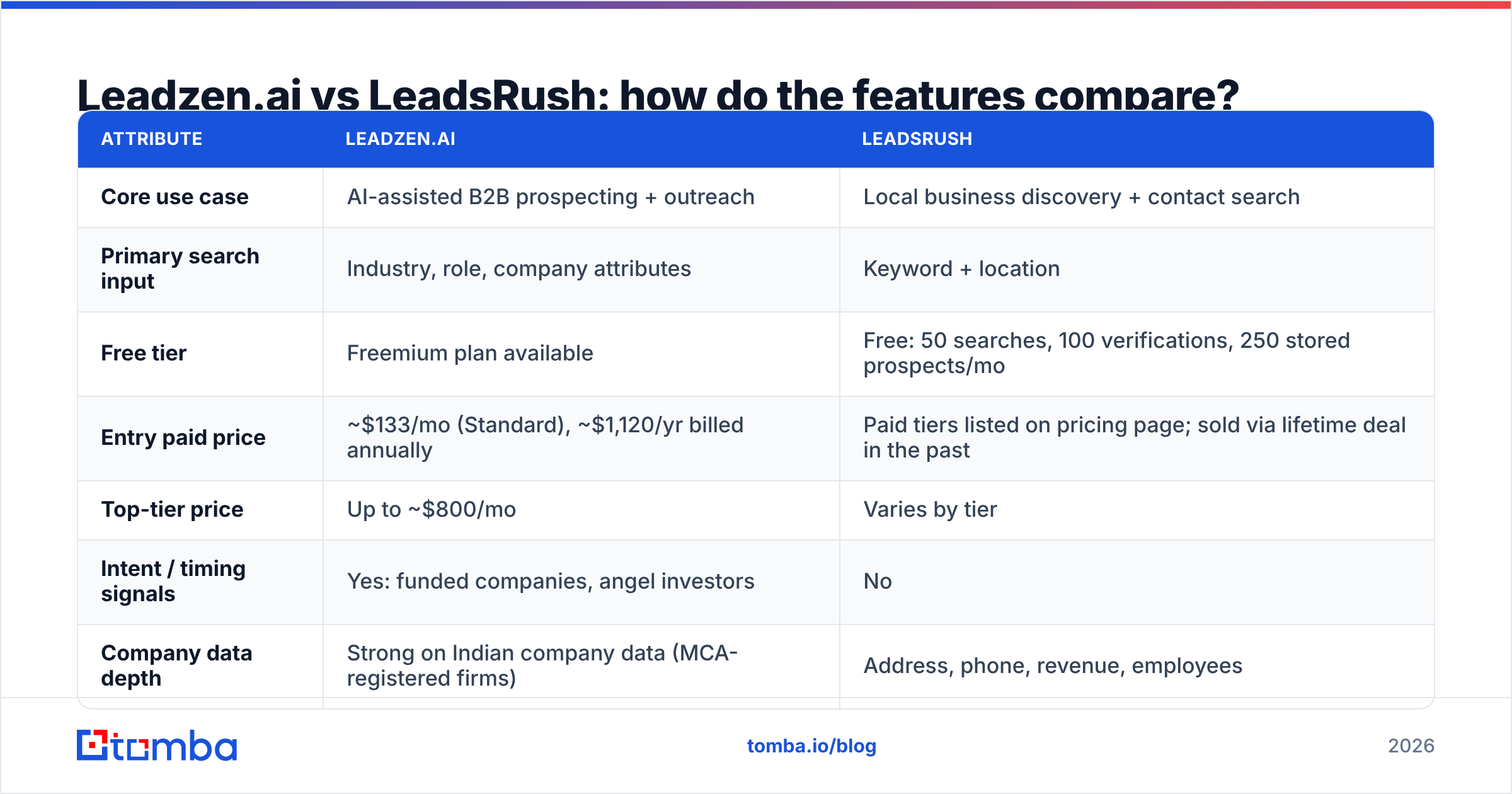
Leadzen.ai vs LeadsRush: how do the features compare?#
The table below uses publicly listed information as of 2026. Pricing in this category changes often, so check each vendor's page before you commit.
| Attribute | Leadzen.ai | LeadsRush |
|---|---|---|
| Core use case | AI-assisted B2B prospecting + outreach | Local business discovery + contact search |
| Primary search input | Industry, role, company attributes | Keyword + location |
| Free tier | Freemium plan available | Free: 50 searches, 100 verifications, 250 stored prospects/mo |
| Entry paid price | ~$133/mo (Standard), ~$1,120/yr billed annually | Paid tiers listed on pricing page; sold via lifetime deal in the past |
| Top-tier price | Up to ~$800/mo | Varies by tier |
| Intent / timing signals | Yes: funded companies, angel investors | No |
| Company data depth | Strong on Indian company data (MCA-registered firms) | Address, phone, revenue, employees |
| Email verification | Not the core focus | Built-in basic verifier |
| Chrome extension | Yes | Not a core feature |
| Outreach channels | Email, LinkedIn DM, WhatsApp, calling | Export to CRM / email tool |
| Best for | Startups and SMB SDR teams selling to tech/fintech, India-heavy | Agencies and vendors selling to local SMBs |
Leadzen.ai figures come from TrustRadius' Leadzen.ai pricing listing and the vendor site. LeadsRush free-plan limits come from its public pricing page.

Which tool has better data for your market?#
For most buyers, this decides it.
Leadzen.ai's advantage is geographic and segment depth. It was built with Indian sales teams in mind. Reviewers point to real-time web crawling and company-registry-grade data for Indian businesses, which is hard to find in US-centric databases. If your TAM is Indian SaaS, fintech, or services firms, Leadzen.ai will probably return more records, and more current ones, than a global generalist tool.
Outside India, coverage is thinner. If most of your pipeline is in North America or Western Europe, run a sample search on your real ICP during the trial. Don't rely on headline database-size numbers.
LeadsRush's advantage is the long tail. Local businesses such as plumbers, clinics, restaurants, and independent agencies rarely show up well in databases built from LinkedIn and funding announcements. They do show up in map-style listings, which is the data LeadsRush is built around. If you sell websites, SEO, POS systems, insurance, or local marketing, a keyword-plus-city search matches how you already think about territory.
The trade-off is contact quality at the person level. A local business listing is often easy to find. The owner's direct email is not. Many small businesses run on a generic info@ inbox or a catch-all mail server. That's why LeadsRush's built-in verifier is useful, and it's also why you'll sometimes need a second tool to confirm addresses.
How accurate are the emails from each tool?#
Neither vendor publishes an independent accuracy benchmark, so you shouldn't assume either tool's exports are ready to send.

Use this rule of thumb. A database tool shows you what it had on file when it last crawled. A dedicated email finder checks the address at the moment you ask. Contact data decays quickly because people change jobs, companies rebrand, and domains move to new mail providers. A list that was 90% valid six months ago may not be anymore.
Before loading either tool's export into a sequencer:
- Run the full list through an email verifier and remove invalid and risky results.
- Handle catch-all domains separately. They accept every address at the SMTP level, so a normal check can't confirm them. Send them in smaller batches.
- For key accounts where the database had no personal email, use a domain search to find the company's email pattern and other named contacts.
Your bounce rate directly affects your sender reputation. It's much cheaper to add a verification step than to recover a damaged sending domain.
How much do Leadzen.ai and LeadsRush cost?#
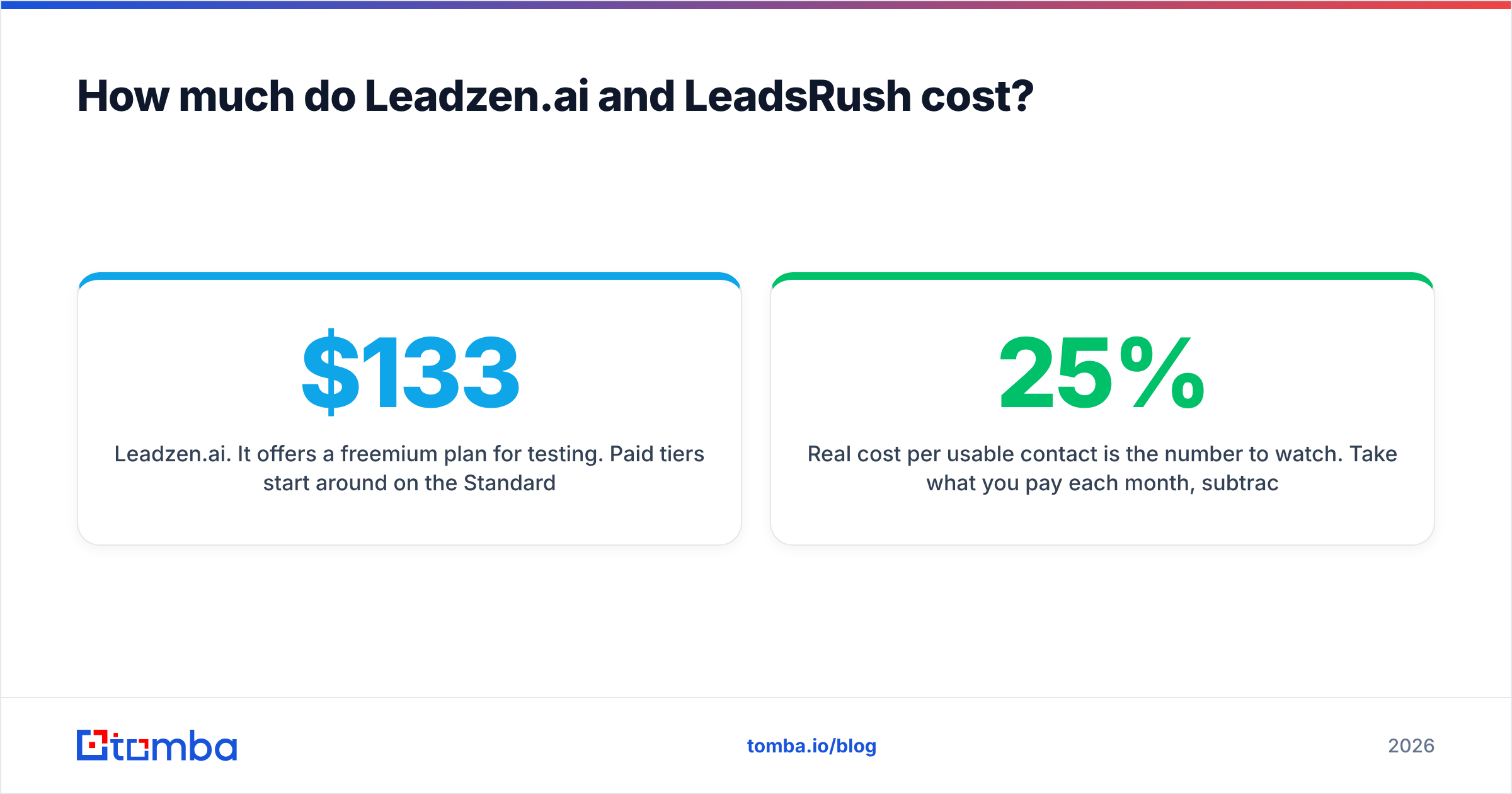
Leadzen.ai. It offers a freemium plan for testing. Paid tiers start around $133/month on the Standard plan (about $1,120 billed annually) and go up to roughly $800/month at the top tier, according to TrustRadius. That's reasonable if you use the outreach layer. If you only need contact data, you're paying for features you won't use.
LeadsRush. The free plan is generous for testing: 50 searches, 100 verifications, and 250 stored prospects a month, no credit card needed. Paid plans add volume. LeadsRush has also been sold as a lifetime deal on RocketHub, which is attractive for agencies that want predictable costs. Lifetime-deal tools do have a known risk: new features and data refreshes sometimes slow down after the deal period ends. Check how often the underlying listings are updated before relying on it long term.
Real cost per usable contact is the number to watch. Take what you pay each month, subtract the contacts you'll throw away after verification, and divide. A cheaper tool with a 25% discard rate can cost more per usable contact than a pricier tool with 5%.
Which one should you choose?#
Pick Leadzen.ai if:
- Your ICP is startups, funded companies, or mid-market B2B, especially in India.
- You want funding and investor signals to time your outreach.
- Your team wants prospecting and multichannel outreach (including WhatsApp) in one tool, without stitching together a separate sequencer.
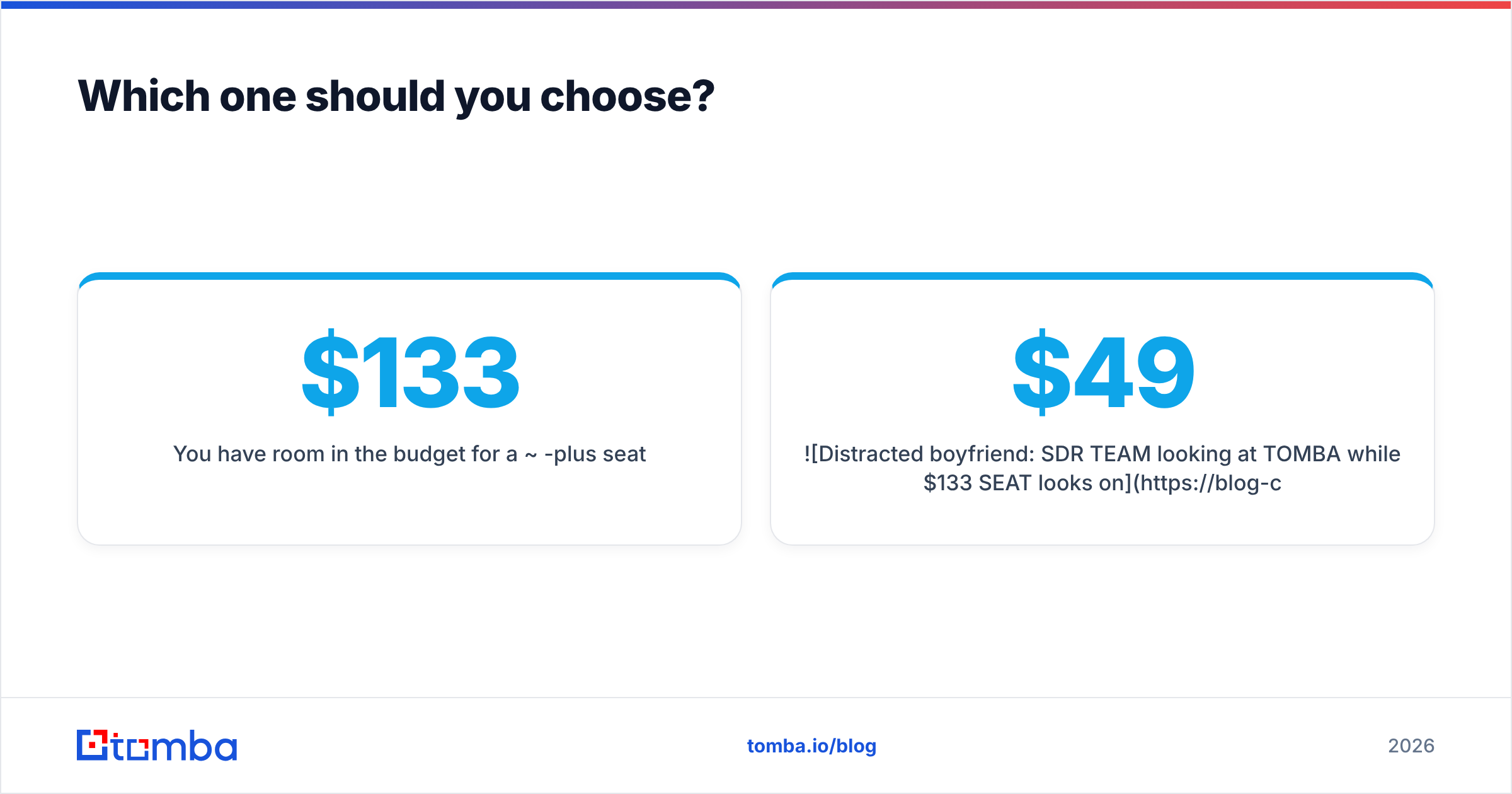
- You have room in the budget for a ~$133/month-plus seat.
Pick LeadsRush if:
- You sell to local or small businesses and plan territory by city or region.
- You're an agency building lists for clients across many niches.
- You already have a CRM and sequencer and just need clean company and contact records to feed them.
- You want a free plan you can actually use to test workflows.
Consider neither as your only data source if:
- You're sending more than a few thousand cold emails a month and deliverability is a KPI.
- You need person-level emails for specific named accounts, not lists.
- You want API access to enrich records inside your own product or data pipeline.

Where do Leadzen.ai and LeadsRush both fall short?#
Both tools are good at their main job, which is finding who to target. They're weaker at the step that follows: confirming that a specific person's email exists and will accept mail today.
In practice that shows up three ways:
- Named-account gaps. Your AE gives you 40 target accounts and three names at each. A database tool returns what it has, and for smaller or non-Indian companies (Leadzen.ai) or non-local firms (LeadsRush) that's often incomplete. An email finder that builds and checks addresses from name + domain fills those gaps.
- Catch-all ambiguity. A large share of SMB domains are catch-all. A basic verifier marks them "unknown," and you either drop good leads or risk bounces. Specialised catch-all verification handles those addresses separately.
- Workflow fit. If your ops team lives in Sheets, a CRM, or a custom pipeline, you want enrichment available through an API or add-on, not only as a CSV export from a web app.
This is why many teams use a stack rather than a single tool: one tool finds the accounts (Leadzen.ai for funded tech, LeadsRush for local SMB), and a dedicated finder and verifier makes sure every address is real before you send.
How does Tomba fit alongside either tool?#
Tomba doesn't replace Leadzen.ai's intent feed or LeadsRush's local search. It covers the contact layer both of them leave to you:
- Find: enter a name + company domain and get the professional email, with sources shown.
- Search: pull every public email on a domain, plus the company's email pattern.
- Verify: check deliverability in bulk, including a dedicated catch-all verifier.
- Scale: process CSVs with the bulk email finder, or connect through the API, Chrome extension, Google Sheets, and CRM integrations.
Pricing starts with a free tier (25 searches/month), then Starter at $49/month, Growth at $99/month, Pro at $249/month, and custom Enterprise plans. See Tomba pricing for credit breakdowns. For a team already paying for Leadzen.ai or LeadsRush, adding a Starter plan costs little compared with a burned sending domain.
Frequently asked questions#
Is Leadzen.ai better than LeadsRush? It depends on who you sell to. Leadzen.ai is better for funded startups and mid-market B2B, especially in India, and for teams that want outreach built in. LeadsRush is better for location-based lists of local and small businesses.
Does LeadsRush have a free plan? Yes. The free plan includes 50 searches, 100 email verifications, and up to 250 stored prospects per month, with no credit card required.
How much does Leadzen.ai cost? Leadzen.ai has a freemium plan. Paid plans start around $133/month (Standard) and go up to about $800/month for the highest tier, based on listings on TrustRadius.
Do I still need an email verifier with these tools? For any serious cold email volume, yes. Database exports go stale, and catch-all domains can't be confirmed with basic checks. Verifying before you send protects your bounce rate and sender reputation.
Can I use Leadzen.ai or LeadsRush outside India or the US? Leadzen.ai is strongest on Indian company data. LeadsRush is built on location-based business search, so coverage depends on the region. Test both with your own ICP during the free tier before you buy.
Whichever tool you choose to build your list, make sure every address actually reaches an inbox before your sequence starts. Tomba Email Finder finds and verifies professional emails from a name and domain, fills the named-account gaps that database tools miss, and plugs into your CRM, Sheets, or API workflow. Start free with 25 searches, then upgrade to Starter at $49/month when you're ready to scale.
Related guides#
Ready to find emails that actually work?
Join 150,000+ professionals who stopped guessing and started sending. Free credits on signup — no credit card required.
Get the Tomba newsletter
Practical outbound tactics and product updates — once every two weeks.
About the author