Leadzenai vs Oceanio: Which B2B Lead Platform Fits Your Team?
Leadzen.ai builds contact lists fast and cheaply. Ocean.io finds accounts that look like your best customers. Here's how to tell which one your pipeline needs, and where each one falls short.
Leadzenai vs Oceanio is really a choice between contact-first and account-first prospecting. Here is how to pick.
TL;DR
- Leadzen.ai is a contact-first lead tool. You search by role, industry and location and get emails and phone numbers back. It is cheapest for fast volume, and its coverage is strongest in India and APAC.
- Ocean.io is an account-first discovery platform. You give it your best customers, and its lookalike engine finds companies like them. It works best for ABM and narrow ICPs.
- The real question is which problem you have. If you don't know who to target, you need Ocean.io. If you know who, but not how to reach them, you need Leadzen.ai.
- Neither tool removes the need to verify addresses before you send.
- Pricing models differ. Leadzen.ai sells self-serve credits. Ocean.io is priced like mid-market ABM software.
What is Leadzen.ai?#
Leadzen.ai is an AI-assisted B2B lead generation platform based in India. The workflow is simple. You describe the people you want to reach (job title, seniority, industry, company size, location). Leadzen returns matching contacts with work emails and, where it has them, phone numbers.
It is built for speed and volume. The typical user is a founder, a small sales team or an agency. They know their buyer and want a list of 500 names by this afternoon. The product includes:
- People and company search with standard firmographic filters
- Email and phone enrichment on the returned contacts
- A browser extension that pulls contact details while you browse professional profiles and company sites
- CSV export and basic CRM pushes
Leadzen's biggest strength is coverage in markets where Western-built databases tend to be thin, especially India and the wider APAC region. If your territory is Bengaluru, Mumbai, Singapore or Jakarta, you should test it for that reason alone.
Its main limitation is that it does little to help you decide who to target. It fills in contact details well. It won't tell you which accounts deserve your attention.
What is Ocean.io?#
Ocean.io is a Copenhagen-founded account intelligence platform. Its core feature is lookalike search. You give it a handful of your best customers as seed companies. It returns other companies that match them on dozens of signals: industry, tech stack, headcount trends, web content, hiring and more.
After you have a list of target accounts, Ocean.io lets you move down to the people level. You pick decision-makers inside those accounts and enrich them with emails and phone numbers. The typical buyer is a RevOps lead, an ABM marketer, or a sales team whose ideal customer can't be described with "SaaS, 50–200 employees, US".
Key capabilities:
- Lookalike company search from seed domains
- Signal filters (tech used, hiring activity, growth)
- Contact discovery inside the accounts you surface
- CRM integrations, with Salesforce and HubSpot as the main ones, so lookalike lists can sync into existing workflows
- Browser extension for company research while you browse
Ocean.io is strongest on account selection. Its contact data is solid and improving, but it isn't the product's reason to exist. Its data also tends to be deeper in Europe and North America than in APAC.
How do Leadzen.ai and Ocean.io compare side by side?#
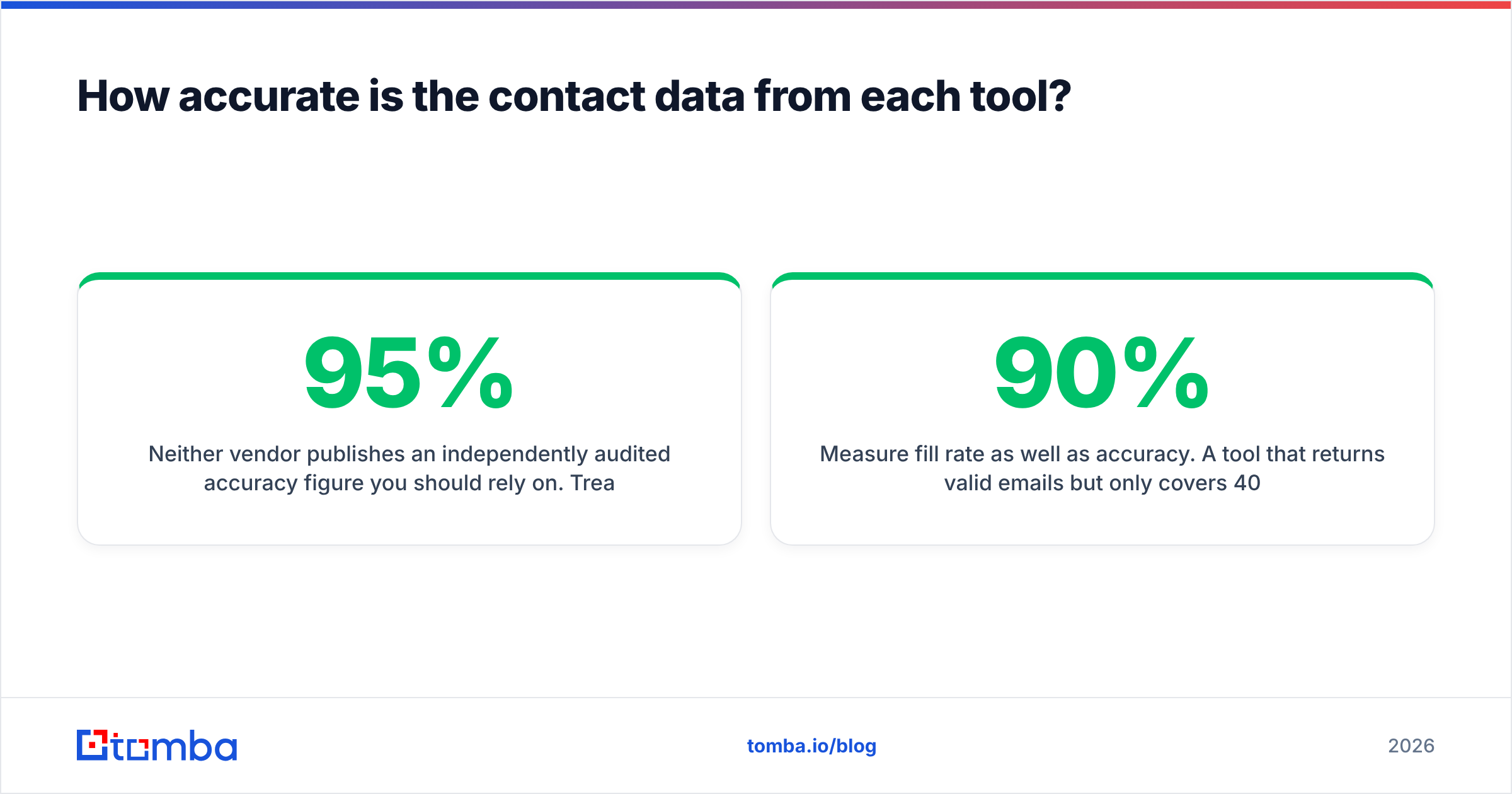
This table is about approach and fit, not a spec sheet. Both vendors ship features often, so confirm any detail that matters to you against their live product pages and recent reviews on G2.
| Attribute | Leadzen.ai | Ocean.io |
|---|---|---|
| Core approach | Contact-first: search people by persona | Account-first: lookalike companies from seed customers |
| Best question it answers | "Who are the VPs of Sales at fintechs in India?" | "Which 300 companies look most like our top 10 customers?" |
| Strongest data regions | India and APAC | Europe and North America |
| Lookalike / ICP modelling | Basic filters only | Core product, multi-signal lookalike engine |
| Contact data (email + phone) | Central to the product | Available, secondary to account discovery |
| CRM integration depth | Export and basic pushes | Native Salesforce and HubSpot sync |
| Pricing model | Self-serve, credit-based, low entry cost | Higher-tier, often annual; mid-market ABM pricing |
| Ideal team | Founders, SDR teams, agencies | RevOps, ABM marketing, mid-market and enterprise sales |
| Learning curve | Low, productive in an hour | Moderate, needs good seed accounts to be useful |
| Main weakness | Weak on "who should we target?" | Overkill if you only need a contact list |
Which approach fits your sales motion?#
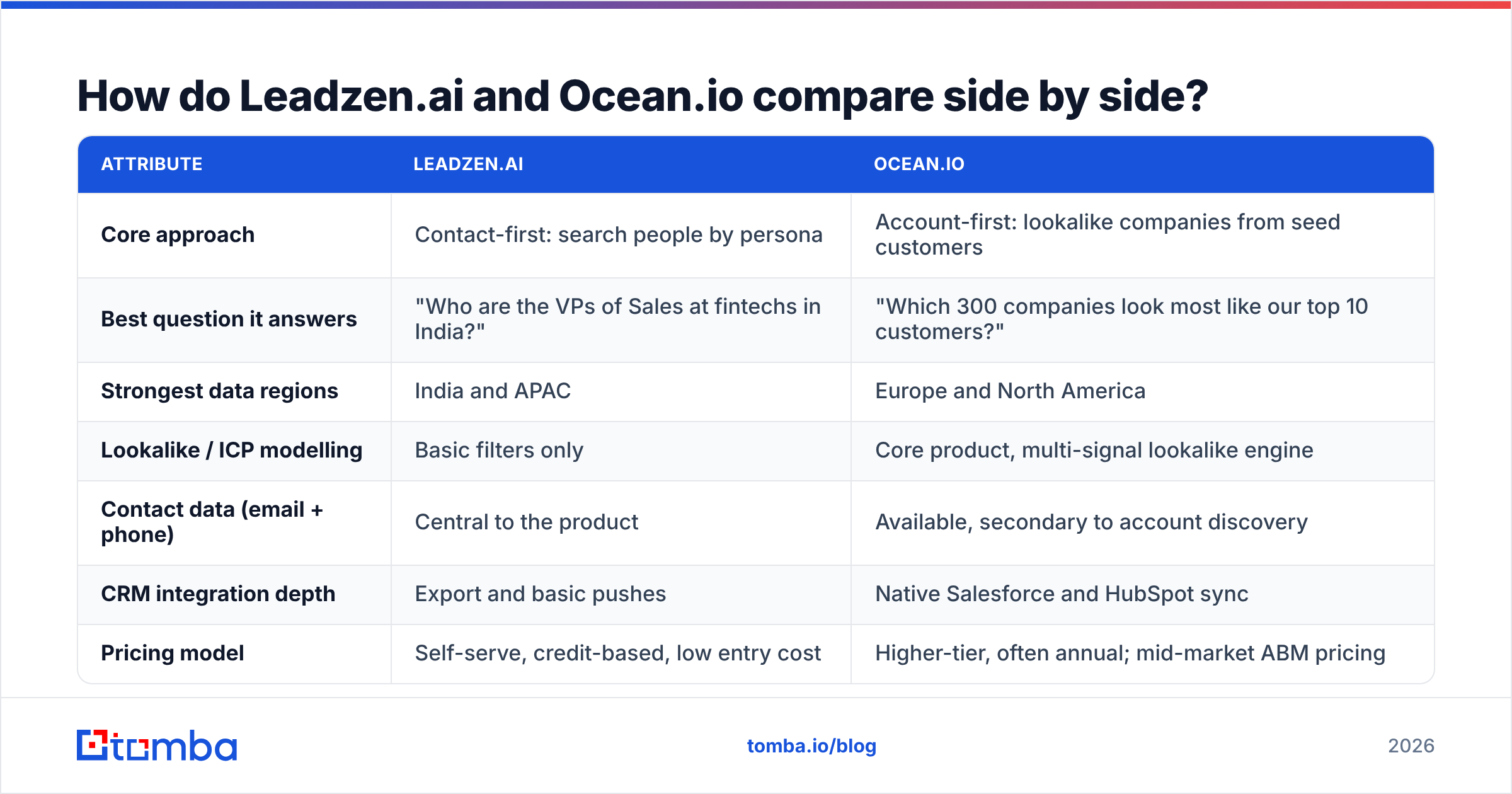
The key difference in Leadzenai vs Oceanio comes down to account-first versus contact-first prospecting. Before you compare features, work out which of these five situations describes your team:
- You have a tight, proven ICP and need volume. Your best customers share obvious firmographics and you just need more contacts matching the persona. Leadzen.ai fits this.
- You have 20+ happy customers but can't say what they have in common. They span industries, and the pattern lives in their tech stack, business model or growth stage. Ocean.io fits this, because lookalike modelling finds patterns that filters can't express.
- You sell into India or Southeast Asia. Start with Leadzen.ai, test coverage on a sample of 100 known accounts, and compare fill rates.
- You run ABM with a named-account list in your CRM. Ocean.io's CRM sync and account-level signals make it easier to expand your target account list without spreadsheet work.
- You're an agency building lists for several clients. Leadzen.ai's self-serve credits and low entry cost are easier to pass on to clients per project.
Plenty of teams need both jobs done. They use an account-discovery tool to build the target list and a separate contact tool to fill in the people. That is a valid stack, but it costs more, and data quality varies between the two tools.
How accurate is the contact data from each tool?#
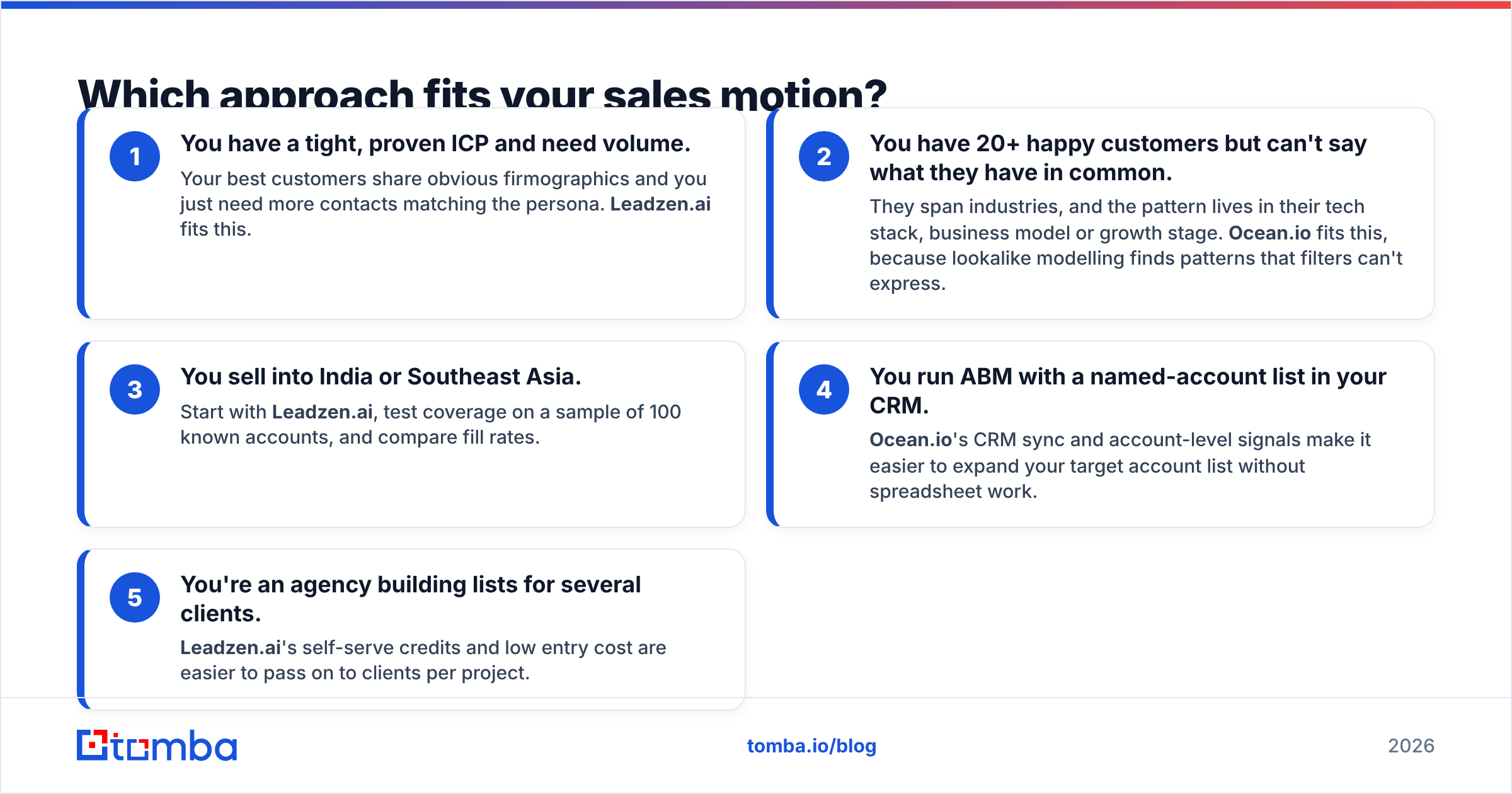
Neither vendor publishes an independently audited accuracy figure you should rely on. Treat any "95%+ accurate" claim on either site as marketing until you have tested it on your own data.
Here is how to test fairly:
- Pull the same 200 contacts from both tools. Choose accounts you know well, such as existing customers or closed-lost deals, so you can spot wrong titles and people who have left.
- Run every returned email through an independent email verifier. Record the share of valid, invalid, catch-all and unknown results for each tool.
- Check job-title freshness manually on 30 contacts per tool. Outdated titles hurt reply rates more quietly than bounces do.
- Measure fill rate as well as accuracy. A tool that returns 90% valid emails but only covers 40% of your list may be less useful than one that returns 82% valid emails on 75% coverage.
In practice, contact-first tools like Leadzen.ai put more effort into email and phone coverage. Account-first tools like Ocean.io put more into company-level signals. So in a head-to-head test, expect Leadzen to fill more contacts in its home markets. Expect Ocean.io to produce more relevant accounts. This is a trend, not a guaranteed result.
Whichever tool wins your test, send nothing without verification. Your sender reputation doesn't care which vendor supplied the bad address.
What do Leadzen.ai and Ocean.io cost?#
The two vendors price for different buyers, and you should budget accordingly.
Leadzen.ai is priced for self-serve buyers. You buy credits or a monthly plan, spend them on contact reveals, and top up as needed. Entry cost is low, so it is easy to trial on a real campaign. Watch how credits are used. Phone reveals may cost more than an email, and unused credits may not roll over.
Ocean.io is priced like mid-market ABM software. It has offered trial and lower-tier options, but teams that use it as their core account-discovery engine usually end up on larger plans. Expect a sales call and possibly an annual contract. The value is also different. You are paying to avoid targeting the wrong accounts, and that is harder to price than cost-per-email.
Vendors change pricing often, so look at the current pages for Leadzen.ai and Ocean.io rather than relying on figures in any blog post, including this one.
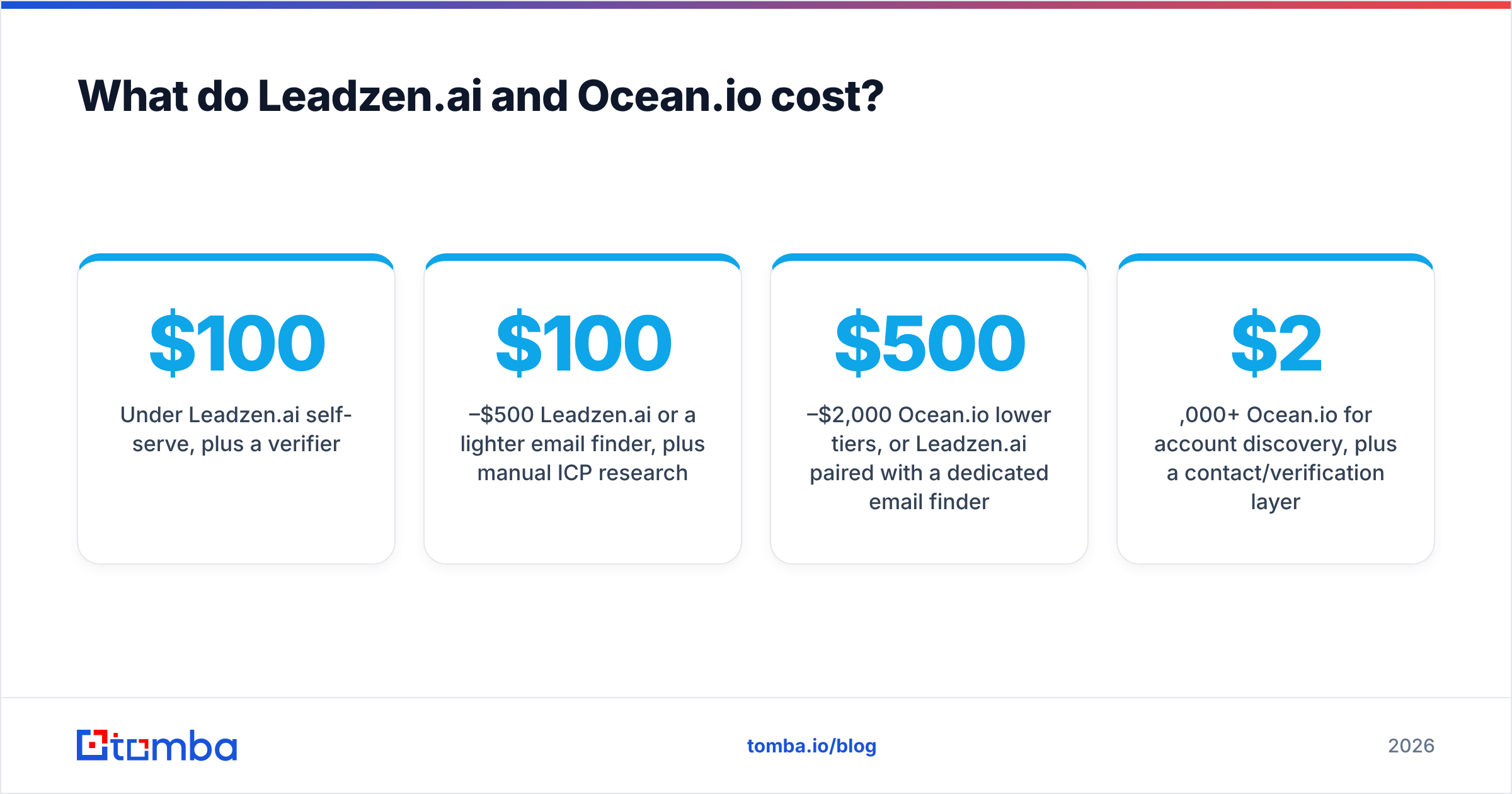
A useful rule of thumb:
| Monthly prospecting budget | Realistic choice |
|---|---|
| Under $100 | Leadzen.ai self-serve, plus a verifier |
| $100–$500 | Leadzen.ai or a lighter email finder, plus manual ICP research |
| $500–$2,000 | Ocean.io lower tiers, or Leadzen.ai paired with a dedicated email finder |
| $2,000+ | Ocean.io for account discovery, plus a contact/verification layer |
Where does each tool fall short?#
Leadzen.ai limitations:
- ICP intelligence is shallow. Filters cover firmographics, but you won't get "companies that behave like our best customers."
- Coverage outside APAC varies. If you sell mainly into the DACH region or the US Midwest, test before you buy.
- Integrations are lighter. Teams with complex CRM workflows may end up with more CSV handling than they would like.
Ocean.io limitations:
- Garbage seeds, garbage lookalikes. If your seed customers are a random mix, the lookalike output will be too. You have to do the ICP homework first.
- Too much for simple list building. If you only need 300 HR directors in Texas, you pay for an engine you don't use.
- Contact depth is secondary. Some teams layer a dedicated email finder on top to raise fill rates on the accounts Ocean.io surfaces.
- Budget threshold. Solo founders and very small teams may find the price hard to justify early on.
Is there a simpler way to get verified contacts for the accounts you pick?#
Yes. A lot of teams split the job in two, and that is often cheaper than forcing one platform to do both.
The workflow looks like this:
- Choose your accounts with whatever method works: Ocean.io lookalikes, your CRM's closed-won data, a G2 category page, or plain analyst research.
- Run a domain search on each target company to see which contacts are publicly discoverable and what email pattern the company uses.
- Find specific people by name plus company domain with a dedicated email finder.
- Verify everything, including catch-all domains, before it goes into your sequencer.
- Enrich leads with title, company size and social profiles so your personalisation has something to work with.
Keeping account selection separate from contact discovery lets you change either layer without rebuilding your whole stack. It also means you never pay premium ABM prices just to look up an email address.
Leadzenai vs Oceanio: which one should you choose?#
Choose Leadzen.ai if:
- Your ICP is already clear and describable with standard filters
- You sell into India or APAC
- You need volume on a tight budget with self-serve buying
- You are a founder, small SDR team or agency
Choose Ocean.io if:
- You have a solid base of customers and want more that look like them
- Your ICP is defined by signals like tech stack, business model or growth stage rather than basic firmographics
- You run ABM and need account lists synced into Salesforce or HubSpot
- You have a mid-market budget and a RevOps owner to run it
Choose neither (or add a layer) if:
- You already know your accounts and only need accurate emails. A dedicated email finder plus verifier is cheaper and more focused.
- Your bounce rate is already hurting deliverability. Fix verification first, then worry about sourcing.
Either way, run the 200-contact test described above before signing anything longer than a month.
FAQ#
Is Leadzen.ai or Ocean.io better for startups? For most early-stage startups, Leadzen.ai. It is cheaper to start, faster to learn, and good at filling a list when the founder already knows the buyer. Ocean.io pays off once you have enough customers to seed a meaningful lookalike model.
Does Ocean.io provide email addresses? Yes. Ocean.io offers contact discovery with emails and phone numbers inside the accounts it surfaces, but account discovery is its main focus.
Can I use Leadzen.ai and Ocean.io together? Yes. Some teams use Ocean.io to pick accounts and a contact-first tool to fill in people. Budget for both, and verify the merged output before sending.
Do I still need an email verifier with either tool? Yes. Every B2B database decays as people change jobs, and catch-all domains hide invalid addresses. Verify before every campaign.
Ready to reach the accounts you've picked?#
Whichever discovery tool you use, the last step is the same: you need a real, deliverable address for a real person. Tomba Email Finder finds professional emails from a name and company domain, or lists every discoverable contact at a domain, with built-in verification so bounces don't reach your sequencer. You can start with 25 free searches a month and move to paid plans from $49/mo when you scale. Compare the Tomba plans and run your target list through the finder today.
Related guides#
// get started
Find, verify and enrich your first contacts today
Start on the free plan with 25 searches a month, then scale when your team is ready.
Free plan · No credit card required · GDPR & CCPA
// about the author