LeadzenAI vs Postaga: Which Outreach Tool Fits Your Team in 2026?
LeadzenAI hands you B2B leads; Postaga turns your content into link-building and PR outreach. They solve different problems. Here's how to pick the right one, and where each falls short.
TL;DR
- LeadzenAI is an AI-driven B2B lead generation platform. You use it to find companies and decision-makers. Recent listings also show it selling done-for-you packages priced per booked meeting.
- Postaga is an outreach platform built around content. You give it a URL and it finds link-building, PR, and partnership opportunities, pulls contacts, and runs personalized sequences.
- Pick LeadzenAI when your bottleneck is who to sell to. Pick Postaga when your bottleneck is getting links, mentions, or podcast spots.
- Neither one is a dedicated email finder or verifier. If you care about bounce rate, check every list before sending, whichever tool you use.
- Postaga's self-serve pricing is public and predictable (Pro from about $84–$99/mo). LeadzenAI's pricing has moved around, so confirm it with sales before you budget.
What is LeadzenAI?#
LeadzenAI (leadzen.ai) describes itself as an AI lead generation tool for startups and SMBs. At its core is a B2B contact and company database. On top of that sit intelligent filters, bulk search, geo-location targeting, and LinkedIn/Chrome extensions that pull prospect data while you browse profiles.
In practice, you'd use it like this:
- Describe your ideal customer (industry, headcount, geography, job titles).
- Let the AI search return matching companies and people.
- Export contacts with emails and phone numbers into your CRM or sequencer.
The product has also moved toward managed outreach. Several 2026 third-party listings show LeadzenAI packages sold by confirmed meetings, for example around $2,000 for 10 meetings and up to $8,000 for 60. Older self-serve credit plans still show up on other listings, so public pricing is inconsistent. The takeaway: LeadzenAI now covers both a data tool and a pipeline service. Ask which one you're buying.
Where it's strong: fast ICP-based list building, phone and email in one place, a LinkedIn workflow, and the option to outsource meeting-setting completely.
Where it's weaker: inconsistent public pricing, a smaller review footprint than the big data vendors, and data coverage outside its strongest regions that you should test before committing.
What is Postaga?#
Postaga is an outreach platform for marketers, SEOs, and agencies who want earned attention: backlinks, guest posts, brand mentions, podcast interviews, and local partnerships. The workflow starts with your content, not with a database:
- Pick a campaign type (skyscraper, broken link, guest post, podcast, PR, local business, and so on).
- Paste in the URL you want to promote.
- Postaga finds relevant sites and pages, identifies the right contact, and verifies the email.
- Its AI assistant reads the target's content and drafts personalized lines that reference it.
- Sequences send automatically, and follow-ups stop when someone replies.
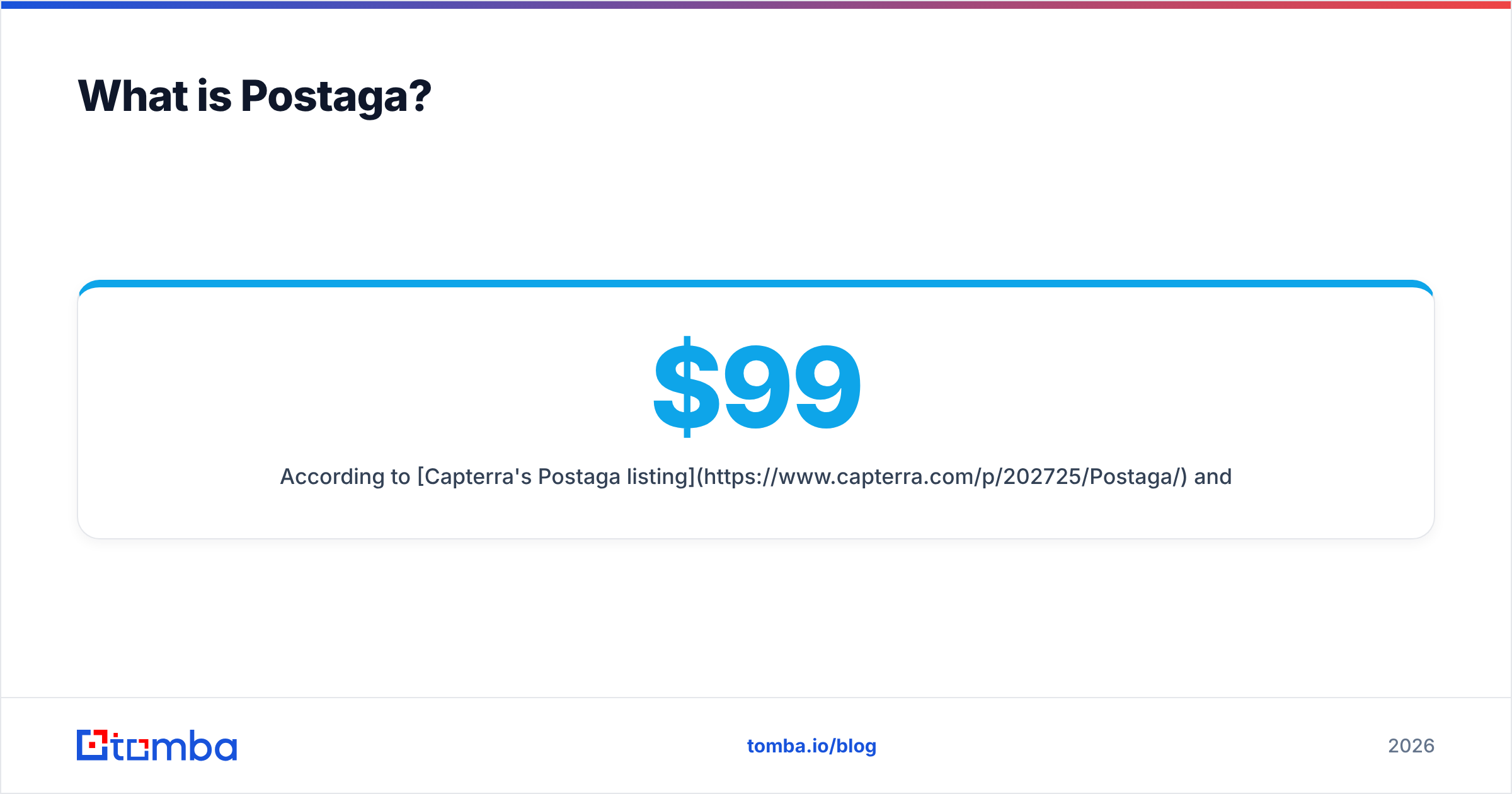
According to Capterra's Postaga listing and other 2026 directories, pricing has two tiers. Pro is $99/mo, or $84/mo billed annually, with roughly 10,000 emails, 2,000 contacts, and 1,000 opportunity searches. Agency is $299/mo, or $250/mo billed annually, with roughly 100,000 emails, 15,000 contacts, and 15,000 opportunity searches. Both come with a 14-day free trial.
Where it's strong: opportunity discovery built into the product, AI personalization that uses the prospect's actual content, and campaign templates for each outreach type.
Where it's weaker: it isn't a general B2B sales prospecting database. It's also overkill if you only need contacts, and some startups on G2's Postaga reviews find the jump from Pro to Agency steep.
How do LeadzenAI and Postaga differ at the core?#
The simplest way to see the difference is to ask what each tool treats as the starting input:
- Starting input. LeadzenAI starts from an ideal customer profile (firmographics and titles). Postaga starts from a piece of content or a campaign goal.
- Primary output. LeadzenAI produces a list of sales-qualified contacts, or booked meetings on its managed plans. Postaga produces sent, personalized outreach and the replies it earns.
- Buyer persona. LeadzenAI fits SDRs, founders doing sales, and small revenue teams. Postaga fits SEO leads, content marketers, PR specialists, and agencies.
- Success metric. LeadzenAI is judged on meetings booked and pipeline created. Postaga is judged on links won, mentions earned, and podcast bookings.
- Where AI helps. In LeadzenAI, AI powers search and matching ("find me people like this"). In Postaga, AI powers opportunity discovery and email personalization ("write to this person about their article").
These tools don't really compete. They serve two different jobs that both happen to involve cold email.

LeadzenAI vs Postaga: how do features and pricing compare?#
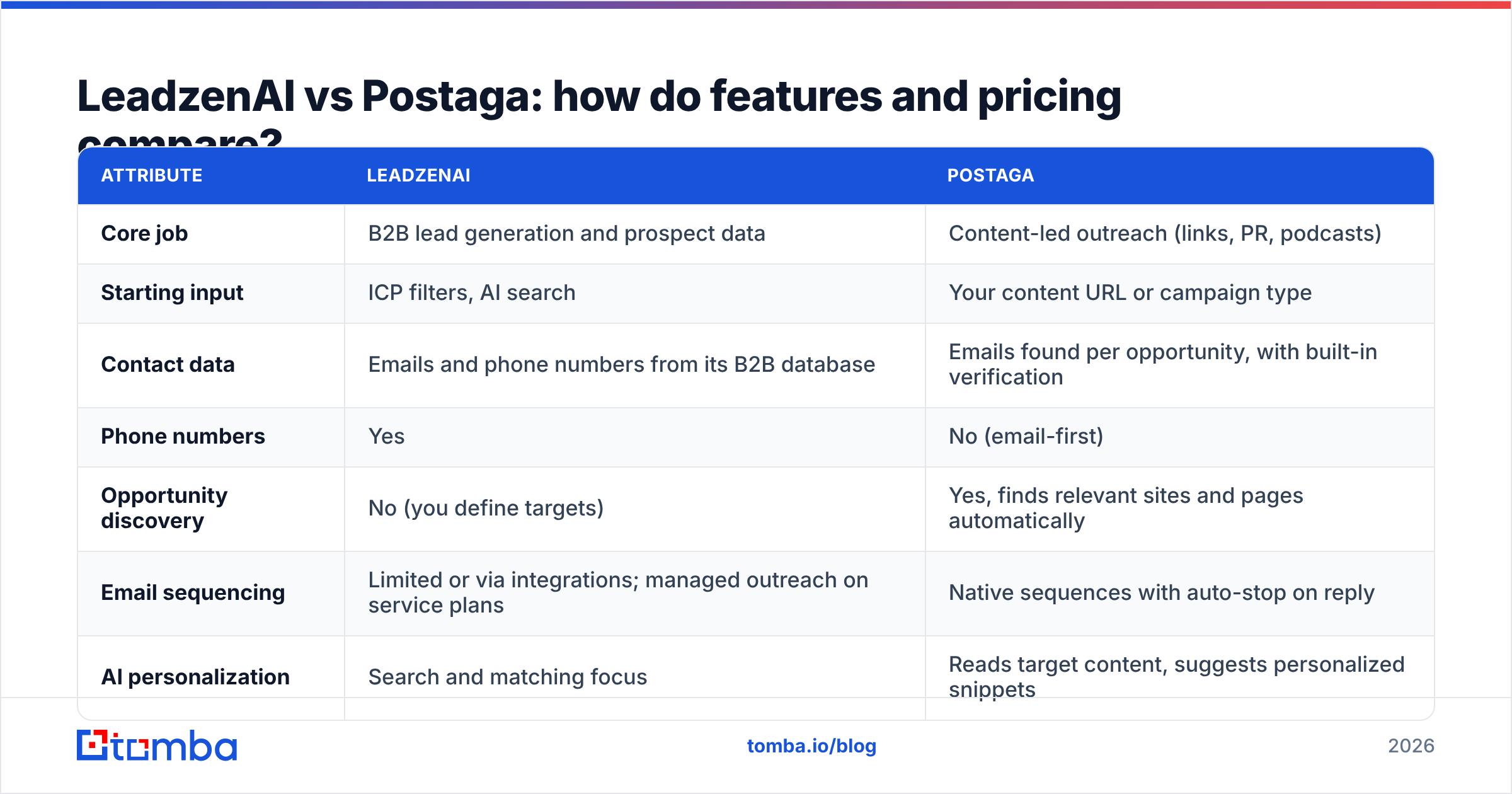
| Attribute | LeadzenAI | Postaga |
|---|---|---|
| Core job | B2B lead generation and prospect data | Content-led outreach (links, PR, podcasts) |
| Starting input | ICP filters, AI search | Your content URL or campaign type |
| Contact data | Emails and phone numbers from its B2B database | Emails found per opportunity, with built-in verification |
| Phone numbers | Yes | No (email-first) |
| Opportunity discovery | No (you define targets) | Yes, finds relevant sites and pages automatically |
| Email sequencing | Limited or via integrations; managed outreach on service plans | Native sequences with auto-stop on reply |
| AI personalization | Search and matching focus | Reads target content, suggests personalized snippets |
| LinkedIn / Chrome extension | Yes | Chrome extension for prospecting |
| Entry pricing | Inconsistent publicly; meeting-based packages reported from ~$2,000 | Pro $99/mo ($84/mo annual) |
| Higher tier | Up to ~$8,000 for 60 meetings (reported) | Agency $299/mo ($250/mo annual) |
| Free trial | Yes (per vendor and listings) | 14-day free trial |
| Best fit | Outbound sales teams needing pipeline | SEO, content, and PR teams needing earned media |
Pricing figures come from public 2026 listings and vendor pages. Both companies change packaging, so check current numbers before you sign.
Which tool gives you better contact data?#
Your answer depends on what "better" means for your use case.
LeadzenAI is stronger on breadth for sales targeting. You can filter by company size, industry, and location and get person-level records with emails and phones. That's what an SDR needs to fill a sequence.
Postaga is stronger on relevance for editorial outreach. It doesn't try to give you every VP of Marketing in Germany. It tries to give you the one editor who wrote the article that links to your competitor. The contact count is smaller, but each contact is more relevant.
Both tools have the usual weak spot of any bundled data source: email accuracy on catch-all and recently changed domains. People change jobs, companies rebrand, and catch-all servers accept anything at the SMTP level and bounce later. A tool's in-app "verified" badge is only as current as its last check.
A pragmatic stack for either tool:
- Export the list.
- Run it through a dedicated email verifier and separate catch-all results from confirmed-valid ones.
- Fill in missing contacts with an email finder, searching by name plus company domain. For editorial targets, where you know the site but not the person, run a domain search to see every public address and pattern on that domain.
This step costs a few minutes and a few credits. Skipping it costs sender reputation, and that takes weeks to rebuild.
Is LeadzenAI better than Postaga for cold sales outreach?#
Yes, if "cold sales outreach" means selling a product to companies that fit a profile.
Postaga can technically email anyone, but its discovery engine is built around content: articles, resource pages, podcasts, local directories. If you sell HR software to 200–1,000 employee manufacturers in the Midwest, Postaga has no filter for that. LeadzenAI does.
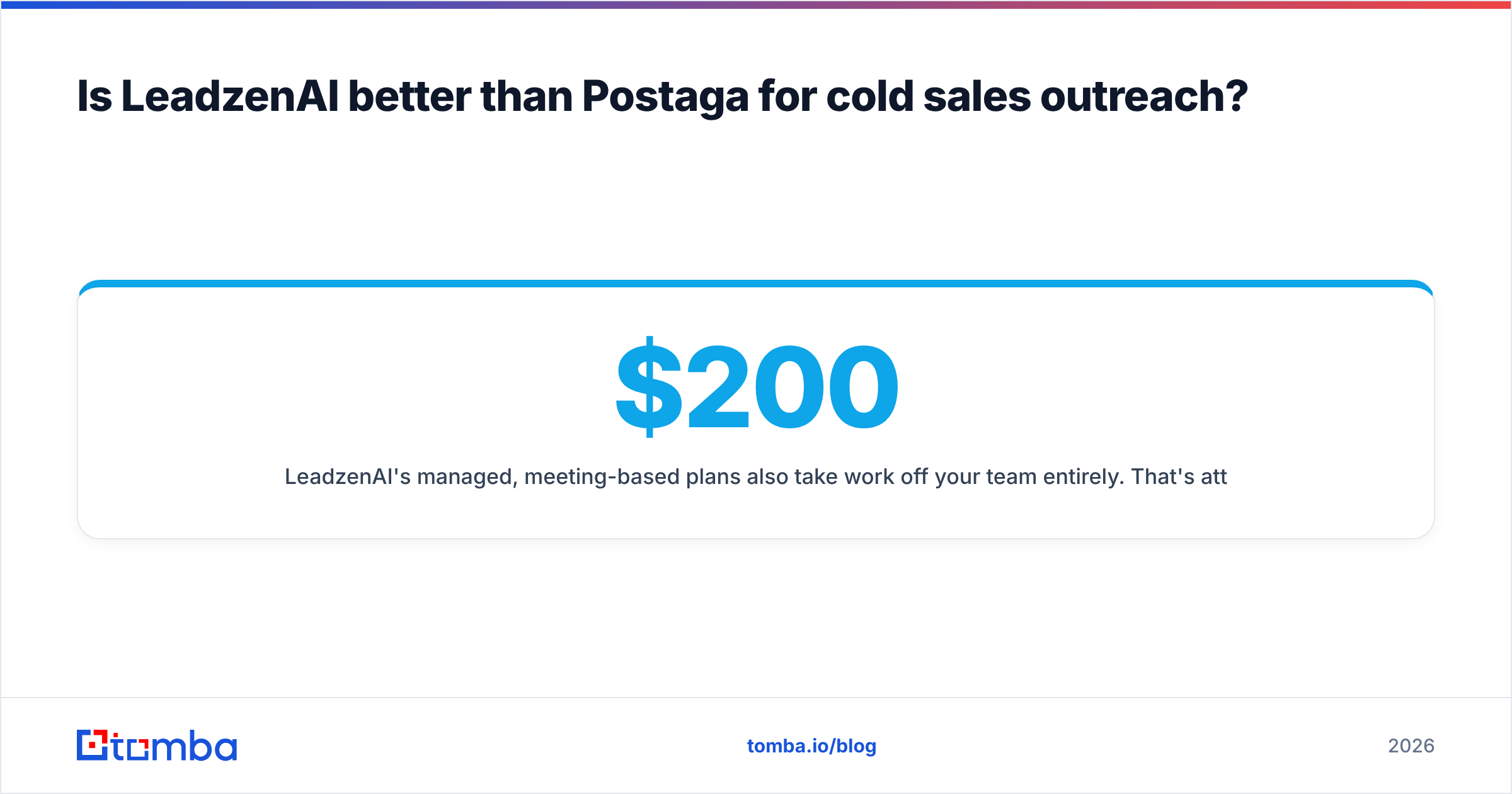
LeadzenAI's managed, meeting-based plans also take work off your team entirely. That's attractive if you don't have an SDR, but compare the per-meeting cost to your average deal size. At about $200 per meeting (reported: $2,000 / 10), the math works for a $15k ACV product. It rarely works for a $50/mo SaaS.
Choose LeadzenAI for sales outreach if:
- You need phone numbers as well as emails.
- Your targeting is firmographic (industry, size, geography, title).
- You'd rather pay for meetings than build an outbound engine.
Is Postaga better than LeadzenAI for link building and PR?#
Clearly yes. LeadzenAI isn't designed for it.
Link building needs three things a sales database doesn't provide:
- Opportunity context. Which page links to a competitor, which article is outdated, which podcast covers your topic.
- Content-aware personalization. Referencing the specific paragraph you'd improve or replace.
- Campaign logic. Different templates for broken-link, skyscraper, guest-post, and podcast pitches.
Postaga bundles all three. Its AI assistant pulls snippets from the target's article so your first line doesn't read like a template. Sequences stop automatically on reply, which matters when an editor answers and your next scheduled follow-up would otherwise land awkwardly.
Choose Postaga for outreach if:
- Your goal is backlinks, mentions, guest posts, or podcast appearances.
- You run outreach for multiple clients (the Agency plan's contact and email limits are built for this).
- You want discovery, contact lookup, and sequencing in one tool instead of three.
How do the pricing models actually compare?#
These are two different spending models:
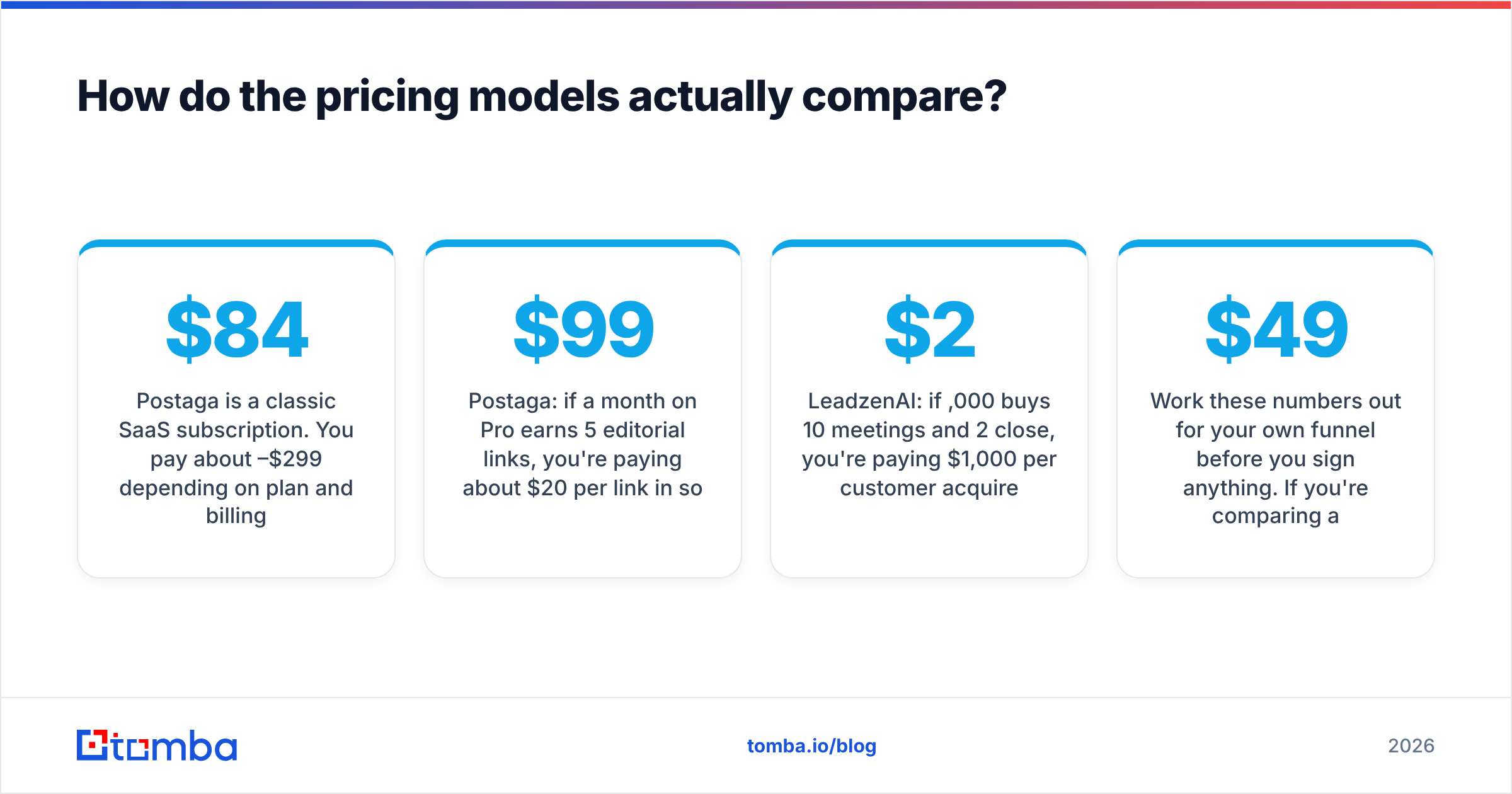
- Postaga is a classic SaaS subscription. You pay about $84–$299/mo depending on plan and billing cycle, and you do the work. Your cost is fixed, and results depend on your pitch quality.
- LeadzenAI (on its current managed packages) is closer to a pay-for-outcome service. You pay per confirmed meeting, and someone else runs the outreach. Your cost scales with results but starts much higher.
Neither model is inherently better. A useful sanity check is cost per positive outcome:
- Postaga: if a $99 month on Pro earns 5 editorial links, you're paying about $20 per link in software. Add your own time on top.
- LeadzenAI: if $2,000 buys 10 meetings and 2 close, you're paying $1,000 per customer acquired through that channel.
Work these numbers out for your own funnel before you sign anything. If you're comparing against a data-only stack, Tomba pricing starts with 25 free searches a month and runs $49, $99, and $249 for Starter, Growth, and Pro. That's useful as a baseline for what raw contact data costs without the service layer.
What do users say about each tool?#
Review volume differs a lot between the two, so weigh it accordingly.
Postaga has a longer public track record on G2 and Capterra. Reviewers most often praise:
- Time saved on finding link opportunities
- Personalization quality compared with generic mail-merge tools
- Responsive support
Common complaints:
- The learning curve for campaign setup
- The price jump between tiers
- Occasional contact misses on smaller sites
LeadzenAI has fewer independent reviews, so treat any score cautiously. Commonly mentioned positives:
- Fast list building
- Phone numbers included
Commonly raised concerns:
- Pricing clarity
- Data depth outside its core markets
Run a pilot on a sample of your real ICP before you commit to a large meeting package.
Can you use LeadzenAI and Postaga together?#
You can, and it makes sense for companies whose marketing and sales teams both do outbound:
- Marketing uses Postaga to earn backlinks and podcast spots, which builds authority and organic traffic.
- Sales uses LeadzenAI to build target-account lists and book demos.
The shared weak point is data hygiene. Two tools with two contact sources, both feeding one CRM, will produce duplicates, stale records, and catch-all addresses that inflate your bounce rate. Put a single verification and enrichment step in front of your CRM. That way both teams send from clean data and neither one damages the shared sending domain.
Which should you choose: LeadzenAI or Postaga?#
Use this decision shortcut:
- You sell a B2B product and need meetings → LeadzenAI, or any ICP-driven lead database plus a sequencer.
- You're growing organic traffic, authority, or brand mentions → Postaga.
- You're an agency doing link building for clients → Postaga Agency.
- You have no SDR and a high ACV → LeadzenAI's meeting-based packages are worth a pilot.
- You already have a sequencer and just need accurate contacts → neither. A focused email finder and verifier is cheaper and cleaner.
The worst choice here is buying one tool to do the other's job. Postaga won't build you a firmographic sales list, and LeadzenAI won't find the editor whose article links to your competitor.
How does Tomba fit into either workflow?#
Whichever tool you pick, the email address is still the weakest link in the chain. Tomba is built for that one job: finding and confirming the right professional email.
- Postaga users can use Tomba to recover contacts the platform misses on small or niche sites.
- LeadzenAI users can use Tomba to double-check exported lists before they reach a sequencer.
If you want a clean contact layer that works with any outreach tool, try Tomba Email Finder. Search by name and domain, get a verification status with every result, and start with 25 free searches a month before moving to a paid plan from $49/mo.
Related guides#
// get started
Find, verify and enrich your first contacts today
Start on the free plan with 25 searches a month, then scale when your team is ready.
Free plan · No credit card required · GDPR & CCPA
// about the author