Leadzenai vs Reachfast (2026): Which B2B Contact Tool Fits You?
Leadzen.ai is an AI lead database built for prospecting. Reachfast is a pay-per-hit enricher for LinkedIn lists. Here is how they differ on data, pricing and phone accuracy, and when a cheaper email-first tool makes more sense.
TL;DR
- Leadzen.ai is a prospecting database. You use it to discover leads with AI filters, bulk search, and "trending" signals such as recently funded companies. It is strongest for Indian and APAC markets and for SMB sales teams that want one place to search and reach out.
- Reachfast is an enrichment engine. You bring it LinkedIn URLs or Sales Navigator lists, and it runs a waterfall across several data providers to return direct dials and verified emails. You pay only when it finds a valid phone number.
- Choose by workflow, not features. If you don't know who to contact yet, Leadzen.ai fits better. If you already have the list and need to reach people on the phone, Reachfast fits better.
- Pricing models are very different. Leadzen.ai is a monthly subscription (third-party listings show plans starting around $133/mo). Reachfast is pay-per-result with a small free credit allowance.
- If you mostly need emails, both tools can be more than you need. An email-first tool like Tomba starts at $49/mo and has a free tier.
What are Leadzen.ai and Reachfast, in one sentence each?#
People compare these two tools because both promise "verified B2B contact data" and both come from the same wave of AI-branded sales tools. They solve different problems, though, and most of the confusion in "leadzenai vs reachfast" searches comes from treating them as the same kind of product.
Leadzen.ai is an AI lead generation platform. It combines a searchable B2B database of people and companies with intelligent filters, bulk search, a Chrome/LinkedIn extension, and outreach across email, LinkedIn, WhatsApp, and calling. It pitches itself to startups and small-to-mid-sized companies, with deep coverage of Indian company data (including MCA-registry-grade firmographics) and signals such as newly funded startups and active angel investors.
Reachfast is a contact enrichment tool. You give it a LinkedIn profile URL, a CSV, or a Sales Navigator search. It queries a waterfall of 7+ data providers and returns direct phone numbers and verified emails. Its main selling point is phone accuracy: it prioritizes personal mobile numbers over switchboard lines, and you're charged only for valid numbers it finds.
A simple way to picture it: Leadzen.ai is the map that helps you decide where to go, and Reachfast is the address lookup for a destination you already chose.
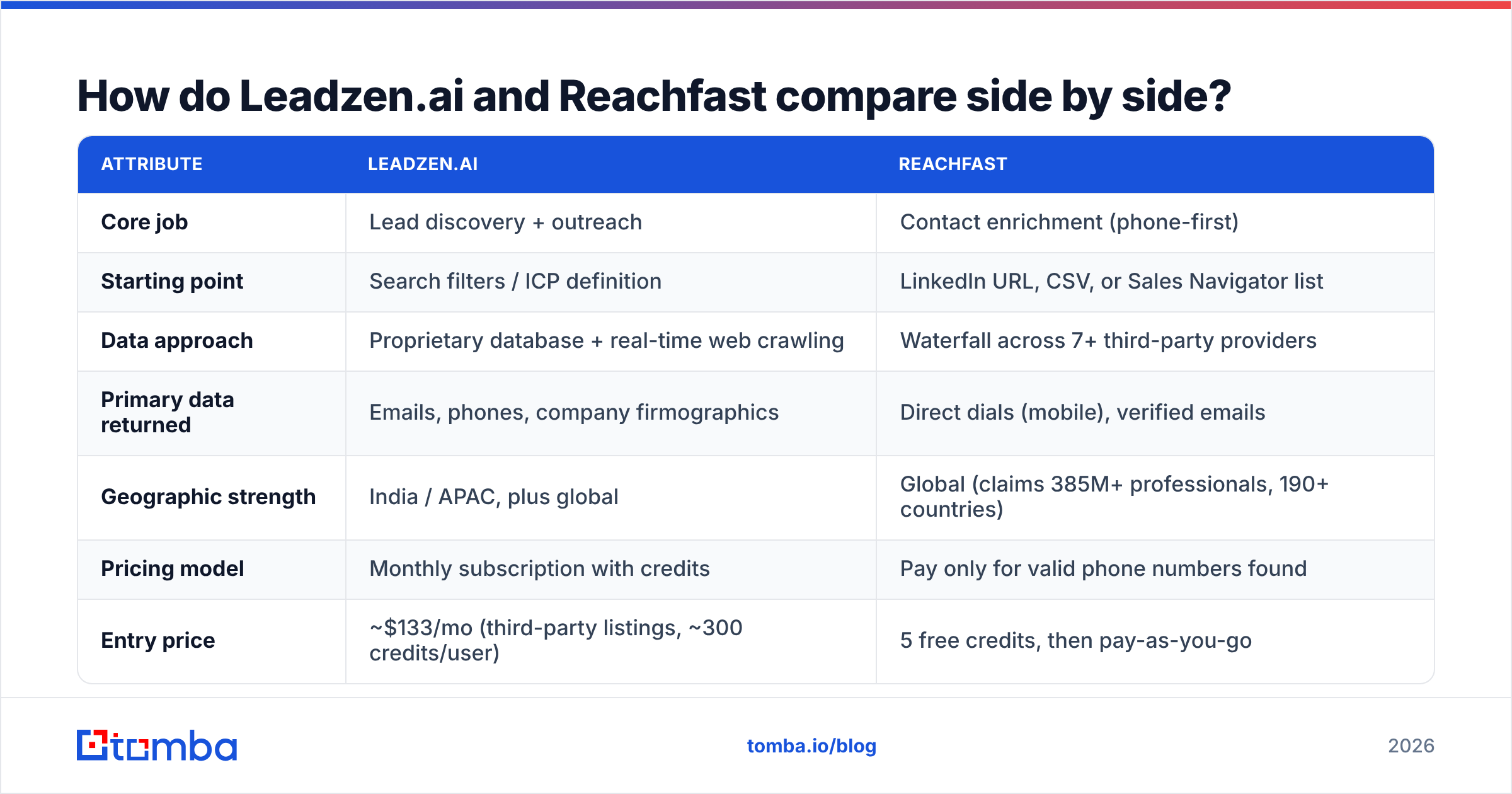
How do Leadzen.ai and Reachfast compare side by side?#
Here is the practical comparison. Pricing is based on public listings and vendor sites as of 2026. Both vendors change plans often, so confirm on their pricing pages before you buy.
| Attribute | Leadzen.ai | Reachfast |
|---|---|---|
| Core job | Lead discovery + outreach | Contact enrichment (phone-first) |
| Starting point | Search filters / ICP definition | LinkedIn URL, CSV, or Sales Navigator list |
| Data approach | Proprietary database + real-time web crawling | Waterfall across 7+ third-party providers |
| Primary data returned | Emails, phones, company firmographics | Direct dials (mobile), verified emails |
| Geographic strength | India / APAC, plus global | Global (claims 385M+ professionals, 190+ countries) |
| Pricing model | Monthly subscription with credits | Pay only for valid phone numbers found |
| Entry price | ~$133/mo (third-party listings, ~300 credits/user) | 5 free credits, then pay-as-you-go |
| Free option | Limited trial | 5 free credits |
| Outreach built in | Yes: email, LinkedIn, WhatsApp, calling | No, export to your dialer/sequencer |
| Chrome / LinkedIn extension | Yes | Yes (LinkedIn-based lookups) |
| Best for | SMB teams that need to build lists | SDR teams that need to call existing lists |
The table points to one clear dividing line. Leadzen.ai wins on breadth of workflow: search, signals, enrichment, and outreach in one tool. Reachfast wins on depth of a single output: getting a working mobile number for a specific person.
How does each tool actually work in a real workflow?#
The day-to-day steps matter more than feature checklists, because they decide how much of your SDRs' time each tool saves. Here is a typical flow for each.
Leadzen.ai workflow
- Define your ICP with filters. Pick industry, headcount, geography, funding stage, and job titles in the Leadzen.ai search interface.
- Use signals to prioritize. The trending section shows recently funded companies and active investors, which is useful when you sell to startups that just raised.
- Bulk-reveal contacts. Spend credits to unlock emails and phone numbers for the shortlisted people.
- Launch outreach from inside the platform. Send emails, LinkedIn touches, or WhatsApp messages without switching tools.
- Export to your CRM for anything the built-in outreach doesn't cover.
Reachfast workflow
- Build the list elsewhere. Usually in LinkedIn Sales Navigator, where your targeting already lives.
- Push the list into Reachfast through the extension, a CSV upload, or the API.
- Let the waterfall run. Reachfast checks provider after provider until it finds a match, then verifies the result.
- Pay only for hits. Profiles with no valid phone number don't use paid credits.
- Export to your dialer or sequencer (Aircall, Orum, Outreach, Instantly, and similar tools).
The difference is where your targeting happens. With Leadzen.ai, targeting happens inside the tool. With Reachfast, targeting happens before the tool, usually in Sales Navigator, which is a separate cost (Sales Navigator Core typically runs around $99/user/month billed annually).
Which has better data accuracy: Leadzen.ai or Reachfast?#
It depends on the data type and the region.
For phone numbers, Reachfast has the structural advantage. Waterfall enrichment is built for phones. Mobile-number coverage is uneven across providers, so querying 7+ sources in sequence raises the match rate compared with any single database. Reachfast also markets a strong accuracy guarantee and charges only for valid numbers, so its business model only works if the numbers connect. That aligns its incentives with yours.
For Indian and APAC company data, Leadzen.ai has the edge. Its firmographics draw on registry-grade company data and real-time crawling, which usually beats global aggregators on Indian SMBs, startups, and private companies that Western databases cover poorly.
For emails, neither is purpose-built. Reachfast returns emails as a by-product of phone enrichment. Leadzen.ai returns them as part of a broader profile. If email is your main channel, run every exported address through a dedicated email verifier before sequencing, whichever tool you choose. A bounce rate above roughly 2% is enough to start hurting your sender reputation, and "verified at export time" data goes stale as people change jobs.
Some caveats on the accuracy claims:
- Guarantees are usually refunds, not outcomes. A "100% accuracy guarantee" typically means you get credits back for bad data. It doesn't mean every number connects.
- Freshness beats volume. A 385M-profile database isn't worth much if the records are 18 months old. Test on 100 contacts you can check yourself before you commit budget.
- Regional coverage varies a lot. Neither vendor publishes per-country match rates. Test in your actual target markets.
How much do Leadzen.ai and Reachfast cost?#
The two pricing models reward different buying behavior.
Leadzen.ai: subscription plus credits. Third-party software directories list three tiers: Standard at about $133/month (300 credits per user), Starter at about $400/month (1,100 credits per user), and Growth at about $800/month (2,600 credits per user), with custom enterprise pricing on top. Figures differ across listings and may reflect currency conversion, so check the current plans on the vendor site or G2. On the Standard tier you pay roughly $0.44 per credit, and the per-credit cost drops on higher tiers.
Reachfast: pay per valid result. You start with 5 free credits and then buy credits that are consumed only when a valid phone number comes back. Emails are bundled or free depending on the plan. This makes cost per connected contact predictable, which is the number phone-heavy teams actually care about.
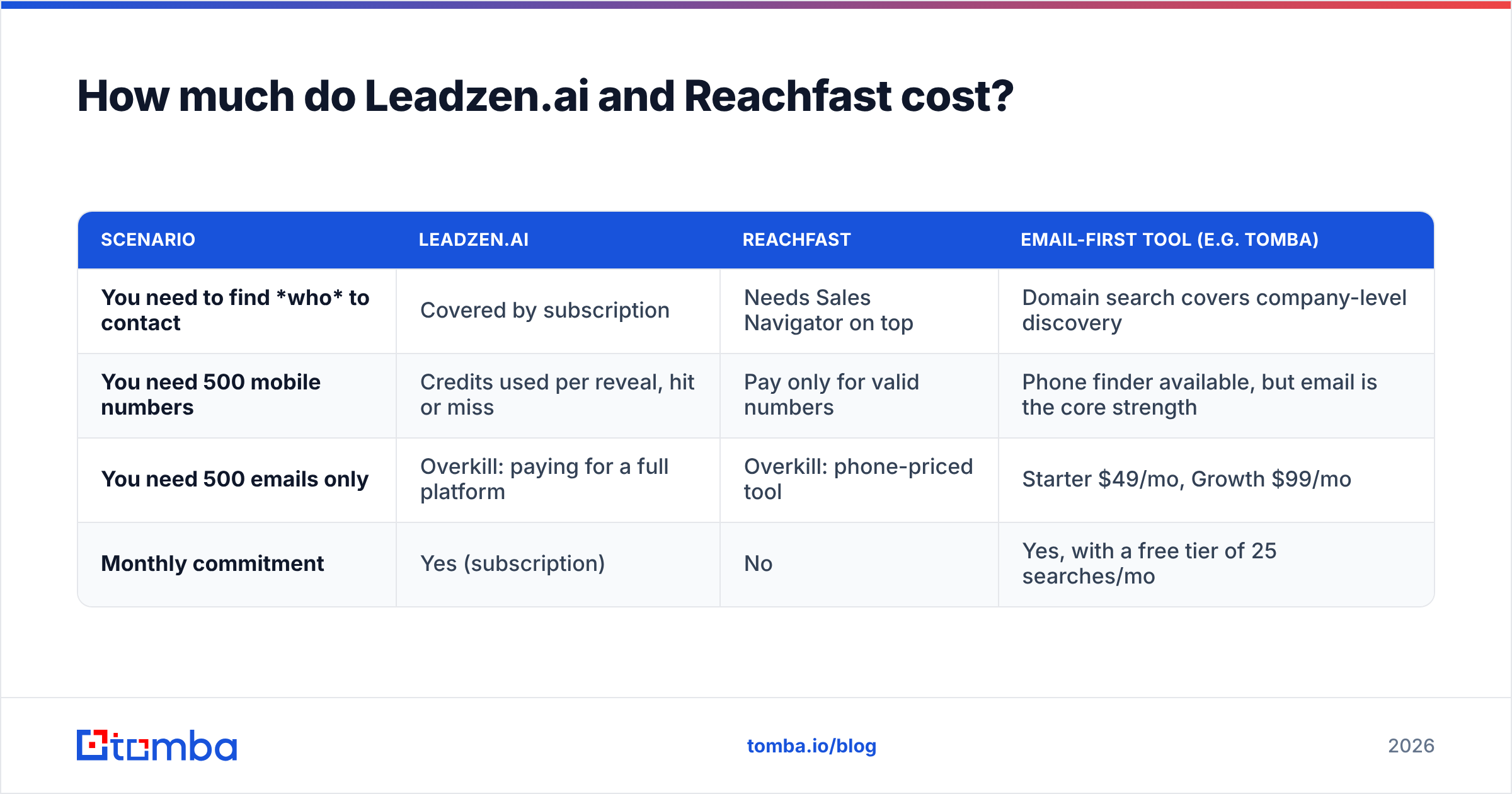
A worked example makes the difference concrete. Say you need 500 reachable contacts per month:
| Scenario | Leadzen.ai | Reachfast | Email-first tool (e.g. Tomba) |
|---|---|---|---|
| You need to find who to contact | Covered by subscription | Needs Sales Navigator on top | Domain search covers company-level discovery |
| You need 500 mobile numbers | Credits used per reveal, hit or miss | Pay only for valid numbers | Phone finder available, but email is the core strength |
| You need 500 emails only | Overkill: paying for a full platform | Overkill: phone-priced tool | Starter $49/mo, Growth $99/mo |
| Monthly commitment | Yes (subscription) | No | Yes, with a free tier of 25 searches/mo |
If your motion is mostly email, both tools can cost more than you need to spend. See the Tomba pricing page for a cheaper email-first baseline.
Which one should you choose for your team?#
Use the decision rules below. Each one maps to a specific team profile, not to a general "better/worse" ranking.
- Choose Leadzen.ai if you sell into India or APAC SMBs. Its registry-backed firmographics and startup-funding signals are hard to replicate with global tools.
- Choose Leadzen.ai if you want one tool for search and outreach. A three-person sales team with no RevOps support will benefit from not having to connect four tools.
- Choose Reachfast if cold calling is your main channel. Phone-first waterfall enrichment and pay-per-valid-number pricing fit this motion.
- Choose Reachfast if you already live in Sales Navigator. It enriches the lists you've built without asking you to rebuild your targeting elsewhere.
- Choose neither if your outbound is email-led. An email-first finder plus verifier will cost less and do the one job you need.
- Combine tools if you run multichannel at scale. Many teams pair a discovery database with a phone enricher and a separate email verification step.
What are the pros and cons of each tool?#
Leadzen.ai: pros
- Discovery, enrichment, and outreach in one platform
- Strong coverage of Indian companies, startups, and investors
- Useful buying signals (funding rounds, trending companies)
- Multichannel outreach, including WhatsApp, which matters in markets where WhatsApp is the default business channel
Leadzen.ai: cons
- Subscription commitment even in slow months
- Relatively high entry price for solo users and very small teams
- Coverage in North America and Europe is less proven than in India/APAC
- Credits are spent on reveals whether or not the contact turns out to be reachable
Reachfast: pros
- Waterfall across 7+ providers improves phone match rates
- You pay only for valid numbers, so there's no waste on misses
- No long-term contract
- Fits cleanly into a Sales Navigator workflow
Reachfast: cons
- No built-in prospecting database: you need a list first
- No native outreach, so you need a dialer and a sequencer
- Email is secondary to phone
- Sales Navigator dependency adds a separate per-seat cost
Where does an email-first tool like Tomba fit in?#
To keep this neutral: Tomba doesn't replace Leadzen.ai's India-focused discovery database, and its phone data isn't built around a multi-provider mobile waterfall the way Reachfast's is. If those are your main needs, pick the matching tool above.
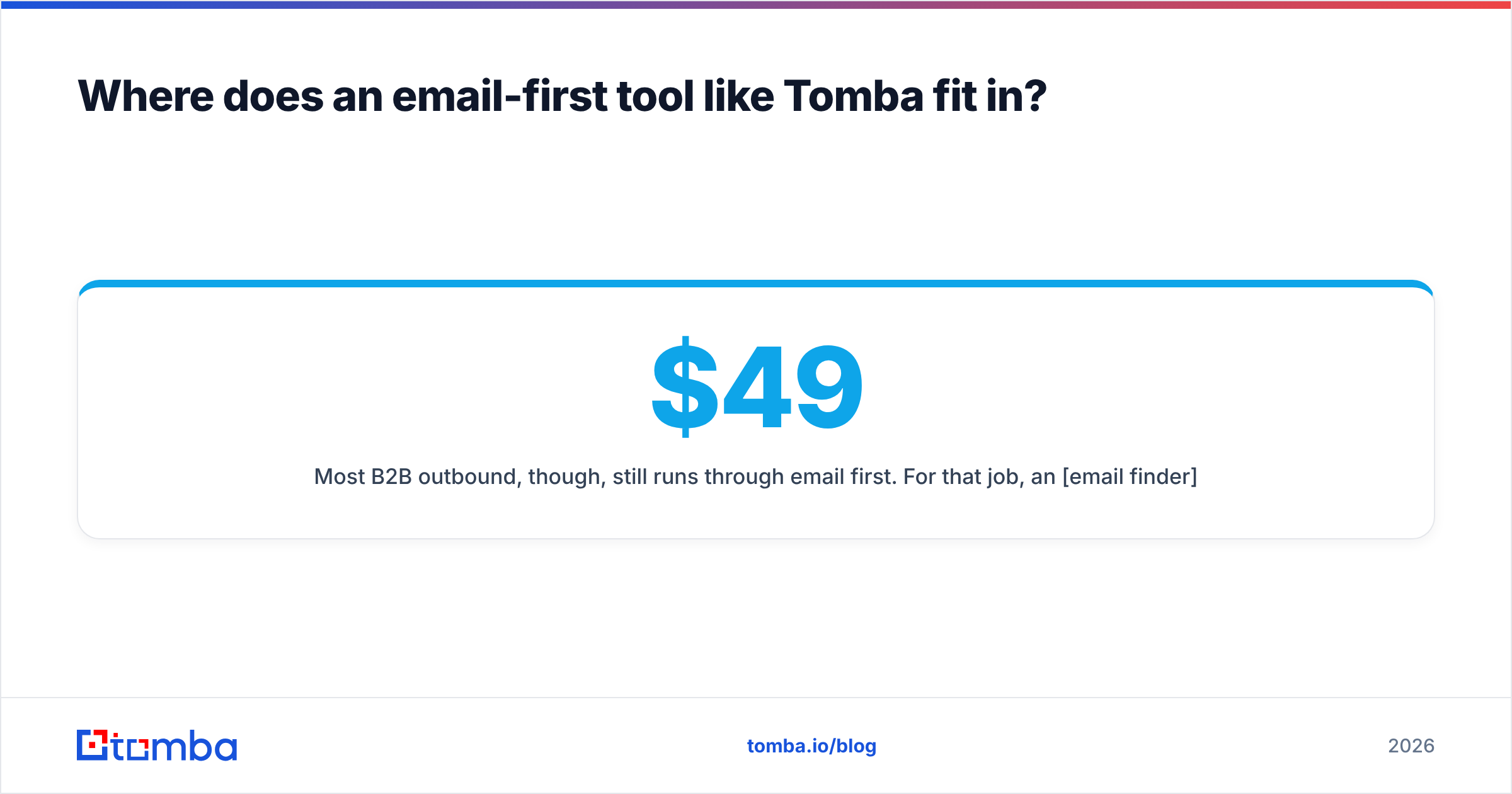
Most B2B outbound, though, still runs through email first. For that job, an email finder that takes a name plus a company domain, returns the address with a confidence score and sources, and verifies it in the same step covers most of the work at a lower cost. Tomba also has a phone finder for the occasional direct dial, plus domain search, catch-all verification, and enrichment, with pricing that starts free (25 searches/month) and moves to $49, $99, and $249 per month.
A common stack for cost-conscious teams:
- Discovery: Sales Navigator, or Leadzen.ai for India-focused ICPs
- Emails: Tomba finder and verifier
- Phones, for high-value accounts only: Reachfast or a similar waterfall enricher
This way you only pay phone-level prices on the accounts that justify a call.
Frequently asked questions#
Is Leadzen.ai better than Reachfast?#
Neither is better overall. Leadzen.ai is better for finding and prioritizing new leads, especially in India and APAC. Reachfast is better for getting working mobile numbers for a list you already have.
Does Reachfast have a free plan?#
Reachfast gives new users 5 free credits to test the service. After that, you buy credits, and they're consumed only when a valid phone number is found.
Does Leadzen.ai include outreach?#
Yes. Leadzen.ai includes multichannel outreach across email, LinkedIn, WhatsApp, and calling, so you can prospect and engage without exporting to a separate sequencer.
Can I use both tools together?#
Yes. A practical setup is to use Leadzen.ai for discovery and signals, export the shortlist, and run the highest-value contacts through Reachfast for direct dials. Verify emails separately before you sequence them.
What is the cheapest option for verified B2B emails?#
For email-only outreach, a dedicated email finder with built-in verification is usually cheaper than either platform. Tomba's paid plans start at $49/month, and there's a free tier for testing.
What's the bottom line?#
Choose Leadzen.ai if you need to find the right accounts, especially Indian and APAC SMBs, and want outreach in the same tool. Choose Reachfast if you already have the list and need phone numbers that connect, paying only for hits. If your pipeline mostly runs on email, you can skip the phone-priced tooling. Start with the Tomba Email Finder: enter a name and a company domain, get a verified professional email with its sources, and test it on the free tier before you commit to any subscription.
Related guides#
// get started
Find, verify and enrich your first contacts today
Start on the free plan with 25 searches a month, then scale when your team is ready.
Free plan · No credit card required · GDPR & CCPA
Get the Tomba newsletter
Product and data updates
// about the author