Leadzenai vs Salesbot: Honest 2026 Comparison for B2B Outbound
Leadzen.ai is built for India-heavy, multichannel prospecting. Salesbot is a cheaper AI outbound autopilot. Here's how they compare on data, workflow, and real cost, plus what to check before you commit.
TL;DR
- Leadzen.ai is an AI lead discovery and enrichment platform built mainly for Indian B2B sales teams. It has a LinkedIn Chrome extension and multichannel outreach, including WhatsApp and calling. Listed pricing starts around $133/month per user.
- Salesbot is an AI outbound tool for SDR teams and agencies. It combines lead research, list building, and personalized outreach. Its listed plans start at $49/month.
- If most of your pipeline is in India, or your buyers answer WhatsApp more than email, pick Leadzen.ai. If you sell into global SMB and mid-market, want a lower entry price, and have a small team, pick Salesbot.
- Neither tool removes the need to verify emails before sending. Budget for a separate verification step whichever one you choose.
- If you mainly need accurate professional emails and don't need a full outbound suite, a dedicated email finder is usually cheaper and simpler than either.
Search for "leadzenai vs salesbot" and you'll mostly find vendor pages and directory listings that repeat each other's feature lists. This comparison covers what actually changes your results: whose data you get, which channels you can reach prospects on, how the pricing behaves once you add seats, and where each tool will frustrate you.
A note on sources: pricing and feature details come from each vendor's public materials and from listings on software directories such as Capterra as of September 2026. Both vendors change packaging often, so confirm current numbers on their sites before you sign anything.
What is Leadzen.ai?#
Leadzen.ai describes itself as an AI lead generation platform. In practice it does three things:
- Lead discovery. You filter a B2B contact database by industry, role, company size, and location. The location filters go down to postal code, which helps teams doing territory-based selling.
- Contact enrichment. A Chrome extension shows verified emails, phone numbers, and AI-generated "buyer intelligence" summaries while you browse LinkedIn profiles.
- Multichannel outreach. Email, LinkedIn messaging, WhatsApp, and calling all run from the same platform.
Leadzen is clearly aimed at India. Its own content talks about solving "India's SDR productivity problem," and its data coverage and channel mix reflect that. WhatsApp outreach is the clearest example. Most Western-built tools treat WhatsApp as an afterthought. In Indian B2B sales it's often the channel that actually gets replies.
Pricing is harder to pin down. Directory listings show editions from about $133/month per user up to roughly $800/month, and some third-party reviews quote much higher enterprise tiers. Leadzen also offers custom pricing tied to usage, and in some packages to qualified meetings delivered. Expect to talk to sales before you get a firm number.
What is Salesbot?#
Salesbot (app.salesbot.cloud) is built for teams and agencies that want to automate outbound prospecting from start to finish. Its pitch is an AI SDR assistant:
- AI lead research. It finds prospects that match your ICP and surfaces context you can use to personalize messages.
- List building. It pulls verified emails and phone numbers into outreach-ready lists.
- Personalized outreach. It drafts and sends first-touch messages using that research.
- Lead management. It has lightweight pipeline tracking, so small teams can run outbound without a full CRM.
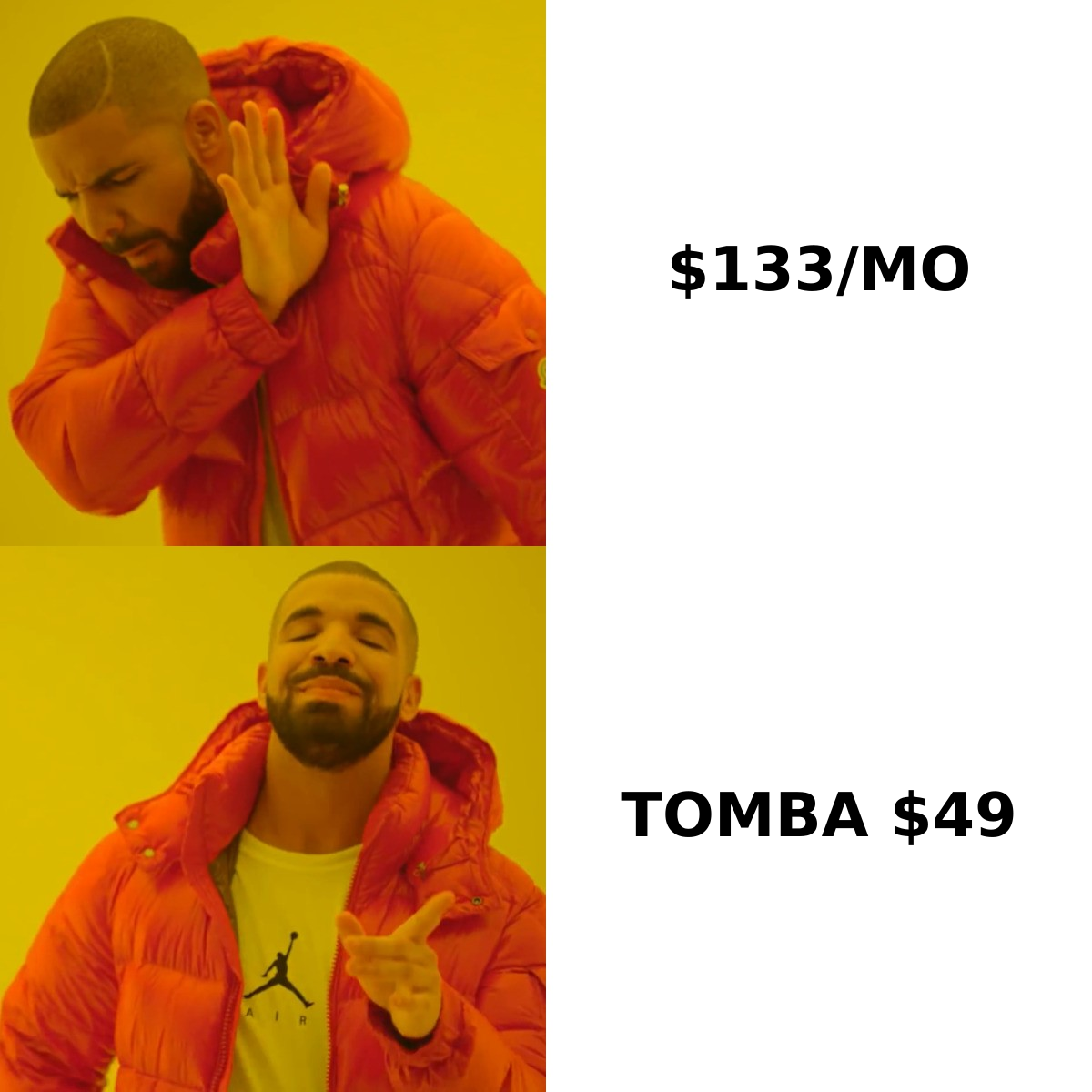
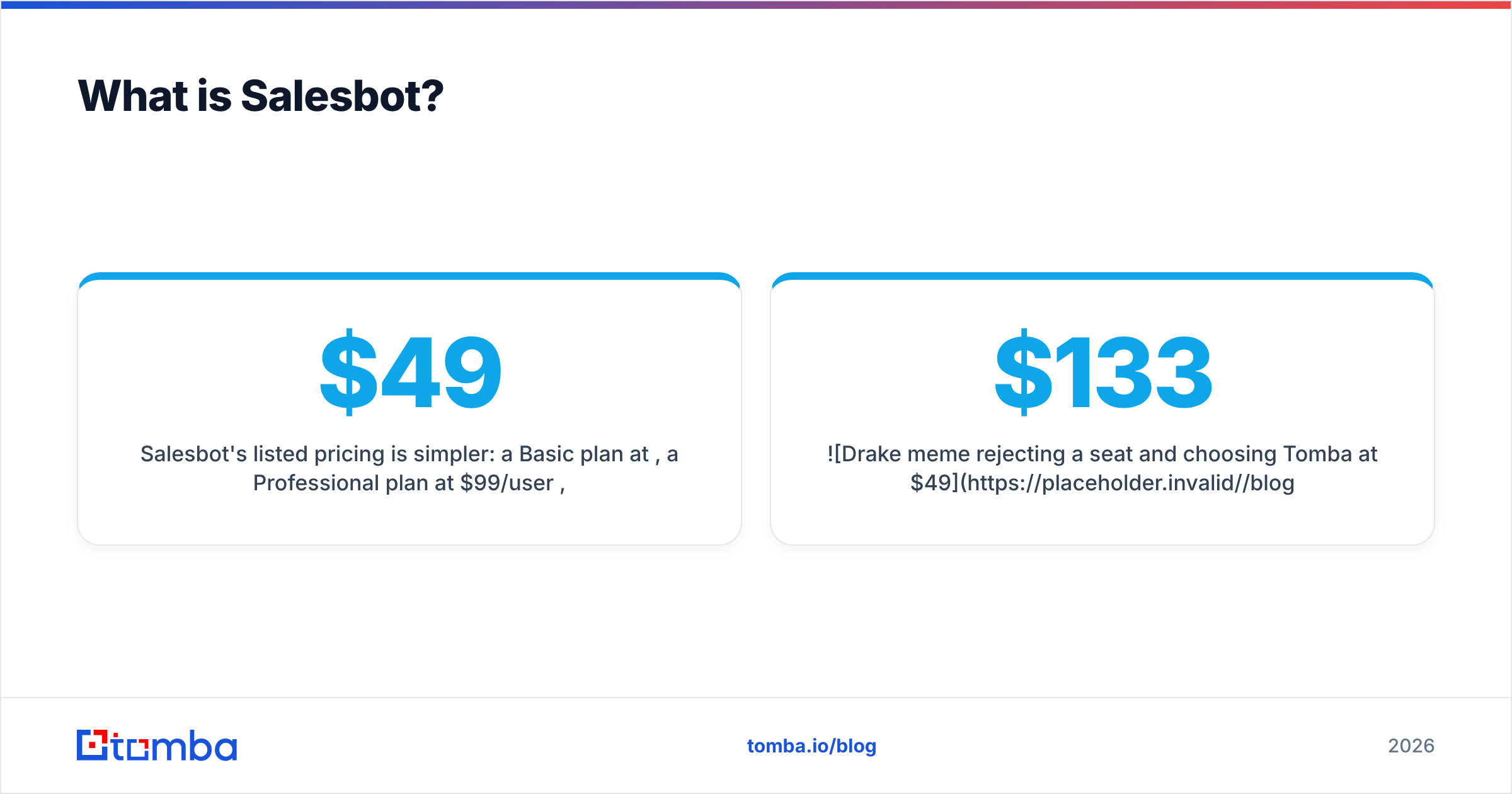
Salesbot's listed pricing is simpler: a Basic plan at $49/month, a Professional plan at $99/user/month, and custom Enterprise pricing. For a solo founder or a two-person SDR team, that's a much lower starting cost than Leadzen.
Salesbot doesn't market itself around any one region. It's positioned as a general AI outbound tool, so your results depend on how well its underlying data covers your specific market.
How do Leadzen.ai and Salesbot compare feature by feature?#
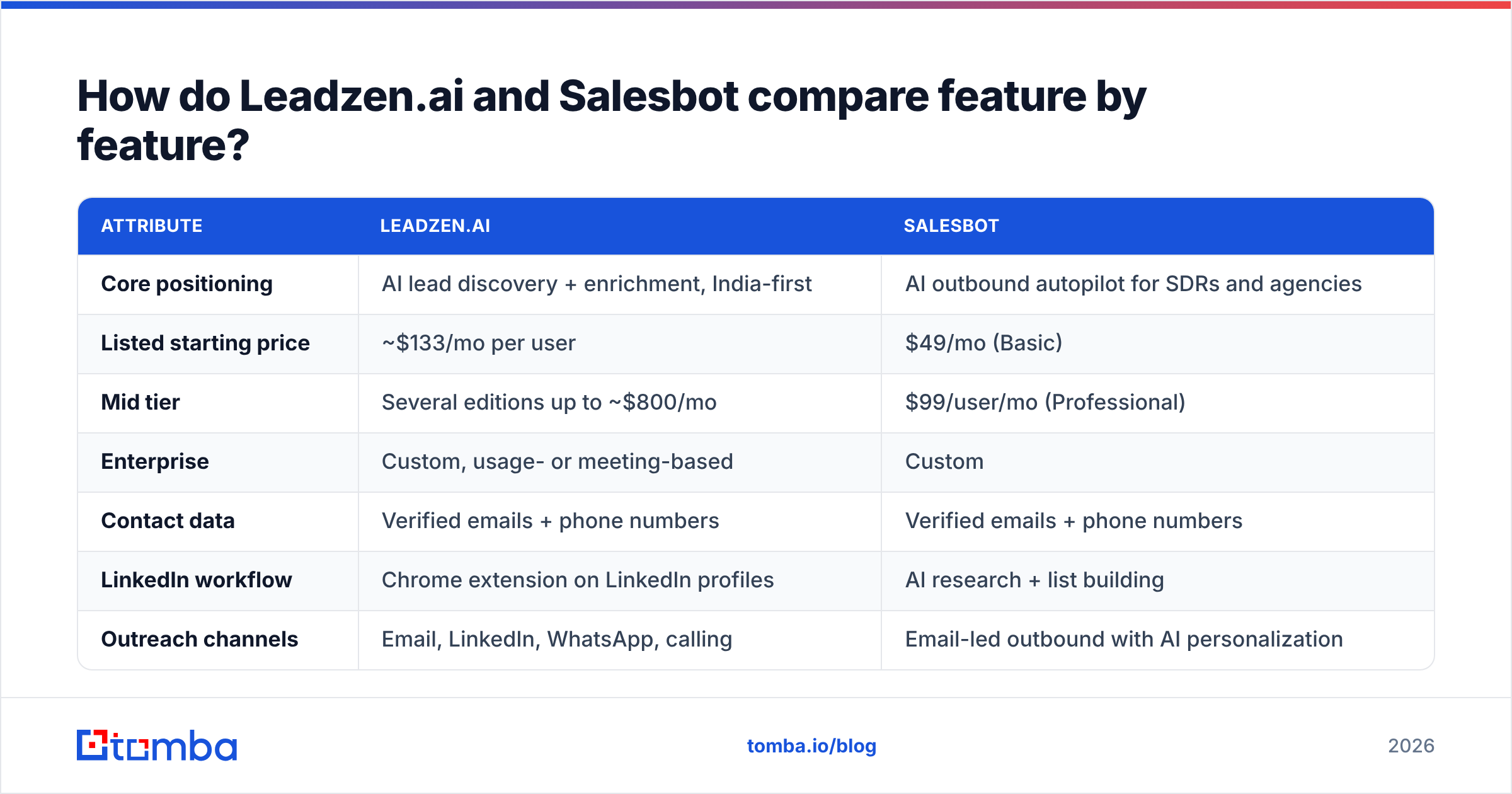
Here's the head-to-head on the attributes that matter most when choosing:
| Attribute | Leadzen.ai | Salesbot |
|---|---|---|
| Core positioning | AI lead discovery + enrichment, India-first | AI outbound autopilot for SDRs and agencies |
| Listed starting price | ~$133/mo per user | $49/mo (Basic) |
| Mid tier | Several editions up to ~$800/mo | $99/user/mo (Professional) |
| Enterprise | Custom, usage- or meeting-based | Custom |
| Contact data | Verified emails + phone numbers | Verified emails + phone numbers |
| LinkedIn workflow | Chrome extension on LinkedIn profiles | AI research + list building |
| Outreach channels | Email, LinkedIn, WhatsApp, calling | Email-led outbound with AI personalization |
| Geo targeting | Down to postal code | Standard firmographic filters |
| Built-in lead management | Basic | Lightweight pipeline/CRM features |
| Best-fit region | India and South Asia | Global SMB / mid-market |
| Standalone email verification | Not the core product | Not the core product |
Two things stand out.
First, the tools solve different bottlenecks. Leadzen is strongest at finding and reaching people in a market where email alone isn't enough. Salesbot is strongest at automating the SDR's day: research, drafting, and sending.
Second, the pricing works differently. Salesbot's per-seat pricing is easy to predict. Leadzen's editions and custom deals can suit a team that wants meetings instead of raw data, but you can't easily compare costs before a sales call.
Which tool has better data coverage?#
It depends on who you're selling to, and this matters more than any feature on the list.
For Indian prospects, Leadzen has the advantage. Its database, phone coverage, and postal-code targeting are built for that market. Mobile numbers in particular are much more useful when your buyers pick up calls and reply on WhatsApp.
For North American and European prospects, neither vendor publishes independent accuracy benchmarks, so be careful with any claimed percentage. Salesbot's general positioning makes it a more natural choice for global outbound, but that's an inference from how it's positioned, not proof of better data.
The practical way to decide is a small, controlled test:
- Build a test list of 100 known contacts in your ICP. These should be people whose real emails you already have from past deals or your CRM.
- Run the list through both tools and record the hit rate: how many contacts came back with an email at all.
- Check accuracy against your known-good emails: how many of the returned emails were correct.
- Run everything through a separate email verifier and count invalid and catch-all results.
- Send a small warm campaign (under 50 emails per inbox) and track bounces.
This takes an afternoon and tells you more than any marketing page. Bounce rate is what protects your email deliverability, and a vendor's own "verified" label doesn't guarantee a low one. Mailbox providers such as Google publish sender guidelines that reward low bounce and complaint rates. A 5–8% bounce rate from a bad list can damage a domain you've spent weeks warming up.
How do the outreach workflows differ in practice?#
The data is only half the value. The other half is what your reps do all day.
A day with Leadzen.ai usually starts in LinkedIn. A rep opens a prospect's profile, the Chrome extension shows contact details and an AI summary, and the rep sends a sequence that might combine an email, a LinkedIn connection request, a WhatsApp message, and a call. That works well for relationship-heavy sales in markets where people expect several touchpoints. The downside is complexity: more channels means more to set up, more compliance questions (WhatsApp business messaging has its own rules), and more ways for reps to be inconsistent.
A day with Salesbot is closer to reviewing than prospecting. The AI researches prospects, builds the list, and drafts personalized openers. The rep's main job is quality control: approving, editing, and handling replies. For small teams this saves a lot of time. The risk is common to every AI outbound tool. If you don't review the output, "personalized" messages start to look alike, and reply rates fall.
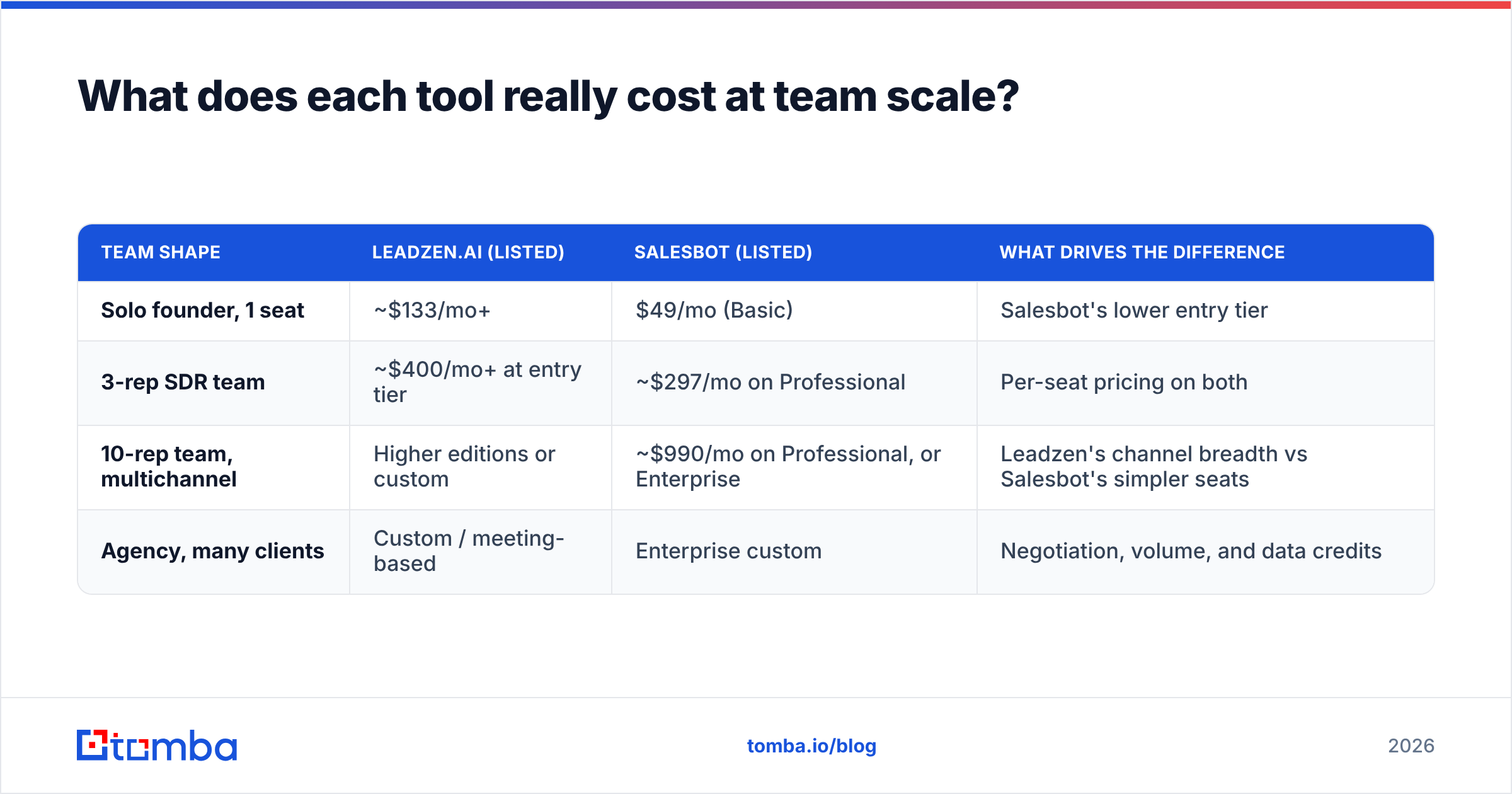
What does each tool really cost at team scale?#
Entry prices don't tell you much. Here's a rough cost picture based on listed pricing for three common team shapes. Treat the numbers as directional and confirm them with each vendor.
| Team shape | Leadzen.ai (listed) | Salesbot (listed) | What drives the difference |
|---|---|---|---|
| Solo founder, 1 seat | ~$133/mo+ | $49/mo (Basic) | Salesbot's lower entry tier |
| 3-rep SDR team | ~$400/mo+ at entry tier | ~$297/mo on Professional | Per-seat pricing on both |
| 10-rep team, multichannel | Higher editions or custom | ~$990/mo on Professional, or Enterprise | Leadzen's channel breadth vs Salesbot's simpler seats |
| Agency, many clients | Custom / meeting-based | Enterprise custom | Negotiation, volume, and data credits |
Watch for these hidden costs with either tool:
- Credit limits. Contact reveals are usually metered. Check how many emails and phone numbers each seat actually includes per month.
- Verification. Neither is a dedicated verification platform, so plan for a separate verifier, especially for catch-all domains.
- Sending infrastructure. Multichannel or AI outbound still needs warmed-up domains and inboxes, which cost extra.
- CRM sync. Confirm native sync with your CRM before you buy, not after.
Is Leadzen.ai better than Salesbot?#
For the right team, yes. For the wrong one, no. Here's the short version.
Choose Leadzen.ai if:
- India is your primary market. Its data coverage, phone numbers, and geo targeting fit that market better.
- Your buyers reply on WhatsApp and phone. Leadzen treats these as main channels, not add-ons.
- You sell by territory. Postal-code-level targeting is uncommon and useful for field sales.
- You'd rather pay for meetings than data. Some of Leadzen's packages are tied to outcomes, which can suit a lean team.
Choose Salesbot if:
- You want a low entry price. $49/month is easy to justify for a trial.
- You're a small team that needs AI to do the SDR groundwork. Research, list building, and first drafts all happen in one place.
- Your market is global SMB or mid-market. Salesbot doesn't depend on a regional data focus.
- You want predictable per-seat billing. It's easier to forecast and explain to finance.
Consider neither if your real problem is simply getting accurate business emails for people you've already chosen to contact. In that case a full AI outbound suite adds cost and complexity you don't need.
Where does a dedicated email finder fit into this stack?#
Many teams comparing Leadzen.ai and Salesbot are really trying to fix one thing: "We can't reliably get the right email for the right person." The multichannel and AI-writing features are appealing, but if the email is wrong, the rest of the sequence doesn't matter.
A dedicated email finder handles that single job. With Tomba Email Finder, you enter a name and company domain and get a professional email address with a confidence score and the public sources it was found on. For account-based work, domain search lists every publicly associated email at a company, which is useful when you're mapping a buying committee instead of targeting one person.
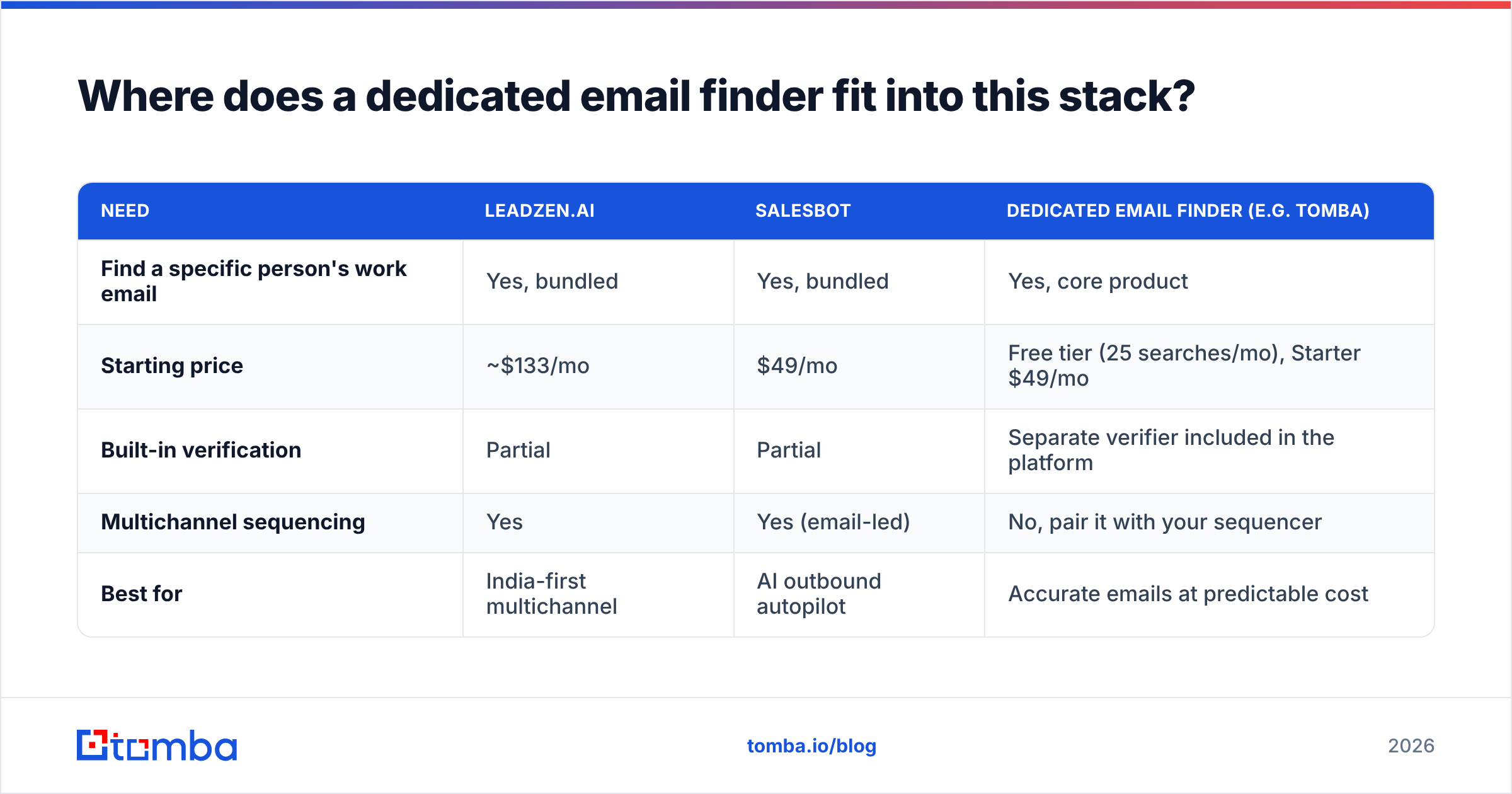
Here's how it compares on the one job both suites also do:
| Need | Leadzen.ai | Salesbot | Dedicated email finder (e.g. Tomba) |
|---|---|---|---|
| Find a specific person's work email | Yes, bundled | Yes, bundled | Yes, core product |
| Starting price | ~$133/mo | $49/mo | Free tier (25 searches/mo), Starter $49/mo |
| Built-in verification | Partial | Partial | Separate verifier included in the platform |
| Multichannel sequencing | Yes | Yes (email-led) | No, pair it with your sequencer |
| Best for | India-first multichannel | AI outbound autopilot | Accurate emails at predictable cost |
The trade-off is simple. A dedicated finder won't write your emails or send WhatsApp messages. But you can plug it into whatever sequencer you already use, whether that's Instantly, Lemlist, HubSpot, or even Salesbot itself. Many teams run a finder alongside an outbound tool, not instead of one. Check Tomba pricing against your monthly lookup volume to see where it fits.
How should you run your own Leadzen.ai vs Salesbot trial?#
Don't decide from a demo. Run a two-week bake-off:
- Define one ICP segment, for example "Heads of Finance at 50–500 employee SaaS companies."
- Pull 200 prospects from each tool using the same filters.
- Verify every email with the same third-party verifier, and log valid, invalid, and catch-all rates.
- Run identical 3-step sequences from separate warmed inboxes. Track bounce rate, response rate, and meetings booked.
- Time your reps. Measure how many minutes it takes to get from "empty list" to "sequence live" in each tool.
- Calculate cost per meeting, not cost per seat. That's the number that matters.
At the end of two weeks you'll have a clear answer based on your own market, not a vendor's claims.
Frequently asked questions#
Is Leadzen.ai only for India? No, but India is clearly its focus. Its data coverage, channel mix (WhatsApp and calling), and marketing are all built around Indian B2B sales. Teams selling mostly into the US or EU should test coverage carefully first.
Does Salesbot have a free plan? Its public listings show paid plans starting at $49/month for Basic, with Professional at $99/user/month and custom Enterprise. Check the vendor site for any current trial.
Can I use Salesbot or Leadzen.ai without a separate email verifier? You can, but it's risky. Both return "verified" contacts, but catch-all domains and job changes still cause bounces. A separate verification pass before large sends protects your sender reputation.
Which is better for agencies? Salesbot's per-seat model and AI automation suit agencies running outbound for several clients in global markets. Leadzen suits agencies serving Indian clients or running multichannel campaigns in South Asia.
The bottom line#
Leadzen.ai and Salesbot are both capable tools built for different teams. Leadzen is the stronger choice for India-first, multichannel prospecting where phone and WhatsApp matter as much as email. Salesbot is the more accessible AI outbound tool for small global teams that want research, list building, and first drafts handled for them at a lower entry price.
If the problem you're really trying to solve is getting the right email for the right person, start with the data layer. Tomba Email Finder finds professional email addresses by name, domain, or company, shows the public sources behind each result, and includes verification in the same platform. The free tier gives you 25 searches a month, and paid plans start at $49/month. Use it on its own or connect it to whichever outbound tool wins your bake-off.
Related guides#
// get started
Find, verify and enrich your first contacts today
Start on the free plan with 25 searches a month, then scale when your team is ready.
Free plan · No credit card required · GDPR & CCPA
// about the author