LeadzenAI vs Salesgenie (2026): Which B2B Lead Database Wins?
One is an AI-first lead platform built around Indian markets. The other is a US data veteran backed by Data Axle. Here is which one fits your territory, budget, and outbound motion.
TL;DR
- Pick based on territory first. Salesgenie (now sold as Data Axle Genie) is built on US and Canadian business and consumer data. LeadzenAI is built for Indian sales teams and Indian company data. If you pick the one that doesn't cover your market, nothing else in this comparison will matter.
- Salesgenie has clearer published pricing. Reported plans run from $99 to $299/month on a 12-month contract. LeadzenAI's pricing is harder to pin down, with a Standard tier reported around $133/month and much higher enterprise editions.
- LeadzenAI handles more of the outreach itself. It crawls the web in real time and supports outreach over email, LinkedIn, WhatsApp, and calling. Salesgenie is mainly a list-building database with some light CRM features.
- Both leave you with a verification job. Neither tool removes the need to verify emails before you send, especially on catch-all domains.
- If you only need verified work emails, a dedicated email finder is usually cheaper than paying for a full lead database.
What is the real difference between LeadzenAI and Salesgenie?#
These two tools look alike on a feature checklist and turn out to be very different once you use them. Each one sells you access to contacts: names, companies, emails, phone numbers. Where they differ is the market they cover, where the data comes from, and what you're meant to do with a list once you've built it.
Salesgenie is the self-serve product from Data Axle, the company formerly called Infogroup, which has compiled US business listings for decades. Its strength is breadth across small and mid-sized US businesses. It covers local plumbers, dental practices, regional distributors and single-location retailers, the kind of companies that are thin or missing in LinkedIn-scraped databases. It also sells consumer data, which most B2B tools don't.
LeadzenAI is a newer platform built around AI search and real-time web crawling. It is aimed at startups and SMEs, and much of its positioning targets Indian SDR teams. That includes Indian company-registry (MCA) data, a trending-leads feed of recently funded companies and active angel investors, and outreach channels such as WhatsApp that Indian B2B buyers actually use.
The simplest way to frame the difference: Salesgenie works like a very large, well-kept phone book for North America, and LeadzenAI works like a research assistant that goes out and finds prospects while you watch. Which one suits you depends on who your buyers are and how you contact them.
How do LeadzenAI and Salesgenie compare feature by feature?#
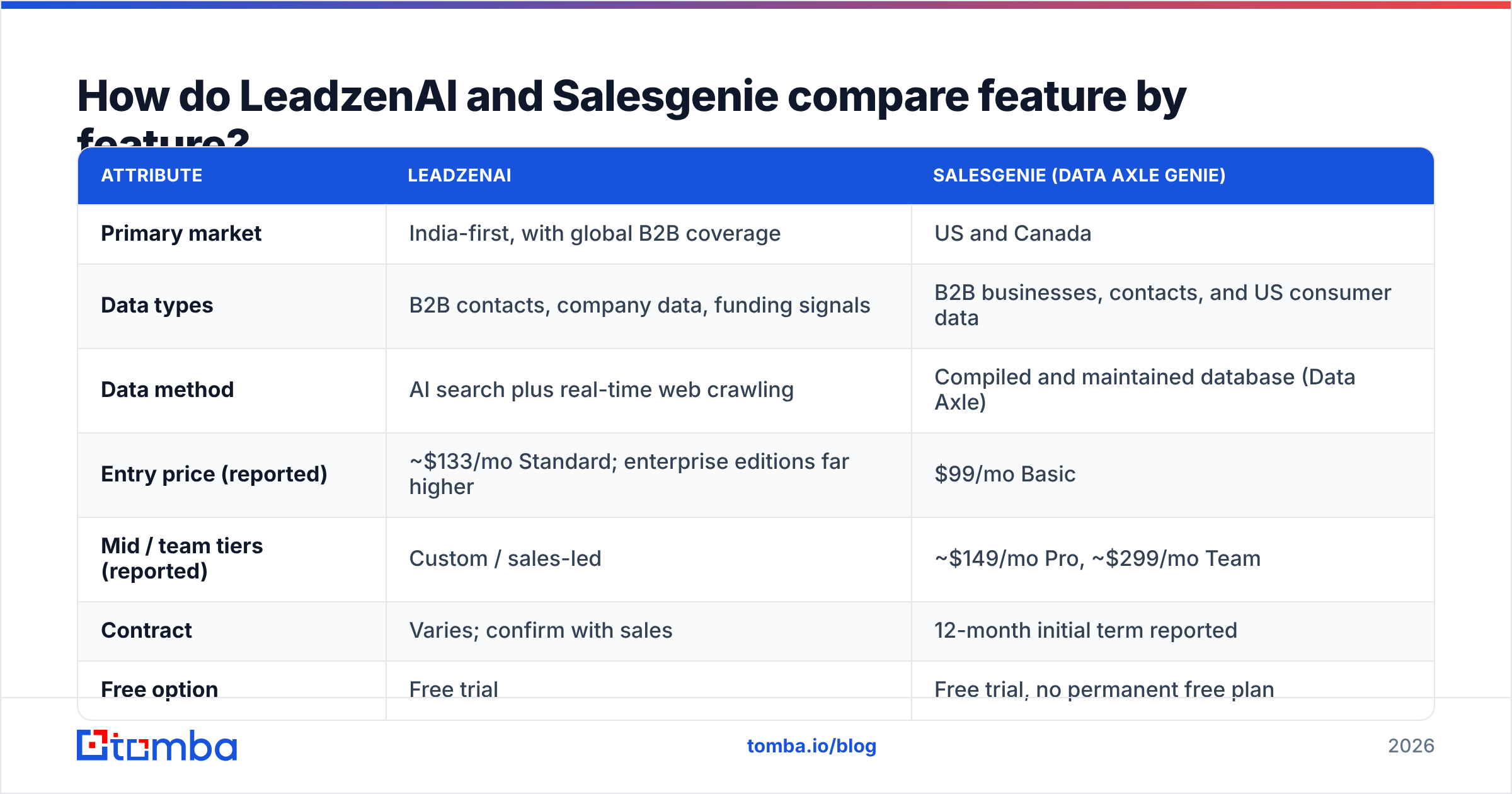
Here is a side-by-side view of the attributes that matter most when choosing between them. Pricing figures come from public listings and review sites as of 2026. Both vendors change packaging often, so confirm with sales before you sign anything.
| Attribute | LeadzenAI | Salesgenie (Data Axle Genie) |
|---|---|---|
| Primary market | India-first, with global B2B coverage | US and Canada |
| Data types | B2B contacts, company data, funding signals | B2B businesses, contacts, and US consumer data |
| Data method | AI search plus real-time web crawling | Compiled and maintained database (Data Axle) |
| Entry price (reported) | ~$133/mo Standard; enterprise editions far higher | $99/mo Basic |
| Mid / team tiers (reported) | Custom / sales-led | ~$149/mo Pro, ~$299/mo Team |
| Contract | Varies; confirm with sales | 12-month initial term reported |
| Free option | Free trial | Free trial, no permanent free plan |
| Chrome / LinkedIn extension | Yes | Limited; web app is the core |
| Built-in outreach | Email, LinkedIn, WhatsApp, calling | Basic email and list tools, light CRM |
| Best for | Indian SDR teams, startup prospecting, funded-company targeting | US SMB and local-business prospecting, consumer lists |
| Main drawback | Pricing is hard to understand; weaker North American SMB depth | Annual lock-in; add-ons can push the real cost well above list price |
Which tool has better data coverage?#
This is the section that matters most. The honest answer is that each tool is better in its own market.
Salesgenie is stronger in North America, especially among small businesses. Data Axle's database was built largely from public records, business filings, directories and phone verification, not from LinkedIn profiles. So you'll find the owner of a three-location HVAC company in Ohio, a business that may have no LinkedIn presence. If you sell to Main Street businesses, franchises or local services, that's a real advantage. User reviews on G2 often praise the SMB filters (SIC codes, employee count, sales volume, geography radius) and often complain about email accuracy on individual contacts. That pattern fits a database built on business records more than on people records.
LeadzenAI is stronger for Indian companies and for "who is moving right now." Its real-time crawling and funding signals suit targeting based on events: companies that just raised money, just hired, or just launched. Indian registry data gives you a solid base for companies that are thin in Western databases. Outside India, coverage exists, but it isn't the core of the product, and you should test it on your own ICP before committing.
A practical test works better than any vendor claim. Take 50 accounts you've already closed or know well, look them up in both trials, and count three things:
- Match rate: did the company appear at all?
- Decision-maker presence: did the right person (title and seniority) show up?
- Contact validity: do the emails pass verification and do the phone numbers connect?
Run the emails from both tools through an email verifier before you draw any conclusion. Raw "found" counts flatter every database. The number that tells you something is how many deliverable addresses you end up with.

How much do LeadzenAI and Salesgenie actually cost?#
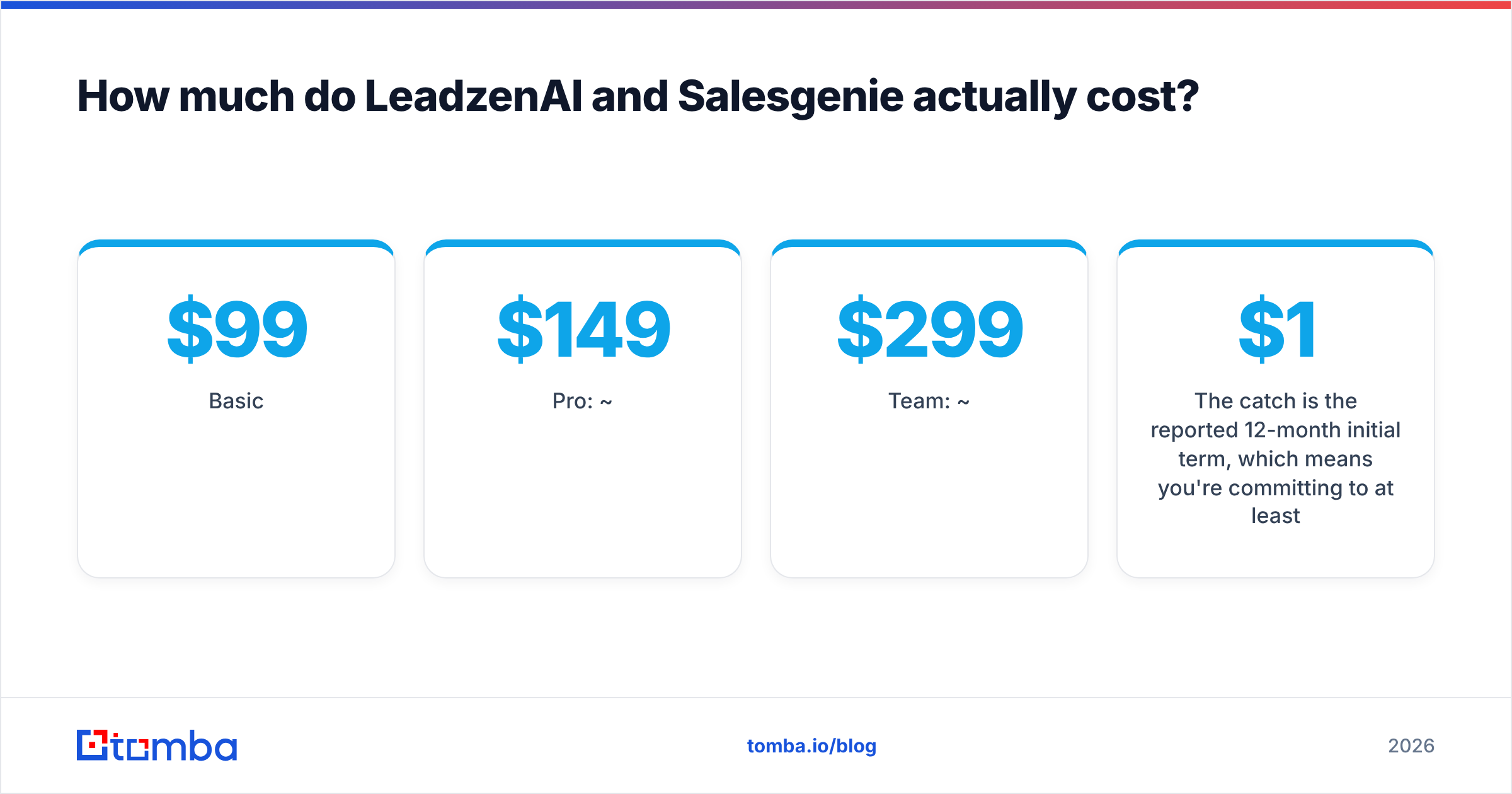
On paper, Salesgenie is the more transparent of the two. Based on public listings and third-party reviews, its three editions sit at roughly:
- Basic: $99/month
- Pro: ~$149/month
- Team: ~$299/month
The catch is the reported 12-month initial term, which means you're committing to at least about $1,188 on the Basic plan before you've tested the data at scale. Several reviewers also report that the real cost ends up well above list price once lead overages and add-ons are included. Read the cancellation and early-termination terms in your contract carefully. Don't assume you can cancel month to month.
LeadzenAI's pricing is harder to read. Public sources cite a Standard plan around $133/month (lower per month on annual billing), with higher editions running into the thousands per month. Some packaging appears to be tied to outcomes such as qualified meetings instead of raw data credits. That can be good value if the managed pieces deliver, but it makes comparing like for like hard. Ask for a written quote that spells out:
- How many contact reveals or exports are included
- Whether phone numbers cost extra credits
- What happens to unused credits at renewal
- Whether outreach channels (WhatsApp, calling) are included or add-ons
What does it cost per verified contact?#
Price per seat is the wrong metric here. Price per usable contact is the one to track. A $99 plan that gives you 1,000 contacts at 70% deliverability costs more per real conversation than a $149 plan with 90% deliverability. Work out your cost per verified contact from the trial data before you look at plan names.
Which is better for outbound workflows?#
The answer depends on where you want the work to happen.
LeadzenAI wants to be your whole outbound stack. It finds leads, enriches them, and lets you contact them by email, LinkedIn, WhatsApp, or phone from one place. For a small team without a separate sequencer, that's appealing: fewer tools, fewer logins, fewer CSV exports. The tradeoff is the usual one for all-in-one platforms. Each individual channel is usually less deep than a specialist tool, and if you later adopt a dedicated sequencer, you may end up paying for overlapping features.
Salesgenie is closer to a list factory. You build a list, export it, and send it to your CRM or engagement tool. It includes some lead-management and light email features, but most teams use it as the data layer that feeds tools like HubSpot or Salesforce. That setup suits a team that already has a sequencer it likes.
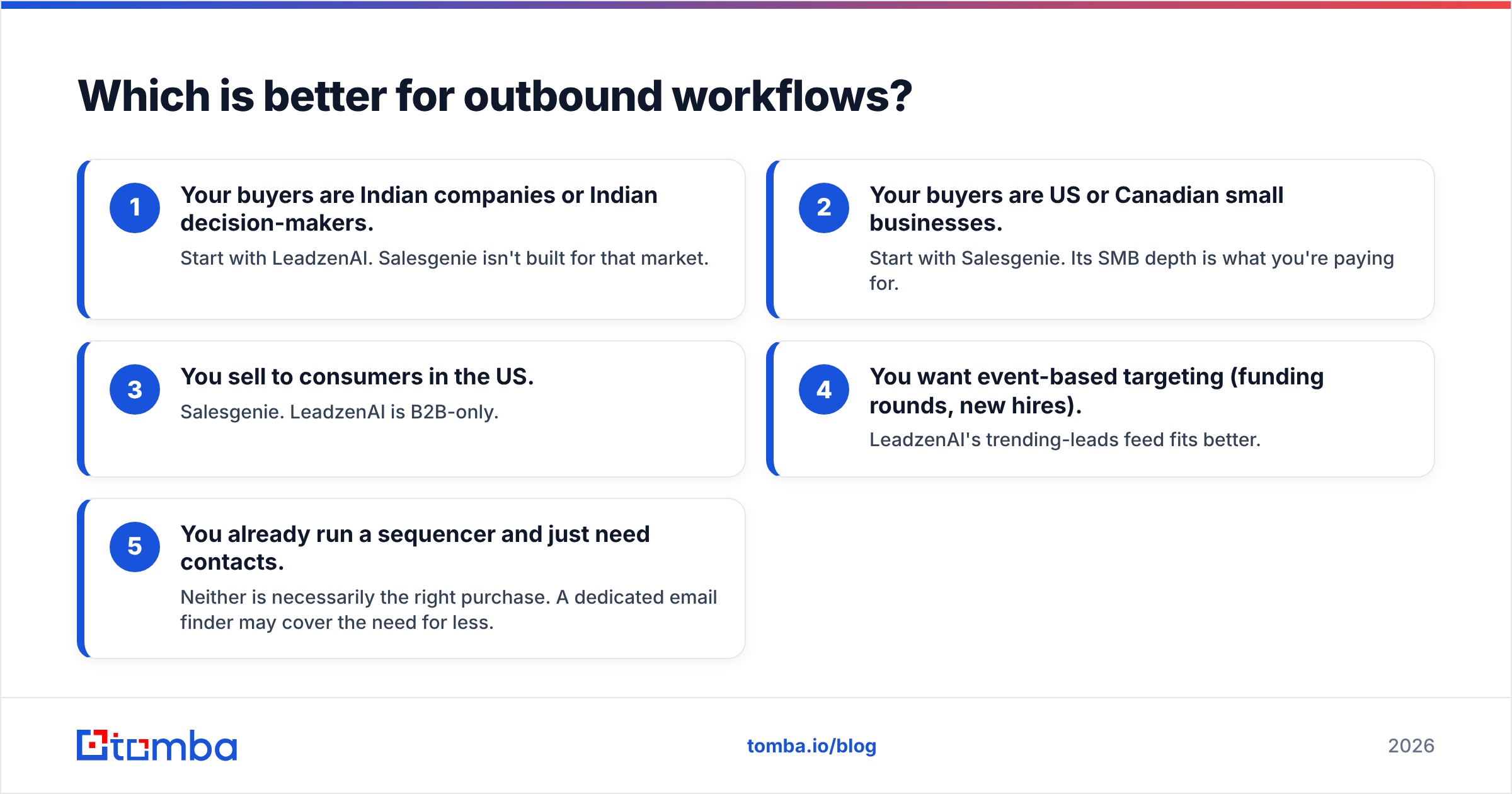
Here's a quick decision framework:
- Your buyers are Indian companies or Indian decision-makers. Start with LeadzenAI. Salesgenie isn't built for that market.
- Your buyers are US or Canadian small businesses. Start with Salesgenie. Its SMB depth is what you're paying for.
- You sell to consumers in the US. Salesgenie. LeadzenAI is B2B-only.
- You want event-based targeting (funding rounds, new hires). LeadzenAI's trending-leads feed fits better.
- You already run a sequencer and just need contacts. Neither is necessarily the right purchase. A dedicated email finder may cover the need for less.
What do users complain about with each tool?#
Every lead database gets complaints, and they tell you where the product falls short. Here are the recurring themes in public reviews.
Salesgenie:
- Contract rigidity. Annual terms and difficult cancellations come up again and again.
- Email accuracy for individuals. Company-level data is strong, but the personal email for a specific contact is weaker.
- Upsells. Overages and add-ons push the real cost above the plan price.
- Dated interface. Some users describe the web app as functional but old-fashioned.
LeadzenAI:
- Pricing confusion. Several reviewers find the edition structure hard to follow.
- Coverage outside India. Results for North American and European SMB targets are reported as less consistent.
- Young product. Features change quickly, which is good for innovation and harder for teams that want a stable workflow.
None of these rules either tool out. They tell you what to test during a trial and what to negotiate in the contract.

Do you still need an email finder if you buy either one?#
Almost always, yes. The reason is structural, not a criticism of either vendor.
Lead databases are optimised for breadth: millions of records, lots of filters, fast list building. Email finders are optimised for precision: given a name and a company domain, return the one address that will actually deliver, verified at the moment you ask. A database record may have been checked months ago. The person may have left the company, or the company may have changed its email format. On catch-all domains, which accept mail for any address, a stored email can look valid and still bounce, or never reach a person at all.
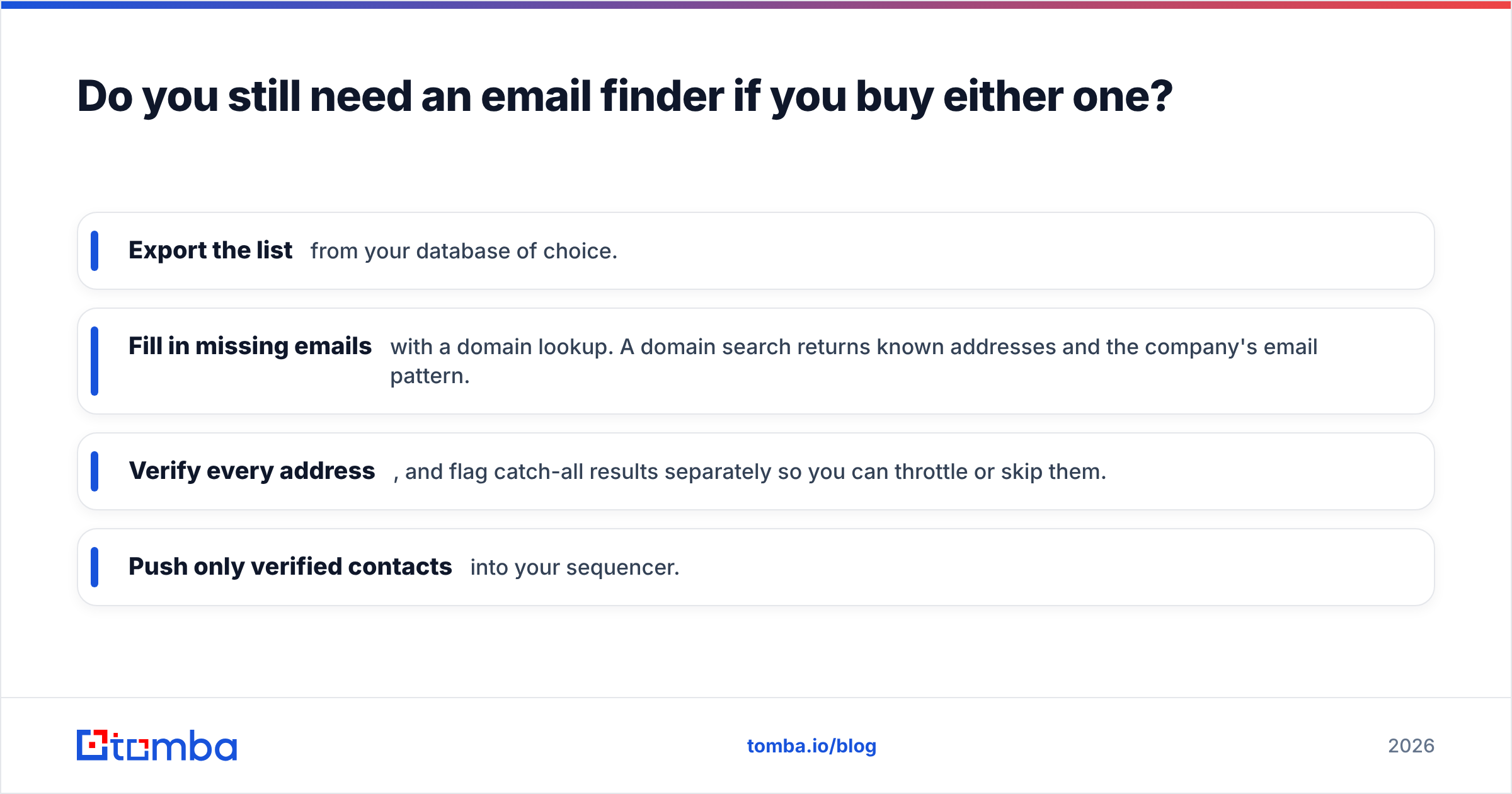
Teams that get good results from Salesgenie or LeadzenAI usually add a verification step before any sequence goes out:
- Export the list from your database of choice.
- Fill in missing emails with a domain lookup. A domain search returns known addresses and the company's email pattern.
- Verify every address, and flag catch-all results separately so you can throttle or skip them.
- Push only verified contacts into your sequencer.
This protects your email deliverability and your sender reputation. Those are worth more than any single list, because one bad send to a list with a high bounce rate can harm your inbox placement for weeks.
Is LeadzenAI or Salesgenie the better choice in 2026?#
The verdict in the LeadzenAI vs Salesgenie matchup depends on geography:
- Choose Salesgenie if you prospect US or Canadian small and mid-sized businesses, need firmographic filters like SIC code, revenue band, and radius search, or need US consumer data. Accept the annual contract only after a trial shows the data holds up for your ICP, and negotiate the add-ons up front.
- Choose LeadzenAI if your market is India, if you want funding and hiring signals, or if you'd like one platform that covers both lead discovery and multichannel outreach, including WhatsApp. Ask for a written quote. Don't rely on the published tiers alone.
- Choose neither if what you actually need is "the right email for the right person at companies I've already chosen." In that case, a lead database is more tool than you need.
A more general tip: whichever database you pick, judge it on your own 50-account test, not on the vendor's total-record count. A database with 250 million records is worth nothing if the 400 accounts on your target list aren't in it.
Where does Tomba fit alongside these tools?#
If your bottleneck is getting deliverable email addresses, not finding companies, you don't need a 12-month database contract to fix it. Tomba Email Finder returns professional email addresses from a name and domain, a domain on its own, or a company. Verification, catch-all checks, and enrichment are available in the same account. You can pair it with a Salesgenie or LeadzenAI export to fill gaps and clean the list before it reaches your sequencer, or use it on its own when you already know which accounts you're targeting. There's a free tier with 25 searches a month so you can test it on your own accounts first. Paid plans start at $49/month with no annual lock-in required. See Tomba pricing for the full plan breakdown.
Related guides#
Ready to find emails that actually work?
Join 150,000+ professionals who stopped guessing and started sending. Free credits on signup — no credit card required.
Get the Tomba newsletter
Practical outbound tactics and product updates — once every two weeks.
About the author