LeadzenAI vs Soleadify: Data, Features and Pricing Compared (2026)
LeadzenAI is built for finding people and doing outreach. Soleadify is built for mapping companies. Here's how the two lead platforms compare on data model, coverage, workflow and cost, and which one fits your pipeline.
TL;DR
- LeadzenAI is people-first. It finds decision-makers, pulls in their contact details, and runs outreach. It's strongest for SDR teams selling into India and APAC, and it works inside LinkedIn through a Chrome extension.
- Soleadify is company-first. It crawls the public web to map businesses, especially small and mid-sized companies, by category, location, technology and size. Its team went on to build Veridion, an enterprise company-data platform.
- Pricing models differ. LeadzenAI's plans are reported to start around $133/mo and go up to enterprise editions. Soleadify doesn't list public prices, so you'll need a sales conversation.
- Neither one replaces verification. Run every exported list through a dedicated email verifier before you put it into a sequence.
- Our pick: Choose LeadzenAI if your motion depends on contacts and outreach. Choose Soleadify if you need to build a market map or a total addressable market (TAM) list of SMBs.
What are LeadzenAI and Soleadify?#
Both are sold as B2B lead generation platforms, but they solve different problems. If you mix them up, you'll end up paying for the wrong data.
LeadzenAI is an AI-assisted prospecting platform aimed at startups and SMEs, with most of its traction among Indian sales teams. The core product is a web console where you search for prospects with filters or in plain language, such as "CFOs at fintech companies in Bangalore with 50-200 employees." A Chrome extension shows emails, phone numbers and AI-generated buyer notes while you browse LinkedIn profiles. On top of that sits an outreach layer covering email, LinkedIn messaging, WhatsApp and calling.
Soleadify started from the other direction. Instead of starting from people, it crawls millions of websites and builds a structured profile of each business: what it sells, where it operates, what technology it runs, and how to contact it. Its positioning is "dedicated data on small businesses worldwide," and the company has described a database of more than 40 million businesses, refreshed weekly from over 10 million web sources. The same team later built Veridion, a company-data API used by procurement, supply-chain and enterprise data teams.
In short, LeadzenAI tells you who to email. Soleadify tells you which companies exist and what they do.
How do their data models actually differ?#
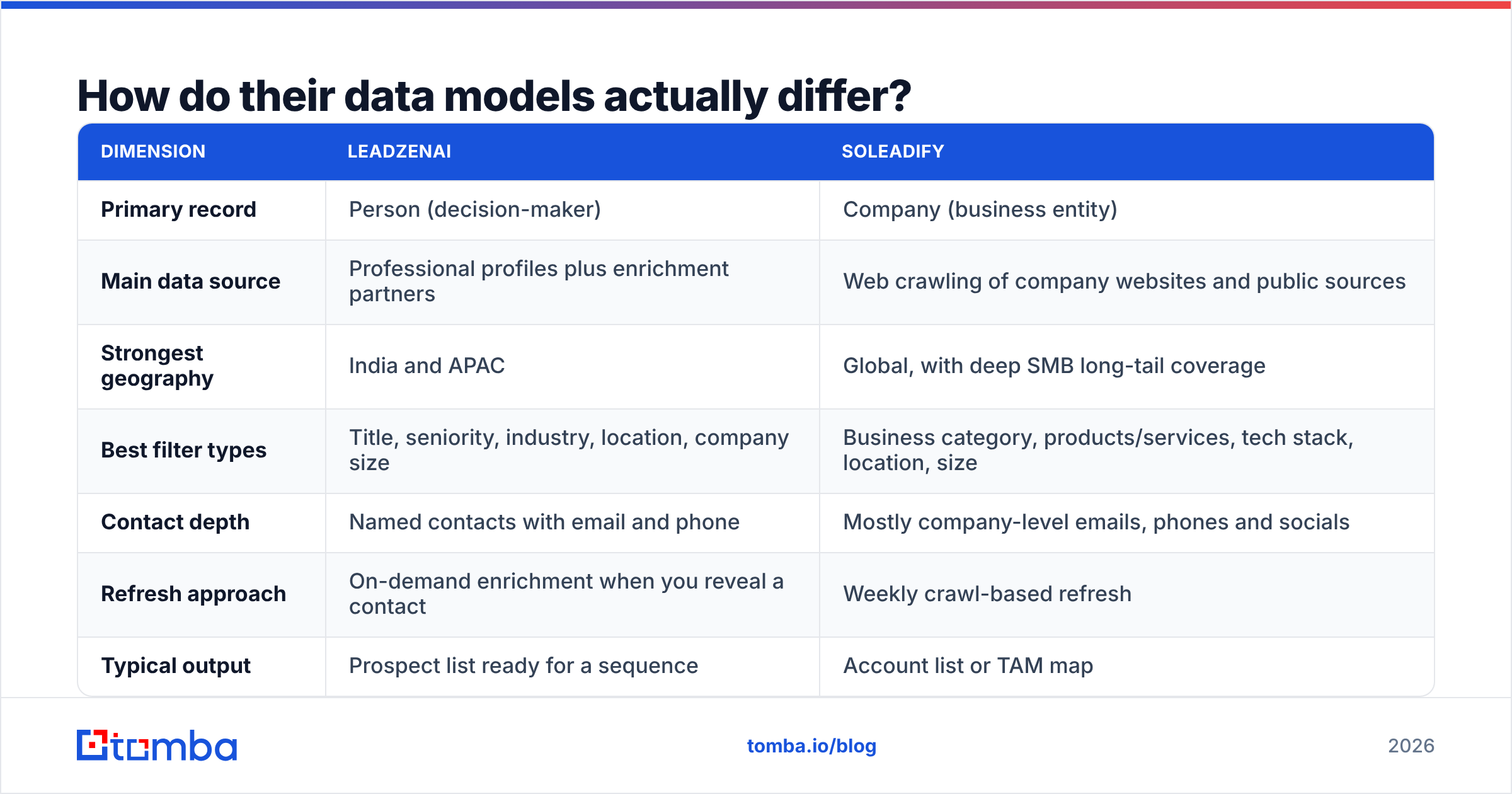
Before you compare feature lists, look at where each tool's records come from. That determines what each one is good at.
| Dimension | LeadzenAI | Soleadify |
|---|---|---|
| Primary record | Person (decision-maker) | Company (business entity) |
| Main data source | Professional profiles plus enrichment partners | Web crawling of company websites and public sources |
| Strongest geography | India and APAC | Global, with deep SMB long-tail coverage |
| Best filter types | Title, seniority, industry, location, company size | Business category, products/services, tech stack, location, size |
| Contact depth | Named contacts with email and phone | Mostly company-level emails, phones and socials |
| Refresh approach | On-demand enrichment when you reveal a contact | Weekly crawl-based refresh |
| Typical output | Prospect list ready for a sequence | Account list or TAM map |
This difference matters more than anything else in this post. If you need "the VP of Operations at 300 logistics companies," a people-first tool like LeadzenAI is the natural fit. If you need "every independent HVAC contractor in Texas with a website and a booking form," Soleadify's crawl-based model is better suited. Many of those businesses don't have a well-maintained LinkedIn footprint, so people-first databases often miss them entirely.
How do LeadzenAI and Soleadify compare feature by feature?#
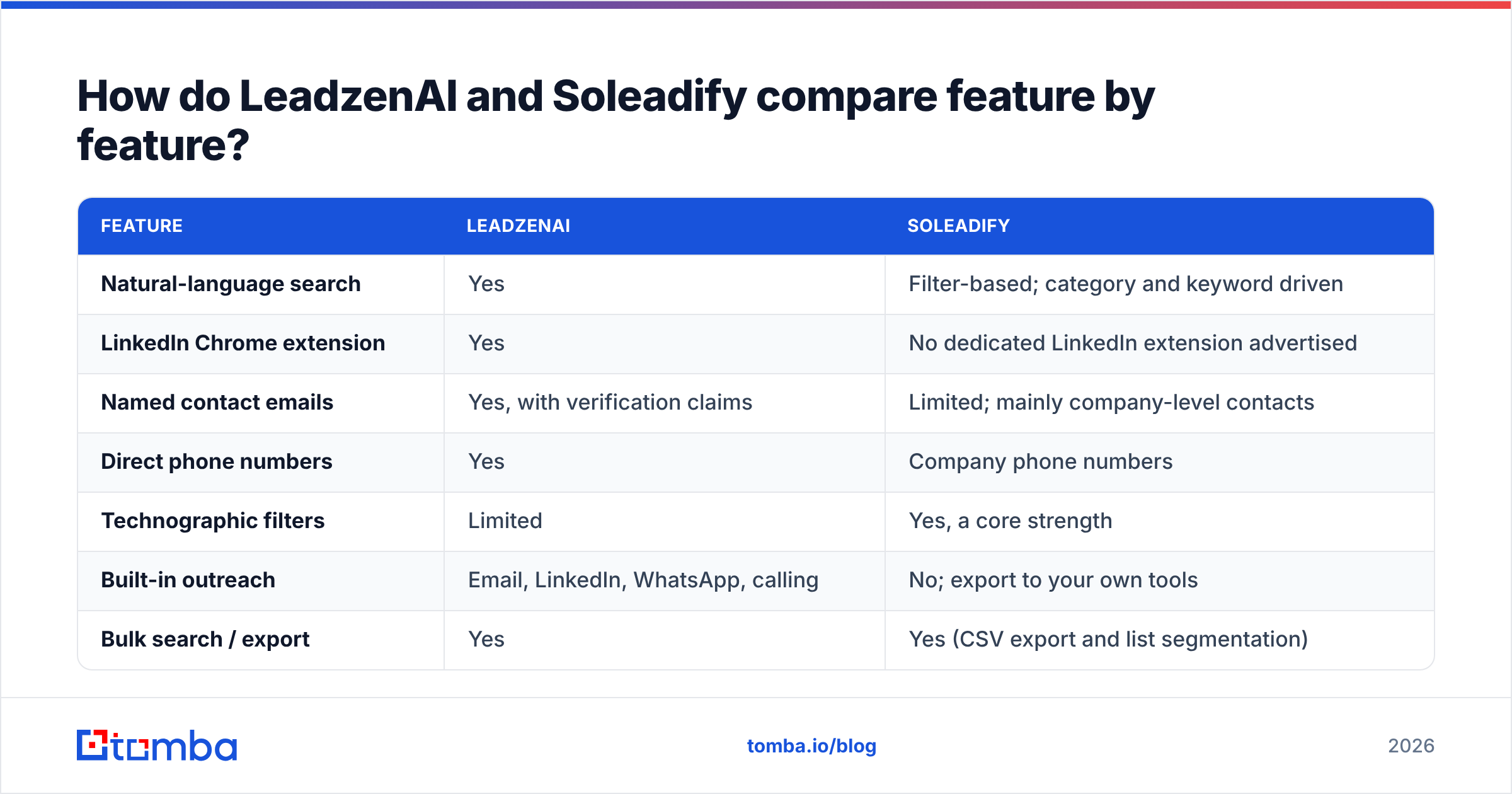
Here's how the two platforms line up on the features buyers usually ask about. Where a vendor hasn't published a detail, we say so instead of guessing.
| Feature | LeadzenAI | Soleadify |
|---|---|---|
| Natural-language search | Yes | Filter-based; category and keyword driven |
| LinkedIn Chrome extension | Yes | No dedicated LinkedIn extension advertised |
| Named contact emails | Yes, with verification claims | Limited; mainly company-level contacts |
| Direct phone numbers | Yes | Company phone numbers |
| Technographic filters | Limited | Yes, a core strength |
| Built-in outreach | Email, LinkedIn, WhatsApp, calling | No; export to your own tools |
| Bulk search / export | Yes | Yes (CSV export and list segmentation) |
| API / data feed | Plan dependent | Yes, via the Veridion data products |
| Free trial | Limited-feature trial | Demo on request |
| Public pricing | Reported from ~$133/mo | Not published; contact sales |
| Best for | SDRs running multichannel outbound | Market mapping, SMB TAM building, account research |
The pattern holds throughout. LeadzenAI adds workflow on top of its data: it wants you to search, reveal and send without leaving the product. Soleadify stays a data platform. You pull lists out and run outreach in whatever stack you already use, whether that's HubSpot, Salesforce, Instantly or something else.
Neither approach is automatically better. If your team already has a sequencer and a CRM, paying for LeadzenAI's outreach layer can mean paying twice for the same capability. If you have neither, Soleadify alone won't get a single email sent.
How much do LeadzenAI and Soleadify cost?#
Budget planning is harder than it should be, because neither vendor makes pricing fully transparent.
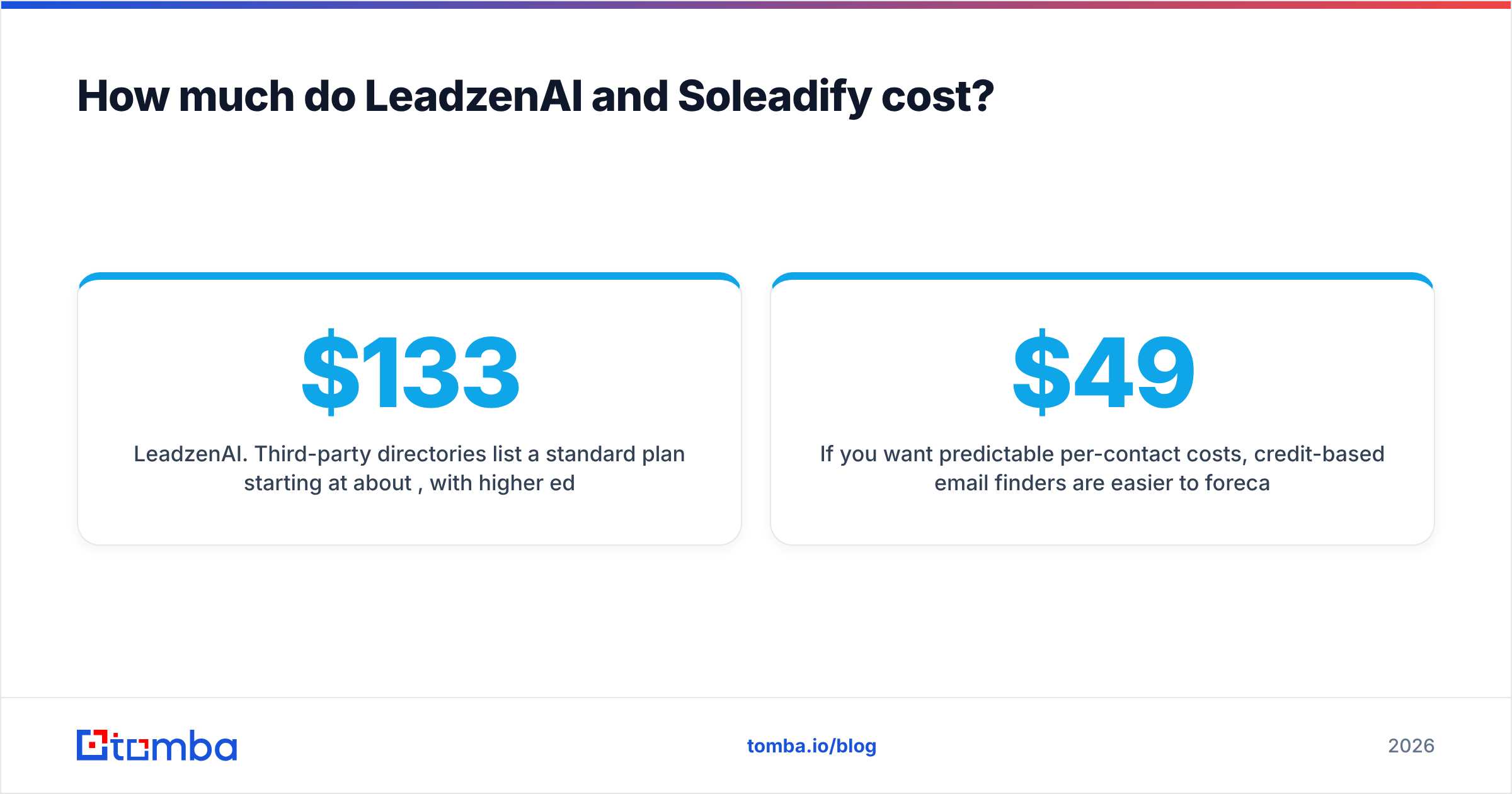
LeadzenAI. Third-party directories list a standard plan starting at about $133/mo, with higher editions running into the thousands per month for larger teams. Some sources also say part of the offering can be priced per qualified meeting delivered, which works more like a done-for-you service than a self-serve SaaS subscription. A free trial with limited features is available. Confirm the current terms on the vendor's site, because India-focused tools often price differently in INR than in USD.
Soleadify. No public pricing is posted. Listings on sites like Capterra describe it as good value, but you'll get a quote only after a demo. Expect the price to depend on the size of the list and the number of records you export, and on whether you want one-off lists or an ongoing data feed.
What this means for you:
- If you want to start small and self-serve, LeadzenAI's published entry tier makes it easier to test.
- If you need a large one-off TAM export, Soleadify's quote-based model can work out cheaper per record. Negotiate on volume.
- If you want predictable per-contact costs, credit-based email finders are easier to forecast. For reference, Tomba plans go from a free tier (25 searches/mo) to Starter at $49/mo, Growth at $99/mo and Pro at $249/mo.
Which one has more accurate data?#
There's no neutral, published head-to-head accuracy benchmark for LeadzenAI vs Soleadify, and any blog that claims a precise bounce-rate gap between them is guessing. What you can do is reason from how each tool collects its data.
LeadzenAI's accuracy risk is contact decay. People-level data goes stale fast. Job changes, layoffs and domain migrations mean some share of any contact database is out of date at any given time. LeadzenAI's value depends on how recently it re-verifies an email before you reveal it. In markets like India, where many mid-market firms run on catch-all mail servers, verification is harder than it looks.
Soleadify's accuracy risk is attribution. Crawled company data is excellent for firmographics, such as what a business does and where it is. Generic addresses from a website (info@, contact@, sales@) are real, but they rarely reach a decision-maker. The data can be accurate and still be the wrong data for outbound.
Whichever tool you pick, add a verification step before sending. A dedicated email verifier catches invalid and risky addresses, and catch-all detection tells you which "valid" results are really coin flips. This one step affects your sender reputation more than the choice between the two databases.
Who should choose LeadzenAI?#
LeadzenAI makes sense when your bottleneck is finding and contacting people, not defining the market.
Pick it if:
- You sell into Indian or APAC mid-market companies and global databases keep returning thin results.
- Your SDRs live on LinkedIn and want contact details shown right on the profile.
- You want WhatsApp and calling in the same workflow as email, which matters a lot in markets where WhatsApp is a primary business channel.
- You don't have a sequencer yet and would rather buy data and outreach in one contract.
Think twice if you already pay for Outreach, Salesloft, Apollo or a similar platform. You'd be duplicating the outreach layer, and the data alone may not justify the higher tiers.
Who should choose Soleadify?#
Soleadify makes sense when your bottleneck is knowing which companies to target in the first place.
Pick it if:
- You sell to small local businesses such as trades, clinics, agencies and retailers, which people-first databases cover poorly.
- You need product- or service-level segmentation, such as "companies that sell refurbished medical equipment," rather than broad industry codes.
- You're doing TAM analysis, territory planning or market-entry research and the account list is the deliverable.
- You want a data feed or API to enrich accounts in your warehouse, which is where its Veridion lineage helps.
Think twice if your team needs named decision-makers with direct emails today. You'll have to pair Soleadify with a people-level email finder to get from "this company exists" to "this person gets our email."
Where do both tools leave gaps?#
Both platforms leave the same gap: getting from a raw list to a verified, sendable contact.
With Soleadify, you have a list of accounts and domains but no decision-maker emails. With LeadzenAI, you have contacts but should still validate them before a large campaign, especially on catch-all domains. In both cases you need a people-level lookup plus independent verification.
That's where most outbound stacks add a specialist tool. A typical pattern:
- Build the account list in Soleadify, or pull it from LeadzenAI's company search.
- Run domain search on each account to see which named employees and email patterns exist at that company.
- Find the specific decision-maker's email by name and domain with an email finder.
- Verify the full list and separate catch-all results before importing into your sequencer.
- Push clean records to your CRM. Tools with native HubSpot or Salesforce connectors save you a CSV round trip.
This layered approach works whichever of the two tools you buy. It also protects you from vendor lock-in: if you switch databases next year, your find-and-verify layer stays the same.
How should you run a fair trial of LeadzenAI vs Soleadify?#
Don't decide from demos. Both vendors will show you their best segments. Run the same test on both:
- Use a fixed ICP sample. Write one ideal customer profile (ICP) definition and pull 200 records from each tool using the closest filters available. Save the exact filter settings so the test can be repeated.
- Measure coverage, not just volume. Count how many of your 50 known best-fit customers each tool actually returns. Coverage of accounts you already know is the most honest signal you have.
- Verify before you trust. Run both exports through the same verifier and record valid, invalid, catch-all and unknown rates side by side.
- Check freshness by hand. Spot-check 20 contacts or companies against LinkedIn and the company website. Look for job changes, closed businesses and dead domains.
- Price per usable record. Divide what you'd pay by the number of records that passed verification and fit your ICP. That number, not the sticker price, is what you're really paying.
- Test the workflow. Time how long it takes one SDR to go from search to a loaded sequence. Saved hours often outweigh small differences in data quality.
For broader context on comparing vendors, G2's lead intelligence category is a useful starting point for reading verified user reviews next to your own trial results.
LeadzenAI vs Soleadify: what's the verdict?#
The two tools answer different questions, so the right choice depends on the question your team is stuck on.
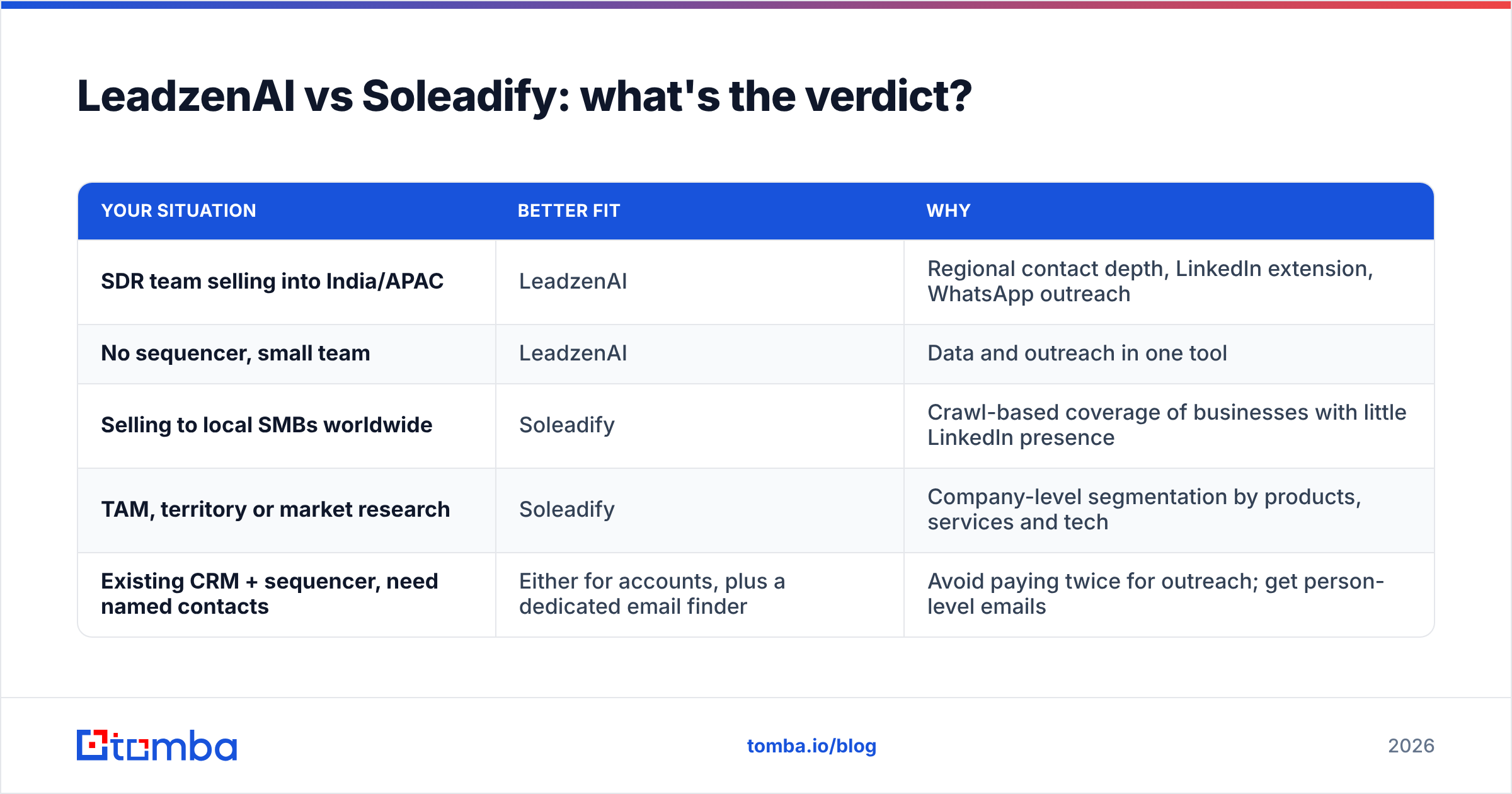
| Your situation | Better fit | Why |
|---|---|---|
| SDR team selling into India/APAC | LeadzenAI | Regional contact depth, LinkedIn extension, WhatsApp outreach |
| No sequencer, small team | LeadzenAI | Data and outreach in one tool |
| Selling to local SMBs worldwide | Soleadify | Crawl-based coverage of businesses with little LinkedIn presence |
| TAM, territory or market research | Soleadify | Company-level segmentation by products, services and tech |
| Existing CRM + sequencer, need named contacts | Either for accounts, plus a dedicated email finder | Avoid paying twice for outreach; get person-level emails |
If you have to pick one for pure outbound, LeadzenAI gets you to a sent email faster. If you need accounts before contacts, Soleadify gives you a stronger foundation. Many teams end up using a company-first source for targeting and a person-level finder for the actual contact.
Frequently asked questions#
Is Soleadify the same as Veridion? They're closely connected. The team behind Soleadify built Veridion, which focuses on enterprise company data and APIs, while soleadify.com continues to market SMB prospecting data. Check with the vendor which product and contract fits your use case.
Does LeadzenAI work outside India? Yes, you can search global profiles. Its positioning and strongest coverage are in the Indian market, so test your specific regions before committing.
Can I use Soleadify for cold email? Yes, but most of its contact data is company-level. For cold outreach to decision-makers, add a person-level email finder and verify every address first.
Which is cheaper, LeadzenAI or Soleadify? LeadzenAI publishes an entry tier reported at about $133/mo. Soleadify is quote-based. For large one-off lists, Soleadify can cost less per record. For small ongoing prospecting, LeadzenAI is easier to budget.
Ready to turn either list into verified contacts?#
Whether you land on LeadzenAI, Soleadify or both, the step that decides your reply rates is the same: getting the right person's real email address and confirming it before you hit send. Tomba Email Finder takes any domain or name-plus-company from your Soleadify or LeadzenAI export and returns a professional email with its sources and a confidence score. Built-in verification and catch-all detection mean you only sequence addresses that will land. You can start on the free tier with 25 searches a month and upgrade to Starter at $49/mo once the workflow proves itself.
Related guides#
// get started
Find, verify and enrich your first contacts today
Start on the free plan with 25 searches a month, then scale when your team is ready.
Free plan · No credit card required · GDPR & CCPA
// about the author