LeadzenAI vs SourceScrub (2026): Which B2B Data Tool Fits You?
LeadzenAI and SourceScrub both sell B2B data, but they solve different problems. One finds contacts for sales reps, the other finds private companies for dealmakers. Here's how to pick the right one.
TL;DR
- LeadzenAI is an AI-assisted prospecting tool. It finds people (names, emails, phone numbers) so sales teams can start outreach. It's aimed at SMBs and agencies that want self-serve access at a low price.
- SourceScrub is a private-company intelligence platform. It finds companies (founder-owned, bootstrapped, pre-institutional), mainly for private equity, investment banks, and corporate development teams.
- They rarely compete for the same buyer. If you run outbound sales, look at LeadzenAI. If you source deals, look at SourceScrub.
- Neither tool is built mainly for verified email coverage at scale. Most teams pair either one with a dedicated email finder and verifier before they send anything.
- Our pick: choose by your workflow, not by the size of the database. Details below.
Searches for "LeadzenAI vs SourceScrub" usually come from one of two people. The first is a sales leader who saw both names on a "B2B data tools" list. The second is a deal team comparing a cheap prospecting tool with an enterprise sourcing platform. Both of you deserve a straight answer, and the answer is that these products sit in different categories that happen to share a buzzword.
This guide covers what each platform does, where the data comes from, how pricing works, and which team should buy which tool.
What is LeadzenAI?#
LeadzenAI is a B2B lead generation platform that uses AI-assisted search to surface prospects and their contact details. In practice, you describe your target, such as a role, industry, location, or company size. It returns people-level records with professional emails and, where available, phone numbers.
What it's built around:
- People-first search. Your query returns individual contacts, and company data is secondary.
- Contact data for outreach. The main output is an email or phone number a rep can act on today.
- Self-serve onboarding. You can sign up and start searching without a sales call, which suits founders, small SDR teams, and agencies.
- Browser-based prospecting. It pulls contact info while you browse professional profiles and company sites.
The typical LeadzenAI user runs cold email or cold calling campaigns and needs a steady supply of contacts at a predictable monthly cost. The platform says little about data sources and verification methods, so test a sample list against your ICP before you commit to a large plan.
What is SourceScrub?#
SourceScrub is a deal-sourcing and company intelligence platform. Its core audience is private equity firms, growth equity investors, investment banks, and corporate development teams hunting for acquisition targets.
The key difference is that SourceScrub is company-first. It's designed to surface private businesses that don't appear in the usual venture databases: founder-owned, bootstrapped, or family-run companies. Those are often the most attractive targets for lower-middle-market investors.
What it's built around:
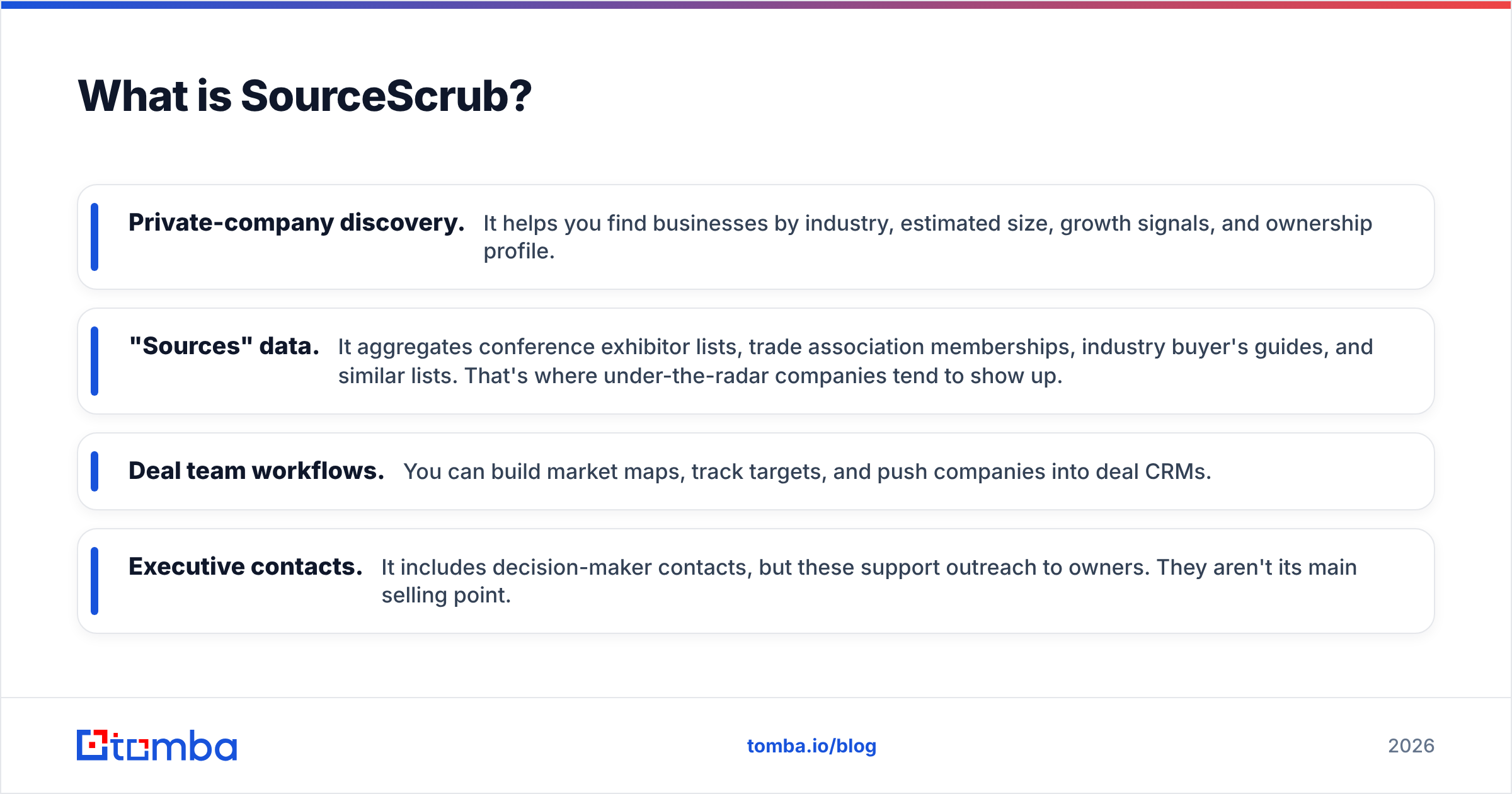
- Private-company discovery. It helps you find businesses by industry, estimated size, growth signals, and ownership profile.
- "Sources" data. It aggregates conference exhibitor lists, trade association memberships, industry buyer's guides, and similar lists. That's where under-the-radar companies tend to show up.
- Deal team workflows. You can build market maps, track targets, and push companies into deal CRMs.
- Executive contacts. It includes decision-maker contacts, but these support outreach to owners. They aren't its main selling point.
SourceScrub is sold with annual, quote-based contracts through a sales process. That puts it in a very different budget bracket from self-serve prospecting tools.
How do LeadzenAI and SourceScrub compare side by side?#
Here's the head-to-head on the attributes buyers ask about most. Pricing for both vendors changes often, so confirm current numbers on their sites before budgeting.
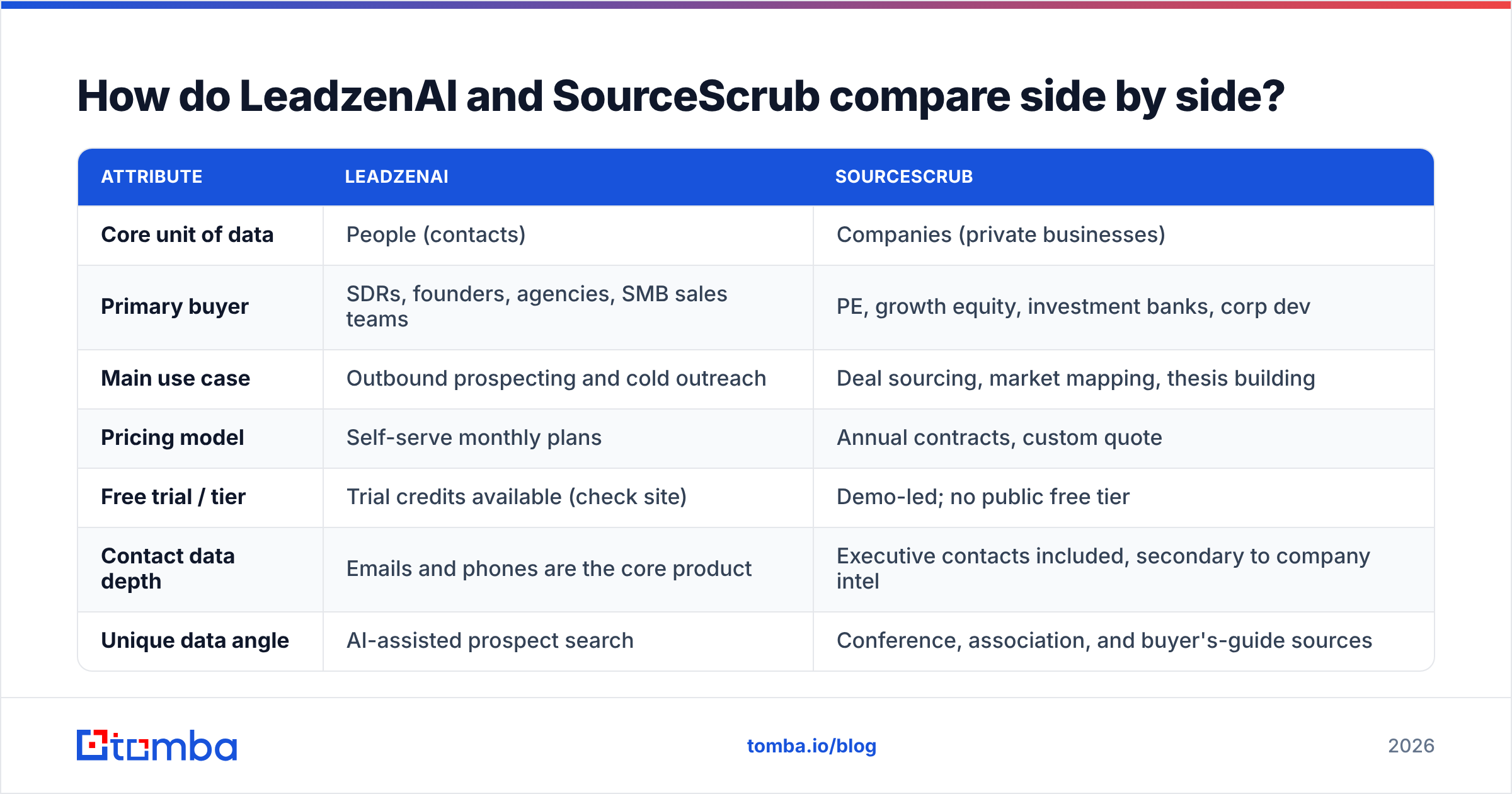
| Attribute | LeadzenAI | SourceScrub |
|---|---|---|
| Core unit of data | People (contacts) | Companies (private businesses) |
| Primary buyer | SDRs, founders, agencies, SMB sales teams | PE, growth equity, investment banks, corp dev |
| Main use case | Outbound prospecting and cold outreach | Deal sourcing, market mapping, thesis building |
| Pricing model | Self-serve monthly plans | Annual contracts, custom quote |
| Free trial / tier | Trial credits available (check site) | Demo-led; no public free tier |
| Contact data depth | Emails and phones are the core product | Executive contacts included, secondary to company intel |
| Unique data angle | AI-assisted prospect search | Conference, association, and buyer's-guide sources |
| CRM fit | General sales CRMs and CSV export | Deal CRMs (e.g. DealCloud) and Salesforce |
| Time to value | Minutes (sign up and search) | Weeks (onboarding, thesis setup) |
| Best for | High-volume outbound on a budget | Finding off-market acquisition targets |
The table shows the central point. LeadzenAI answers "who should I email?" SourceScrub answers "which company should we buy or back?" Comparing them on database size alone is like comparing a fishing rod with a sonar map. Both help you find fish, but they do different jobs.

Which data model fits your workflow?#
Before you look at features, work out which workflow you actually run. Most buying mistakes in this category come from choosing a tool built for someone else's process. Use this checklist:
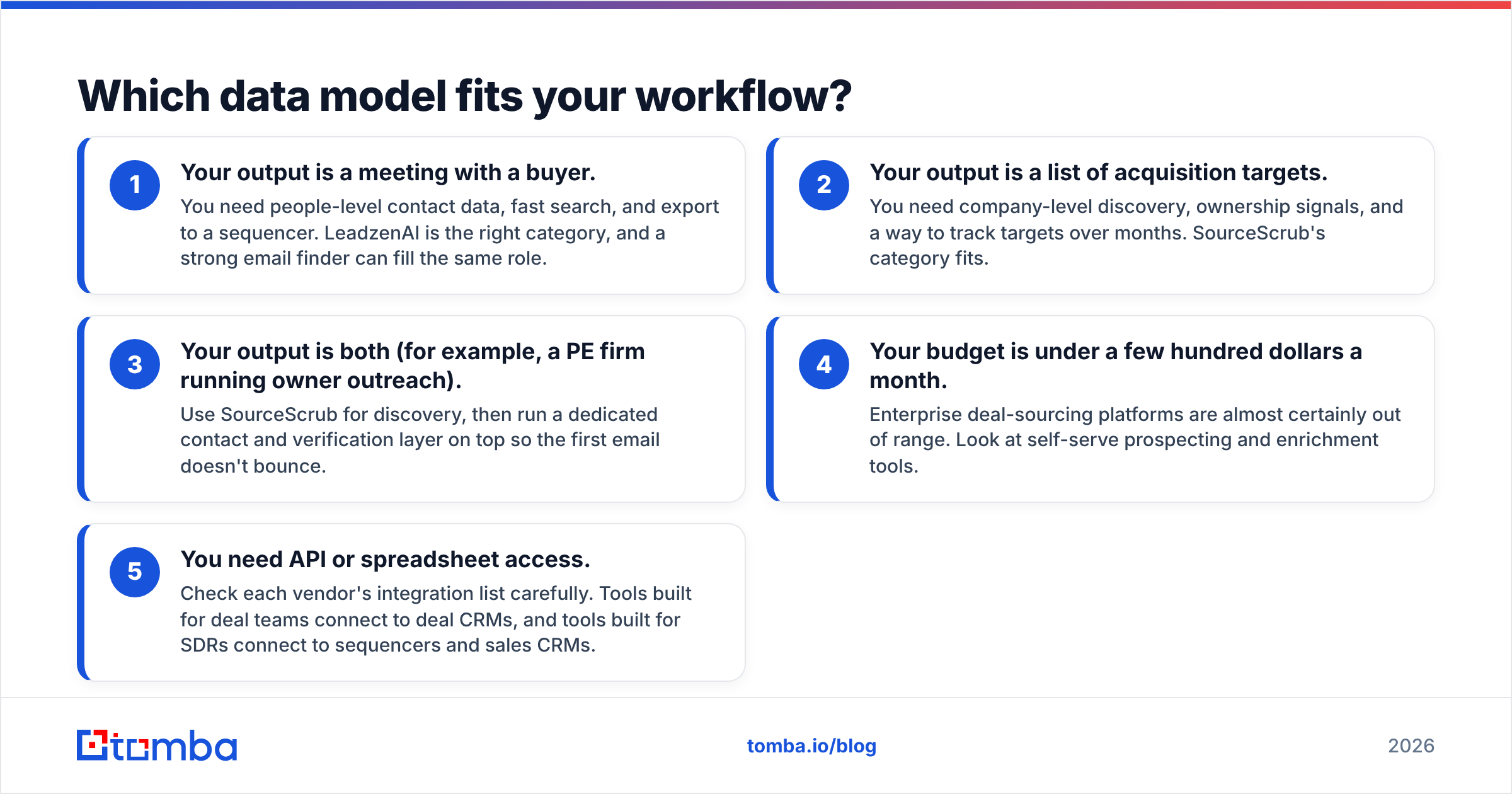
- Your output is a meeting with a buyer. You need people-level contact data, fast search, and export to a sequencer. LeadzenAI is the right category, and a strong email finder can fill the same role.
- Your output is a list of acquisition targets. You need company-level discovery, ownership signals, and a way to track targets over months. SourceScrub's category fits.
- Your output is both (for example, a PE firm running owner outreach). Use SourceScrub for discovery, then run a dedicated contact and verification layer on top so the first email doesn't bounce.
- Your budget is under a few hundred dollars a month. Enterprise deal-sourcing platforms are almost certainly out of range. Look at self-serve prospecting and enrichment tools.
- You need API or spreadsheet access. Check each vendor's integration list carefully. Tools built for deal teams connect to deal CRMs, and tools built for SDRs connect to sequencers and sales CRMs.
If you're stuck between points 1 and 2, you probably need two tools, not one.
Is LeadzenAI better than SourceScrub for sales prospecting?#
For classic outbound sales, yes, simply because LeadzenAI is built for it and SourceScrub isn't.
A sales rep's day looks like this: define an ICP, pull 200 contacts, verify them, load them into a sequence, and book meetings. LeadzenAI's people-first search maps onto that flow directly. SourceScrub would make you start with companies, drill into each one, and then find the right contact. That's workable, but slow and expensive for pure pipeline generation.
Watch out for a few things with LeadzenAI:
- Verification. No prospecting database is 100% accurate, because people change jobs constantly. Run every export through an email verifier before sending. Otherwise you risk bounce rates that damage your sender reputation.
- Coverage by region and niche. AI-assisted search is only as good as the underlying records. Test your exact ICP (for example, "HVAC distributors in Texas") before you buy a large plan.
- Credit math. Self-serve plans usually meter by credit. Work out your real cost per verified, usable contact, not just the cost per record.
Is SourceScrub better than LeadzenAI for deal sourcing?#
Clearly, yes. Deal sourcing is SourceScrub's reason to exist.
Lower-middle-market investors win by finding companies before competitors do. Those targets usually have no venture funding, limited press coverage, and a minimal digital footprint. SourceScrub's approach of mining conference exhibitor lists, trade associations, and industry directories is built to surface exactly those businesses. A general prospecting tool doesn't organise data around ownership, growth signals, or investment thesis.
Deal teams also value the workflow around the data: saved searches tied to a thesis, market maps, and CRM sync so associates don't copy targets into spreadsheets by hand. Review platforms like G2 are useful for reading how PE and banking users rate onboarding and data freshness in practice.
The trade-offs:
- Cost and commitment. Annual contracts and custom pricing make it a considered purchase, not a quick experiment.
- Contact depth. Executive contacts are included, but owner outreach at volume usually benefits from an extra email-finding and verification step, especially at small private companies with unusual email formats.
- Overkill for sales teams. If you don't source deals, you'll pay for a lot of capability you'll never use.
How does pricing compare in 2026?#
Pricing is where the two tools differ most, and where buyers most often misjudge the comparison.
LeadzenAI uses self-serve monthly plans with credit allowances. You can usually start small, test data quality, and scale up. That's the standard model for SMB prospecting tools, and it keeps the downside of a bad fit low.
SourceScrub uses annual contracts priced by quote, usually based on seats and modules. Neither vendor publishes a full, fixed price list that covers every tier, so any exact number you see in a third-party article (including this one) can go out of date quickly. Get a written quote.
A practical way to compare total cost:
- Cost per usable contact (sales teams): take the plan price, divide by verified contacts that fit your ICP, and include the cost of verification.
- Cost per qualified target (deal teams): take the annual contract, divide by companies that entered your pipeline, and weigh that against analyst hours saved.
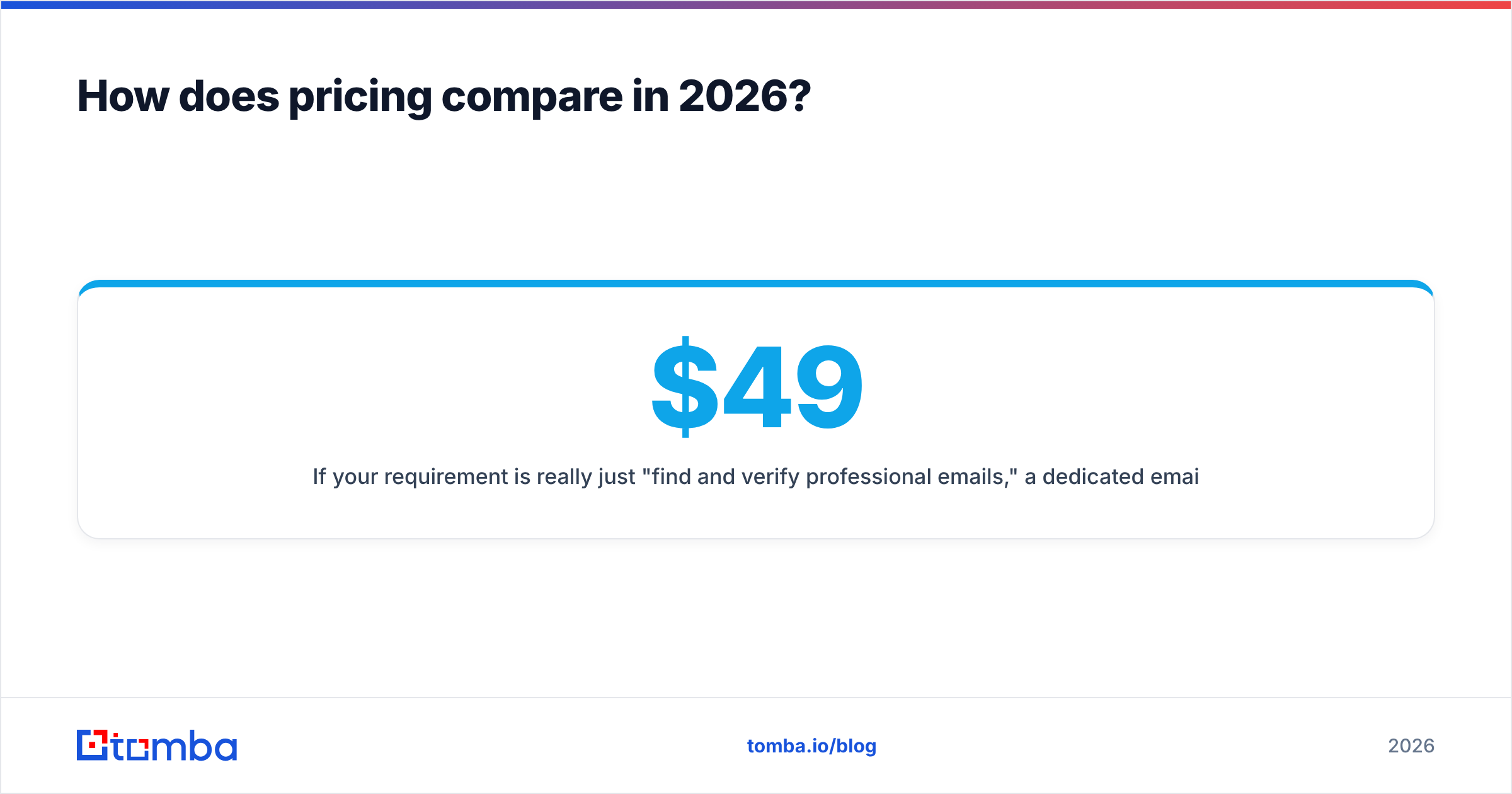
If your requirement is really just "find and verify professional emails," a dedicated email tool is usually far cheaper than either platform. Tomba, for example, has a free tier with 25 searches a month, then Starter at $49/mo, Growth at $99/mo, and Pro at $249/mo. See Tomba pricing for current limits.
Where do both tools fall short?#
Neither product is a complete stack. The gaps are predictable:
- Email accuracy at the moment of sending. Databases decay. Jobs change, domains migrate, and catch-all servers hide invalid addresses. Whatever your discovery tool, verify right before you send.
- Catch-all domains. Many small private companies, the exact targets SourceScrub users chase, run catch-all mail servers. A standard verifier returns "unknown" for these addresses, so you need a catch-all-aware check.
- Company-to-contact bridging. SourceScrub gives you a company, and you still need the right person's address. A domain search that lists every public email on a company domain, along with its detected email pattern, closes that gap quickly.
- Enrichment into your CRM. Both tools export data, but keeping records fresh inside HubSpot or Salesforce usually needs an enrichment layer. HubSpot's CRM documentation is a good reference for how enrichment fields should map to contact and company objects.
This is why experienced teams rarely rely on one vendor. Discovery, contact finding, and verification are three separate jobs, and specialist tools tend to do each one better.
Which should you choose: LeadzenAI or SourceScrub?#
Here's the direct recommendation.
Choose LeadzenAI if:
- You run outbound sales, SDR, or agency lead gen.
- You need people-level contacts this week, not company intelligence this quarter.
- You want self-serve pricing you can cancel.
Choose SourceScrub if:
- You're a PE firm, growth investor, investment bank, or corp dev team.
- Your pipeline is made of companies to acquire or invest in, not buyers to sell to.
- You can justify an annual contract with analyst time saved and deals sourced.
Choose neither (or add a specialist) if:
- Your real bottleneck is finding and verifying the email of a person at a known company. That's a smaller, cheaper problem. A dedicated email finder with built-in verification solves it without an enterprise contract or a broad prospecting subscription.
The honest verdict: LeadzenAI wins for sales prospecting, and SourceScrub wins for deal sourcing. Most "vs" confusion disappears once you name the output you need, whether that's a meeting or a target list.
How does Tomba fit alongside either tool?#
Tomba doesn't replace SourceScrub's private-market intelligence, and it isn't trying to be an all-in-one AI prospecting database. It covers the step both workflows share: turning a name and a company into a deliverable email address.
- For SourceScrub users: export a target list, run the domains through Tomba's domain search to find owners and executives, then verify before owner outreach.
- For LeadzenAI users (or anyone doing outbound): use Tomba to fill gaps where your prospecting tool returned no email, and to double-check addresses before they go into a sequence.
- For lean teams: if you already know your target accounts, Tomba alone may cover most of what you'd buy a larger platform for.
Final take: which tool should you buy?#
LeadzenAI and SourceScrub turn up in the same searches, but they serve different people. Pick by your output. If you need meetings with buyers, start with a people-first prospecting tool. If you need companies to acquire, invest in a company-first sourcing platform. Either way, don't send an email you haven't verified.
If you mainly need the contact layer, meaning accurate professional emails from a name, a domain, or a company, try the Tomba Email Finder. It includes built-in verification, a free tier to test on your own target list, and paid plans from $49/mo when you're ready to scale. It works with whichever discovery tool you choose.
Related guides#
Ready to find emails that actually work?
Join 150,000+ professionals who stopped guessing and started sending. Free credits on signup — no credit card required.
Get the Tomba newsletter
Practical outbound tactics and product updates — once every two weeks.
About the author