LeadzenAI vs Tami AI: Which B2B Lead Platform Wins in 2026?
Leadzen.ai is built for Indian sales teams and multichannel outreach. Tami AI is built for GDPR-compliant data and CRM enrichment. Here is how they compare on coverage, pricing and workflow, and which one fits your team.
TL;DR
- Leadzen.ai is an AI lead-discovery and outreach platform built mainly for Indian B2B sales teams. It combines search, a LinkedIn Chrome extension, and outreach over email, LinkedIn, WhatsApp and calling.
- Tami AI is a GDPR-focused B2B data platform with UK and European roots. Its strengths are real-time contact refresh, job-change alerts and automatic CRM enrichment.
- Pricing is structured differently. Third-party directories list Leadzen.ai's Standard plan from about $133/month. Tami AI publishes per-user pricing of about $47 (Basic) and $67 (Growth) per user per month, billed annually.
- Pick by territory and workflow, not features. If you sell into India and want WhatsApp in your sequences, choose Leadzen.ai. If you sell into the UK or EU and need clean CRM data, choose Tami AI.
- Neither tool removes the need to verify emails before you send. A dedicated email finder and verifier stays useful either way.
What are Leadzen.ai and Tami AI?#
Leadzen.ai and Tami AI both sell B2B contact data, but they started from different problems, and that difference affects everything else in this comparison.
Leadzen.ai calls itself an AI lead-generation platform for startups and SMEs, and most of its users are Indian sales teams. The product has three layers:
- A web console where you search for prospects with filters or plain-language queries ("CFOs at fintech companies in Bengaluru with 50-200 employees").
- A Chrome extension that shows verified emails, phone numbers and AI-generated buyer notes while you browse LinkedIn.
- A multichannel outreach layer that covers email, LinkedIn messaging, WhatsApp and calling.
WhatsApp matters a lot here. In India, a WhatsApp message to a decision-maker often gets answered faster than an email, and most Western tools don't support that channel natively.
Tami AI is built around data quality and compliance. It describes itself as a real-time B2B data and market-intelligence platform covering more than 150 million companies in 190 countries. Its main selling points are:
- GDPR-compliant contact data, which matters if you prospect in the UK or EU
- Real-time refresh of contact records, with the vendor claiming bounce rates under 5%
- Alerts when a contact changes jobs, gets a new role or moves companies
- Native CRM sync with Salesforce, HubSpot, Pipedrive and Close, with automatic field mapping
Put simply, Leadzen.ai is a prospecting-and-outreach tool that includes data, and Tami AI is a data-and-enrichment tool that includes prospecting.
How do Leadzen.ai and Tami AI compare at a glance?#
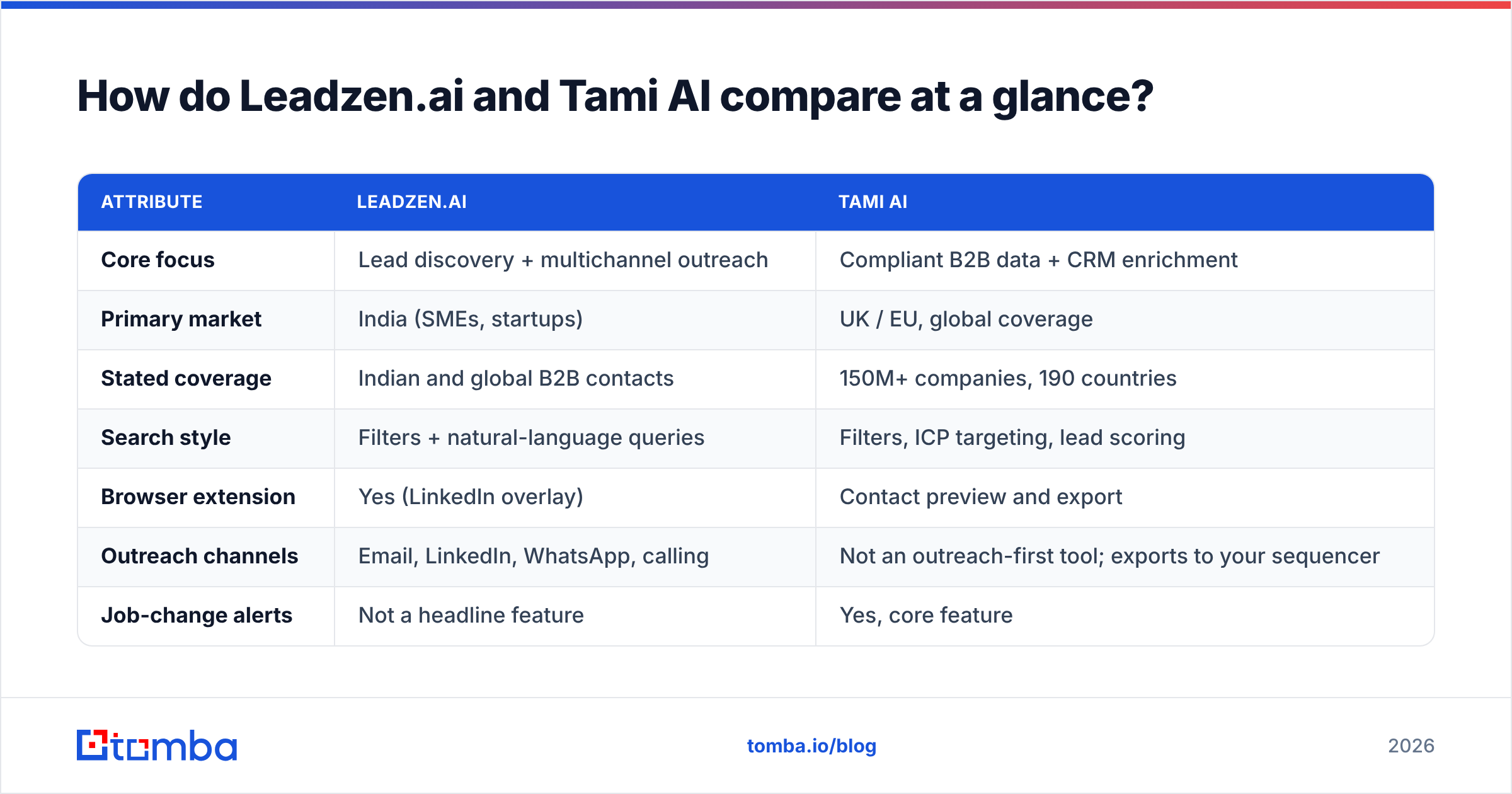
This table summarizes each product's documented capabilities as of September 2026. Vendors change plans often, so confirm the details on their pricing pages before you buy.
| Attribute | Leadzen.ai | Tami AI |
|---|---|---|
| Core focus | Lead discovery + multichannel outreach | Compliant B2B data + CRM enrichment |
| Primary market | India (SMEs, startups) | UK / EU, global coverage |
| Stated coverage | Indian and global B2B contacts | 150M+ companies, 190 countries |
| Search style | Filters + natural-language queries | Filters, ICP targeting, lead scoring |
| Browser extension | Yes (LinkedIn overlay) | Contact preview and export |
| Outreach channels | Email, LinkedIn, WhatsApp, calling | Not an outreach-first tool; exports to your sequencer |
| Job-change alerts | Not a headline feature | Yes, core feature |
| CRM integrations | Available | Salesforce, HubSpot, Pipedrive, Close, custom CRMs |
| Compliance positioning | General | GDPR-compliant data as a core claim |
| Entry pricing | ~$133/mo Standard (per directories) | ~$47/user/mo Basic, billed annually |
| Free trial | Yes | Demo / trial on request |
| Best fit | Indian SDR teams running multichannel sequences | RevOps teams that need clean, current CRM data |

The table shows the main split. Leadzen.ai covers more of the workflow, from finding a lead to the first touch. Tami AI covers less of the workflow but puts more effort into keeping data correct over time.
Which one has better data coverage and accuracy?#
It depends on where your buyers are.
For Indian mid-market and SME accounts, Leadzen.ai has the edge. The company is based in India and its dataset is weighted toward Indian companies. It also collects mobile numbers, which Indian SDR teams rely on more than their US or UK counterparts. Western data vendors are often thin on Indian SMEs outside the large metros.
For UK and European accounts, Tami AI is the safer choice. Its GDPR positioning isn't just a label. If you prospect EU residents, you need a lawful basis for processing their data, usually legitimate interest, and you need to be able to show where the data came from. The GDPR makes the data controller (you) responsible, not only the vendor, so a provider that documents its sourcing makes compliance easier.
On accuracy, Tami AI's claim of bounce rates under 5% comes from real-time refresh. B2B contact data decays quickly because people change jobs, companies rebrand and domains move. A tool that re-checks records continuously will stay ahead of one that refreshes quarterly, all else being equal.

Treat every vendor's accuracy number as a marketing claim until you have tested it on your own list. This test takes about an hour:
- Pull 200 contacts from your real ICP, split across the regions you sell into.
- Look up the same 200 contacts in each tool you are evaluating.
- Run every returned address through an independent email verifier. Don't use the vendor's own verifier.
- Compare valid rates, catch-all rates and "not found" rates by region.
The results by region will usually decide the purchase faster than any feature demo.
How does LeadzenAI vs Tami AI pricing compare?#
The two vendors price in different units, which makes a direct comparison harder than it looks.
Leadzen.ai pricing is not fully transparent in public. Directories like GetApp and Software Advice list a Standard plan starting at about $133/month, or about $1,120 billed annually. Some listings show higher tiers reaching into the thousands per month, and at least one describes pricing linked to qualified meetings delivered. You will probably need a sales conversation to get the real number for your team size.
Tami AI publishes per-seat pricing: about $47 per user per month on the Basic plan and about $67 per user per month on Growth, both billed annually.
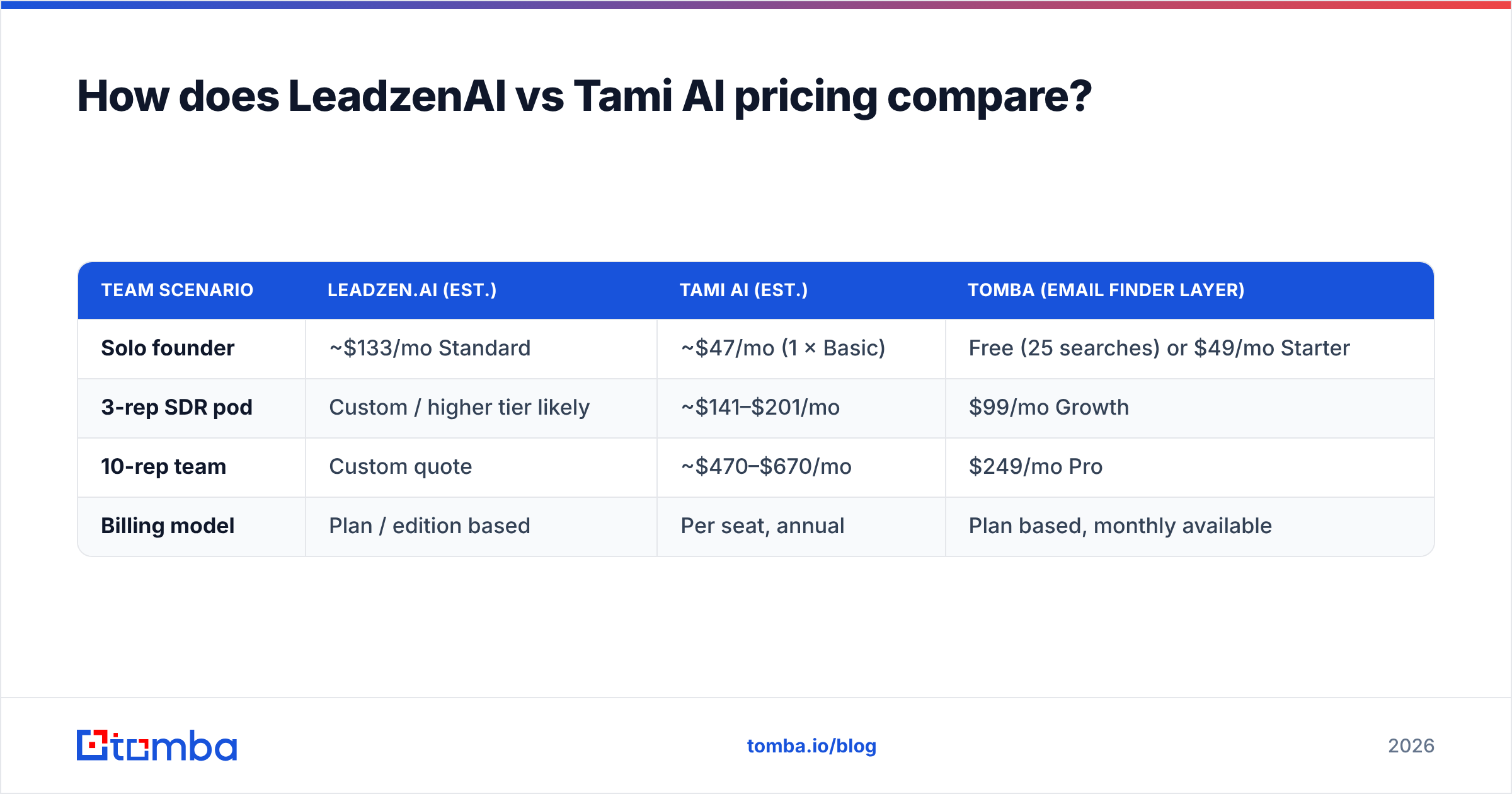
Here is how that works out for a typical team, with a dedicated email finder added as a point of reference:
| Team scenario | Leadzen.ai (est.) | Tami AI (est.) | Tomba (email finder layer) |
|---|---|---|---|
| Solo founder | ~$133/mo Standard | ~$47/mo (1 × Basic) | Free (25 searches) or $49/mo Starter |
| 3-rep SDR pod | Custom / higher tier likely | ~$141–$201/mo | $99/mo Growth |
| 10-rep team | Custom quote | ~$470–$670/mo | $249/mo Pro |
| Billing model | Plan / edition based | Per seat, annual | Plan based, monthly available |
Two things to keep in mind:
- Per-seat pricing grows with headcount. Tami AI is inexpensive for one or two users and gets expensive as you hire. Plan-based pricing grows with usage instead.
- Leadzen.ai's price includes outreach. If it replaces a separate sequencer and a WhatsApp tool, the higher entry price can cost less overall than buying Tami AI plus a sequencer.
If you only need verified emails, not a full data platform, check Tomba pricing before you commit to annual seats.
Which is better for outreach and daily SDR workflow?#
Leadzen.ai wins on outreach because Tami AI doesn't try to compete there.
An SDR using Leadzen.ai might spend a day like this: search for "HR heads at IT services companies in Pune," open a few LinkedIn profiles with the extension to read the AI buyer notes, add 40 leads to a sequence that starts with email, follows with a LinkedIn connection request, and sends a WhatsApp message on day four. Everything happens in one tool.
An SDR using Tami AI works differently. They build a scored list of target accounts, export verified contacts, or let the CRM sync handle it, and then run sequences in their existing tool such as HubSpot, Outreach, Salesloft or Instantly. Tami AI's role is to keep that CRM accurate: when a champion leaves an account, the job-change alert tells the rep to follow them to their new company.
That job-change feature is underrated. Former customers who move to a new company are one of the warmest outbound audiences you have. According to HubSpot's sales research, warm and referral-based outreach consistently converts better than cold lists. Tami AI makes it easier to catch those moves.
So:
- If your team doesn't have a sequencer yet and sells into India, Leadzen.ai covers more of what you need.
- If your team already runs a sequencer and a CRM, Tami AI adds cleaner data without making reps learn another outreach UI.
How do integrations and compliance stack up?#
Tami AI has the clearer integration story. It connects natively with Salesforce, HubSpot, Pipedrive and Close, supports custom CRMs, and maps fields automatically. For a RevOps team, that means less CSV cleanup and fewer duplicate records.
Leadzen.ai offers CRM integrations too, but it expects more of the work to happen inside Leadzen.ai itself. That suits a small team that uses Leadzen.ai as its main system. It suits a company that treats Salesforce as the source of truth less well.
On compliance:
- Selling into the EU or UK: Tami AI's GDPR focus is a real advantage. Ask any vendor for its data-sourcing documentation and opt-out process. Tami AI should have these ready.
- Selling into India: India's Digital Personal Data Protection Act (DPDP) is now in force, and its rules on consent and purpose limitation are being phased in. Ask Leadzen.ai how its data collection and WhatsApp outreach fit the DPDP framework before you scale volume.
- Selling anywhere: Whatever the tool, verify addresses before sending. High bounce rates damage your sender reputation regardless of which vendor supplied the list.
Where does a dedicated email finder fit alongside either tool?#
Many teams end up with a platform like Leadzen.ai or Tami AI for discovery and a specialist tool for email finding and verification. There are three practical reasons.
- Coverage gaps. Every database has weak spots, such as small companies, new hires, niche industries or specific countries. When your main tool returns "not found," running a domain search on the company website often recovers the contact.
- Independent verification. A second opinion on email validity from a separate verifier catches bad addresses the first vendor missed, especially on catch-all domains.
- Cost control. Buying extra platform seats just to look up a few hundred emails a month is expensive. A plan-based email finder is usually cheaper for that job.
This isn't a criticism of Leadzen.ai or Tami AI. Both are full platforms that do more than email lookup. Specialist tools just do one job well, and your outbound stack will usually combine both kinds.
Which should you choose: Leadzen.ai or Tami AI?#
Match the tool to your situation:
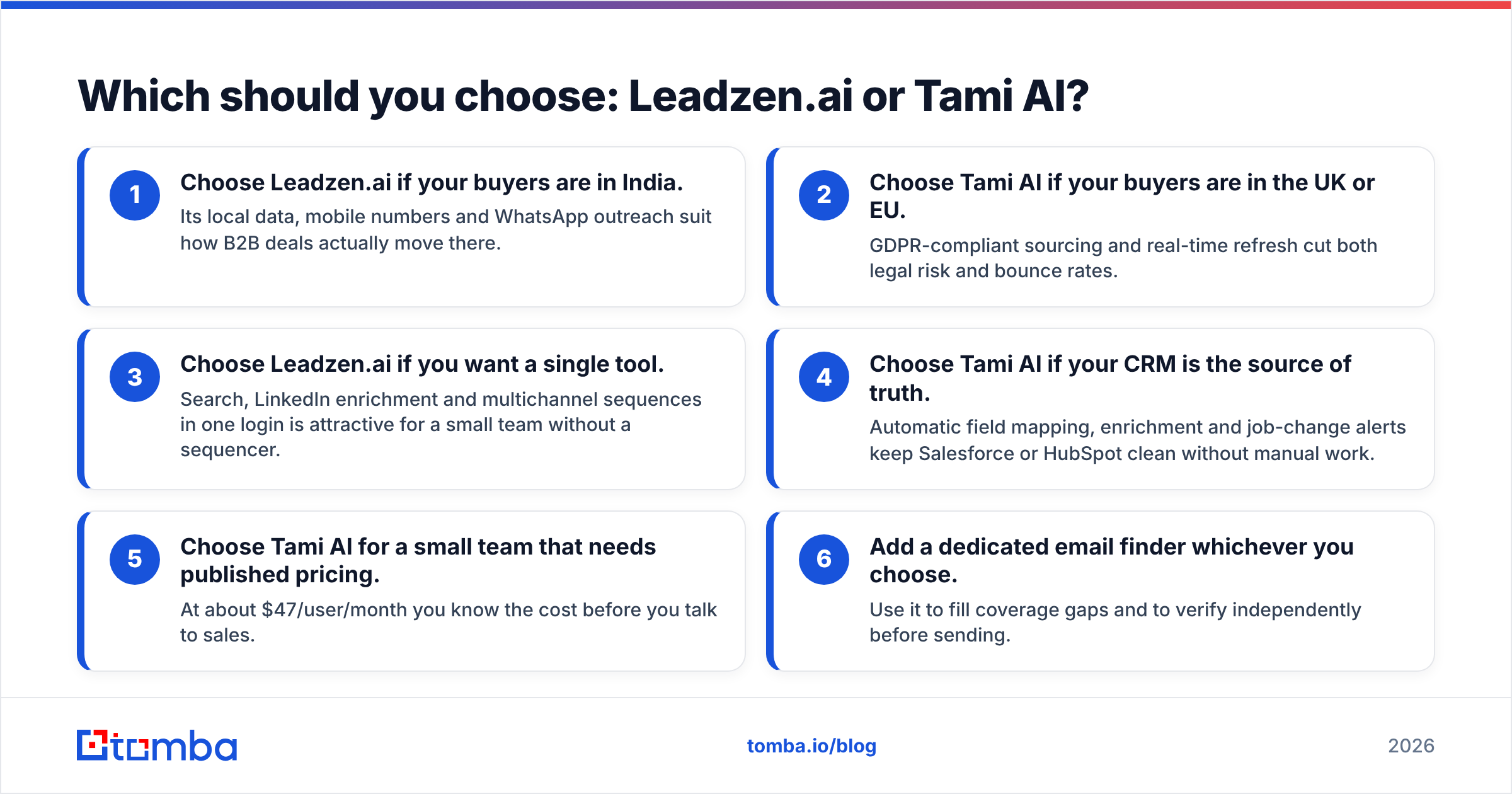
- Choose Leadzen.ai if your buyers are in India. Its local data, mobile numbers and WhatsApp outreach suit how B2B deals actually move there.
- Choose Tami AI if your buyers are in the UK or EU. GDPR-compliant sourcing and real-time refresh cut both legal risk and bounce rates.
- Choose Leadzen.ai if you want a single tool. Search, LinkedIn enrichment and multichannel sequences in one login is attractive for a small team without a sequencer.
- Choose Tami AI if your CRM is the source of truth. Automatic field mapping, enrichment and job-change alerts keep Salesforce or HubSpot clean without manual work.
- Choose Tami AI for a small team that needs published pricing. At about $47/user/month you know the cost before you talk to sales.
- Add a dedicated email finder whichever you choose. Use it to fill coverage gaps and to verify independently before sending.
If you still can't decide, run the 200-contact test described above on both free trials. Regional hit rates plus your existing stack will almost always settle it.
FAQ#
Is Leadzen.ai better than Tami AI?#
Neither is better overall. Leadzen.ai is stronger for Indian markets and multichannel outreach, including WhatsApp. Tami AI is stronger for GDPR-compliant data, real-time accuracy and CRM enrichment in the UK and EU.
How much does Tami AI cost?#
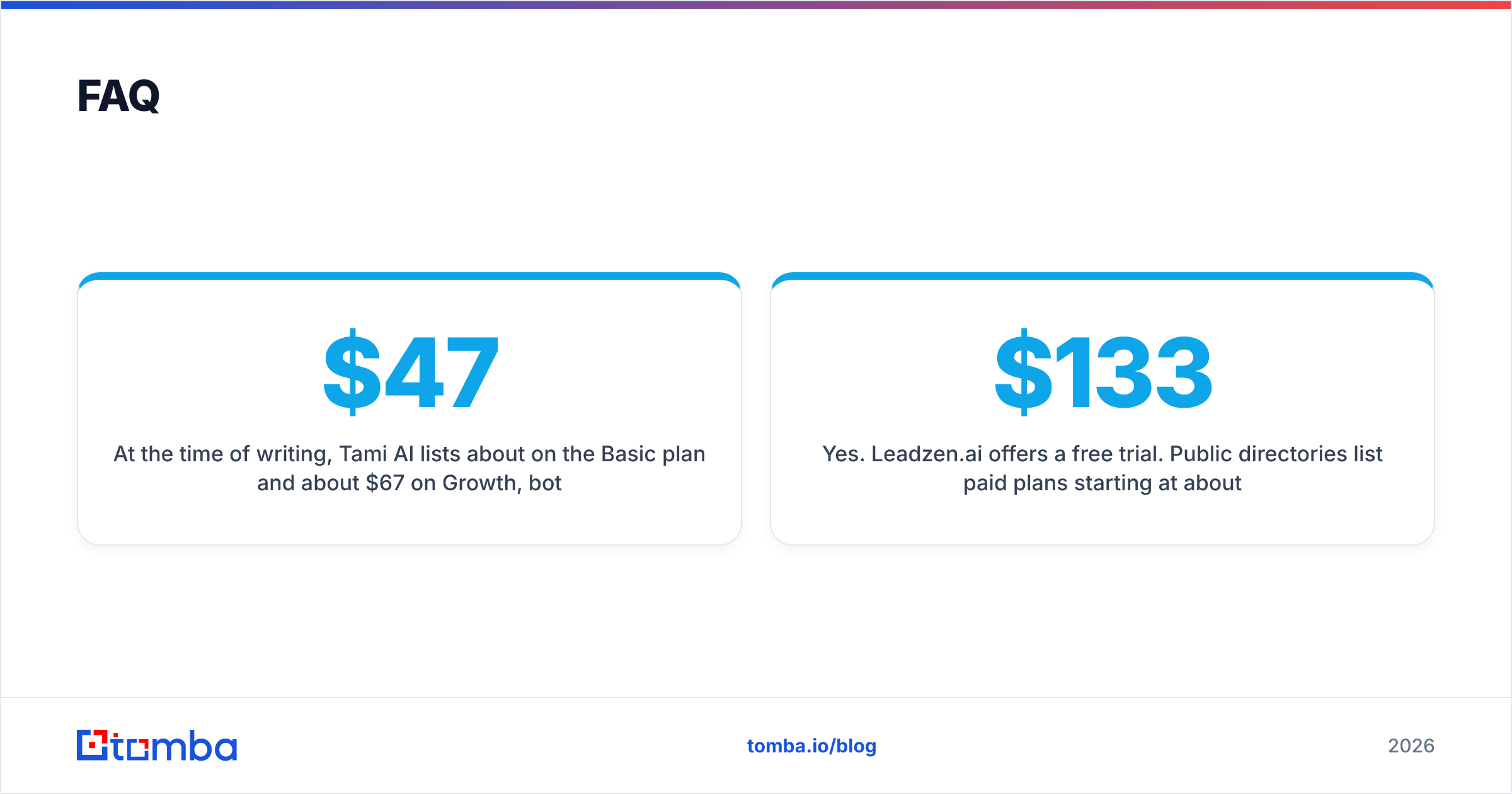
At the time of writing, Tami AI lists about $47 per user per month on the Basic plan and about $67 per user per month on Growth, both billed annually. Check the vendor's site for current pricing.
Does Leadzen.ai have a free trial?#
Yes. Leadzen.ai offers a free trial. Public directories list paid plans starting at about $133/month, but larger teams usually need a custom quote.
Can I use Tami AI data for cold email in Europe?#
Tami AI positions its data as GDPR-compliant, but compliance also depends on how you use the data. You still need a lawful basis such as legitimate interest, a clear opt-out and a documented data source.
Do I still need an email verifier with these tools?#
Yes. Every data vendor's records decay over time. Verifying independently before each campaign protects your domain reputation and keeps bounce rates low.
Ready to fill the gaps either platform leaves?#
Whether you choose Leadzen.ai for India-first outreach or Tami AI for GDPR-first data, you will still find contacts that come back as "not found" and addresses that need a second check before a campaign goes out. The Tomba Email Finder handles that job. It finds professional email addresses by name, domain or company, verifies them before you send, and offers a free tier with 25 searches a month so you can test it against your own list. Start with the accounts your current tool couldn't find and compare the hit rates yourself.
Related guides#
// get started
Find, verify and enrich your first contacts today
Start on the free plan with 25 searches a month, then scale when your team is ready.
Free plan · No credit card required · GDPR & CCPA
// about the author