Leadzenai vs The Data City: Contact Data or Market Intelligence?
Leadzenai and The Data City both sell B2B data, but they answer different questions. One helps you reach a person. The other helps you understand a market. Here is how to tell which one your team needs.
TL;DR
- Leadzenai and The Data City are not direct substitutes. Leadzenai is an AI prospecting and contact-data tool. The Data City is a UK-first industry intelligence platform built around Real-Time Industrial Classifications (RTICs).
- Choose Leadzenai if you need names, emails, and phone numbers for outbound. Choose The Data City if you need to size a sector, map an emerging industry, or build a target-account universe that SIC codes miss.
- Their pricing models differ. Leadzenai sells self-serve, credit-based plans. The Data City sells subscriptions and project licences mostly through sales conversations.
- Many teams need both layers: market intelligence to decide who to target, and a contact finder plus verifier to actually reach them.
- Verify before you send. Contact data from any provider goes stale, so run exports through an email verifier before they go into a sequence.
What is the real difference in the Leadzenai vs The Data City question?#
People usually search "Leadzenai vs The Data City" because both show up when they look for "B2B data". The phrase covers two very different jobs, though:
- Account and market intelligence: which companies exist in a sector, how fast they grow, where they are, and what they actually do.
- Contact intelligence: who works at those companies and how to reach them by email or phone.
The Data City does the first job. Leadzenai does the second. When you compare them feature by feature, you are really choosing which layer of your go-to-market stack is missing.
A useful analogy is a property search. The Data City is the map that shows every street in a new neighbourhood and which ones are growing. Leadzenai is the directory that tells you who lives at each address and how to contact them. You can't knock on doors with a map, and a directory won't show you which neighbourhood to target.
What is Leadzenai?#
Leadzenai is an AI-driven B2B lead generation platform. It focuses on finding prospects and revealing their contact details. The typical workflow:
- Search for prospects using filters such as job title, seniority, industry, location, and company size.
- Reveal contact data (work emails, and phone numbers where available) using credits.
- Use the Chrome extension to pull contact details while browsing LinkedIn profiles.
- Enrich existing lists by uploading records and filling in missing fields.
- Export to CSV or connect to your CRM and outreach tools.
The product is aimed at SDRs, founders running their own outbound, recruiters, and agencies. You sign up, get a small allowance of credits, and start pulling contacts within minutes. The whole motion is self-serve.
Leadzenai is at its best when your ideal customer profile (ICP) is already clear and you just need reachable people inside that profile. It is not built to tell you whether that ICP is the right one, or how big the addressable market really is.
What is The Data City?#
The Data City is a UK-based data company that classifies businesses by reading their websites and other public signals with machine learning. Traditional Standard Industrial Classification (SIC) codes are self-reported, rarely updated, and too coarse for new sectors. The Data City builds Real-Time Industrial Classifications (RTICs) instead: sector definitions for areas like net zero, cybersecurity, AI, fintech, space, or life sciences that SIC codes either split across dozens of codes or miss completely.
Its core capabilities:
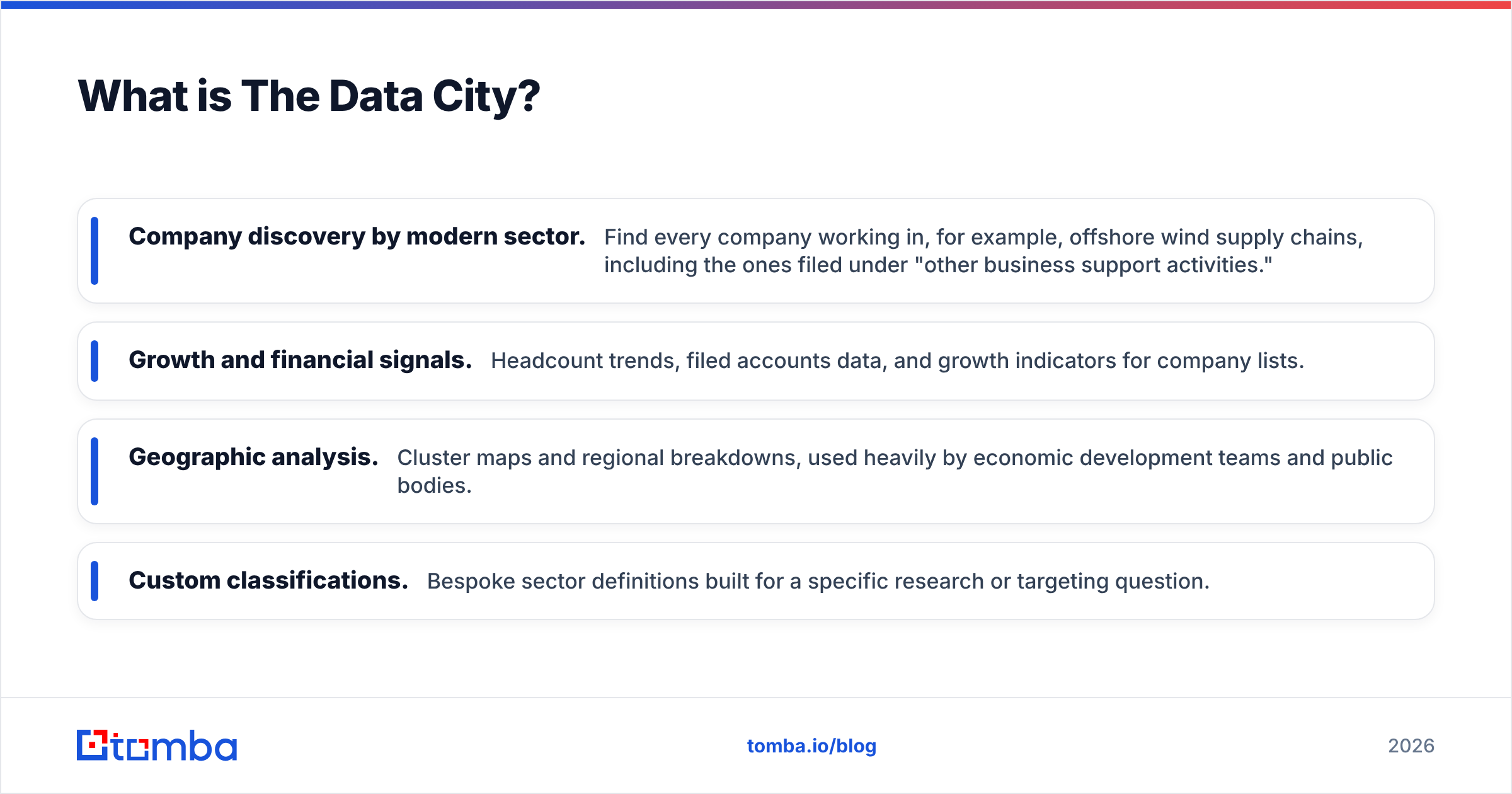
- Company discovery by modern sector. Find every company working in, for example, offshore wind supply chains, including the ones filed under "other business support activities."
- Growth and financial signals. Headcount trends, filed accounts data, and growth indicators for company lists.
- Geographic analysis. Cluster maps and regional breakdowns, used heavily by economic development teams and public bodies.
- Custom classifications. Bespoke sector definitions built for a specific research or targeting question.
Its customers are mostly local and national government bodies, economic development agencies, universities, investors, consultancies, and B2B companies doing serious market sizing. The deliverable is a list of organisations with context, not a list of people with inboxes.

How do Leadzenai and The Data City compare side by side?#
This table compares both platforms on the attributes that decide a purchase. Pricing details change often, so confirm current figures on each vendor's site before you budget.
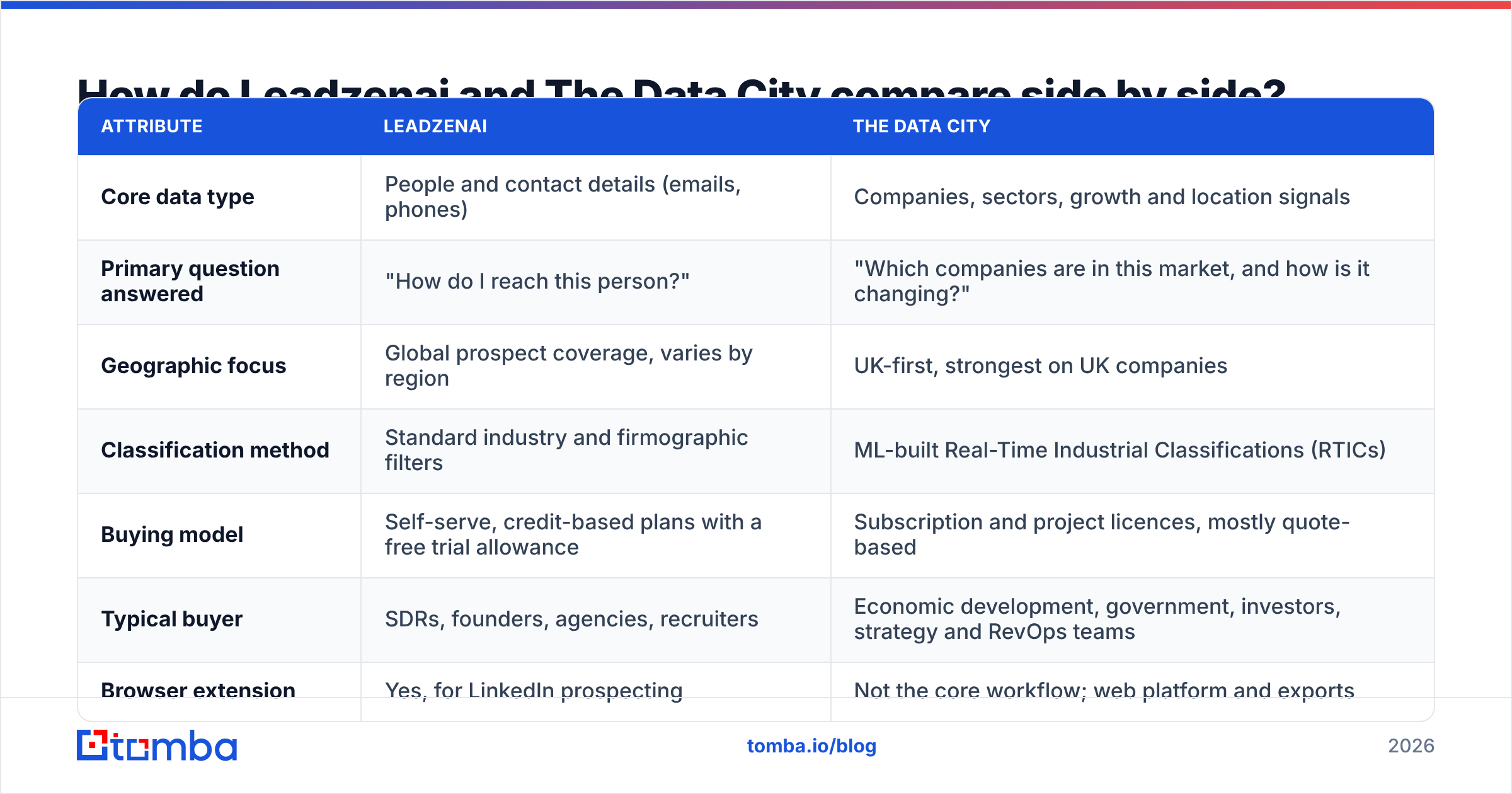
| Attribute | Leadzenai | The Data City |
|---|---|---|
| Core data type | People and contact details (emails, phones) | Companies, sectors, growth and location signals |
| Primary question answered | "How do I reach this person?" | "Which companies are in this market, and how is it changing?" |
| Geographic focus | Global prospect coverage, varies by region | UK-first, strongest on UK companies |
| Classification method | Standard industry and firmographic filters | ML-built Real-Time Industrial Classifications (RTICs) |
| Buying model | Self-serve, credit-based plans with a free trial allowance | Subscription and project licences, mostly quote-based |
| Typical buyer | SDRs, founders, agencies, recruiters | Economic development, government, investors, strategy and RevOps teams |
| Browser extension | Yes, for LinkedIn prospecting | Not the core workflow; web platform and exports |
| Best output | A contact list ready for outreach | A target-account universe or a sector report |
| Main limitation | Doesn't define or size your market | Doesn't give you personal contact details for outreach |
The table shows a clean split. The overlap is small: both help you build lists of companies you might sell to. Beyond that, they diverge.
Which tool is better for outbound prospecting?#
Leadzenai is the better fit for outbound prospecting, because outbound needs a named person and a working channel. The Data City can tell you there are 1,400 UK companies in a niche sector. It won't hand you the Head of Procurement's email at each one.
With Leadzenai the loop is short: filter, reveal, export, sequence. For an SDR team that needs 50 fresh contacts a day, that speed matters more than sector nuance.
Leadzenai's weakness in outbound is the same one every contact-data provider has: data decay. People change jobs, companies change email patterns, and domains get reconfigured as catch-all. Whatever tool you use, treat revealed emails as candidates, not certainties. Run them through an email verifier before they reach your sending domain, especially at volume. Protecting your sender reputation is cheaper than repairing it.
Which tool is better for market sizing and account targeting?#
The Data City is clearly stronger for market sizing and account-universe work. This is where SIC-based filtering, which most contact-data tools inherit, breaks down.
Say you sell software to companies in the UK hydrogen economy. There is no clean SIC code for that. A standard filter in a prospecting tool returns a mix of chemical manufacturers, engineering consultancies, and irrelevant firms, and it misses the startups that registered under generic codes. The Data City's approach of reading what a company actually says it does on its website produces a far more accurate list of who is really in the space.
That matters for:
- TAM/SAM estimates that board members and investors will actually believe.
- Territory planning, where regional density decides headcount allocation.
- ABM programmes, where a tight, accurate account list is worth more than a big, noisy one.
- Investment and policy research, which is The Data City's original home turf.
Leadzenai's filters are good enough for "Series A SaaS companies in London with 50–200 employees." They are not designed for "every company building battery storage components in the North of England."
How does pricing compare?#
The two companies charge in fundamentally different ways, and that affects who can realistically buy each tool.
Leadzenai uses a credit model with a trial allowance and tiered monthly or annual plans. You pay roughly in proportion to how many contacts you reveal. A solo founder can start small and scale up, and costs map directly to pipeline activity.
The Data City sells access to its platform and data, and runs custom classification or research projects. Pricing is generally scoped through a sales conversation and depends on coverage, seats, and whether you need bespoke RTICs. You're buying a strategic data asset, not a per-contact consumable.
Some practical takeaways:
- Budget owner differs. Leadzenai usually comes out of a sales or growth budget. The Data City tends to sit with strategy, RevOps, research, or a public-sector programme budget.
- Cost per useful output differs. A single well-built sector list from The Data City can shape a year of targeting. A Leadzenai credit buys one contact reveal.
- Hidden costs exist on both sides. With contact tools, the hidden cost is verification and bounce management. With intelligence platforms, it's the analyst time needed to turn the data into decisions.
For benchmarks on what contact-data tools cost per verified email, peer reviews on G2 are a reasonable starting point. Weight recent reviews more heavily, because data quality changes over time.
What are the pros and cons of each?#
Leadzenai pros
- Fast time to value: you can have a usable contact list the same day.
- Self-serve pricing that suits small teams and individual reps.
- LinkedIn extension that fits how many SDRs already prospect.
- Enrichment for lists you already have.
Leadzenai cons
- Contact accuracy varies by region and seniority, as it does for every provider, so plan to verify.
- Firmographic filters are conventional and weak for emerging or niche sectors.
- No market-sizing layer, so it assumes you already know who to target.
The Data City pros
- Sector definitions that reflect reality, not decades-old SIC codes.
- Strong UK coverage with growth, location, and financial context.
- Credible for strategy work, including investor decks, policy reports, and territory design.
- Custom classifications for unusual markets.
The Data City cons
- No outreach-ready contact data, so you still need a contact layer.
- UK-first coverage limits it for teams selling mainly into other regions.
- Sales-led buying is slower than swiping a card.

Can you use Leadzenai and The Data City together?#
Yes. For teams selling into specialised UK sectors, the combination often works better than either tool alone. A practical stack looks like this:
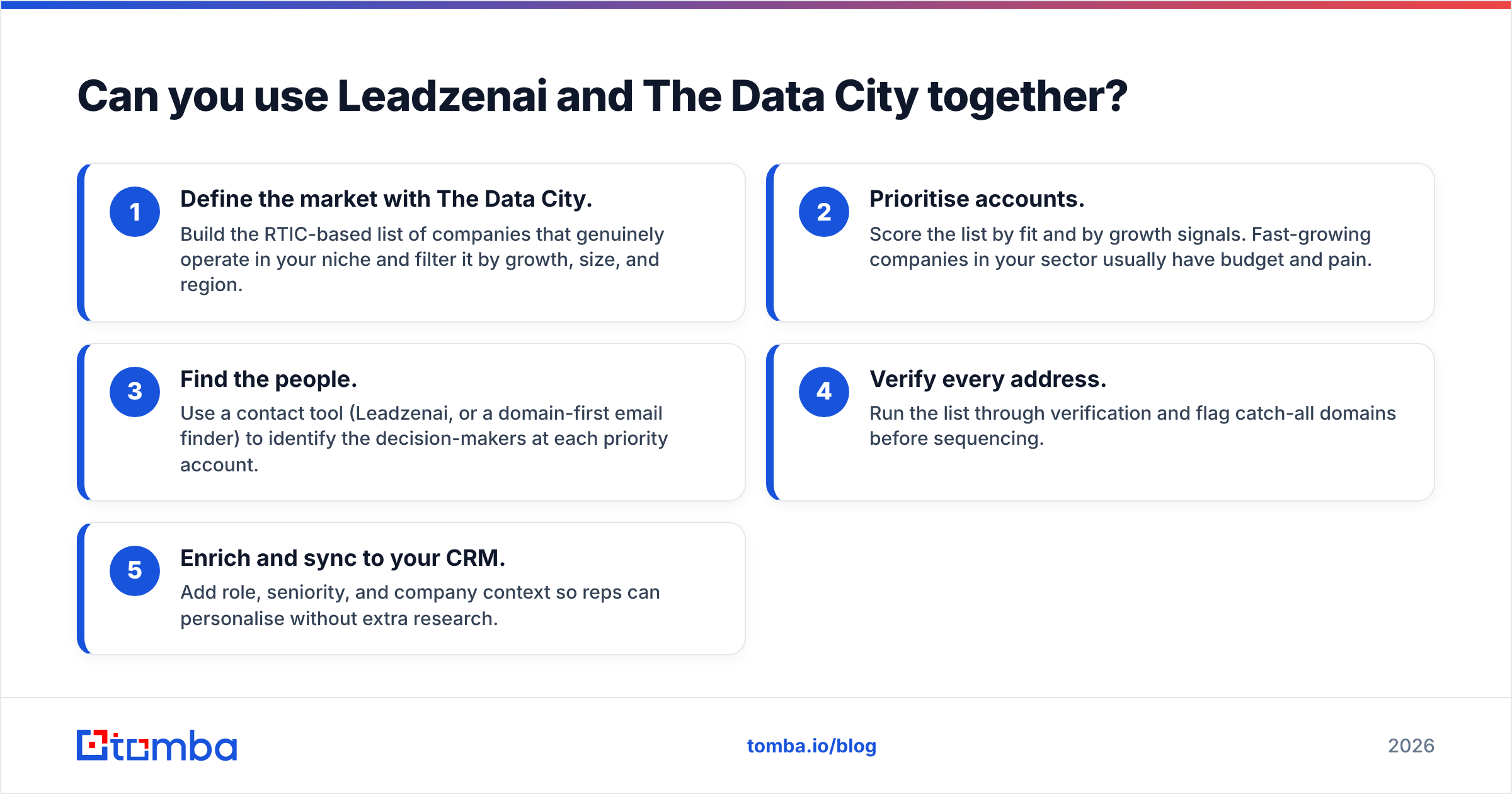
- Define the market with The Data City. Build the RTIC-based list of companies that genuinely operate in your niche and filter it by growth, size, and region.
- Prioritise accounts. Score the list by fit and by growth signals. Fast-growing companies in your sector usually have budget and pain.
- Find the people. Use a contact tool (Leadzenai, or a domain-first email finder) to identify the decision-makers at each priority account.
- Verify every address. Run the list through verification and flag catch-all domains before sequencing.
- Enrich and sync to your CRM. Add role, seniority, and company context so reps can personalise without extra research.
Step 3 is where the tool choice gets interesting. The Data City's output is a list of companies and domains, so a domain-based finder slots in naturally: feed in the domain, get the known addresses and the company's email pattern back. Name-and-LinkedIn tools like Leadzenai work best when you already have the person in front of you.
Where does Tomba fit into this comparison?#
Tomba sits in the contact layer next to Leadzenai. It is not a replacement for The Data City's industry intelligence. Where it tends to fit better is the "I have a list of company domains, now I need people" step described above.
- Domain-first search. Paste a domain and get the publicly sourced emails associated with it, plus the detected email pattern.
- Name + domain lookups for when you know exactly who you want.
- Built-in verification, including catch-all handling, so you aren't bolting on a second vendor.
- Bulk processing for turning a few hundred target accounts from a market-intelligence export into contacts in one pass.
- Data enrichment to add firmographic and role context back onto your records.
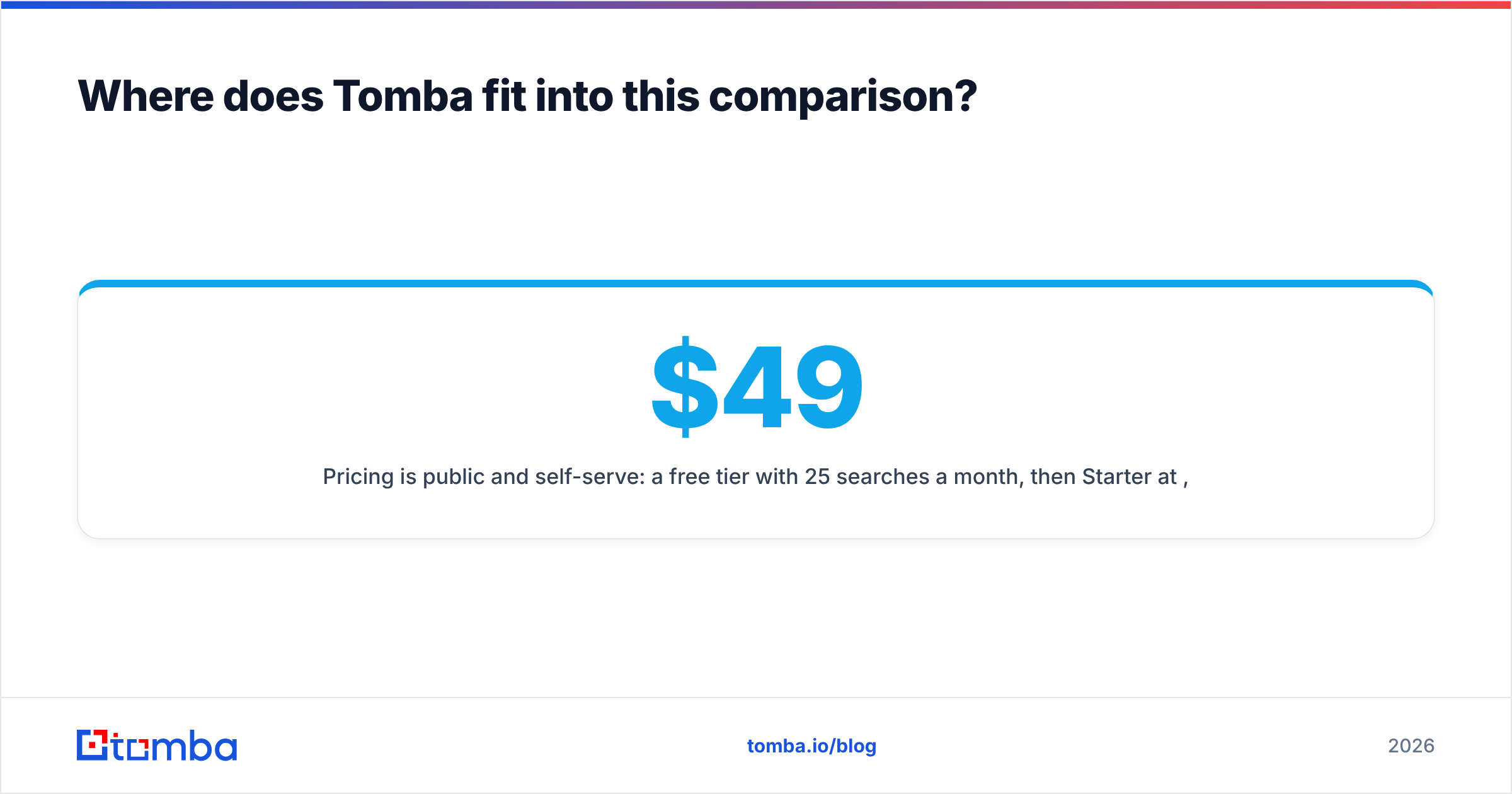
Pricing is public and self-serve: a free tier with 25 searches a month, then Starter at $49/mo, Growth at $99/mo, Pro at $249/mo, and custom Enterprise plans. Full Tomba pricing lists what each tier includes.
The honest positioning is this: if your bottleneck is finding the right companies in a specialised UK market, no email finder solves it, and The Data City is worth the conversation. If your bottleneck is reaching people at companies you've already identified, a contact tool does the job, and it comes down to accuracy, verification, and cost per usable email.
So which should you choose: Leadzenai or The Data City?#
Use this decision shortcut:
- You need contacts this week for an outbound campaign → Leadzenai (or another contact finder).
- You need to know how big a UK sector is, who is in it, and where it's growing → The Data City.
- You sell into a niche UK industry and run account-based outbound → Both: The Data City for the account universe, a contact finder plus verifier for the people.
- You're a public body, investor, or consultancy doing sector research → The Data City. Leadzenai isn't built for this.
- You're a solo founder on a tight budget → Start with a self-serve contact tool. Market intelligence platforms are usually overkill until your ICP needs sharper definition.
The mistake to avoid is buying one of these to do the other's job. A prospecting tool won't give you a defensible market map, and an intelligence platform won't fill your sequences.
Ready to turn your target accounts into verified contacts?#
If you already know which companies you want, whether they came from The Data City, your CRM, or a spreadsheet of target domains, the next step is reaching the right people without burning your domain. Tomba Email Finder takes a domain or a name and company and returns professional email addresses with built-in verification. Start on the free tier with 25 searches a month, test it on your own account list, and upgrade only when the numbers justify it.
Related guides#
// get started
Find, verify and enrich your first contacts today
Start on the free plan with 25 searches a month, then scale when your team is ready.
Free plan · No credit card required · GDPR & CCPA
// about the author