Lean Sales: How to Cut Waste From Your B2B Sales Process in 2026
Most sales teams don't have a pipeline problem. They have a waste problem. Here is how lean sales finds the handoffs, tools, and bad data eating your reps' week, and what to cut first.
TL;DR
- Lean sales applies Toyota's lean manufacturing ideas to selling. You map every step from first touch to closed deal, then remove any step the buyer wouldn't pay for.
- Most B2B sales waste falls into seven types. The worst are bad contact data, too many handoffs, and admin work that pulls reps away from selling.
- A lean sales process adds nothing new. It starts by cutting: fewer tools, fewer stages, fewer meetings, cleaner data.
- The fastest win for most teams is fixing lead data at the source. Verified emails and enriched records remove bounces, rework, and wasted sequences further down the funnel.
- You can put a basic lean sales system in place in about 30 days using a value stream map, a waste audit, and a weekly improvement habit.
What is lean sales?#
Lean sales means running your sales process on lean principles. You define value from the buyer's point of view, map the steps that deliver it, and remove the steps that don't.
The ideas come from the Toyota Production System. Toyota built it around eliminating muda (waste) on the factory floor. Later the Lean Enterprise Institute and others adapted it for knowledge work: software, healthcare, and eventually sales and revenue teams.
On a factory floor, waste looks like excess inventory or parts waiting between stations. In sales, it looks like this:
- An SDR spends 40 minutes hunting for one decision-maker's email.
- A lead sits in a queue for three days because nobody owns the handoff.
- An AE re-asks discovery questions the SDR already covered.
- A 12-step sequence goes out to a list where one address in five bounces.
- Reps fill in CRM fields that nobody ever reports on.
None of these steps moves the buyer closer to a decision. Lean sales treats each one as a defect to remove, not a cost of doing business.
Lean sales is not a plan to cut headcount or squeeze reps harder. The goal is to give your existing team more selling time. Salesforce's State of Sales research has repeatedly found that reps spend only about 30% of their week actually selling. The other 70% is where lean sales does its work.
How is lean sales different from a traditional sales process?#
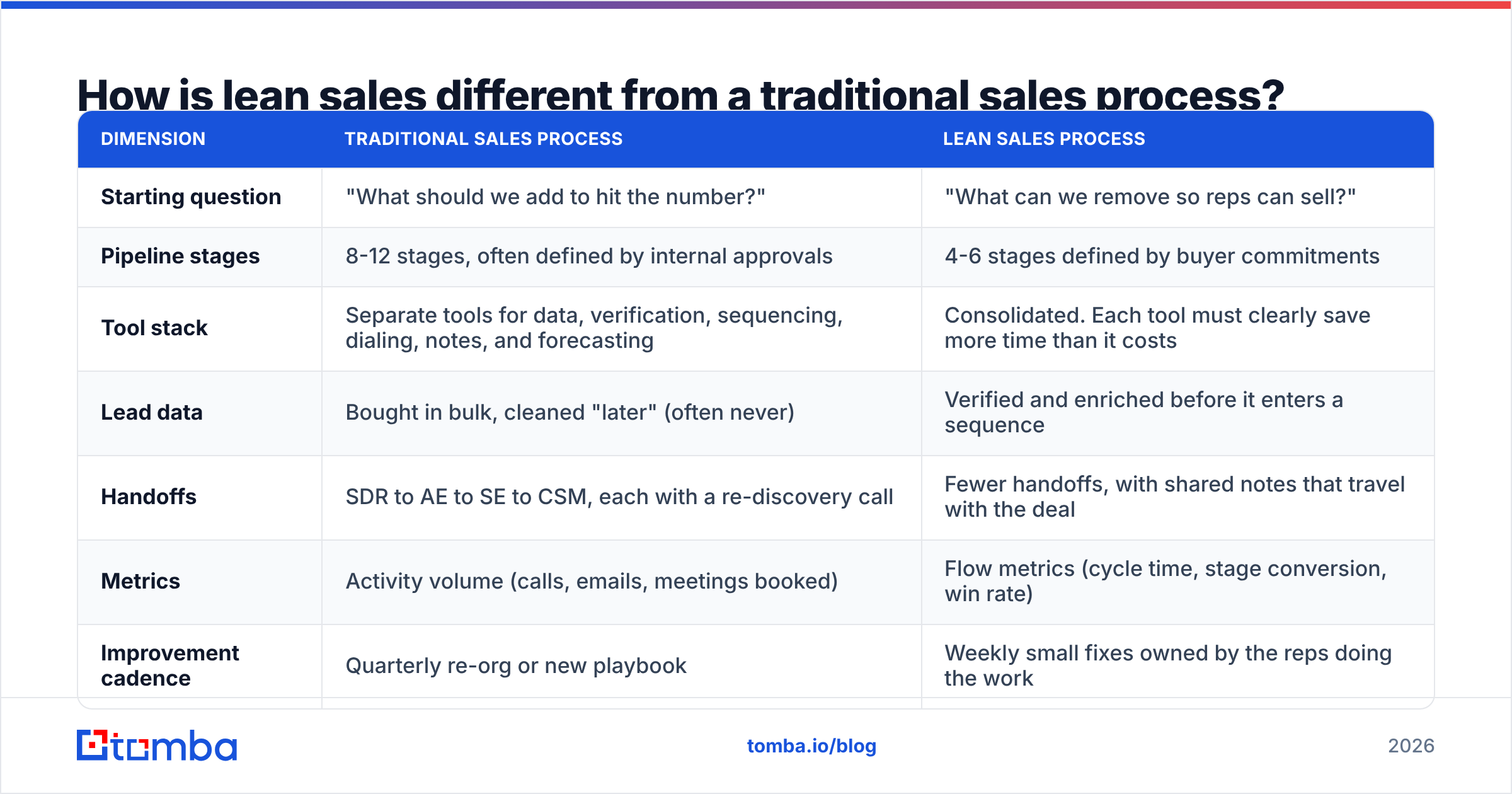
A traditional sales process tends to grow by adding things. When conversion drops, the team adds a tool, a stage, an approval step, or a new report. A lean process starts from the other direction and asks what it can take away.
| Dimension | Traditional sales process | Lean sales process |
|---|---|---|
| Starting question | "What should we add to hit the number?" | "What can we remove so reps can sell?" |
| Pipeline stages | 8-12 stages, often defined by internal approvals | 4-6 stages defined by buyer commitments |
| Tool stack | Separate tools for data, verification, sequencing, dialing, notes, and forecasting | Consolidated. Each tool must clearly save more time than it costs |
| Lead data | Bought in bulk, cleaned "later" (often never) | Verified and enriched before it enters a sequence |
| Handoffs | SDR to AE to SE to CSM, each with a re-discovery call | Fewer handoffs, with shared notes that travel with the deal |
| Metrics | Activity volume (calls, emails, meetings booked) | Flow metrics (cycle time, stage conversion, win rate) |
| Improvement cadence | Quarterly re-org or new playbook | Weekly small fixes owned by the reps doing the work |
| Typical failure mode | Tool sprawl and busywork | Over-trimming steps buyers actually need |
The last row is important. Lean done badly turns into cost-cutting theater. The discipline is to remove waste as the buyer sees it. A security review may feel like friction to your AE, but an enterprise buyer needs it. Remove it and you lose the deal.
What are the 7 wastes in a sales process?#
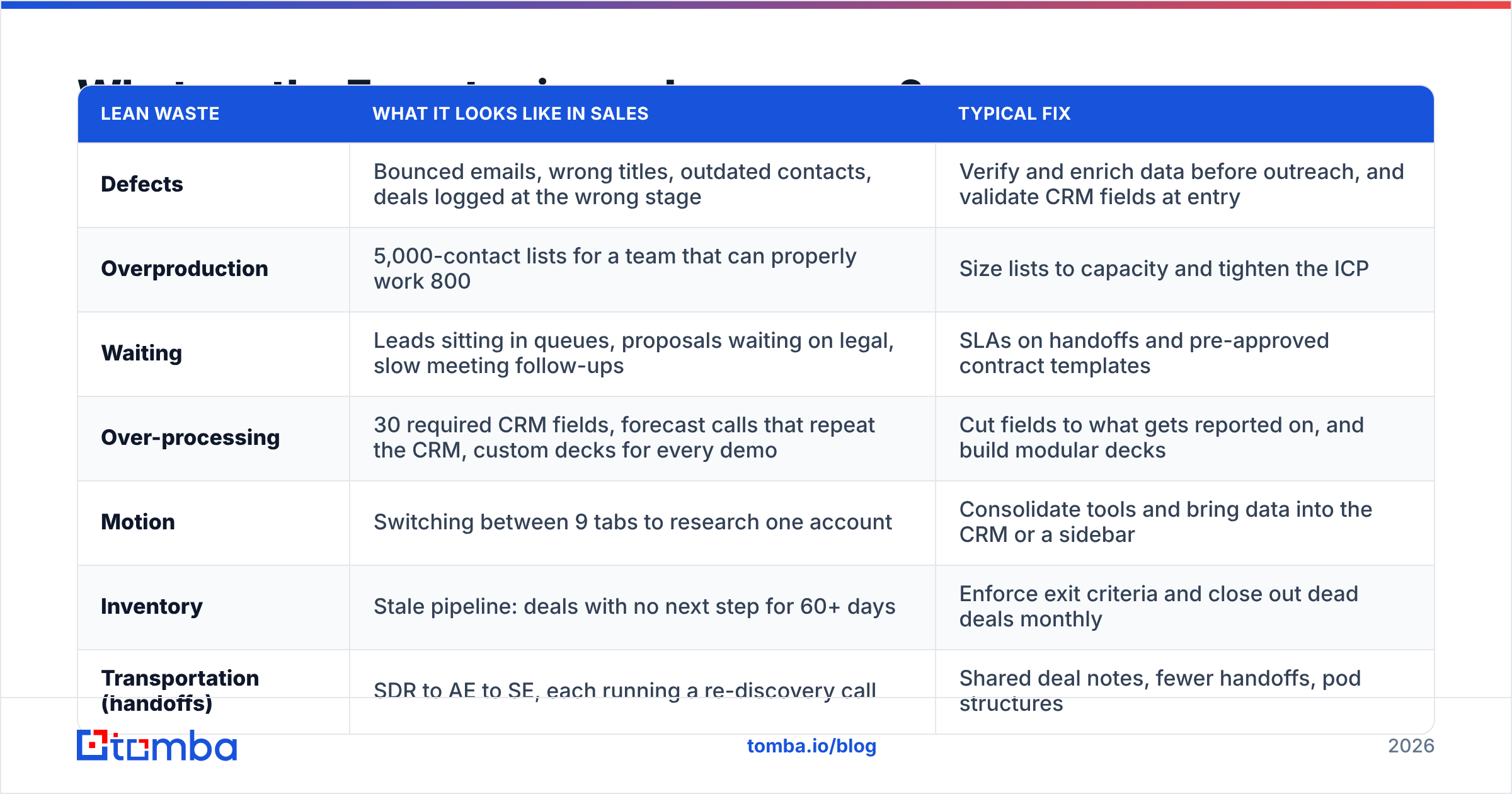
Lean manufacturing names seven classic wastes. They carry over to B2B sales with very little translation. Use this table as your audit checklist.
| Lean waste | What it looks like in sales | Typical fix |
|---|---|---|
| Defects | Bounced emails, wrong titles, outdated contacts, deals logged at the wrong stage | Verify and enrich data before outreach, and validate CRM fields at entry |
| Overproduction | 5,000-contact lists for a team that can properly work 800 | Size lists to capacity and tighten the ICP |
| Waiting | Leads sitting in queues, proposals waiting on legal, slow meeting follow-ups | SLAs on handoffs and pre-approved contract templates |
| Over-processing | 30 required CRM fields, forecast calls that repeat the CRM, custom decks for every demo | Cut fields to what gets reported on, and build modular decks |
| Motion | Switching between 9 tabs to research one account | Consolidate tools and bring data into the CRM or a sidebar |
| Inventory | Stale pipeline: deals with no next step for 60+ days | Enforce exit criteria and close out dead deals monthly |
| Transportation (handoffs) | SDR to AE to SE, each running a re-discovery call | Shared deal notes, fewer handoffs, pod structures |
Some lean practitioners add an eighth waste, unused talent. In sales that means senior AEs doing list-building or data cleanup that a tool or a junior teammate could handle.
Why defects are usually the most expensive waste#
Defects cost the most because they compound. Suppose one in five emails in your list is invalid:
- Your sequence tool sends to dead addresses, and your bounce rate climbs.
- Mailbox providers notice, and inbox placement drops for your good contacts too.
- Reply rates fall, so the team concludes "the messaging isn't working" and rewrites copy.
- Reps spend hours re-researching contacts by hand to replace bounced ones.
One upstream defect creates four downstream wastes. That is why lean teams fix data quality at the entry point. They run lists through an email verifier before anything is sequenced, and they fill in missing titles, company size, and phone numbers with data enrichment so reps don't research by hand.
How do you build a lean sales process step by step?#
You don't need a consultant or a six-month transformation. Here is a practical five-step sequence that most teams can run in about 30 days.
Define value from the buyer's side. Write down what your buyer actually needs to reach a decision: the proof, the people, the paperwork. Anything your process does that isn't on this list is a candidate for removal. Interview three recent closed-won customers and three closed-lost ones and ask which steps helped and which slowed them down.
Map the value stream. Put every step from "contact identified" to "contract signed" on a whiteboard. For each step, record who owns it, how long it takes in active work, and how long it sits waiting. Most teams find that waiting time is 5-10x the active work time. That gap is your biggest opportunity.
Tag every step as value, necessary waste, or pure waste. Value moves the buyer forward, like a tailored demo. Necessary waste doesn't add value but can't be skipped yet, like a procurement form. Pure waste can go today, like a manual list export or a duplicate discovery call. Cut the pure waste immediately and put necessary waste on a list to shrink over time.
Create flow and pull. Remove queues between stages. Set handoff SLAs (for example, AE accepts or rejects an SDR-sourced meeting within 4 business hours). Limit work in progress: an AE juggling 60 open opportunities gives none of them proper attention. Let reps pull new leads when they have capacity instead of pushing lists at them.
Improve continuously (kaizen). Hold a 30-minute weekly review in which reps name one friction point and one small fix. Track the change in cycle time or stage conversion. Lean is a habit, not a project, and teams that stop the weekly review drift back to where they started within two quarters.
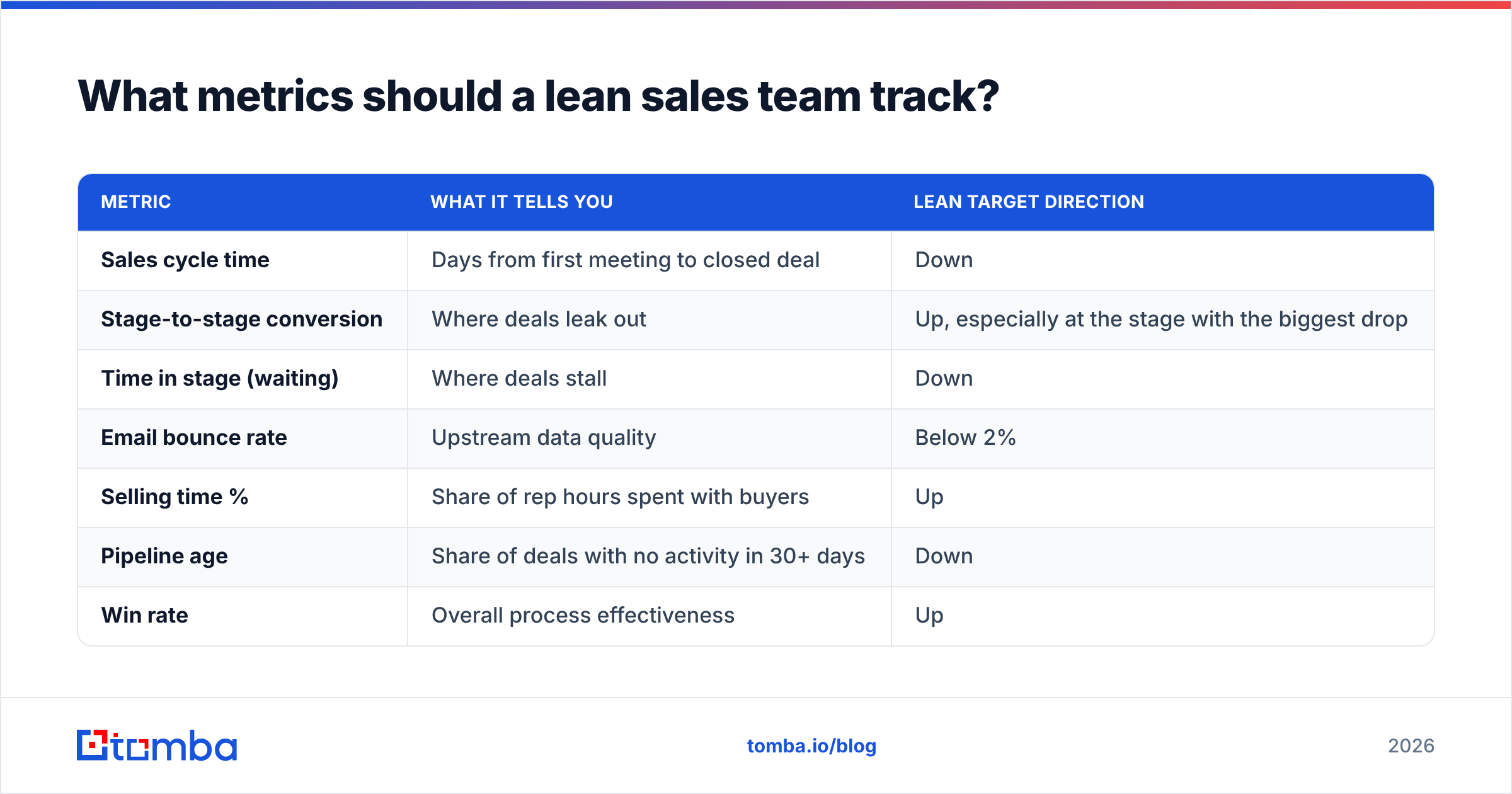
What metrics should a lean sales team track?#
Traditional dashboards reward activity: dials, emails sent, meetings booked. Lean sales tracks flow, which tells you how smoothly value moves through the system.
| Metric | What it tells you | Lean target direction |
|---|---|---|
| Sales cycle time | Days from first meeting to closed deal | Down |
| Stage-to-stage conversion | Where deals leak out | Up, especially at the stage with the biggest drop |
| Time in stage (waiting) | Where deals stall | Down |
| Email bounce rate | Upstream data quality | Below 2% |
| Selling time % | Share of rep hours spent with buyers | Up |
| Pipeline age | Share of deals with no activity in 30+ days | Down |
| Win rate | Overall process effectiveness | Up |
Pick three of these to start. The combination of cycle time, bounce rate, and selling time % covers data quality, flow, and rep capacity in a single view.
Which tools fit a lean sales stack?#
Lean sales doesn't oppose tools. It opposes tools that add motion without removing work. Before you keep or buy any tool, ask: does this remove a step, or does it add a screen?
A lean B2B stack usually has four layers:
- CRM as the single source of truth. HubSpot, Salesforce, or Pipedrive. One system, not three, with the minimum fields you actually report on.
- Data layer. Finding, verifying, and enriching contacts. This is where defects either get caught or leak into the rest of the process. Tomba, Apollo, BookYourData, and others all compete here. BookYourData's prebuilt lists work well for teams that want ready-made segments. Tomba focuses on domain and name-based email finding with built-in verification. The right choice depends on whether you build lists yourself or buy them.
- Engagement layer. One sequencing tool for email and, if needed, calls. Don't run two.
- Conversation and forecasting layer. Only once the first three work. Many teams under 20 reps don't need it at all.
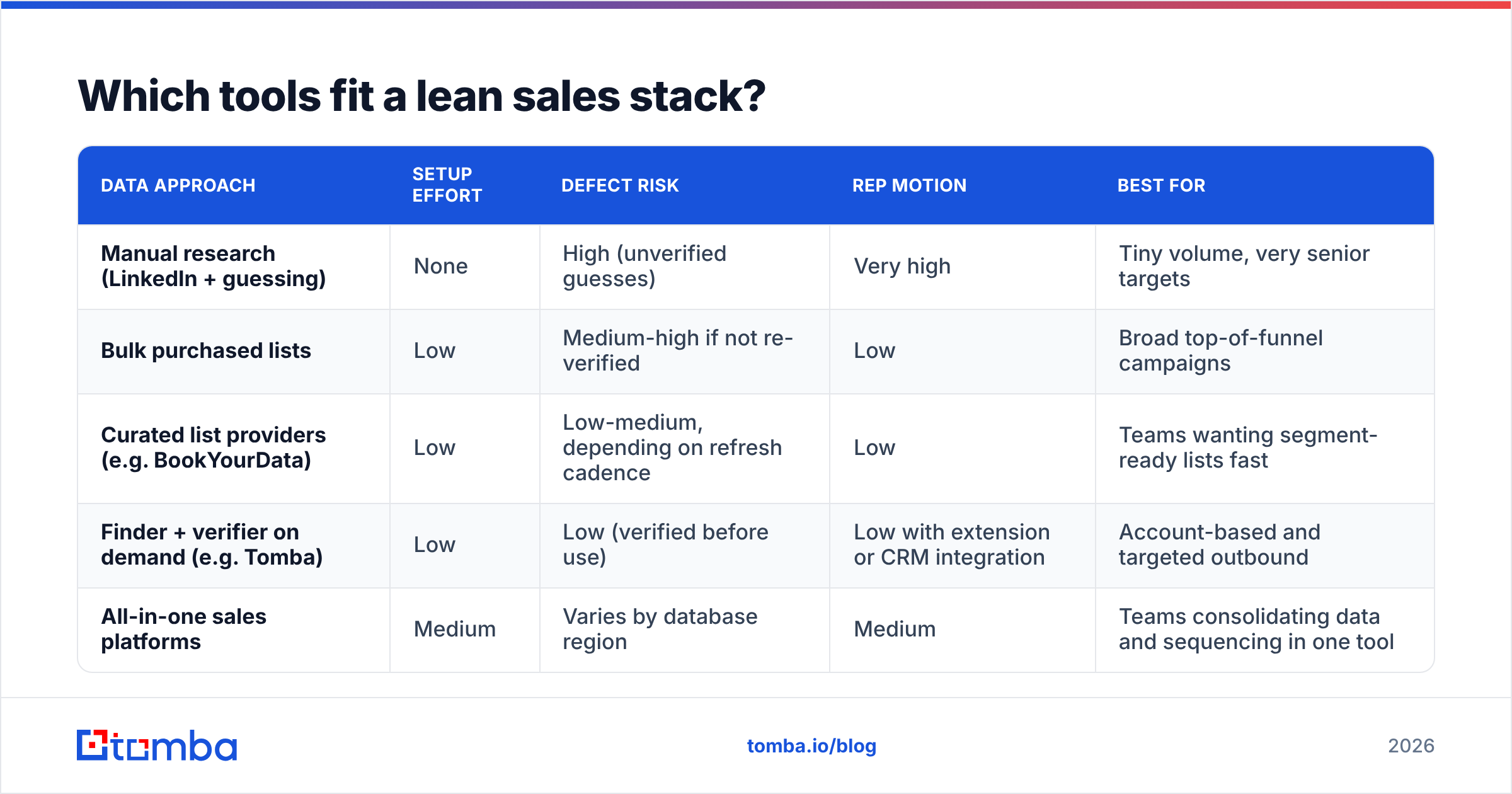
Here is how the data-layer choice affects lean flow:
| Data approach | Setup effort | Defect risk | Rep motion | Best for |
|---|---|---|---|---|
| Manual research (LinkedIn + guessing) | None | High (unverified guesses) | Very high | Tiny volume, very senior targets |
| Bulk purchased lists | Low | Medium-high if not re-verified | Low | Broad top-of-funnel campaigns |
| Curated list providers (e.g. BookYourData) | Low | Low-medium, depending on refresh cadence | Low | Teams wanting segment-ready lists fast |
| Finder + verifier on demand (e.g. Tomba) | Low | Low (verified before use) | Low with extension or CRM integration | Account-based and targeted outbound |
| All-in-one sales platforms | Medium | Varies by database region | Medium | Teams consolidating data and sequencing in one tool |
No single approach is always right. The lean test is whether the method gets verified, enriched contacts into your sequence without a rep doing manual cleanup in between.
What are the most common lean sales mistakes?#
Most failed lean sales initiatives stumble on the same few problems.
- Cutting value along with waste. Removing discovery calls to "speed up the cycle" usually lowers win rates. Only cut steps the buyer wouldn't miss.
- Running lean as a top-down project. Reps know where the friction is. If leadership draws the value stream map alone, it will miss the waste that matters most.
- Measuring activity while claiming to be lean. If reps are still ranked on dials per day, they will keep producing volume instead of flow.
- Ignoring data quality. Teams map handoffs and stage definitions beautifully, then keep feeding the process unverified lists. Defects at the top wipe out every improvement below them.
- Buying a tool to "become lean." Automation layered on a wasteful process just produces waste faster. Map and cut first, then automate what's left. The glossary entry on sales automation covers where automation actually pays off.
Does lean sales work for small teams and startups?#
Yes, and small teams often benefit more. A five-person team with a 15-tool stack is common, and each tool takes real time to maintain. Lean principles push small teams toward:
- One ICP definition that everyone uses.
- A four-stage pipeline (Qualified, Discovery, Proposal, Closed).
- One data tool that finds and verifies contacts. Tomba's free tier (25 searches per month) and $49/month Starter plan are both sized for this stage.
- A weekly 30-minute friction review instead of a monthly pipeline "deep dive."
Startups rarely suffer from too little process. They suffer from borrowed enterprise process that doesn't fit their deal size. A $5,000 ACV deal doesn't need a mutual action plan, three approvers, and an SE demo.
How long does it take to see results from lean sales?#
Most teams see measurable changes within one or two sales cycles:
- Week 1-2: Bounce rates drop as soon as list verification starts. This is the fastest signal.
- Week 3-6: Handoff SLAs cut waiting time, and cycle time starts to shrink.
- Month 2-3: Stage conversion improves as stale inventory is cleared and reps focus on fewer, better deals.
- Quarter 2 onward: Win rate and forecast accuracy improve as the process stabilizes.
Treat these as typical patterns, not guarantees. Your results depend on deal complexity, cycle length, and how consistently the weekly improvement habit holds.
Frequently asked questions about lean sales#
Is lean sales the same as agile sales? No, but they overlap. Agile sales borrows short iterations and retrospectives from software development. Lean sales focuses on removing waste and improving flow. Many teams use both: a lean value stream map plus agile-style weekly retros.
Do I need to reduce my team size to run lean? No. Lean frees up capacity. Most teams move that capacity back into selling rather than cutting people.
What's the single best first step? Audit your contact data. Pull your last 1,000 sequenced contacts and check bounce rate and title accuracy. If more than 3-5% bounce, fix that before anything else. It's the defect every other stage inherits.
How is lean sales different from sales efficiency? Sales efficiency is an outcome metric (revenue divided by sales and marketing cost). Lean sales is one method for improving it, by removing non-value work rather than only cutting spend.
What's the best way to start with clean data?#
Every lean sales process runs into the same constraint: you can't build smooth flow on top of bad contact data. If your reps are guessing email formats, re-researching bounced contacts, or sending sequences to half-dead lists, you're paying for defects at every stage of the funnel.
Tomba Email Finder fixes that at the source. It finds professional email addresses by domain, name, or company and verifies them before they reach your sequencer, so reps skip the manual research and your bounce rate stays low. Start with the free plan's 25 monthly searches to test it on your current target accounts, then scale up once you've seen the difference in your bounce rate and selling time.
Related guides#
Ready to find emails that actually work?
Join 150,000+ professionals who stopped guessing and started sending. Free credits on signup — no credit card required.
Get the Tomba newsletter
Practical outbound tactics and product updates — once every two weeks.
About the author