Lemlist vs Outreach: Pricing, Features, and Which to Pick in 2026
Lemlist is a multichannel cold outreach tool built for small teams. Outreach is a sales execution platform built for enterprise revenue orgs. This comparison covers pricing, deliverability, AI, and team fit so you can choose the right one.
TL;DR
- Lemlist is a multichannel cold outreach tool (email, LinkedIn, calls, WhatsApp). It is built for founders, agencies, and SDR teams of roughly 1–30 people. You can sign up yourself, pricing is public, and you can be running a campaign the same afternoon.
- Outreach is an enterprise sales execution platform. It combines sequences, conversation intelligence, deal management, and forecasting. It is built for revenue orgs with 50+ reps running on Salesforce or Dynamics.
- On cost, Lemlist lists its prices publicly, starting in the tens of dollars per user per month. Outreach doesn't publish pricing. Buyers commonly report paying more than $100 per user per month on annual contracts, plus onboarding.
- Choose Lemlist if you're building outbound from scratch and care about personalization and deliverability. Choose Outreach if you need governance, forecasting, and one system for every rep's pipeline.
- Neither tool fixes bad data. Your bounce rate depends on the list you import. Verify contacts before they go into either tool.
What is the real difference between Lemlist and Outreach?#
These two tools look similar on a feature grid, but they serve different buyers. Both send sequenced emails, both track opens and replies, and both touch LinkedIn. The difference is in who they were designed for.
Lemlist started in 2018 as a cold email tool known for personalized images and custom landing pages. Since then it has become a multichannel prospecting platform. It includes built-in email warmup (lemwarm), a B2B lead database, LinkedIn automation, and AI-written sequences. The product assumes you're a small team that needs to create pipeline quickly. You can see the current plans on lemlist.com.
Outreach started in 2014 as a sales engagement platform and now calls itself an AI sales execution platform. Beyond sequences, it covers call recording and conversation intelligence (Kaia), deal inspection, pipeline forecasting, and rep coaching. It assumes you already have a sales org, a CRM admin, and a RevOps function. Its main job is to manage and forecast pipeline across dozens or hundreds of reps. Details are on outreach.io.
In short, Lemlist helps a small team generate conversations. Outreach helps a large team run a repeatable sales process and report on it.
How do Lemlist and Outreach compare feature by feature?#
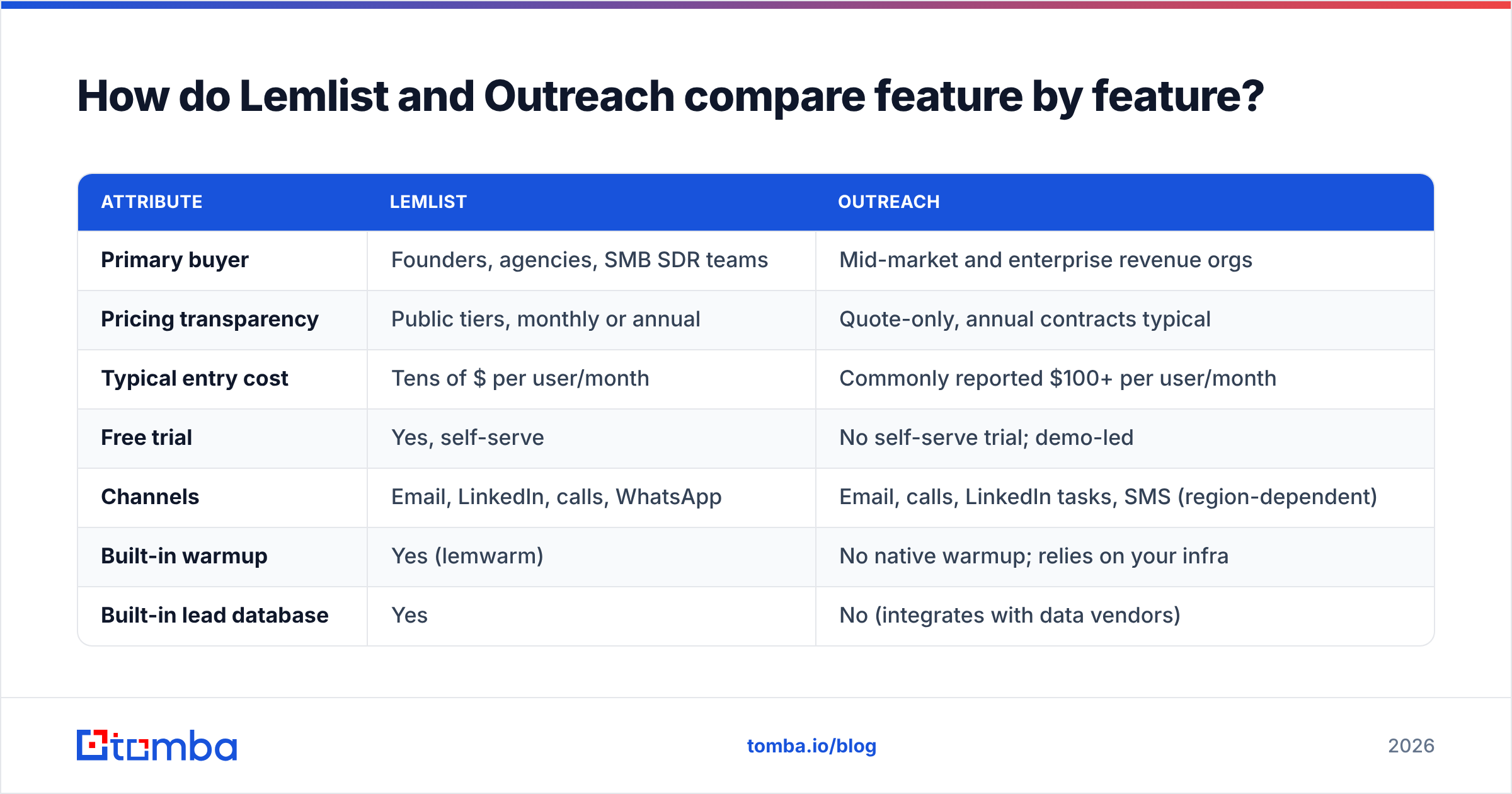
Here is a direct comparison on the attributes that usually decide the purchase.
| Attribute | Lemlist | Outreach |
|---|---|---|
| Primary buyer | Founders, agencies, SMB SDR teams | Mid-market and enterprise revenue orgs |
| Pricing transparency | Public tiers, monthly or annual | Quote-only, annual contracts typical |
| Typical entry cost | Tens of $ per user/month | Commonly reported $100+ per user/month |
| Free trial | Yes, self-serve | No self-serve trial; demo-led |
| Channels | Email, LinkedIn, calls, WhatsApp | Email, calls, LinkedIn tasks, SMS (region-dependent) |
| Built-in warmup | Yes (lemwarm) | No native warmup; relies on your infra |
| Built-in lead database | Yes | No (integrates with data vendors) |
| Personalization depth | Image, video, landing page, AI variables | Snippets, templates, AI drafting |
| Conversation intelligence | Basic call features | Full call recording, transcription, coaching |
| Forecasting and deal management | No | Yes, core module |
| CRM depth | HubSpot, Salesforce, Pipedrive sync | Deep bi-directional Salesforce and Dynamics |
| Setup time | Hours | Weeks, often with a partner or admin |
| Best for | Creating pipeline fast | Governing and forecasting pipeline at scale |
Reviews on G2 follow the same split. Lemlist reviewers praise its ease of use and personalization. Outreach reviewers praise its reporting and Salesforce integration, and they complain about the learning curve and contract terms.
What should you evaluate before choosing?#
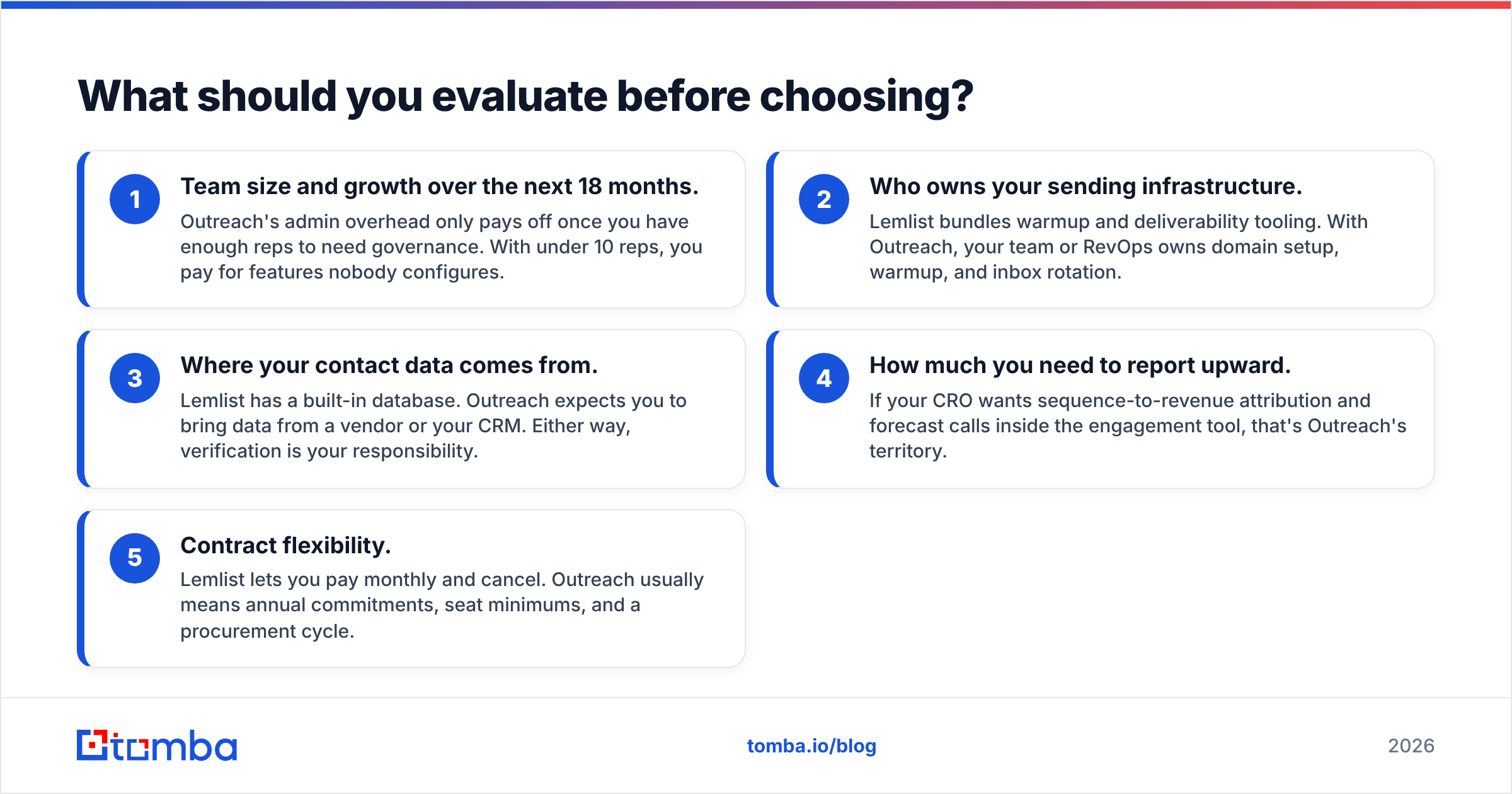
Before you book demos, score both tools on these five dimensions. They explain most of the regret buyers report later.
- Team size and growth over the next 18 months. Outreach's admin overhead only pays off once you have enough reps to need governance. With under 10 reps, you pay for features nobody configures.
- Who owns your sending infrastructure. Lemlist bundles warmup and deliverability tooling. With Outreach, your team or RevOps owns domain setup, warmup, and inbox rotation.
- Where your contact data comes from. Lemlist has a built-in database. Outreach expects you to bring data from a vendor or your CRM. Either way, verification is your responsibility.
- How much you need to report upward. If your CRO wants sequence-to-revenue attribution and forecast calls inside the engagement tool, that's Outreach's territory.
- Contract flexibility. Lemlist lets you pay monthly and cancel. Outreach usually means annual commitments, seat minimums, and a procurement cycle.
If you answer "small, us, bring our own, not much, and flexible," the choice is already Lemlist. If you answer "large, RevOps, vendor, heavily, and annual is fine," it's Outreach.

How much do Lemlist and Outreach actually cost?#
Pricing is the widest gap between the two tools, and it isn't just the sticker price.
Lemlist publishes per-user tiers on its pricing page. At the time of writing, the entry email plan and the multichannel plan are priced in the tens of dollars per user per month. Annual billing gives a discount, and enterprise pricing is custom. Warmup and a set of database credits are included on most tiers. Extra enrichment credits cost more. Lemlist has changed its plans several times over the years, so check the live page before you budget.
Outreach doesn't publish pricing. Buyers report per-user costs well above $100 per month on annual contracts. Add-ons such as conversation intelligence, forecasting, or AI agents raise the total, and implementation or onboarding fees are common. For a 20-seat team, the gap between the two tools can reach five figures a year before you add any data spend.
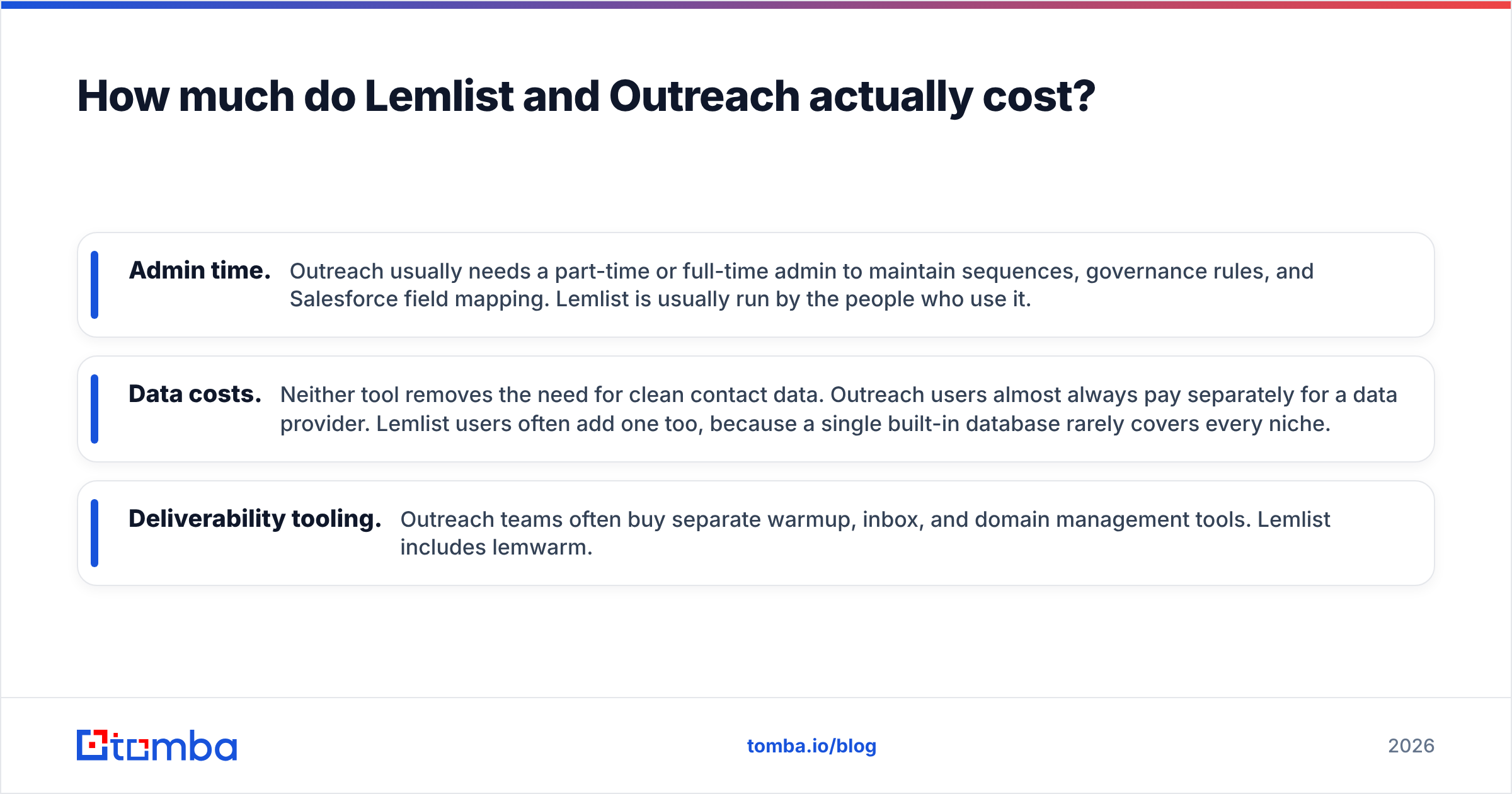
The total cost of ownership includes things the invoice doesn't show:
- Admin time. Outreach usually needs a part-time or full-time admin to maintain sequences, governance rules, and Salesforce field mapping. Lemlist is usually run by the people who use it.
- Data costs. Neither tool removes the need for clean contact data. Outreach users almost always pay separately for a data provider. Lemlist users often add one too, because a single built-in database rarely covers every niche.
- Deliverability tooling. Outreach teams often buy separate warmup, inbox, and domain management tools. Lemlist includes lemwarm.
Which tool gets better email deliverability?#
Deliverability depends mostly on your domains, your sending volume, and your list quality. The tool matters less, but it can make good habits easier or harder.
Lemlist makes good habits easier for small teams. Lemwarm warms up inboxes automatically. The platform shows deliverability checks for things like SPF, DKIM, and DMARC, and it supports sending from multiple inboxes. If you're a founder setting up outbound for the first time, these defaults stop you from making the classic mistakes.
Outreach assumes you already have this in place. It has solid sending controls: throttling, schedule windows, bounce and unsubscribe handling, and governance over which templates reps can use. It won't warm your domains for you. In large orgs, a RevOps or IT team handles domain strategy, and Outreach is just the sending layer on top.
Both tools have the same weakness: if you import a list with a 10% invalid rate, your sender reputation suffers no matter which tool sent the email. Mailbox providers like Google and Microsoft now enforce bulk sender requirements. Spam complaints and hard bounces cost you inbox placement across your whole domain. Run every list through an email verifier before it reaches a sequence. This matters most for catch-all domains, where a simple SMTP check can't tell you whether the mailbox exists.
Is Lemlist or Outreach better for personalization and AI?#
They take different approaches.
Lemlist's personalization is visible to the prospect. You can insert the prospect's name into an image, drop in a company logo, link to a custom landing page, or embed a personalized video thumbnail. Its AI features write full sequences from your ICP and value proposition, and they pull in variables from the prospect's LinkedIn profile or website. For cold outreach, where the first line decides whether the email gets read, this is the stronger toolkit.
Outreach's AI works on the rep's process. It drafts emails, summarizes calls, flags deals that are at risk, suggests next steps, and more and more it runs agent-style workflows that research accounts and draft follow-ups. The goal is to make every rep more consistent and let managers see what's working across the whole team. Much of its value comes from warm pipeline: renewals, multi-threaded deals, and follow-ups after discovery calls.
If your bottleneck is "prospects don't reply," Lemlist's personalization helps more. If it's "reps don't follow the process and we can't forecast," Outreach's AI helps more.
How do the CRM integrations compare?#
This matters more than most feature grids suggest.
Outreach's integrations with Salesforce and Microsoft Dynamics are deep and bi-directional. Activities, sequence states, opportunity stages, and custom objects sync both ways, and admins control field mapping precisely. For a Salesforce-centric org, this is often the deciding factor. Outreach behaves like an extension of the CRM rather than a separate silo.
Lemlist integrates natively with HubSpot, Salesforce, and Pipedrive, and connects to others through Zapier and Make. The sync covers the core needs: pushing leads, logging activities, and updating statuses. It isn't built for complex custom-object mapping. For teams on HubSpot or Pipedrive, it's usually enough. For a heavily customized Salesforce instance, expect some gaps.
Whichever tool you pick, enrich contacts before they reach the CRM. If your data enters Salesforce through an email finder with native sync, such as the Salesforce integration, both Lemlist and Outreach start from the same clean records. You don't end up with duplicate and half-verified contacts in each tool.
What are the pros and cons of each?#
Lemlist: pros
- Public pricing, monthly billing, and a self-serve trial
- Built-in warmup and deliverability checks
- Best-in-class visual personalization for cold outreach
- Multichannel sequences (email, LinkedIn, calls) in one builder
- Built-in lead database to get started quickly
Lemlist: cons
- No forecasting, deal inspection, or advanced coaching
- Governance and permissions are light for large teams
- LinkedIn automation carries platform-policy risk, as with any tool
- Database coverage varies by region and niche
Outreach: pros
- Mature enterprise governance, permissions, and compliance
- Deep Salesforce and Dynamics sync
- Conversation intelligence, forecasting, and deal management in one platform
- Strong reporting from sequence activity to revenue
Outreach: cons
- Quote-only pricing, annual contracts, and seat minimums
- Weeks to implement properly; needs an admin
- No native warmup or contact database
- More than a small team needs
If you're comparing Outreach with other options, our Outreach alternative breakdown covers where the lighter tools fit.
Can you use Lemlist and Outreach together?#
Some companies do, and there's a reasonable pattern for it. A top-of-funnel SDR or growth team runs cold, high-personalization campaigns in Lemlist, often from separate sending domains to protect the main domain. Once a prospect replies or books a meeting, the contact moves into Salesforce and account executives work the deal in Outreach.
This split keeps risky cold volume away from the enterprise sending setup and gives each team the tool that suits it. The cost is two tools, two sets of templates, and a handoff that has to be defined clearly in the CRM. It usually only makes sense above about 30 reps. Below that, pick one.
Which should you choose: Lemlist or Outreach?#
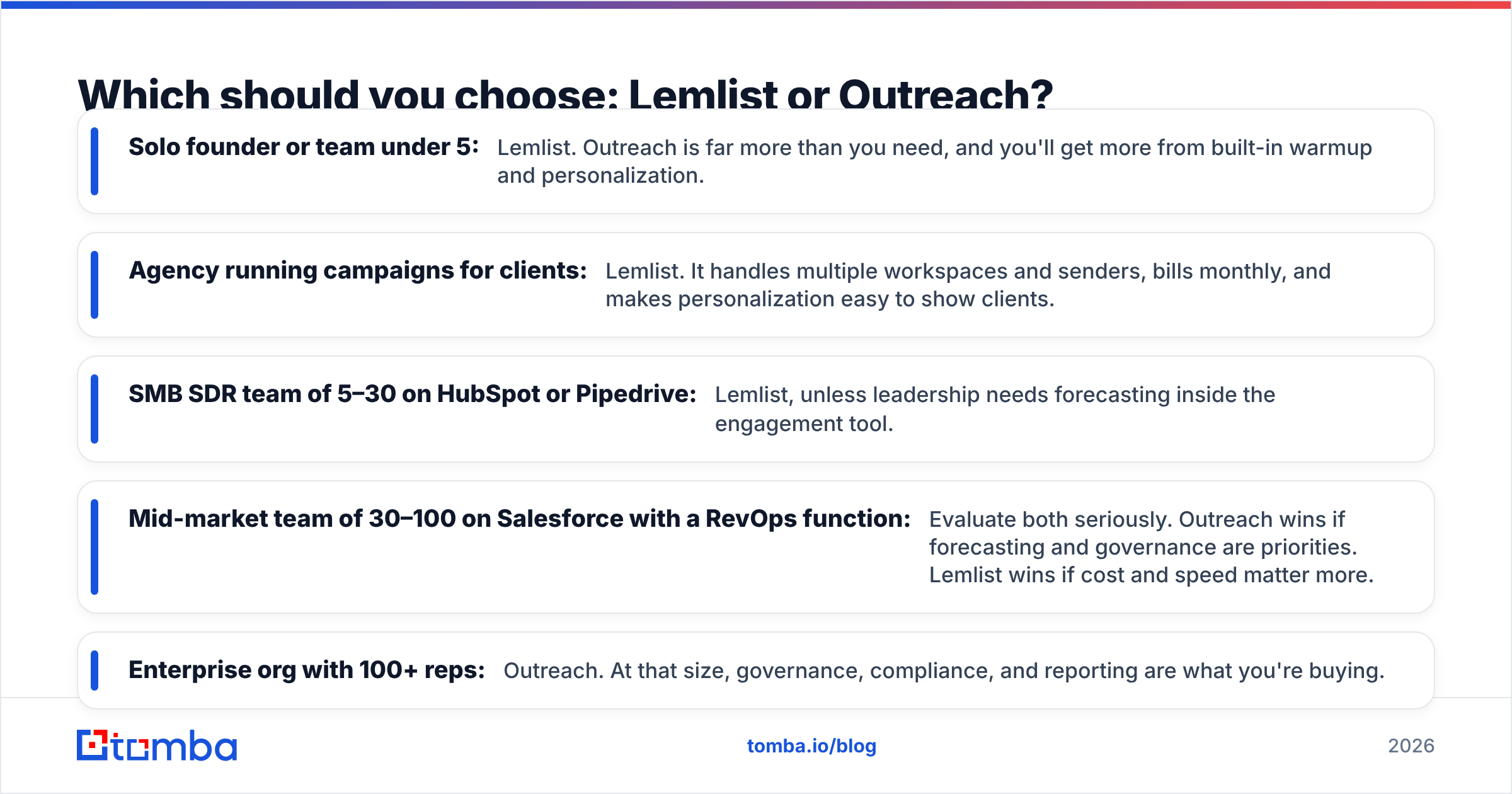
Here is our recommendation by scenario:
- Solo founder or team under 5: Lemlist. Outreach is far more than you need, and you'll get more from built-in warmup and personalization.
- Agency running campaigns for clients: Lemlist. It handles multiple workspaces and senders, bills monthly, and makes personalization easy to show clients.
- SMB SDR team of 5–30 on HubSpot or Pipedrive: Lemlist, unless leadership needs forecasting inside the engagement tool.
- Mid-market team of 30–100 on Salesforce with a RevOps function: Evaluate both seriously. Outreach wins if forecasting and governance are priorities. Lemlist wins if cost and speed matter more.
- Enterprise org with 100+ reps: Outreach. At that size, governance, compliance, and reporting are what you're buying.
Across all of these, the tool you pick matters less than the data you put into it. A good sequence sent to unverified addresses still bounces, and a bounced email doesn't turn into a reply.
Frequently asked questions#
Is Lemlist cheaper than Outreach? Yes, in almost every scenario. Lemlist publishes per-user pricing starting in the tens of dollars per month. Outreach is quote-only, and buyers commonly report more than $100 per user per month on annual contracts, before add-ons.
Does Outreach have email warmup like lemwarm? No. Outreach doesn't include native inbox warmup. Teams usually handle warmup and domain management with separate tools or through IT and RevOps.
Can Lemlist replace Outreach for an enterprise team? For cold prospecting, it can. It doesn't replace Outreach's forecasting, deal management, and conversation intelligence, which are usually why enterprises buy Outreach.
Do I need a separate email finder with Lemlist? Often, yes. Lemlist's built-in database is useful, but coverage varies. Most teams add a dedicated finder and verifier to fill gaps and keep bounce rates low.
Where does Tomba fit in your Lemlist or Outreach stack?#
Whichever sequencer you choose, your reply rate depends on the accuracy of the addresses in it. Tomba Email Finder finds professional email addresses by name, company, or domain, and checks them before you export. Then you can push clean contacts to Lemlist, Salesforce, or your CRM through native integrations. The free tier includes 25 searches a month, so you can test it on your current ICP before you commit, and paid plans start at $49/mo. Build your next Lemlist campaign or Outreach sequence on verified data and your domain reputation will hold up better.
Related guides#
Ready to find emails that actually work?
Join 150,000+ professionals who stopped guessing and started sending. Free credits on signup — no credit card required.
Get the Tomba newsletter
Practical outbound tactics and product updates — once every two weeks.
About the author