LetsExtract vs RampedUp: Email Scraper or B2B Contact Database?
LetsExtract scrapes emails that are published on the open web. RampedUp sells access to a prospecting database. They do different jobs, so the right pick depends on how you build lists. Here is how to choose.
- LetsExtract is an extraction toolkit. It crawls websites, search results, and files to collect emails and phone numbers that are already public, then verifies and sends to them.
- RampedUp is a B2B contact data platform. It serves decision-makers, direct dials, and verified emails from a database and a Chrome extension that runs on LinkedIn and your inbox.
- Choose LetsExtract for high-volume, budget scraping of niche or local websites. Choose RampedUp for targeted account-based prospecting where you need named people and direct phone numbers.
- Neither vendor lists full, transparent self-serve pricing, so budget time for a sales call or a license quote.
- If you need named-contact email finding with published pricing and a free tier, a dedicated email finder such as Tomba sits between the two.
What is the real difference between LetsExtract and RampedUp?#
The two tools get emails in different ways. A letsextract vs rampedup comparison only makes sense once you see that.
LetsExtract works like a fishing net. You point it at a keyword, a list of URLs, a search engine query, or a folder of files, and it pulls out every email address and phone number it finds. Nothing is stored ahead of time. The data is whatever the open web shows today.
RampedUp works more like a library card. It keeps a large B2B database. On its own site the vendor claims more than 500 million contacts and tens of millions of businesses. You look up a person or an account and get back a structured record: name, title, company, email, direct dial, and social links.
In practice that means:
- LetsExtract returns addresses. They are often generic ones like info@, sales@, or support@, plus whatever personal addresses a site happens to publish.
- RampedUp returns people. You get a named contact tied to a role, which is what outbound SDRs usually need.
You can see this on each vendor's site. LetsExtract presents itself as an email extractor, verifier, and sender. RampedUp presents itself as a contact data solution for sellers.
How do LetsExtract and RampedUp compare feature by feature?#
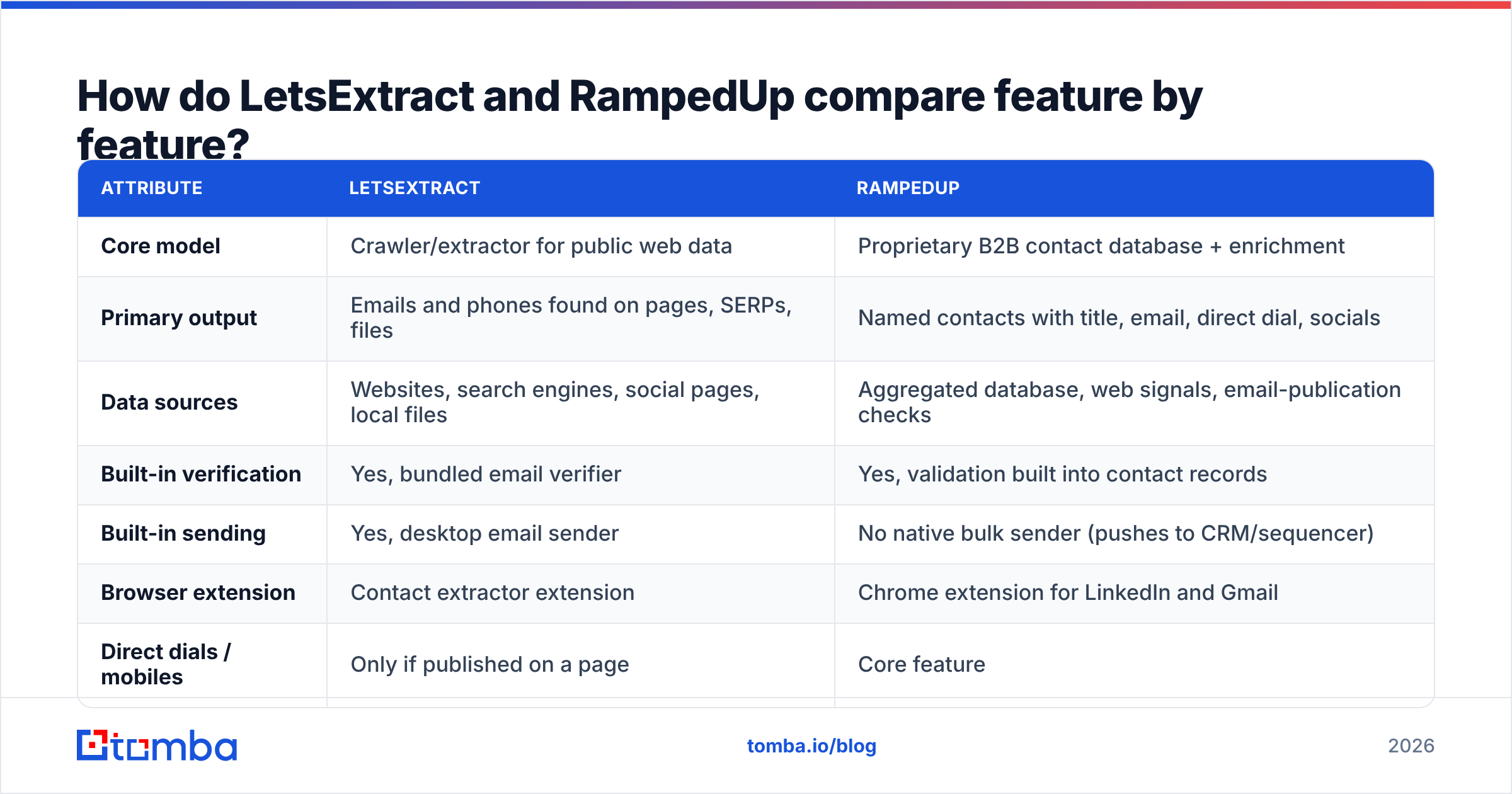
Here is a side-by-side view of the attributes that matter most to someone building outbound lists in 2026.
| Attribute | LetsExtract | RampedUp |
|---|---|---|
| Core model | Crawler/extractor for public web data | Proprietary B2B contact database + enrichment |
| Primary output | Emails and phones found on pages, SERPs, files | Named contacts with title, email, direct dial, socials |
| Data sources | Websites, search engines, social pages, local files | Aggregated database, web signals, email-publication checks |
| Built-in verification | Yes, bundled email verifier | Yes, validation built into contact records |
| Built-in sending | Yes, desktop email sender | No native bulk sender (pushes to CRM/sequencer) |
| Browser extension | Contact extractor extension | Chrome extension for LinkedIn and Gmail |
| Direct dials / mobiles | Only if published on a page | Core feature |
| Account-based search | No, keyword/URL driven | Yes, filter by company, role, seniority |
| Pricing transparency | License/quote model; confirm on site | Quote-based; contact sales |
| Best for | Local SMB lists, niche directories, high-volume scraping | ABM, enterprise SDR teams, phone-heavy outreach |
| Compliance burden | High: you own the scraping decisions | Moderate: vendor handles sourcing, you handle use |

Reading the table: the two tools overlap on verification and not much else. LetsExtract is broad and shallow. RampedUp is narrow and deep.
What is LetsExtract good at?#
LetsExtract is at its best when your target market is scattered across thousands of small websites that no B2B database covers well. Examples include dental clinics in Ohio, roofing contractors, independent bookstores, and regional law firms.
Where it shines:
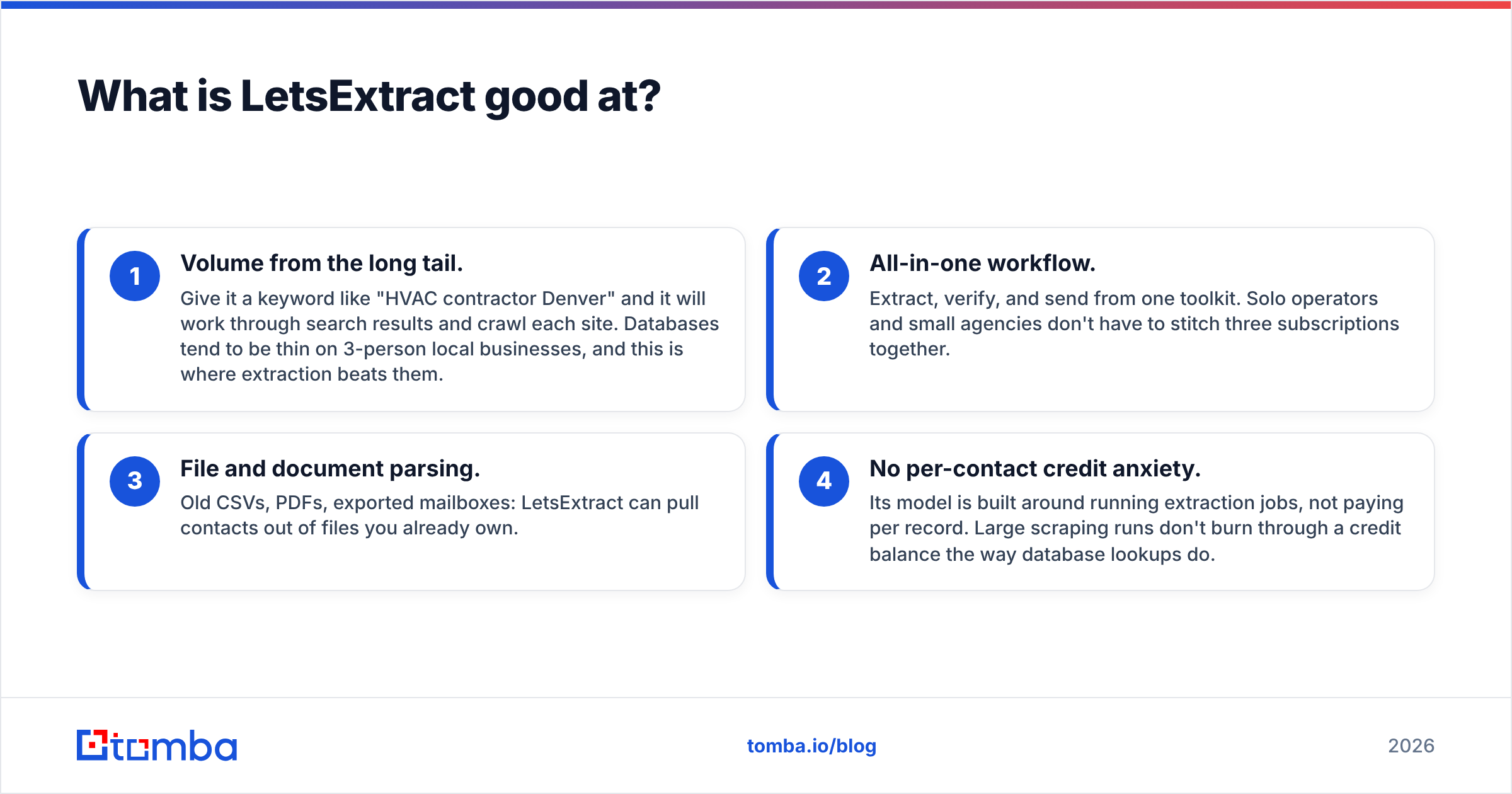
- Volume from the long tail. Give it a keyword like "HVAC contractor Denver" and it will work through search results and crawl each site. Databases tend to be thin on 3-person local businesses, and this is where extraction beats them.
- All-in-one workflow. Extract, verify, and send from one toolkit. Solo operators and small agencies don't have to stitch three subscriptions together.
- File and document parsing. Old CSVs, PDFs, exported mailboxes: LetsExtract can pull contacts out of files you already own.
- No per-contact credit anxiety. Its model is built around running extraction jobs, not paying per record. Large scraping runs don't burn through a credit balance the way database lookups do.
Where it struggles:
- Generic inboxes dominate. Many small-business sites only list info@ or contact@. Those addresses deliver, but they rarely reach the decision-maker, and reply rates show it.
- No role targeting. You can't ask LetsExtract for "the VP of Marketing at these 200 SaaS companies." It only finds what's published.
- Deliverability risk. Scraped lists are where spam traps, role accounts, and stale addresses pile up. You must verify before sending. Even then, blasting scraped lists from your main domain is a fast way to damage your sender reputation.
- Legal exposure. Under GDPR and similar regimes, you are the one who decided to collect and process that data. Scraping public addresses is not automatically lawful, especially for EU recipients.

What is RampedUp good at?#
RampedUp is built for sellers who already know which accounts they want and need the right people inside them.
Where it shines:
- Named decision-makers. Search by company, then filter by title or department. You get a person, not an inbox.
- Direct dials. For teams that still cold call, and many enterprise SDR teams do, phone coverage is often the deciding factor. RampedUp puts direct dials front and center.
- In-workflow extension. The Chrome extension shows contact data while you browse LinkedIn profiles or read email threads. Research moves to where reps already spend their time.
- Email publication signals. RampedUp says it checks where and how often an address has been published across the web. That is a useful extra confidence signal beyond an SMTP ping.
Where it struggles:
- Opaque pricing. Review aggregators like G2 note that pricing isn't fully published, so you'll likely need a sales conversation before you know your cost per contact.
- Database decay. Every database ages. People change jobs at roughly 20-30% a year in many B2B segments, so records need re-verification before a campaign.
- Weaker on micro-businesses. If your ICP is the local plumbing company, RampedUp's database approach will return fewer hits than a crawler.
- No sending layer. You still need a sequencer or CRM to run the outreach.
Which one is more accurate?#
This is the question buyers usually ask, and the honest answer is that they measure accuracy differently.
LetsExtract's accuracy is about existence: is the address it found on the page real and deliverable? For published addresses, the answer is usually yes, because someone put it there on purpose. The weak point is relevance. A valid info@ address is accurate but often useless for reaching a specific buyer.
RampedUp's accuracy is about match quality: is this the right email for this named person, and are they still at the company? That is a harder problem. Every contact database, RampedUp included, will have a slice of stale or pattern-guessed records.

Whichever tool you choose, run every list through a separate email verifier before it reaches your sequencer. Pay special attention to catch-all domains, because both tools will return addresses there that SMTP checks can't fully confirm. Verification costs a fraction of a cent per address. A bounce-driven reputation hit can cost you the domain.
How does pricing compare?#
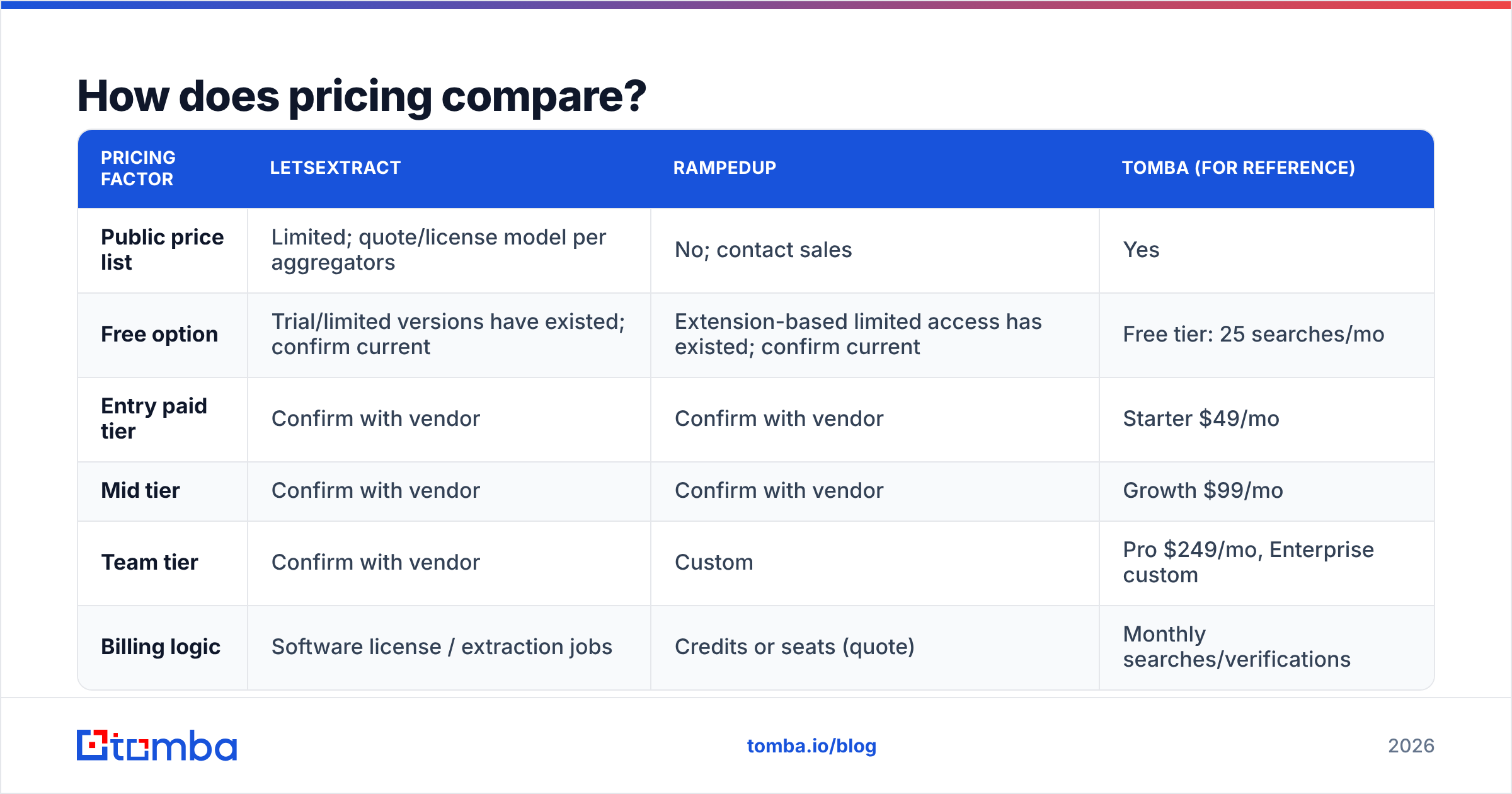
Neither vendor makes this easy.
| Pricing factor | LetsExtract | RampedUp | Tomba (for reference) |
|---|---|---|---|
| Public price list | Limited; quote/license model per aggregators | No; contact sales | Yes |
| Free option | Trial/limited versions have existed; confirm current | Extension-based limited access has existed; confirm current | Free tier: 25 searches/mo |
| Entry paid tier | Confirm with vendor | Confirm with vendor | Starter $49/mo |
| Mid tier | Confirm with vendor | Confirm with vendor | Growth $99/mo |
| Team tier | Confirm with vendor | Custom | Pro $249/mo, Enterprise custom |
| Billing logic | Software license / extraction jobs | Credits or seats (quote) | Monthly searches/verifications |
Here is a practical way to budget:
- LetsExtract tends to cost less per address because you run extraction jobs rather than buying records. Add the hidden costs, though: verification rounds, a separate sending domain, proxies if you scrape at scale, and the hours spent cleaning generic inboxes out of the list.
- RampedUp costs more per contact, but each record is a person with a title, so fewer contacts are wasted. For a 10-rep SDR team calling into 500 target accounts, cost per meeting matters more than cost per record.
Before signing either contract, ask for a trial export on 50 accounts from your real ICP. Measure three things: match rate, bounce rate after verification, and the share of contacts that are actual decision-makers.
Which should you choose for your use case?#
Match the tool to how your pipeline is actually built.
- You sell to local SMBs at volume (agencies, home services, local retail): LetsExtract. Database coverage is thin here, and extraction finds contacts the big providers don't have.
- You run account-based outbound into mid-market or enterprise: RampedUp. Named contacts and direct dials matter more than raw volume.
- Your team is phone-first: RampedUp, because its direct-dial coverage is the whole point.
- You're a solo founder who wants extract-verify-send in one place: LetsExtract, with the caveat that you should send from a secondary, warmed domain.
- You need named contacts but want published pricing, a free tier, and API access: neither is ideal. A dedicated email finder is the better fit.

Is there a middle ground between scraping and a database?#
Yes. Many teams compare LetsExtract and RampedUp because they want a middle ground: named-person emails without an enterprise contract, and without scraping-level compliance risk.
That is what dedicated email finders do. With Tomba, for example, you can:
- Run a domain search to see every professional email associated with a company, including the email pattern it uses and the public sources where each address appeared.
- Enter a first name, last name, and company domain to find one specific decision-maker's address.
- Verify every result in the same workflow, including catch-all handling.
- Enrich leads with title, company, and social data before pushing them to your CRM.
Pricing is published on the Tomba pricing page: a free tier with 25 searches a month, then Starter at $49/mo, Growth at $99/mo, Pro at $249/mo, and custom Enterprise plans. You can test your ICP before you talk to anyone in sales.
This doesn't replace everything. If you need deep direct-dial coverage for a large calling team, a phone-first database like RampedUp still has an edge. If you're scraping 10,000 local contractor sites, a crawler like LetsExtract fits that job better. For the common B2B case of finding the right person's email at companies on a target list, a focused finder is usually the more efficient tool.
What mistakes should you avoid with either tool?#
A few patterns sink campaigns no matter which tool produced the list:
- Skipping verification because the tool "already verified." Re-verify within 30 days of sending. Data decays weekly.
- Mixing scraped generic inboxes with named contacts in one sequence. Copy written for a VP reads strangely to a shared support@ inbox. Segment first.
- Sending from your primary domain. Use a secondary domain, warm it up, and keep volume per inbox modest.
- Ignoring jurisdiction. EU and UK prospects bring GDPR/PECR obligations. Document your legitimate interest and give recipients an easy opt-out.
- Judging tools by list size. 10,000 contacts with a 1% reply rate lose to 1,000 contacts with a 6% reply rate on every metric that matters.
So, LetsExtract vs RampedUp: which wins?#
It depends on the job, and here is the split:
- LetsExtract wins on breadth, long-tail SMB coverage, and an all-in-one extract-verify-send workflow for small operators on a budget.
- RampedUp wins on named decision-makers, direct dials, and in-browser prospecting for account-based sales teams.
If your real need is "the right person's work email at the companies I already picked," neither tool is the most direct route.
That need is what Tomba Email Finder is built for. Enter a name and a company domain, get a verified professional email with its public sources, and scale the same workflow through bulk uploads, the API, or the Chrome extension. Start on the free tier with 25 searches a month, run your own ICP through it, and compare the bounce rate against whatever LetsExtract or RampedUp gives you. The numbers will settle the decision.
Related guides#
// get started
Find, verify and enrich your first contacts today
Start on the free plan with 25 searches a month, then scale when your team is ready.
Free plan · No credit card required · GDPR & CCPA
// about the author