LetsExtract vs Sparklane: Scraper vs Sales Intelligence in 2026
LetsExtract scrapes emails from the open web. Sparklane tells you which accounts are about to buy. They solve different problems. Here's how to tell which one your team needs, and where both leave gaps.
TL;DR
- LetsExtract is an email extraction tool. It crawls websites, search results and pages you point it at, then pulls out any email addresses and phone numbers it finds. It's cheap and fast, and it has no idea who each contact actually is.
- Sparklane is a B2B sales intelligence platform with its roots in France. It watches companies for "business signals" such as funding, hiring, expansion and leadership changes, then helps you rank the accounts most likely to buy.
- They aren't really competitors. LetsExtract answers "what email addresses exist on these pages?" Sparklane answers "which companies should I call this week?"
- Pick LetsExtract for low-cost bulk harvesting from known sources. Pick Sparklane for account-based selling in Europe, especially France. Neither one fully covers "find and verify the right person's work email," which is its own step.
- If you mainly need verified, named decision-maker emails, a dedicated email finder plus verifier fills the gap both tools leave.
What is LetsExtract?#
LetsExtract is an email and contact extraction tool. Its best-known product has been a Windows desktop application, and a browser-based extension sits alongside it. The workflow is simple. You give it a source (a list of URLs, a keyword it runs through search engines, or a site to crawl) and it scans the pages for anything that looks like an email address or phone number. Then it exports the results.
That's all it does, and for some jobs that's enough. If you're building a list of local agencies, directory listings or conference exhibitors and the contact details are already published, LetsExtract collects them much faster than copy-pasting by hand.
Some limits come built into that approach:
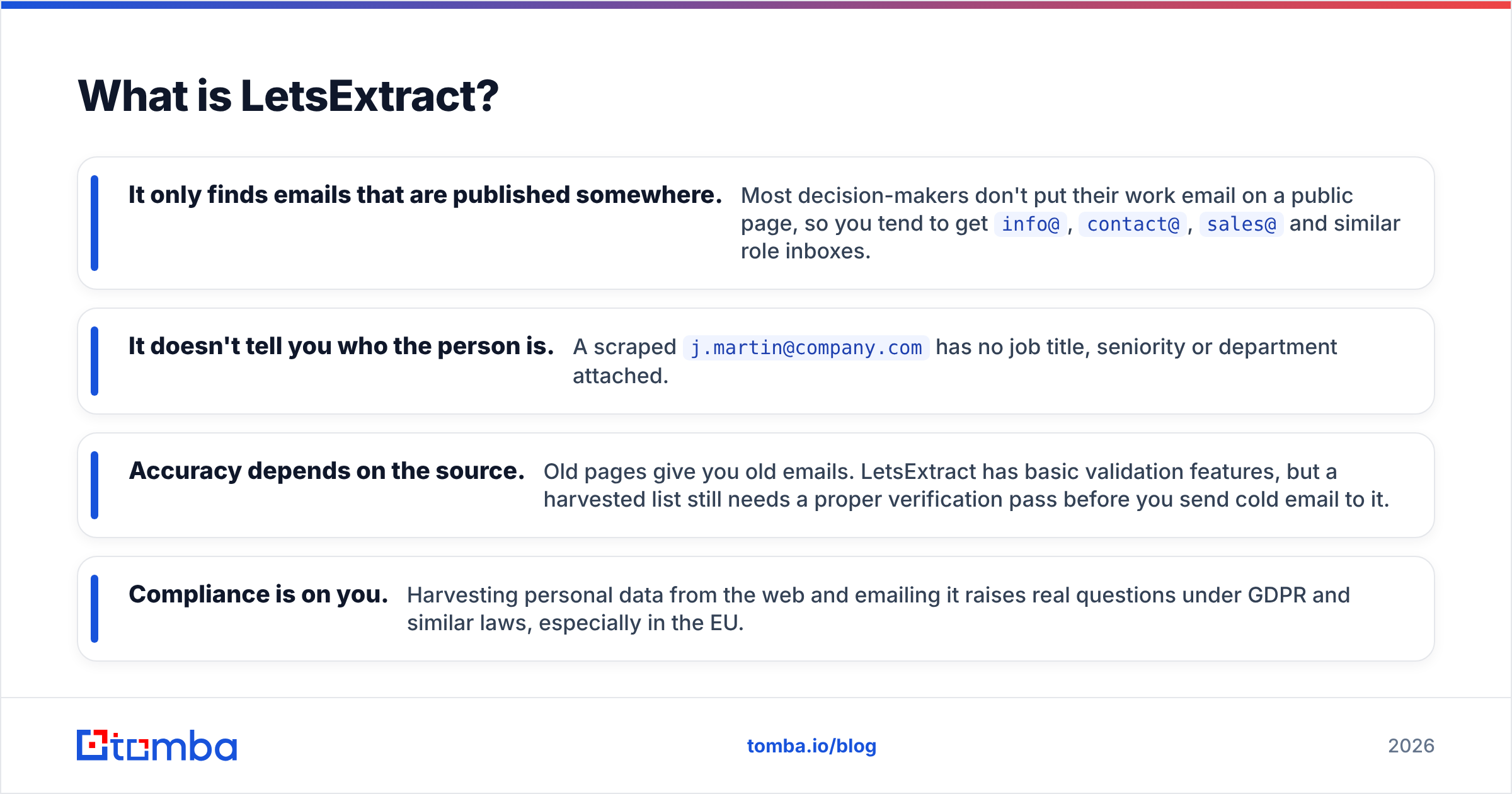
- It only finds emails that are published somewhere. Most decision-makers don't put their work email on a public page, so you tend to get
info@,contact@,sales@and similar role inboxes. - It doesn't tell you who the person is. A scraped
j.martin@company.comhas no job title, seniority or department attached. - Accuracy depends on the source. Old pages give you old emails. LetsExtract has basic validation features, but a harvested list still needs a proper verification pass before you send cold email to it.
- Compliance is on you. Harvesting personal data from the web and emailing it raises real questions under GDPR and similar laws, especially in the EU.
What is Sparklane?#
Sparklane comes at prospecting from the other end. It doesn't start from web pages. It starts from companies and events. The platform monitors news, company registries, job postings and other public sources for signals that suggest a company might be ready to buy, such as a funding round, a new site, a hiring spike, a new executive or an acquisition.
Those signals feed a scoring model, so sales teams can rank target accounts by timing instead of working an alphabetical list. Sparklane grew out of the French market and its data is strongest on French and wider European companies. It also connects to common CRMs, so the signals show up where reps already work.
What Sparklane is not:
- It's not a bulk email harvester. You buy it for account and timing intelligence. A pile of addresses is not the product.
- It's not built for self-serve buyers. Pricing is quote-based and aimed at sales teams, not freelancers buying a one-off license.
- It's not strong everywhere. If your territory is mainly North America or APAC, check coverage carefully during a trial.

How do LetsExtract and Sparklane compare side by side?#
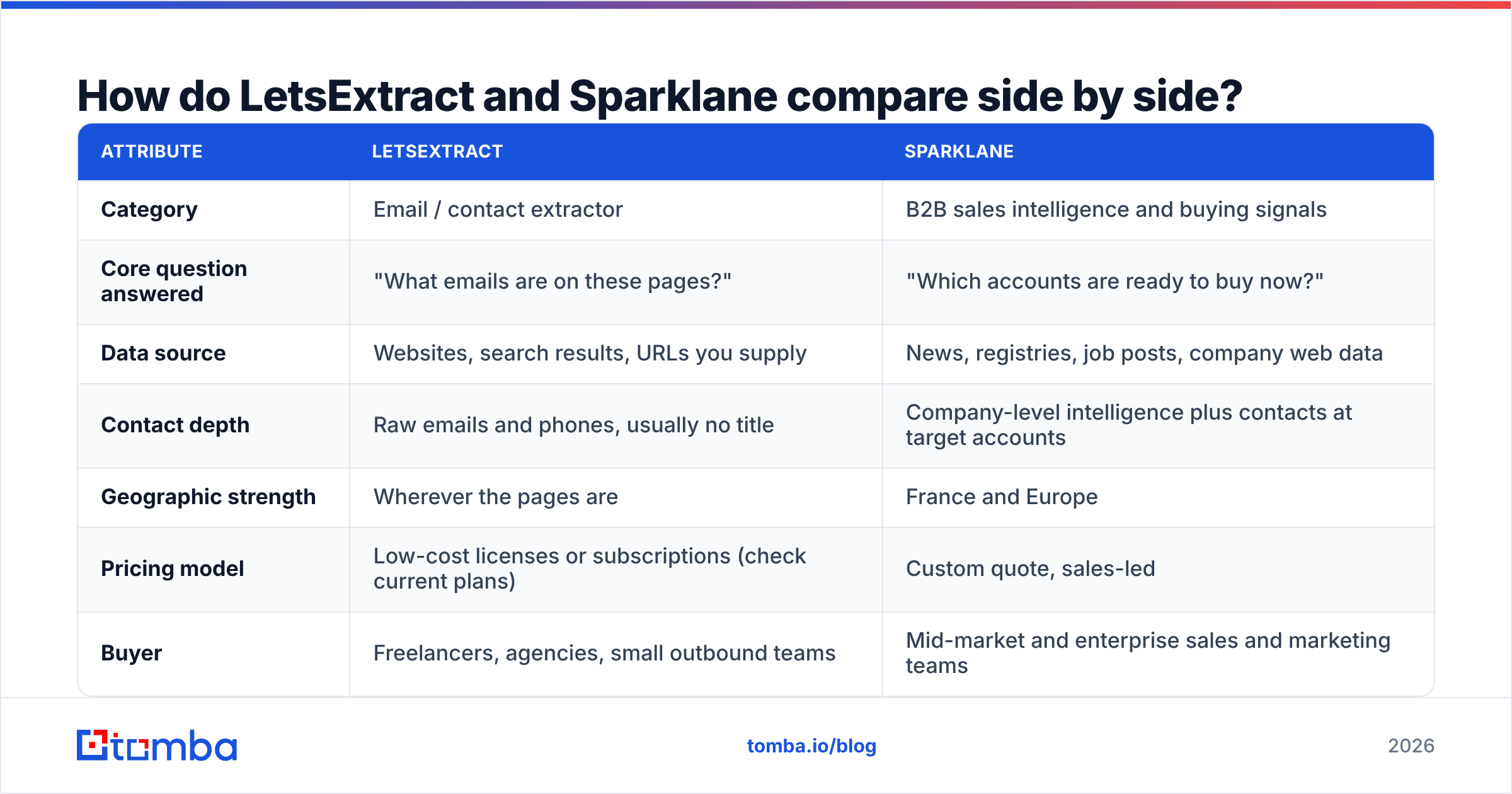
This is the core of the comparison. The two tools sit at different layers of the prospecting stack, and the table shows it.
| Attribute | LetsExtract | Sparklane |
|---|---|---|
| Category | Email / contact extractor | B2B sales intelligence and buying signals |
| Core question answered | "What emails are on these pages?" | "Which accounts are ready to buy now?" |
| Data source | Websites, search results, URLs you supply | News, registries, job posts, company web data |
| Contact depth | Raw emails and phones, usually no title | Company-level intelligence plus contacts at target accounts |
| Geographic strength | Wherever the pages are | France and Europe |
| Pricing model | Low-cost licenses or subscriptions (check current plans) | Custom quote, sales-led |
| Buyer | Freelancers, agencies, small outbound teams | Mid-market and enterprise sales and marketing teams |
| CRM integration | Export-based (CSV/Excel) | Native CRM connectors |
| Verification built in | Basic | Not the core focus |
| Compliance posture | User carries the burden of harvested data | Designed around EU business-data use |
| Learning curve | Low | Moderate: scoring, personas, signal setup |
Vendors change plans often. Treat the pricing column as a direction, not a quote, and check both vendors' sites before you commit.
Which tool gives you better data quality?#
It depends on what "quality" means for you.
LetsExtract's data is exactly as good as its source. If you point it at a well-maintained industry directory, you'll get current, usable contacts. If you point it at a keyword search, you'll get a mix of role inboxes, stale addresses from old blog posts, and sometimes spam traps sitting on abandoned pages. In practice, the useful share of a raw scrape can be small. Verification isn't optional.
Sparklane's data quality is really about relevance and timing. It exists to cut the time reps waste on accounts that aren't in-market. A good signal ("this Lyon SaaS company just raised a Series B and posted six sales roles") is worth more than a thousand random addresses. It does not by itself guarantee that the email of the specific VP you want is correct and deliverable. That's a different job.
So the honest answer to "which has better data?" is: Sparklane has better account data, LetsExtract has more raw address volume, and neither is a dedicated person-level email verifier.
Whatever you use to build the list, run it through an email verifier before it goes into a sequencer. That protects your sender reputation and keeps bounce rates below the thresholds mailbox providers watch.
How much do LetsExtract and Sparklane cost?#
The pricing models are as different as the products.
LetsExtract has historically been one of the cheapest options in the category. It has sold desktop licenses and lower-cost subscription tiers, and small teams can often start for well under the cost of one sales-intelligence seat. The catch is hidden cost: time spent cleaning, deduplicating and verifying, plus the deliverability risk if you skip those steps.
Sparklane doesn't publish self-serve prices. Expect a sales conversation, an annual contract and pricing tied to seats, modules and data volume. That's normal for sales intelligence platforms (ZoomInfo, Cognism and Dealfront work similarly). It also means you need a clear ROI case before the conversation.
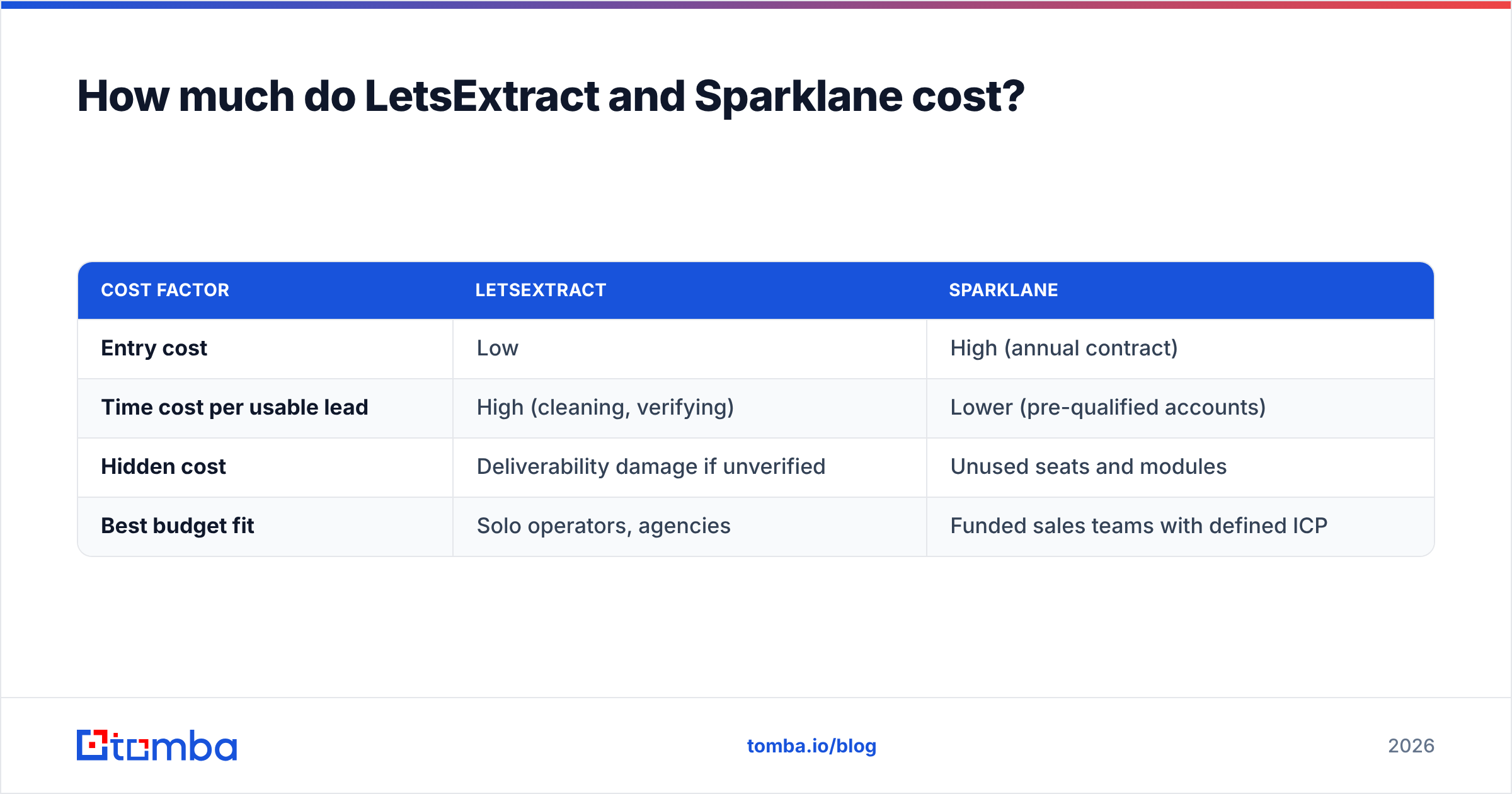
A rough way to frame it:
| Cost factor | LetsExtract | Sparklane |
|---|---|---|
| Entry cost | Low | High (annual contract) |
| Time cost per usable lead | High (cleaning, verifying) | Lower (pre-qualified accounts) |
| Hidden cost | Deliverability damage if unverified | Unused seats and modules |
| Best budget fit | Solo operators, agencies | Funded sales teams with defined ICP |
For reference, dedicated email finders sit between the two. Tomba, for example, starts with a free tier (25 searches a month), then runs $49/mo for Starter, $99/mo for Growth and $249/mo for Pro, with custom Enterprise plans. Full breakdown on Tomba pricing.
Is LetsExtract better than Sparklane for cold email?#
For a pure cold email campaign, neither is ideal on its own, but they fail in different ways.
With LetsExtract, you get volume with little targeting. Role inboxes like info@ get low reply rates, and unverified scraped lists are one of the fastest ways to land on a blocklist. It can work if the campaign is aimed at small businesses where the owner reads the generic inbox, such as local services, e-commerce stores or agencies.
With Sparklane, you get strong targeting and a good reason to reach out ("congrats on the new office in Bordeaux"), which is exactly what lifts reply rates. What you still need is a reliable way to get the right person's direct email at each flagged account.
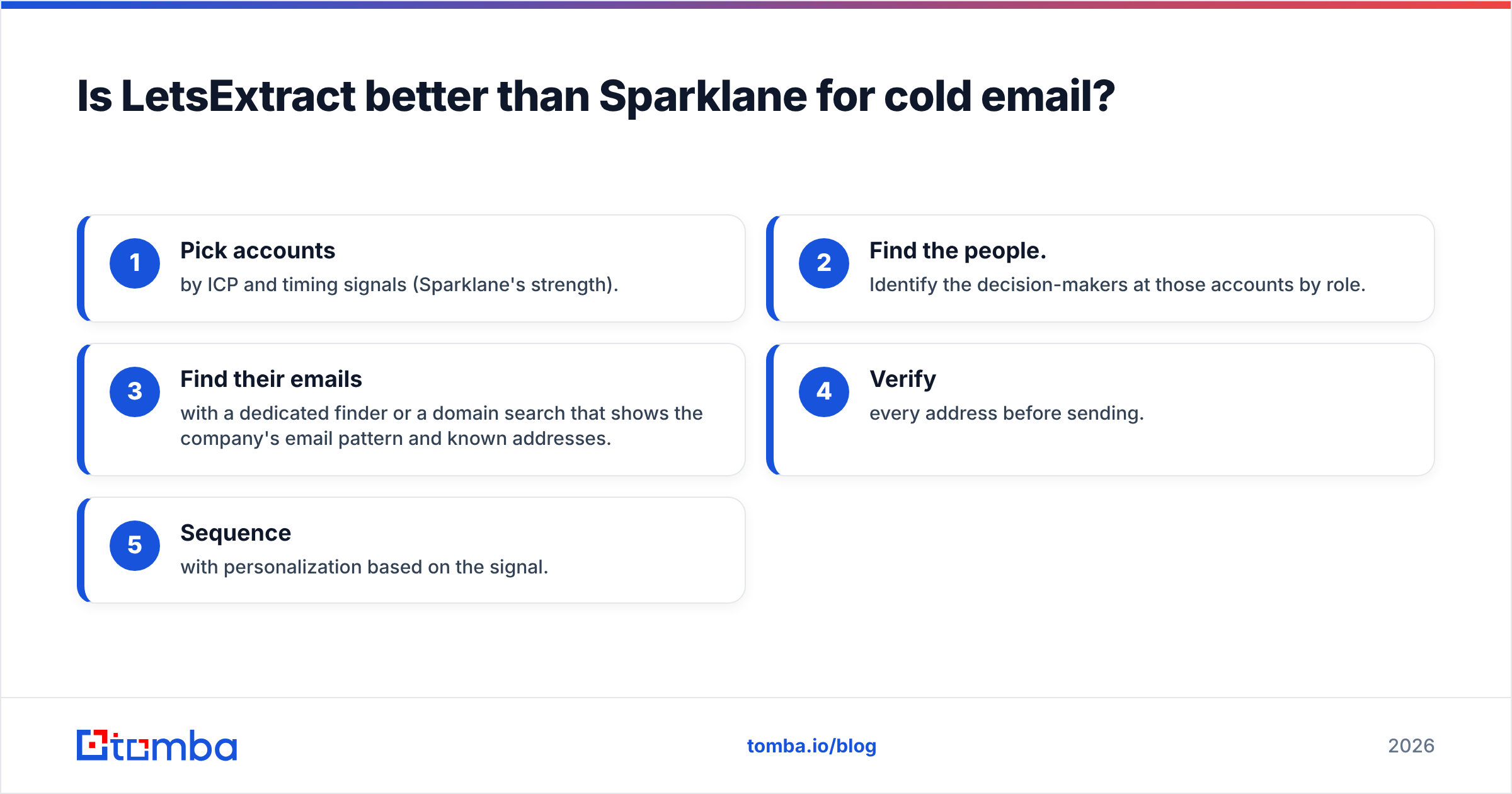
The most effective setups combine layers:
- Pick accounts by ICP and timing signals (Sparklane's strength).
- Find the people. Identify the decision-makers at those accounts by role.
- Find their emails with a dedicated finder or a domain search that shows the company's email pattern and known addresses.
- Verify every address before sending.
- Sequence with personalization based on the signal.
LetsExtract fits step 3 only when contacts are already published. Sparklane owns step 1. Steps 2 to 4 are where most teams leak pipeline.
What are the pros and cons of each tool?#
LetsExtract pros
- Very low cost of entry
- Fast bulk extraction from sources you choose
- Simple and easy to learn in an afternoon
- Good for directories, listings and niche sites where contacts are public
LetsExtract cons
- Mostly generic role inboxes, few named decision-makers
- No firmographic or intent context
- Needs heavy cleaning and verification
- Compliance risk from harvesting personal data
Sparklane pros
- Buying-signal detection helps reps time outreach
- Strong French and European company coverage
- Account scoring and CRM integration suit ABM workflows
- Better fit for regulated EU selling environments
Sparklane cons
- Quote-based pricing and annual commitment
- More setup: personas, scoring and signal tuning
- Coverage outside Europe needs validating
- Person-level email accuracy isn't its main value
Reviews on G2 are worth scanning for both. Filter by company size and region, because a 5-person agency and a 200-rep sales org will rate the same tool very differently.

Who should choose LetsExtract?#
Pick LetsExtract if:
- You're a freelancer, small agency or solo founder with a tight budget
- Your targets publish contact details (local businesses, directories, event lists, niche communities)
- You're comfortable doing your own verification and compliance checks
- You want a one-off list, not an always-on intelligence feed
Don't pick it if you need named executives at mid-market or enterprise accounts. Those emails are rarely published, so a scraper won't find them.
Who should choose Sparklane?#
Pick Sparklane if:
- You sell B2B into France or wider Europe
- Your team runs account-based selling and needs to rank a large total addressable market
- You have the budget for an annual sales intelligence contract
- Timing matters in your market (funding, expansion, hiring and leadership changes drive your deals)
Don't pick it if you mainly need a cheap way to get email addresses, or your territory sits mostly outside its strongest coverage.
Is there a better option than LetsExtract or Sparklane?#
For many teams the real question isn't "LetsExtract or Sparklane?" but "what's missing from my stack?" The usual gap is finding and verifying emails at the person level. You know which company and which role you want, and you need a deliverable work email for that person.
That's the job of a dedicated email finder. Compared with the two tools above:
- Compared with LetsExtract, an email finder doesn't depend on the email being published on a page. It combines known patterns, indexed sources and verification to return a likely address for a named person at a domain, with a confidence signal.
- Compared with Sparklane, an email finder doesn't tell you when to reach out. It makes sure that when you do, the message lands in the right inbox.
Plenty of teams run Sparklane (or a similar intelligence layer) for account selection and add an email finder for contact resolution. Budget-minded teams that used a scraper often find that switching to a finder plus verifier cuts cleanup time and bounce rates more than it adds cost.
Final verdict: LetsExtract vs Sparklane?#
- Choose LetsExtract for cheap, fast extraction of contact details that are already public, and budget time for verification.
- Choose Sparklane for signal-driven account prioritization in European B2B markets, when you have the budget and process to act on it.
- Choose neither alone if your bottleneck is getting accurate, named decision-maker emails. That's a separate step, and it deserves a tool built for it.
If that last point describes your pipeline, try Tomba Email Finder. Enter a name and company domain, get the professional email with a verification status, and push it to your CRM or sequencer. The free tier gives you 25 searches a month to test it on your real target accounts before you pay, and it fits with whatever you use upstream, whether that's a Sparklane account list or a scraped directory you want to upgrade to named contacts.
Related guides#
// get started
Find, verify and enrich your first contacts today
Start on the free plan with 25 searches a month, then scale when your team is ready.
Free plan · No credit card required · GDPR & CCPA
// about the author