LFBBD (Lead for Business) Pricing, Reviews, Pros and Cons 2026
Quote-based pricing, 250M+ claimed contacts, and 15 reviews: what LFBBD really costs, where it shines, and when a self-serve email finder is cheaper.
- LFBBD (Lead for Business Ltd) runs a done-for-you data service, not a self-serve tool. You send them your ideal customer profile and they deliver a researched CSV or XLS list, usually within 24 to 48 hours.
- Pricing is quote-based. Third-party listings show a range from about $0.01 per contact up to five-figure annual deals, with orders reported to start around $100. No public monthly plan exists.
- Reviews are positive but the sample is thin. Trustpilot scores it about 4.3 to 4.5 out of 5, but that comes from roughly 15 reviews. Most praise responsiveness and custom research. A few note some irrelevant records in big batches.
- It works best for one-off, niche lists such as Amazon sellers, eCommerce stores, or hard-to-reach verticals. It fits less well if you prospect every day and need live lookups inside your workflow.
- If you need ongoing, on-demand contacts, a credit-based tool like Tomba (free tier, then $49/mo) usually costs less per usable email over a year.
What is LFBBD (Lead for Business)?#
Lead for Business (the domain is lfbbd.com, which is why most buyers search for "LFBBD") is a lead-generation and B2B data company. It sells three main kinds of data:
- B2B contact lists. Decision-makers with email, direct dial, and mobile numbers, filtered by industry, title, company size, and location.
- eCommerce store data. Shopify, WooCommerce, and similar store owners with contact details and store metadata.
- Amazon seller data. The company advertises 500K+ Amazon seller contacts, including 200K+ verified emails and 50K+ direct mobile numbers, with 20+ data points per seller (revenue band, category, SKU count, location). It says the data is refreshed every 15 to 30 days.
Across all categories, LFBBD claims more than 250 million business contacts and "up to 95% accuracy guaranteed." The Amazon product pages go further and cite 95 to 99% accuracy after "triple verification."
The main thing to understand before you look at the price is how you buy. LFBBD is not a SaaS platform where you log in, search, and export. It works like a research agency. You describe the list you want, their team (reviewers often mention the founder, Riad, by name) builds or pulls it, checks it, and emails you a spreadsheet. That model shapes everything that follows: the price, the turnaround, and who it suits.
How does Lead for Business pricing work?#
LFBBD does not publish fixed monthly tiers. Its pricing page asks you to request a quote, and the team offers free samples so you can check quality before you pay. The public numbers come from its Datarade provider profile, where the listed datasets range from roughly $0.01 per contact on bulk database pulls to $45 per 1,000 records on some packages. Larger engagements reach $14,999 per year for subscriptions and up to $25,000 per purchase for big custom builds. Entry orders are listed as starting from about $100.
In practice, your quote depends on four variables:
- Data type. A raw pull from an existing database costs far less per record than manually researched contacts.
- Depth per record. Email only is cheapest. Adding direct dials, mobile numbers, LinkedIn URLs, or revenue data raises the per-contact rate. One Datarade reviewer said the team "offered multiple rates based on our level of specificity for each contact."
- Niche difficulty. Amazon sellers or specific job titles at small companies take more research time than "VP Sales at US SaaS companies."
- Volume and recurrence. Annual subscriptions and large orders get lower unit prices.
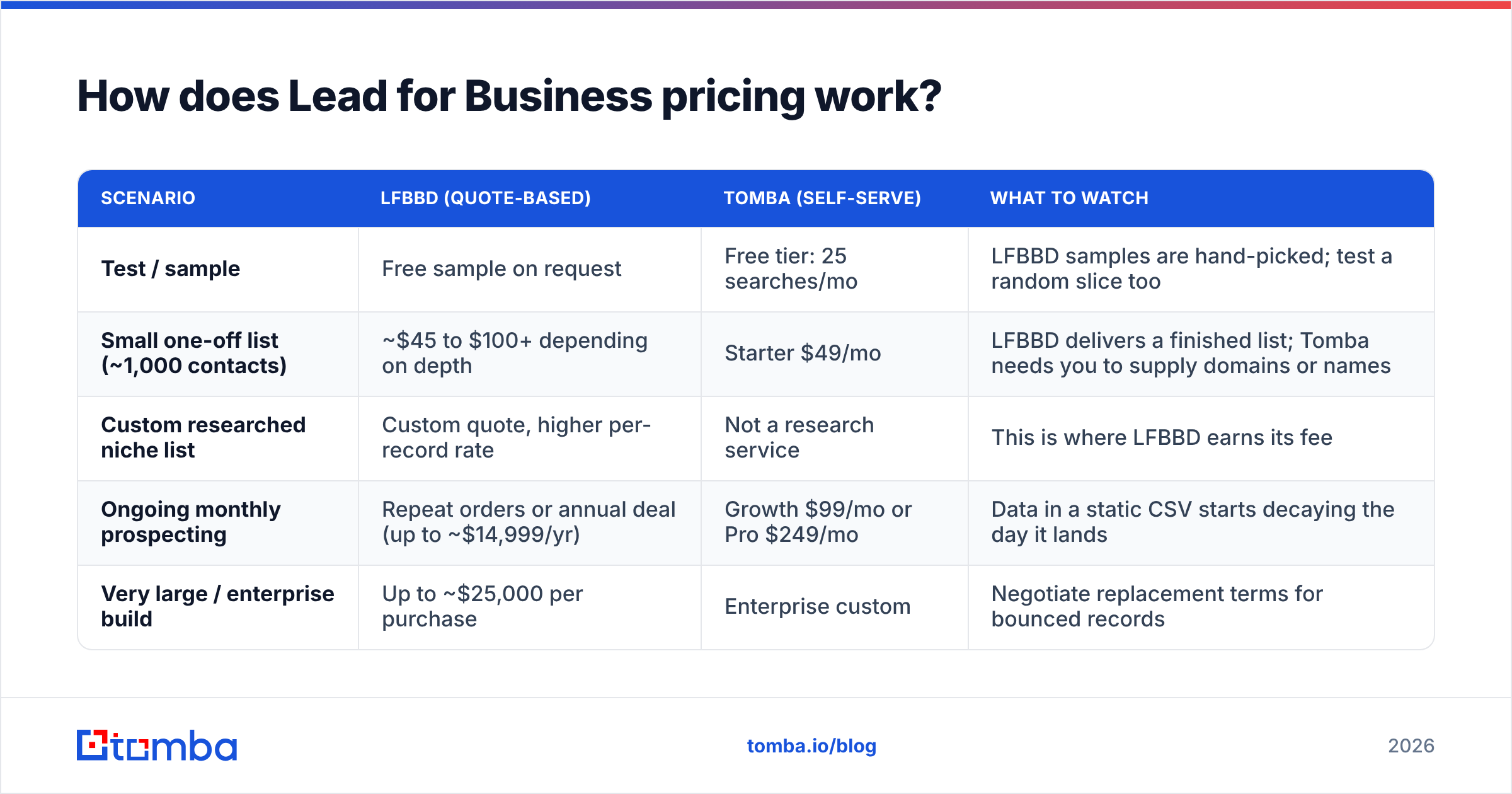
Here is how the typical scenarios compare to a self-serve email tool, using the published ranges.
| Scenario | LFBBD (quote-based) | Tomba (self-serve) | What to watch |
|---|---|---|---|
| Test / sample | Free sample on request | Free tier: 25 searches/mo | LFBBD samples are hand-picked; test a random slice too |
| Small one-off list (~1,000 contacts) | ~$45 to $100+ depending on depth | Starter $49/mo | LFBBD delivers a finished list; Tomba needs you to supply domains or names |
| Custom researched niche list | Custom quote, higher per-record rate | Not a research service | This is where LFBBD earns its fee |
| Ongoing monthly prospecting | Repeat orders or annual deal (up to ~$14,999/yr) | Growth $99/mo or Pro $249/mo | Data in a static CSV starts decaying the day it lands |
| Very large / enterprise build | Up to ~$25,000 per purchase | Enterprise custom | Negotiate replacement terms for bounced records |

What are the hidden costs of buying lead lists?#
The sticker price per contact is only part of the real cost. With any list vendor, LFBBD included, budget for these:
- Decay after delivery. B2B contact data goes stale quickly as people change jobs, and a list bought in January is less accurate by June. Unless you reorder, you pay again to refresh, or you run your own checks before every campaign.
- Verification before sending. Even at a claimed 95% accuracy, a 10,000-row list could hold about 500 bad addresses. Sending to them hurts your domain. Run the file through an email verifier before the first send; it costs very little compared with a burned domain.
- Relevance leakage. One Trustpilot reviewer noted that most leads were accurate "though some irrelevant ones" appeared in a high-volume order. Irrelevant rows are records you paid for and can't use.
- Manual import work. CSV delivery means someone has to map fields, dedupe against your CRM, and upload. That labor cost doesn't show up on the invoice.
- Replacement terms. Ask before you pay: does LFBBD replace bounced or wrong-person records, and within what window? Quote-based vendors often agree to this, but only when you ask up front.
What do LFBBD reviews say?#
Reviews are mostly favorable. The limit is how many there are.
On Trustpilot, Lead for Business Ltd shows a TrustScore of roughly 4.3 to 4.5 out of 5 (it varies by regional page and date) from about 15 reviews. Datarade carries a handful more. The recurring themes:
- Responsiveness. Reviewers often name the founder and describe quick replies, flexible quotes, and early delivery.
- Custom fit. Buyers say they got "exactly what they needed," including very specific segments that off-the-shelf databases couldn't produce.
- Fair pricing. Several reviews call the lists "reasonably priced" for the level of research.
- Mixed accuracy at scale. The critical notes don't claim bad data. They say large batches contain some irrelevant or off-target records.
Fifteen reviews is too few to support firm conclusions. Compare that with SaaS tools on G2 or Capterra that have hundreds or thousands of reviews. Treat the positive sentiment as a sign that the service is legitimate and responsive, not as proof of accuracy at your volume. Your own sample test matters more than the star rating.
What are the pros and cons of Lead for Business?#
Pros
- Done-for-you research. You skip building the list yourself, which helps small teams with no SDR capacity.
- Niche coverage. Amazon seller and eCommerce data are hard to find in mainstream B2B databases, which lean toward corporate employees.
- Phones included. Direct dials and mobile numbers come bundled per record when you pay for them, which helps cold-calling teams.
- Free samples and flexible quotes. You can check quality before committing, and the pricing adjusts to how much detail you need.
- Fast turnaround. Most orders arrive in 24 to 48 hours.
Cons
- No transparent public pricing. You can't budget without a sales conversation, and quotes may differ from one buyer to the next.
- Static delivery. A spreadsheet doesn't update itself. There's no live search, no browser extension, and no CRM sync to keep records fresh.
- Small review footprint. About 15 public reviews makes it hard to benchmark against established platforms.
- Accuracy claims are self-reported. "Up to 95%" and "95 to 99%" are vendor figures. Plan to verify independently.
- Poor fit for high-frequency prospecting. If your reps need five fresh contacts every hour, ordering lists by email slows them down.
Is LFBBD better than a self-serve email finder?#
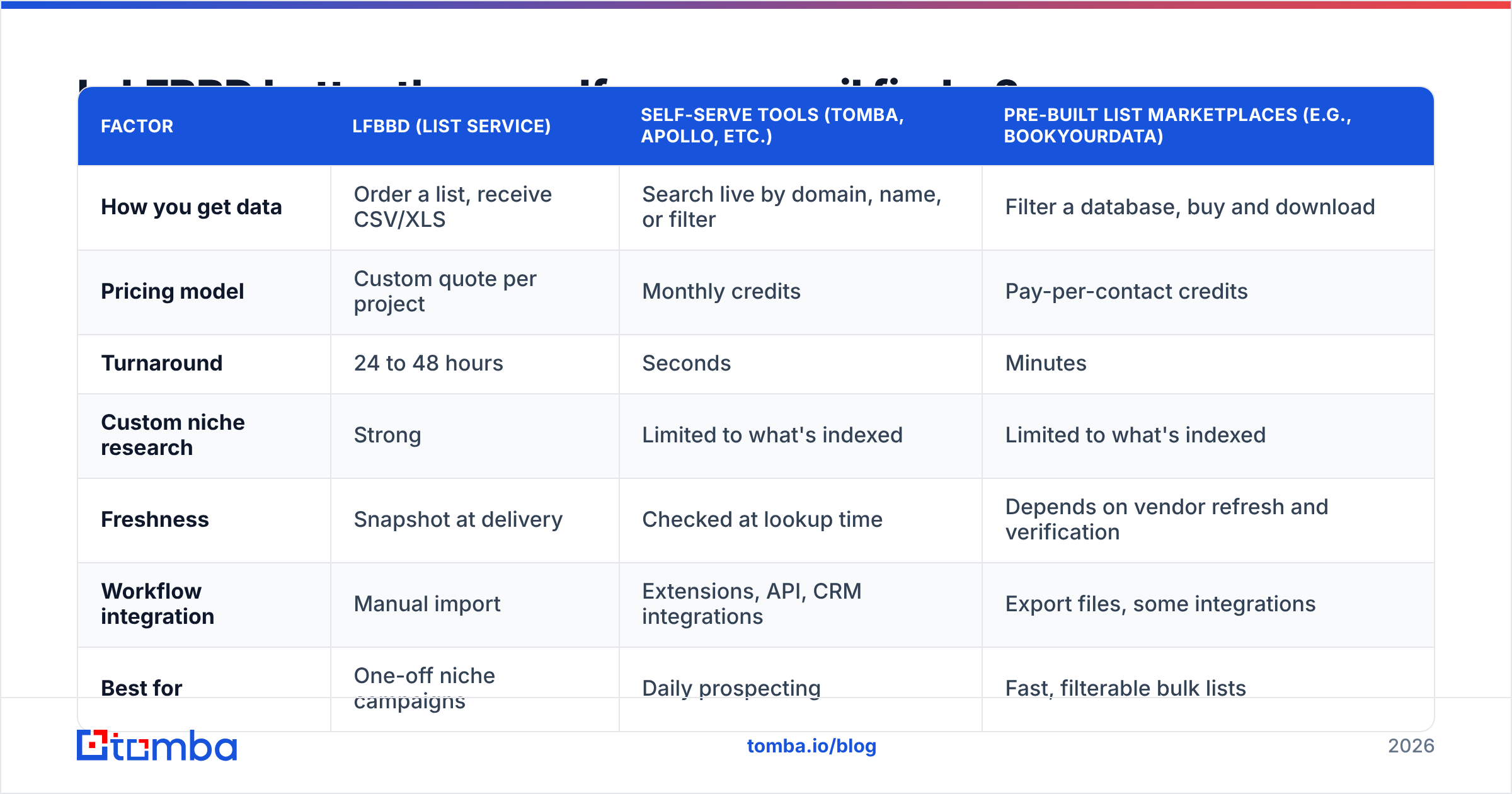
It depends on how you prospect. The two models solve different problems:
| Factor | LFBBD (list service) | Self-serve tools (Tomba, Apollo, etc.) | Pre-built list marketplaces (e.g., BookYourData) |
|---|---|---|---|
| How you get data | Order a list, receive CSV/XLS | Search live by domain, name, or filter | Filter a database, buy and download |
| Pricing model | Custom quote per project | Monthly credits | Pay-per-contact credits |
| Turnaround | 24 to 48 hours | Seconds | Minutes |
| Custom niche research | Strong | Limited to what's indexed | Limited to what's indexed |
| Freshness | Snapshot at delivery | Checked at lookup time | Depends on vendor refresh and verification |
| Workflow integration | Manual import | Extensions, API, CRM integrations | Export files, some integrations |
| Best for | One-off niche campaigns | Daily prospecting | Fast, filterable bulk lists |
In short, buy from LFBBD when the list is the hard part, such as sellers in a specific Amazon category with revenue over a set threshold. Use a self-serve finder when the lookup is the hard part. That means you already know your target accounts and need the right person's verified email today.
Many teams do both. They order a niche seed list once, then enrich and re-verify it on their own as it ages. If you already have target accounts, a domain search turns a company website into a list of verified employee emails in one step, with no research order needed.

What does a year of each approach cost?#
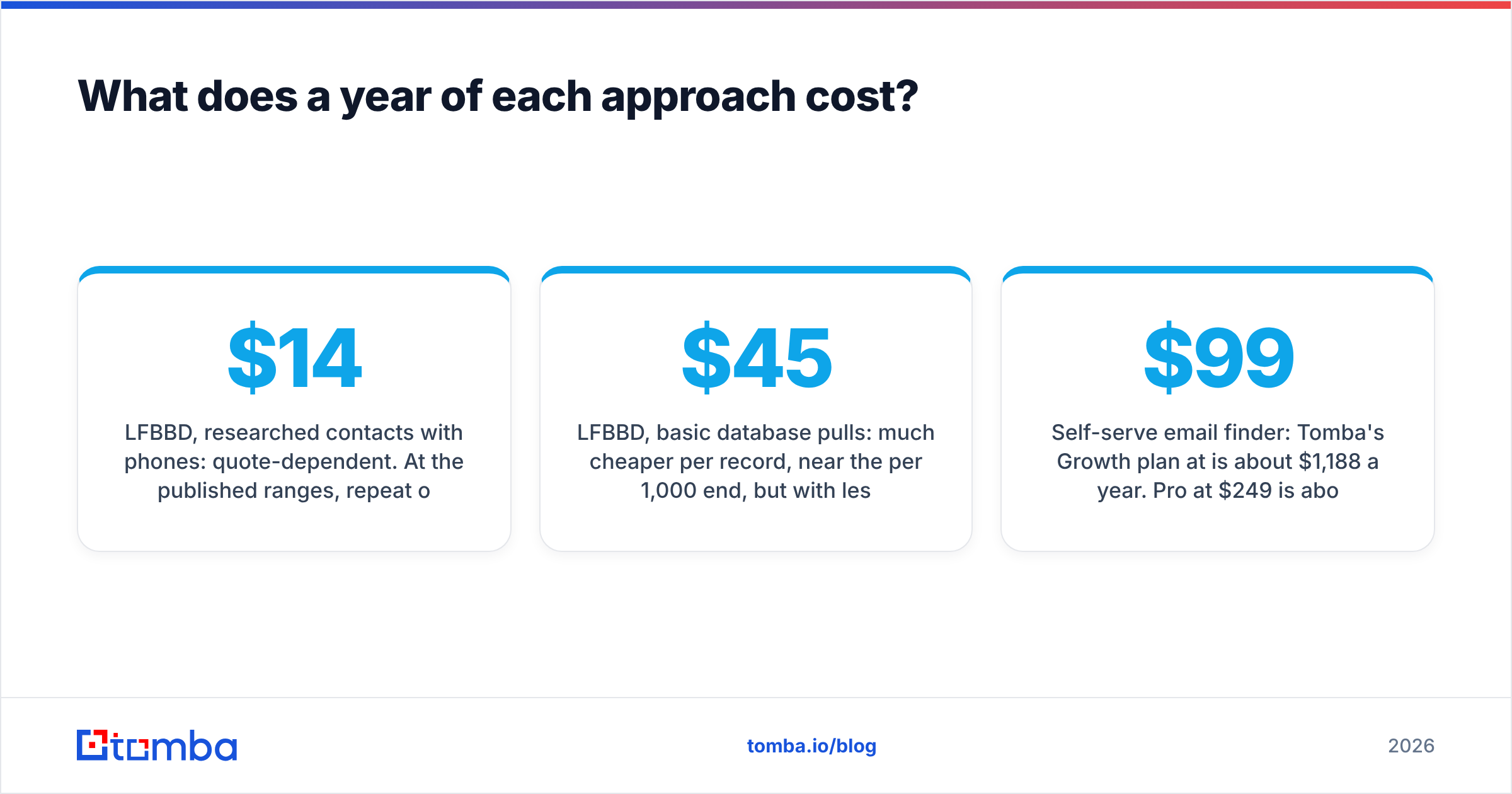
Take an example team that needs about 1,000 new verified contacts a month (12,000 a year). Rough annual costs:
- LFBBD, researched contacts with phones: quote-dependent. At the published ranges, repeat orders plus an annual deal could land anywhere from a few thousand dollars to the ~$14,999/yr tier, depending on depth. Add a verification pass on every batch.
- LFBBD, basic database pulls: much cheaper per record, near the $45 per 1,000 end, but with less manual research behind each row.
- Self-serve email finder: Tomba's Growth plan at $99/mo is about $1,188 a year. Pro at $249/mo is about $2,988 a year for heavier volume. Verification is included in the workflow. Check Tomba pricing for exact credit allowances per plan.
The self-serve route usually wins on cost per usable email over twelve months. LFBBD wins when your segment isn't well covered by standard databases or when nobody on your team has time to build lists. If you're weighing broader databases, Tomba's B2B database sits between the two: filter-based list building with on-demand verification.
How do you get the most out of an LFBBD order?#
If you decide to buy, these steps protect your budget:
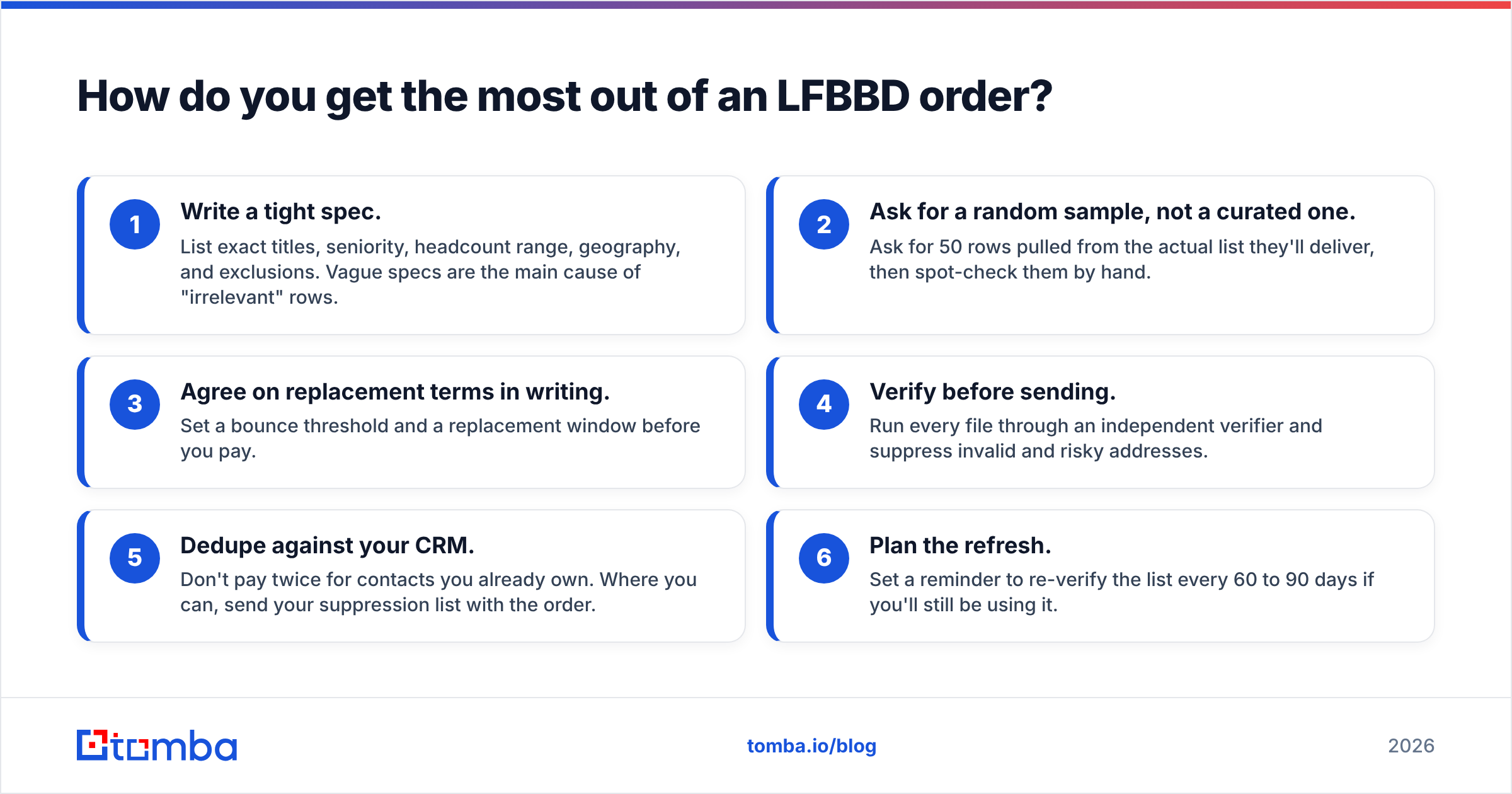
- Write a tight spec. List exact titles, seniority, headcount range, geography, and exclusions. Vague specs are the main cause of "irrelevant" rows.
- Ask for a random sample, not a curated one. Ask for 50 rows pulled from the actual list they'll deliver, then spot-check them by hand.
- Agree on replacement terms in writing. Set a bounce threshold and a replacement window before you pay.
- Verify before sending. Run every file through an independent verifier and suppress invalid and risky addresses.
- Dedupe against your CRM. Don't pay twice for contacts you already own. Where you can, send your suppression list with the order.
- Plan the refresh. Set a reminder to re-verify the list every 60 to 90 days if you'll still be using it.
Final verdict: is Lead for Business worth it in 2026?#
Lead for Business is a legitimate, responsive, custom-research data vendor with good (if limited) reviews and useful niche coverage, especially for Amazon sellers and eCommerce. It's worth a free sample if your target market is hard to find in mainstream databases, or if you need a finished list fast without doing the research yourself.
It's harder to justify as your main prospecting engine. Opaque pricing, static CSV delivery, and self-reported accuracy mean you'll pay for verification and refreshes on top of the quote. Teams that prospect every week usually get better value from a self-serve tool that checks data at the moment of lookup.
If you already know which companies you want to reach and just need the right people's addresses, start with the Tomba Email Finder. Enter a name and a domain and you get a verified professional email in seconds. The free tier gives you 25 searches a month to test it against any list you've bought, and paid plans start at $49/mo when you're ready to scale.
Related guides#
Ready to find emails that actually work?
Join 150,000+ professionals who stopped guessing and started sending. Free credits on signup — no credit card required.
Get the Tomba newsletter
Practical outbound tactics and product updates — once every two weeks.
About the author