LFBBD Lead for Business vs Ocean.io: Which B2B Data Source Fits?
LFBBD sells custom, manually researched contact lists. Ocean.io finds lookalike accounts from your best customers. They fix different problems, so here's how to choose the right one for your pipeline.
TL;DR
- LFBBD (Lead for Business) is a done-for-you data vendor. You describe your target audience, and it delivers a custom contact list with emails and direct dials, usually within 24-48 hours.
- Ocean.io is a self-serve account discovery platform. You give it a few of your best customers, and its lookalike engine returns companies that resemble them. Contacts and emails are available as a credit-based add-on.
- Choose LFBBD when you already know your ICP and want a finished list without doing the work yourself. Choose Ocean.io when you still need to figure out which companies to go after.
- Neither tool removes the need to verify contacts before you send. Run every export through an email verifier to protect your sender reputation.
- For most small outbound teams, the cheapest setup is Ocean.io (or another source) for accounts plus a dedicated email finder for the contacts.
What is LFBBD (Lead for Business)?#
LFBBD, trading as Lead for Business Ltd, is a B2B data provider. It sells prospect lists instead of software seats. The company says it has more than 250 million business contact records, covering B2B companies, eCommerce stores, and Amazon sellers. Where available, records include a named contact, a business email, and a direct dial or mobile number.
The model is service-first. You don't log into a search interface and filter a database yourself. Instead, you send a brief (industry, geography, job titles, company size, technology used) and the team delivers a spreadsheet. According to its Datarade provider profile, pricing starts at around $45 per 1,000 records for standard datasets and goes up to large custom purchases. Free samples are offered so you can check quality before committing.
Its main selling points, as the company presents them:
- Direct dials and mobile numbers, not just switchboard lines
- Manually researched and verified records
- Turnaround of 24-48 hours on custom lists
- Lifetime support on purchased data
In practice, LFBBD works like a research agency with a big data warehouse behind it. The value is the labour you don't have to do yourself.
What is Ocean.io?#
Ocean.io is a SaaS platform built around one feature: lookalike company search. You enter the domains of your best customers, and Ocean returns companies with similar attributes, such as industry signals, website content, technology, headcount, growth, and geography. Its database covers tens of millions of company profiles.
You can then go from accounts to people inside the platform by revealing contacts, work emails, and phone numbers, with each type of data costing a different number of credits. Third-party reviews describe a credit-pool model with annual plans. Emails and phone numbers cost several times more credits than a company result, so how you use the platform matters as much as which plan you pick.
Ocean.io is aimed at RevOps teams, founders, and SDR leaders who are building target account lists for ABM or outbound and want a better answer to "who else looks like our best customers?" than a standard firmographic filter can give.
How do LFBBD and Ocean.io actually differ?#
The key point is that these tools solve different steps of the prospecting process. LFBBD answers "give me contacts that match this spec." Ocean.io answers "help me find the right companies in the first place."
- Discovery vs. delivery. Ocean.io is a discovery tool, and the lookalike model finds accounts you wouldn't have thought to filter for. LFBBD is a delivery service that executes on a spec you've already written.
- Self-serve vs. done-for-you. With Ocean.io, you run the searches, adjust the seed list, and export. With LFBBD, a team does the research and hands you a file.
- Account-first vs. contact-first. Ocean.io's core unit is the company, and contacts come second. LFBBD's core unit is the contact record, with company details attached.
- Subscription vs. per-list. Ocean.io runs on recurring credits. LFBBD is mostly transactional: you pay per list or per thousand records.
- Phone coverage. LFBBD puts direct dials front and centre. Ocean.io offers phone numbers, but they cost the most credits, so heavy calling teams will use up their credit pool quickly.
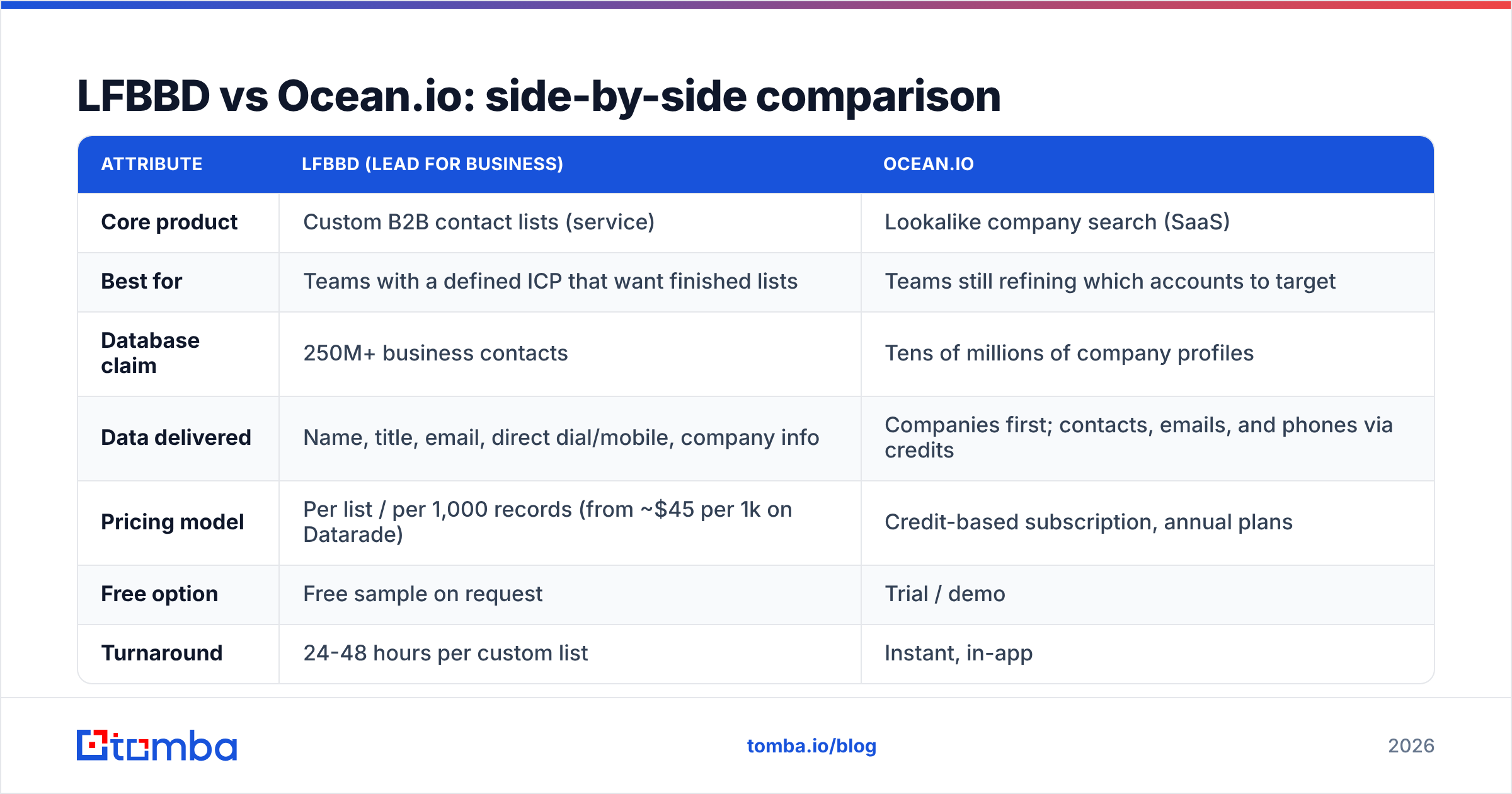
LFBBD vs Ocean.io: side-by-side comparison#
| Attribute | LFBBD (Lead for Business) | Ocean.io |
|---|---|---|
| Core product | Custom B2B contact lists (service) | Lookalike company search (SaaS) |
| Best for | Teams with a defined ICP that want finished lists | Teams still refining which accounts to target |
| Database claim | 250M+ business contacts | Tens of millions of company profiles |
| Data delivered | Name, title, email, direct dial/mobile, company info | Companies first; contacts, emails, and phones via credits |
| Pricing model | Per list / per 1,000 records (from ~$45 per 1k on Datarade) | Credit-based subscription, annual plans |
| Free option | Free sample on request | Trial / demo |
| Turnaround | 24-48 hours per custom list | Instant, in-app |
| Niche verticals | eCommerce and Amazon seller data | Strong for SaaS and tech-adjacent ICPs |
| CRM integration | File delivery (CSV/XLSX) | Native CRM and workflow integrations |
| Main risk | Data decays between research and send date | Lookalike results can be too broad for narrow niches |
Which is more accurate: LFBBD or Ocean.io?#
Neither vendor publishes an independent accuracy audit you can rely on, so don't treat either one's claims as proof. What you can do is understand where each tends to fail.
LFBBD's accuracy risk is timing. Manual research is only as fresh as the day it was done. B2B contact data decays quickly because people change jobs, get promoted, and companies rebrand. If there are three weeks between delivery and your first send, some addresses will already be out of date. "Manually verified" is a good sign, but it describes the data at one point in time, not on the day you hit send.
Ocean.io's accuracy risk is relevance. The emails may be fine, but the accounts can miss. Reviews on G2's Ocean.io comparison pages are mixed. Users praise the interface and onboarding, but some reviewers in narrow or regulated niches say the lookalike lists came back too broad. If your ICP is "mid-market precision-parts manufacturers with ISO 13485 certification," a similarity model trained on website text may not pick up that detail.
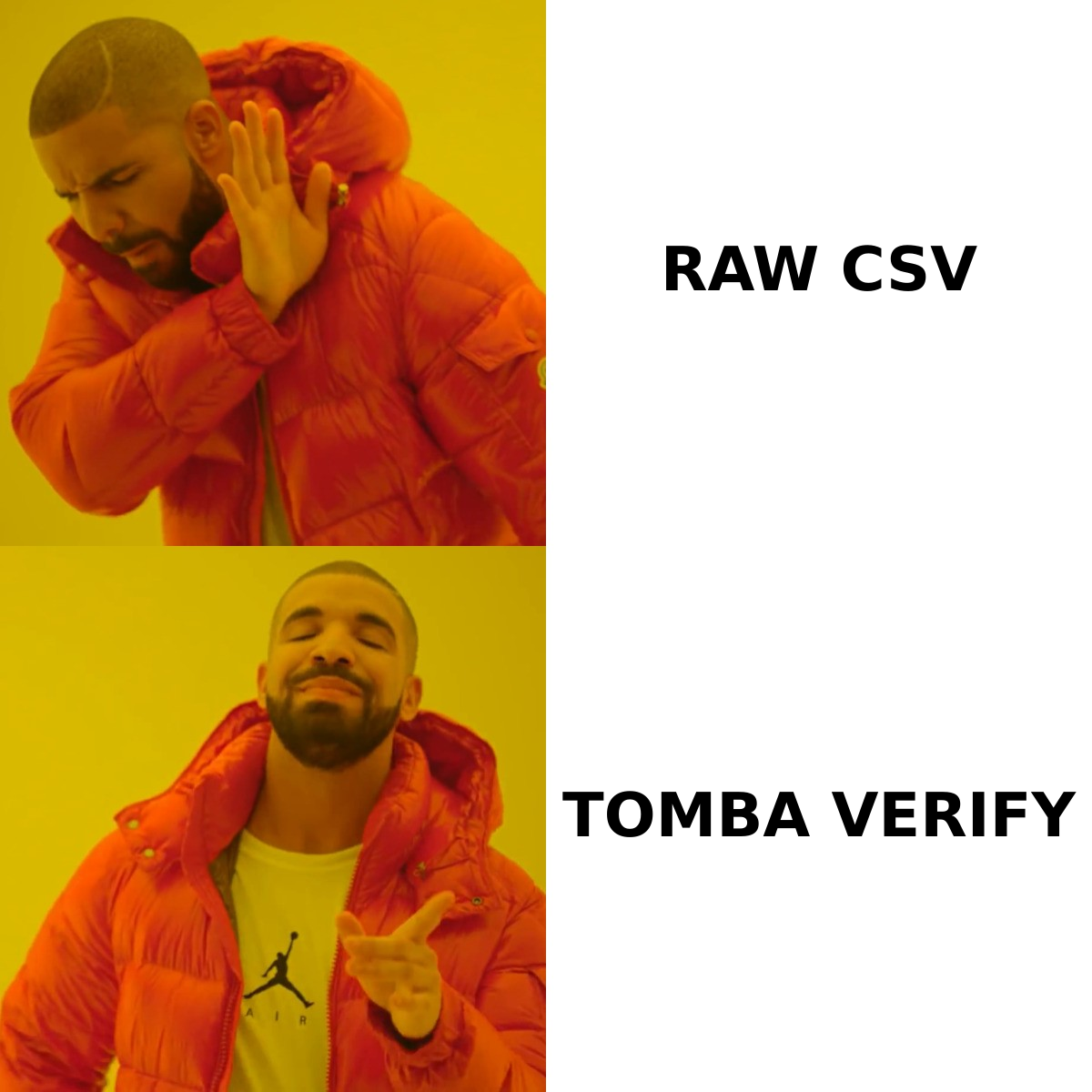
The fix is the same for both: verify contacts before they reach your sequencer. Run every file through an email verifier and remove invalid, disposable, and risky catch-all addresses. That one step does more for your bounce rate than any vendor's accuracy badge.
How much do LFBBD and Ocean.io cost in practice?#
The pricing models are hard to compare directly, so work out cost per usable contact instead of reading the headline price.
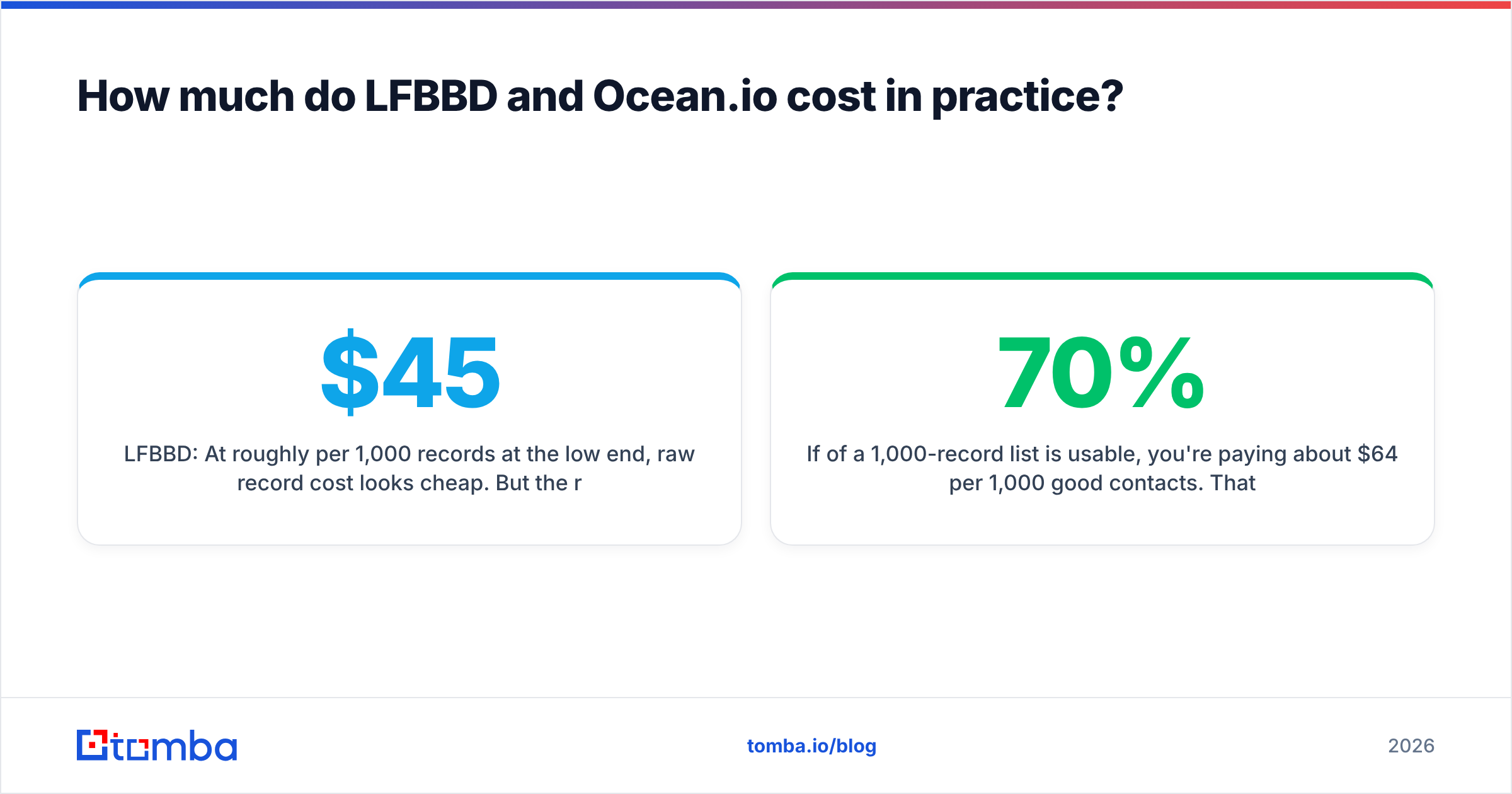
LFBBD: At roughly $45 per 1,000 records at the low end, raw record cost looks cheap. But the real cost per usable contact depends on:
- How many records match your titles exactly, not just roughly
- How many emails pass verification
- Whether the direct dials connect
If 70% of a 1,000-record list is usable, you're paying about $64 per 1,000 good contacts. That's still competitive, especially with phone numbers included. Custom research on narrow segments costs more, so get a quote for your specific brief.
Ocean.io: Credits are spent at different rates. A company result is cheap, but an email costs several credits and a phone number costs even more. A team that mostly builds account lists and pulls a few contacts per account will get good value. A team that reveals five emails and three phones per account will run through its credits quickly. Check Ocean.io's pricing page for current plan sizes, since plans are annual and third-party reports list different starting points.
Hidden cost for both: list maintenance. A one-time LFBBD list gets out of date. Unused Ocean.io credits usually don't roll over indefinitely. Plan for a verification and enrichment budget either way.
When should you pick LFBBD?#
LFBBD is the better fit if:
- Your ICP is already locked. You know the exact titles, industries, and regions you want and don't need help with discovery.
- You call prospects. Direct dials and mobiles are part of the offer, not an expensive add-on.
- You sell to eCommerce or Amazon sellers. Few general-purpose B2B platforms cover these merchant segments well.
- You don't have in-house ops capacity. No one on your team has time to learn a prospecting platform, and a finished file is worth more than a login.
- You buy in campaigns, not continuously. Quarterly pushes, event follow-ups, and market-entry tests suit per-list pricing better than a year-long subscription.
The trade-off is less control. You can't adjust a filter at 11 p.m. and re-run the search. Every change goes back through the vendor.
When should you pick Ocean.io?#
Ocean.io is the better fit if:
- You don't have a clear answer to "who else should we target?" Lookalike modelling surfaces accounts that a filter-based search would miss.
- You run ABM. Account lists are the starting point for ABM, and Ocean builds them quickly.
- Your ICP is tech- or SaaS-heavy. Website and technology signals are most reliable in these segments.
- You want CRM-connected workflows. Push accounts into your CRM, score them, and route them without passing spreadsheets around.
- You iterate every week. Self-serve means you can test a new seed list on a Tuesday afternoon.
The trade-off is cost at scale for contact-level data, and some risk that the model's idea of "similar" doesn't match yours in very specialised markets.
Can you use LFBBD and Ocean.io together?#
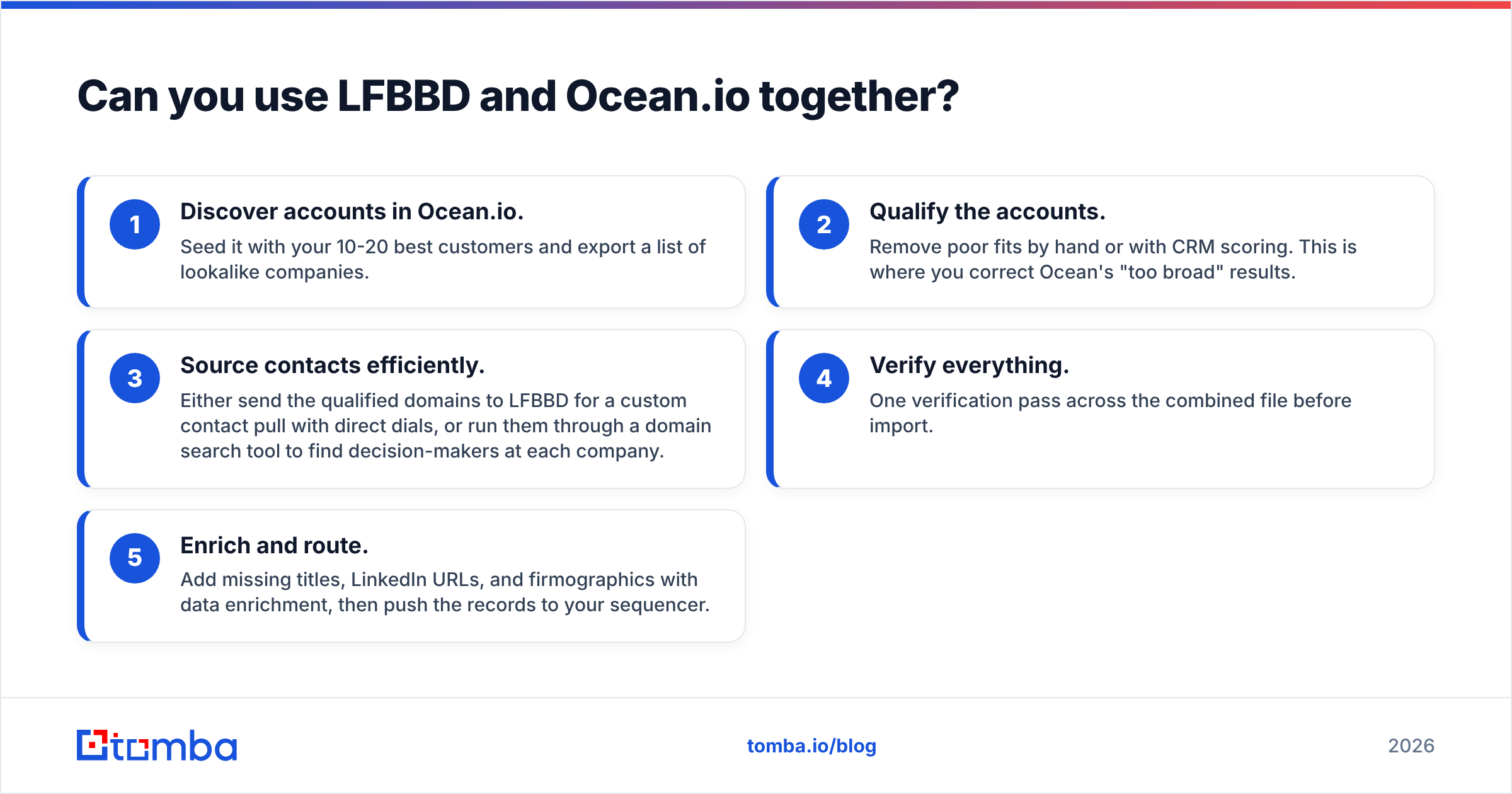
Yes, and for some teams it's the most practical setup. A common workflow:
- Discover accounts in Ocean.io. Seed it with your 10-20 best customers and export a list of lookalike companies.
- Qualify the accounts. Remove poor fits by hand or with CRM scoring. This is where you correct Ocean's "too broad" results.
- Source contacts efficiently. Either send the qualified domains to LFBBD for a custom contact pull with direct dials, or run them through a domain search tool to find decision-makers at each company.
- Verify everything. One verification pass across the combined file before import.
- Enrich and route. Add missing titles, LinkedIn URLs, and firmographics with data enrichment, then push the records to your sequencer.
This splits the work so each tool handles what it's best at: Ocean chooses the accounts, and a contact source (LFBBD's researchers or a self-serve email finder) fills in the people.

What are the alternatives if neither fits?#
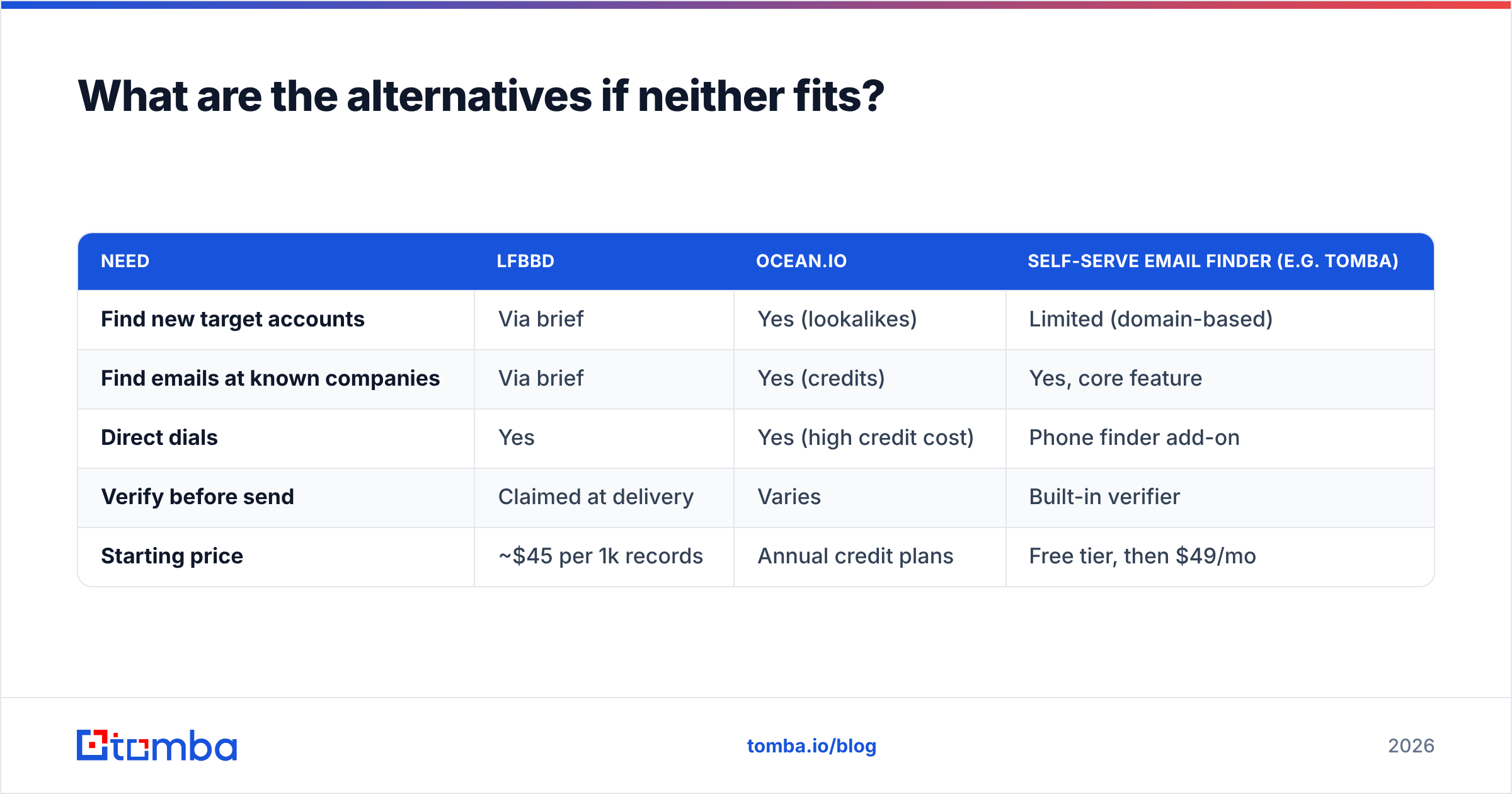
If you want LFBBD's contact depth without paying per list, or Ocean's accounts without the credit cost of contact reveals, consider a self-serve email finder paired with a separate account source.
| Need | LFBBD | Ocean.io | Self-serve email finder (e.g. Tomba) |
|---|---|---|---|
| Find new target accounts | Via brief | Yes (lookalikes) | Limited (domain-based) |
| Find emails at known companies | Via brief | Yes (credits) | Yes, core feature |
| Direct dials | Yes | Yes (high credit cost) | Phone finder add-on |
| Verify before send | Claimed at delivery | Varies | Built-in verifier |
| Starting price | ~$45 per 1k records | Annual credit plans | Free tier, then $49/mo |
Tomba's pricing starts with a free tier of 25 searches per month, then Starter at $49/mo, Growth at $99/mo, and Pro at $249/mo. That makes it a cheap way to add contact-level coverage to accounts you found elsewhere. It won't replace Ocean's lookalike engine, and it isn't a done-for-you research service like LFBBD. It covers the "find and verify the person" step.
So, LFBBD vs Ocean.io: which should you choose?#
Base the choice on the gap in your process, not on feature lists:
- Gap = "we know who we want but can't find them." Choose LFBBD, especially if you call prospects or sell to eCommerce merchants.
- Gap = "we don't know which accounts to target." Choose Ocean.io, especially for ABM and SaaS-type ICPs.
- Gap = "we have accounts but need emails cheaply." Neither is the most cost-effective option. Use a self-serve email finder and verifier.
Whichever you choose, ask for a sample, run it through verification, and calculate your real cost per usable contact before you sign anything annual.
If you already have a target account list from Ocean.io, an LFBBD delivery, or your own CRM, the next step is getting accurate emails for the people at those companies. The Tomba Email Finder finds professional addresses by name, domain, or company, and it comes with a built-in verifier so bad addresses are removed before they affect your deliverability. Start on the free plan, test it against a sample of your current list, and compare the hit rate for yourself.
Related guides#
// get started
Find, verify and enrich your first contacts today
Start on the free plan with 25 searches a month, then scale when your team is ready.
Free plan · No credit card required · GDPR & CCPA
// about the author