LFBBD Lead for Business vs SalesIntel: 2026 B2B Data Comparison
One sells custom lead lists by the thousand. The other sells annual seats on a human-verified database. Here's how LFBBD Lead for Business and SalesIntel compare on price, freshness, and fit, and when neither is the right buy.
TL;DR
- LFBBD (Lead for Business) is a list vendor. You tell it who you want, it builds a custom dataset (B2B, eCommerce, and Amazon seller contacts), and you pay per batch. Its public data listings start at about $45 per 1,000 records.
- SalesIntel is a subscription platform. You pay per seat, usually on an annual contract, and you get ongoing access to a database of 200M+ contacts that it says human researchers re-verify on a rolling cycle.
- LFBBD works best for one-off campaigns and niche segments like Amazon sellers. SalesIntel works best for SDR teams that need fresh direct dials every day and have a five-figure data budget.
- Neither one replaces verification. Run every exported list through an email verifier before you send, whichever vendor it came from.
- If you mostly need a few hundred accurate emails a month, a pay-as-you-go email finder usually costs less than either option.
What is LFBBD Lead for Business?#
Lead for Business (its domain is lfbbd.com, which is why buyers search for "LFBBD") sells B2B contact data. Its Datarade provider profile describes it as a lead generation company that supplies B2B, eCommerce, and Amazon seller data, with contact emails and direct dial or mobile numbers. It claims more than 250 million business contacts, including a segment of 200K+ Amazon seller contacts.
LFBBD sells lists, not software. You don't log into a search interface and filter records yourself. You send a brief ("US-based Shopify stores doing $1M+ with a named founder and phone number"), LFBBD sends a sample, you approve it, and it delivers a file. Pricing listed on Datarade ranges from roughly $45 per 1,000 records at the low end to five-figure custom purchases. Reviewers also say the rate changes with how specific each contact needs to be.
LFBBD fits three kinds of buyers:
- Agencies building a campaign for a client in a narrow vertical
- eCommerce SaaS and service companies that sell to Amazon or Shopify merchants
- Teams that need one large batch now, not a year-long subscription
What is SalesIntel?#
SalesIntel is a sales intelligence platform. Its main selling point is human-verified contact data. The company says around 2,000 researchers re-verify records on a rolling cycle, and it advertises a 95% accuracy guarantee on verified contacts. The database has 200M+ records, with direct dials and mobile numbers as a strong focus.
You work inside the platform. You filter by firmographics, technographics, and (with add-ons) intent signals, then push records to your CRM or sequencer. Published and third-party pricing data for 2026 shows:
- Individual plans from about $99/month, billed annually, with limited credits
- Team plans that usually start around $18,000/year for three seats
- A reported median contract of around $17,600/year, with deals ranging from about $8,700 to $41,000+
- Add-ons such as advanced Intent and VisitorIntel, which can add $6K to $13K a year
Reviews on Capterra tend to praise the phone data quality and criticise the annual commitment. That tradeoff shows up throughout this comparison.
How do the two models actually differ?#
The core difference is how you buy the data. LFBBD sells you a finished file of contacts. SalesIntel sells you ongoing access to a database. That one difference drives most of the others:
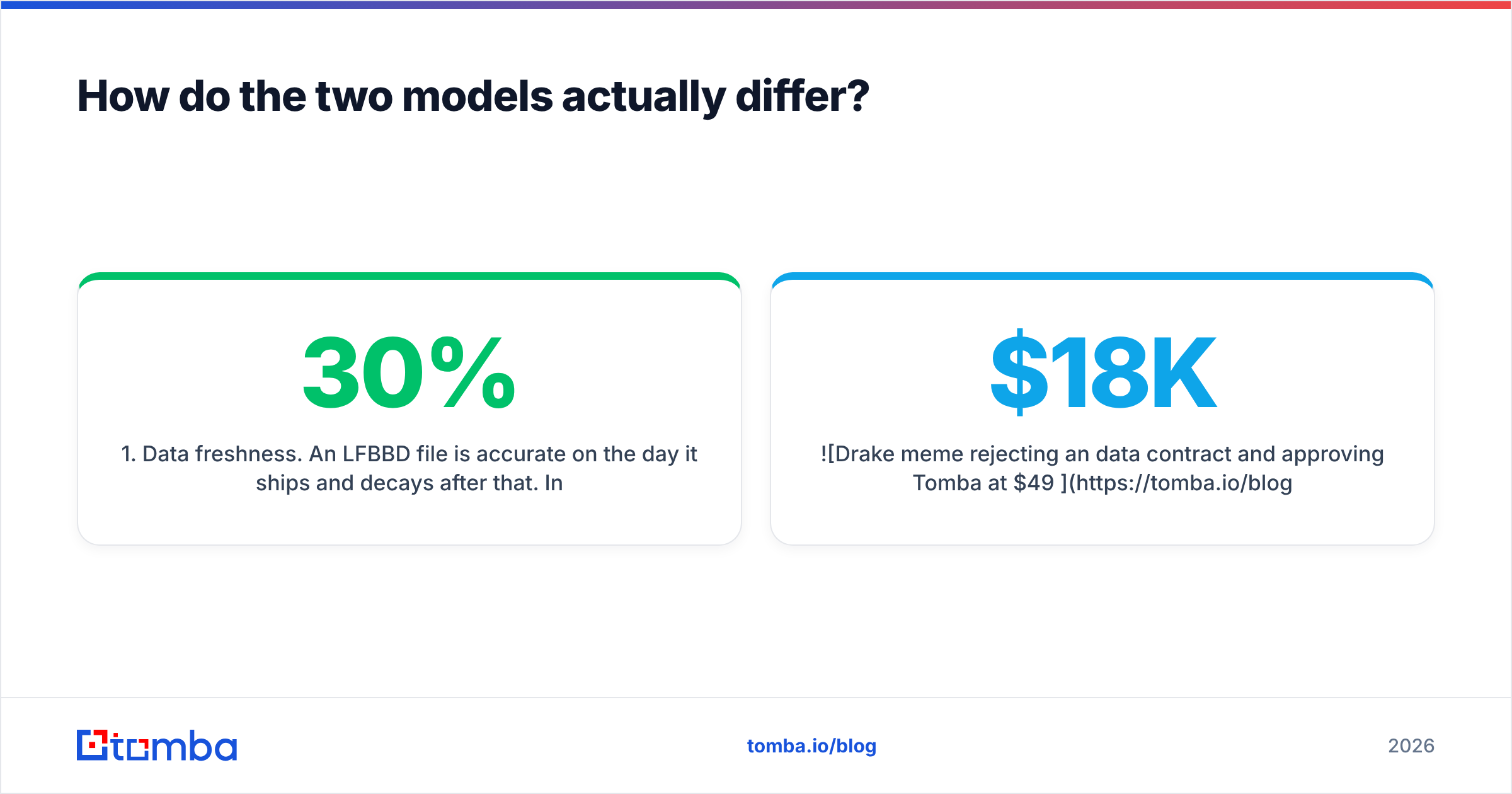
- Data freshness. An LFBBD file is accurate on the day it ships and decays after that. Industry estimates usually put B2B contact decay at 20–30% a year. SalesIntel keeps re-verifying its database, so a record you pull in month nine was checked more recently than a file you bought in month one.
- Targeting flexibility. With LFBBD, you define the segment once, up front. If you want to change the ICP halfway through a campaign, you order again. With SalesIntel, you change the filters and export again whenever you like.
- Cost structure. LFBBD is a capex-style purchase: you pay per batch and know the price in advance. SalesIntel is an opex subscription with a contract. It is cheaper per record if your team uses it heavily and much more expensive if the team doesn't.
- Niche coverage. LFBBD openly targets Amazon sellers and eCommerce merchants, a segment most enterprise platforms cover poorly. SalesIntel is built around North American B2B companies and job titles.
- Workflow. SalesIntel connects to CRMs, sequencers, and browser workflows. LFBBD gives you a CSV, and you handle the import, deduplication, and verification.
How does LFBBD Lead for Business compare with SalesIntel side by side?#
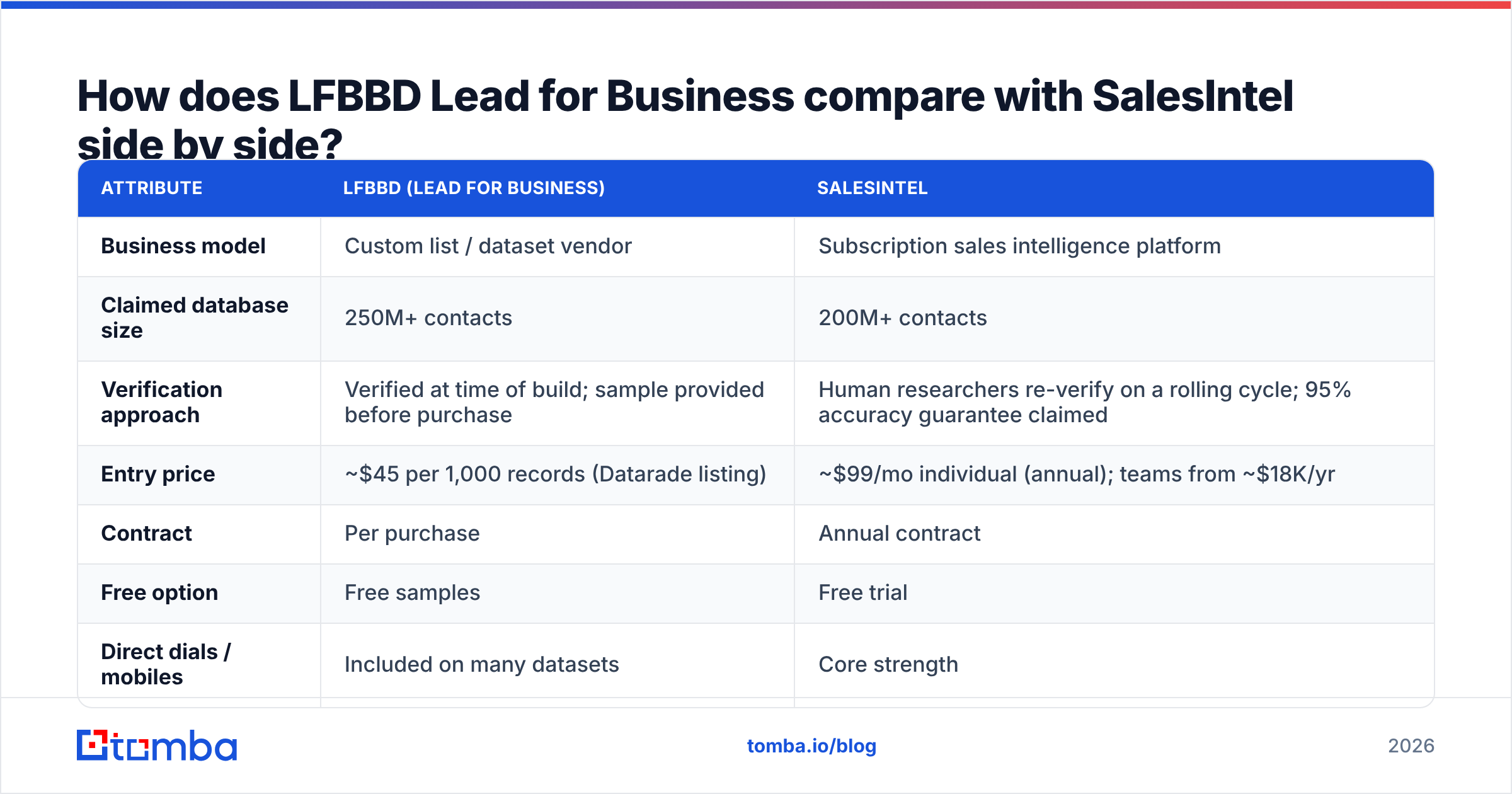
| Attribute | LFBBD (Lead for Business) | SalesIntel |
|---|---|---|
| Business model | Custom list / dataset vendor | Subscription sales intelligence platform |
| Claimed database size | 250M+ contacts | 200M+ contacts |
| Verification approach | Verified at time of build; sample provided before purchase | Human researchers re-verify on a rolling cycle; 95% accuracy guarantee claimed |
| Entry price | ~$45 per 1,000 records (Datarade listing) | ~$99/mo individual (annual); teams from ~$18K/yr |
| Contract | Per purchase | Annual contract |
| Free option | Free samples | Free trial |
| Direct dials / mobiles | Included on many datasets | Core strength |
| Intent data | No | Yes (add-on) |
| Website visitor ID | No | Yes (VisitorIntel add-on) |
| Niche segments | Amazon sellers, eCommerce, Shopify merchants | Mid-market and enterprise B2B, North America-heavy |
| CRM integrations | None (file delivery) | Salesforce, HubSpot, Outreach, and more |
| Best for | Agencies, one-off campaigns, eCommerce targeting | SDR teams with steady daily prospecting volume |
Pricing on both sides changes with volume and negotiation. Use the numbers above for rough budgeting and get a quote before you commit.
Is LFBBD cheaper than SalesIntel?#
LFBBD is almost always cheaper at first. It is often more expensive per usable contact once you take decay into account.
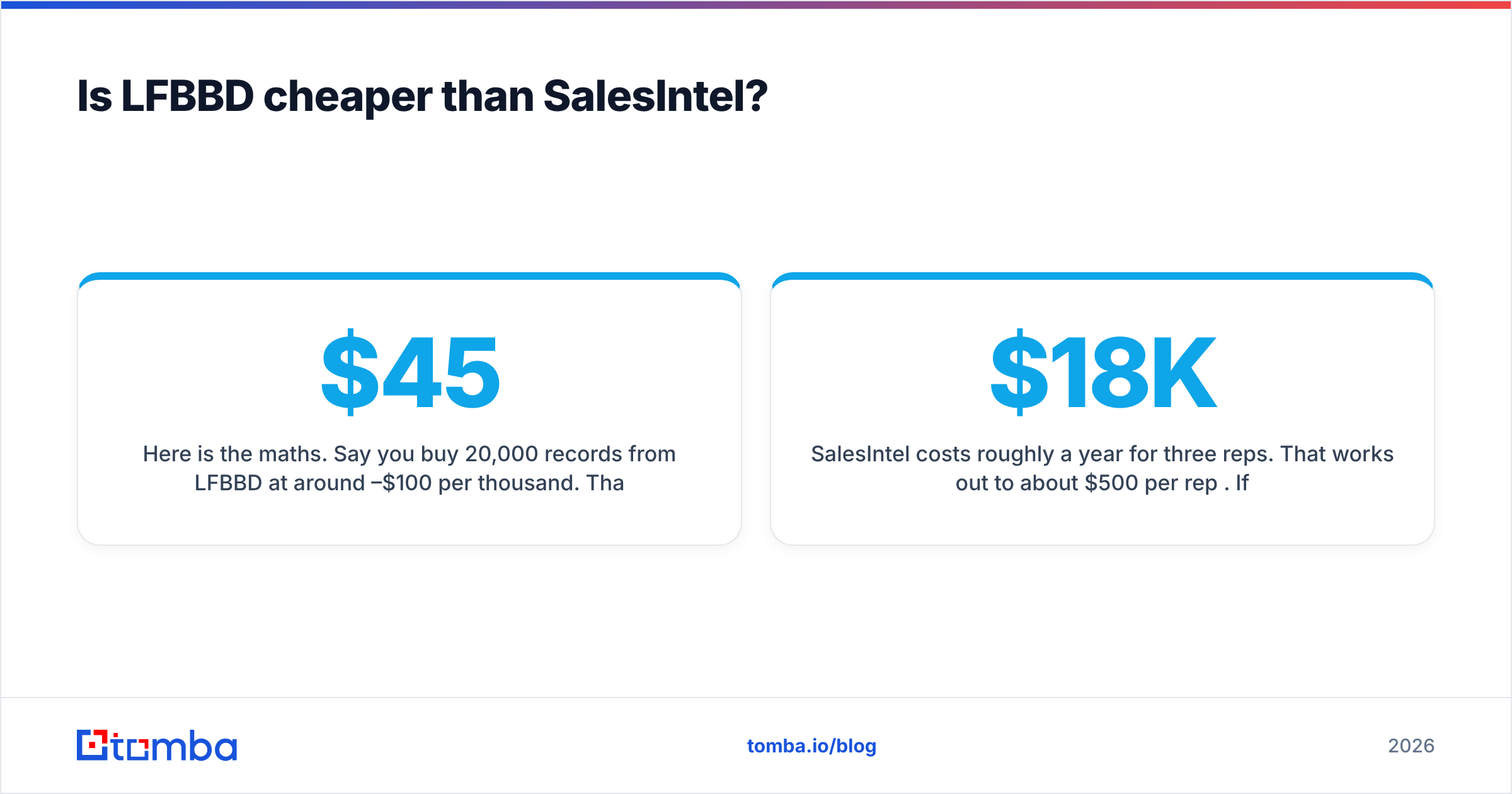
Here is the maths. Say you buy 20,000 records from LFBBD at around $45–$100 per thousand. That's $900–$2,000, well under one SalesIntel seat for a year. But if 25% of those emails have gone stale by the time your third sequence runs, you have paid for 5,000 records you can't use. You will also pay for verification and deduplication yourself.
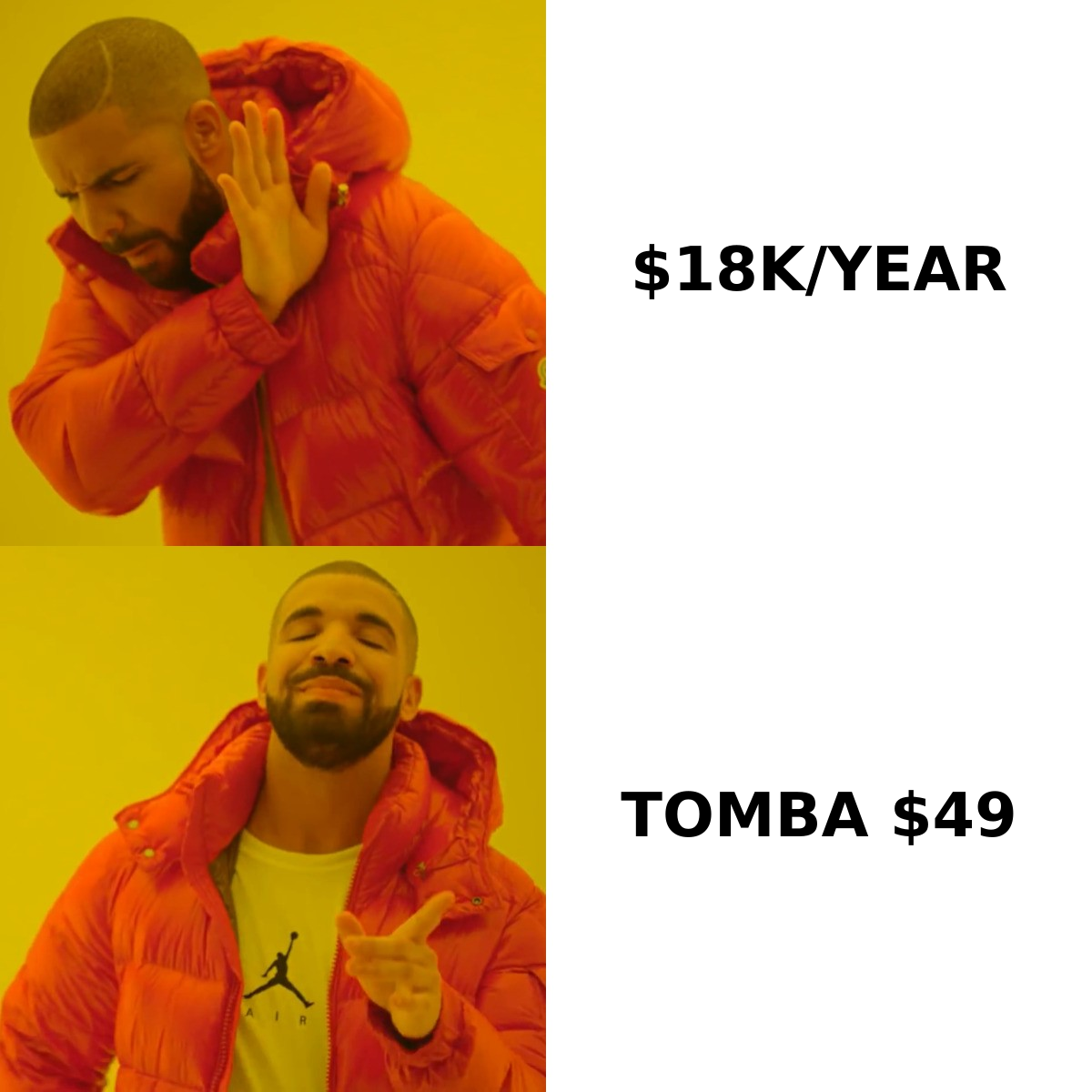
SalesIntel costs roughly $18K a year for three reps. That works out to about $500 per rep per month. If each rep pulls 400 or more verified contacts a month and books meetings from them, the cost per record drops sharply and the direct dials justify the price. If your reps only pull 50 contacts a month, you are overpaying by a lot.
Use this rule of thumb:
- Under ~2,000 contacts per quarter: don't sign an annual contract with anyone. Buy a targeted list or use a credit-based finder.
- 2,000–10,000 per quarter, one segment: a list vendor like LFBBD, plus your own verification, is the cheaper route.
- 10,000+ per quarter across changing ICPs, with a calling motion: SalesIntel's subscription starts to justify its price.
Which has better data accuracy?#
SalesIntel has the stronger published accuracy claim. It is one of the few vendors that puts a number on accuracy (95%) and attributes it to human re-verification rather than scraping alone. That doesn't mean every record will be correct. It does mean there is a process behind the number and a vendor you can hold to it.
LFBBD's accuracy is harder to judge from the outside because each dataset is built to order. The free sample is your best tool. Before you buy a full list:
- Ask for a sample of 100–200 records from the exact segment you're buying, not a generic demo file.
- Run the emails through an email verifier and record the valid, risky, and invalid rates.
- Call 20 of the phone numbers. That one step tells you more than any vendor claim.
- Check 10 job titles against LinkedIn to see how current the list is.
If more than 10–15% of the sample emails are invalid, negotiate or walk away. Apply the same test to a SalesIntel trial export, because both vendors should be judged on your ICP, not their marketing pages.
Which is better for cold email vs cold calling?#
For cold calling, SalesIntel has the edge. Its direct dials and mobile numbers are the main reason teams pay the enterprise price. Its human verification has the most impact on phone data, because a wrong number wastes a rep's time on every dial.
For cold email, the gap is smaller. Email addresses can be checked cheaply and at scale, so the value of pre-verified emails falls once you add your own verification step. A LFBBD list run through a verifier and a catch-all check can perform well in email sequences, especially for eCommerce targets that SalesIntel covers less deeply.
Before you send anything, protect your sending domain. Warm up new inboxes, keep bounces under 2%, and never load a purchased file straight into a sequencer. As HubSpot's email deliverability guide explains, bounce rate is one of the fastest ways to damage your sender reputation.

What are the pros and cons of each?#
| LFBBD (Lead for Business) | SalesIntel | |
|---|---|---|
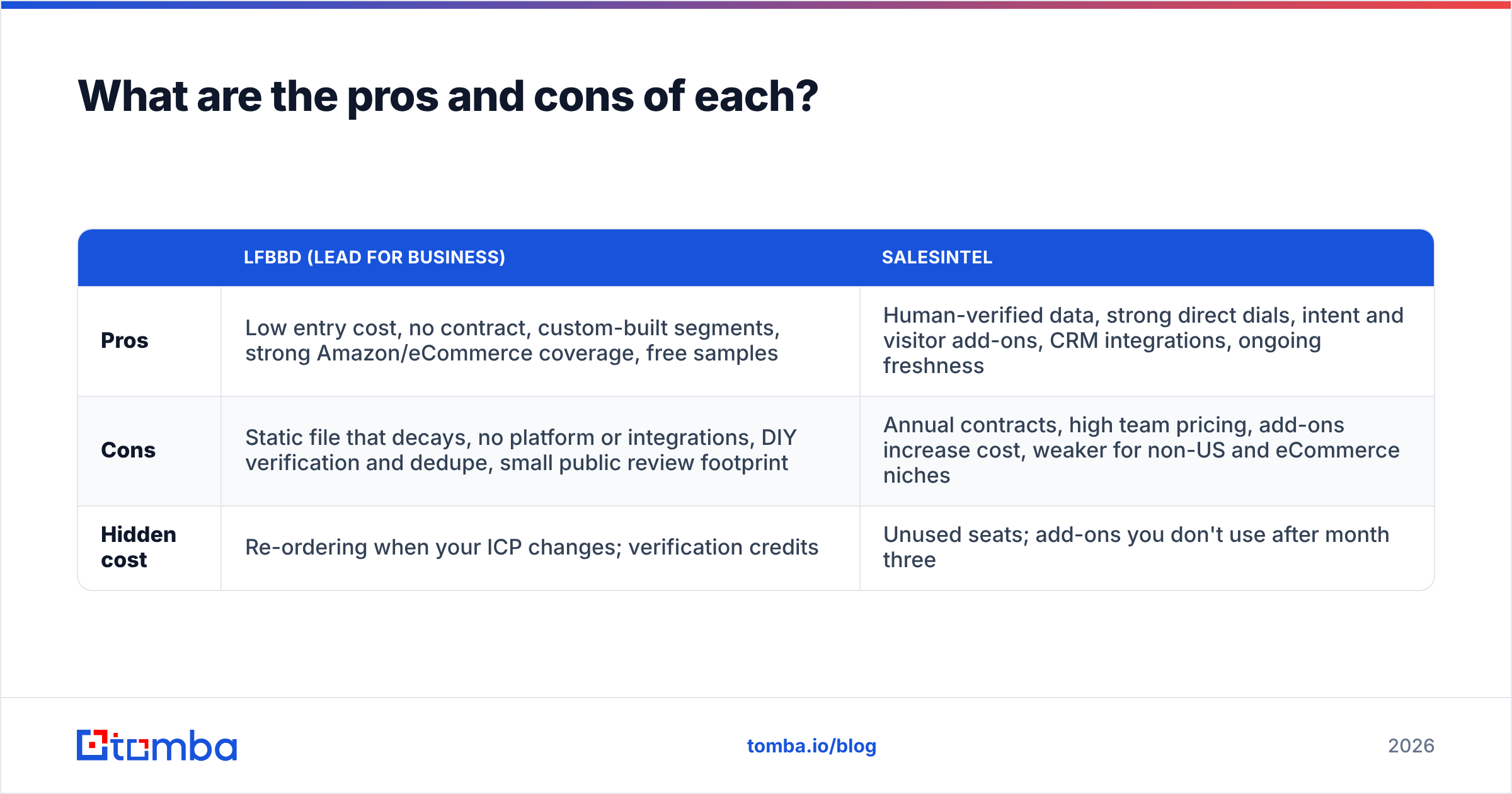
| Pros | Low entry cost, no contract, custom-built segments, strong Amazon/eCommerce coverage, free samples | Human-verified data, strong direct dials, intent and visitor add-ons, CRM integrations, ongoing freshness |
| Cons | Static file that decays, no platform or integrations, DIY verification and dedupe, small public review footprint | Annual contracts, high team pricing, add-ons increase cost, weaker for non-US and eCommerce niches |
| Hidden cost | Re-ordering when your ICP changes; verification credits | Unused seats; add-ons you don't use after month three |
Who should pick LFBBD Lead for Business?#
Choose LFBBD if:
- You sell to Amazon sellers, Shopify stores, or DTC brands and need contact data most platforms don't index well
- You run a campaign-based motion (a launch, an event push, a client project) instead of daily prospecting
- You want a fixed cost per list and no annual contract
- You already have verification and CRM hygiene in place
Treat it as a one-off purchase. Verify the sample, verify the full list, and plan to refresh within a quarter.
Who should pick SalesIntel?#
Choose SalesIntel if:
- You have 3+ SDRs prospecting every day, especially by phone
- You sell into North American mid-market or enterprise accounts
- You want intent data and visitor identification in the same platform as your contacts
- Your finance team is fine with an annual contract in the $10K–$40K range
Get a trial, use it hard for the whole trial period, and negotiate add-ons separately. Don't bundle intent until you've shown that your team will act on it.
Is there a cheaper middle ground?#
Yes. Many teams comparing these two only need accurate emails for specific people at specific companies, not a 250M-record export or an $18K platform. For them, a credit-based email finder is usually the better fit:
- Search on demand. You look up contacts when a rep actually needs them, so records don't decay in a spreadsheet.
- Verification built in. Each result carries a confidence status, so you don't need a separate tool.
- Monthly billing. Tomba starts free (25 searches/month), then Starter at $49/mo, Growth at $99/mo, and Pro at $249/mo. See Tomba pricing for credit limits.
- Enrichment when you need it. Use data enrichment to add firmographics and social profiles to the leads you already have, instead of buying new ones.
This setup doesn't replace SalesIntel's phone depth for a large calling team or LFBBD's Amazon seller segment. For email-first outbound at small and mid-sized scale, it covers most of what you need for much less money.
So, LFBBD Lead for Business vs SalesIntel: which wins?#
It depends on your motion:
- Campaign-based, eCommerce-focused, budget-conscious: LFBBD Lead for Business. You get a custom list, a known cost, and no contract. Just verify everything before you send.
- Phone-heavy SDR team, enterprise ICP, data budget of $15K or more: SalesIntel. Human verification and direct dials justify the price once reps use it every day.
- Email-first, a few hundred to a few thousand contacts a month: neither. A pay-as-you-go finder with built-in verification costs less and doesn't leave you with a decaying file.
Whichever you choose, test with your own ICP before signing, measure bounce and connect rates from the first campaign, and don't pay for an annual contract you won't fully use.
If your outbound is mainly email and you want verified addresses without a five-figure contract or a static list, try the Tomba Email Finder. Search by name and company or by domain, get a verification status with every result, and start on the free plan before deciding whether you need more.
Related guides#
// get started
Find, verify and enrich your first contacts today
Start on the free plan with 25 searches a month, then scale when your team is ready.
Free plan · No credit card required · GDPR & CCPA
Get the Tomba newsletter
Product and data updates
// about the author