LFBBD Lead For Business vs Warpleads: Which B2B Lead Source Wins?
One sells researched lead lists by quote. The other sells unlimited self-serve exports for $99 a month. Here is how LFBBD Lead For Business and Warpleads compare on pricing, data quality, and workflow, and which one fits your team.
TL;DR
- LFBBD (Lead For Business) is a done-for-you data vendor. You describe your ideal customer, and its team researches and delivers a custom list, usually within 24–48 hours. Pricing is by quote or per record.
- Warpleads is a self-serve database with 100M+ contacts. Its main hook is unlimited exports on a flat plan, reported at $59/mo for Essentials and $99/mo for Unlimited.
- Pick LFBBD for niche lists (eCommerce stores, Amazon sellers, direct dials) that you don't want to build yourself. Pick Warpleads if you run high-volume outbound and want to filter and export as often as you like.
- Neither one replaces verification. Run any list through an email verifier before it reaches your sending domain.
- If you mostly need specific people at specific accounts rather than bulk lists, a pay-per-search email finder is usually the cheaper and cleaner choice.
What are LFBBD Lead For Business and Warpleads?#
Both tools answer the same question: "Where do I get contacts to sell to?" They answer it in very different ways.
LFBBD (Lead For Business Ltd) works like a data agency. According to its Datarade provider profile, the company advertises 250M+ business contacts, around 50M business profiles, and 150M+ direct dial and mobile numbers. It also sells specialist datasets, including eCommerce store owners and Amazon seller contacts. Its pitch centres on manually researched, verified records delivered in 24–48 hours, with free samples before you buy. You send a brief and get back a spreadsheet.
Warpleads is a self-serve SaaS database. You log in, filter by job title, location, company size, industry, or technology, and export. The company claims 100M+ leads and 20M+ companies. Its main differentiator is pricing: unlimited exports on a flat monthly fee instead of per-credit metering. You can see the current tiers on the Warpleads pricing page.
In short, LFBBD is like hiring a researcher to build your list, and Warpleads is like getting a key to the warehouse.
How do the two data models actually differ?#
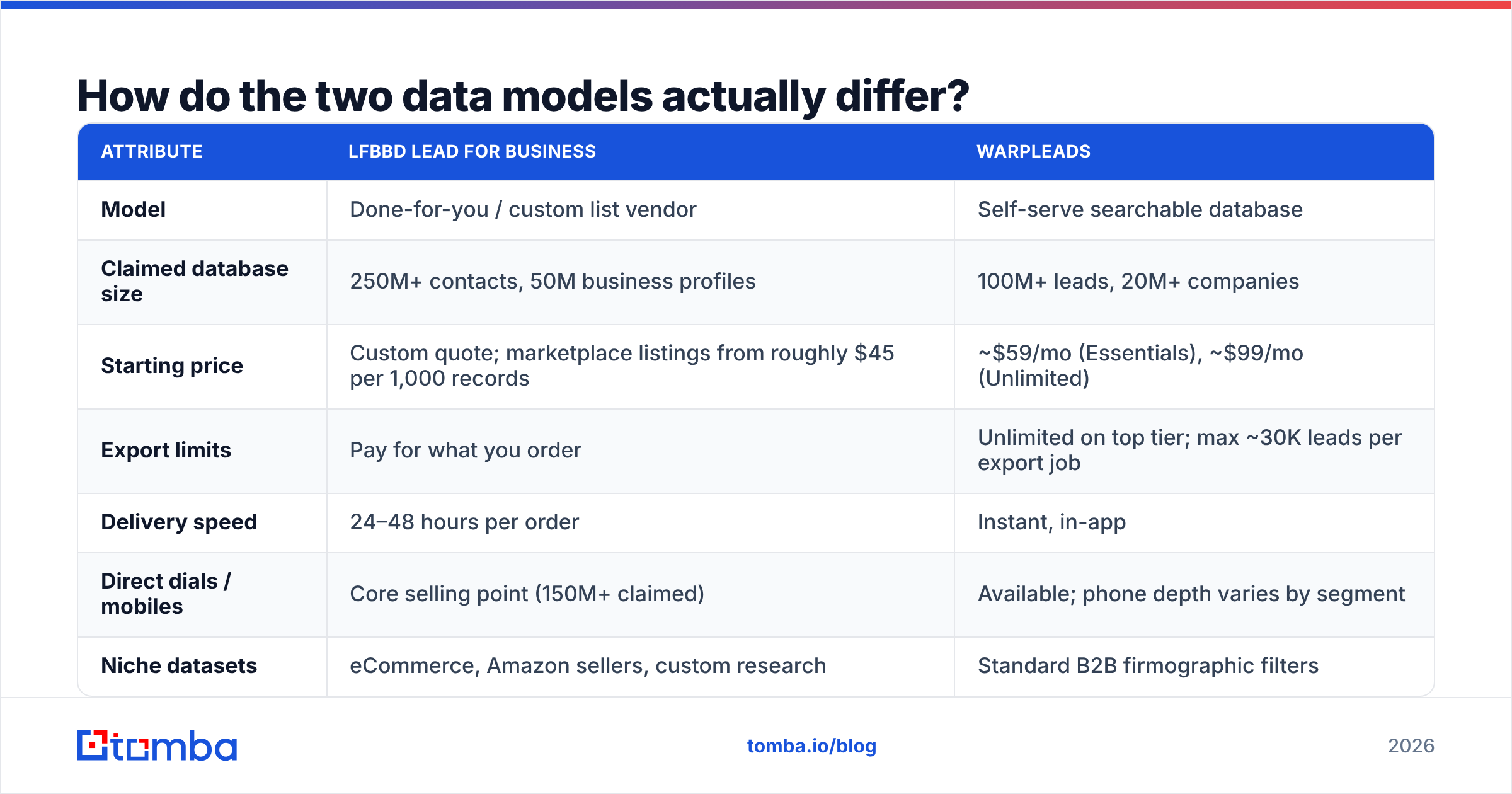
Most of the practical differences come from one design choice: who builds the list. The table below covers the attributes that matter when you are making a buying decision.
| Attribute | LFBBD Lead For Business | Warpleads |
|---|---|---|
| Model | Done-for-you / custom list vendor | Self-serve searchable database |
| Claimed database size | 250M+ contacts, 50M business profiles | 100M+ leads, 20M+ companies |
| Starting price | Custom quote; marketplace listings from roughly $45 per 1,000 records | ~$59/mo (Essentials), ~$99/mo (Unlimited) |
| Export limits | Pay for what you order | Unlimited on top tier; max ~30K leads per export job |
| Delivery speed | 24–48 hours per order | Instant, in-app |
| Direct dials / mobiles | Core selling point (150M+ claimed) | Available; phone depth varies by segment |
| Niche datasets | eCommerce, Amazon sellers, custom research | Standard B2B firmographic filters |
| Who does the filtering | LFBBD's team | You |
| Free trial / sample | Free sample on request | Check current plan page |
| Best for | Niche, one-off, or phone-heavy campaigns | High-volume, repeated email outbound |
A caveat on pricing: LFBBD does not publish a fixed plan grid, and Warpleads has changed its tiers before. Treat the figures above as mid-2026 reference points and confirm them before you commit.
Which one is cheaper for your use case?#
The answer depends on how many records you export per month and how often you rebuild lists.
Warpleads wins on volume. At about $99/mo for unlimited exports, the cost per record falls quickly as you pull more. An agency exporting 50,000 contacts a month pays a fraction of a cent per contact. No per-record vendor can match that on raw cost.
LFBBD wins on labour. Per-record pricing looks expensive next to "unlimited" until you count your own time. A self-serve database gives you the raw material. You still have to:
- Build and refine filters, often across several sessions.
- Remove duplicates and irrelevant titles.
- Verify emails, because unlimited exports usually mean unlimited unverified exports.
- Hunt down phone numbers the database doesn't have.
If LFBBD delivers a list that is already scoped, researched, and phone-enriched, you skip most of that work. For a one-off campaign into a narrow niche, such as Shopify stores with $1M+ revenue in Germany, paying per record can cost less overall than paying a month of SDR time to assemble the list yourself.
A simple rule: if you would export more than roughly 5,000 records a month every month, self-serve unlimited usually comes out ahead. Below that, or for niches that standard B2B filters handle poorly, a researched list is often better value.

How accurate is the data in each tool?#
Both vendors make strong accuracy claims. LFBBD advertises "95% accuracy guaranteed" and manual verification. Warpleads positions itself on scale rather than hand-checking. Neither publishes an independent, third-party audit that you can compare directly, so read both sets of claims with some caution.
What the available signals suggest:
- LFBBD has a small but positive review footprint. Its Trustpilot profile shows a 4.5/5 TrustScore across about 15 reviews, with reviewers mentioning quick delivery, responsive support, and targeted lists. Fifteen reviews is a thin sample, but they are consistent.
- Warpleads reviews tend to praise the pricing and flag the usual problems of a large static database: some stale titles, people who have changed jobs, and bounce rates that depend heavily on the segment you pull.
The structural issue is the same for both. Any database that is built once and resold decays. B2B contact data goes stale as people change jobs, companies rebrand, and domains switch mail providers. A list that was 95% accurate on delivery day is less accurate 90 days later.
That makes verification your job, whichever vendor you choose. Before a single send:
- Run the full file through a bulk email verifier to remove invalid and risky addresses.
- Handle catch-all domains separately. They accept every address at the SMTP level, so a basic "valid" result tells you very little.
- Remove duplicates against your CRM so you don't email the same prospect from two sequences.
If you skip this step, even a good list can damage your sender reputation in one campaign.
What workflows does each tool fit best?#
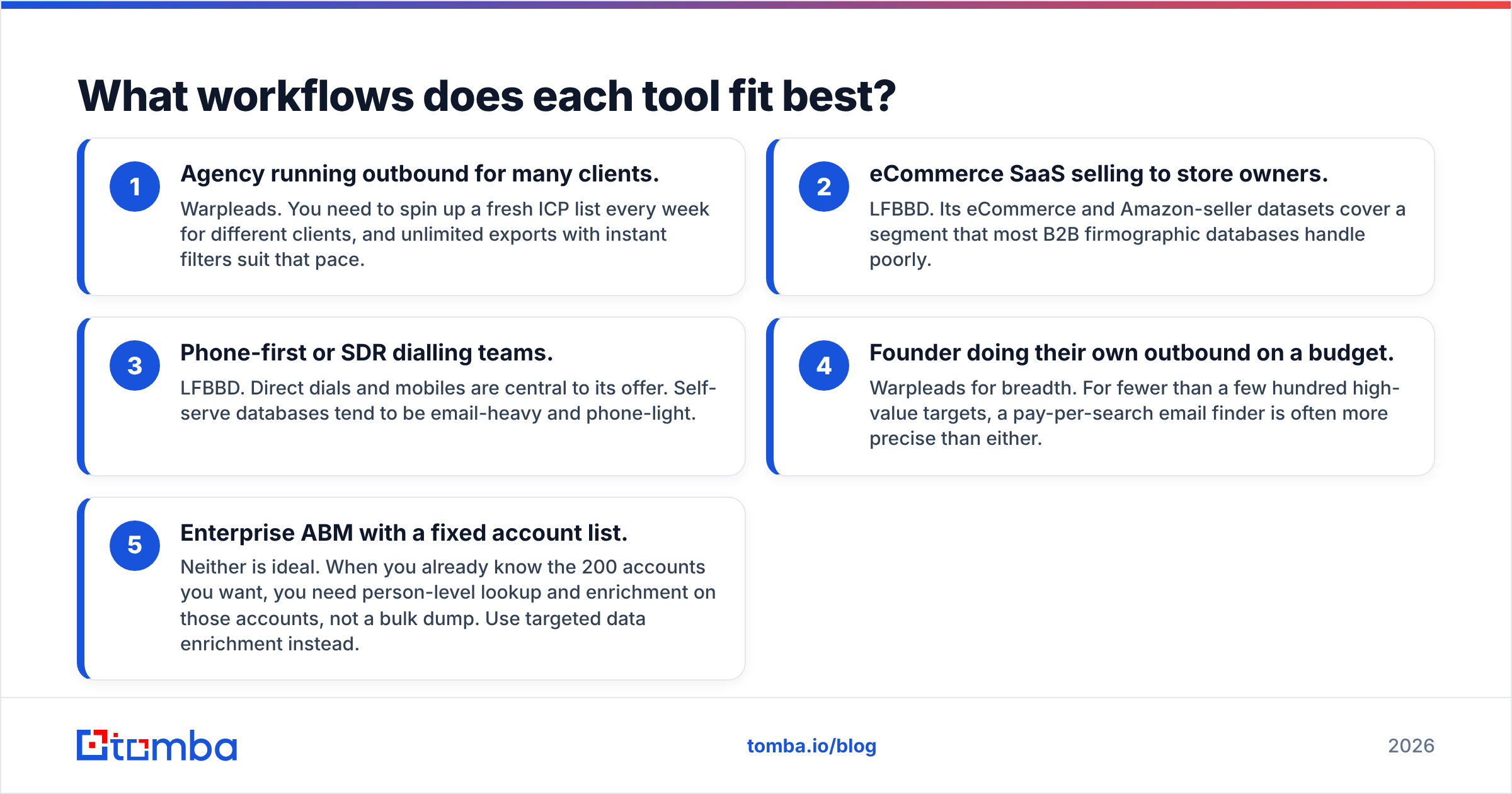
The table covers the specs. In day-to-day terms, the split looks like this:
- Agency running outbound for many clients. Warpleads. You need to spin up a fresh ICP list every week for different clients, and unlimited exports with instant filters suit that pace.
- eCommerce SaaS selling to store owners. LFBBD. Its eCommerce and Amazon-seller datasets cover a segment that most B2B firmographic databases handle poorly.
- Phone-first or SDR dialling teams. LFBBD. Direct dials and mobiles are central to its offer. Self-serve databases tend to be email-heavy and phone-light.
- Founder doing their own outbound on a budget. Warpleads for breadth. For fewer than a few hundred high-value targets, a pay-per-search email finder is often more precise than either.
- Enterprise ABM with a fixed account list. Neither is ideal. When you already know the 200 accounts you want, you need person-level lookup and enrichment on those accounts, not a bulk dump. Use targeted data enrichment instead.
Is Warpleads better than LFBBD?#
Neither is better overall. They solve different problems, and choosing the wrong one costs you either money or time.
Choose Warpleads if:
- You export thousands of contacts every month.
- You have someone who enjoys building filters and cleaning data.
- Email is your main channel and phone numbers are secondary.
- You want instant access instead of waiting 1–2 days per list.
Choose LFBBD Lead For Business if:
- Your ICP is niche and standard B2B filters miss it.
- Phone numbers matter as much as emails.
- You would rather pay for research than do it yourself.
- You buy lists occasionally, per campaign, not continuously.
Consider neither if:
- You are working a named-account list and need specific decision-makers.
- Your sending domain is new and can't absorb the bounce risk of bulk exports.
- You need contact data that syncs into your CRM continuously rather than arriving as one-off CSVs.

What are the pros and cons of each?#
LFBBD Lead For Business
Pros:
- Custom, researched lists scoped to your brief
- Strong direct-dial and mobile coverage claims
- Niche datasets (eCommerce, Amazon sellers) that few self-serve tools offer
- Free samples, so you can check quality before you pay
- Consistently positive, though limited, customer reviews
Cons:
- No self-serve search, so you depend on the vendor for every new list
- 24–48 hour turnaround per order
- Quote-based pricing makes budgeting harder
- Delivered files still decay and need verification over time
Warpleads
Pros:
- Flat pricing with unlimited exports on the top tier
- Instant filtering by title, location, size, industry, and technology
- Very low cost per record at high volume
- Good fit for agencies and high-volume outbound
Cons:
- You do all the list building and cleaning
- Exports are capped per job (about 30K), so large pulls need several runs
- Phone coverage is uneven across segments
- Unlimited exports make it easy to send to large, unverified lists, which is a real deliverability risk
How should you protect deliverability with either list?#
This step decides whether the list you bought produces pipeline or spam complaints. Mailbox providers now enforce strict bulk-sender rules. Google's and Yahoo's requirements push complaint rates below 0.3%, and high bounce rates hurt your domain's standing quickly. A 10% bounce rate on a 20,000-contact campaign can undo months of domain warmup.
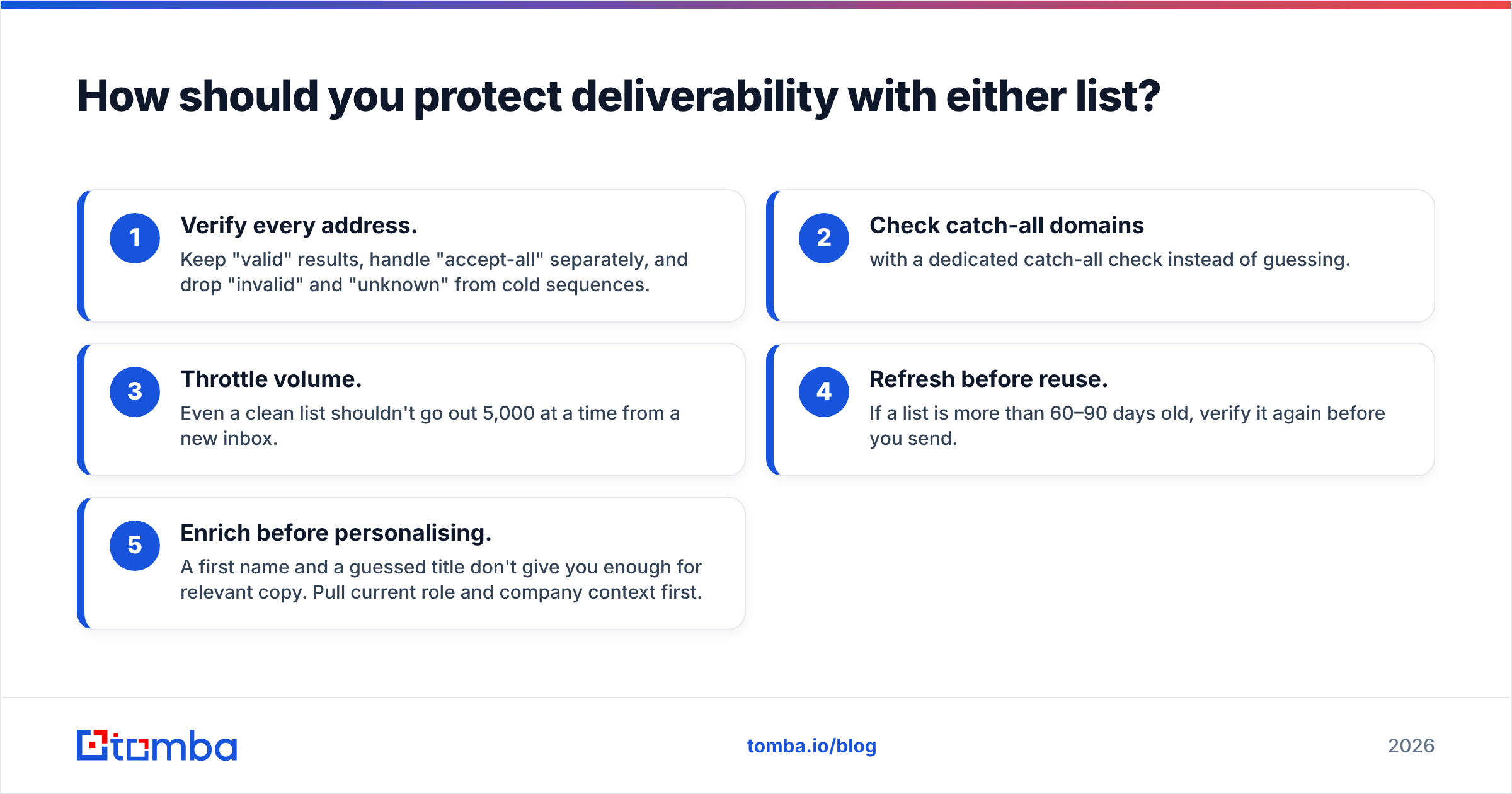
A pre-send checklist that works with either vendor:
- Verify every address. Keep "valid" results, handle "accept-all" separately, and drop "invalid" and "unknown" from cold sequences.
- Check catch-all domains with a dedicated catch-all check instead of guessing.
- Throttle volume. Even a clean list shouldn't go out 5,000 at a time from a new inbox.
- Refresh before reuse. If a list is more than 60–90 days old, verify it again before you send.
- Enrich before personalising. A first name and a guessed title don't give you enough for relevant copy. Pull current role and company context first.
Make these five steps a standard part of your process, whichever vendor supplies the data.
Is there a middle ground between bulk lists and custom research?#
Yes. Many teams end up with a hybrid setup: a bulk source for top-of-funnel volume, plus a precise lookup tool for the accounts that matter.
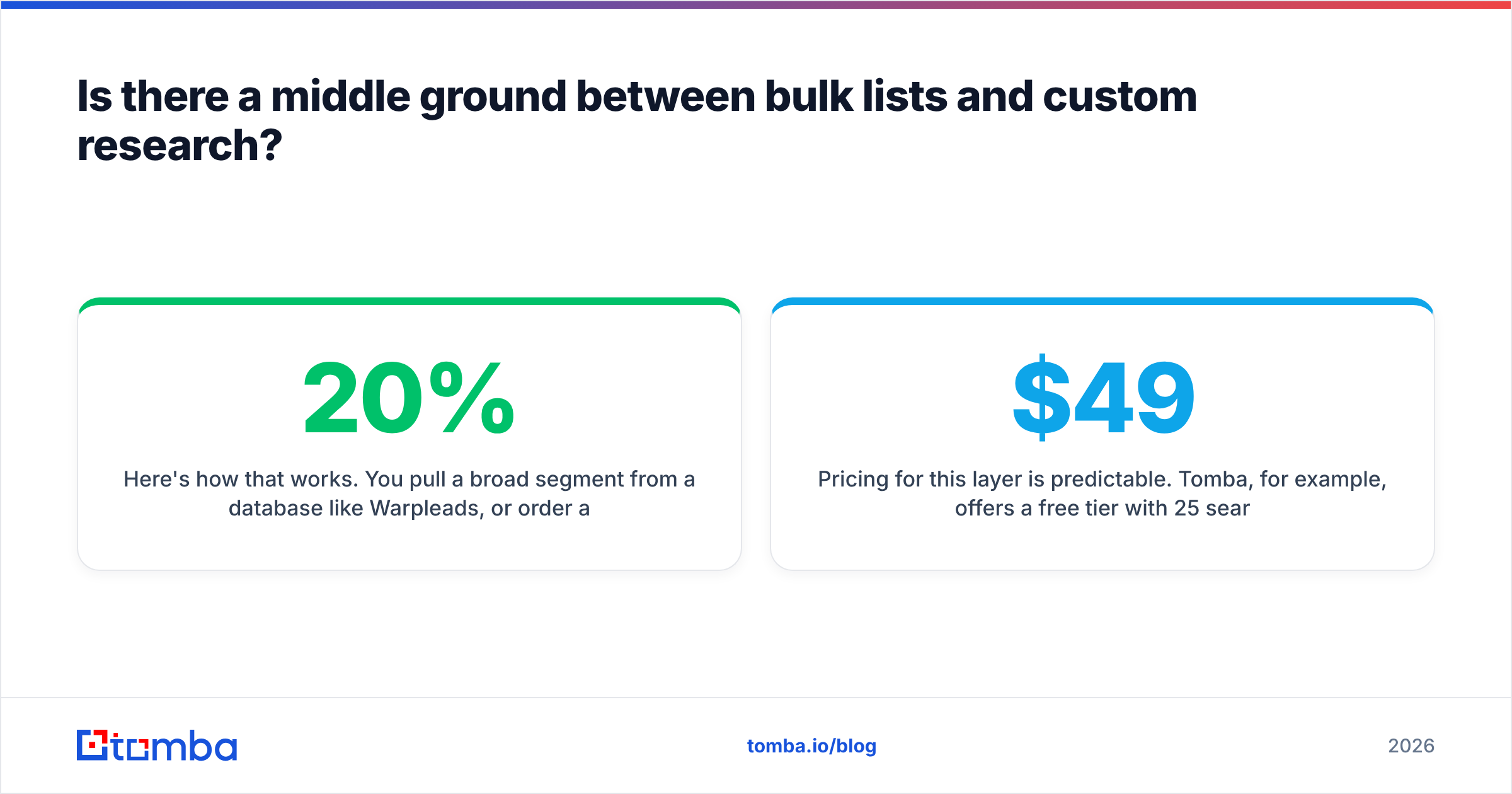
Here's how that works. You pull a broad segment from a database like Warpleads, or order a niche file from LFBBD. Then, for the 10–20% of accounts that fit your ICP best, you look up the actual decision-makers by name and domain with an email finder, verify them in real time, and enrich them before they go into a personalised sequence.
This keeps volume costs low and reserves your best copy and your best-verified addresses for the prospects most likely to buy. It also keeps your CRM cleaner, because the high-value records come from live lookups instead of a CSV that started ageing the day it was exported.
Pricing for this layer is predictable. Tomba, for example, offers a free tier with 25 searches a month, then Starter at $49/mo, Growth at $99/mo, and Pro at $249/mo. See Tomba pricing for current credit allowances. That is a different model from both LFBBD's per-order quotes and Warpleads' flat unlimited plan: you pay for precision on named targets, not for bulk.
What's the final verdict?#
Warpleads is the better choice for teams that need volume: agencies, high-output SDR teams, and anyone who wants to filter and export as often as they like on a flat fee. Budget for the cleaning and verification that "unlimited" implies.
LFBBD Lead For Business is the better choice for teams that need a specific list: niche segments, phone-heavy campaigns, and buyers who would rather pay a researcher than spend their own afternoons on it. The trade-off is waiting a day or two and getting a quote for each order.
Both work best as the starting point of a data workflow, not the whole of it. The teams with the best reply rates verify everything, refresh often, and look up their highest-value prospects individually instead of relying on a bulk file.
If you're heading into that last step, finding the exact decision-maker at an account you already know you want, try Tomba Email Finder. Enter a name and a company domain, and it returns a professional email address along with its sources and a verification status. It adds precision to whichever bulk source you choose, and the free tier lets you test it on your own target accounts first.
Related guides#
// get started
Find, verify and enrich your first contacts today
Start on the free plan with 25 searches a month, then scale when your team is ready.
Free plan · No credit card required · GDPR & CCPA
// about the author