7 Best Liine Alternatives for Healthcare Call Tracking in 2026
Liine is built for multisite dental, medical and vet groups. If your practice needs cheaper call tracking, deeper AI coaching or enterprise attribution instead, here are seven alternatives worth considering, with honest trade-offs for each.
TL;DR
- Liine is an AI call tracking and marketing attribution platform built for multisite healthcare, dental and veterinary groups. Its pricing is usage-based and depends on call volume.
- The strongest Liine alternatives are CallRail (general call tracking that's easy to budget for), CallTrackingMetrics (a flexible contact center), Invoca (enterprise conversation intelligence), WhatConverts (lowest entry price), Patient Prism (dental call coaching with human coaches), Weave (practice communications) and Marchex (conversational analytics for large groups).
- A single-location practice will usually find Liine more than it needs. A 20+ location DSO or medical group often won't find a better healthcare-specific fit.
- Before you switch, check EHR/PMS integrations and how HIPAA and BAAs are handled. List price matters less than either of those.
What is Liine, and why do practices look for alternatives?#
Liine describes itself as an AI-powered call tracking, marketing analytics and ad optimization platform for multisite healthcare practices. It records and analyzes every call, form fill and online booking, then ties each one to the marketing source that produced it. Because it integrates with EHR and practice management systems, you can measure campaigns by booked appointments and revenue, not clicks.
Users rate it highly. Its Capterra listing shows a 4.9/5 average across more than 150 reviews. Reviewers mention centralized call data, recordings they use for front-desk training, and dashboards marketing teams actually open.
So why search for Liine alternatives at all? It usually comes down to one of four reasons:
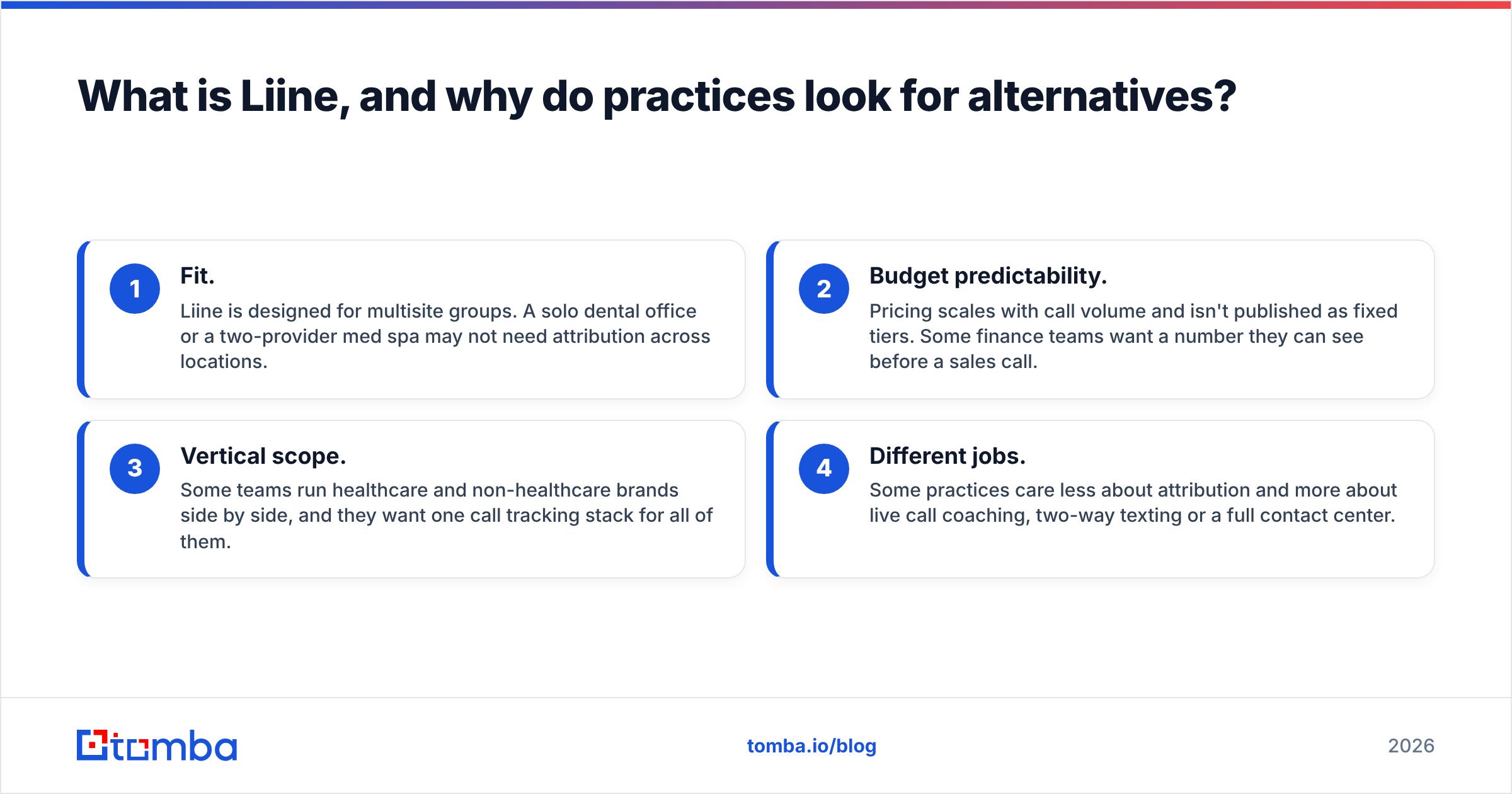
- Fit. Liine is designed for multisite groups. A solo dental office or a two-provider med spa may not need attribution across locations.
- Budget predictability. Pricing scales with call volume and isn't published as fixed tiers. Some finance teams want a number they can see before a sales call.
- Vertical scope. Some teams run healthcare and non-healthcare brands side by side, and they want one call tracking stack for all of them.
- Different jobs. Some practices care less about attribution and more about live call coaching, two-way texting or a full contact center.
The right replacement depends on which of those four reasons applies to you.
What should you compare when evaluating Liine alternatives?#
Pick your criteria before you book demos. These five decide most outcomes:
- Attribution depth. Does the tool stop at the marketing source (Google Ads, GBP, organic), or can it follow the lead to a booked appointment and the revenue it produced?
- Healthcare integrations. Check for connectors to your PMS/EHR (Dentrix, Open Dental, Eaglesoft, athenahealth and similar). If one is missing, "booked appointment" data ends up in manual spreadsheets.
- AI call analysis. Look for automatic classification of new-patient vs. existing-patient calls, missed-opportunity flags and agent scoring.
- Compliance. Ask whether the vendor will sign a BAA, and how recordings and transcripts are stored and redacted.
- Pricing model. Is it flat tiers, usage billing on numbers and minutes, or a custom quote? Model the cost at your real monthly call volume, not at the entry tier.

What are the best Liine alternatives in 2026?#
Here are the seven tools practices shortlist most often, grouped by the job each does best. Prices come from public pricing pages and third-party trackers as of mid-2026. Nearly all call tracking vendors bill extra for tracking numbers and minutes, so treat the entry price as the minimum you'll pay.
1. CallRail — best general-purpose Liine alternative#
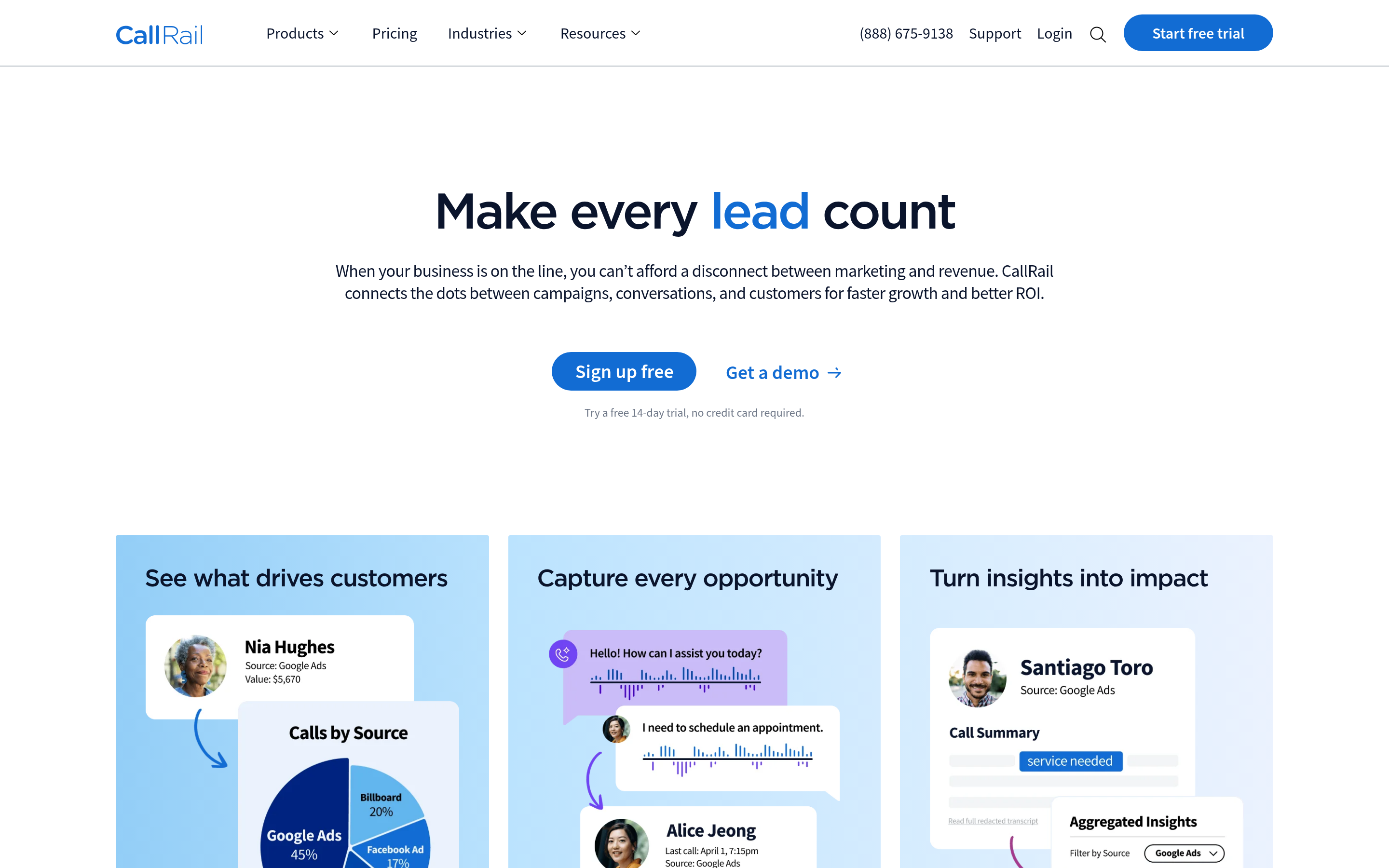
CallRail is the default call tracking tool for SMBs and agencies. Setup is fast, dynamic number insertion is reliable, and it integrates with Google Ads, GA4 and most CRMs. Its AI features (Conversation Intelligence, lead scoring) come in the higher tiers.
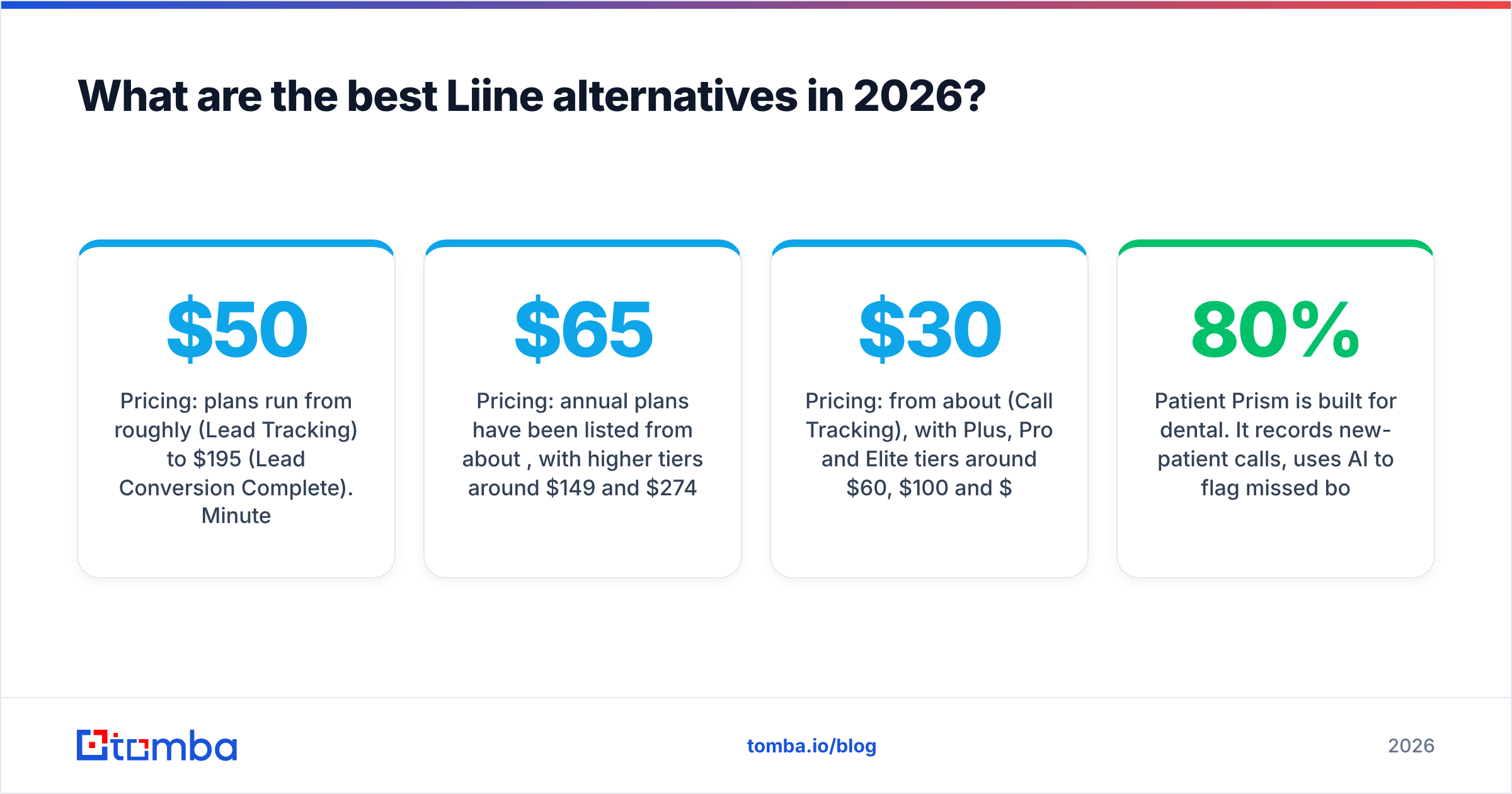
- Pricing: plans run from roughly $50/mo (Lead Tracking) to $195/mo (Lead Conversion Complete). Minutes, numbers and seats cost extra, and a working setup often comes out above $100/mo.
- Strengths: mature product, huge agency ecosystem, clear self-serve pricing.
- Trade-offs: it isn't healthcare-specific. Tying calls to booked appointments in your PMS usually means Zapier-style workarounds or manual tagging.
- Best for: single-location and small multi-location practices, and agencies managing many clients.
2. CallTrackingMetrics — best for practices that also run a contact center#
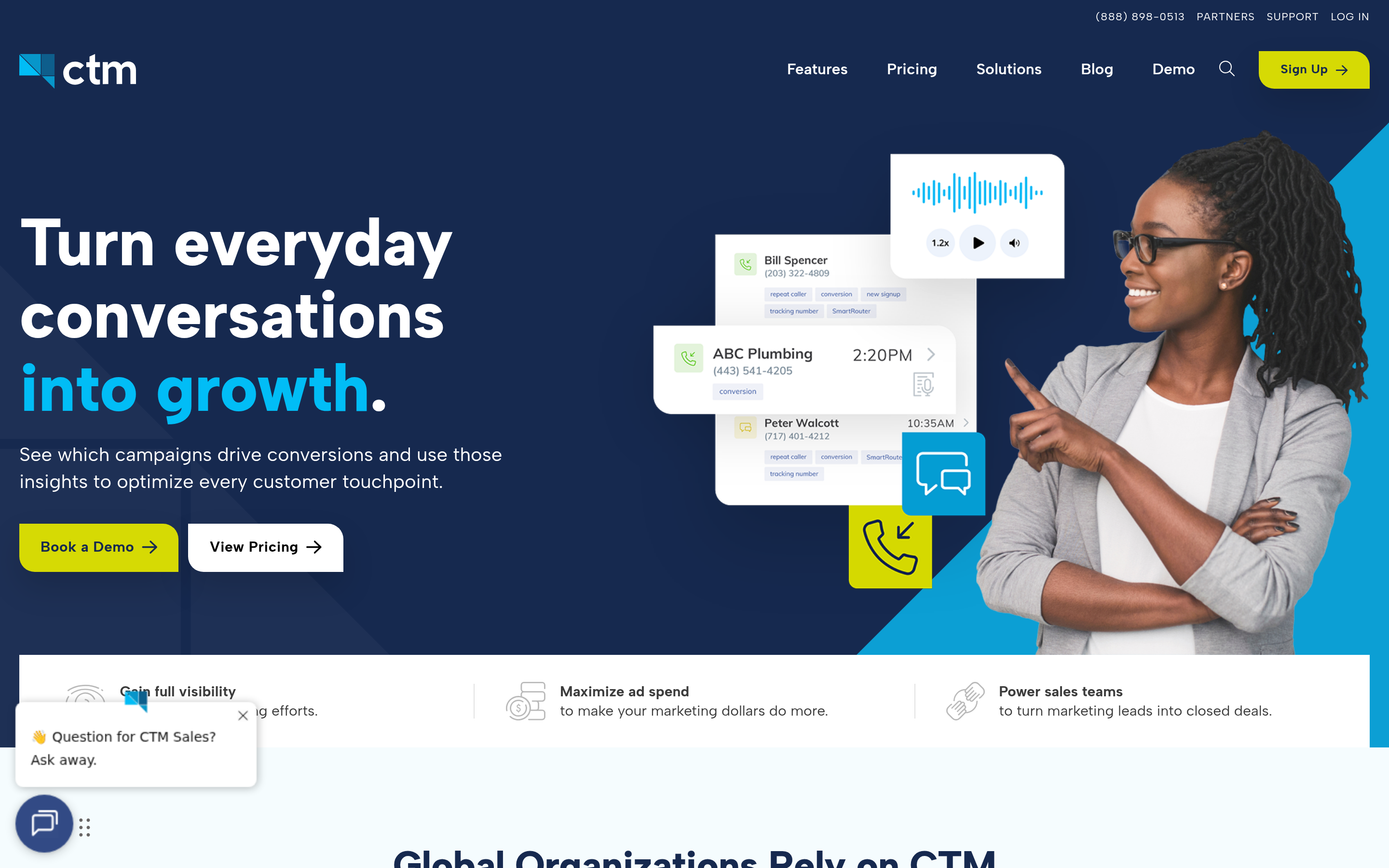
CallTrackingMetrics (CTM) combines call tracking with a full cloud contact center: IVR, queues, routing, SMS and chat. For a group that runs a central scheduling team, that removes a separate phone system.
- Pricing: annual plans have been listed from about $65/mo, with higher tiers around $149/mo and $274/mo, plus an enterprise tier. Numbers and minutes are billed on top.
- Strengths: routing flexibility, strong API, HIPAA-oriented options on higher plans.
- Trade-offs: there's a steeper learning curve, and you'll build the healthcare reporting yourself.
- Best for: groups with a centralized call center that want tracking and telephony in one system.
3. Invoca — best enterprise conversation intelligence#
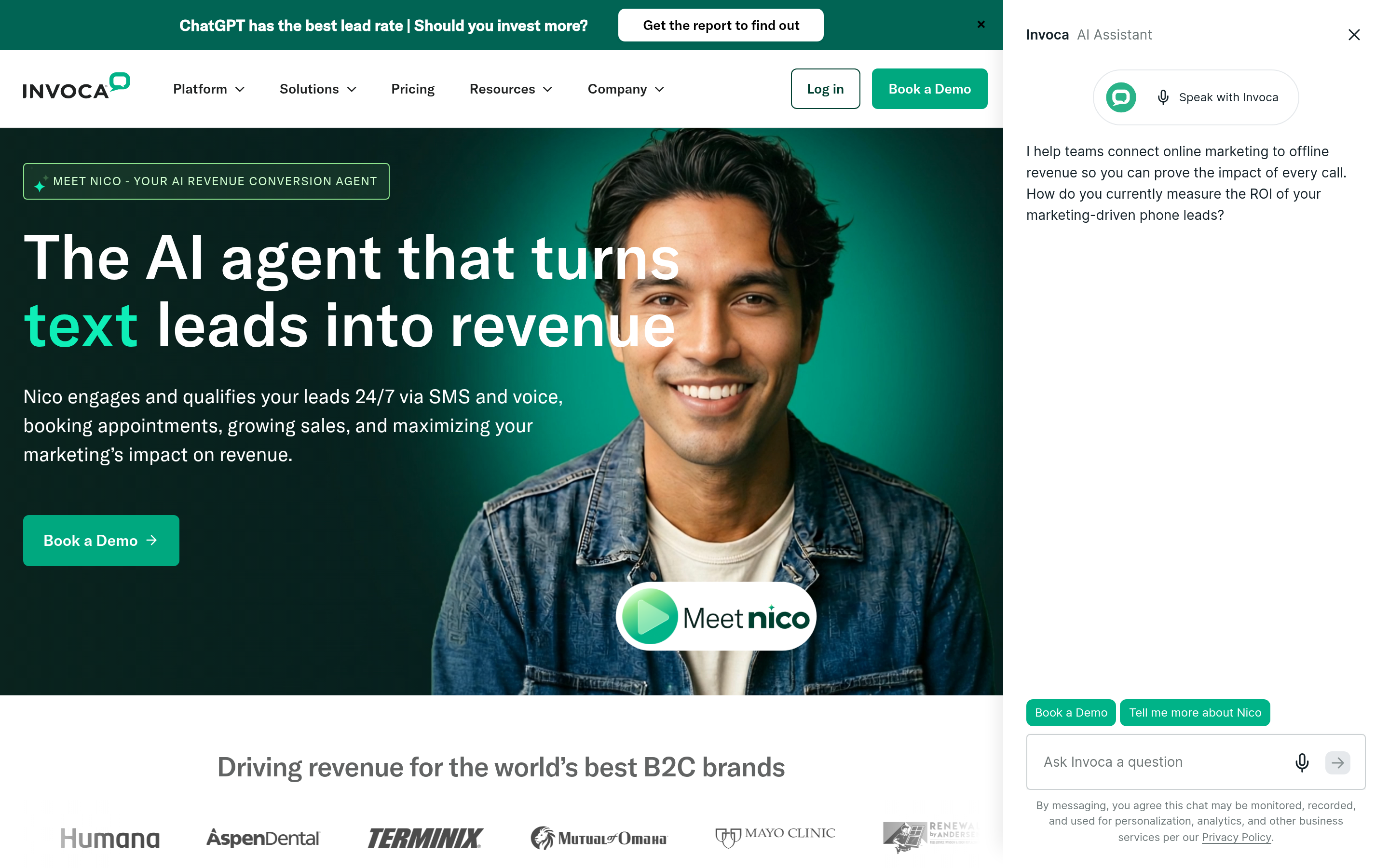
Invoca is built for large brands with serious ad budgets, and healthcare is one of its core verticals. Its AI classifies call outcomes, pushes conversion signals back to Google and Meta for bidding, and handles high call volumes across many locations.
- Pricing: custom quote, sized for enterprise.
- Strengths: advanced AI classification, deep ad-platform integrations, enterprise security and compliance.
- Trade-offs: priced and scoped for large organizations, with longer implementation.
- Best for: hospital systems and large DSOs whose marketing budget justifies an enterprise platform.
4. WhatConverts — best budget Liine alternative#
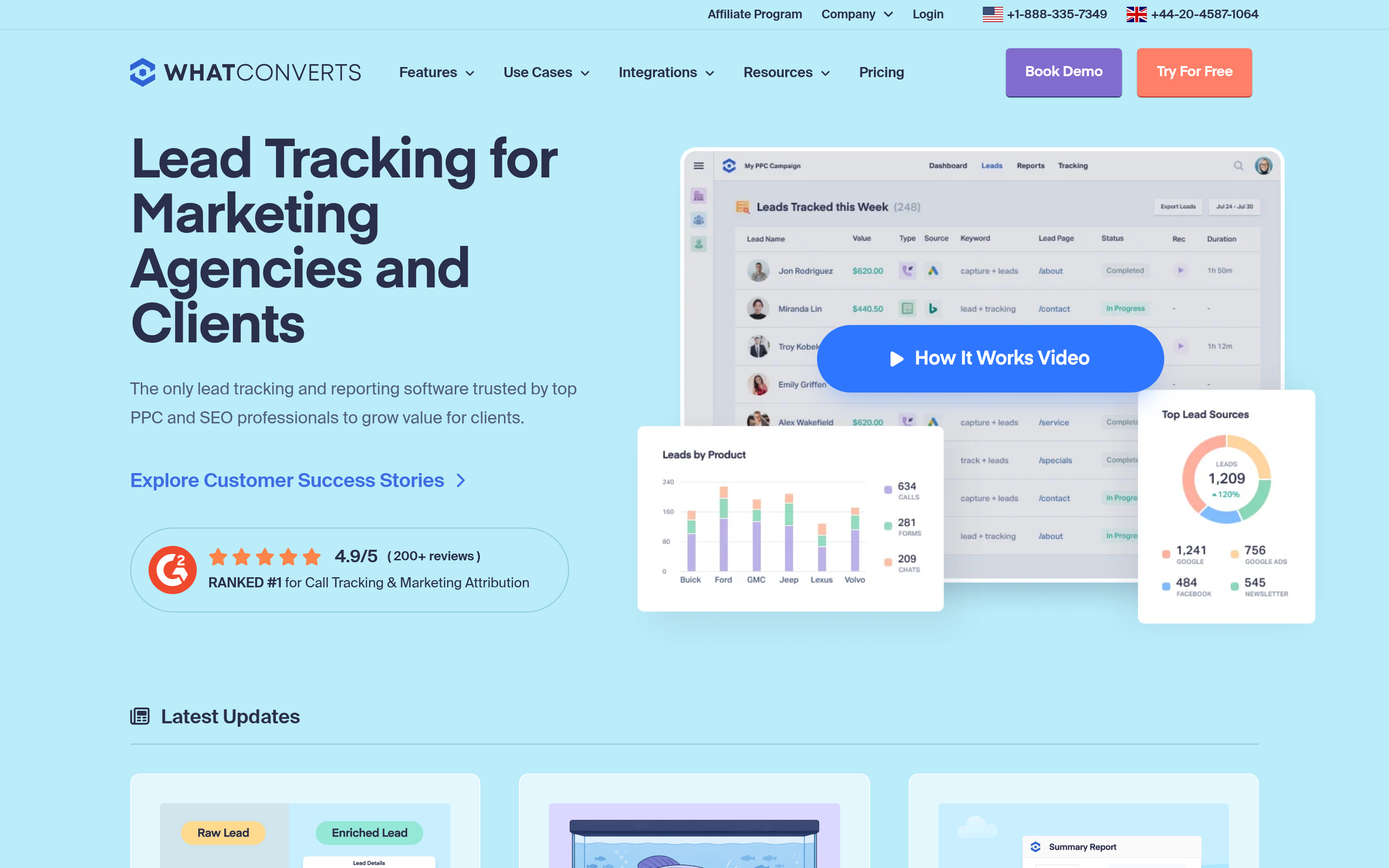
WhatConverts tracks calls, forms and chats in one lead log, and the entry price is lower than most. You can tag each lead with a quote or sale value, which gives you a lightweight version of revenue attribution.
- Pricing: from about $30/mo (Call Tracking), with Plus, Pro and Elite tiers around $60, $100 and $160/mo. Usage beyond included credits is extra. There's a 14-day free trial.
- Strengths: cheap to start, unified lead log, good value for agencies.
- Trade-offs: no native PMS integration, and the AI analysis is lighter than Liine's.
- Best for: small practices that want to know which channels ring the phone without paying for enterprise features.
5. Patient Prism — best for dental front-desk coaching#
Patient Prism is built for dental. It records new-patient calls, uses AI to flag missed booking opportunities, and routes the calls to human coaches who give feedback and training. The company says practices that book roughly half of new-patient calls can move toward 75-80%.
- Pricing: custom, per-location.
- Strengths: AI plus human coaching, dental-specific scripts, focus on conversion rate.
- Trade-offs: it's weaker as a pure marketing-attribution tool, since coaching is the core product.
- Best for: practices where the leak is the front desk, not the ad spend.
6. Weave — best all-in-one practice communication#
Weave isn't a call tracking tool in the strict sense. It's a patient communication platform with VoIP phones, two-way texting, reviews, reminders and payments, plus call analytics. Many dental and optometry practices pick it to consolidate systems.
- Pricing: custom quote, typically bundled with phones.
- Strengths: one vendor for phones, texting and reminders, with deep PMS sync.
- Trade-offs: limited ad-level attribution compared with Liine or Invoca.
- Best for: practices whose priority is patient experience and fewer vendors, not marketing ROI.
7. Marchex — best conversational analytics for large groups#
Marchex focuses on conversational analytics: it turns call and text conversations into insight about outcomes, agent performance and marketing effectiveness. It sells to multi-location businesses in healthcare, auto and home services.
- Pricing: custom quote.
- Strengths: mature analytics, industry-specific outcome models, multi-location reporting.
- Trade-offs: it's enterprise-oriented, and the value shows up at scale.
- Best for: large, multi-brand groups that want conversation insight across locations.
How do Liine alternatives compare side by side?#
| Tool | Starting price | Healthcare-specific | PMS/EHR revenue attribution | AI call analysis | Best for |
|---|---|---|---|---|---|
| Liine | Usage-based (call volume) | Yes | Yes, native | Yes | Multisite dental, medical, vet |
| CallRail | ~$50/mo + usage | No | Via workarounds | Higher tiers | SMBs and agencies |
| CallTrackingMetrics | ~$65/mo + usage | Partial | Via API/integrations | Yes | Groups with call centers |
| Invoca | Custom | Strong vertical | Yes (enterprise) | Advanced | Hospital systems, large DSOs |
| WhatConverts | ~$30/mo + usage | No | Manual value tagging | Basic | Budget-conscious practices |
| Patient Prism | Custom | Dental | Limited | AI + human coaches | Front-desk conversion |
| Weave | Custom | Yes | Limited | Basic | All-in-one practice comms |
| Marchex | Custom | Partial | Via integrations | Advanced | Large multi-brand groups |
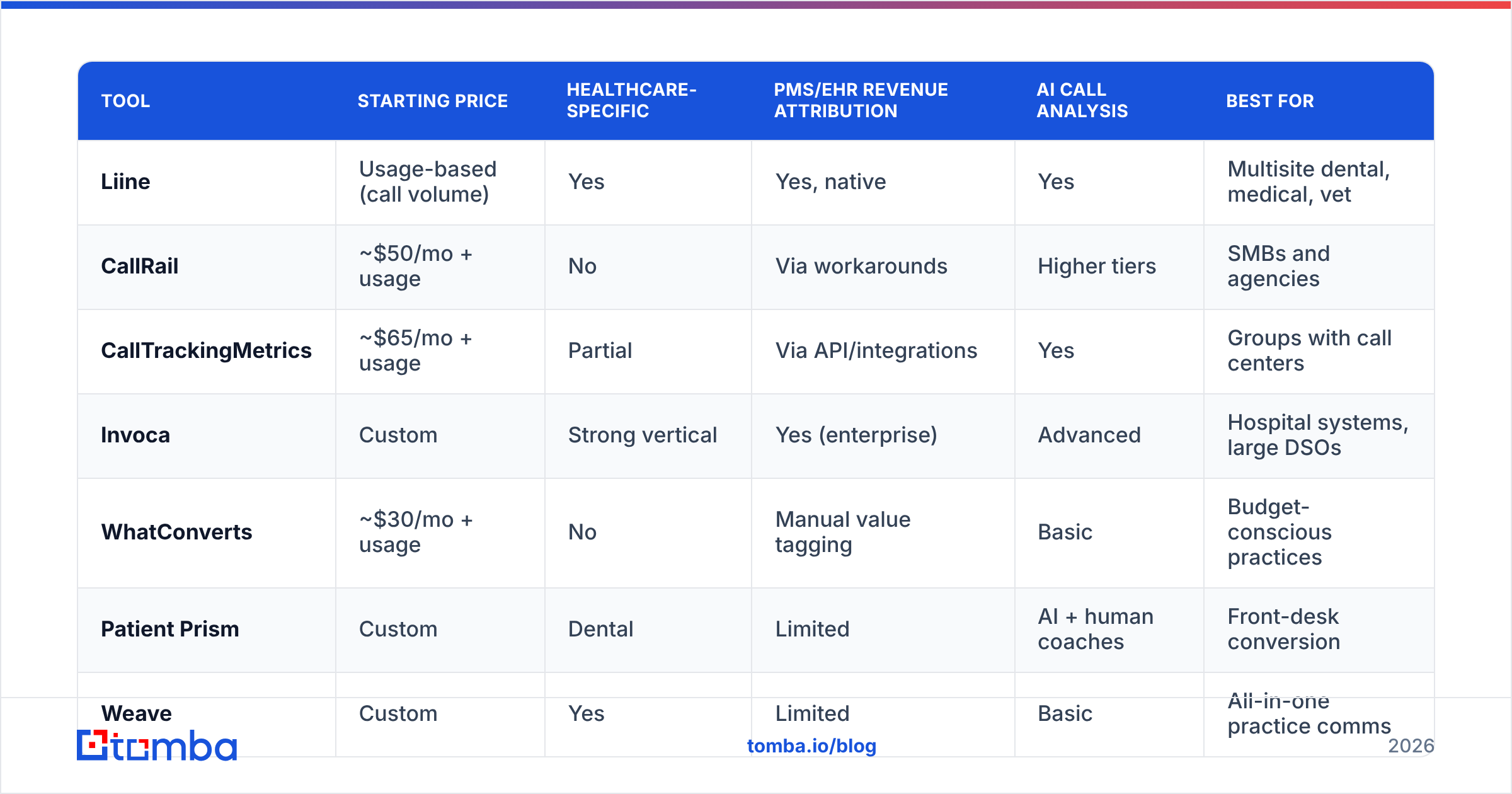
The table shows the main trade-off: cheaper general-purpose tools give up native healthcare revenue attribution, and tools that match Liine's depth cost enterprise money. Liine sits in between, and that's why multisite groups like it.
Is Liine better than CallRail for dental practices?#
For a multi-location dental group, usually yes. Liine's native link between a call, a booked appointment and the revenue from that patient is what DSO marketing teams need for budget decisions. CallRail tells you a Google Ads click produced a four-minute call. Liine tells you whether that call became a $3,000 treatment plan.
For a single dental office spending $2,000/mo on ads, the answer changes. CallRail or WhatConverts will show which channels produce calls at a fraction of the complexity, and a front-desk coaching tool like Patient Prism may do more for revenue than better attribution would.
A useful test is to ask how many locations you'll track and whether anyone will act on location-level revenue data every month. If the answer is "one" or "nobody", a lighter tool is the rational pick.
How do you migrate from Liine without losing attribution data?#
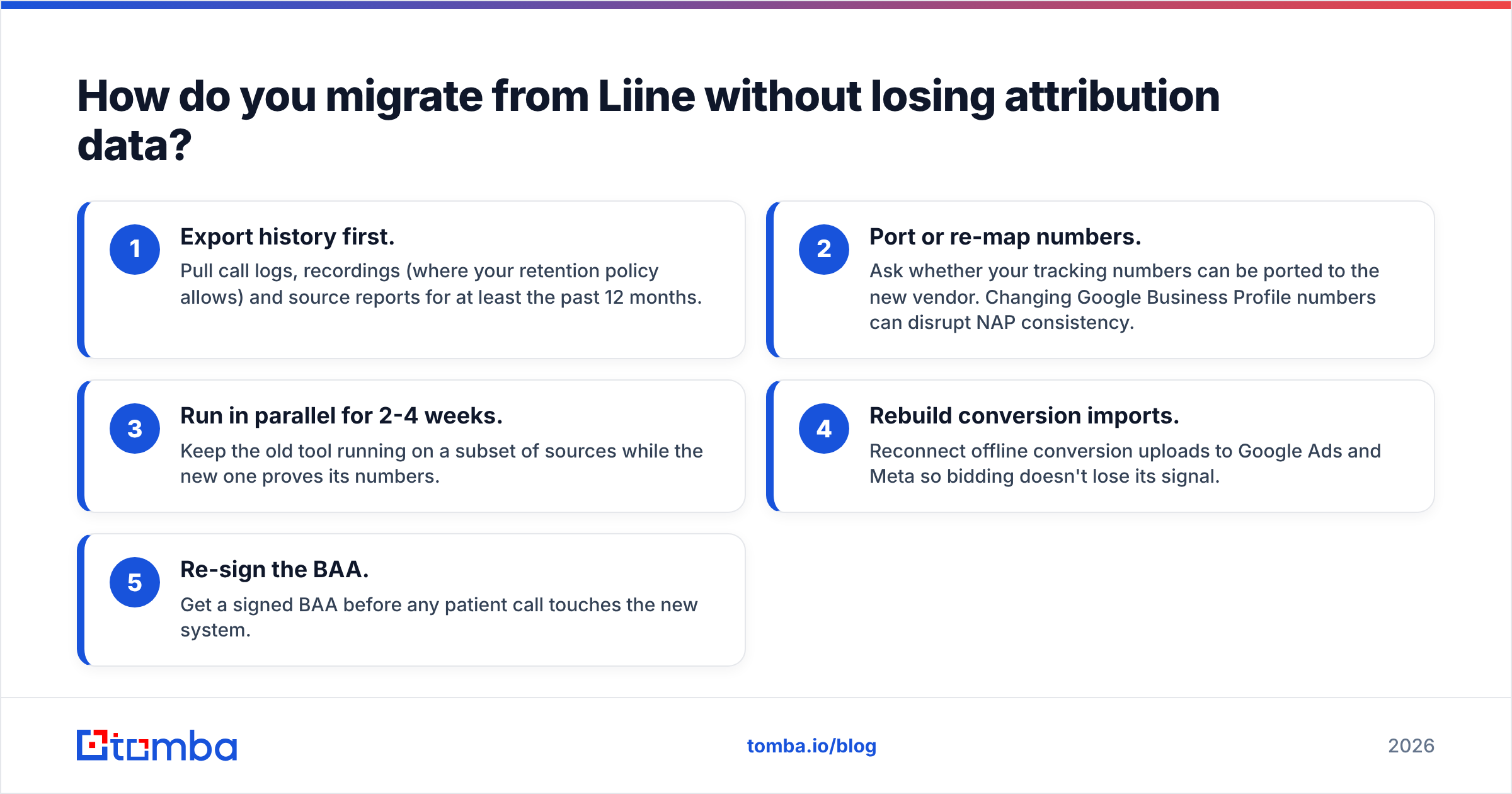
Switching call tracking tools is riskier than most software swaps, because your phone numbers are printed on ads, listings and signage. Work through it in this order:
- Export history first. Pull call logs, recordings (where your retention policy allows) and source reports for at least the past 12 months.
- Port or re-map numbers. Ask whether your tracking numbers can be ported to the new vendor. Changing Google Business Profile numbers can disrupt NAP consistency.
- Run in parallel for 2-4 weeks. Keep the old tool running on a subset of sources while the new one proves its numbers.
- Rebuild conversion imports. Reconnect offline conversion uploads to Google Ads and Meta so bidding doesn't lose its signal.
- Re-sign the BAA. Get a signed BAA before any patient call touches the new system.
If your marketing reporting lives in a CRM, plan how the new tool writes to it as well. Revenue operations teams tend to find that the integration layer, not the tracking tool, is where attribution breaks.
Where does B2B contact data fit into this stack?#
Call tracking tools like Liine handle inbound demand: patients calling practices. Many readers of this comparison work on the other side of that relationship. They're agencies, healthcare SaaS vendors and consultants who sell to dental groups, DSOs and medical practices.
For those teams, the hard part isn't attribution. It's reaching the marketing director or COO of a 30-location dental group. General inboxes like info@ rarely reach them. You need verified, named contacts:
- Use domain search on a DSO's website to list the professional emails published for that organization.
- Use an email finder when you have a name and company, such as a VP of Marketing you found on LinkedIn.
- Enrich leads with role, company size and location data before they go into your CRM, so sequences are segmented by practice type.
If your pipeline runs through HubSpot, the Tomba HubSpot integration writes these contacts straight into your records. This is a separate job from what Liine does, but the two often sit side by side in agency and vendor workflows.
Which Liine alternative should you choose?#
Match the tool to the problem you're actually trying to solve:
- "We just need to know which ads ring the phone." Choose WhatConverts or CallRail.
- "Our central scheduling team needs routing and tracking in one system." Choose CallTrackingMetrics.
- "We're a hospital system or large DSO with enterprise ad spend." Choose Invoca or Marchex.
- "Our front desk is losing new-patient calls." Choose Patient Prism.
- "We want fewer vendors across phones, texting and reminders." Choose Weave.
- "We're multisite and need call-to-revenue attribution in our PMS." Liine is probably still the best fit, so renegotiate before you switch.
For side-by-side user reviews, G2's call tracking category is worth checking alongside Capterra. Whatever you shortlist, run a paid pilot on real call volume before you sign an annual contract.
Selling into multisite practices? Start with the right contacts#
If you're an agency or healthcare vendor pitching call tracking, marketing or software to dental groups, DSOs or medical practices, your outbound will only be as good as your contact data. Tomba Email Finder finds and verifies the professional emails of practice owners, marketing directors and operations leaders by name, domain or company. The free plan includes 25 searches a month, so you can test it on your target account list before paying anything.
Related guides#
// get started
Find, verify and enrich your first contacts today
Start on the free plan with 25 searches a month, then scale when your team is ready.
Free plan · No credit card required · GDPR & CCPA
Get the Tomba newsletter
Product and data updates
// about the author