Limeleads vs Oceanio: Contact Database or Lookalike Engine?
Limeleads sells you unlocked contacts. Ocean.io sells you lists of companies that look like your best customers. Here's which one fits your outbound motion, what each costs, and where both leave gaps.
TL;DR
- Limeleads is a filterable B2B contact database with a US focus. You pay per unlocked contact, and its pricing is simple and predictable: Pro $99/mo, Business $150/mo, Enterprise $400/mo.
- Ocean.io is a company-first lookalike engine. You give it your best customers and it returns a ranked list of similar accounts. Contacts and emails come second in its workflow.
- If you already know your ICP and just need names and emails, pick Limeleads. If your problem is working out which accounts to target, pick Ocean.io.
- Neither one replaces a dedicated email finder and verifier. Budget for a verification step before any sequence goes out.
- Tomba ($49/mo Starter) covers the email-finding and verification layer that both tools leave thin.
What is Limeleads?#
Limeleads is a self-serve B2B lead database. You filter by industry, job title, seniority, company size and location, preview the matching records, and spend credits to unlock contact details. Each credit unlocks one contact. The product is built for founders, SDRs and small agencies who want a clean CSV without a sales call or a platform migration.
What sets it apart:
- Pay-per-unlock model. You only pay for records you export, not for browsing.
- Credit rollover. Third-party pricing trackers report that unused credits carry forward on paid plans. Most competitors don't allow this, and it matters if your prospecting volume swings month to month.
- US-heavy coverage. The database is strongest for North American SMB and mid-market companies. Coverage thins out quickly in EMEA and APAC.
- Small seat caps. Plans are sold as shared team accounts, but seats are capped (reported as 1 on Pro, 2 on Business, 5 on Enterprise).
Limeleads works like a filing cabinet. You know what you're looking for, you pull the drawer, and you take out the folders. It does not suggest which drawer to open.
What is Ocean.io?#
Ocean.io is an account-discovery platform built on lookalike modelling. You enter one or more "seed" companies (usually your best-fit customers) and it returns a ranked list of similar companies. The similarity score draws on signals such as website content, technology, headcount, growth and industry. Once you have the accounts, you can pull decision-makers, emails and phone numbers from the same interface.
What sets it apart:
- Company-first workflow. You start from accounts, not from job titles.
- Lookalike ranking. Results come sorted by how closely they match your seed accounts, not alphabetically or by headcount.
- Global and European strength. Ocean.io is headquartered in Copenhagen, and its company data is noticeably better in Europe than most US-born databases.
- Unlimited users on paid plans, with a Chrome extension, CRM integrations and API access (per its published plan comparison).
- Credit metering. Search results, verified emails and direct phones use credits at different rates. Phone numbers cost about ten times as much as an email.
If Limeleads is a filing cabinet, Ocean.io is a matchmaker. You describe who you've succeeded with, and it introduces you to similar companies.

How do Limeleads and Ocean.io compare side by side?#
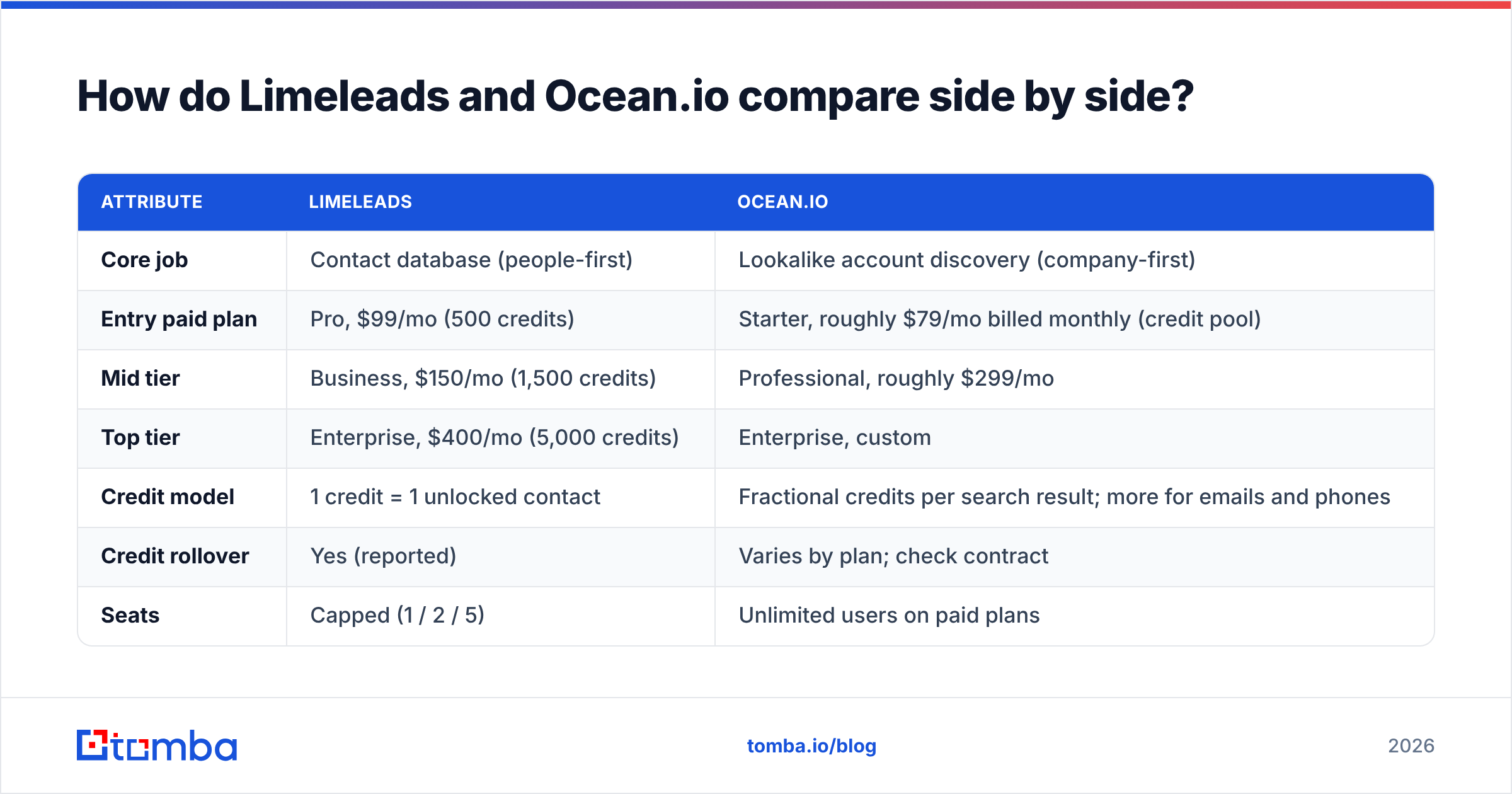
This is the core comparison. Pricing figures come from public plan pages and third-party trackers as of 2026. Both vendors change their packaging, so check the live pricing page before you commit.
| Attribute | Limeleads | Ocean.io |
|---|---|---|
| Core job | Contact database (people-first) | Lookalike account discovery (company-first) |
| Entry paid plan | Pro, $99/mo (500 credits) | Starter, roughly $79/mo billed monthly (credit pool) |
| Mid tier | Business, $150/mo (1,500 credits) | Professional, roughly $299/mo |
| Top tier | Enterprise, $400/mo (5,000 credits) | Enterprise, custom |
| Credit model | 1 credit = 1 unlocked contact | Fractional credits per search result; more for emails and phones |
| Credit rollover | Yes (reported) | Varies by plan; check contract |
| Seats | Capped (1 / 2 / 5) | Unlimited users on paid plans |
| Geographic strength | US / North America | Europe and global |
| Lookalike search | No | Yes, the flagship feature |
| Chrome extension | Limited | Yes |
| CRM integrations | CSV export first | HubSpot, Salesforce, Pipedrive and API |
| Best for | Solo founders, small SDR teams, agencies | ABM teams, RevOps, EU-focused outbound |
The main difference is the direction of search. Limeleads assumes you already know who you want. Ocean.io assumes you're not sure yet and helps you find out.
Which tool has better data quality?#
Neither tool wins outright. It depends on what you're measuring.
Contact-level accuracy. Limeleads is built around unlocking contact records, so the email field is the product. Independent reviews on G2 often mention clean US SMB data along with some stale titles, which is normal for any static database. Ocean.io's contact data is solid for European mid-market companies, but contacts are a secondary layer on top of its company graph. Expect gaps at very small companies.
Company-level accuracy. Ocean.io is clearly ahead here. Its firmographic and technographic signals are the whole product, and it re-crawls company websites to keep similarity scores current. Limeleads stores company attributes mainly as filters for finding people.
Freshness. Both tools depend on refresh cycles you can't see. Job changes run at roughly 20-30% a year in many B2B segments, so any record older than a couple of quarters has a real chance of bouncing.
In practice, treat any exported email as a candidate, not a fact. Run the list through an email verifier before you load a sequence, whichever database it came from. That single step does more for your bounce rate than switching vendors.
Is Limeleads cheaper than Ocean.io?#
On a per-contact basis for straightforward US prospecting, usually yes.
Here's the maths at list price, using published figures:
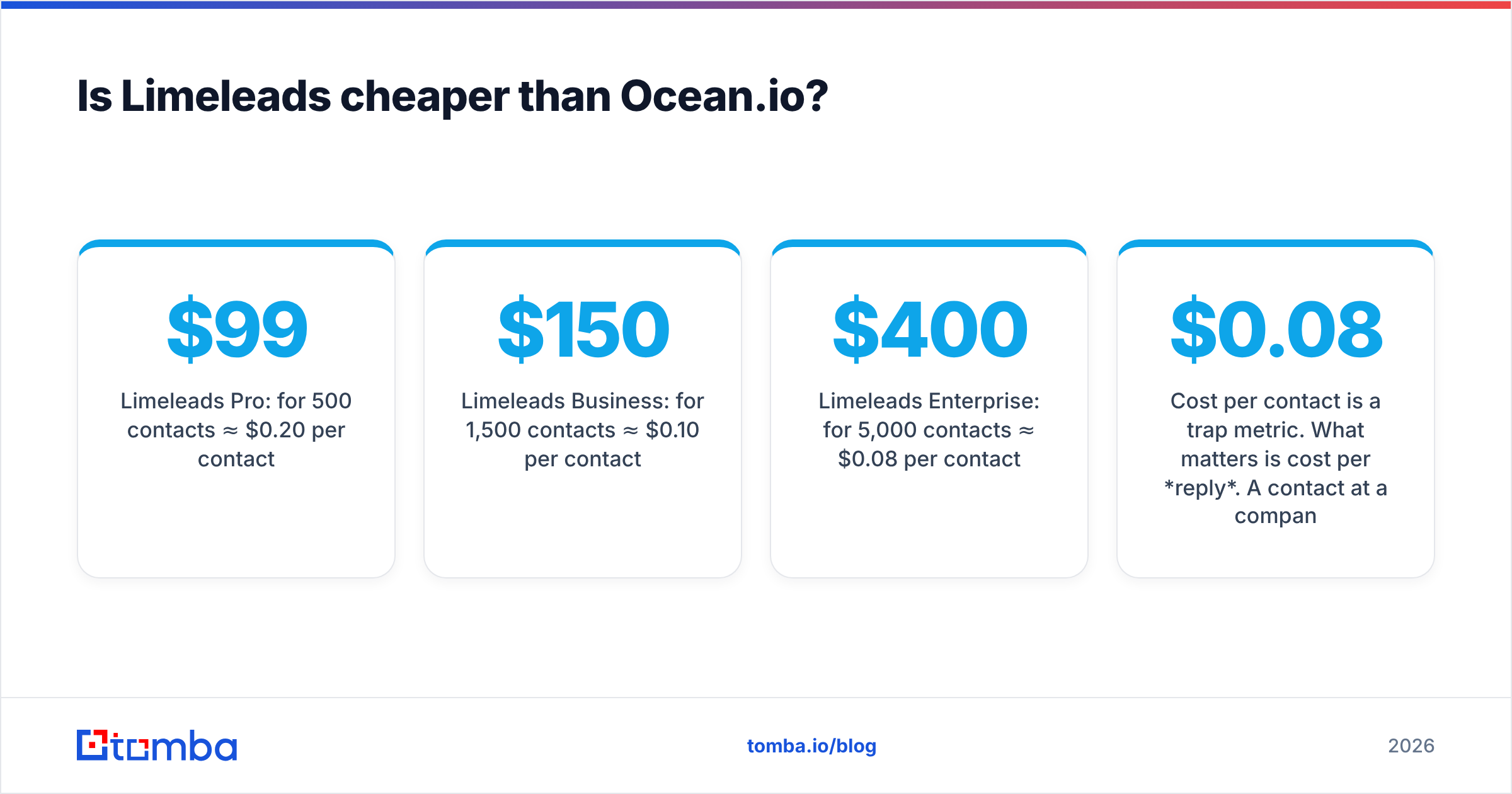
- Limeleads Pro: $99 for 500 contacts ≈ $0.20 per contact
- Limeleads Business: $150 for 1,500 contacts ≈ $0.10 per contact
- Limeleads Enterprise: $400 for 5,000 contacts ≈ $0.08 per contact
Ocean.io is harder to reduce to one number. You spend credits on discovery (browsing lookalike results) and on enrichment (emails, phones). A team that researches heavily but exports lightly can burn through credits before unlocking many contacts. A team that exports aggressively pays mostly for emails and phones, and phones cost many times what an email does.
A rough rule of thumb:
- If you need 1,000+ US contacts a month from a known ICP, Limeleads Business or Enterprise will almost always cost less.
- If you need 200 highly qualified accounts a month and only 1-2 contacts per account, Ocean.io's cost per good account can be lower, because you waste fewer credits on poor-fit companies.
- If phone numbers matter, model Ocean.io's phone credit burn carefully before signing. It's the line item that most often surprises buyers.
- If you're a team of five or more, Ocean.io's unlimited users remove a seat constraint that Limeleads keeps.
Cost per contact is a trap metric. What matters is cost per reply. A $0.08 contact at a company that will never buy costs more than a $0.50 contact at a company that looks like your top customer.
When should you choose Limeleads?#
Pick Limeleads if most of these describe you:
- Your ICP is already locked. For example, "Heads of Operations at US logistics companies with 50-500 employees." You don't need an algorithm to suggest accounts.
- You work in a spreadsheet, not a CRM. Limeleads' CSV-first workflow suits people who clean, dedupe and upload manually.
- Your volume varies. Credit rollover means a slow month doesn't waste money.
- You're US-focused. The database is deepest there.
- You're one person or a very small team. The seat caps don't hurt at that size, and the lower tiers stay affordable.
Where Limeleads falls short: it won't tell you which accounts are worth targeting, its non-US coverage is thin, and it doesn't have the account-scoring signals an ABM team expects.
When should you choose Ocean.io?#
Pick Ocean.io if most of these describe you:
- You have 10+ great customers and want 500 more like them. This is exactly the problem the lookalike engine is built for.
- You run account-based motions. Ranked account lists feed straight into ABM tiering, ad audiences and SDR territories.
- You sell into Europe. Ocean.io's European company coverage is a real advantage.
- RevOps owns the tooling. Unlimited seats, API access and native CRM sync fit a team-wide rollout. Ocean.io's HubSpot and Salesforce connectors push accounts directly into your CRM instead of relying on CSV round-trips.
- You care about account fit more than contact volume. Ocean.io suits a precise, low-volume approach.
Where Ocean.io falls short: pricing is harder to forecast, phone enrichment is expensive, and the contact layer at very small companies can be sparse. That's a trade-off for buying a company-intelligence tool.
Can you use Limeleads and Ocean.io together?#
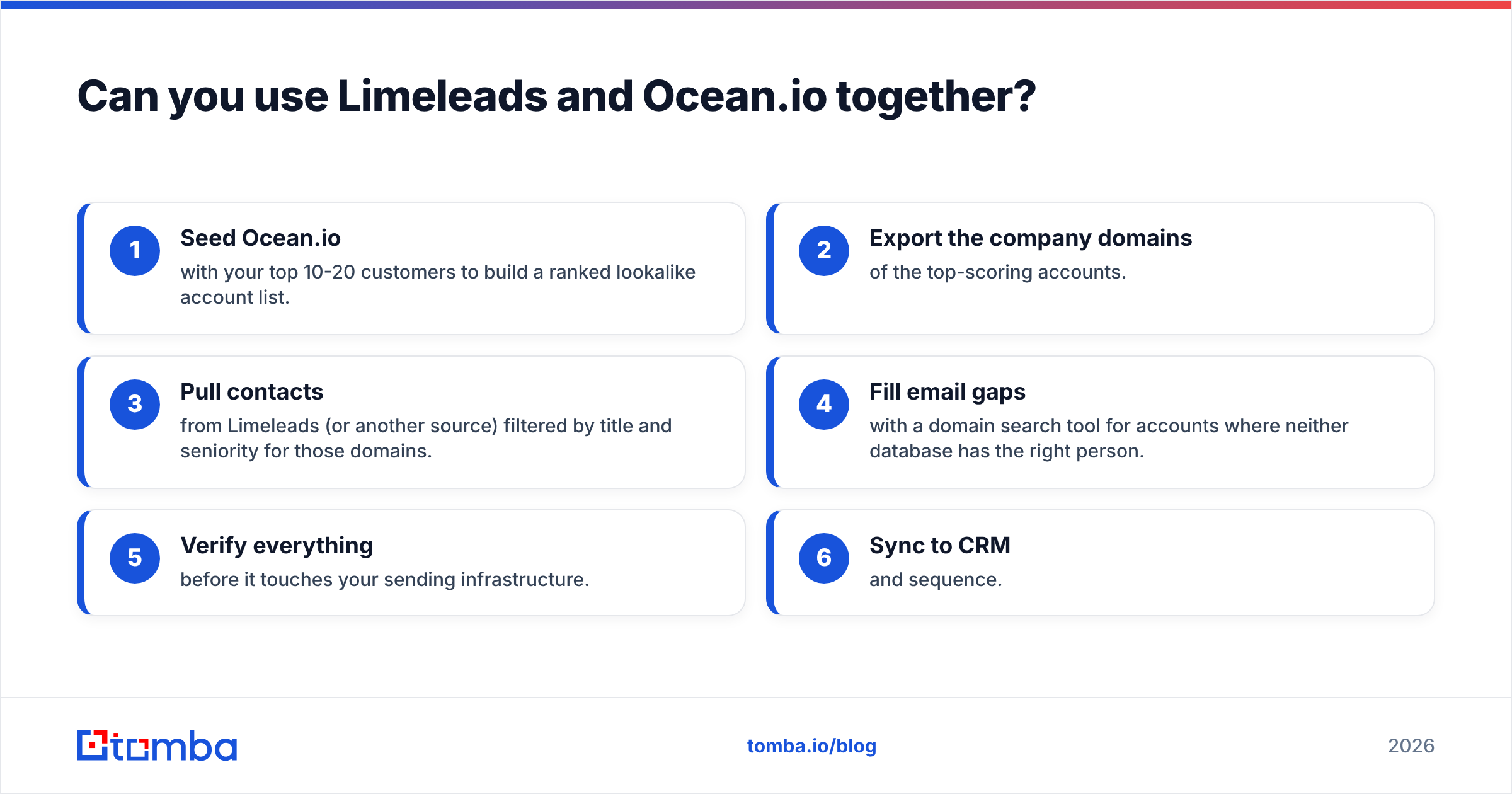
Yes, and some teams do. The combined workflow looks like this:
- Seed Ocean.io with your top 10-20 customers to build a ranked lookalike account list.
- Export the company domains of the top-scoring accounts.
- Pull contacts from Limeleads (or another source) filtered by title and seniority for those domains.
- Fill email gaps with a domain search tool for accounts where neither database has the right person.
- Verify everything before it touches your sending infrastructure.
- Sync to CRM and sequence.
This workflow has an obvious cost. You're paying for two subscriptions, managing two credit pools, and reconciling two sets of company records. For many teams, the more efficient setup is one account-discovery tool (Ocean.io, or a free ICP filter in your CRM) plus one dedicated email-finding and verification layer.

What do both tools leave out?#
This gap matters more than any feature on the comparison table above.
Real-time email finding. Both products mainly return emails that already exist in their database. If the person you want isn't indexed, or has changed jobs since the last refresh, you get nothing or a stale address. A live email finder builds and checks the address on demand from the name and domain.
Catch-all handling. Many B2B domains accept every address at the SMTP level, so a basic verification returns "valid" for addresses that will later bounce or go nowhere. Neither Limeleads nor Ocean.io is specialised for catch-all resolution.
Enrichment on your own lists. If you already have a list of 5,000 leads from an event, webinar or inbound form, you want data enrichment that fills in missing fields. You don't want to rebuy the same people from a database.
Deliverability protection. A 5% bounce rate on a new sending domain can damage your sender reputation for weeks. Gmail's and Yahoo's bulk-sender rules, which Google documents here, make list hygiene a hard requirement rather than a nice-to-have.
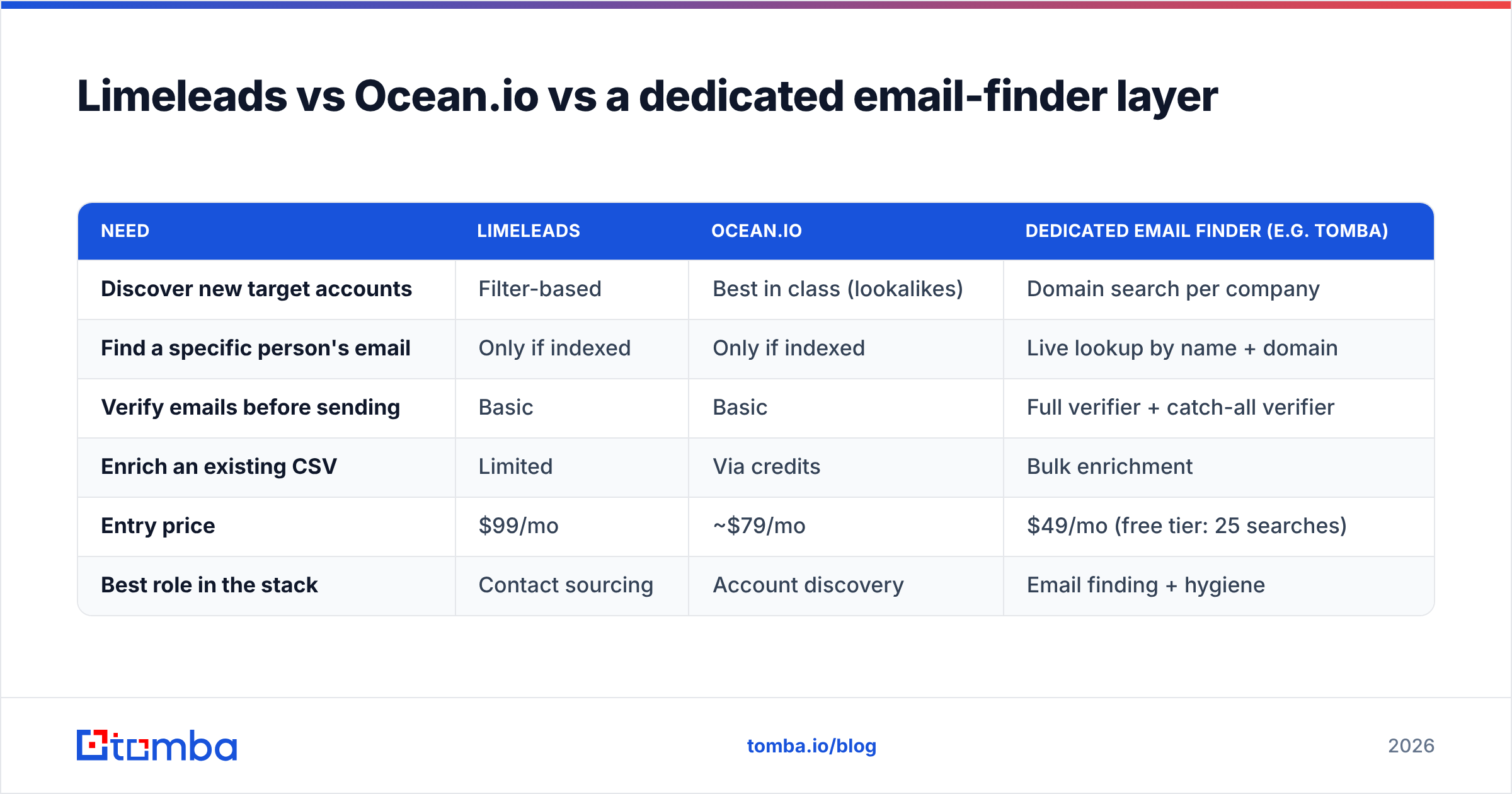
Limeleads vs Ocean.io vs a dedicated email-finder layer#
To put all three in context:
| Need | Limeleads | Ocean.io | Dedicated email finder (e.g. Tomba) |
|---|---|---|---|
| Discover new target accounts | Filter-based | Best in class (lookalikes) | Domain search per company |
| Find a specific person's email | Only if indexed | Only if indexed | Live lookup by name + domain |
| Verify emails before sending | Basic | Basic | Full verifier + catch-all verifier |
| Enrich an existing CSV | Limited | Via credits | Bulk enrichment |
| Entry price | $99/mo | ~$79/mo | $49/mo (free tier: 25 searches) |
| Best role in the stack | Contact sourcing | Account discovery | Email finding + hygiene |
The honest takeaway: Limeleads and Ocean.io compete for the sourcing budget, and a finder/verifier sits underneath either of them. Choosing one of the two doesn't remove the need for that bottom layer.
So, Limeleads vs Ocean.io: which should you buy?#
Choose Limeleads if you're a founder, a small SDR team or an agency prospecting into the US with a clear ICP, and you want the lowest predictable cost per contact with rollover credits.
Choose Ocean.io if you're a RevOps-led or ABM team, especially one selling into Europe, and the hard part is finding the right accounts rather than finding people at them.
Choose neither on its own if your real problem is bounces, missing emails or unverified lists. That's a finder and verifier problem, and neither of these tools is built mainly to solve it.
Whichever you choose, take a trial list of 200 records from your actual ICP, verify every email independently, and compare deliverable-contact rates before you sign an annual contract. That hour of testing will tell you more than any review, including this one.
Where does Tomba fit?#
If you're comparing Limeleads and Ocean.io, you're probably building a sourcing stack. Whichever one you pick, run its exports through the Tomba Email Finder. It finds professional addresses live from a name and company domain, fills in the contacts your database missed, and pairs with Tomba's verifier and catch-all checks so bounces never reach your sending domain. The free plan gives you 25 searches a month to test against your own list, and paid plans start at $49/mo. See the full Tomba pricing to size it against your volume.
Related guides#
// get started
Find, verify and enrich your first contacts today
Start on the free plan with 25 searches a month, then scale when your team is ready.
Free plan · No credit card required · GDPR & CCPA
// about the author