Limeleads vs Outboundview: Self-Serve Data or Done-for-You Outbound?
Limeleads sells you a self-serve US contact database from $99/mo. Outboundview runs HR-focused outbound for you from about $1,000/mo. Here is how to tell which one your pipeline actually needs.
TL;DR
- Limeleads is a self-serve B2B contact database focused on the US. You search, filter, and export verified emails and phone numbers yourself. Paid plans start at $99/mo.
- Outboundview is a US sales development agency that works only with companies selling to HR buyers. It sells intent data, access to its TalentView HR database, and SDR or cold-calling programs, with published packages from about $1,000/mo up to $2,500/mo.
- These two don't really compete. Limeleads gives you data and leaves the work to you. Outboundview gives you pipeline and does the work for you, but only if your buyer sits in HR.
- Pick Limeleads if you already have reps and need cheap US contacts. Pick Outboundview if you sell HR tech or services and would rather pay for booked meetings than hire SDRs.
- If you mainly need accurate emails for named people or domains around the world, a dedicated email finder is cheaper than either one.
What is the real difference between Limeleads and Outboundview?#
Think of it as buying groceries versus hiring a caterer. Limeleads sells you ingredients: contact records you filter, export, and put into your own sequences. Outboundview cooks the meal. It builds lists from its own HR database, adds buyer-intent signals, and in its higher tiers runs the calls and emails that book meetings for you.
That's why the "limeleads vs outboundview" question comes up so often. The two show up in the same "B2B lead generation" searches, but they fit different operating models:
- Limeleads assumes you have an outbound engine (reps, a sequencer, a CRM) and just need records to feed it.
- Outboundview assumes you'd rather rent the engine, and that your target buyer is an HR leader at manager level or above.
If you get this framing wrong, you'll either overpay an agency for data you could have pulled yourself, or buy a database you have no one to work.
What is Limeleads?#
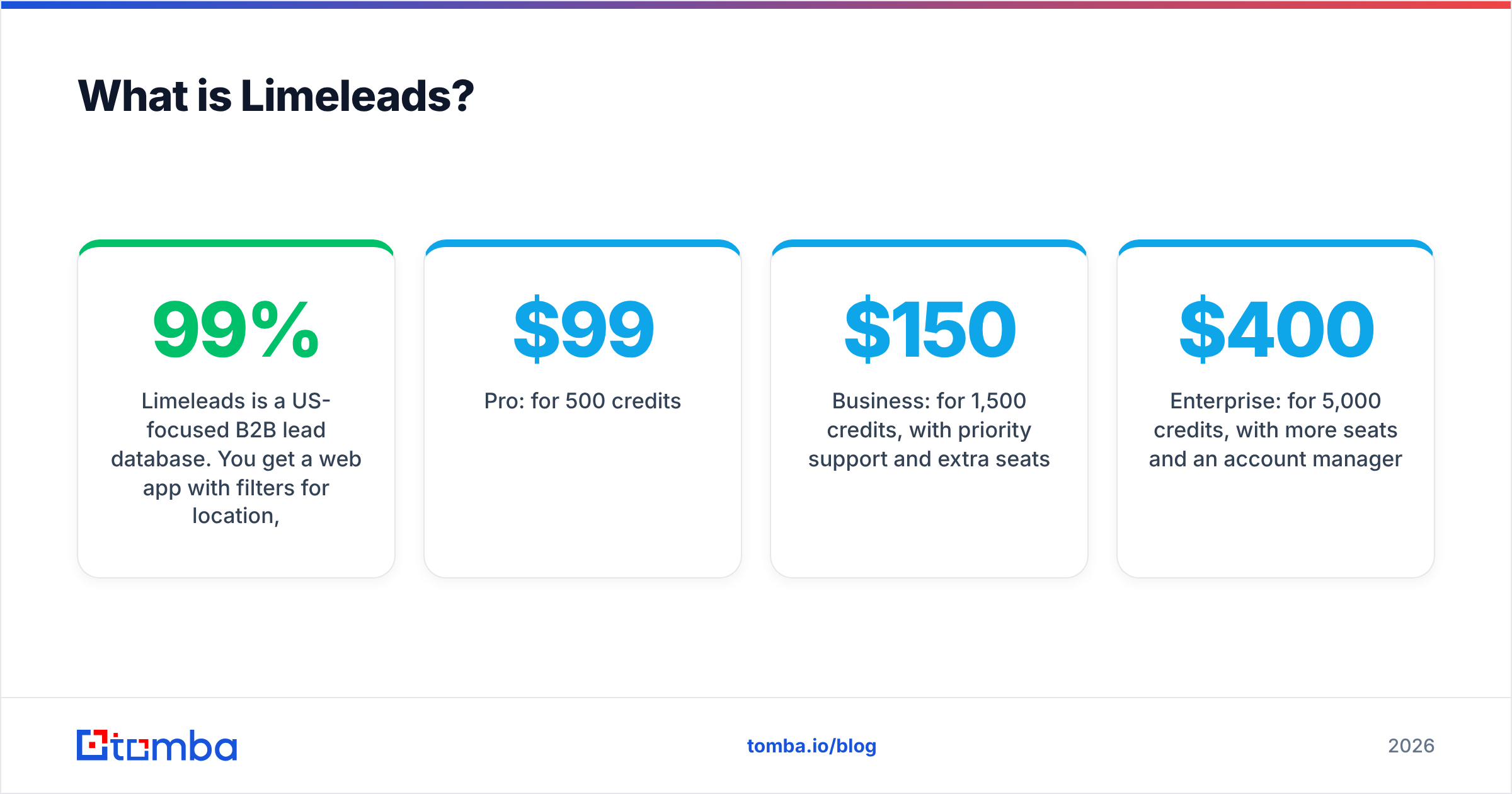
Limeleads is a US-focused B2B lead database. You get a web app with filters for location, industry, company size, and revenue. Records include business emails and, on many contacts, direct or mobile numbers. The vendor markets its email data as highly accurate (it claims 99%), and verification is included in the export flow, so you aren't paying a separate verifier for each row.
Pricing runs on credits, and published tiers look roughly like this:
- Pro: $99/mo for 500 credits
- Business: $150/mo for 1,500 credits, with priority support and extra seats
- Enterprise: $400/mo for 5,000 credits, with more seats and an account manager
Annual billing lowers these prices a lot (the vendor advertises about 35% off), and unused credits roll over, which is uncommon in this category. There's a free trial so you can check data quality before you pay. Current tier details are on Limeleads' Capterra listing and the vendor's own pricing page.
Its main limit is coverage. Limeleads is built around US companies. If your territory includes EMEA or APAC, you'll hit thin results quickly.
What is Outboundview?#
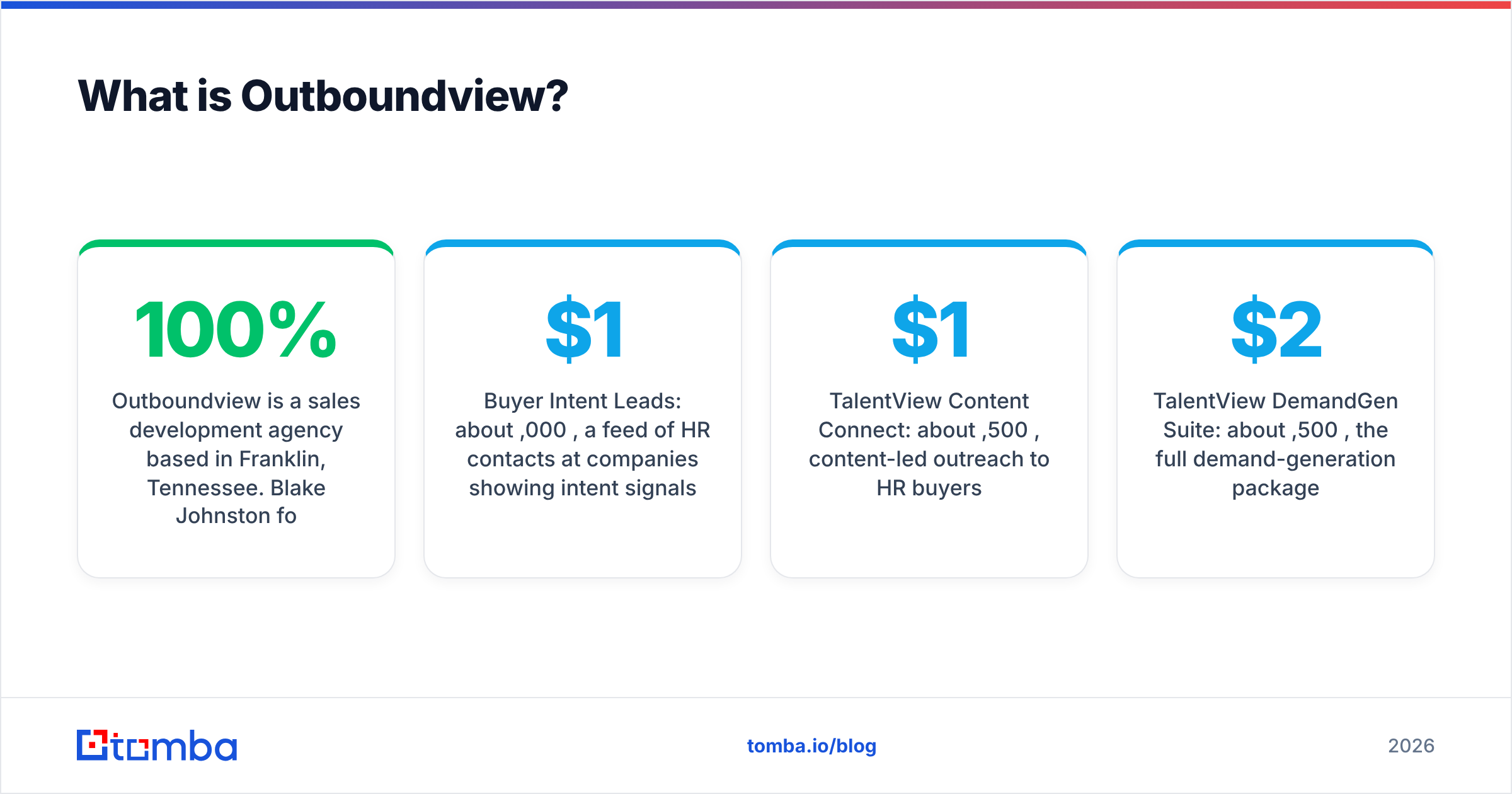
Outboundview is a sales development agency based in Franklin, Tennessee. Blake Johnston founded it in 2017. What sets it apart is focus: it says it is the only agency that works 100% on HR buyers. Every product sits on top of TalentView, its human-verified database of HR decision-makers, plus buyer-intent data showing which companies are researching HR topics right now.
Its lineup includes:
- Buyer Intent Leads: about $1,000/mo, a feed of HR contacts at companies showing intent signals
- TalentView Content Connect: about $1,500/mo, content-led outreach to HR buyers
- TalentView DemandGen Suite: about $2,500/mo, the full demand-generation package
- Scale: outsourced appointment setting with dedicated SDRs
- Dialworks: a custom cold-calling setup and infrastructure program
- Launch: consulting for companies building their first inside sales team
You can see how it describes the intent product on Outboundview's buyer intent data page, and user feedback is on G2. For a similar head-to-head with an enterprise data vendor, we also covered DiscoverOrg vs Outboundview.

How do Limeleads and Outboundview compare side by side?#
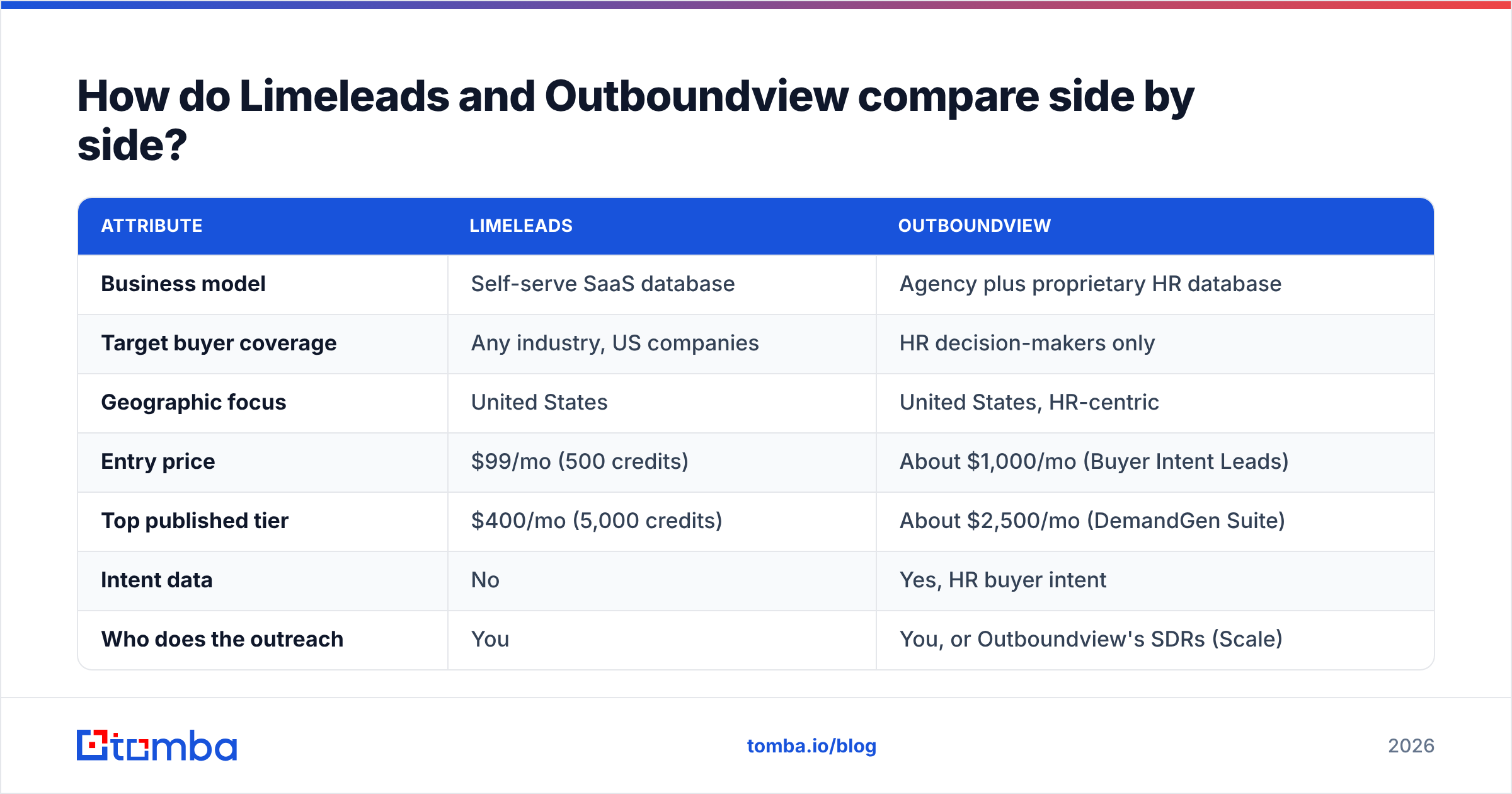
Here's the matchup on the attributes that usually decide the purchase.
| Attribute | Limeleads | Outboundview |
|---|---|---|
| Business model | Self-serve SaaS database | Agency plus proprietary HR database |
| Target buyer coverage | Any industry, US companies | HR decision-makers only |
| Geographic focus | United States | United States, HR-centric |
| Entry price | $99/mo (500 credits) | About $1,000/mo (Buyer Intent Leads) |
| Top published tier | $400/mo (5,000 credits) | About $2,500/mo (DemandGen Suite) |
| Intent data | No | Yes, HR buyer intent |
| Who does the outreach | You | You, or Outboundview's SDRs (Scale) |
| Cold-calling program | No | Yes (Dialworks) |
| Credit rollover | Yes | Not applicable (retainer model) |
| Free trial | Yes | No, sales-led |
| Best for | Lean teams with their own reps | HR tech and HR services vendors |
The table makes one thing clear: comparing price per contact is misleading. Outboundview's retainer pays for list building, intent research, and in some tiers human outreach. Limeleads' credit only pays for a record.
Which one has better data quality?#
Each is accurate in its own way, and the two can't be compared directly.
Limeleads gives broad US coverage with emails verified at export. Its strength is volume at a low price across many industries. Its weaknesses are the usual ones for a static database: titles age, people change jobs, and records outside the US are sparse. Check a sample of any export against LinkedIn before you trust a large list.
Outboundview trades breadth for depth. TalentView is human-verified and covers one persona, the HR leader. For that buyer, a specialist database with intent overlays will usually beat a generalist one. People who have been in a role for years get re-checked, and intent signals tell you when to reach out, not only who to contact. If your buyer is a CFO or a VP of Engineering, though, TalentView doesn't help you.
Whichever source you use, run the list through an independent email verifier before it reaches your sending domain. Even good databases go stale, and one bad batch can hurt your sender reputation for weeks.
How much will each actually cost you?#
Map cost to the outcome you're buying, not the line item.
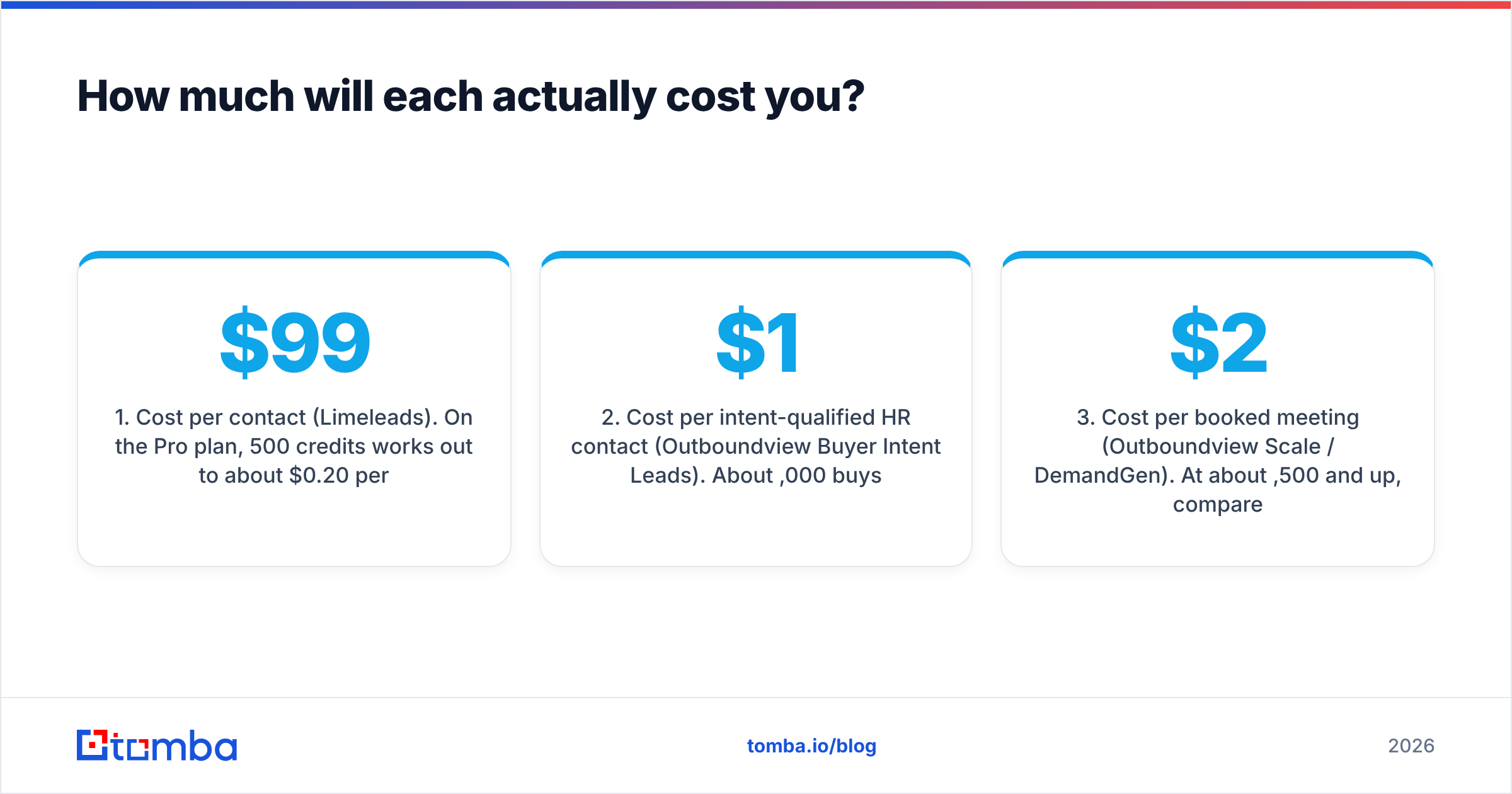
- Cost per contact (Limeleads). On the $99 Pro plan, 500 credits works out to about $0.20 per record. On Enterprise at $400 for 5,000, it's about $0.08. Add rep time, a sequencer, and domain warmup to get the real cost of a meeting.
- Cost per intent-qualified HR contact (Outboundview Buyer Intent Leads). About $1,000/mo buys timing, not just contacts. If one closed HR-tech deal pays for a year of the retainer, the math is easy.
- Cost per booked meeting (Outboundview Scale / DemandGen). At about $2,500/mo and up, compare it with a fully loaded in-house SDR. In the US that's often several times the monthly retainer once you count salary, tools, and ramp time.
- Hidden costs. For Limeleads, it's the labor to work the list. For Outboundview, it's the contract term and how dependent you become on an outside team's messaging.
So Limeleads is cheaper to start, and Outboundview can be cheaper per meeting, but only when your buyer matches its niche.
Who should choose Limeleads?#
Choose Limeleads if most of these are true:
- You sell into the US across several industries.
- You already have at least one rep and a sequencing tool.
- You want to self-serve, test segments fast, and control the messaging.
- Your budget is under $500/mo for data.
- You like credit rollover because your prospecting volume goes up and down.
It's a sensible default for early-stage founders doing their own outbound and for small SDR teams that need a steady supply of US contacts.
Who should choose Outboundview?#
Choose Outboundview if most of these are true:
- Your product or service is bought by HR: HRIS, payroll, benefits, recruiting, L&D, employee engagement, and so on.
- You don't have an SDR team, or it's too small to hit your pipeline target.
- You value intent signals and would rather spend budget on timing than on volume.
- You can commit $1,000 to $2,500+ per month and judge the result on meetings booked.
- You want help setting up cold-calling or building your first inside sales motion.
For HR-tech vendors, a specialist agency with its own persona database is a real advantage. Generalist databases can't match that depth of coverage or those intent signals for one buyer.

Is Limeleads or Outboundview better for you?#
Neither one wins outright. The better pick depends on your go-to-market model:
- Self-serve, multi-industry, US, tight budget: Limeleads.
- HR buyer, want meetings not spreadsheets, budget for a retainer: Outboundview.
- Global coverage, named-account prospecting, or you already know the companies you want: neither is ideal. You need an email finder.
That third group is bigger than most teams expect. If you work from a target account list, whether from your CRM, a conference attendee list, or a partner's customer list, you don't need a whole database subscription. You need to turn "Jane Doe at acme.com" into a verified address, then enrich the lead with title and company data before you sequence it.
What are the pros and cons of each?#
Limeleads pros
- Low entry price and a free trial
- Credits roll over month to month
- Covers many industries across the US
- Verified emails included in the credit
Limeleads cons
- Thin coverage outside the US
- No intent data
- You do all of the outreach work
Outboundview pros
- Deep, human-verified HR decision-maker data
- Buyer-intent signals built in
- Can run the outreach and cold calling for you
- Consulting for teams building inside sales
Outboundview cons
- Only useful if your buyer is in HR
- Retainer pricing starts around $1,000/mo
- Sales-led buying process, no self-serve trial
How does a dedicated email finder fit in?#
A dedicated email finder works at a different layer than either tool. Limeleads sells a pre-built list. Outboundview sells a managed program. An email finder answers one question well: "What is this person's verified work email?" That question matters for anyone doing account-based outreach, recruiting, partnerships, or link building, and a static US-only or HR-only database won't always have the answer.
Many teams combine them: an agency or database for net-new discovery, and an email finder to fill gaps, check exports, and cover regions the database misses. You can compare Tomba pricing with the costs above. The Free tier includes 25 searches a month, and Starter is $49/mo, Growth $99/mo, and Pro $249/mo, so the email-finding layer costs a fraction of either option here.
Final verdict#
Limeleads and Outboundview are both solid products, but they're built for different buyers. Limeleads is a low-cost, self-serve US database for teams that already have the people to do outbound. Outboundview is a specialist agency for companies that sell to HR and would rather pay for intent-qualified meetings than build an SDR team. Pick based on your buyer and your headcount, not on sticker price.
If your real bottleneck is simpler, namely finding the right email for the right person at a company you already picked, start with the Tomba Email Finder. You enter a name and domain and get back a verified professional email, with no retainer and no US-only limit. Test it on the free plan's 25 monthly searches, then upgrade to Starter at $49/mo once it proves itself in your pipeline.
Related guides#
// get started
Find, verify and enrich your first contacts today
Start on the free plan with 25 searches a month, then scale when your team is ready.
Free plan · No credit card required · GDPR & CCPA
// about the author