DiscoverOrg vs OutboundView: Data Platform or Outsourced SDRs?
DiscoverOrg (now ZoomInfo) sells you the data. OutboundView sells you the people who use it. Here is an honest breakdown of cost, contracts, accuracy, and which one actually fits your pipeline math in 2026.
DiscoverOrg vs OutboundView is not a fair fight. One sells B2B contact data. The other sells the SDR team that works it. Here is the cost math, the contract math, and the fit for each.
TL;DR
- Different categories. DiscoverOrg is a B2B contact database, folded into ZoomInfo in 2019. OutboundView is a US outsourced SDR agency. One sells data. The other sells people.
- Costs differ. Data platforms run five figures a year, per seat, on a 12-month lock. Agency retainers are monthly, mid-four to five figures, with a 3-6 month ramp.
- Have reps already? Paying an agency to do their job is the wrong fix. Have no outbound at all? A database alone will not build one.
- Both are heavy. If you just need verified contacts for a list you scoped, an email finder does that for far less.
- Verdict: ZoomInfo for big teams that need intent data and org charts. OutboundView for post-PMF teams with no outbound staff. A light data stack for everyone else.
DiscoverOrg vs OutboundView: what is each one, exactly?#
Start here. The names confuse most people who search this comparison.
DiscoverOrg was a B2B contact and company database, founded in 2007. It was best known for hand-checked org charts in IT, marketing, finance, and HR. Real analysts called into companies to confirm who reported to whom. That was the edge, not scraping. In February 2019, DiscoverOrg bought ZoomInfo. It later took the ZoomInfo name for the merged product. So if you buy "DiscoverOrg" in 2026, you are buying ZoomInfo. The research method lived on. The brand did not.
OutboundView is a service, not software. It is based in Indianapolis. It runs outbound programs for B2B companies: dedicated SDRs, appointment setting, cold email setup, list building, and coaching. You hire a team and a process. They bring whatever data tools they like.
So the honest way to frame DiscoverOrg vs OutboundView is not "which tool is better." It is this: do you need raw material, or do you need labor?
DiscoverOrg vs OutboundView: how do they compare head-to-head?#
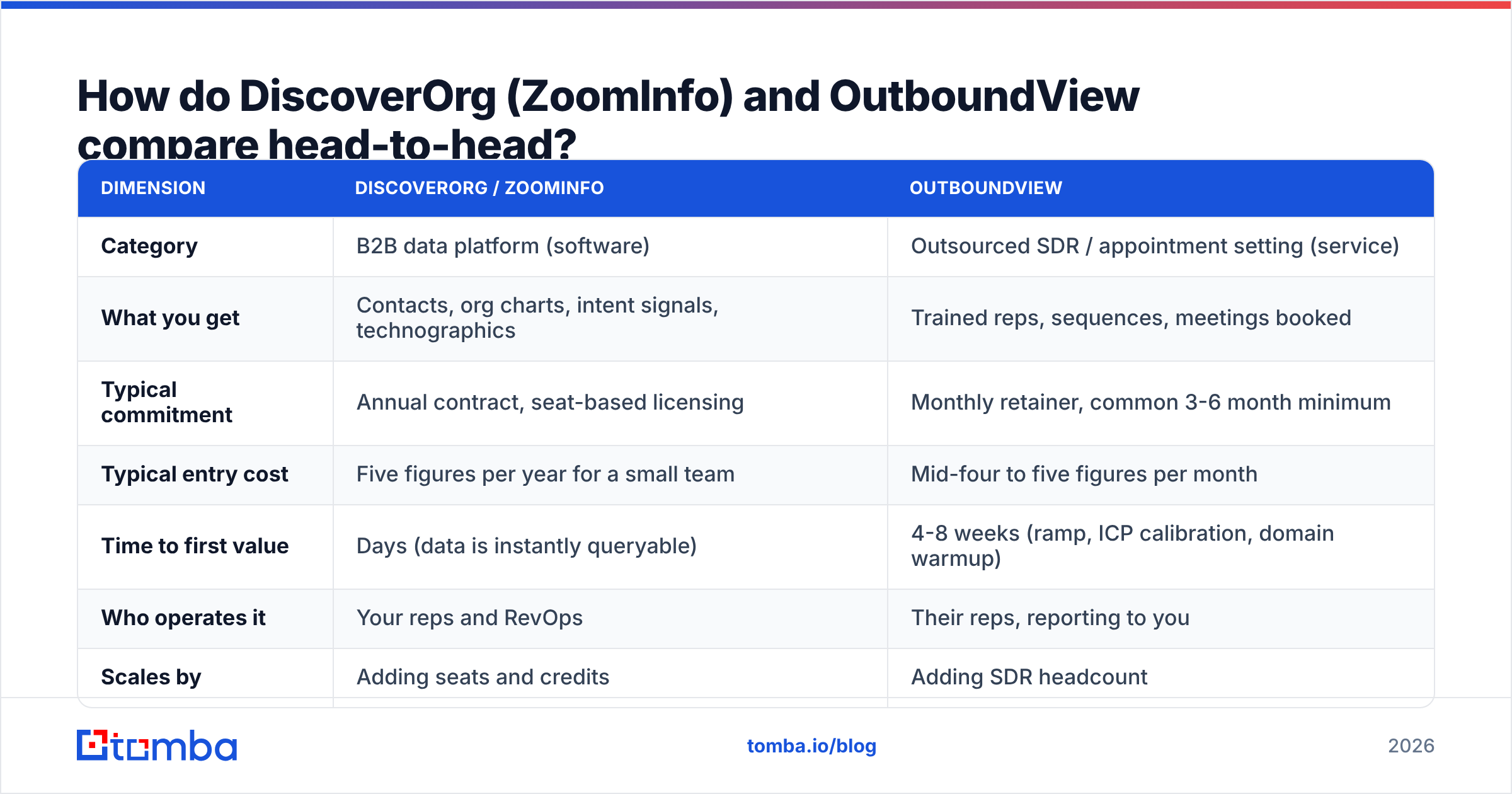
| Dimension | DiscoverOrg / ZoomInfo | OutboundView |
|---|---|---|
| Category | B2B data platform (software) | Outsourced SDR / appointment setting (service) |
| What you get | Contacts, org charts, intent signals, technographics | Trained reps, sequences, meetings booked |
| Typical commitment | Annual contract, seat-based licensing | Monthly retainer, common 3-6 month minimum |
| Typical entry cost | Five figures per year for a small team | Mid-four to five figures per month |
| Time to first value | Days (data is instantly queryable) | 4-8 weeks (ramp, ICP calibration, domain warmup) |
| Who operates it | Your reps and RevOps | Their reps, reporting to you |
| Scales by | Adding seats and credits | Adding SDR headcount |
| Biggest risk | Paying for seats nobody logs into | Meetings booked that never convert to pipeline |
| Data ownership | You keep exported records | Depends on contract — clarify before signing |
| Best fit | 10+ rep sales orgs with RevOps support | Post-PMF companies with no outbound team |
The table makes the trade clear. DiscoverOrg gives you leverage, but it assumes you have people. OutboundView gives you people, but you rent their judgment about your market.
DiscoverOrg vs OutboundView: what does each one cost in 2026?#
Neither company posts prices. That alone tells you something about the buying process. Both run on sales calls and custom quotes. Below is what buyers report on sites like G2 and in procurement forums. Treat them as ranges to negotiate against, not list prices.
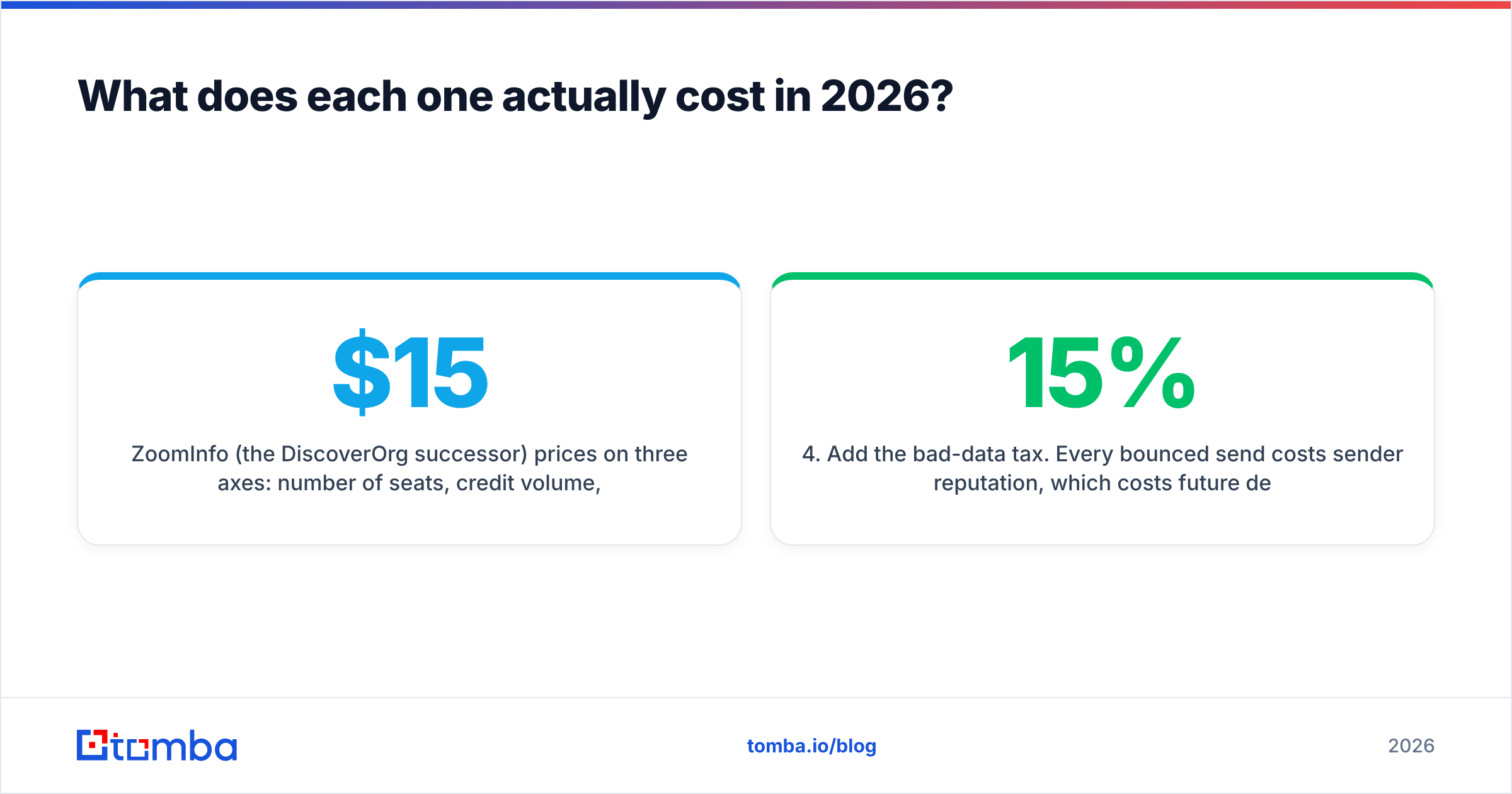
ZoomInfo (the DiscoverOrg successor) prices on three things: seats, credits, and the data modules you turn on (intent, scoops, technographics, WebSights). Small teams often report $15,000-$40,000 a year. Deals with intent data and CRM sync run much higher. Overage fees and auto-renewal are the common gripes. Read the renewal terms line by line.
OutboundView prices per program. An outsourced SDR deal is quoted as a monthly retainer. It scales with the number of dedicated reps, plus setup for tools and list building. Agency pricing here tends to run a few thousand dollars per month, per rep. Some plans add a bonus tied to meetings booked.
Now the part no sales deck shows. Your real cost is not the invoice. Add ramp time. Add the manager who runs the relationship. Add CRM cleanup after bad records land. Add the cost of a 12-month lock on a motion you have not proven yet.
Run the pipeline math before you sign:
- Count your target accounts. A market of 3,000 accounts does not need a database built for 100M records.
- Estimate contacts per month. Reps working 40 accounts a week at 3 contacts each need about 500 verified contacts. Not 50,000.
- Find your cost per booked meeting. Agency: retainer ÷ meetings. Platform: cost ÷ meetings your own reps book with that data.
- Add the bad-data tax. Bounces hurt your sender score, which hurts delivery, which costs meetings. A 15% bounce rate on 2,000 sends wastes 300 emails.
- Set a kill date. Decide now what month four must look like to earn a renewal. Contracts with no exit rule renew by habit.
DiscoverOrg vs OutboundView: which one has better data quality?#
They fail in different ways, so ask a different question of each.
DiscoverOrg's old edge was human checking. You still see it in ZoomInfo's org charts for mid-market and enterprise tech. It is genuinely strong there. It gets weaker on SMBs, on non-US regions, and on any company under about 50 staff. Job changes are the shared enemy. B2B contact data decays about 2-3% a month. Any snapshot is stale within a quarter, no matter how it was built. That is not a dig at one vendor. It is physics.
OutboundView does not sell data quality. It sells outcomes. Still, the data behind its campaigns comes from tools it picks, and quality shifts by engagement. Ask three things in the sales call: which data sources do you use, what bounce rate do you aim for, and who owns the list when the contract ends? If a vendor cannot answer the bounce-rate question fast, do not sign.
Either way, the control you need is a check at send time, not at buy time. Run every address through an email verifier before it enters a sequence. That catches decay no refresh cycle will. Add a catch-all verifier for domains that accept every address. Then your email deliverability no longer rides on who sold you the list.
Who should choose DiscoverOrg (ZoomInfo)?#
Pick the platform when these are true:
- You have 10+ reps who will log in every week. Per-seat pricing punishes idle seats.
- You sell to mid-market or enterprise tech, where org charts and buying committees matter more than raw volume.
- You have a RevOps or sales ops owner to run CRM sync, dedupe rules, and credits. Without one, you own a very costly lookup tool.
- Intent data would change what reps do first. If they would truly reorder their day on a surge signal, pay for it. If not, skip it.
- You need enrichment inside Salesforce or HubSpot in the background, not by hand.
Who should choose OutboundView?#
Pick the agency when these are true:
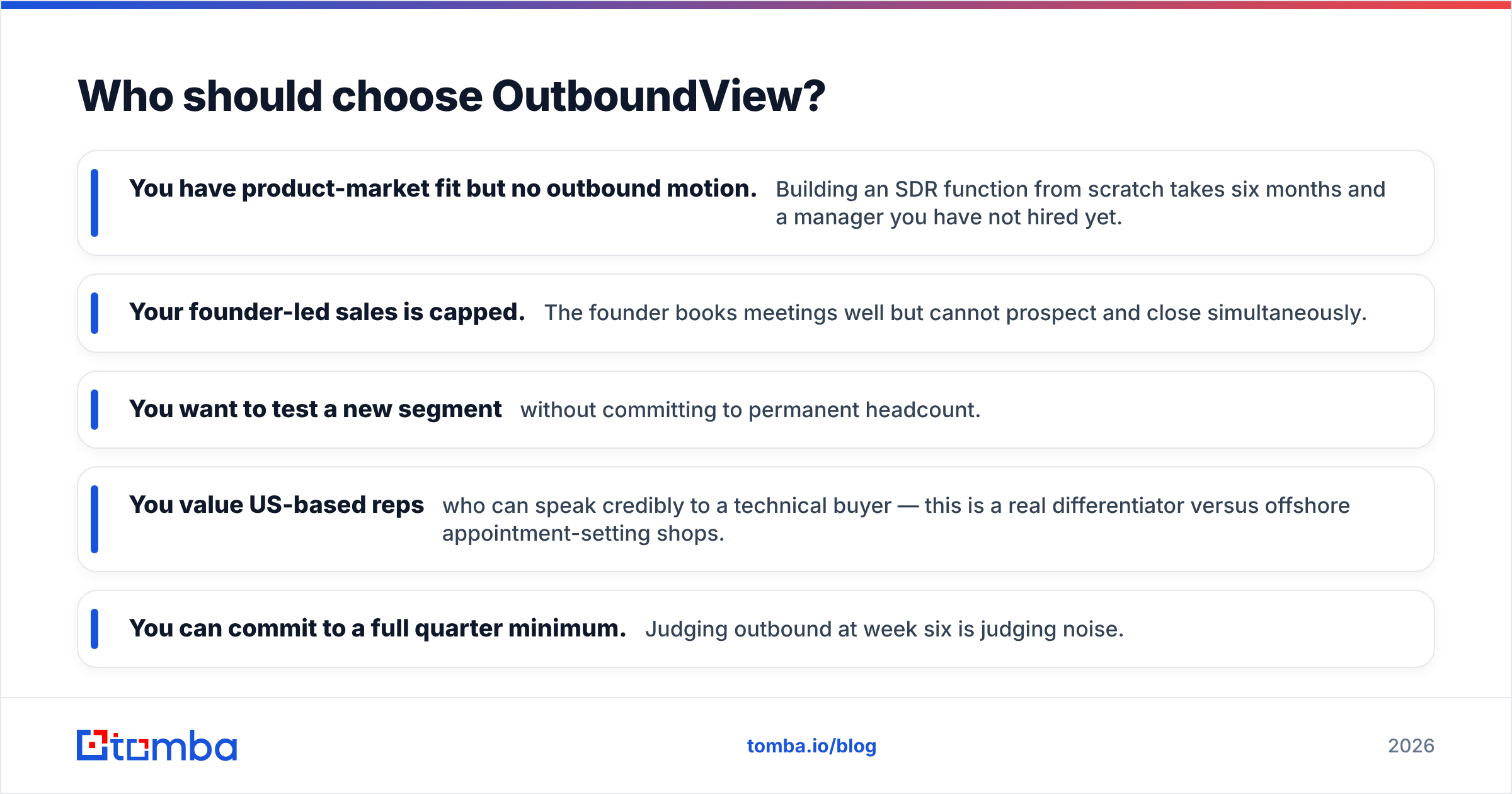
- You have product-market fit but no outbound motion. Building an SDR team from zero takes six months and a manager you have not hired.
- Founder-led sales has hit its ceiling. The founder books meetings well, but cannot prospect and close at once.
- You want to test a new segment without hiring for good.
- You want US-based reps who can hold a real talk with a technical buyer. That is a true edge over offshore setters.
- You can commit to a full quarter. Judging outbound at week six is judging noise.
Agencies fail the same way every time. A company with a weak offer hires one to fix demand. It never works. Outbound amplifies a message that already lands. It cannot create one.
DiscoverOrg vs OutboundView: is there a middle path?#
Yes. Most companies under 50 staff belong there.
The DiscoverOrg vs OutboundView debate assumes you must buy a whole system. You usually do not. Most teams need something smaller: a verified list of the right people at the right accounts, dropped into the sequencer they already use. Priced by what they use, not by who they hire.
That stack looks like this:
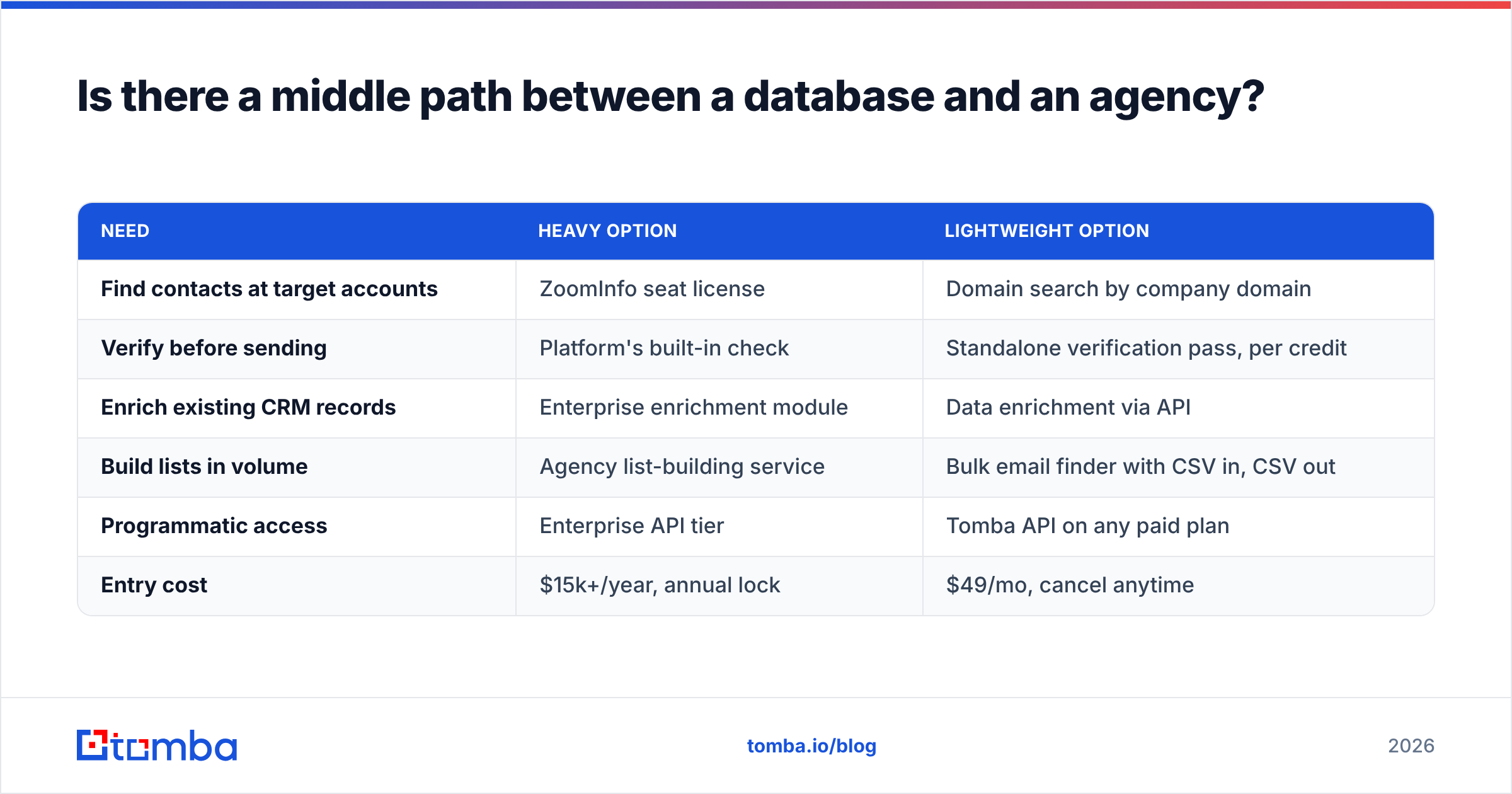
| Need | Heavy option | Lightweight option |
|---|---|---|
| Find contacts at target accounts | ZoomInfo seat license | Domain search by company domain |
| Verify before sending | Platform's built-in check | Standalone verification pass, per credit |
| Enrich existing CRM records | Enterprise enrichment module | Data enrichment via API |
| Build lists in volume | Agency list-building service | Bulk email finder with CSV in, CSV out |
| Programmatic access | Enterprise API tier | Tomba API on any paid plan |
| Entry cost | $15k+/year, annual lock | $49/mo, cancel anytime |
Tomba is clear about what it is. It finds and verifies work email addresses. Around that it adds domain search, catch-all checks, phone lookup, and enrichment. It does not sell intent data. It does not build org charts. It does not staff SDRs. If you need those, buy the platform or the agency. That is the right call.
But say your need is "500 verified contacts a month at accounts I already picked." Then the Tomba pricing ladder covers it with no procurement cycle: a free tier at 25 searches, Starter at $49/mo, Growth at $99/mo, Pro at $249/mo. BookYourData sits in a similar honest middle on the prebuilt-list side. It is a good pick if you would rather buy a filtered list than run searches yourself.
What do buyers actually complain about?#
Platform contracts draw the same three gripes: surprise auto-renewals, seat counts that outgrew real use, and thin coverage outside North American mid-market. None of this is secret. It sits in plain sight on review sites. Ask for a usage true-up clause and a 60-day renewal notice. Most of the pain goes away.
Outsourced SDR programs draw a different set. Buyers question credit for results and the quality of booked meetings. A chat with a curious junior analyst counts on the agency dashboard and does nothing for your pipeline. Fix that in the contract. Define a qualified meeting in writing, with a seniority bar and a stated problem, before the first campaign runs. Track response rate and meeting-to-opportunity rate on their own, and review both monthly.
The lesson spans both. The vendor is rarely the problem. Vague success criteria are.
DiscoverOrg vs OutboundView: how do you decide this week?#
Answer three questions honestly.
Do you have reps who will use a database daily? If not, the platform is five-figure shelfware.
Do you have an offer that converts once it reaches the right person? If not, an agency will burn a quarter proving it.
Is your real block contact data or contact volume? If it is data quality on accounts you already picked, neither vendor is the efficient answer. A per-credit finder plus verification is.
Run a 30-day test before you sign anything annual. Pull 200 target accounts. Find and verify contacts. Send a real sequence. Measure reply rate and bounce rate. That test costs under $100 and teaches you more than any demo. If replies are healthy and you simply cannot scale sending, hire the agency. If replies are flat, no data or headcount will save the message. Fix the offer first.
Ready to run that test? Start with the Tomba Email Finder. Search by domain, name, or company. Verify every result before it hits your sequencer. Then read real reply data on your own accounts. The free tier gives you 25 searches. Starter is $49/mo if you want to run the full 200-account test this week. No annual contract. No procurement call. No ramp.
Related guides#
// get started
Find, verify and enrich your first contacts today
Start on the free plan with 25 searches a month, then scale when your team is ready.
Free plan · No credit card required · GDPR & CCPA
// about the author