LimeLeads vs ZoomInfo (2026): Pricing, Data Depth, and Our Pick
LimeLeads starts at $99/month with no contract. ZoomInfo starts near $15,000/year with a three-seat minimum. Here's what each price gets you, where each tool falls short, and which one suits your team.
TL;DR
- LimeLeads is a self-serve B2B contact database. Paid plans run from $99 to $400 a month, credits roll over, you can pay monthly, and emails are verified when you unlock a contact. It suits small teams and agencies whose volume goes up and down.
- ZoomInfo is an enterprise go-to-market platform. It adds intent data, org charts, direct dials, website visitor tracking, and CRM enrichment on top of its contact data. Contracts usually start around $15,000 a year with a three-seat minimum.
- Choose LimeLeads if you need affordable, verified contact lists this month. Choose ZoomInfo if you run a funded sales team that will actually use intent signals and deep enrichment.
- Neither one is cheap per contact for simple email lookups. If you already know which accounts you want, a dedicated email finder costs much less.
What is the real difference between LimeLeads and ZoomInfo?#
The short answer is that LimeLeads sells contacts and ZoomInfo sells a platform.
LimeLeads is a B2B lead database. You filter by industry, company size, job title, and location, unlock the contacts you want, and export them. When you unlock a contact, its email is checked in real time, so the list you download should already be clean. There's no onboarding call and no annual commitment. You get a search bar, filters, and a credit balance.
ZoomInfo goes much further. The contact database is only the base. On top of it sit buyer intent signals, company org charts, technographics, website visitor identification, a sales engagement layer, conversation intelligence, AI account research, and continuous CRM enrichment. You don't buy it for a list. You buy it so your whole revenue team works from one data layer.
So comparing them feature by feature is a bit like comparing a well-stocked hardware store with a general contractor. Both can get your deck built, but one hands you lumber and the other hands you a project plan and an invoice.
How do LimeLeads and ZoomInfo compare side by side?#
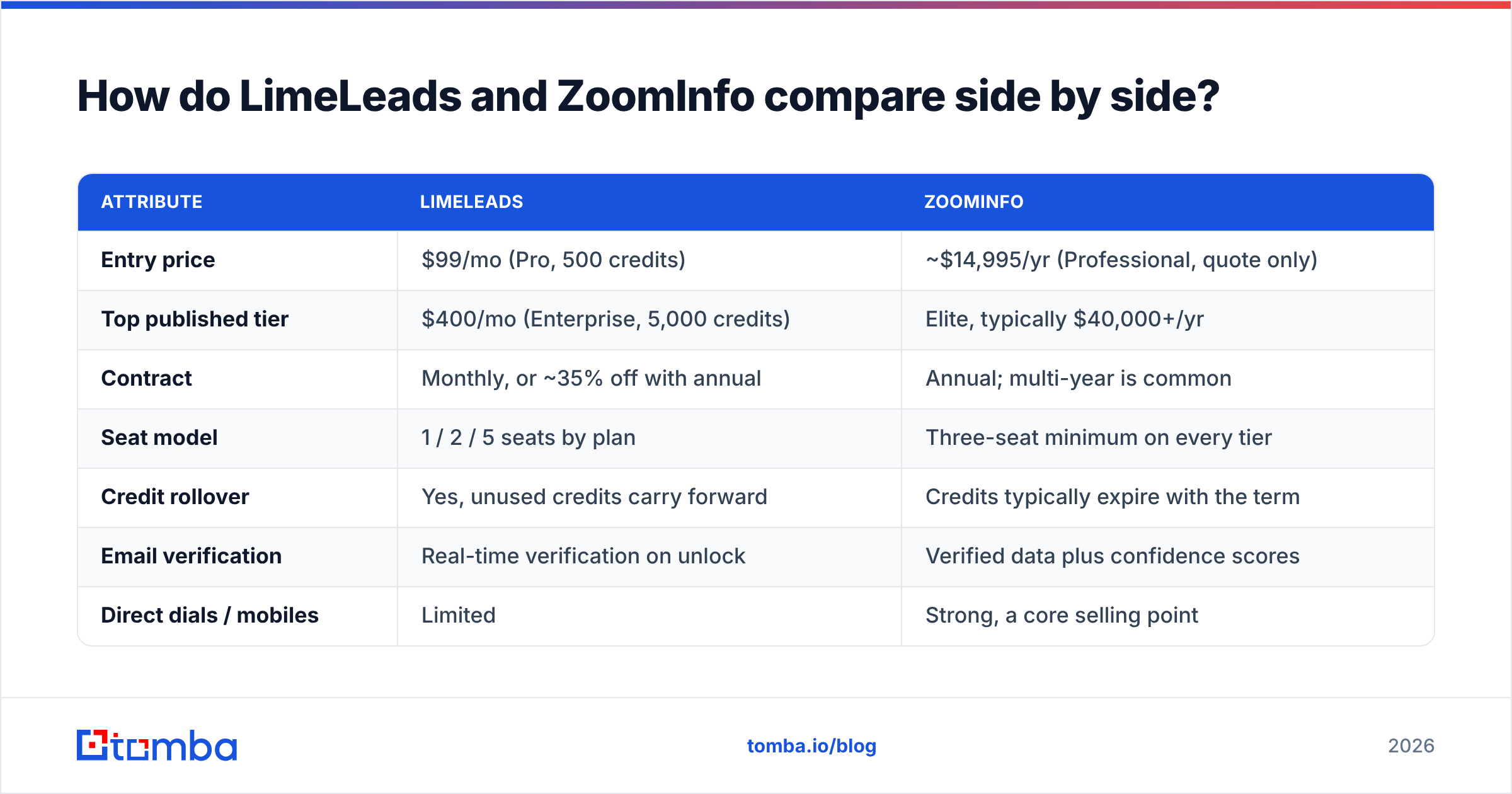
Here's how the two stack up on the attributes that usually decide a purchase.
| Attribute | LimeLeads | ZoomInfo |
|---|---|---|
| Entry price | $99/mo (Pro, 500 credits) | ~$14,995/yr (Professional, quote only) |
| Top published tier | $400/mo (Enterprise, 5,000 credits) | Elite, typically $40,000+/yr |
| Contract | Monthly, or ~35% off with annual | Annual; multi-year is common |
| Seat model | 1 / 2 / 5 seats by plan | Three-seat minimum on every tier |
| Credit rollover | Yes, unused credits carry forward | Credits typically expire with the term |
| Email verification | Real-time verification on unlock | Verified data plus confidence scores |
| Direct dials / mobiles | Limited | Strong, a core selling point |
| Intent data | No | Yes (Advanced and above) |
| Org charts and technographics | Basic firmographics | Deep |
| CRM integration | CSV export, basic integrations | Native Salesforce, HubSpot, Dynamics enrichment |
| Best fit | Freelancers, agencies, SMB outbound | Mid-market and enterprise sales orgs |
ZoomInfo doesn't publish list prices. The figures above come from third-party contract data and buyer reports, and negotiated deals often close 15–35% below the first quote. LimeLeads pricing and seat caps are as published at the time of writing. Check the LimeLeads listing on Capterra or its pricing page before you commit, because small vendors change tiers often.
How much do LimeLeads and ZoomInfo actually cost per contact?#
Look past the headline prices and work out the cost of each usable contact.
LimeLeads:
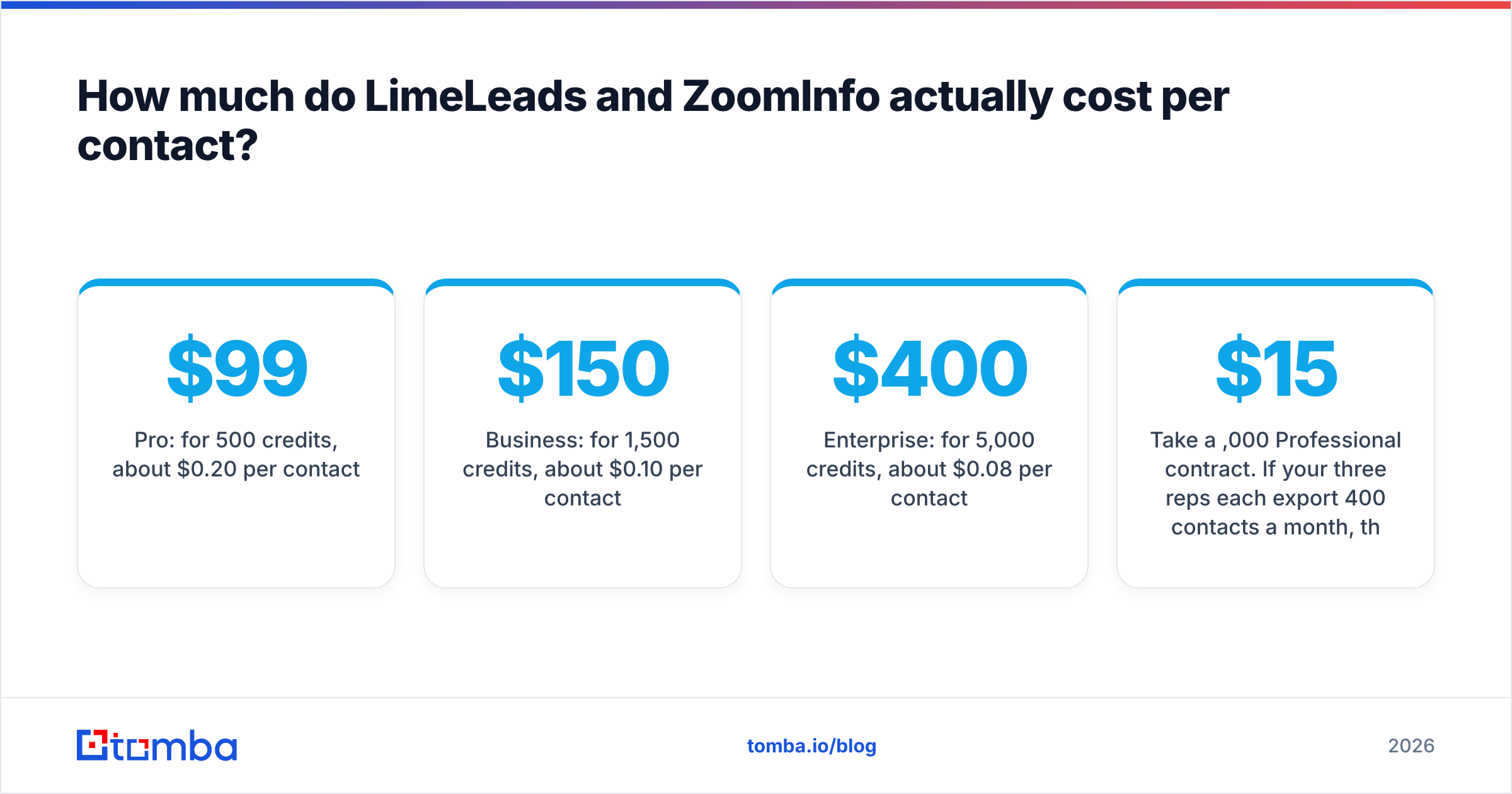
- Pro: $99 for 500 credits, about $0.20 per contact
- Business: $150 for 1,500 credits, about $0.10 per contact
- Enterprise: $400 for 5,000 credits, about $0.08 per contact
With annual billing those numbers drop by roughly a third. Credits roll over, so a quiet month doesn't cost you anything. That matters if you're an agency running campaigns for clients whose timing you don't control.
ZoomInfo: Take a $15,000 Professional contract. If your three reps each export 400 contacts a month, that's 14,400 contacts a year, or just over $1 per contact before any unused credits expire. On a $33,000 mid-tier deal, which is roughly the median reported by third-party procurement data, the per-contact math only works if you're using intent data, enrichment, and the other workflow tools. Otherwise you're paying enterprise prices for a CSV.
That's the core tradeoff. ZoomInfo's price only makes sense if you use the whole platform. LimeLeads' price makes sense on the first day.

Which has better data quality, LimeLeads or ZoomInfo?#
It depends on what you mean by quality. Here are the dimensions that matter.
- Email validity at export. LimeLeads checks each email when you unlock it, so bounce risk at download time is low. ZoomInfo also verifies emails and shows confidence scores, but a record can go stale between its last refresh and your export. For a pure "will this email bounce today" test, the two are close, and LimeLeads' check at the moment of unlock is a real advantage.
- Coverage breadth. ZoomInfo's database is much larger, especially for enterprise accounts, deep org charts, and roles below director level. LimeLeads' coverage leans toward North American SMB and mid-market companies. If you sell into Fortune 500 buying committees, ZoomInfo will find people LimeLeads doesn't have.
- Phone data. ZoomInfo's direct dials and mobile numbers are one of the main reasons teams pay for it. LimeLeads is mainly an email tool. If your motion depends on cold calling, this point alone may decide it.
- Freshness and enrichment. ZoomInfo keeps enriching records inside your CRM, updating job changes and firmographics automatically. LimeLeads gives you a snapshot. Once it's exported, keeping it current is your job.
- International data. Both are weaker outside the US than inside it. ZoomInfo has more EMEA and APAC coverage but is still uneven. Test your own target market in a trial before you trust either one.
Whichever you choose, run exported lists through an email verifier before a large send. Verification at export time protects you on day one, not on day 45 when the campaign finally goes out.
What does ZoomInfo do that LimeLeads can't?#
A few things only ZoomInfo offers, and they matter for teams that use them:
- Intent data. ZoomInfo flags accounts researching topics related to what you sell. For account-based teams, this changes who reps call on Monday morning.
- Website visitor identification. It shows which companies are browsing your pricing page, which ties marketing and sales together.
- CRM hygiene at scale. Automatic enrichment and deduplication in Salesforce or HubSpot saves RevOps teams dozens of hours a month.
- Org charts and buying committees. You can map every stakeholder at a target account, not just the one title you searched for.
- Workflow tooling. Engagement sequences, conversation intelligence, and AI account research in the same tool as the data.
If your team would genuinely use three or more of these, ZoomInfo is probably worth its price. If you'd use one of them, you're paying for a platform to get a feature.
What does LimeLeads do better than ZoomInfo?#
LimeLeads wins on everything related to how easy it is to buy:
- No sales call. You sign up, pay, and start searching the same day. ZoomInfo's buying process involves demos, quotes, and negotiation.
- Monthly billing. You can pause when the pipeline is full and pick up again when it isn't.
- Rollover credits. What you pay for stays yours.
- Predictable cost per contact. You can calculate your list cost in advance, which agencies need when quoting clients.
- Simplicity. New hires can use it in ten minutes. ZoomInfo's depth comes with a learning curve, and many companies use only a fraction of what they pay for.
Buyer reviews on sites like G2 and Capterra follow the same pattern. LimeLeads reviewers praise the price and ease of use. ZoomInfo reviewers praise data depth and complain about contract terms and renewal increases.
Is ZoomInfo worth it over LimeLeads for a small team?#
Usually not. A team of one to five people doing outbound almost never gets full value from an annual contract with a three-seat minimum. The hidden cost isn't only the invoice. It's the renewal clauses, auto-renew notice periods, and the internal pressure to "use the credits" even when the leads aren't a good fit.
ZoomInfo starts to make sense once these conditions are true:
- You have a dedicated SDR team of five or more
- You sell to mid-market or enterprise buying committees
- Someone owns RevOps and will set up enrichment and intent workflows
- Phone outreach is a primary channel
- You have the budget to spend $25,000 or more a year without hurting other tools
If you meet two or fewer of these, start with LimeLeads or a lighter-weight tool and move up later.

Are there cheaper alternatives to both?#
Yes, and which one fits depends on where you are in the process.
LimeLeads and ZoomInfo are both built for discovery: finding companies and people you don't know yet. Many teams already know which accounts they want, from a target account list, a conference attendee sheet, or inbound signups. In that case you're paying for database search you don't need.
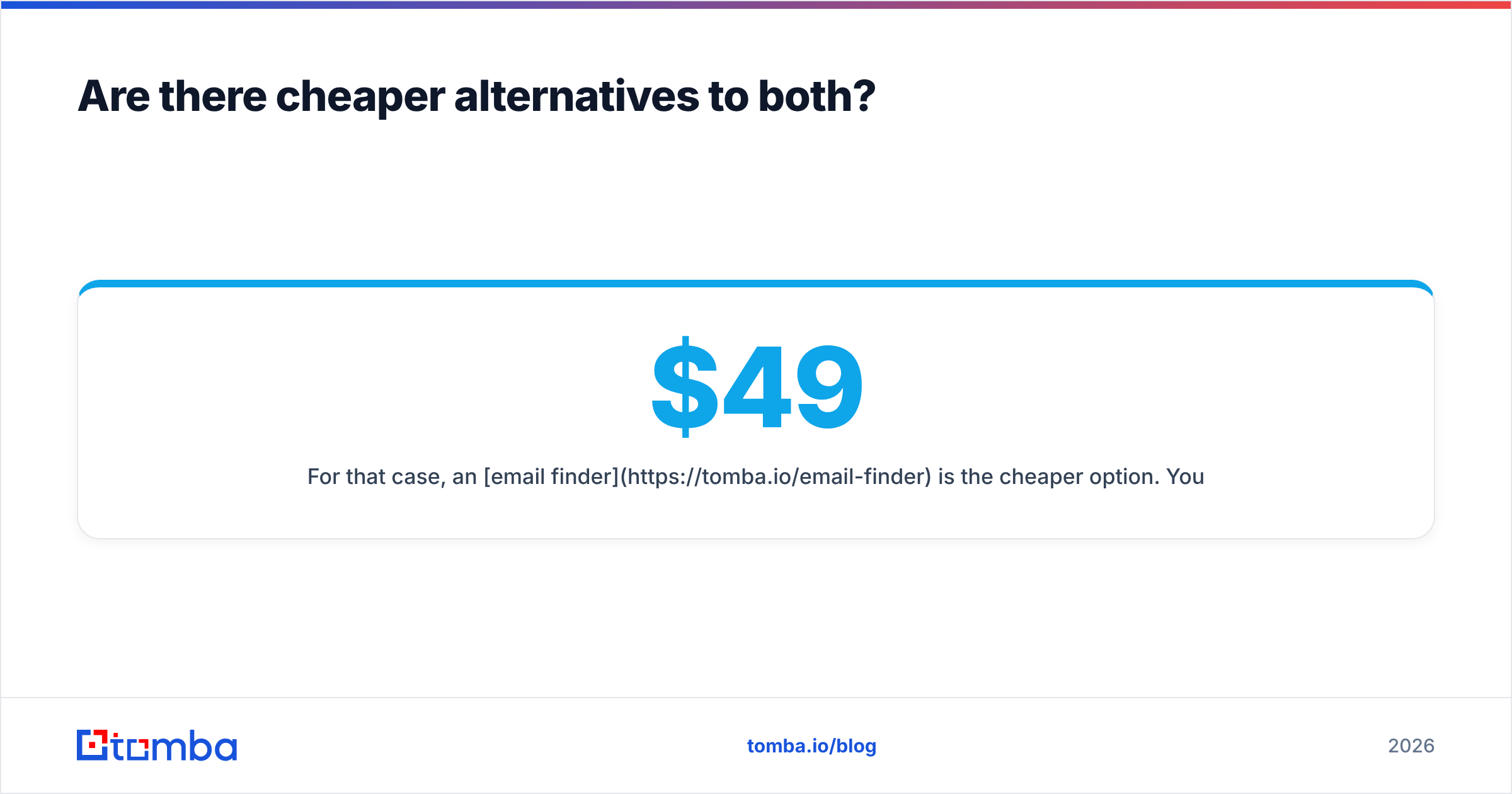
For that case, an email finder is the cheaper option. You enter a name and a company domain and get a verified professional email back. Tomba's pricing starts with a free tier of 25 searches a month, then $49/mo for Starter, $99/mo for Growth, and $249/mo for Pro, with Enterprise on custom terms. You can combine it with domain search, data enrichment, and verification without signing an annual contract.
Other options worth a look depending on your needs:
- Apollo.io if you want a database plus sequencing in one place at a mid-range price (see our Apollo alternative breakdown)
- Lusha or Cognism if phone data is the priority but ZoomInfo is out of budget
- Clay-style enrichment workflows if you have technical ops people and want to combine several data sources
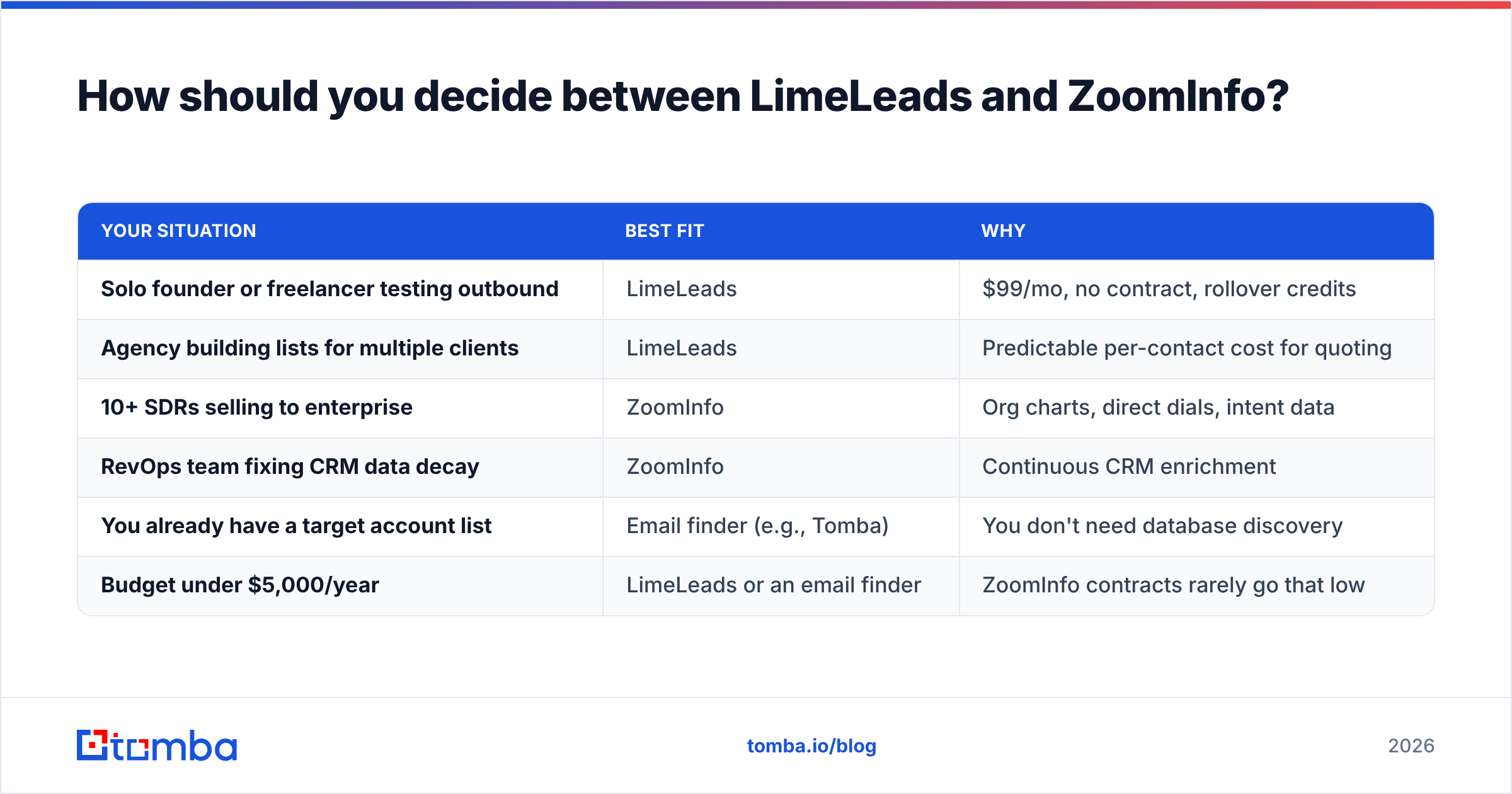
How should you decide between LimeLeads and ZoomInfo?#
Use this quick decision guide:
| Your situation | Best fit | Why |
|---|---|---|
| Solo founder or freelancer testing outbound | LimeLeads | $99/mo, no contract, rollover credits |
| Agency building lists for multiple clients | LimeLeads | Predictable per-contact cost for quoting |
| 10+ SDRs selling to enterprise | ZoomInfo | Org charts, direct dials, intent data |
| RevOps team fixing CRM data decay | ZoomInfo | Continuous CRM enrichment |
| You already have a target account list | Email finder (e.g., Tomba) | You don't need database discovery |
| Budget under $5,000/year | LimeLeads or an email finder | ZoomInfo contracts rarely go that low |
Before signing either, run the same test on both:
- Pull 100 contacts from your real ideal customer profile (ICP), not the vendor's demo filters.
- Verify every email independently.
- Check 20 contacts by hand against LinkedIn for title accuracy.
- Count how many are actually in your target market.
The tool with the most usable contacts for your cost wins, whatever the feature list says.
What's the final verdict on LimeLeads vs ZoomInfo?#
These two tools aren't really competing for the same buyer.
LimeLeads is the better choice for most small teams, agencies, and early-stage companies. It's cheap enough to start today, flexible enough to pause, and verified enough to protect your sender reputation. You give up phone depth and intent signals.
ZoomInfo is the better choice for established sales organizations that will put its whole feature set to work: intent data, enrichment, org charts, and dialer-ready phone numbers. You give up flexibility and a lot of money.
If your actual problem is "I know who I want to reach, I just need their email," neither one is the most efficient answer.
For that job, try the Tomba Email Finder. Enter a name and a company domain and get a verified professional email back. It starts free with 25 searches a month, paid plans begin at $49/mo, and there's no annual contract or seat minimum. Use it alone for targeted outreach, or next to LimeLeads or ZoomInfo to fill gaps their databases miss.
Related guides#
// get started
Find, verify and enrich your first contacts today
Start on the free plan with 25 searches a month, then scale when your team is ready.
Free plan · No credit card required · GDPR & CCPA
Get the Tomba newsletter
Product and data updates
// about the author