List of Sales Techniques: 15 Methods That Close Deals in 2026
Fifteen sales techniques, from SPIN and Challenger to trigger-based outbound, with notes on when each one works, when it backfires, and how to combine them into a pipeline.
TL;DR
- No single sales technique wins every deal. The reps who close most often use two or three methods and switch between them based on deal size, how aware the buyer is of the problem, and how many people are in the buying group.
- Discovery-led methods (SPIN, Gap Selling, consultative) fit complex B2B deals. Insight-led methods (Challenger, Insight Selling) fit buyers who don't yet see a problem. Process methods (MEDDIC, BANT) keep your forecast honest.
- Outbound techniques like trigger-based outreach, multithreading, and social selling fill the pipeline. Closing methods only matter once that pipeline exists.
- Most techniques fail for the same boring reason: you're talking to the wrong person, or you can't reach the right one.
- Pick one method for each stage (prospecting, discovery, qualification, closing) and don't adopt all 15 at once.
What counts as a "sales technique" in 2026?#
A sales technique is a repeatable way to move a buyer from one stage of a decision to the next. That's the whole definition. A methodology like MEDDIC or SPIN is a framework built from several techniques. A tactic, like a breakup email, is a single move you can make inside that framework.
The difference matters because the buyer has changed. Gartner's B2B buying research has pointed out for years that buyers spend only a small share of their buying journey talking to vendors. Most of the work happens in self-directed research and internal debate. So whatever technique you use has to do one of three things:
- Get you into a conversation the buyer wasn't planning to have.
- Make the time you do get with them count more than their own research would.
- Help your champion sell internally when you're not in the room.
A technique that doesn't do at least one of these is theater. Keep that filter in mind as you go through the list below.
Which sales techniques should be on your list?#
Here are the 15 techniques that matter most for B2B teams today, grouped by the stage of the deal where they do the most work.
Prospecting and pipeline techniques#
1. Trigger-based outreach. You contact accounts right after something changes: a funding round, a new VP hire, a tech-stack migration, an expansion into a new region. The trigger gives you a reason to reach out that isn't "just checking in." Reply rates run far higher than on cold, generic sequences because timing does half the persuading for you.
2. Multithreading. You open conversations with 3-5 people at the same account instead of one. Buying groups in B2B commonly include six or more stakeholders, so a single-threaded deal dies the moment your contact changes jobs or goes quiet. Multithreading only works if you can find the other people, which means you need a reliable email finder or a domain-level contact search in your stack.
3. Social selling. You build credibility on LinkedIn before the ask: comment on prospects' posts, share useful points of view, and use connection requests as a soft first touch. It's slow, but it compounds. For a deeper breakdown, see Tomba's glossary entry on social selling.
4. Referral and warm-intro selling. You ask current customers, investors, or mutual connections to introduce you. The conversion rate beats everything else on this list, but the volume is low, so treat it as a multiplier, not a pipeline strategy.
5. Account-based selling. Sales and marketing pick a short list of high-fit accounts and coordinate personalized outreach, ads, and content toward each one. It works well for large contracts and wastes money when deals are small.
Discovery techniques#
6. SPIN Selling. Neil Rackham's framework, built on research into thousands of sales calls, structures discovery into Situation, Problem, Implication, and Need-payoff questions. The Implication questions do the heavy lifting because they get the buyer to say out loud what the problem costs. The SPIN selling summary on Wikipedia covers the origins well.
7. Gap Selling. You map the buyer's current state, their desired future state, and the gap between the two. The size of that gap is your deal size. It's blunt and practical, and it keeps reps from pitching features nobody asked for.
8. Consultative selling. You act as an advisor who diagnoses before prescribing. That sounds obvious, but most reps still pitch in the first ten minutes. Consultative selling works best when your product is configurable and the right setup depends on the buyer's situation.
9. Solution selling. You sell the outcome, not the product, and build the pitch around a specific pain the buyer admits to. It's an older framework, and many modern methods borrow from it. See the solution selling overview for its history.
Insight and persuasion techniques#
10. The Challenger Sale. You teach the buyer something new about their business, tailor it to each stakeholder, and take control of the conversation, including pushing back on their assumptions. It works well with buyers who think they already have the answer. It backfires when a junior rep tries to "challenge" a VP without real insight to back it up.
11. Insight selling. This is a lighter version of Challenger. You open with a data point or pattern the buyer hasn't considered, then connect it to their situation. A good benchmark, an industry trend, or an anonymized peer comparison usually does the job.
12. Storytelling and customer proof. You replace claims with stories about a similar company that had the same problem and got a measurable result. Stories travel inside the buying committee in a way feature lists never do.
Qualification and closing techniques#
13. MEDDIC / MEDDPICC. This is a qualification framework: Metrics, Economic buyer, Decision criteria, Decision process, Paper process, Identify pain, Champion, Competition. It doesn't sell anything by itself. It tells you which deals to stop forecasting, and your win rate usually improves as a result.
14. BANT. Budget, Authority, Need, Timeline. It's crude but fast, and it's still useful for SDR-to-AE handoffs where you need a quick yes or no before booking a full discovery call.
15. Assumptive and next-step closing. You end every call by proposing a concrete next step with a date, not by asking "any questions?" Modern closing rarely comes down to a single dramatic ask. It comes from a string of small commitments that make the final signature feel like the obvious next step.
How do these sales techniques compare side by side?#
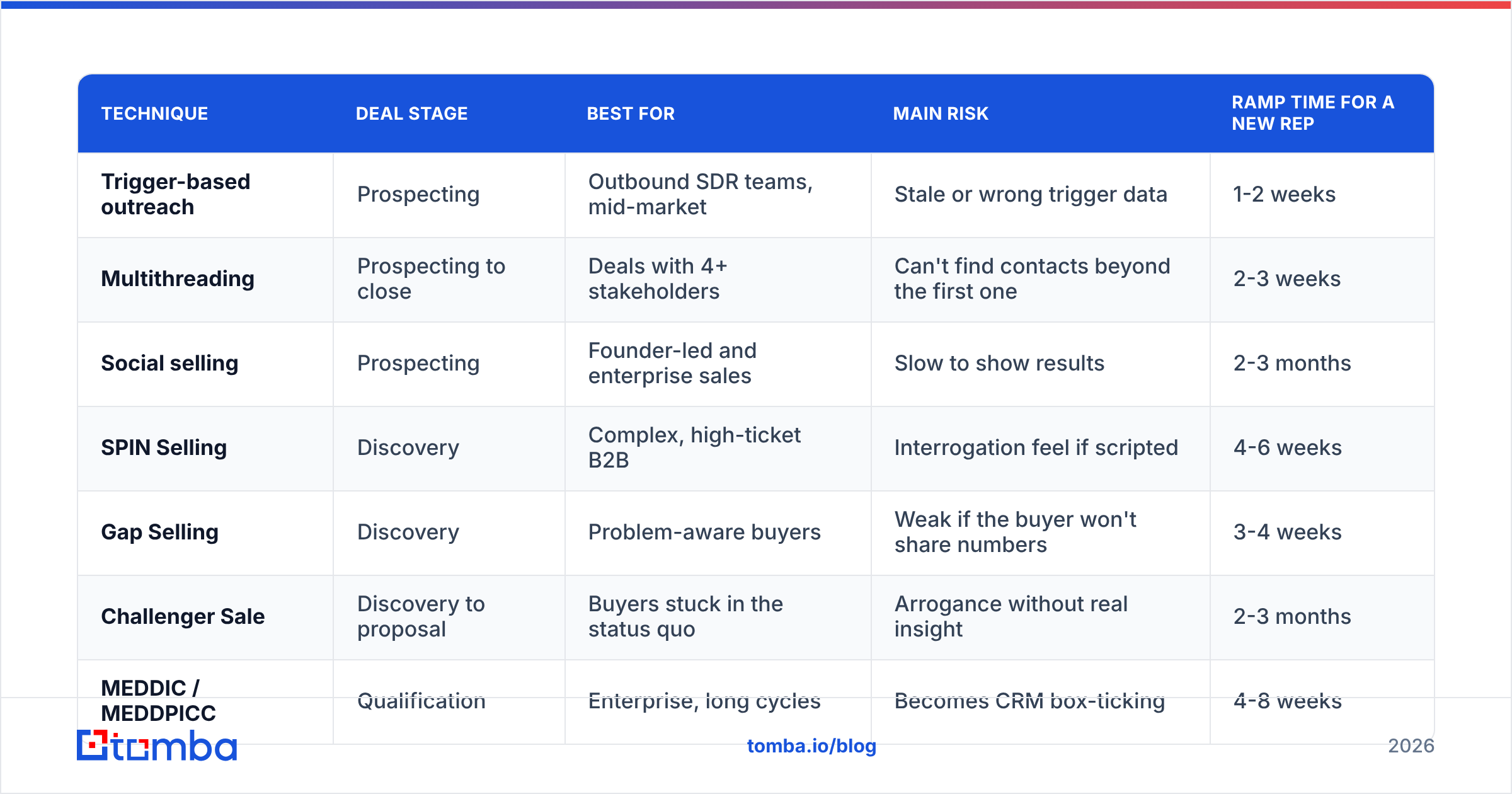
Use this table to shortlist. The "best for" column matters more than the name of the technique.
| Technique | Deal stage | Best for | Main risk | Ramp time for a new rep |
|---|---|---|---|---|
| Trigger-based outreach | Prospecting | Outbound SDR teams, mid-market | Stale or wrong trigger data | 1-2 weeks |
| Multithreading | Prospecting to close | Deals with 4+ stakeholders | Can't find contacts beyond the first one | 2-3 weeks |
| Social selling | Prospecting | Founder-led and enterprise sales | Slow to show results | 2-3 months |
| SPIN Selling | Discovery | Complex, high-ticket B2B | Interrogation feel if scripted | 4-6 weeks |
| Gap Selling | Discovery | Problem-aware buyers | Weak if the buyer won't share numbers | 3-4 weeks |
| Challenger Sale | Discovery to proposal | Buyers stuck in the status quo | Arrogance without real insight | 2-3 months |
| MEDDIC / MEDDPICC | Qualification | Enterprise, long cycles | Becomes CRM box-ticking | 4-8 weeks |
| BANT | Qualification | SMB, SDR handoffs | Disqualifies early-stage interest | 1 week |
| Next-step closing | Every call | Every deal | None worth mentioning | Days |
A few patterns stand out from the table:
- The fastest wins come from the dullest techniques. Next-step closing and BANT take days to learn and fix obvious leaks.
- The most powerful techniques take the longest to learn. Challenger and social selling take months before you see results. Budget for that.
- Two techniques depend on your data. Trigger-based outreach and multithreading are only as good as your contact and account data. If a third of your emails bounce, the technique isn't the problem.
Is one sales technique better than the others?#
No. But some pairings are clearly better than others. Here's how high-performing teams usually combine them:
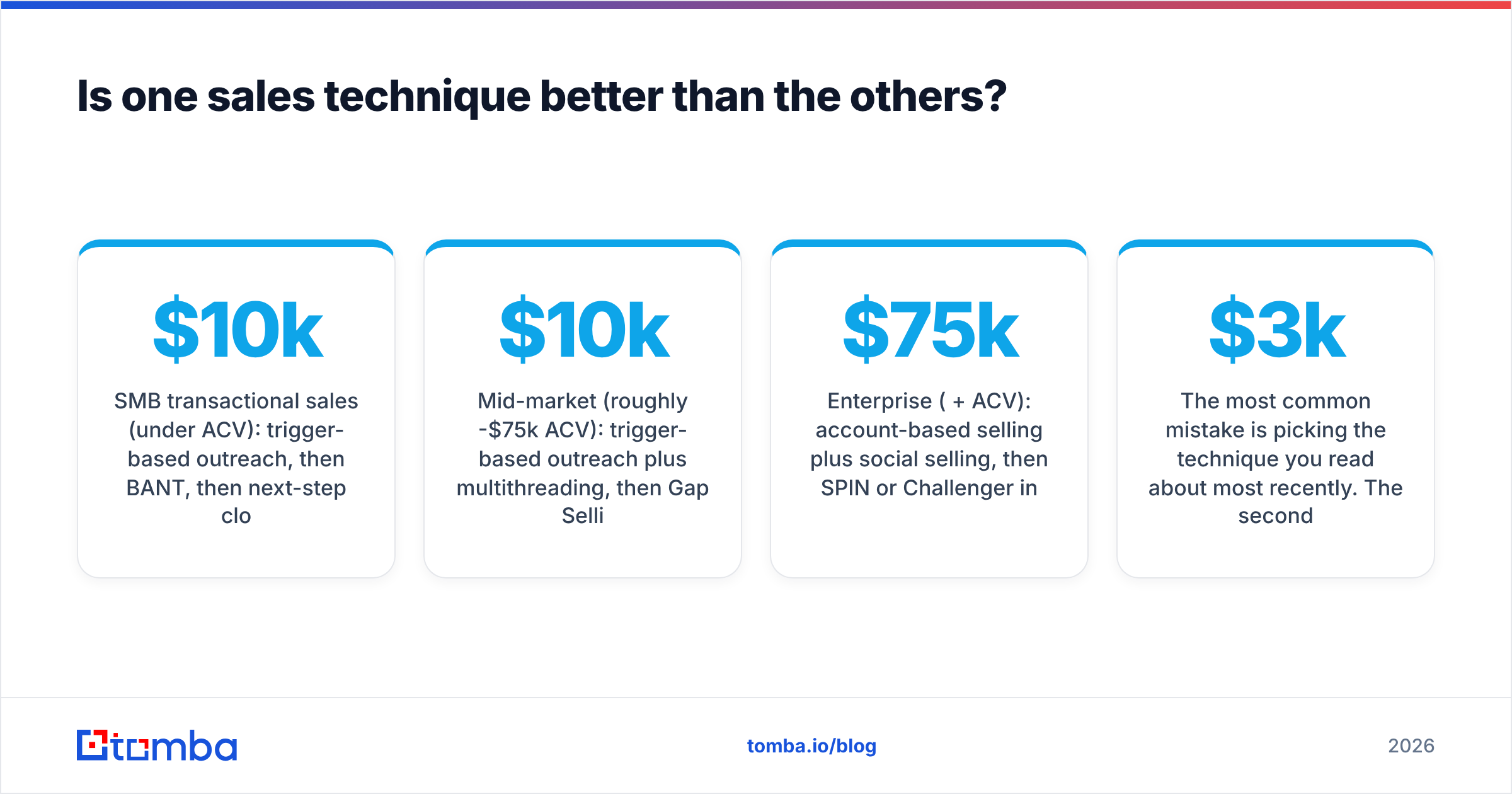
- SMB transactional sales (under $10k ACV): trigger-based outreach, then BANT, then next-step closing. Keep cycles short and don't over-engineer discovery.
- Mid-market (roughly $10k-$75k ACV): trigger-based outreach plus multithreading, then Gap Selling for discovery, then light MEDDIC for forecasting.
- Enterprise ($75k+ ACV): account-based selling plus social selling, then SPIN or Challenger in discovery, then full MEDDPICC with a named champion.
- Founder-led sales: social selling plus warm intros, then consultative discovery. Founders usually close on credibility, not technique.
The most common mistake is picking the technique you read about most recently. The second most common is using an enterprise framework like MEDDPICC on a $3k deal, where the qualification ends up taking longer than the sales cycle itself.
Why do good sales techniques still fail?#
When a proven method underperforms, the cause is almost always upstream of the technique. Watch for these four failure modes:
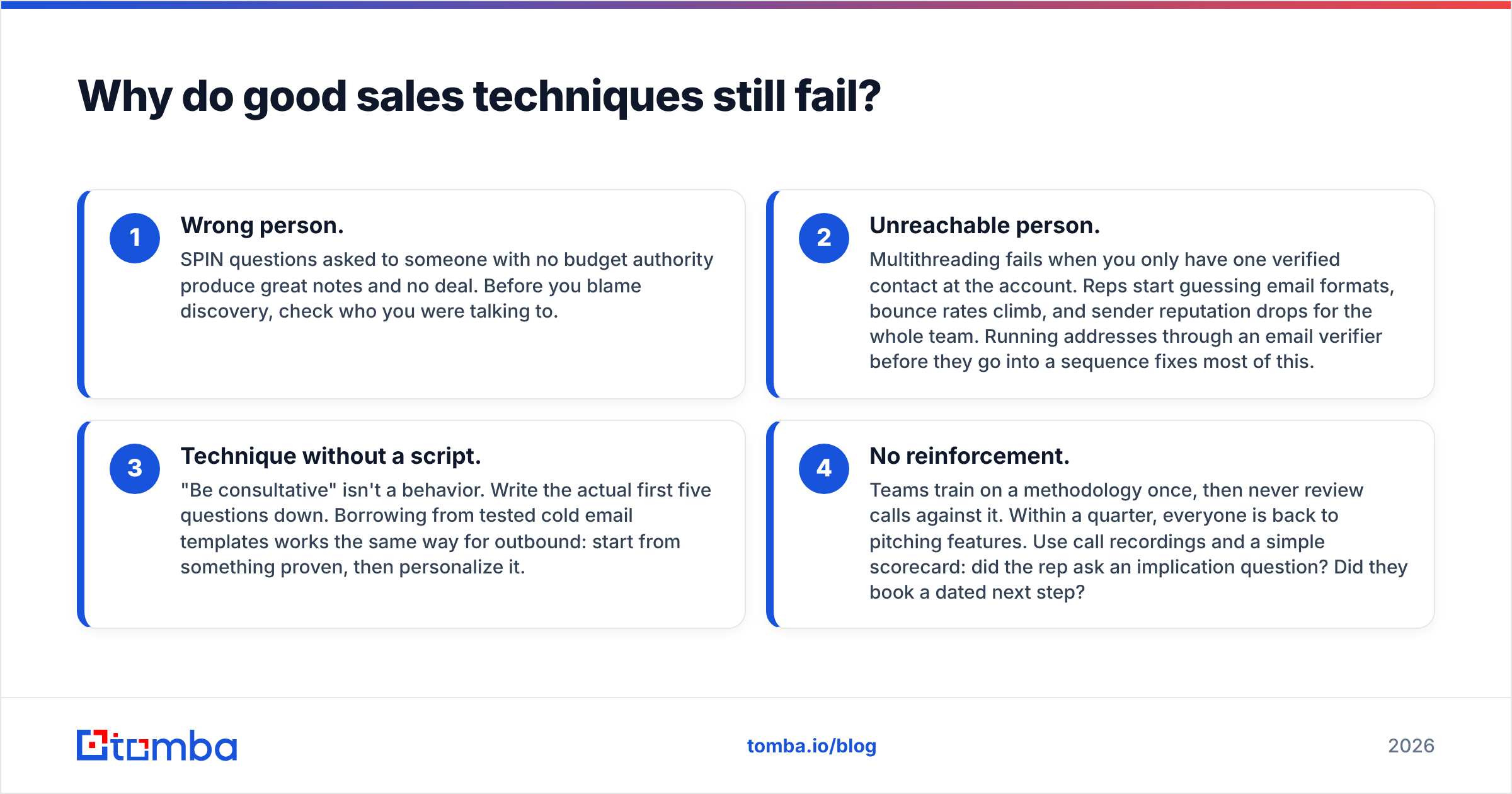
- Wrong person. SPIN questions asked to someone with no budget authority produce great notes and no deal. Before you blame discovery, check who you were talking to.
- Unreachable person. Multithreading fails when you only have one verified contact at the account. Reps start guessing email formats, bounce rates climb, and sender reputation drops for the whole team. Running addresses through an email verifier before they go into a sequence fixes most of this.
- Technique without a script. "Be consultative" isn't a behavior. Write the actual first five questions down. Borrowing from tested cold email templates works the same way for outbound: start from something proven, then personalize it.
- No reinforcement. Teams train on a methodology once, then never review calls against it. Within a quarter, everyone is back to pitching features. Use call recordings and a simple scorecard: did the rep ask an implication question? Did they book a dated next step?
How do you roll out a new sales technique without derailing your quarter?#
Treat it like a product launch, not a memo.
- Pick one stage to fix. Look at your funnel. If meetings are low, work on prospecting techniques. If meetings convert poorly to opportunities, work on discovery. If opportunities stall, work on qualification.
- Run a two-week pilot with 2-3 reps. Compare their stage conversion against the rest of the team. Keep the change small enough that you can tell it caused the lift.
- Build the artifacts. That means question banks, email templates, and a one-page cheat sheet. If you use HubSpot or Salesforce, add the framework fields to the opportunity record so managers can inspect deals against the method. HubSpot's own sales resources are a reasonable starting point for CRM-side setup.
- Inspect weekly. One call review per rep per week against the new method. Anything less and the technique fades.
- Keep what works, kill what doesn't. A technique that doesn't move a stage metric within 6-8 weeks probably doesn't fit your market. That's useful information, not a failure.
Which sales techniques work best for outbound teams specifically?#
If your pipeline is mostly outbound, three techniques on this list do most of the work: trigger-based outreach, multithreading, and next-step closing. What they have in common is that each needs you to reach specific people at specific accounts quickly.
That's where data becomes the constraint. A strong trigger (say, a newly hired Head of RevOps) is worthless if you spend 20 minutes guessing their email address. Here's a practical outbound workflow:
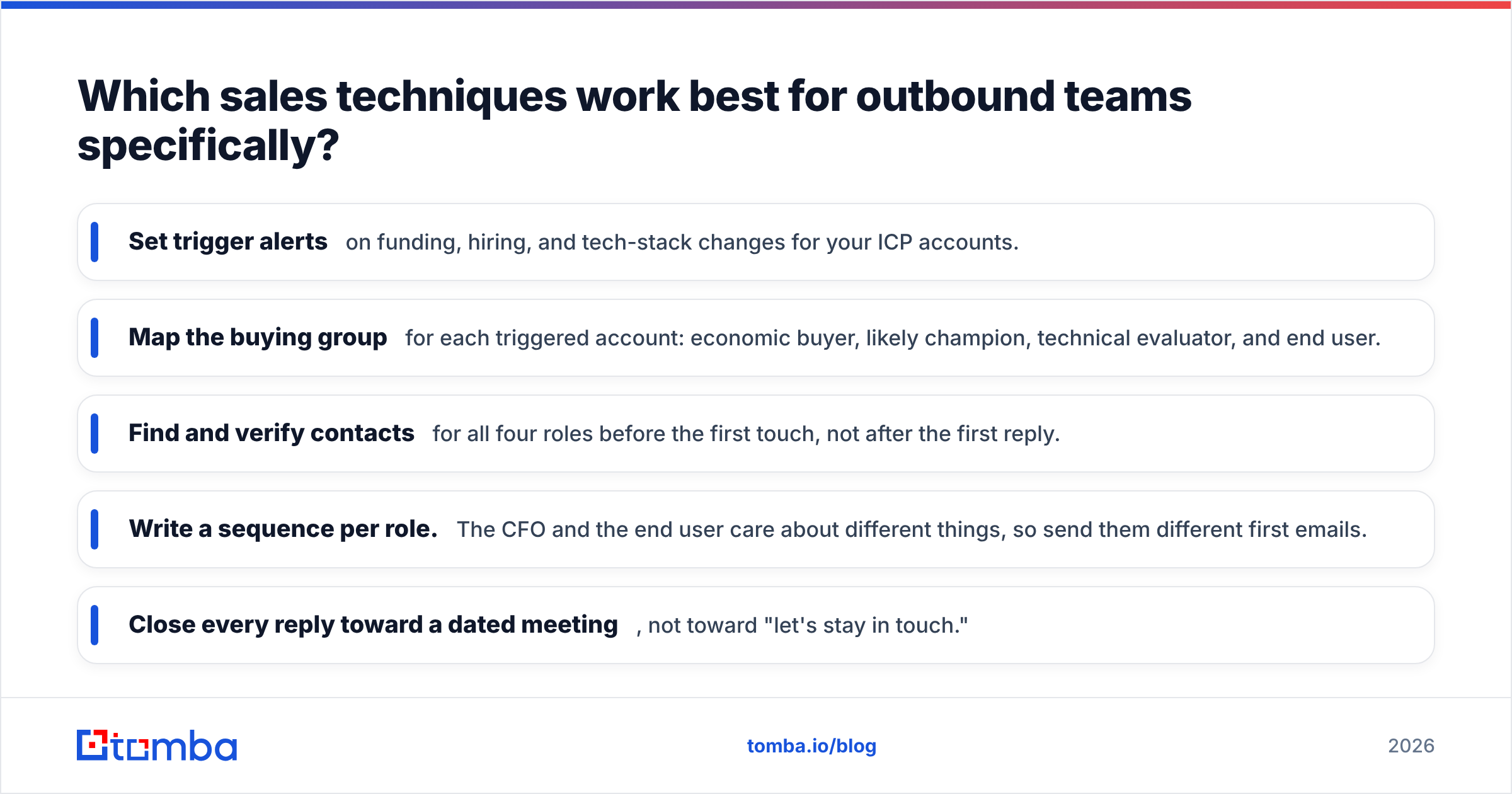
- Set trigger alerts on funding, hiring, and tech-stack changes for your ICP accounts.
- Map the buying group for each triggered account: economic buyer, likely champion, technical evaluator, and end user.
- Find and verify contacts for all four roles before the first touch, not after the first reply.
- Write a sequence per role. The CFO and the end user care about different things, so send them different first emails.
- Close every reply toward a dated meeting, not toward "let's stay in touch."
Teams that run this loop well tend to see higher reply rates and fewer single-threaded deals slipping at the end of the quarter. They didn't find a magic script. The technique is simply getting the right inputs.
Final take: how should you use this list of sales techniques?#
Don't try to master all 15. Choose one technique per stage, match it to your deal size, write down the exact behaviors, and review calls against them every week. Revisit the mix twice a year as your market and average contract value shift.
If your chosen techniques depend on reaching more stakeholders (and multithreading, trigger-based outreach, and account-based selling all do), the fastest improvement is usually better contact data rather than a new methodology. Tomba Email Finder lets you find professional email addresses by domain, name, or company, so you can map a full buying group in minutes and put your sales technique to work on the people who actually sign. You can start on the free tier (25 searches a month) and move to Starter at $49/mo once the workflow proves itself.
Related guides#
// get started
Find, verify and enrich your first contacts today
Start on the free plan with 25 searches a month, then scale when your team is ready.
Free plan · No credit card required · GDPR & CCPA
// about the author