ListKit vs Ocean.io (2026): Which B2B Prospecting Tool Fits You?
ListKit sells verified contact lists built for cold email volume. Ocean.io finds companies that look like your best customers. We compare their data, credits, and real cost per lead so you can pick the right one for your outbound motion.
ListKit vs Ocean.io comes down to one question: do you need more verified contacts, or better target accounts? Here is the short answer, then the full breakdown.
TL;DR
ListKit is a contact-first tool. You filter a B2B database, export leads with triple-verified emails, and send them into a cold email tool. It's built for agencies and SDR teams that care about volume.
Ocean.io is account-first. You give it your best customers' domains, and its lookalike engine returns ranked lists of similar companies. Contacts and emails come second.
Pricing: both use credits. ListKit's published annual plans run from about $83/mo to $508/mo. Ocean.io charges from one credit pool (search results, emails and phones each cost a set number of credits), and its entry plans are under $100/mo on annual billing.
Our pick: if your ICP is clear and you need a lot of emails, go with ListKit. If you don't know which accounts to go after, go with Ocean.io. Many teams do best with an account tool plus a separate email finder and verifier.
Whichever you choose, verify every address before a campaign. Neither tool's "verified" label replaces a check at send time.
ListKit vs Ocean.io: what is the real difference?#
These two tools solve different problems. They show up in the same "B2B data" category, but they start from opposite ends of the funnel.
A simple way to picture it: ListKit is a well-stocked warehouse of names, and Ocean.io is a scout that tells you which neighborhoods to knock on. You can use either alone. Most outbound teams, though, eventually need both kinds of work done.
ListKit (listkit.io) starts with people. You filter by title, seniority, industry, headcount, location and technology, then export contacts. Its main pitch is email quality. Addresses are marked triple-verified before export, and billing is designed around cold email volume. In recent plan changes, ListKit has also bundled sending-side features for people running outbound at scale.
Ocean.io (ocean.io) starts with companies. You paste in the domains of your best-fit customers. Its model then scores millions of companies by similarity across industry, tech stack, headcount trend, website content and other signals. After that, you pull decision-makers and their emails from the matched accounts.
So "ListKit vs Ocean.io" really asks something else: is your bottleneck finding the right accounts, or getting enough verified contacts at accounts you already know you want?
How do ListKit and Ocean.io work, step by step?#
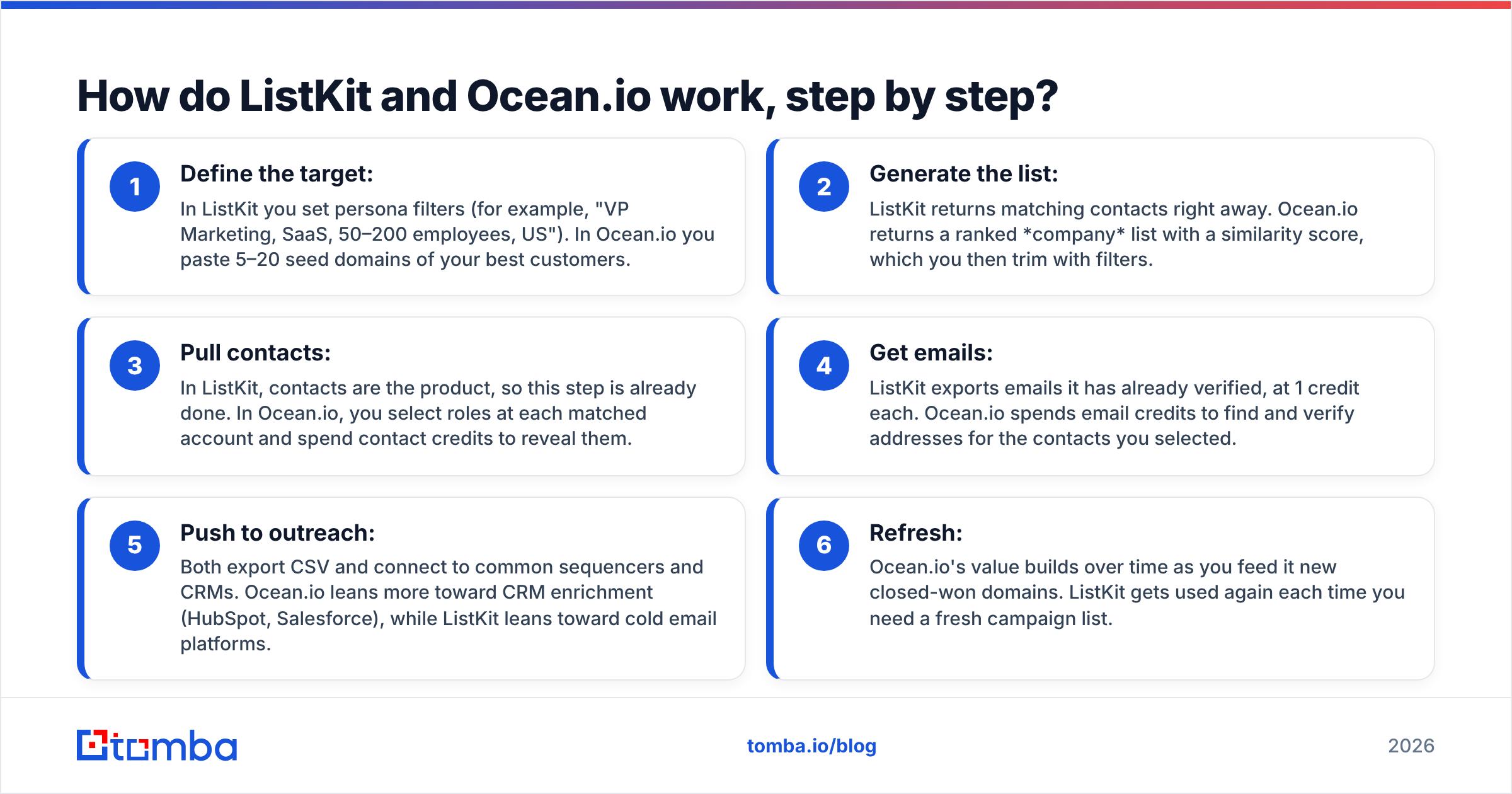
The workflow is where the difference shows up most. Here is a typical flow in each tool, from the first click to a lead sitting in your sequencer:
Define the target: In ListKit you set persona filters (for example, "VP Marketing, SaaS, 50–200 employees, US"). In Ocean.io you paste 5–20 seed domains of your best customers.
Generate the list: ListKit returns matching contacts right away. Ocean.io returns a ranked company list with a similarity score, which you then trim with filters.
Pull contacts: In ListKit, contacts are the product, so this step is already done. In Ocean.io, you select roles at each matched account and spend contact credits to reveal them.
Get emails: ListKit exports emails it has already verified, at 1 credit each. Ocean.io spends email credits to find and verify addresses for the contacts you selected.
Push to outreach: Both export CSV and connect to common sequencers and CRMs. Ocean.io leans more toward CRM enrichment (HubSpot, Salesforce), while ListKit leans toward cold email platforms.
Refresh: Ocean.io's value builds over time as you feed it new closed-won domains. ListKit gets used again each time you need a fresh campaign list.
In practice, ListKit rewards teams with a tight, stable ICP. Ocean.io rewards teams still working out where their next 500 accounts will come from.

ListKit vs Ocean.io: how do they compare feature by feature?#
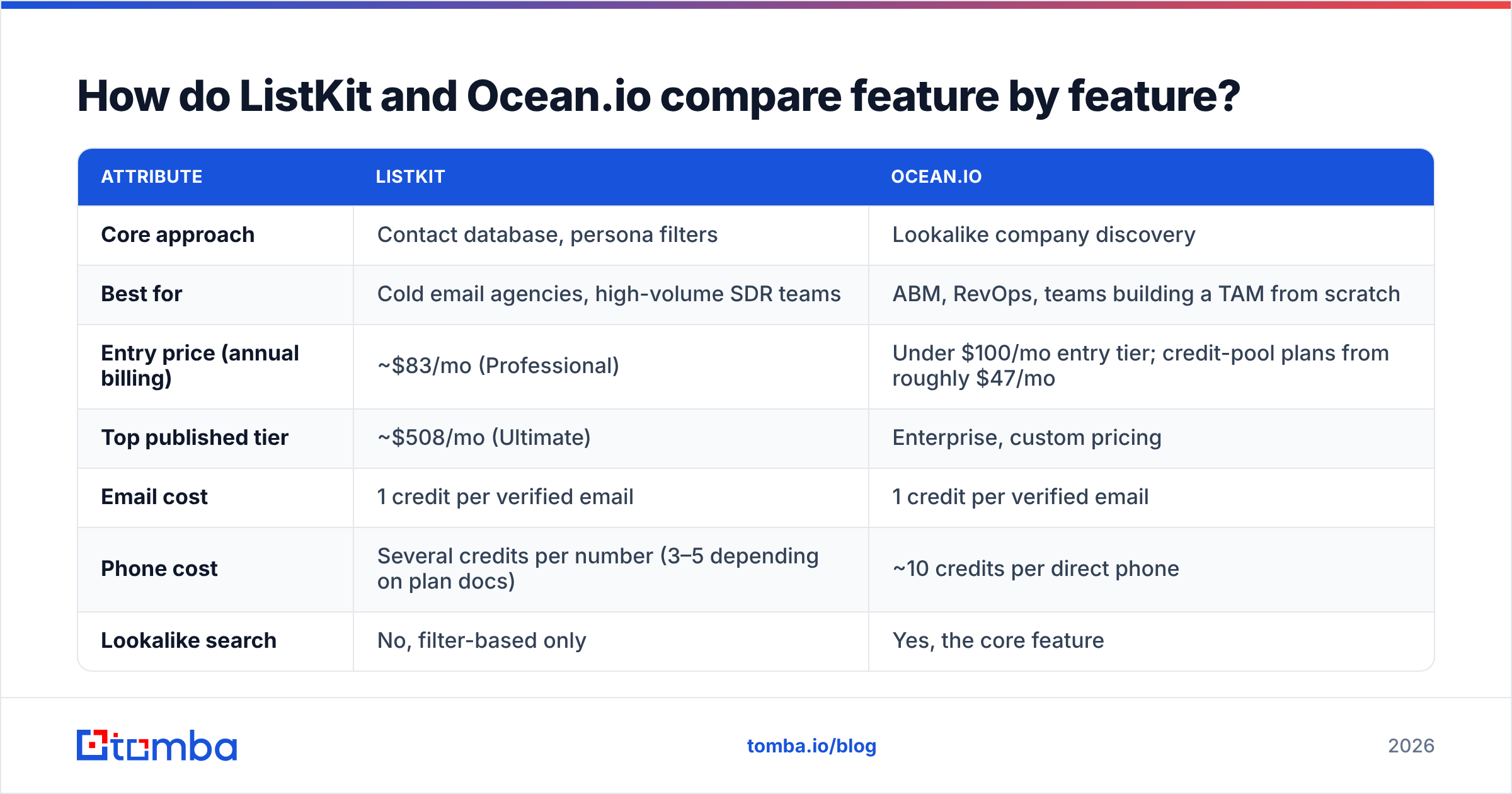
Here is the ListKit vs Ocean.io head-to-head. Pricing reflects publicly listed information as of 2026. Both vendors change credit maths often, so check their pricing pages before you commit.
| Attribute | ListKit | Ocean.io |
|---|---|---|
| Core approach | Contact database, persona filters | Lookalike company discovery |
| Best for | Cold email agencies, high-volume SDR teams | ABM, RevOps, teams building a TAM from scratch |
| Entry price (annual billing) | ~$83/mo (Professional) | Under $100/mo entry tier; credit-pool plans from roughly $47/mo |
| Top published tier | ~$508/mo (Ultimate) | Enterprise, custom pricing |
| Email cost | 1 credit per verified email | 1 credit per verified email |
| Phone cost | Several credits per number (3–5 depending on plan docs) | ~10 credits per direct phone |
| Lookalike search | No, filter-based only | Yes, the core feature |
| Email verification | Triple-verified before export | Verified on reveal |
| Seats | Plan-dependent | Unlimited seats on credit plans |
| Credit rollover | Tied to subscription tier | Credits valid for 12 months |
| CRM enrichment | Basic exports and integrations | Stronger: HubSpot and Salesforce enrichment |
| Monthly vs annual | Monthly is much pricier with fewer credits | Annual pricing is noticeably better |
Two things stand out.
First, the cost per email is similar. Both charge about one credit per verified address. The difference is in everything around the email. ListKit charges more for phones and extras such as AI script generation. Ocean.io charges for search results and contact reveals before you ever get to an email.
Second, Ocean.io's unlimited seats and 12-month credit validity fit teams whose usage comes in bursts, like quarterly ABM pushes. ListKit's model fits teams that send every week and use up their credits reliably.
Is ListKit better than Ocean.io for cold email?#
For pure cold email volume, yes, usually.
ListKit is built for people whose KPI is "meetings booked from outbound." The export-and-send workflow is short. The verification claim targets the biggest risk in cold email: bounces hurting your domain. And credits are priced so that a 5,000-lead campaign is easy to budget.
It has weak spots, though:
- Phones are expensive. If you run a call-heavy motion, phone credits drain a plan quickly. By ListKit's own help-center maths, a fully enriched contact can cost around 10 credits.
- No account intelligence. ListKit won't tell you which companies look like your best customers. You have to bring the ICP yourself.
- Monthly billing hurts. Users and third-party reviews consistently say monthly plans come with far fewer credits. Plan on annual billing, or budget for the higher price.
For a mid-sized agency sending 20,000+ emails a month across several clients, ListKit wins the ListKit vs Ocean.io matchup for straightforward list building.
Is Ocean.io better than ListKit for account-based marketing?#
Yes. ABM is where Ocean.io earns its price.
The lookalike engine is the reason to buy it. Say your ten happiest customers are all 80–300 person logistics software companies that recently hired a Head of RevOps. Ocean.io can find the next 400 companies with that profile faster than any filter combination you'd build by hand. It scores on website semantics and growth signals, not just firmographic checkboxes, so it often surfaces accounts that filters would miss.
Ocean.io also fits well into CRM-driven teams. You can enrich existing accounts in HubSpot or Salesforce and use similarity scores to prioritize territories. G2 reviewers tend to praise its list quality and interface. They tend to criticize credit usage on large searches. You can read the reviews yourself on G2's Ocean.io page.
Its weaker spots:
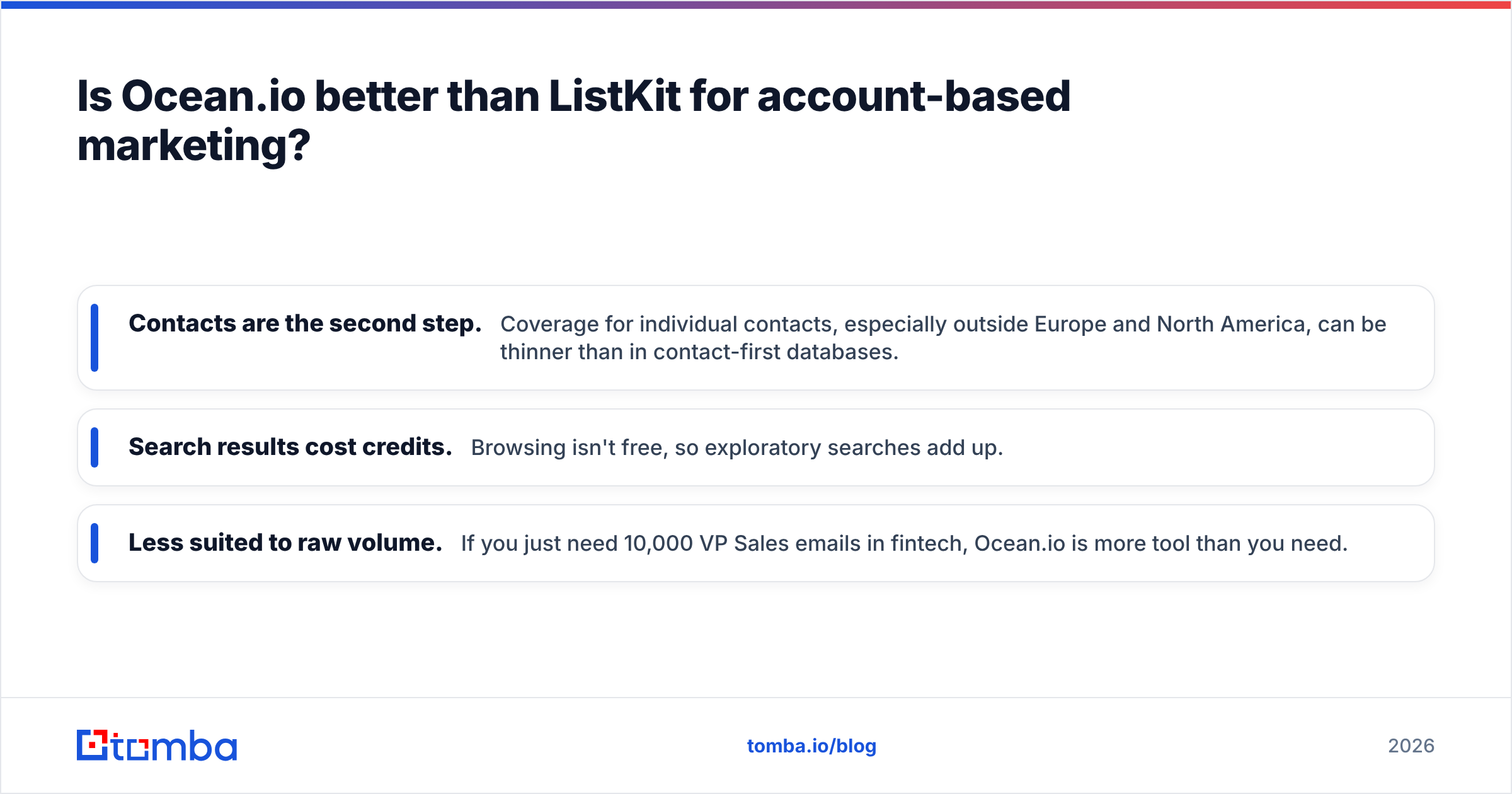
- Contacts are the second step. Coverage for individual contacts, especially outside Europe and North America, can be thinner than in contact-first databases.
- Search results cost credits. Browsing isn't free, so exploratory searches add up.
- Less suited to raw volume. If you just need 10,000 VP Sales emails in fintech, Ocean.io is more tool than you need.
ListKit vs Ocean.io: which is cheaper per usable lead?#
It depends on what you count as a "lead," so run the maths on your own workflow.
Take a scenario: 1,000 contacts with verified emails, no phones.
- ListKit: about 1,000 credits. On a mid-tier annual plan, that is a small share of the monthly allowance. Your effective cost is low and easy to predict.
- Ocean.io: you pay for search results (fractions of a credit each), then contact reveals, then email credits. For 1,000 final contacts you might scan 3,000–5,000 companies. The total is still reasonable, but it is harder to forecast.
Now add phones. 1,000 contacts with verified emails and direct dials changes the ListKit vs Ocean.io picture. Phones cost several credits in ListKit and about 10 in Ocean.io. Both tools end up much more expensive than their headline prices suggest.
The pattern holds across most B2B data tools: the email is cheap, and phones and enrichment are what cost you. If you mainly need emails, a dedicated email finder is often the cheapest part of the stack. You can compare that against Tomba pricing, which starts with a free tier of 25 searches a month and a $49/mo Starter plan.
What do both tools get wrong about "verified"?#
Both vendors verify emails, and both do it at a single point in time. B2B data decays by roughly 2–3% a month. People change jobs, companies rebrand, and mail servers switch to catch-all setups. A contact marked verified in January can bounce in April.
Three habits protect your sender reputation no matter which tool you buy:
- Re-verify right before sending. Run the final CSV through an independent email verifier within 48 hours of launch, especially for lists that have been sitting in your CRM.
- Handle catch-all domains separately. Neither tool can fully confirm addresses on accept-all servers. Put those in a smaller, slower send.
- Keep bounce rates under 2%. Mailbox providers watch this closely. Google's own sender guidelines spell out what bulk senders are expected to do.

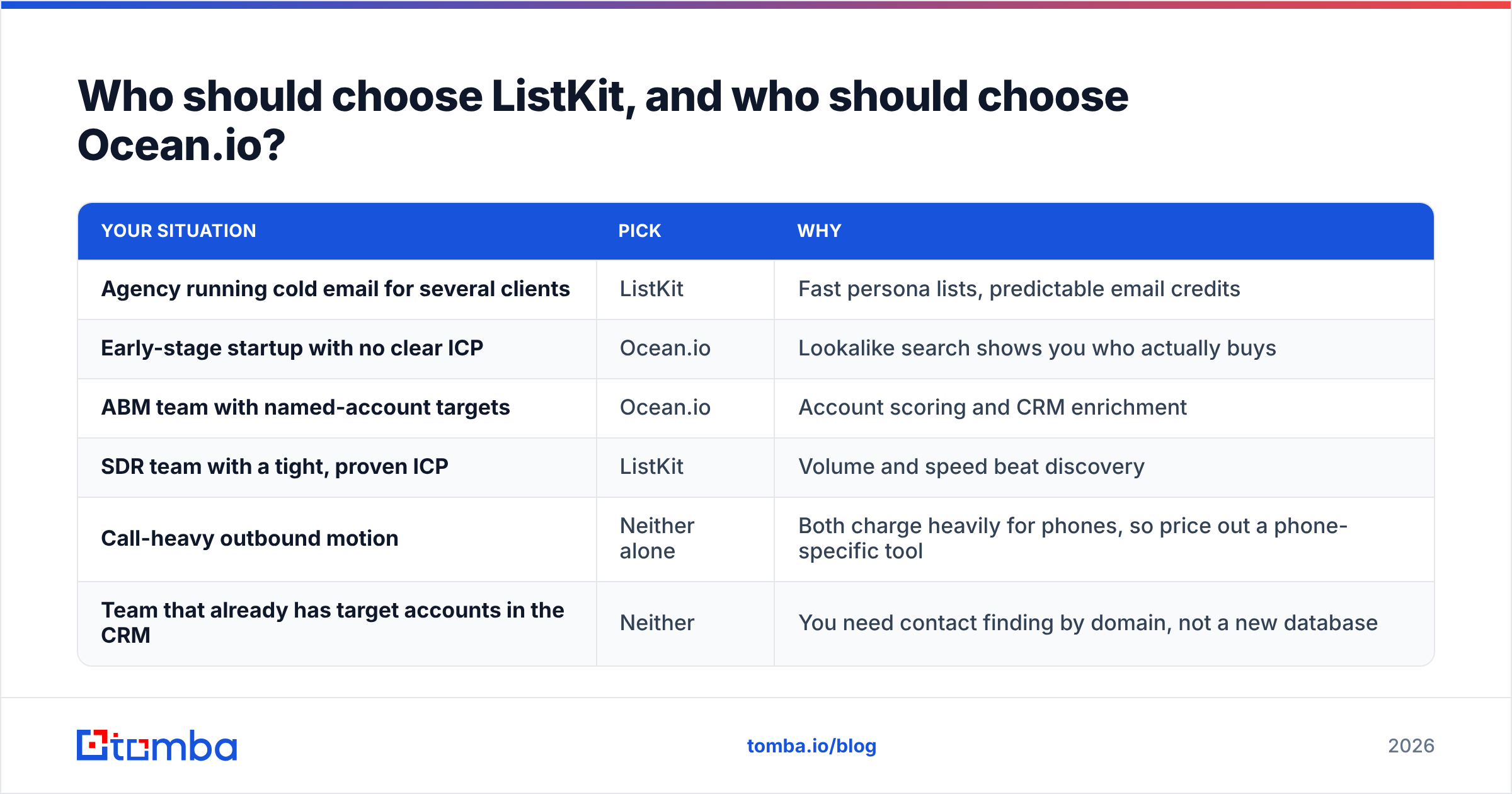
Who should choose ListKit, and who should choose Ocean.io?#
Here is the short version.
| Your situation | Pick | Why |
|---|---|---|
| Agency running cold email for several clients | ListKit | Fast persona lists, predictable email credits |
| Early-stage startup with no clear ICP | Ocean.io | Lookalike search shows you who actually buys |
| ABM team with named-account targets | Ocean.io | Account scoring and CRM enrichment |
| SDR team with a tight, proven ICP | ListKit | Volume and speed beat discovery |
| Call-heavy outbound motion | Neither alone | Both charge heavily for phones, so price out a phone-specific tool |
| Team that already has target accounts in the CRM | Neither | You need contact finding by domain, not a new database |
The last row matters more than it looks. Many teams buy a list tool when they already have the accounts. They just need the right person's email at each one. In that case, a domain search returns every public professional address at a company for a fraction of the cost of either platform.
Can you use ListKit and Ocean.io together?#
Yes, and some RevOps teams do. The common setup:
- Ocean.io builds and scores the account list each quarter.
- ListKit or a dedicated email finder fills in contacts at those accounts.
- A separate verifier cleans the combined list before it reaches the sequencer.
It works, but you pay for two credit systems. For teams under ten reps, there is a leaner option. Pair Ocean.io (or a free lookalike approach, such as studying your closed-won list in the CRM) with a pay-as-you-go email finder. You keep the account intelligence and skip paying for a second contact database.
Frequently asked questions#
Is ListKit data really triple-verified? ListKit runs several verification passes before export, and that does lower bounce rates compared with unverified databases. But verification only reflects the moment it ran. Re-verify lists that are older than a few weeks.
Does Ocean.io have a free trial? Ocean.io has offered trials and demos at various points. Check the current offer on their site, since trial terms change often.
Which has better European data? Ocean.io was founded in Denmark and is generally seen as strong on European company coverage. ListKit's database is weighted more toward North America.
Do credits roll over? Ocean.io's credit-pool credits are valid for 12 months. ListKit's credits are tied to your subscription tier, so confirm rollover terms before signing an annual deal.
Is there a cheaper option if I only need emails? Yes. If you already know your target companies, a standalone email finder with domain search usually costs far less per verified email than either platform's bundle.
ListKit vs Ocean.io: which should you pick?#
Pick the tool that matches your bottleneck:
- Not enough verified contacts, clear ICP → ListKit.
- Unsure which accounts to target, ABM motion → Ocean.io.
- Accounts already known, just need emails → neither. Use a focused email finder.
Don't judge ListKit vs Ocean.io on headline plan price. Model your cost per usable lead: emails plus phones plus the searches it takes to get there. Then check a sample of 200 exported contacts for bounces before you commit to an annual contract.
If your account list is already done and what's missing is the right inbox at each company, Tomba Email Finder is the lighter option. Enter a name and domain (or just a domain). You get professional email addresses with confidence scores and sources, plus built-in verification. You can start on the free plan with 25 searches a month and move up to Starter at $49/mo once it's part of your outbound routine.
Related guides#
// get started
Find, verify and enrich your first contacts today
Start on the free plan with 25 searches a month, then scale when your team is ready.
Free plan · No credit card required · GDPR & CCPA
// about the author