ListKit vs PrivCo: Lead Database or Private Company Intel?
ListKit and PrivCo both sell B2B data, but they do very different jobs. One fills cold email sequences and the other helps you research private company financials. Here's how to tell which one your team needs.
TL;DR
- ListKit is a B2B lead database for outbound. You filter by title, industry, and headcount, then export verified emails straight into your sequencer.
- PrivCo is a private-company research platform. It covers revenue estimates, funding, M&A, and investor data for companies that don't file public financials.
- For cold email pipeline, pick ListKit. For account research, sizing a deal, or vetting a private target, pick PrivCo.
- The two tools overlap less than most "vs" pages suggest. Plenty of teams use PrivCo to choose accounts and a contact tool to reach them.
- If you only need a verified email for a specific person or domain, a dedicated email finder costs less than either one.
Most "ListKit vs PrivCo" searches come from someone who has shortlisted "B2B data tools" and wants to know which to buy. The honest answer is that these products answer different questions. ListKit tells you who to email. PrivCo tells you how big a private company is, who funded it, and whether it's worth pursuing.
The sections below compare features, pricing, and the teams each tool fits. We also cover a common setup where both sit in the same stack.
What is ListKit?#
ListKit is a B2B contact database aimed at cold email teams, agencies, and founders who do their own outbound. You build a list with filters such as job title, seniority, industry, company size, location, and technology. Then you export contacts with work emails, and phone numbers on some records.
Its main pitch is verification. ListKit markets its emails as multi-step verified before export, which matters because bounces hurt your sender reputation quickly. The product is designed for one workflow: search, filter, export to CSV or a sequencer, send.
Pricing is credit-based. A business email costs 1 credit, a phone number costs more, and a fully enriched contact can use several credits. Every plan includes the same features, so what you're really buying is volume.
Where ListKit is strong:
- Fast list building for outbound campaigns
- Emails verified before export, which reduces bounce risk
- Simple credit model that's easy to forecast for campaign volume
- Built for agencies running many client campaigns
Where it's thinner:
- Little company-level financial depth (no reliable revenue estimates for private firms, no deal history)
- Coverage outside North America and Western Europe can vary
- Monthly billing costs a lot more per credit than annual
What is PrivCo?#
PrivCo is a financial intelligence platform for privately held companies. Public companies file 10-Ks. Private companies don't, so PrivCo fills that gap with revenue estimates, employee counts, funding rounds, valuations, M&A transactions, and profiles of private equity and venture capital investors.
Its core users are investment bankers, PE and VC analysts, corporate development teams, consultants, and university business libraries. Sales teams use it too, mostly for enterprise account research. A typical question is "Is this $80M company big enough to justify a six-figure deal cycle?"
PrivCo sells individual subscriptions, institutional licences (often IP-based for universities), and one-off company reports. It also offers a limited free tier. Reviewers on G2 generally praise the depth on private-company financials and say the contact data is not its focus.
Where PrivCo is strong:
- Revenue and financial estimates for private companies
- Funding, valuation, and M&A transaction history
- Investor profiles (PE firms, VCs, family offices)
- Useful for market sizing, target screening, and deal research
Where it's thinner:
- Not built as a bulk contact export engine for outbound
- Paid plans cost more than contact databases aimed at SMBs
- Mostly US-focused, with the strongest coverage on US private companies
How do ListKit and PrivCo differ at the core?#
An analogy helps. ListKit is a phone book with filters. PrivCo is a credit analyst's file on each company. One tells you how to reach someone. The other tells you whether the company deserves your time.
Here are the practical differences:
- Primary question answered. ListKit answers "Who at this company can I email?" PrivCo answers "What is this private company worth, and who owns it?"
- Unit of data. ListKit is contact-first: people, titles, emails, phones. PrivCo is company-first: financials, deals, investors.
- Primary buyer. ListKit sells to SDRs, agencies, and growth founders. PrivCo sells to analysts, bankers, corp dev, and enterprise AEs doing account research.
- Output format. ListKit gives you a CSV or sequencer-ready list. PrivCo gives you a company profile, a screener result, or a report.
- Success metric. With ListKit, you measure reply rate and bounce rate. With PrivCo, you measure better target selection and fewer wasted cycles on companies that don't fit.
If your problem is "our sequences are empty," PrivCo won't fix it. If your problem is "we keep chasing companies that are too small to buy," ListKit won't fix that.
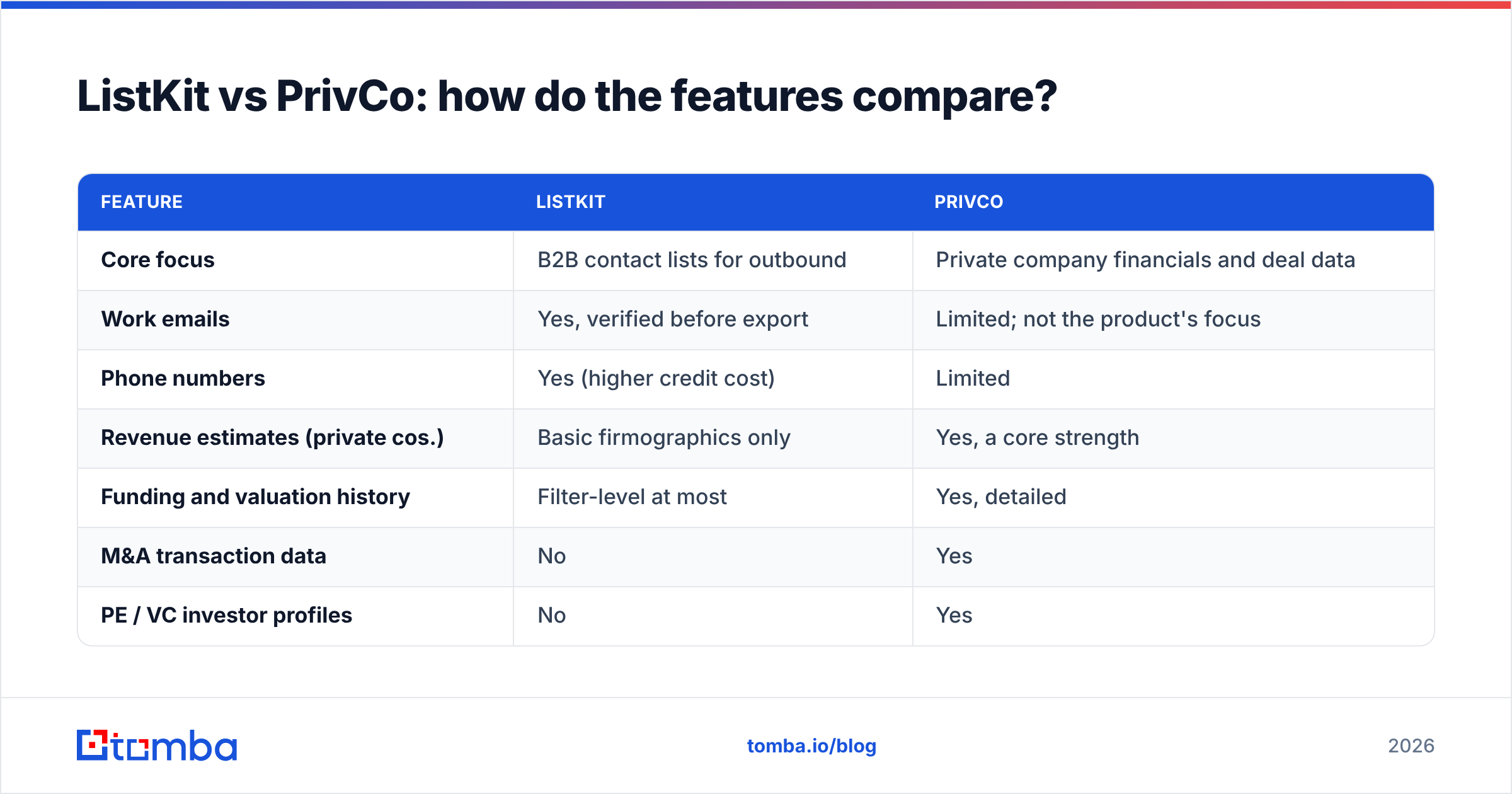
ListKit vs PrivCo: how do the features compare?#
| Feature | ListKit | PrivCo |
|---|---|---|
| Core focus | B2B contact lists for outbound | Private company financials and deal data |
| Work emails | Yes, verified before export | Limited; not the product's focus |
| Phone numbers | Yes (higher credit cost) | Limited |
| Revenue estimates (private cos.) | Basic firmographics only | Yes, a core strength |
| Funding and valuation history | Filter-level at most | Yes, detailed |
| M&A transaction data | No | Yes |
| PE / VC investor profiles | No | Yes |
| Search filters | Title, seniority, industry, size, location, tech | Industry, revenue, location, founding year, ownership, keywords |
| Export to sequencers / CSV | Yes, core workflow | Research-oriented exports |
| Free tier | 100 credits total | Limited basic membership |
| Best for | SDRs, agencies, outbound founders | Analysts, corp dev, investors, enterprise account research |
Look at the "Work emails" and "Revenue estimates" rows first. Those two rows explain most of why the tools rarely compete head to head. Each one is strong exactly where the other is thin.

How much do ListKit and PrivCo cost?#
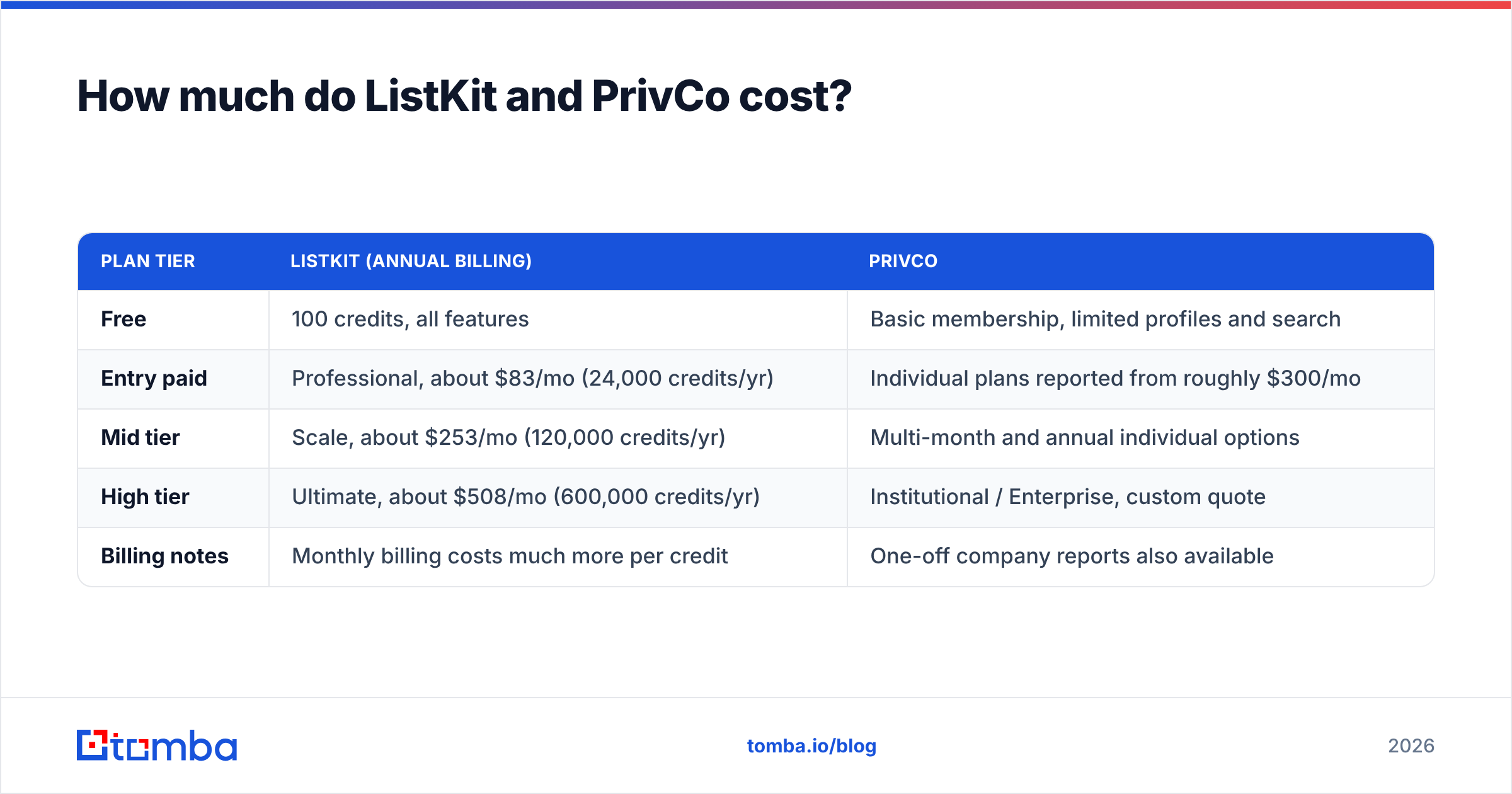
Both vendors change pricing often, so check their live pages before you commit. At the time of writing, published and third-party figures look like this:
| Plan tier | ListKit (annual billing) | PrivCo |
|---|---|---|
| Free | 100 credits, all features | Basic membership, limited profiles and search |
| Entry paid | Professional, about $83/mo (24,000 credits/yr) | Individual plans reported from roughly $300/mo |
| Mid tier | Scale, about $253/mo (120,000 credits/yr) | Multi-month and annual individual options |
| High tier | Ultimate, about $508/mo (600,000 credits/yr) | Institutional / Enterprise, custom quote |
| Billing notes | Monthly billing costs much more per credit | One-off company reports also available |
How to read these numbers:
- ListKit cost scales with volume. If you send 5,000 cold emails a month, the Professional tier's credit pool covers basic email exports. Adding phone numbers and full enrichment burns credits much faster.
- PrivCo cost scales with seats and depth. You aren't paying per contact. You're paying for access to financial profiles and screeners. A single analyst seat may be worth it if one better-qualified deal covers a year of subscription.
- Compare cost per outcome. Cost per record is misleading here. For ListKit, measure cost per reply. For PrivCo, measure cost per qualified target or per avoided dead-end deal.
Which data quality matters more for your use case?#
Both vendors say their data is accurate. "Accuracy" means something different for each product.
For ListKit, accuracy means deliverability. An email that bounces does more than waste a credit. Mailbox providers treat high bounce rates as a spam signal, and that hurts email deliverability for the whole domain. Many teams keep bounce rates under 2%. That's why the verification step matters, and why many senders re-check any list older than a few weeks before loading it. You can run exports through a separate email verifier as a final check. This is especially useful for catch-all domains, where verification results are less certain.
For PrivCo, accuracy means how close the estimates are. Private companies don't publish audited revenue, so every figure is modeled from employee counts, funding, industry benchmarks, news, and filings where they exist. PrivCo's value lies in its methodology and analyst research. Still, treat its revenue numbers as informed ranges rather than audited facts. Firms like Gartner have long noted that B2B data decays quickly. Company-level estimates age too, just more slowly than contact data.
To test either tool, take 50 records you already know well. For ListKit, use contacts you've emailed recently. For PrivCo, use private companies whose revenue you know from deals or conversations. Score each tool on your own data, not on vendor claims.
When should you choose ListKit?#
Pick ListKit if most of these describe you:
- You run outbound email as a main pipeline channel.
- You need thousands of contacts a month that match a clear ICP (title + industry + headcount).
- You're an agency running campaigns for several clients and need predictable credit costs.
- Your deals are SMB to mid-market, so you don't need a deep financial review before reaching out.
- You care more about bounce rate and speed than about company financials.
ListKit is a poor fit if your sales cycle depends on judging a private company's financial health before anyone gets in touch. It also struggles when your targets are a few hundred enterprise accounts that need hand research.
When should you choose PrivCo?#
Pick PrivCo if most of these describe you:
- You screen private companies by revenue, growth, funding, or ownership.
- You work in PE, VC, M&A advisory, corp dev, or consulting.
- Your sales team sells large contracts and needs to confirm an account can afford them.
- You need investor data, for example which PE firms own companies in a vertical.
- You work from a short, high-value target list rather than a high-volume sequence.
PrivCo is a poor fit if you mainly need to fill an outbound sequencer this week. You'll end up with well-researched target accounts and nobody to email.
Can you use ListKit and PrivCo together?#
Yes. For account-based teams this is often the best setup, because each tool covers the other's gap. A typical workflow looks like this:
- Screen accounts in PrivCo. Filter private companies by industry, revenue band, and recent funding. Export a target account list of maybe 200 to 500 companies.
- Tier the accounts. Tag tier 1 (best financial fit), tier 2, and tier 3 using revenue and growth signals.
- Source contacts. Pull decision-makers at those domains from ListKit, or run a domain search to see every public work email tied to each company.
- Verify before sending. Re-verify addresses right before the campaign launches, especially on older lists.
- Personalize with financial context. Use PrivCo details such as a recent funding round, acquisition, or expansion as the opening line for tier 1 accounts.
The combined stack costs more than either tool alone. For teams with enterprise deal sizes, one good opening line tied to a real funding event can easily beat a generic sequence to a larger list.

Where does a dedicated email finder fit in?#
Here's a gap many buyers overlook. Some teams don't need a 600,000-credit database or a financial research seat. They need the correct work email for a specific person at a specific company, found reliably and at low cost.
That's what a dedicated email finder is for. With Tomba, you enter a name and a domain, or just a domain, and get addresses with a confidence score and the public sources where each one appeared. You can then enrich leads with company and role data. In practice, it's a lighter option for teams that:
- Do targeted, account-based outreach instead of volume blasts
- Already use a research tool like PrivCo and just need contact coverage for the shortlisted accounts
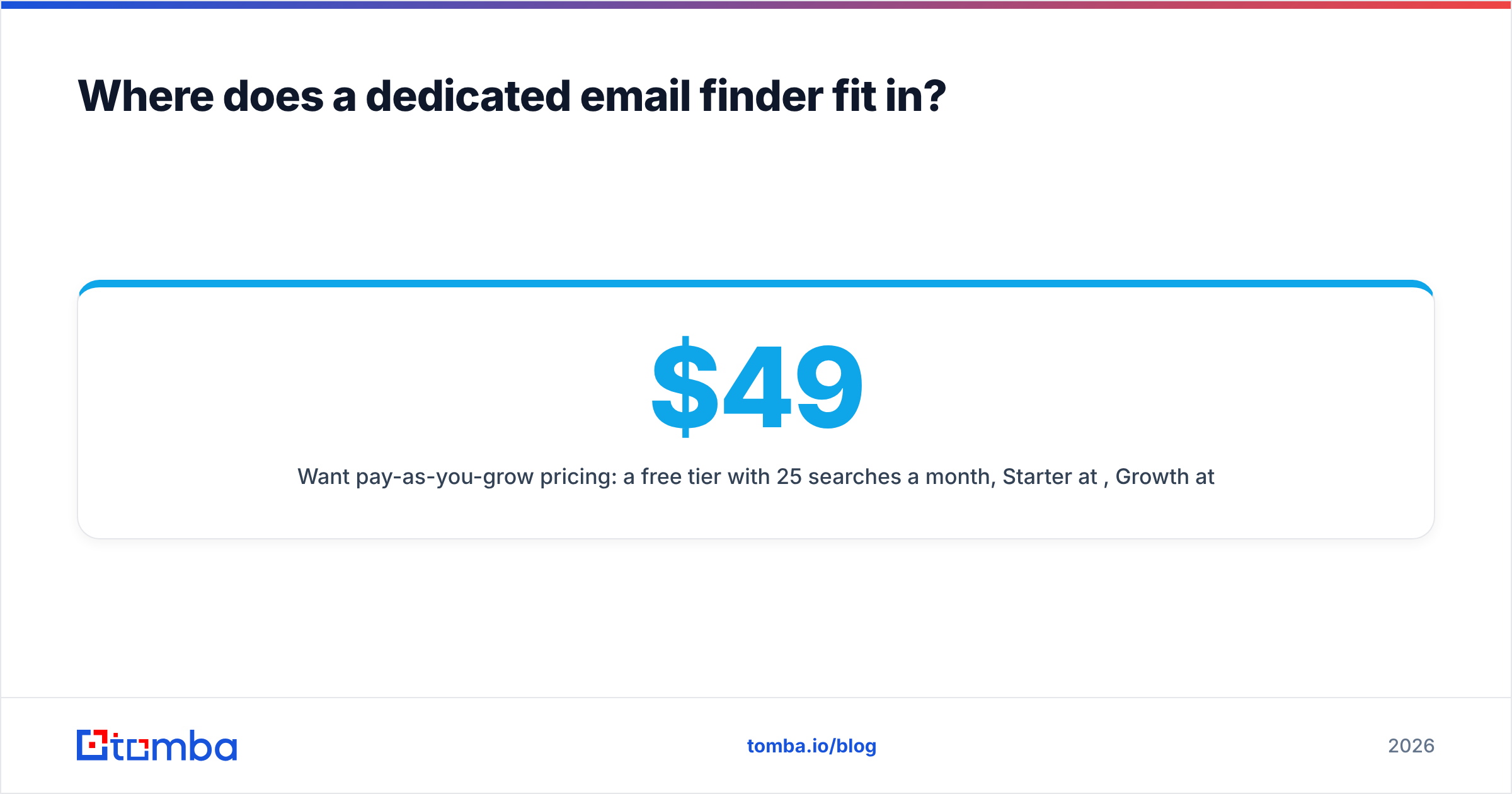
- Want pay-as-you-grow pricing: a free tier with 25 searches a month, Starter at $49/mo, Growth at $99/mo, Pro at $249/mo, and custom Enterprise plans (see Tomba pricing)
It won't replace PrivCo's financial models. If you want a pre-filtered list of 20,000 contacts by title, a volume database like ListKit may still fit better. It does cover the "find this one person's email" job that neither ListKit nor PrivCo was mainly built for.
So, ListKit vs PrivCo: which should you pick?#
Start with the job you need done. Brand reputation matters less.
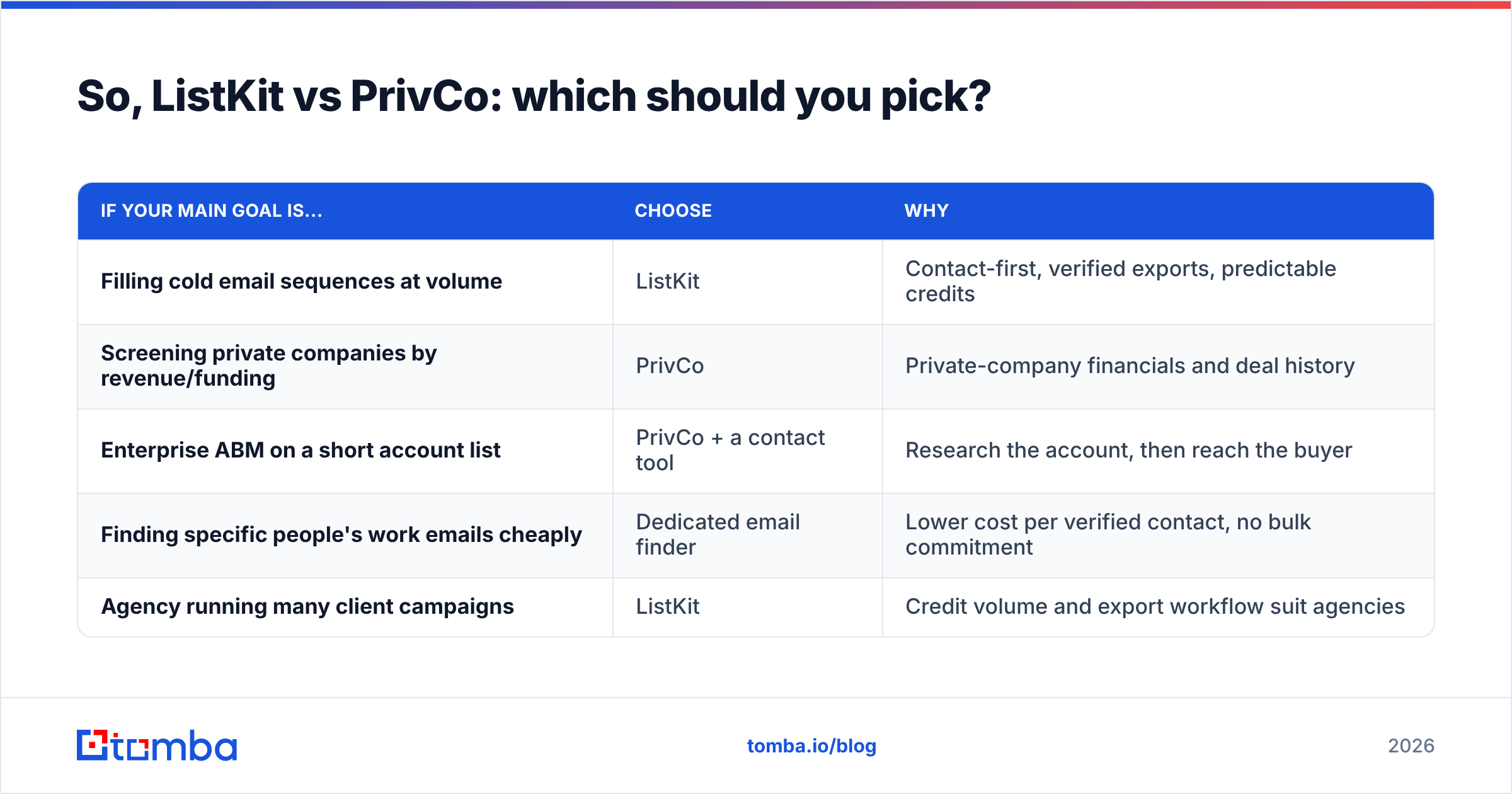
| If your main goal is... | Choose | Why |
|---|---|---|
| Filling cold email sequences at volume | ListKit | Contact-first, verified exports, predictable credits |
| Screening private companies by revenue/funding | PrivCo | Private-company financials and deal history |
| Enterprise ABM on a short account list | PrivCo + a contact tool | Research the account, then reach the buyer |
| Finding specific people's work emails cheaply | Dedicated email finder | Lower cost per verified contact, no bulk commitment |
| Agency running many client campaigns | ListKit | Credit volume and export workflow suit agencies |
Our verdict: ListKit wins for outbound teams that measure success in replies and meetings booked. PrivCo wins for anyone whose decisions depend on understanding private-company financials, including investors, corp dev, and enterprise sellers who qualify accounts before they reach out. These aren't really rivals. If you're weighing one against the other, you probably need to decide first whether your bottleneck is who to contact or which companies to contact.
Frequently asked questions#
Is PrivCo a lead generation tool? Not mainly. It's a financial research platform for private companies. Sales teams use it for account research and qualification, but it isn't built for bulk contact exports.
Does ListKit have company revenue data? It has firmographic filters such as company size and industry, which help you target. It doesn't offer PrivCo-level revenue modeling, funding history, or M&A data on private companies.
Which is cheaper, ListKit or PrivCo? For outbound contact volume, ListKit is much cheaper per record. PrivCo usually costs more per seat, but its pricing covers financial intelligence, not contacts, so a direct cost comparison is misleading.
Can I get verified emails for PrivCo target accounts? Yes. Export your PrivCo shortlist, then run the domains through a contact database or email finder and verify before sending.
Find the right contact once you've found the right company#
Whether you shortlist accounts in PrivCo or build lists another way, the last step is always the same: reach a real person without bouncing. Tomba Email Finder finds professional email addresses by name, domain, or company, and shows a confidence score and public sources for every result. It's a good match for account-based teams who've done the research and now need the right inbox. Start on the free plan with 25 searches a month and upgrade only when your outreach volume calls for it.
Related guides#
// get started
Find, verify and enrich your first contacts today
Start on the free plan with 25 searches a month, then scale when your team is ready.
Free plan · No credit card required · GDPR & CCPA
// about the author