ListKit vs Salutary Data: Self-Serve Lists or Licensed B2B Data?
ListKit sells triple-verified lead lists on a self-serve credit plan. Salutary Data licenses curated US contact data through APIs and data feeds. Here is how they differ on price, coverage, and fit, and which one suits your team.
TL;DR
- ListKit is a self-serve lead-list platform for outbound teams. Plans start at $97/mo for 2,000 credits, emails come triple-verified, and you can build and export a list the same afternoon you sign up.
- Salutary Data is a data provider, not a prospecting app. It licenses a curated US contact database (roughly 156M professional profiles and 4M+ companies) through APIs, a web UI, and full or custom data feeds. Deals are quoted, and reported entry pricing starts around $5,000.
- Salutary Data was acquired by Intentsify in early 2026, so its roadmap is now tied to an intent-data platform.
- Pick ListKit if you're an SDR team or agency that needs to launch campaigns this week. Pick Salutary Data if you're a platform, RevOps team, or data buyer who needs bulk US records or CRM enrichment under contract.
- If what you mostly need is to find and verify individual work emails without a four-figure commitment, a pay-as-you-go email finder is often the cheaper option.
"ListKit vs Salutary Data" looks like a normal head-to-head, but these two products are built for different buyers. One is a store where you pick leads off the shelf. The other is a wholesaler that sells by the pallet. Most bad purchases in this category happen when a team buys the wholesaler's product and actually needed the store, or the other way round.
This guide covers what each tool does, how they're priced, where their data comes from, and which type of team gets the most out of each.
What is ListKit?#
ListKit is a B2B lead-generation platform aimed at cold-email teams, agencies, and founders who do their own outbound. You filter a contact database by title, industry, headcount, location, and technology, and export the matches with emails that have been run through three verification passes before you're charged. The official site is listkit.io.
In practice, ListKit gives you:
- AI company search: describe your ideal accounts in plain language and get a filtered list back.
- Triple-verified emails: each email goes through multiple verification checks, which cuts bounce risk on cold campaigns.
- Phone numbers and enrichment: mobile and direct numbers cost extra credits, charged only when a number is found.
- Intent signals: basic buying-intent data attached to accounts.
- CRM integrations and unlimited users on every plan, including the entry tier.
ListKit is built for people who send email. There's no procurement step, no data-licensing agreement, and no sales call. You swipe a card, build a list, and push it into your sequencer.
What is Salutary Data?#
Salutary Data calls itself a boutique B2B contact and company data provider. It doesn't give you a prospecting workspace with sequences and list folders. It sells the underlying data to companies that want to own it, enrich with it, or build products on it.
Here's what it offers, according to its public profiles on G2 and data marketplaces:
- A curated US database: about 156 million verified professional profiles and 4M+ companies, drawn from more than 500 million records it evaluates each quarter.
- Direct dials and mobiles: millions of direct-dial and mobile numbers, which it lists as a key differentiator.
- High field completeness: it reports a job-title fill rate of about 99%, which matters for segmentation and lead scoring.
- Delivery options: an API suite, a web UI, and full or custom data feeds.
- Use cases beyond sales: CRM and lead enrichment, recruiting and HR, identity resolution, and training data for ML and AI.
- Redistribution licensing: software vendors and agencies can license the data to resell inside their own products.
In January 2026, Intentsify announced it had acquired Salutary Data, its second acquisition after Five by Five. For buyers, that likely means Salutary's contact data will be combined with intent signals over time. It could also mean packaging and contract terms change as the two companies integrate.
How do ListKit and Salutary Data compare side by side?#
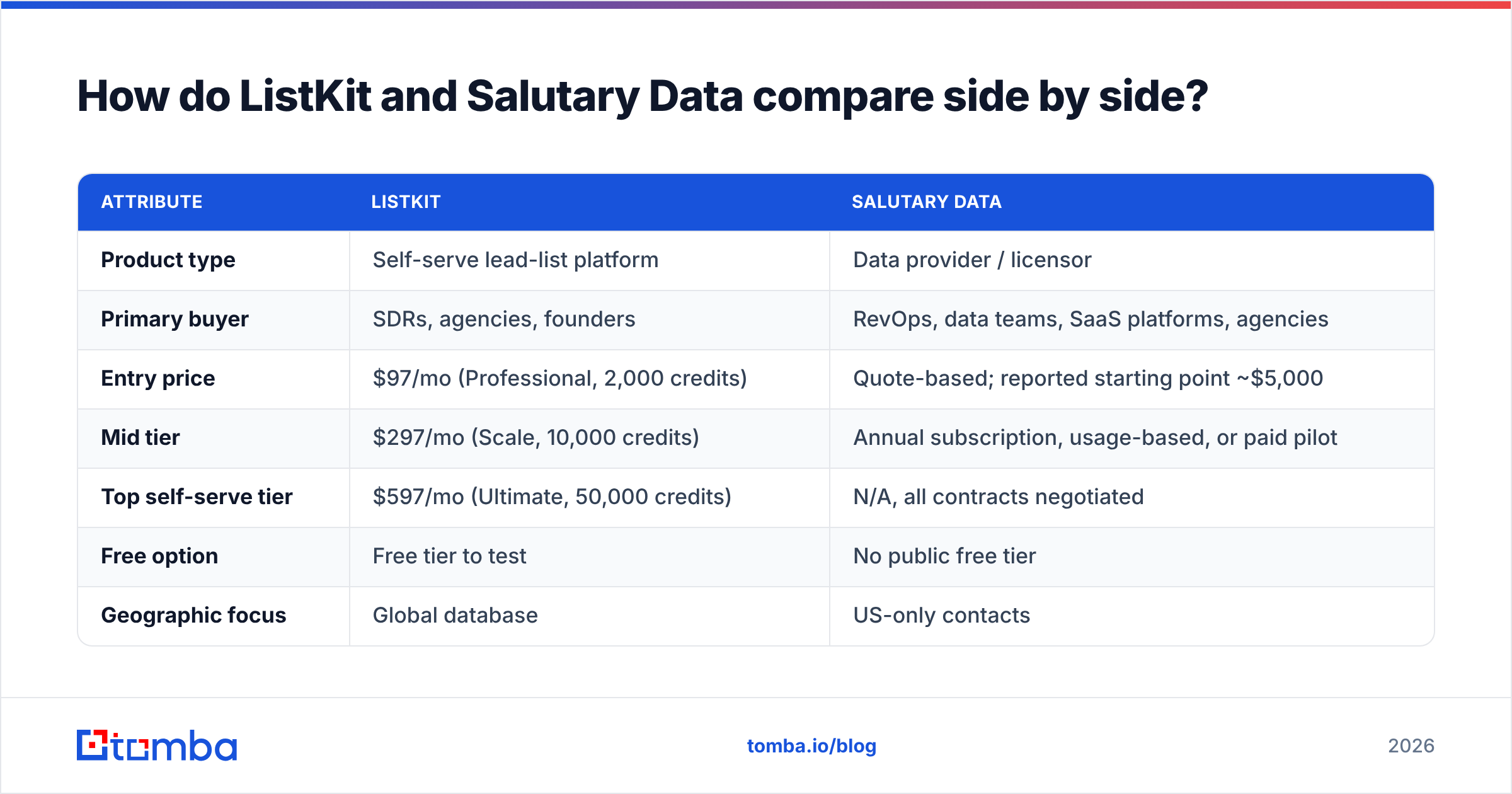
The table below covers the attributes that actually drive the decision. Salutary Data prices by quote, so its figures are ranges based on public listings, not a published rate card.
| Attribute | ListKit | Salutary Data |
|---|---|---|
| Product type | Self-serve lead-list platform | Data provider / licensor |
| Primary buyer | SDRs, agencies, founders | RevOps, data teams, SaaS platforms, agencies |
| Entry price | $97/mo (Professional, 2,000 credits) | Quote-based; reported starting point ~$5,000 |
| Mid tier | $297/mo (Scale, 10,000 credits) | Annual subscription, usage-based, or paid pilot |
| Top self-serve tier | $597/mo (Ultimate, 50,000 credits) | N/A, all contracts negotiated |
| Free option | Free tier to test | No public free tier |
| Geographic focus | Global database | US-only contacts |
| Email verification | Triple-verified before export | Verified email coverage on records |
| Phone data | Extra credits per number found | Direct dials and mobiles are a core strength |
| Delivery | Web app export, CRM push | API, web UI, full and custom data feeds |
| Redistribution rights | No | Yes, on licensing contracts |
| Time to first lead | Minutes | Days to weeks (scoping, contract, delivery) |
The short version: ListKit is priced per lead you export, and Salutary Data is priced per dataset or contract.

How does ListKit pricing actually work in practice?#
The published plans are easy to read, but credits run out faster than the headline numbers suggest. ListKit's credit rules roughly work out to:
- Email only: 1 credit per lead, so 2,000 credits get you 2,000 leads.
- Email plus LinkedIn URL: about 2 credits per lead, so 1,000 leads.
- Email plus intent signal: about 3 credits per lead, so roughly 666 leads.
- Full enrichment with mobile: 8 to 10 credits per lead, so 200 to 250 leads on the Professional plan.
- AI script writer: 100 credits per script, taken from the same pool.
If your campaigns only need an email and a first name, the $97 plan is good value. If your playbook depends on mobile numbers for multichannel outreach, plan on the Scale tier or higher. Annual billing saves about 15% on every plan.
How does Salutary Data pricing work?#
Salutary Data doesn't publish a price list. Its models include annual subscriptions, usage-based fees, and paid pilots, and quotes depend on volume tier, cost per lead, and the quality guarantee you negotiate. Public listings put entry-level API and dataset deals at around $5,000.
That number means different things depending on who you are:
- For a 3-person outbound team, $5,000 is often more than the whole year's tooling budget, and you'd be paying for records you'll never email.
- For a SaaS platform enriching millions of sign-ups, or a RevOps team rebuilding a messy CRM, cost per record through a licensing deal can end up far lower than any self-serve credit plan.
- For agencies reselling data, redistribution rights are the main reason to go with Salutary. ListKit's terms don't cover that.
Before you sign, ask for a paid pilot against a sample of your own CRM records. Compare match rate, bounce rate, and title accuracy on data you already know is correct, not on a hand-picked demo file.
Where does each provider's data come from, and how accurate is it?#
Neither vendor publishes a full list of its sources, so be careful with any accuracy claim, including the vendors' own.
ListKit runs every email through three verification passes before you pay for it. That's the right approach for cold email, where a bounce rate above roughly 2% starts to hurt your sender reputation. The catch is that verification tells you the mailbox exists. It doesn't tell you the person still holds that title.
Salutary Data puts its emphasis on curation. It reviews hundreds of millions of raw records each quarter and publishes a smaller, cleaner set. The reported 99% title fill rate and strong direct-dial coverage are the main reasons data teams choose it. The trade-off is that it only covers the US. If your target market includes the UK, DACH, or APAC, you'll need a second provider.
Whichever you choose, check the data yourself before a big send. Run a sample through an independent email verifier. Catch-all domains in particular hide bad addresses behind a technically "valid" response.
Which teams should choose ListKit?#
ListKit fits if most of these apply to you:
- You run cold email campaigns weekly and need fresh lists on demand.
- You're an agency managing outbound for several clients and want unlimited seats without per-user fees.
- Your budget is monthly, not annual, and you want to cancel if results slip.
- You sell outside the US and need global coverage.
- Nobody on the team does data engineering. A CSV export or CRM push is all you need.
The main weakness shows up when you depend on phone data. Heavy mobile enrichment uses up credits quickly, and phone-first teams can end up on the $297 or $597 tier sooner than they planned.
Which teams should choose Salutary Data?#
Salutary Data fits if most of these apply:
- You're building a product that needs contact data inside it, and you need legal redistribution rights.
- You're enriching a large CRM or inbound form fills at scale through an API.
- Your market is the US, and you care about direct dials for phone-heavy sales motions.
- You buy through procurement and are comfortable with annual contracts, pilots, and quality guarantees.
- You're interested in intent data, since the Intentsify acquisition points toward combined contact and intent packages.
It's the wrong fit for a founder who wants 300 leads by Friday. You'd spend more time scoping the contract than sending emails.
Is ListKit better than Salutary Data?#
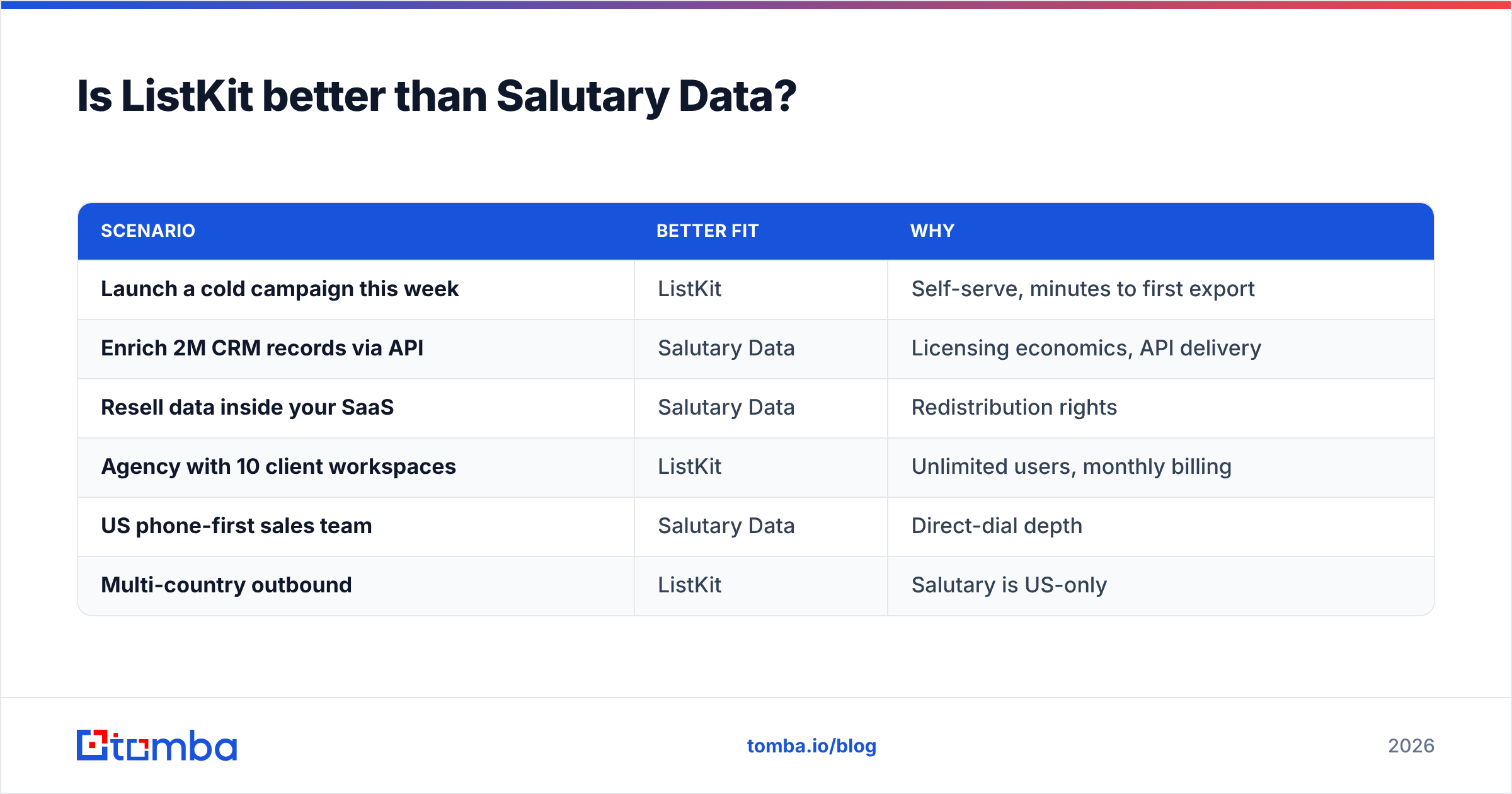
Neither is better overall. Each wins its own category.
| Scenario | Better fit | Why |
|---|---|---|
| Launch a cold campaign this week | ListKit | Self-serve, minutes to first export |
| Enrich 2M CRM records via API | Salutary Data | Licensing economics, API delivery |
| Resell data inside your SaaS | Salutary Data | Redistribution rights |
| Agency with 10 client workspaces | ListKit | Unlimited users, monthly billing |
| US phone-first sales team | Salutary Data | Direct-dial depth |
| Multi-country outbound | ListKit | Salutary is US-only |
If you're still unsure, ask yourself whether you'll be pulling specific leads or taking in a whole dataset. If you'll be pulling leads, choose ListKit. If you'll be taking in datasets, choose Salutary Data.

What should you check before signing with either vendor?#
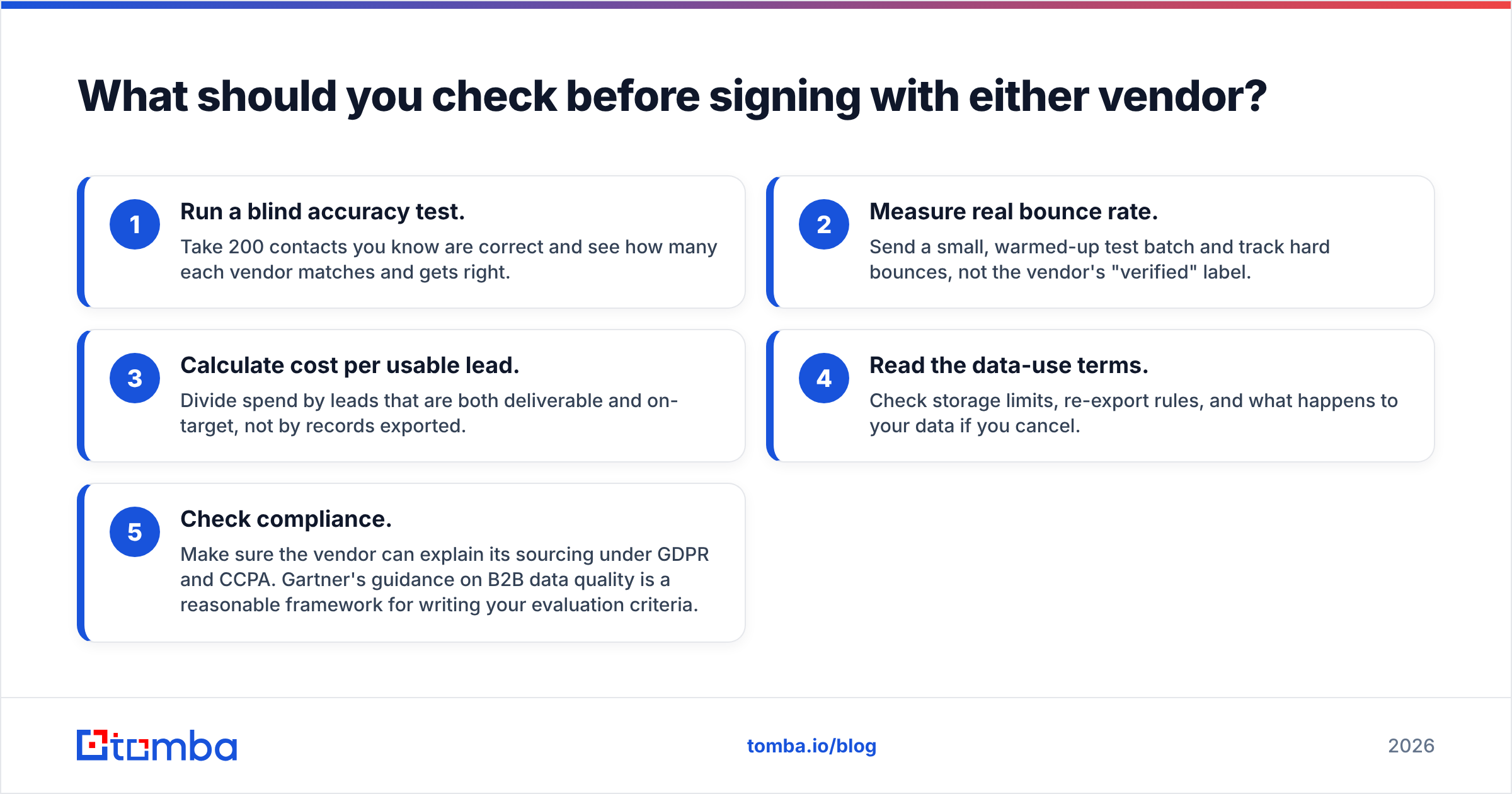
A short checklist will save you from most expensive mistakes in this category:
- Run a blind accuracy test. Take 200 contacts you know are correct and see how many each vendor matches and gets right.
- Measure real bounce rate. Send a small, warmed-up test batch and track hard bounces, not the vendor's "verified" label.
- Calculate cost per usable lead. Divide spend by leads that are both deliverable and on-target, not by records exported.
- Read the data-use terms. Check storage limits, re-export rules, and what happens to your data if you cancel.
- Check compliance. Make sure the vendor can explain its sourcing under GDPR and CCPA. Gartner's guidance on B2B data quality is a reasonable framework for writing your evaluation criteria.
Is there a lighter-weight alternative for finding emails?#
Plenty of teams comparing these two don't actually need a lead database or a licensing deal. They already know who they want to reach, whether that's accounts from a target list, conference attendees, or people who engaged with their LinkedIn posts, and they just need the right email address.
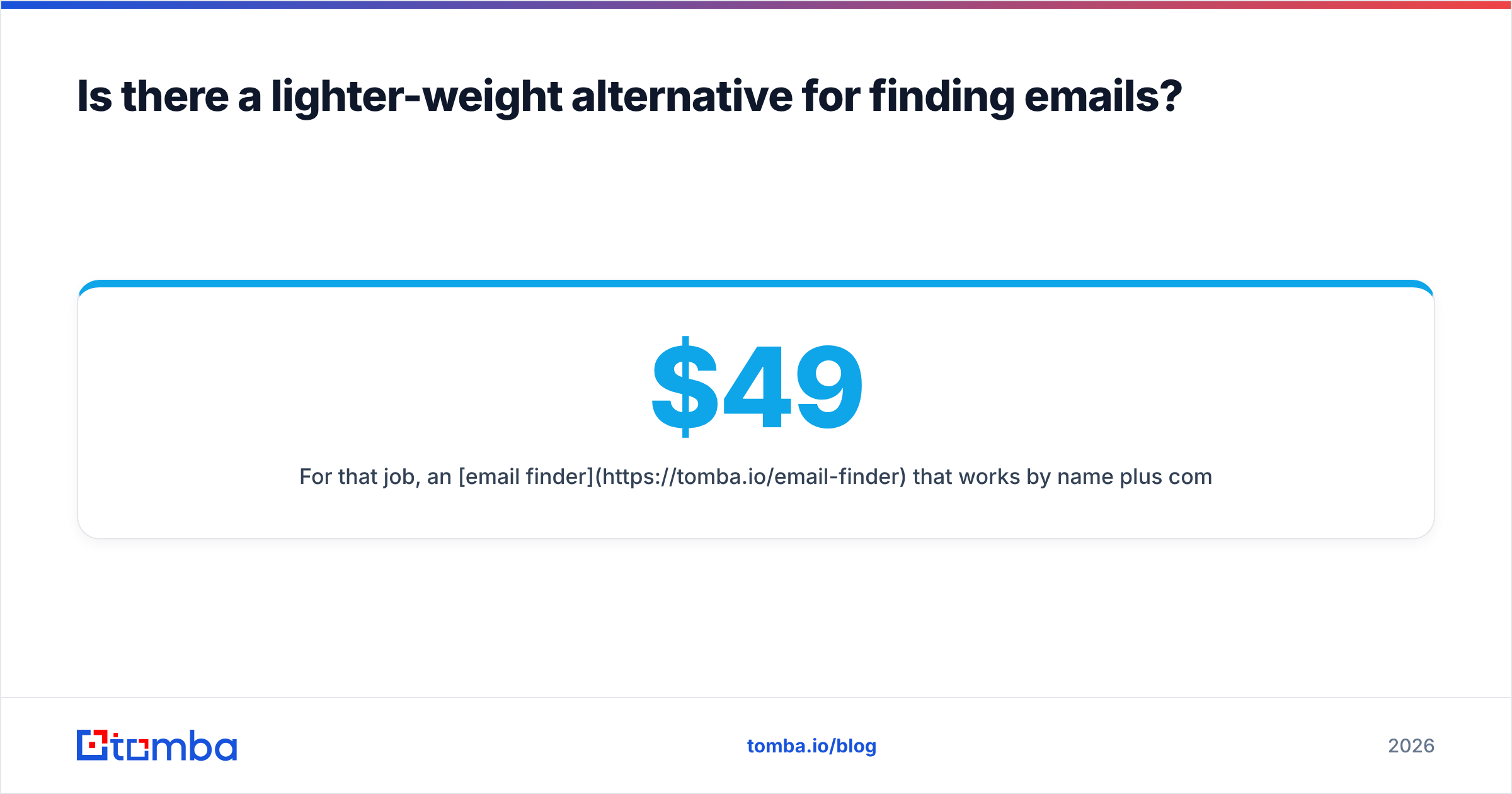
For that job, an email finder that works by name plus company domain is usually cheaper and more accurate than exporting a pre-built list. You pay only for the contacts you look up, and domain search shows you everyone public at a target account in one query. Tomba's plans start with a free tier (25 searches a month), then Starter at $49/mo, Growth at $99/mo, and Pro at $249/mo. That's cheaper than ListKit's entry plan and a small fraction of a typical Salutary Data contract. You can check current limits on the Tomba pricing page.
To be fair to both vendors: an email finder isn't a replacement for Salutary's licensed US dataset if you're building a data product, and it won't hand you a filtered list of 5,000 VPs the way ListKit will. It fills the gap between them. It's the precise, low-commitment option when you already know your targets.
Final verdict: ListKit or Salutary Data?#
- Choose ListKit if you're an outbound operator. It's transparent, self-serve, global, and built around deliverable emails.
- Choose Salutary Data if you're a data buyer. It's curated, US-focused, API-first, strong on direct dials, and licensable, and after the acquisition it's increasingly tied to Intentsify's intent data.
- Choose neither if you just need accurate work emails for accounts you've already picked.
If that last case sounds like you, try Tomba Email Finder. Enter a name and a company domain, get a verified professional email with its public sources, and start on the free plan before spending anything. When your targets are already defined, it's the quickest way to reach them without buying a lead database or signing an annual data contract.
Related guides#
// get started
Find, verify and enrich your first contacts today
Start on the free plan with 25 searches a month, then scale when your team is ready.
Free plan · No credit card required · GDPR & CCPA
Get the Tomba newsletter
Product and data updates
// about the author