Listkit vs Soleadify: Contact Lists vs Company Data in 2026
Listkit sells verified contact lists for cold email. Soleadify became Veridion, an enterprise company-data platform. Here's which one fits your outbound work in 2026, and where each one falls short.
Listkit vs Soleadify looks like a simple tool match-up. It isn't. One tool sells contacts. The other sells company data, and it now goes by a new name.
TL;DR
- Listkit is a lead-list builder for cold emailers. You filter by title, industry and company size. Then you export verified contacts. Pricing is credit-based and starts around $83/mo on annual billing.
- Soleadify was a company-level lead tool. It was renamed Veridion in 2023. It now sells company data to procurement, supply chain and risk teams, not SDRs.
- Need people and email addresses for a sequence this week? Listkit is the closer fit. Need a large, fresh map of companies and what they make? Veridion is the right product.
- Neither tool finds the email of one named person at one known company. That job needs a separate tool, so budget for it.
What is the real difference in Listkit vs Soleadify?#
The short answer: Listkit sells people, and Soleadify sold companies.
Listkit is built for outbound teams and agencies that run cold email at volume. Its promise is simple. You set filters (job title, seniority, industry, headcount, location, tech used). You get a list of contacts with verified business emails. Then you push it into a sending tool like Instantly or Smartlead. You pay for credits, and every plan unlocks the same features.
Soleadify started in 2019 with a different idea. It did not license a contact database. Instead, it crawled the public web to build company profiles: what they do, what they sell, where they operate, and how to reach them. The pitch was "find every company in your target market." Your team then worked out who to contact.
That difference in data type decides everything else in this comparison. It shapes who each tool suits, how you pay, and what else you need to buy.
What happened to Soleadify?#
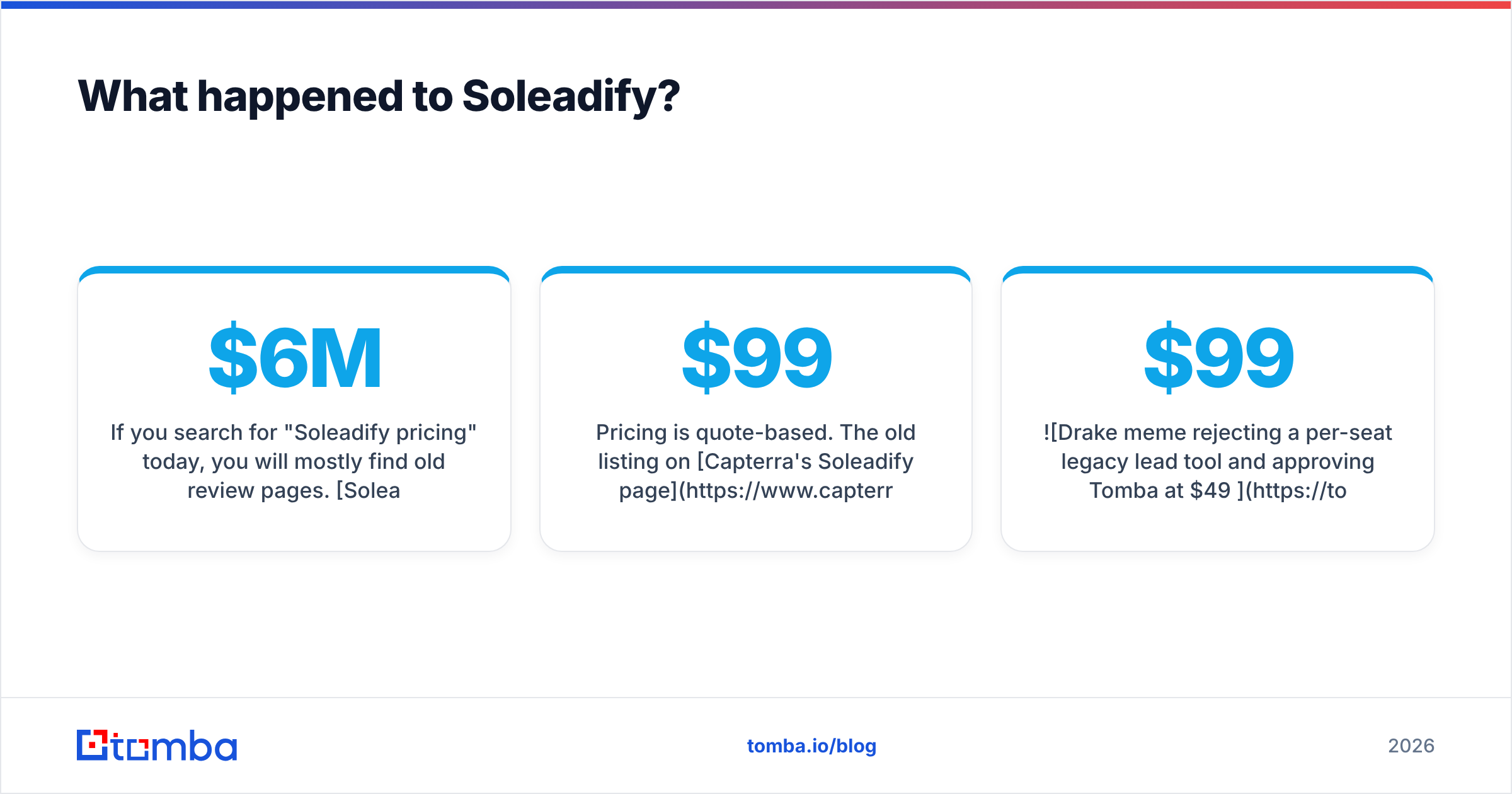
If you search for "Soleadify pricing" today, you will mostly find old review pages. Soleadify rebranded as Veridion in February 2023 and raised a $6M round at the same time. The founders said the word "lead" kept getting them routed to marketing teams. Their real buyers were large firms that needed reliable company data at scale.
In practice, that means:
- The product has moved upmarket. Veridion now sells AI-driven business data for procurement, supplier discovery, supply chain mapping and risk.
- Delivery is mostly API and data feeds. It is no longer a click-and-export tool for a solo SDR.
- Pricing is quote-based. The old listing on Capterra's Soleadify page shows $99 per user. That price reflects the legacy lead-gen product. Don't plan your 2026 budget around it.
So when you compare "Listkit vs Soleadify," you're really comparing a mid-market outbound tool with an enterprise data vendor. Both are good at their own job. Their jobs just barely overlap.

Listkit vs Soleadify: how do they compare feature by feature?#
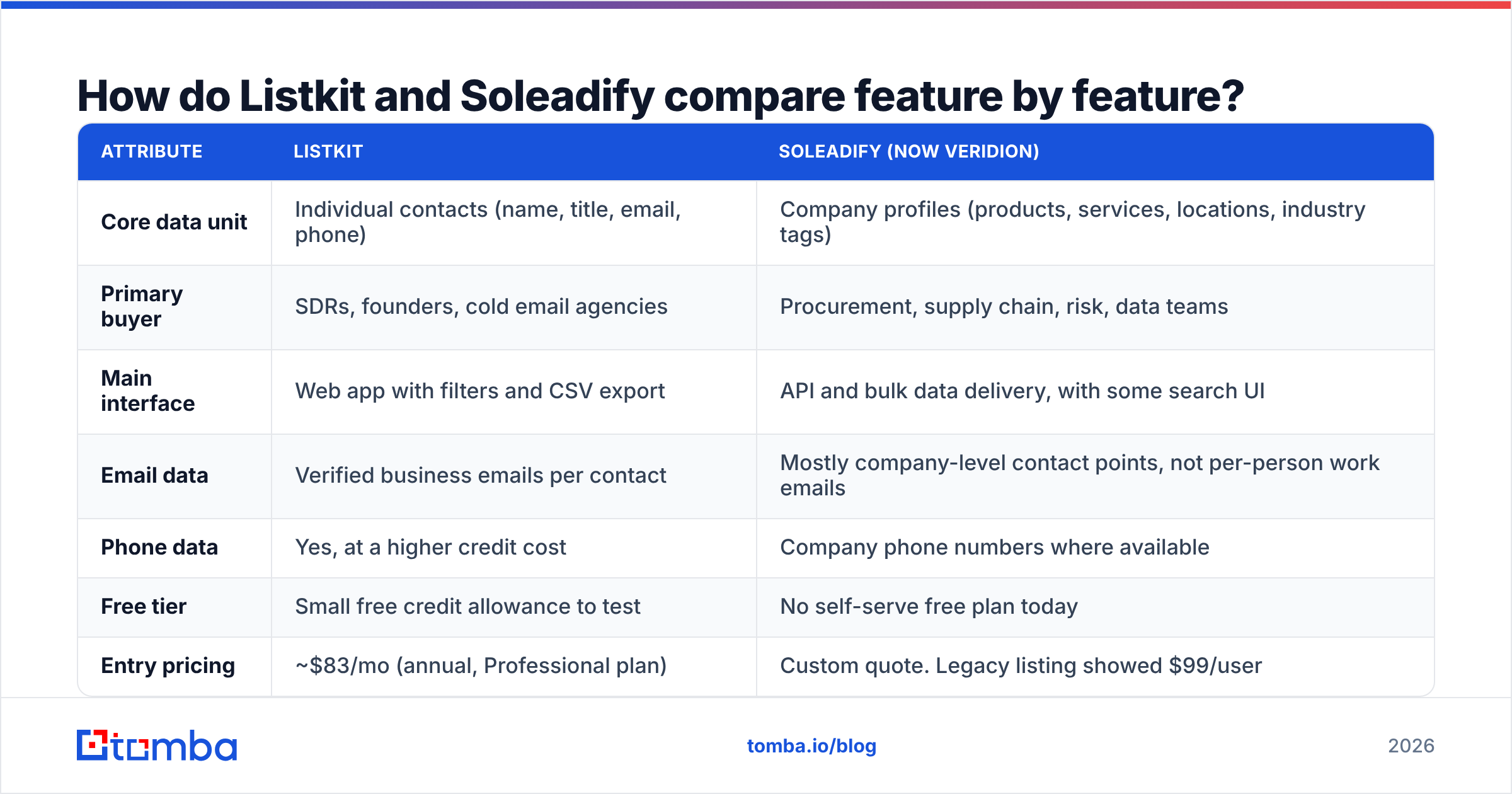
Here's the side-by-side. Soleadify's column describes the product as it exists today (Veridion). Notes show where the legacy tool behaved differently.
| Attribute | Listkit | Soleadify (now Veridion) |
|---|---|---|
| Core data unit | Individual contacts (name, title, email, phone) | Company profiles (products, services, locations, industry tags) |
| Primary buyer | SDRs, founders, cold email agencies | Procurement, supply chain, risk, data teams |
| Main interface | Web app with filters and CSV export | API and bulk data delivery, with some search UI |
| Email data | Verified business emails per contact | Mostly company-level contact points, not per-person work emails |
| Phone data | Yes, at a higher credit cost | Company phone numbers where available |
| Free tier | Small free credit allowance to test | No self-serve free plan today |
| Entry pricing | ~$83/mo (annual, Professional plan) | Custom quote. Legacy listing showed $99/user |
| Billing model | Credits (email ~1 credit, phone ~5 credits) | Contract / volume-based |
| Best at | Fast, filterable cold email lists | Deep, fresh firmographics and product-level company data |
| Weak spot | Credits drain fast when you enrich phones | Not built for person-level outreach |
Two rows matter most for a sales team: core data unit and email data. If your workflow ends with "send an email to a human," Listkit gets you there in fewer steps.
How does the data actually differ?#
This is the core of the Listkit vs Soleadify decision. Here's how the two data models behave in real use.
- Company depth versus contact depth. Veridion describes a company in detail: its products, certifications and sites. Listkit covers the people at a company and checks that their inbox exists.
- Freshness. Veridion says it re-reads billions of web pages all the time. Listkit verifies emails before delivery. That protects your sender reputation even if the record is a few months old.
- Filter logic. On Listkit you filter by persona ("VP Sales, 50–200 employees, SaaS, US"). On Veridion you filter by what a business does ("stainless steel valve makers with a plant in Mexico"). A generic contact database can't easily do the second.
- Output shape. Listkit hands you a CSV ready for your sequencer. Veridion hands you company records. You still need to find the right person and their email.
- Niche industries. Web-crawled data tends to win on small, offline-heavy firms, such as industrial suppliers and local services. These firms rarely keep LinkedIn profiles.
That fourth point is where most teams get stuck. A great company list gives you nobody to email. To bridge the gap, run each domain through a domain search to pull public staff emails. Or use an email finder with a name and domain once you know the decision-maker.
Listkit vs Soleadify pricing: what does each cost in 2026?#
Listkit publishes its pricing. Veridion does not.
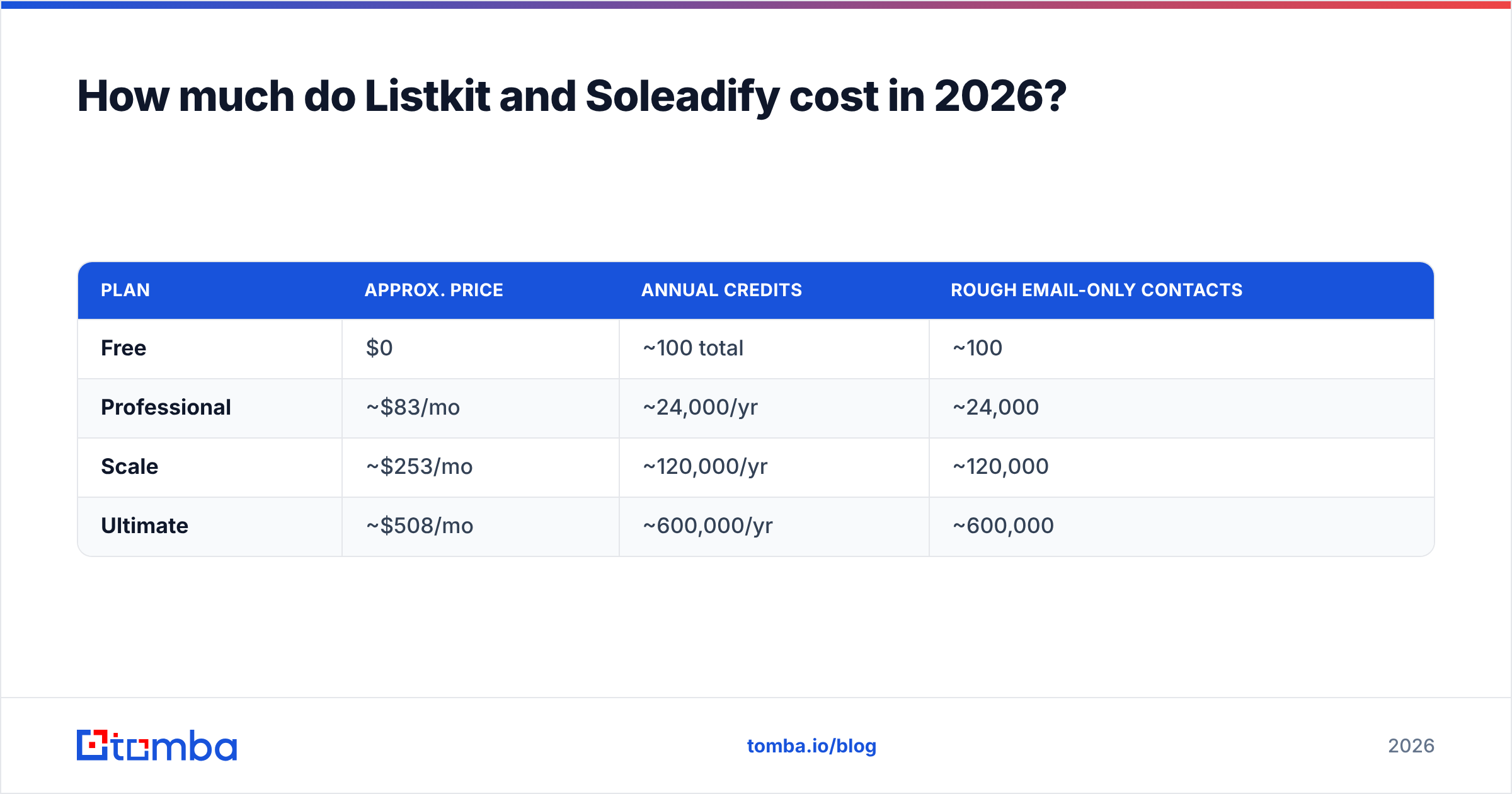
Listkit (annual billing, per month):
| Plan | Approx. price | Annual credits | Rough email-only contacts |
|---|---|---|---|
| Free | $0 | ~100 total | ~100 |
| Professional | ~$83/mo | ~24,000/yr | ~24,000 |
| Scale | ~$253/mo | ~120,000/yr | ~120,000 |
| Ultimate | ~$508/mo | ~600,000/yr | ~600,000 |
Monthly billing on Listkit costs more and includes far fewer credits. So the annual numbers above are the real comparison point. Watch the phone-number multiplier. If you add a mobile to every contact, your usable lead count drops sharply. Check the live figures on Listkit's site before you buy, because credit allowances change.
Soleadify / Veridion:
- No public pricing. Expect a sales call, a scoped data contract, and pricing tied to record volume, refresh rate and API usage.
- The $99/user figure on review sites is a leftover from the pre-2023 product.
- For a team of one to five people running outbound, this is usually more contract than you need.
A practical rule: if your monthly data budget is a few hundred dollars and you want to email this week, the enterprise path is the wrong door.
Which is more accurate for cold email?#
On accuracy for cold email, Listkit wins the Listkit vs Soleadify match-up. Here, accuracy means one thing: does this inbox exist and accept mail? Listkit verifies emails before delivery, and your bounce rate depends on that.
Veridion's accuracy is a different kind. It asks whether the company record is correct. Is the business active? Does it still make that product? Is that site still open? For supplier discovery or market sizing, that matters more than one person's inbox. For a 1,000-contact sequence, it doesn't help much on its own.
Whichever source you use, re-verify before you send. Data decays every month as people change jobs. A list that was clean at export can be 3–5% stale a quarter later. Running the file through an email verifier right before launch costs very little. It also protects the domain you spent weeks warming up.
Who should choose Listkit?#
Listkit is the better pick if you:
- Run cold email as a core channel and want sequencer-ready CSVs
- Target clear personas (titles and seniority) inside industries that are well represented on LinkedIn
- Want predictable, published pricing and a free tier to test data quality
- Work at an agency building lists for several clients at once
- Don't need deep product-level detail on each company
The trade-off: Listkit behaves like a database you query. If your ideal customer is defined by what a company makes or does, not who works there, persona filters won't find them precisely.
Who should choose Soleadify (Veridion)?#
Veridion is the better pick if you:
- Need to map an entire market or supply base, including small and offline-heavy businesses
- Care about product, service or capability-level attributes that standard firmographic filters don't expose
- Have data engineering capacity to consume an API or bulk feed
- Buy data for procurement, risk, M&A research or market sizing, not just outbound
- Have the budget and patience for an enterprise contract
Maybe you're an SDR who misses the old Soleadify UI. That product no longer exists in its original form. Look at lighter tools instead.

Can you use Listkit and Soleadify together?#
Yes, and some teams do. Listkit vs Soleadify doesn't have to be an either-or choice. The pattern looks like this:
- Build the account list from company data. Use Veridion (or a similar source) to find companies with a precise capability, such as "contract manufacturers offering injection moulding in Poland."
- Dedupe and prioritise. Score the accounts on fit and remove current customers.
- Find the people. Pull decision-makers from Listkit where coverage exists.
- Fill the gaps. For companies Listkit doesn't cover well, run their domains through an email finder or domain search.
- Verify, then send. Verify the whole list in one pass before it reaches your sequencer.
This stack costs more and takes more work to run. It only makes sense when your market is narrow and hard to define with job-title filters alone.
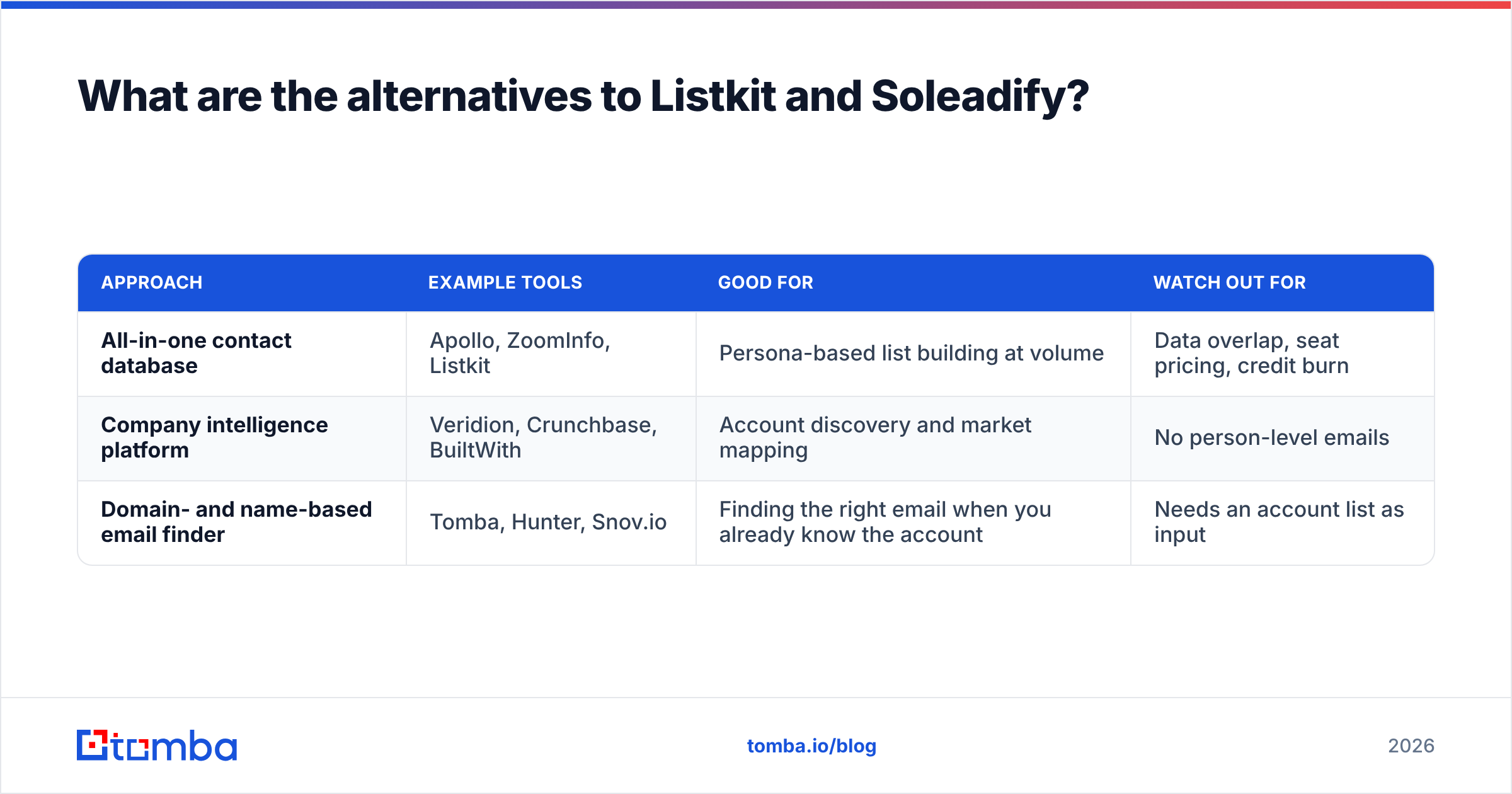
What are the alternatives to Listkit and Soleadify?#
If neither side of Listkit vs Soleadify fits cleanly, most teams land on one of three approaches:
| Approach | Example tools | Good for | Watch out for |
|---|---|---|---|
| All-in-one contact database | Apollo, ZoomInfo, Listkit | Persona-based list building at volume | Data overlap, seat pricing, credit burn |
| Company intelligence platform | Veridion, Crunchbase, BuiltWith | Account discovery and market mapping | No person-level emails |
| Domain- and name-based email finder | Tomba, Hunter, Snov.io | Finding the right email when you already know the account | Needs an account list as input |
Many outbound teams pair a light account source (a spreadsheet, a directory or a company data export) with a pay-as-you-go email finder. That avoids a large annual database contract. Compare Tomba pricing with the Listkit plans above. Tomba has a free tier of 25 searches a month, then $49/mo for Starter and $99/mo for Growth. Which option wins depends on how many contacts you need each month and how much of your list you already have.
Listkit vs Soleadify: which should you pick?#
For most sales teams weighing Listkit vs Soleadify in 2026, Listkit is the practical answer. It's built for outbound, and its prices are published. It hands you verified contacts you can load into a sequencer the same day.
Soleadify, now Veridion, is a strong product in a different category. Pick it when company-level data is the actual problem, such as supplier discovery, market mapping or risk. You also need the budget and engineering capacity to use an API-first data vendor.
Maybe your real bottleneck is simpler: finding the right email at accounts you've already chosen. Then a dedicated finder is the leaner option. Tomba Email Finder takes a name and a company domain. It returns a professional email with a confidence score and public sources. You go from a target account list to a verified inbox without an annual data contract. Start on the free tier, test it on 25 of your hardest accounts, and judge the hit rate yourself.
Related guides#
// get started
Find, verify and enrich your first contacts today
Start on the free plan with 25 searches a month, then scale when your team is ready.
Free plan · No credit card required · GDPR & CCPA
// about the author