Listkit vs Sourcescrub: Lead Lists or Private Company Intel?
Listkit sells verified cold email lists by the credit. Sourcescrub sells private company intelligence for deal teams on annual contracts. Here is how to tell which one your team needs, and when you need neither.
TL;DR
- Listkit is a self-serve lead list builder for outbound teams and cold email agencies. Plans start at $97/mo, it runs on monthly credits, and emails are verified at export.
- Sourcescrub is a private company intelligence platform for private equity, investment banks, and corp dev teams. Pricing is custom, sold on annual contracts, and built around finding founder-owned businesses before they go to market.
- These tools are not really competitors. Listkit answers "who do I email this week?" Sourcescrub answers "which private companies should we acquire or invest in?"
- Choose Listkit if you run high-volume cold email. Choose Sourcescrub if you run a deal-sourcing process that justifies a five-figure data budget.
- If you only need verified contact emails at companies you already picked, a dedicated email finder costs much less than either.
People usually search "Listkit vs Sourcescrub" because both show up when you look for "B2B data" or "company lists," and both will hand you a spreadsheet of companies and contacts. That's roughly where the overlap stops. The two products were built for different buyers and different budgets, and they measure success differently. Buy the wrong one and you either overpay for M&A research you'll never use or end up with a cold email list that can't tell you whether a company is family-owned and ready to sell.
This guide covers what each platform does, what it costs, where its data comes from, and which kind of team gets value from it.
What is Listkit?#
Listkit is a B2B lead generation platform for outbound sales. You filter a database of hundreds of millions of contact profiles by title, industry, headcount, location, and technology. You build a list, and each email gets checked at export by what Listkit calls its triple-verification engine. The file then goes into your sequencer (Instantly, Smartlead, lemlist, and so on).
Its audience is clear from the product: cold email agencies, SDR teams, solo founders, and growth operators who send thousands of emails a month and care most about bounce rate and cost per contact.
What stands out about Listkit:
- Unlimited users on every plan. Agencies especially like this because they don't pay per seat.
- Verification at export. You aren't billed for a list and then left to clean it in a separate tool.
- AI company search. You can describe the kind of company you want in plain language instead of stacking filters.
- Credits that expire monthly. Unused credits don't roll over, and there is no free trial.
What is Sourcescrub?#
Sourcescrub is a deal-sourcing and market intelligence platform. Private equity firms, independent sponsors, investment banks, and corporate development teams use it to find, profile, and track privately held companies. Its focus is the lower middle market: founder-led and family-owned businesses that rarely appear in Crunchbase or PitchBook because they never raised venture money.
What sets Sourcescrub apart is where its data comes from. Besides the web, it aggregates "sources" such as trade show exhibitor lists, industry association directories, and buyer's guides. It then attaches firmographics, estimated revenue and headcount, ownership signals, and growth indicators. That lets a deal team build a thesis ("US-based HVAC distributors, $10-50M revenue, founder-owned, no institutional capital") and pull a list of targets that match it.
Sourcescrub also includes executive contacts so associates can start owner outreach. But contact data is a feature of the product, not its purpose. Its purpose is company discovery and monitoring. Sourcescrub is now part of Datasite, which also owns other M&A workflow tools, and it connects to the CRMs deal teams use, such as DealCloud and Salesforce.

How do Listkit and Sourcescrub compare side by side?#
Here are the two products compared on the attributes that usually decide the purchase.
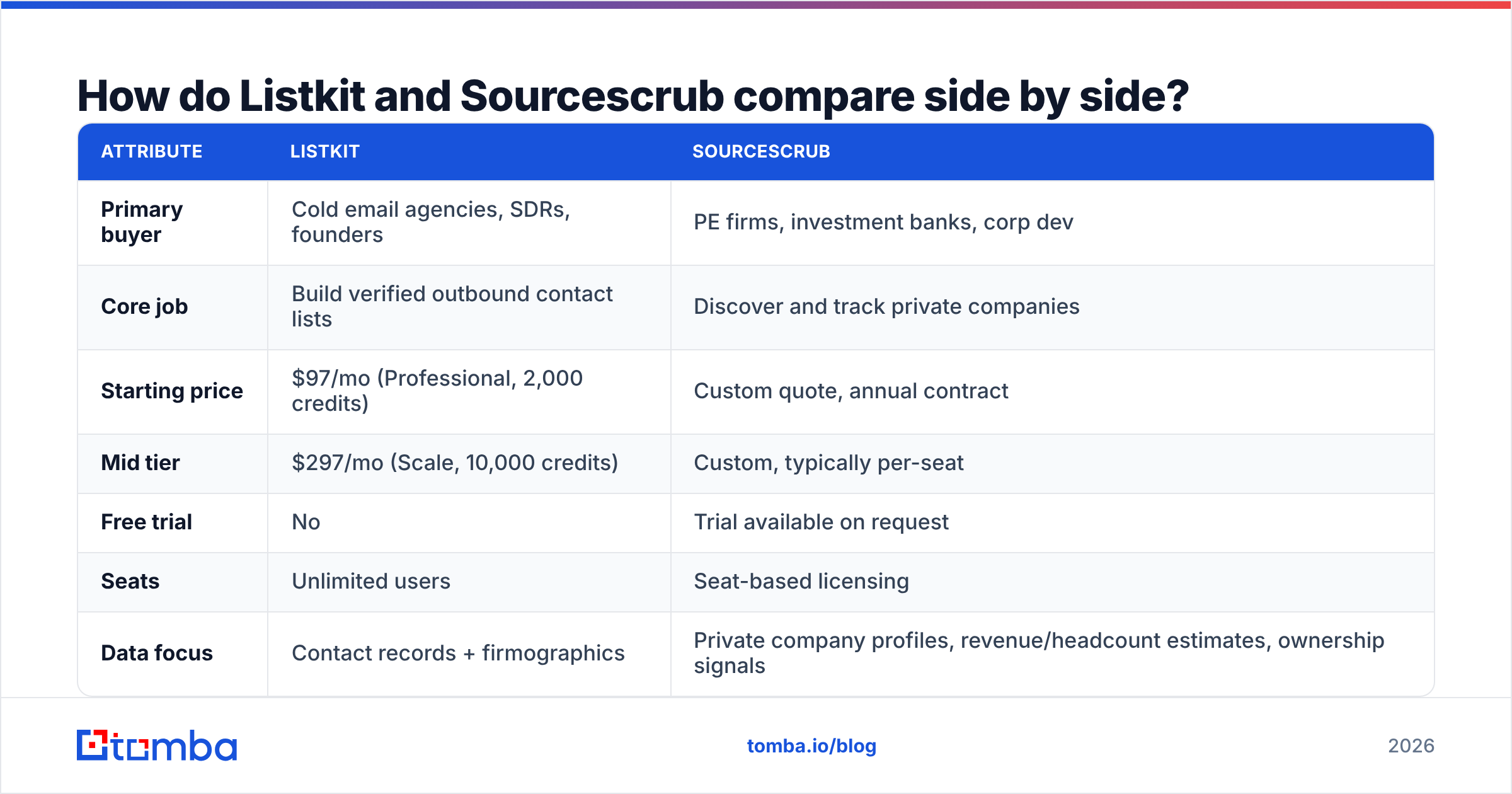
| Attribute | Listkit | Sourcescrub |
|---|---|---|
| Primary buyer | Cold email agencies, SDRs, founders | PE firms, investment banks, corp dev |
| Core job | Build verified outbound contact lists | Discover and track private companies |
| Starting price | $97/mo (Professional, 2,000 credits) | Custom quote, annual contract |
| Mid tier | $297/mo (Scale, 10,000 credits) | Custom, typically per-seat |
| Free trial | No | Trial available on request |
| Seats | Unlimited users | Seat-based licensing |
| Data focus | Contact records + firmographics | Private company profiles, revenue/headcount estimates, ownership signals |
| Unique data sources | Aggregated B2B profile database | Conference lists, association directories, buyer's guides |
| Email verification | Built-in, at export | Contact data included; verification is not the headline feature |
| Best output | CSV ready for a sequencer | Target list + monitoring for a deal pipeline |
| Credit rollover | No, monthly expiry | Not credit-based in the same way |
Listkit's pricing comes from its public plans (Professional $97/mo, Scale $297/mo, Ultimate $597/mo, Enterprise custom, with discounts on annual billing). Sourcescrub doesn't publish prices. Its listings on marketplaces such as G2's PitchBook vs Sourcescrub comparison direct buyers to contact sales. In practice, budget for it the way you would for any institutional research platform, not the way you would for a SaaS tool you put on a card.
Is Listkit better than Sourcescrub for cold email?#
Yes, clearly. For cold email specifically, Listkit is the better tool, and the reason is structural, not a matter of feature quality.
A cold email program depends on three things: volume, deliverability, and cost per contact. Listkit is built around all three.
- Volume: 10,000 credits on the Scale plan is enough for a small agency's monthly send across several clients.
- Deliverability: verifying at export protects your sender domains. Every hard bounce damages your email deliverability, and bounce rates above roughly 2% start causing trouble with mailbox providers.
- Cost per contact: at $297 for 10,000 credits you pay about three cents a contact before you account for unused credits.
Sourcescrub's per-seat economics don't work for a campaign that sends 50,000 emails a quarter to marketing managers at SaaS companies. It also isn't designed to support that. Its filters are built around ownership, revenue bands, and industry niches, not personas and job-change signals.
The honest caveat: Listkit's monthly credit expiry penalizes uneven usage. If you prospect in bursts, say a big list-build every other month, you'll lose credits. And with no free trial, you pay before you can check whether its coverage matches your ICP.
Is Sourcescrub better than Listkit for private equity and M&A?#
Yes, and by a wide margin. If your team is looking for acquisition targets, Listkit is the wrong tool.
Deal sourcing asks questions a sales database can't answer:
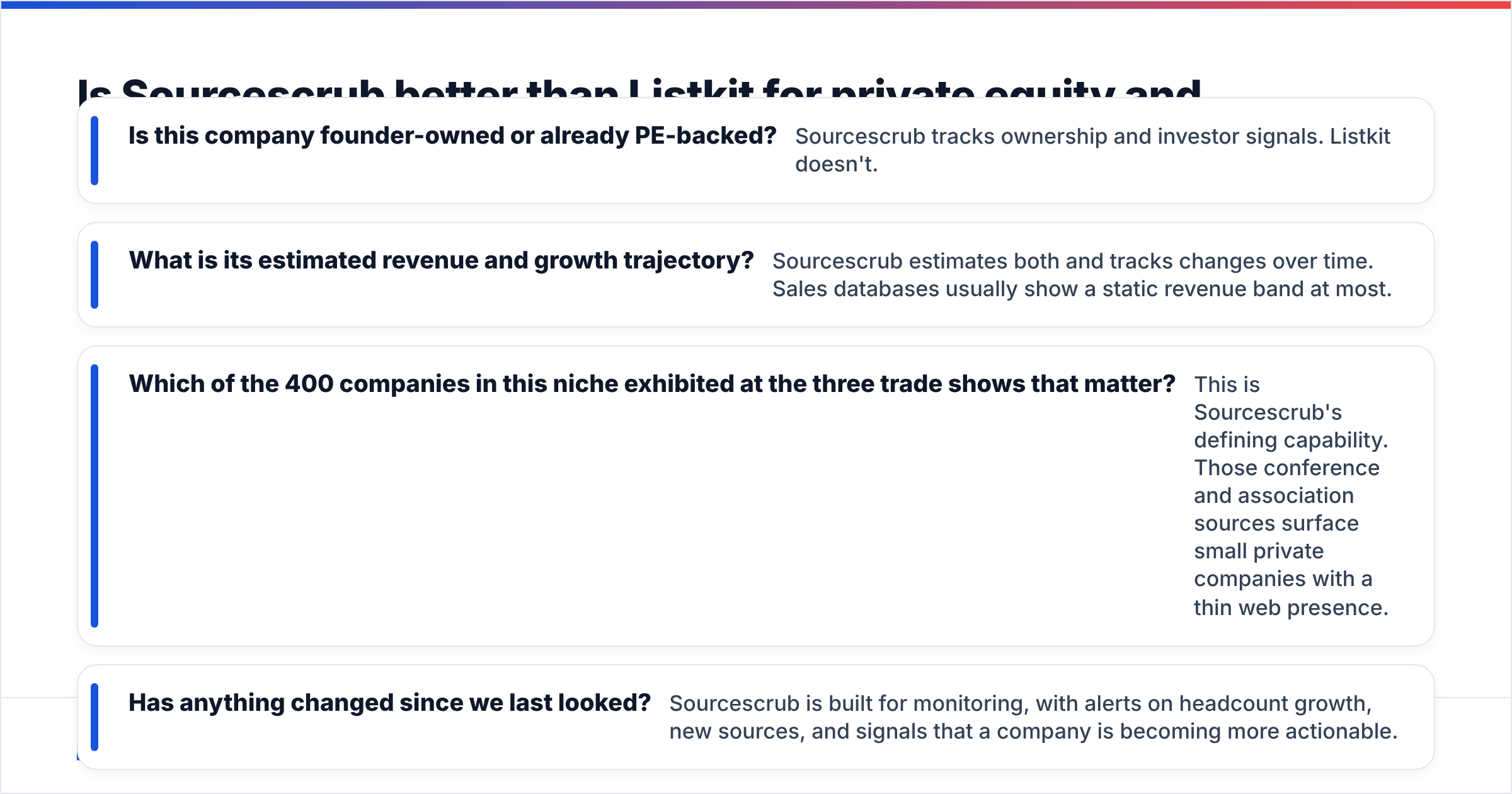
- Is this company founder-owned or already PE-backed? Sourcescrub tracks ownership and investor signals. Listkit doesn't.
- What is its estimated revenue and growth trajectory? Sourcescrub estimates both and tracks changes over time. Sales databases usually show a static revenue band at most.
- Which of the 400 companies in this niche exhibited at the three trade shows that matter? This is Sourcescrub's defining capability. Those conference and association sources surface small private companies with a thin web presence.
- Has anything changed since we last looked? Sourcescrub is built for monitoring, with alerts on headcount growth, new sources, and signals that a company is becoming more actionable.
A mid-market PE associate may spend weeks building a thesis on one niche. For that work, paying for a platform that finds 30 more qualified targets is easy to justify. One closed deal pays for many years of subscription. That's the math behind Sourcescrub's price, and it's the reason the math never works for an SDR team.
Where does each tool's data come from, and how accurate is it?#
Data provenance matters more than database size. Both vendors quote large numbers, but you only need to know whether the records you'll actually use are correct.
Listkit combines contact data from several providers and then runs verification on export. Verification gives you a strong signal on deliverability (will the mailbox accept mail?) but no guarantee that the person still holds the job the record shows. Independent reviews generally rate its email validity well for mainstream personas in the US and Western Europe, with weaker coverage for niche industries and smaller markets.
Sourcescrub is strongest where most sales databases are weakest: small private companies. Its revenue and headcount numbers are estimates. Treat them as directionally useful for screening, not as diligence-grade figures. Its contact coverage for owners and CEOs is useful, but deal teams often run those contacts through a separate verification step before outreach. Owner emails at small businesses are often on catch-all domains or use formats that don't follow a standard pattern.
That verification step applies to both tools. Whatever your source, check any address against a dedicated email verifier before it goes into a sequence, particularly on catch-all domains, where a "valid" result only means the server accepts everything.
What are the pros and cons of each?#
Listkit pros
- Transparent public pricing starting at $97/mo
- Unlimited users on every plan
- Verification built into export, so you get fewer surprise bounces
- Fast list-building through AI company search
Listkit cons
- No free trial
- Credits expire monthly with no rollover
- Built for persona-based prospecting, not company research
- Coverage gets thinner in niche verticals and outside core markets
Sourcescrub pros
- Among the deepest coverage of lower-middle-market private companies available
- Unique conference, association, and buyer's-guide sources
- Ownership, growth, and monitoring signals built for deal teams
- Integrates with deal CRMs used in private capital
Sourcescrub cons
- No public pricing; annual contracts at an institutional price point
- Overkill for sales prospecting
- Revenue and headcount figures are estimates, not verified financials
- Contact data is a secondary feature, not the product's core
Which one should you choose?#
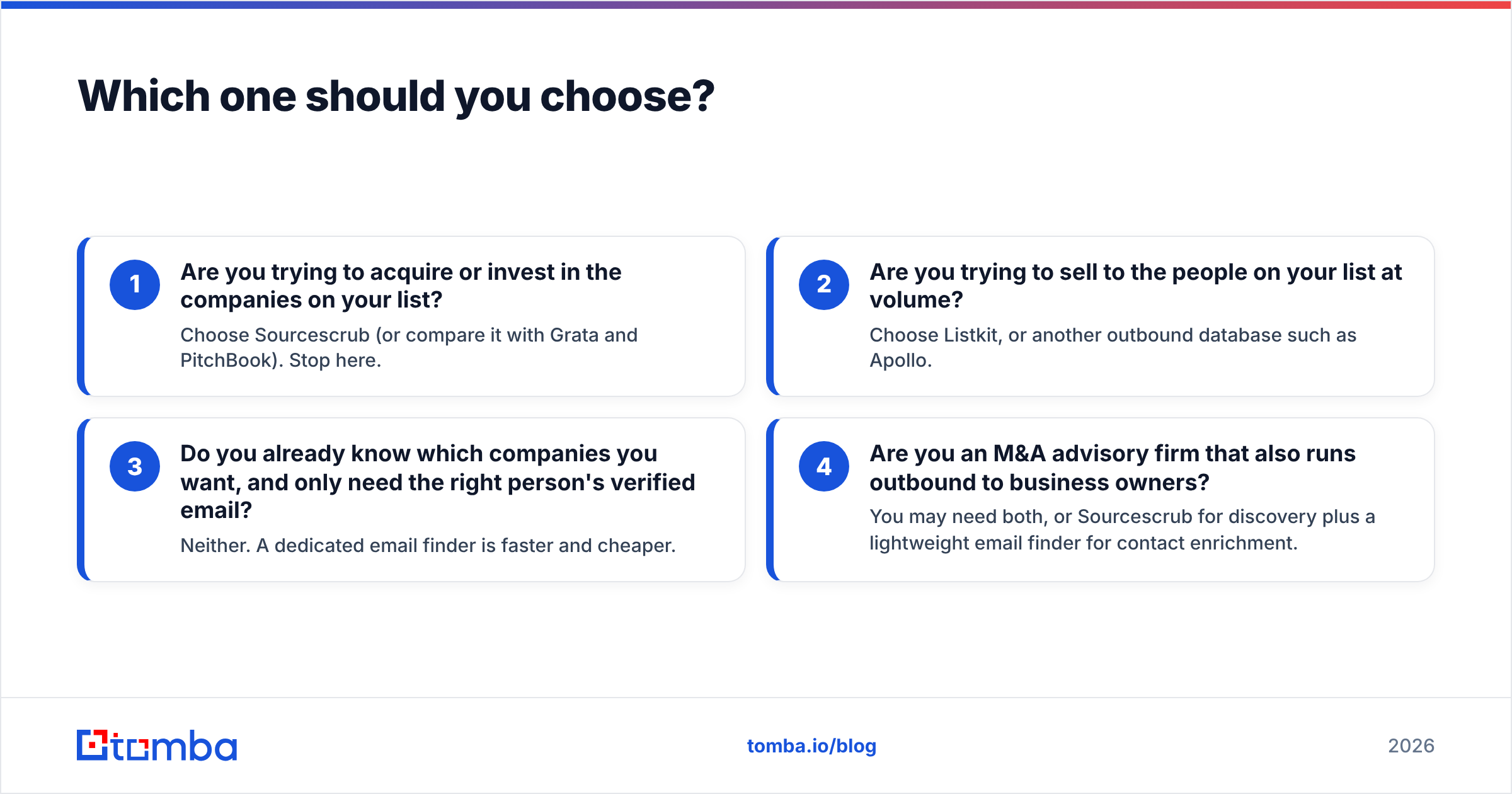
Use this decision path. It resolves almost every "Listkit vs Sourcescrub" question in under a minute.
- Are you trying to acquire or invest in the companies on your list? Choose Sourcescrub (or compare it with Grata and PitchBook). Stop here.
- Are you trying to sell to the people on your list at volume? Choose Listkit, or another outbound database such as Apollo.
- Do you already know which companies you want, and only need the right person's verified email? Neither. A dedicated email finder is faster and cheaper.
- Are you an M&A advisory firm that also runs outbound to business owners? You may need both, or Sourcescrub for discovery plus a lightweight email finder for contact enrichment.
The third scenario is more common than most buyers expect. Many teams that shortlist Listkit already have their target accounts from a CRM, an event attendee list, or a Sourcescrub export. They don't need another database. They need verified emails for specific people at specific domains.

Do you need either tool if you only need emails?#
Often you don't. Both platforms charge for a lot you won't use if all you need is contact emails.
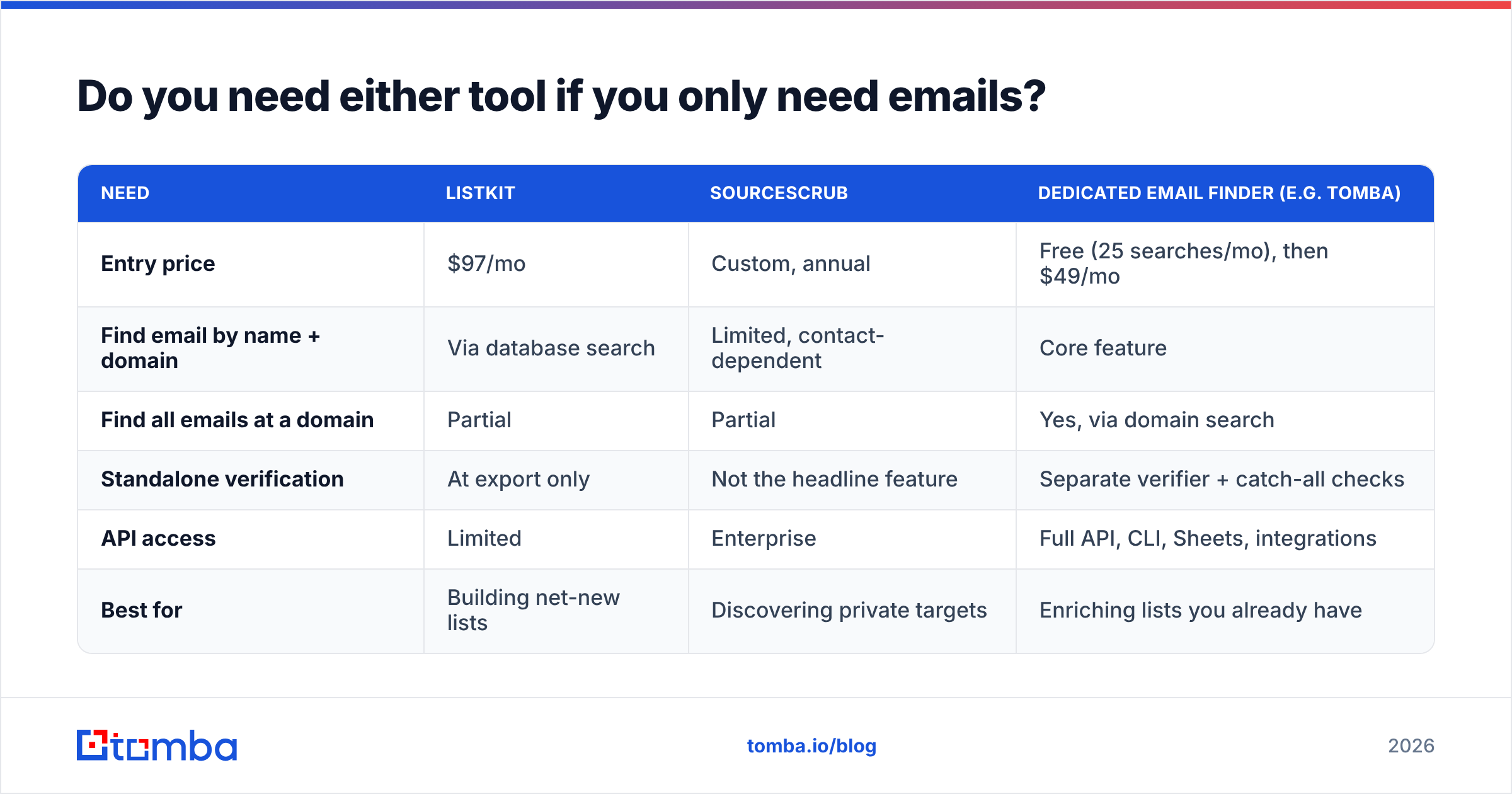
Here is how the three most common approaches compare when the job is simply "get me verified emails for these accounts":
| Need | Listkit | Sourcescrub | Dedicated email finder (e.g. Tomba) |
|---|---|---|---|
| Entry price | $97/mo | Custom, annual | Free (25 searches/mo), then $49/mo |
| Find email by name + domain | Via database search | Limited, contact-dependent | Core feature |
| Find all emails at a domain | Partial | Partial | Yes, via domain search |
| Standalone verification | At export only | Not the headline feature | Separate verifier + catch-all checks |
| API access | Limited | Enterprise | Full API, CLI, Sheets, integrations |
| Best for | Building net-new lists | Discovering private targets | Enriching lists you already have |
If your account list already exists, whether it comes from Sourcescrub, a trade show, or your CRM, you can find email addresses for the right contacts by name and domain, or run a domain search to see every public address at a company. Deal teams in particular find this useful: the discovery platform supplies the company, and a lightweight finder supplies a verified owner email without adding another five-figure seat. The full tier breakdown is on the Tomba pricing page.
What do reviewers say about each?#
Review sites help here, but read them with care because the two products attract very different reviewers. Listkit reviews on G2 come mostly from agency owners and outbound operators. They praise the speed and verified exports and complain about credit expiry. Sourcescrub reviews come from associates and VPs at PE firms. They praise private-company coverage and the conference sourcing and note that revenue estimates need a sanity check. Neither group is evaluating what the other group cares about, so don't compare star ratings across the two as though the products were interchangeable.
Before you sign anything, run a small real-world test with each tool you're considering:
- Listkit: buy one month of Professional, export 500 contacts in your exact ICP, send to them from a warmed secondary domain, and measure the bounce rate yourself.
- Sourcescrub: ask for a trial scoped to one live thesis, and count how many targets it surfaces that your current tools missed.
These two tests will tell you more than any comparison article, this one included.
The bottom line on Listkit vs Sourcescrub#
Listkit and Sourcescrub only look similar from far away. Listkit is an affordable, credit-based list builder for teams whose success is measured in replies and meetings. Sourcescrub is an institutional-grade discovery engine for teams whose success is measured in closed deals and deployed capital. Pick based on the job: outbound volume points to Listkit, and private-market deal flow points to Sourcescrub.
If you already know your target accounts and only need the right person's verified address, you probably need neither. Tomba Email Finder lets you find professional emails by name, domain, or company, verify them in the same workflow, and push them to your CRM or sequencer. It starts free with 25 searches a month and costs $49/mo when you need more. It's a practical way to close the contact-data gap without paying for a database built for someone else's job.
Related guides#
// get started
Find, verify and enrich your first contacts today
Start on the free plan with 25 searches a month, then scale when your team is ready.
Free plan · No credit card required · GDPR & CCPA
Get the Tomba newsletter
Product and data updates
// about the author