Listkit vs Sparklane: B2B Lead Data Tools Compared for 2026
ListKit sells high-volume, triple-verified lead lists for cold email. Sparklane sells AI-scored buying signals for European account-based teams. Here's which one fits your outbound motion, and what each one costs.
TL;DR
- ListKit is a volume lead-list builder. You describe your ICP in plain English, it builds the list, and you export triple-verified emails. Pricing is credit-based and every plan includes unlimited users.
- Sparklane is a French sales-intelligence platform built around AI-scored business signals, predictive account scoring, and European (especially French) company data. It charges per seat, with custom enterprise tiers.
- Pick ListKit if you run high-volume cold email and care most about cost per verified contact.
- Pick Sparklane if you sell account-based into Europe and need to know when to reach an account, not only who to email.
- If what you really need is to find and verify specific decision-maker emails without paying per seat, a lighter tool may beat both. More on that below.
What are ListKit and Sparklane, and why compare them?#
On a G2 grid, these two tools sit in the same "B2B data" box. They answer different questions, though.
ListKit (listkit.io) answers "Give me 5,000 verified contacts that match this ICP, cheap." It's built for agencies, SDR teams, and founders who run outbound through tools like Instantly or Smartlead and need clean lists to feed them. Its main selling points are AI company search, triple-verification of emails, bundled intent data, and no per-seat pricing.
Sparklane (sparklane.com) answers "Which accounts in my market are about to buy, and why?" It started in France and works as a predictive sales-intelligence layer. It watches business signals like fundraising, hiring, leadership changes, expansion, and tenders, scores accounts against your ICP, and surfaces contacts plus contextual messaging inside your CRM.
So the real comparison isn't "which database is bigger." It's whether your pipeline problem comes from volume or from timing and relevance. Get that wrong and you'll overpay for signals you never use, or you'll spray lists at accounts that aren't ready to buy.
How do ListKit and Sparklane compare side by side?#
Here's the head-to-head on the attributes buyers ask about most. Prices are published list prices at the time of writing. Both vendors change plans often, so confirm on their pricing pages before you sign.
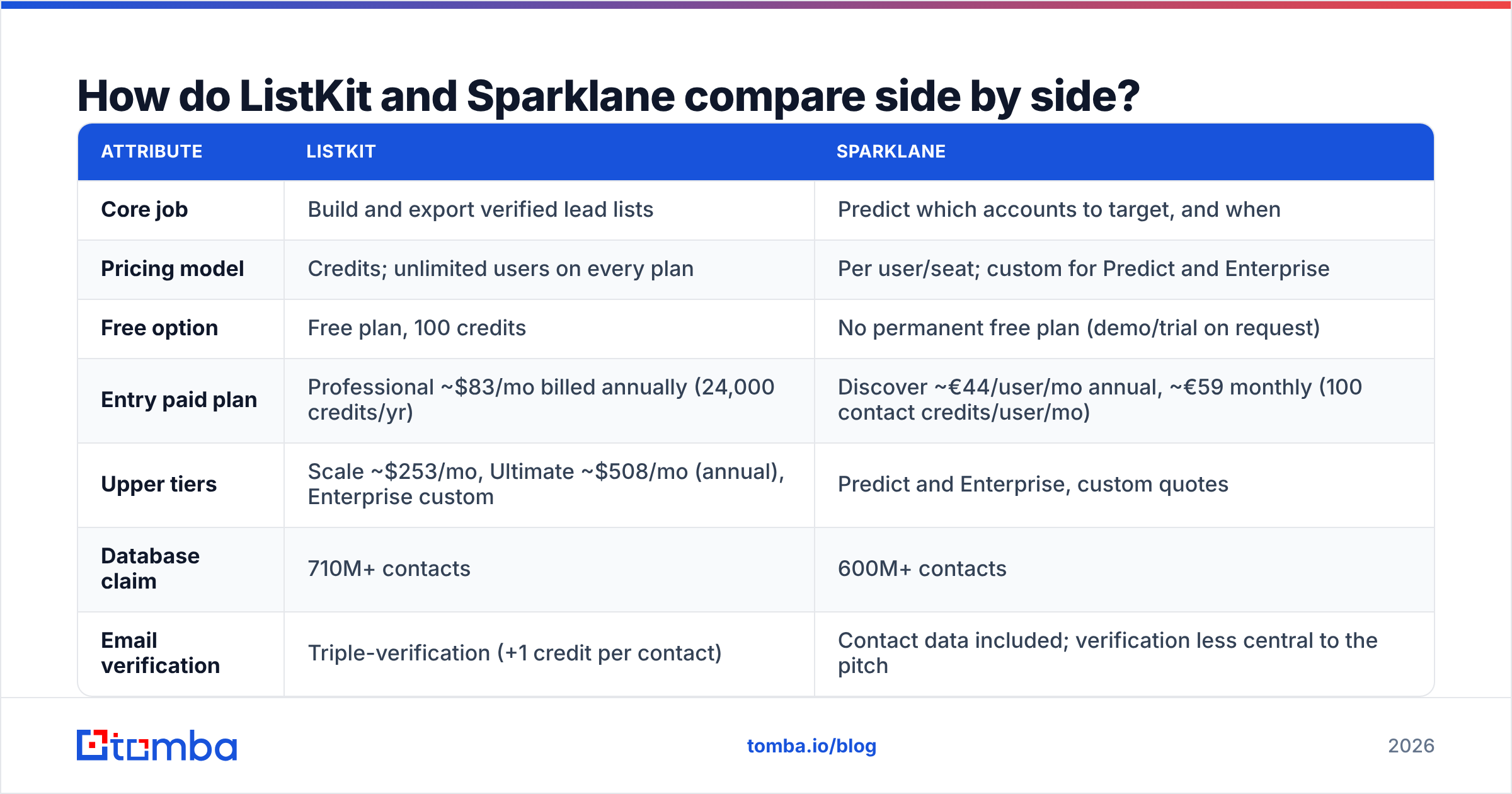
| Attribute | ListKit | Sparklane |
|---|---|---|
| Core job | Build and export verified lead lists | Predict which accounts to target, and when |
| Pricing model | Credits; unlimited users on every plan | Per user/seat; custom for Predict and Enterprise |
| Free option | Free plan, 100 credits | No permanent free plan (demo/trial on request) |
| Entry paid plan | Professional ~$83/mo billed annually (24,000 credits/yr) | Discover ~€44/user/mo annual, ~€59 monthly (100 contact credits/user/mo) |
| Upper tiers | Scale ~$253/mo, Ultimate ~$508/mo (annual), Enterprise custom | Predict and Enterprise, custom quotes |
| Database claim | 710M+ contacts | 600M+ contacts |
| Email verification | Triple-verification (+1 credit per contact) | Contact data included; verification less central to the pitch |
| Intent / signals | Intent data bundled | Core product: AI-scored business signals, predictive scoring |
| Geographic strength | Broad, US-leaning B2B coverage | Strongest in France and Europe |
| Best-fit buyer | Agencies, SDR teams, cold-email operators | Account-based enterprise and mid-market sales teams in Europe |
| CRM integrations | Major CRMs included on all plans | Dynamics 365, HubSpot, Pipedrive, Salesloft, Marketo, SugarCRM and others |
The pricing models alone tell you who each tool is for. ListKit's cost grows with how many contacts you pull. Sparklane's cost grows with how many people use it. A five-person SDR team pulling 20,000 contacts a month feels those two models very differently.
How does each tool actually work day to day?#
The workflows differ enough that they're worth walking through.
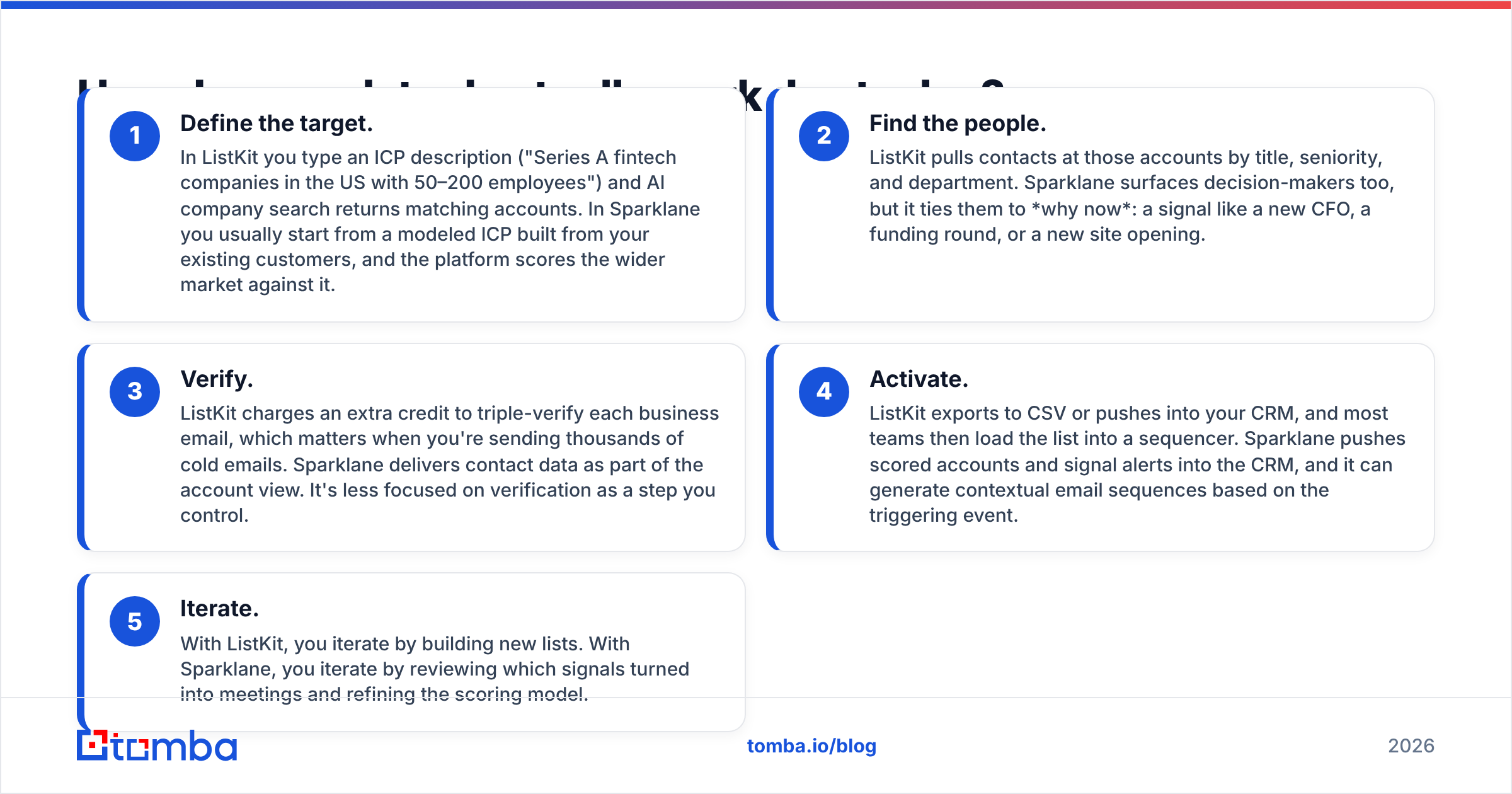
- Define the target. In ListKit you type an ICP description ("Series A fintech companies in the US with 50–200 employees") and AI company search returns matching accounts. In Sparklane you usually start from a modeled ICP built from your existing customers, and the platform scores the wider market against it.
- Find the people. ListKit pulls contacts at those accounts by title, seniority, and department. Sparklane surfaces decision-makers too, but it ties them to why now: a signal like a new CFO, a funding round, or a new site opening.
- Verify. ListKit charges an extra credit to triple-verify each business email, which matters when you're sending thousands of cold emails. Sparklane delivers contact data as part of the account view. It's less focused on verification as a step you control.
- Activate. ListKit exports to CSV or pushes into your CRM, and most teams then load the list into a sequencer. Sparklane pushes scored accounts and signal alerts into the CRM, and it can generate contextual email sequences based on the triggering event.
- Iterate. With ListKit, you iterate by building new lists. With Sparklane, you iterate by reviewing which signals turned into meetings and refining the scoring model.
If step 3 is where your campaigns break (bounces, catch-all domains, burned sending domains), keep an independent email verifier in your stack no matter which platform you choose. Neither vendor's verification replaces a pre-send check on lists you've aged for weeks.

Is ListKit cheaper than Sparklane?#
For most outbound teams, yes, and by a wide margin once you add more than a couple of users.
Take a typical five-rep SDR team:
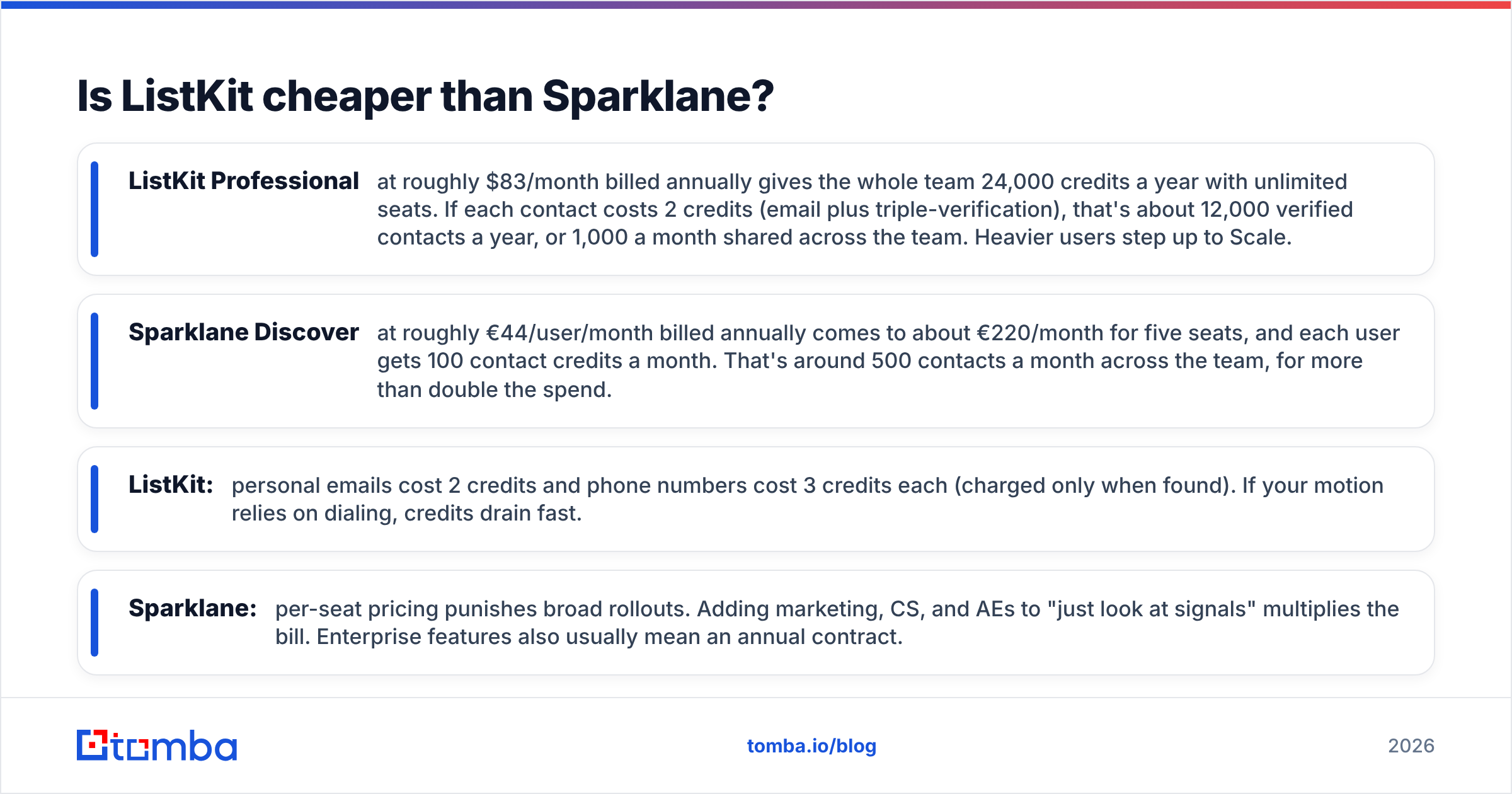
- ListKit Professional at roughly $83/month billed annually gives the whole team 24,000 credits a year with unlimited seats. If each contact costs 2 credits (email plus triple-verification), that's about 12,000 verified contacts a year, or 1,000 a month shared across the team. Heavier users step up to Scale.
- Sparklane Discover at roughly €44/user/month billed annually comes to about €220/month for five seats, and each user gets 100 contact credits a month. That's around 500 contacts a month across the team, for more than double the spend.
Sparklane isn't overpriced, though. It's priced for a different output. Discover is its entry tier, and the product's real value (predictive scoring, 50+ targeting attributes, signal-based prioritization) sits in the custom-quoted Predict and Enterprise plans. You're paying for a smaller number of better-timed conversations, not a bigger list.
Watch these hidden costs:
- ListKit: personal emails cost 2 credits and phone numbers cost 3 credits each (charged only when found). If your motion relies on dialing, credits drain fast.
- Sparklane: per-seat pricing punishes broad rollouts. Adding marketing, CS, and AEs to "just look at signals" multiplies the bill. Enterprise features also usually mean an annual contract.
Which has better data quality and coverage?#
It depends on where your buyers are.
ListKit leans toward broad, English-speaking B2B markets, with the US strongest. Triple-verification is a real advantage for cold email because it cuts hard bounces before they hurt your sender reputation. The trade-off matches every high-volume list tool: records go stale, and titles and companies change faster than any database refreshes. Verify at send time, not at export time.
Sparklane is at its best in France and wider Europe. It draws on local company registries, press, legal announcements, and hiring data that US-centric databases often miss or only cover lightly. If you sell to French mid-market companies, public-sector bodies, or industrial firms, that depth is hard to match. As a European vendor, it also builds its data practices around GDPR, which matters to legal and procurement teams at EU enterprises.
In practice:
- US or global SMB outbound: ListKit's coverage and verification will usually serve you better.
- French or European enterprise ABM: Sparklane's signal data and local depth win.
- Mixed geography: you'll probably end up running a list tool plus a verifier, or a signals tool plus a separate contact-finding layer.
Does Sparklane's intent data beat ListKit's?#
They're different kinds of "intent."
ListKit bundles intent data into every plan. It's useful for filtering lists toward companies researching relevant topics, and it's a nice extra that helps prioritize within a big list.
For Sparklane, signals are the product. Its AI watches business events, scores each account's likelihood to buy, and alerts reps with the context to open a conversation ("Congrats on the new Lyon facility; teams scaling production usually hit X"). That's closer to what platforms like 6sense or Demandbase do for the US market, and it fits account-based teams that work a defined territory in depth.
If your reps each own 150 named accounts, Sparklane's approach is the stronger one. If your team sends 10,000 emails a week across an open market, ListKit's "intent as a filter" is all you need, and paying for predictive scoring would be overkill.
Who should choose ListKit?#
Choose ListKit if most of these apply:
- You run cold email at volume. You need thousands of verified contacts a month to feed Instantly, Smartlead, or a similar sequencer.
- You have many users. Agencies and growing SDR teams benefit hugely from unlimited seats.
- Your market is broad and US-leaning. SaaS, agencies, e-commerce, and professional services targeted by title and firmographics.
- Cost per contact is your key metric. Credit-based pricing makes unit economics easy to model.
- You want self-serve. Sign up, build a list, and export in an afternoon without a sales call.
Who should choose Sparklane?#
Choose Sparklane if most of these apply:
- You sell into France or Europe. Local data depth and GDPR alignment matter to your buyers and your legal team.
- You run account-based sales. Reps own named territories and need to know which accounts to work this week.
- Your deals are larger and your cycles longer. A few well-timed conversations are worth more than thousands of cold touches.
- Your CRM is the center of your process. Sparklane's value shows up as prioritized accounts and alerts inside Dynamics, HubSpot, or Salesforce-adjacent stacks.
- You have budget for a platform, not a list. The Predict and Enterprise tiers are where the differentiation lives.

Is there a simpler alternative to both?#
For many teams, yes, because the real job is narrower than either platform.
A lot of buyers who evaluate ListKit or Sparklane already know which companies they want. The list is in a spreadsheet, a CRM view, a conference attendee export, or a Sparklane signal alert. What they're missing is the right person's verified email address. Paying for a full list-building platform or a per-seat intelligence suite to solve that one step is like buying a delivery truck to carry groceries.
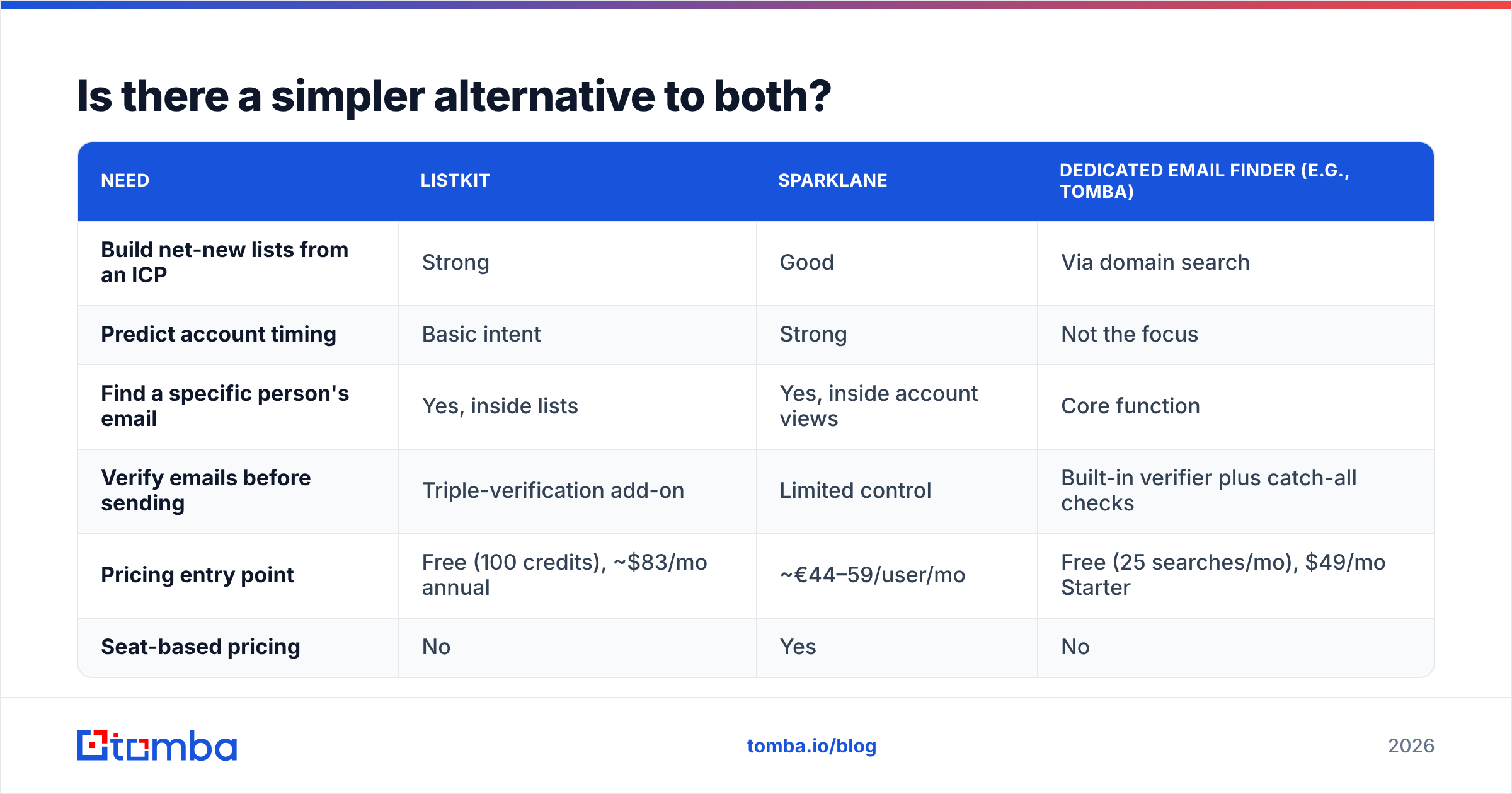
That's where a dedicated email finder fits. You feed it a domain, or a name plus company, and get back the address with a confidence score and sources. Then you run a verifier before sending. The comparison looks like this:
| Need | ListKit | Sparklane | Dedicated email finder (e.g., Tomba) |
|---|---|---|---|
| Build net-new lists from an ICP | Strong | Good | Via domain search |
| Predict account timing | Basic intent | Strong | Not the focus |
| Find a specific person's email | Yes, inside lists | Yes, inside account views | Core function |
| Verify emails before sending | Triple-verification add-on | Limited control | Built-in verifier plus catch-all checks |
| Pricing entry point | Free (100 credits), ~$83/mo annual | ~€44–59/user/mo | Free (25 searches/mo), $49/mo Starter |
| Seat-based pricing | No | Yes | No |
Tomba's plans run from a free tier (25 searches/month) through Starter at $49/month, Growth at $99/month, Pro at $249/month, and custom Enterprise. See the Tomba pricing page for credit details. Teams that already get signals from Sparklane often pair it with a lighter finder and verifier for the contacts the platform misses. ListKit users sometimes do the same for re-verifying older exports.
So, ListKit vs Sparklane: which should you pick?#
ListKit wins for volume outbound. If your pipeline math is "more verified contacts in, more meetings out," its credit pricing, unlimited seats, and triple-verification give it the lower cost per usable contact.
Sparklane wins for European account-based selling. If your reps work defined territories, sell larger deals, and need to know why now for each account, its signal-scoring and French/European data depth justify the per-seat price, especially on the Predict tier.
A quick way to decide: count how many accounts each rep touches per month. Under ~200 named accounts points to Sparklane's model. Thousands of contacts points to ListKit. If the honest answer is "we already know the accounts, we just need the emails," you may not need either platform.
Before committing, run a two-week pilot with each. Pull the same 200 target accounts, compare match rate, bounce rate after verification, and meetings booked. Your own data beats any review, this one included.
Where does Tomba fit into your stack?#
If your bottleneck is getting from "the right company" to "the right inbox," Tomba Email Finder does that one job without seat fees or a platform contract. Enter a domain or a name plus company and you get professional email addresses with confidence scores and public sources. Verification and catch-all checks sit right alongside it, and you can start free with 25 searches a month. Use it on its own, or next to ListKit or Sparklane to fill gaps and re-verify contacts before every send.
Related guides#
// get started
Find, verify and enrich your first contacts today
Start on the free plan with 25 searches a month, then scale when your team is ready.
Free plan · No credit card required · GDPR & CCPA
// about the author