ListKit vs The Data City: Lead Lists or UK Sector Intelligence?
ListKit builds verified outbound lead lists for about $97 a month. The Data City maps UK industries for £10,000 a year and up. They solve different problems, and this guide shows which one your team needs.
TL;DR
- ListKit is a lead list builder for outbound teams. It sells credits, verifies every exported email three times, and starts free with 100 credits a month. The paid Professional plan costs about $97/month.
- The Data City is a UK company and sector intelligence platform. It classifies businesses with its own Real-Time Industrial Classifications (RTICs). Annual licences start at £10,000.
- The two tools answer different questions. ListKit tells you who to email. The Data City tells you which UK companies make up a market and how that market is growing.
- If you want to book meetings, pick ListKit or a cheaper email finder. If you're sizing a UK sector, building a policy case, or mapping clusters, pick The Data City.
- Some teams use both: The Data City to define the target universe, and an email finder to reach the people inside it.
People search "ListKit vs The Data City" because both tools show up when you look for B2B company data. Past that, the overlap is small. One is a self-serve prospecting tool priced for sales reps. The other is a research platform priced for government bodies, universities, trade associations, and investors. Buy the wrong one and you either pay five figures for data you can't use in a sequence, or you get a contact list that can't tell you anything about market structure.
This guide compares them on what they do, what they cost, and which buyer each one suits.
What is ListKit?#
ListKit is a B2B lead database for cold email. You filter by job title, industry, company size, location, and technology. You pull a list, and every email in the export goes through triple verification before you download it. ListKit's pitch is that you get sequence-ready contacts without having to clean the data yourself.
The feature set is the same on every plan. Tiers differ only in how many credits you get. Every plan includes unlimited users, AI company search, triple verification, intent data, data enrichment, and CRM integrations.
According to ListKit's credit documentation, credits are spent like this:
- Business email: 1 credit, with triple verification costing 1 more
- Personal email: 2 credits
- US mobile number: 3 credits, charged only when a number is found
Verification is mandatory, so an export costs more per contact than the headline rate suggests. Your list will be cleaner for it, though. ListKit says its process delivers roughly 98% deliverability at scale. That's the vendor's own figure. Check it against your bounce rates on a first campaign before you commit to a large plan.
What is The Data City?#
The Data City is a UK data provider focused on emerging sectors, high-growth companies, innovation clusters, and investment. Its database covers millions of UK companies. Its main idea is to replace SIC codes with Real-Time Industrial Classifications (RTICs).
SIC codes have been used to classify British industry since the 1980s, and they struggle with anything modern. A net-zero hydrogen startup, a cybersecurity scale-up, and a generic IT consultancy can all end up in the same "other" bucket. The Data City uses machine learning on company websites and other sources to put businesses into more than 400 emerging-sector classifications. That makes questions like these answerable:
- How many companies in the West Midlands work in battery technology?
- How has employment in the UK space sector changed over three years?
- Which regional clusters are pulling in the most investment in immersive tech?
The platform comes with reporting dashboards, an API, a Data Services team, and optional add-ons such as jobs and skills data. The customer base is policy-heavy: government departments, local authorities, universities, think tanks, and trade associations.
The Data City is not built as a contact finder. It's a market-definition and economic-intelligence tool. You can export company lists from it. What you won't get is a sequence of verified personal work emails ready to load into Instantly.

How do ListKit and The Data City compare side by side?#
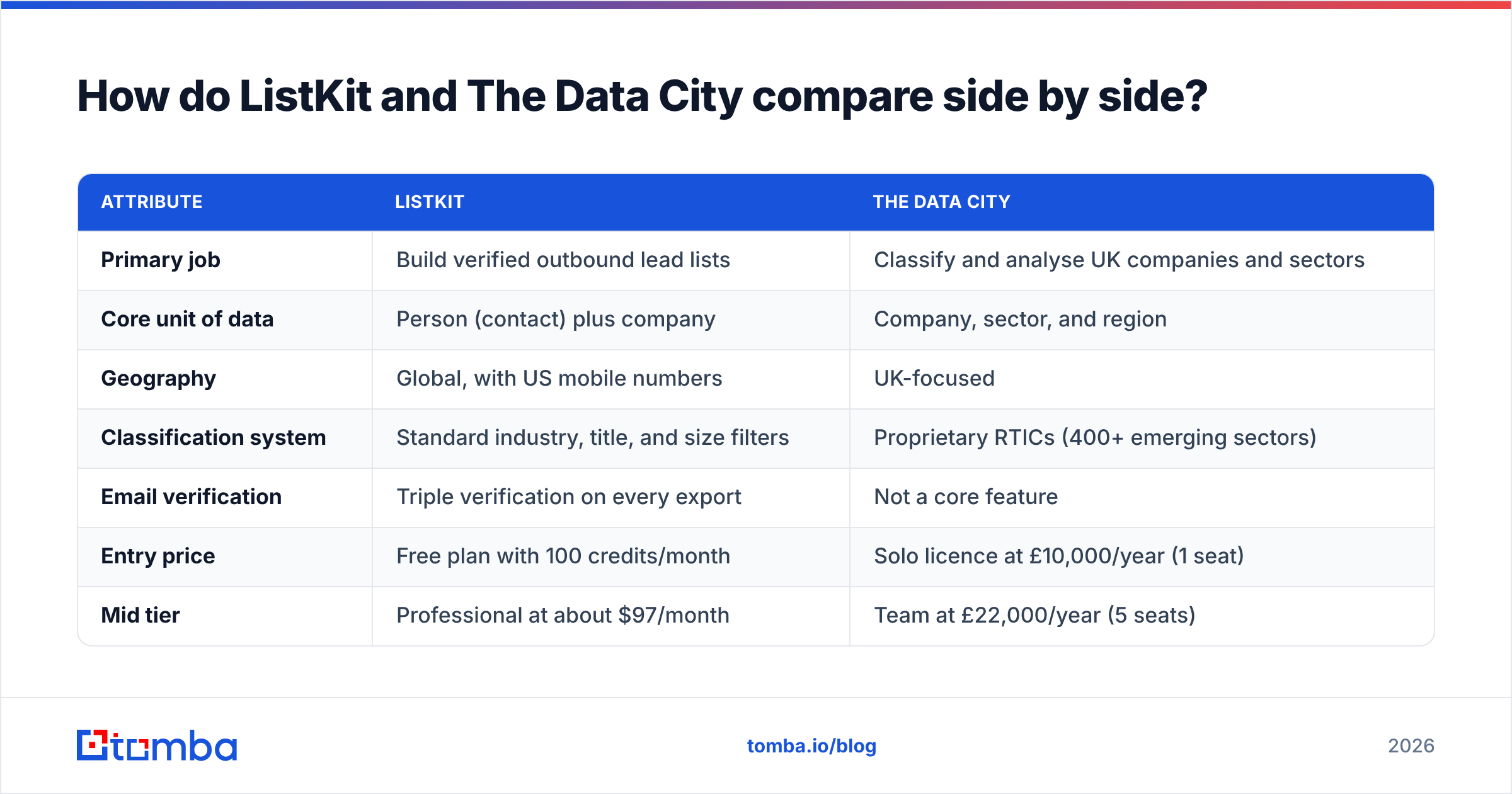
This table covers the attributes that matter most when you're choosing between them.
| Attribute | ListKit | The Data City |
|---|---|---|
| Primary job | Build verified outbound lead lists | Classify and analyse UK companies and sectors |
| Core unit of data | Person (contact) plus company | Company, sector, and region |
| Geography | Global, with US mobile numbers | UK-focused |
| Classification system | Standard industry, title, and size filters | Proprietary RTICs (400+ emerging sectors) |
| Email verification | Triple verification on every export | Not a core feature |
| Entry price | Free plan with 100 credits/month | Solo licence at £10,000/year (1 seat) |
| Mid tier | Professional at about $97/month | Team at £22,000/year (5 seats) |
| Upper tier | Scale at about $297/month; Enterprise custom | Department at £35,000/year; projects from £20,000 |
| Users | Unlimited users on all plans | Priced per seat bundle |
| Typical buyer | SDRs, agencies, founders doing outbound | Government, universities, trade bodies, investors |
| Buying motion | Self-serve, monthly | Annual licence, often via procurement |
Pricing taken from each vendor's public pages at the time of writing. The Data City lists its prices on its pricing page. Multi-year licences and charities get a 10% discount there.
Which one has better data?#
It depends on what "better" means for your use case, because the two tools measure different things.
ListKit's strength is how usable each contact is. Every email is checked three times before export, so the list is ready for outreach. The trade-off is depth of company context. You get firmographics and some intent signals. You don't get a view of how an industry is structured or how it is changing.
The Data City's strength is classification accuracy. If you need every UK company doing precision agriculture, SIC codes will miss half of them and put in plenty that don't belong. RTICs are designed to fix that. The platform also tracks growth, employment, and investment over time, which a sales database doesn't try to do.
So each tool does its own job well. ListKit gives the more accurate answer to "is this email real?" The Data City gives the more accurate answer to "is this company actually in the sector I care about?"
How do the pricing models differ?#
The cost gap is large, and it tells you who each product is for.
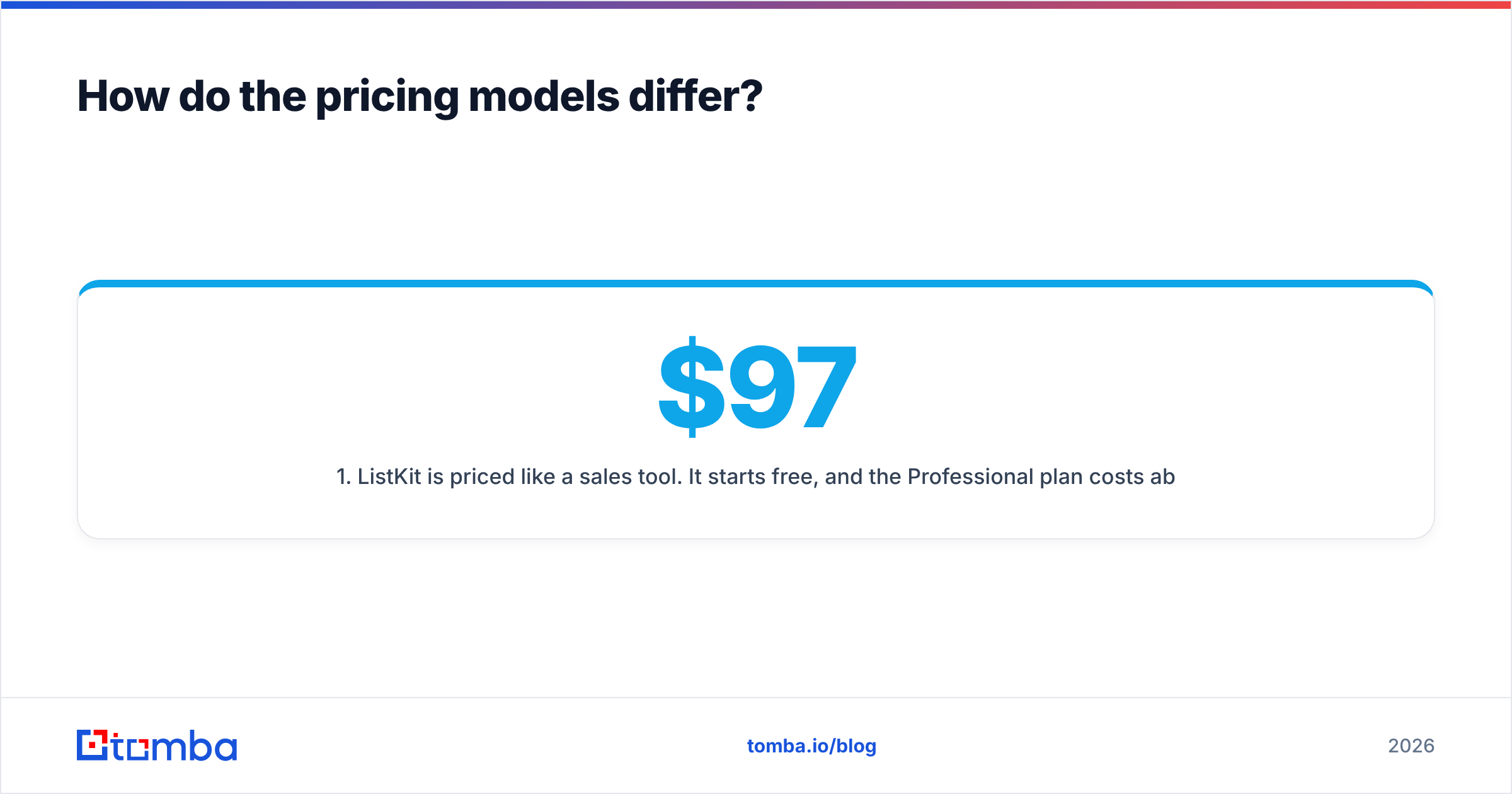
- ListKit is priced like a sales tool. It starts free, and the Professional plan costs about $97/month, or roughly $1,164 a year. Even the Scale plan at about $297/month comes to around $3,564 a year, well below The Data City's cheapest licence.
- The Data City is priced like a research licence. The Solo plan is £10,000/year for one seat. Team is £22,000/year for five seats. Department is £35,000/year. Each user can download up to 200,000 records a year, and the Data Services team is included.
- Custom work costs extra. RTIC sponsorship, where you help define and build a new sector in the platform, runs £20,000 to £25,000 per year. Bespoke projects start at £20,000.
- Contract terms differ too. ListKit runs month to month. The Data City sells annual licences, with a discount for multi-year terms.
For a five-person SDR team, ListKit costs a small fraction of a Team licence. For a regional growth agency that has to publish a defensible sector report, ListKit wouldn't produce the report at any price. At £22,000 a year, The Data City is the right purchase for that job.
When should you choose ListKit?#
Pick ListKit if most of these describe you:
- You run cold email and need contacts every week, not sector reports every quarter.
- You care about bounce rates and sender reputation, and you want verification built into the export.
- You prospect outside the UK, or you need US mobile numbers.
- You want a monthly plan you can cancel, with no procurement cycle.
- Your team shares one account, so unlimited users on every plan makes a real difference.
ListKit has weaknesses too. Mandatory verification raises the real cost per contact. Credits run out faster than first-time buyers expect. Filters based on standard industry taxonomies won't find niche emerging-tech companies as well as a classification-first platform would.
When should you choose The Data City?#
Pick The Data City if most of these fit:
- Your output is a report, a funding bid, a policy paper, or an investment thesis, not a sequence.
- You have to define a UK market that SIC codes describe badly, such as clean tech, AI, fintech, space, or creative industries.
- You need data over time on growth, employment, and investment by region.
- You want expert support from a Data Services team, not just a search box.
- Your organisation already buys data on annual licences and has the budget for it.
The weaknesses are the other side of those strengths. It's UK-only. The entry price is high for small teams. It doesn't give you verified personal contact data, so a sales team would still need a second tool to reach decision-makers.
Can you use ListKit and The Data City together?#
Yes. For one kind of buyer the combination works well. Think of a UK trade association, an innovation agency, or a consultancy selling into emerging sectors.
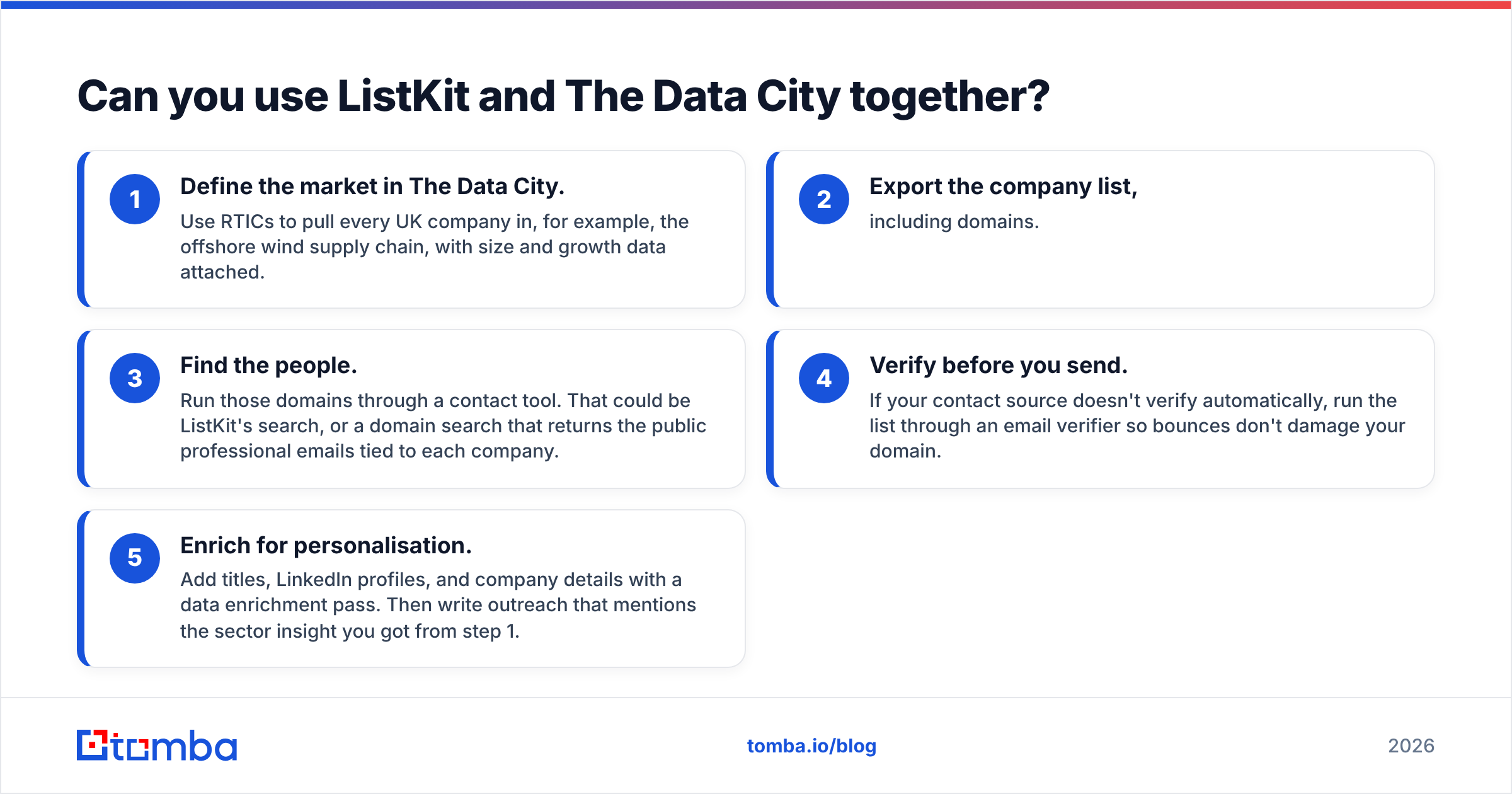
The workflow looks like this:
- Define the market in The Data City. Use RTICs to pull every UK company in, for example, the offshore wind supply chain, with size and growth data attached.
- Export the company list, including domains.
- Find the people. Run those domains through a contact tool. That could be ListKit's search, or a domain search that returns the public professional emails tied to each company.
- Verify before you send. If your contact source doesn't verify automatically, run the list through an email verifier so bounces don't damage your domain.
- Enrich for personalisation. Add titles, LinkedIn profiles, and company details with a data enrichment pass. Then write outreach that mentions the sector insight you got from step 1.
This split plays to what each tool does best. The Data City gives you a better-defined target universe than any sales database. The contact tool gets you into the inbox.

What are the most common mistakes buyers make here?#
These are the mistakes that come up most often when teams compare the two:
- Buying The Data City for prospecting. A sales leader sees "5 million UK companies" and assumes it's a lead database. Then the £22,000 Team invoice arrives, and there are no inbox-ready contacts in it.
- Using ListKit for market sizing. A ListKit search result isn't a census of an industry. Contact databases are skewed toward companies with a web and LinkedIn presence, so counts from them undercount niche and early-stage sectors.
- Ignoring the true credit cost. On ListKit, a verified business email really costs 2 credits once verification is added. Budget around that figure, not the headline 1 credit.
- Skipping the geography check. If half your pipeline is in Germany or the US, The Data City's UK focus rules it out as your main data source.
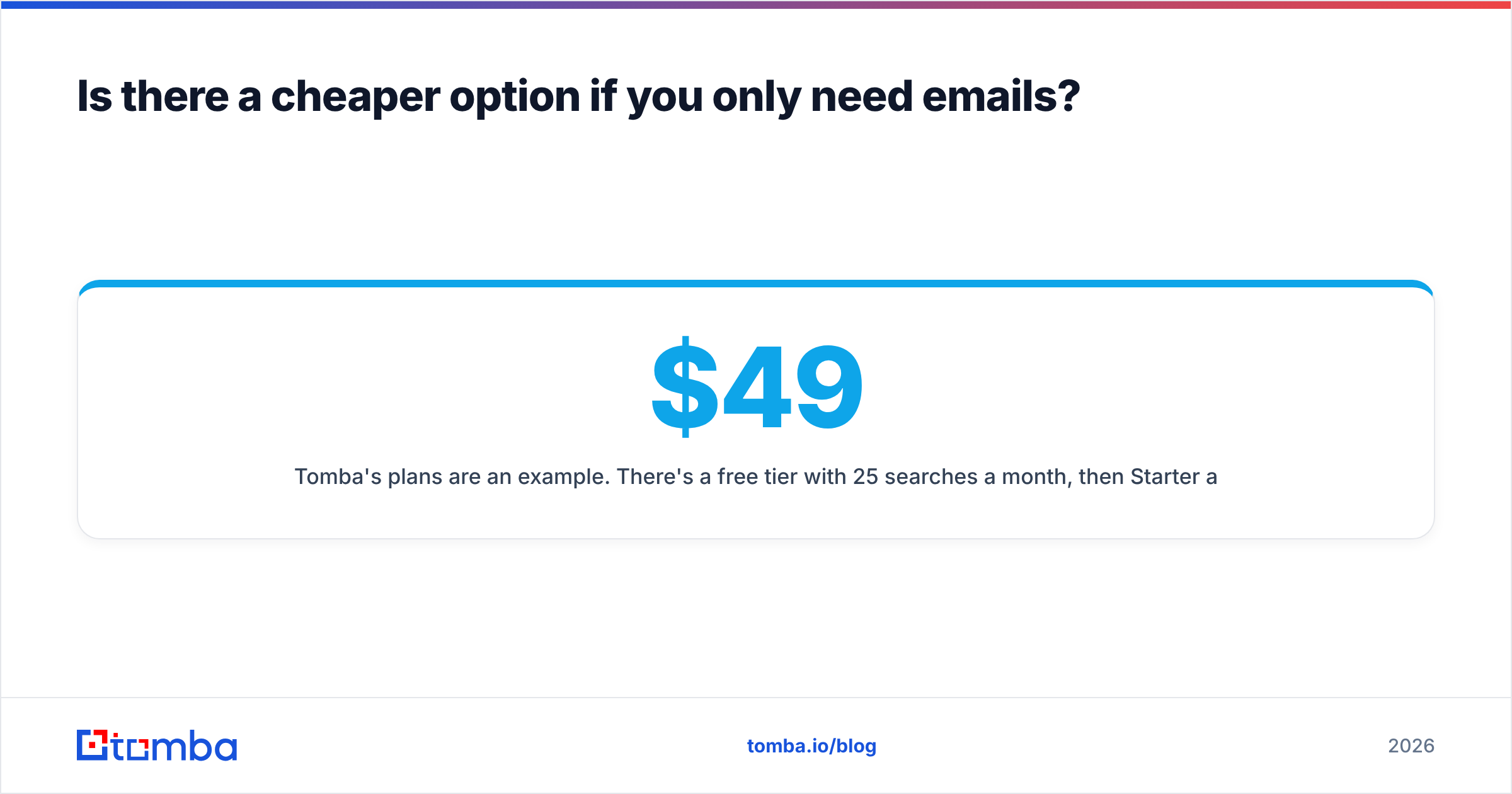
Is there a cheaper option if you only need emails?#
If what you really need is "give me the verified work email of this person at this company," both tools are more than you need. ListKit bundles list-building, intent, and enrichment. The Data City bundles sector research. A dedicated email finder covers that single job for less.
Tomba's plans are an example. There's a free tier with 25 searches a month, then Starter at $49/month, Growth at $99/month, and Pro at $249/month (full pricing details). You can look up a person by name and domain, pull every public address at a company, and verify results in the same account. It won't replace The Data City's sector classification, and it isn't designed to. It does fit well into the combined workflow above, and for small teams it costs less than a list-builder subscription.
So, ListKit vs The Data City: which should you pick?#
The two products aren't really competitors, so the decision usually comes down to what you need the data for:
- Choose ListKit if you're a sales team, agency, or founder who needs verified contacts for outbound, billed monthly, anywhere in the world.
- Choose The Data City if you're a policy body, university, trade association, investor, or consultancy that needs an accurate, classified view of UK sectors and how they're growing.
- Use both, or The Data City plus an email finder, if you sell into UK emerging sectors and need precise market definition and inbox-ready contacts.
Start from what you'll produce with the data, whether that's booked meetings or a published analysis, and the right tool is usually clear.
If your answer is "booked meetings" and you mainly need the right person's address, try Tomba Email Finder. Enter a name and company domain and get a verified professional email back. The free tier gives you 25 searches a month to test it against your target accounts before you pay for any list-building platform or research licence.
Related guides#
// get started
Find, verify and enrich your first contacts today
Start on the free plan with 25 searches a month, then scale when your team is ready.
Free plan · No credit card required · GDPR & CCPA
// about the author