ListKit vs Truemail (2026): Lead Database or Email Verifier?
ListKit sells verified B2B leads and now sending infrastructure. Truemail only checks whether emails you already have will bounce. Here's how to tell which one your outbound stack is missing.
TL;DR
- ListKit and Truemail do different jobs. ListKit is a B2B lead database: it gives you new contacts with emails it has already verified. Truemail is an email verifier: it checks addresses you already have and tells you which ones will bounce.
- ListKit costs more but gives you more. Paid plans start around $83–$97/mo for 24,000 credits a year, and the newer Bundles tier (leads plus domains and inboxes) starts at $597/mo. Truemail has a 100-credit free plan and low-cost verification tiers.
- If you're short on leads, choose ListKit. If you have plenty of contacts from your CRM, events, or scraping but your bounce rate is climbing, choose Truemail.
- Plenty of teams need both jobs done. In that case, a combined finder-plus-verifier such as Tomba usually beats paying for two separate tools.
What is the real difference between ListKit and Truemail?#
People search "ListKit vs Truemail" as if the two were competitors. They mostly aren't. They sit at different stages of the outbound workflow.
Think of a kitchen. ListKit sells you groceries that have already been washed. Truemail is the sink where you wash groceries you brought home yourself. You can have both, but what you need depends on whether you're short of food or short of clean food.
- ListKit is a prospecting database. You filter by title, industry, headcount, location, and technology. You pull contacts, and each business email comes "triple-verified" before export. In 2026 it also sells Bundles, which package lead data with pre-warmed domains and inboxes, so it now competes with cold-email infrastructure vendors as well.
- Truemail.io is an email verification service. You upload a list or call its API, and it returns a status for each address: valid, invalid, disposable, unknown, and so on. It also runs domain-health checks (SPF, DKIM, DMARC) and removes duplicates. It won't find you new people.
One naming trap: "Truemail" is also the name of an open-source Ruby validation library (truemail-rb). This post covers the hosted SaaS at truemail.io, not the gem.
How do ListKit and Truemail compare feature by feature?#
This table puts the two tools side by side on the attributes that affect your cost and your workflow.
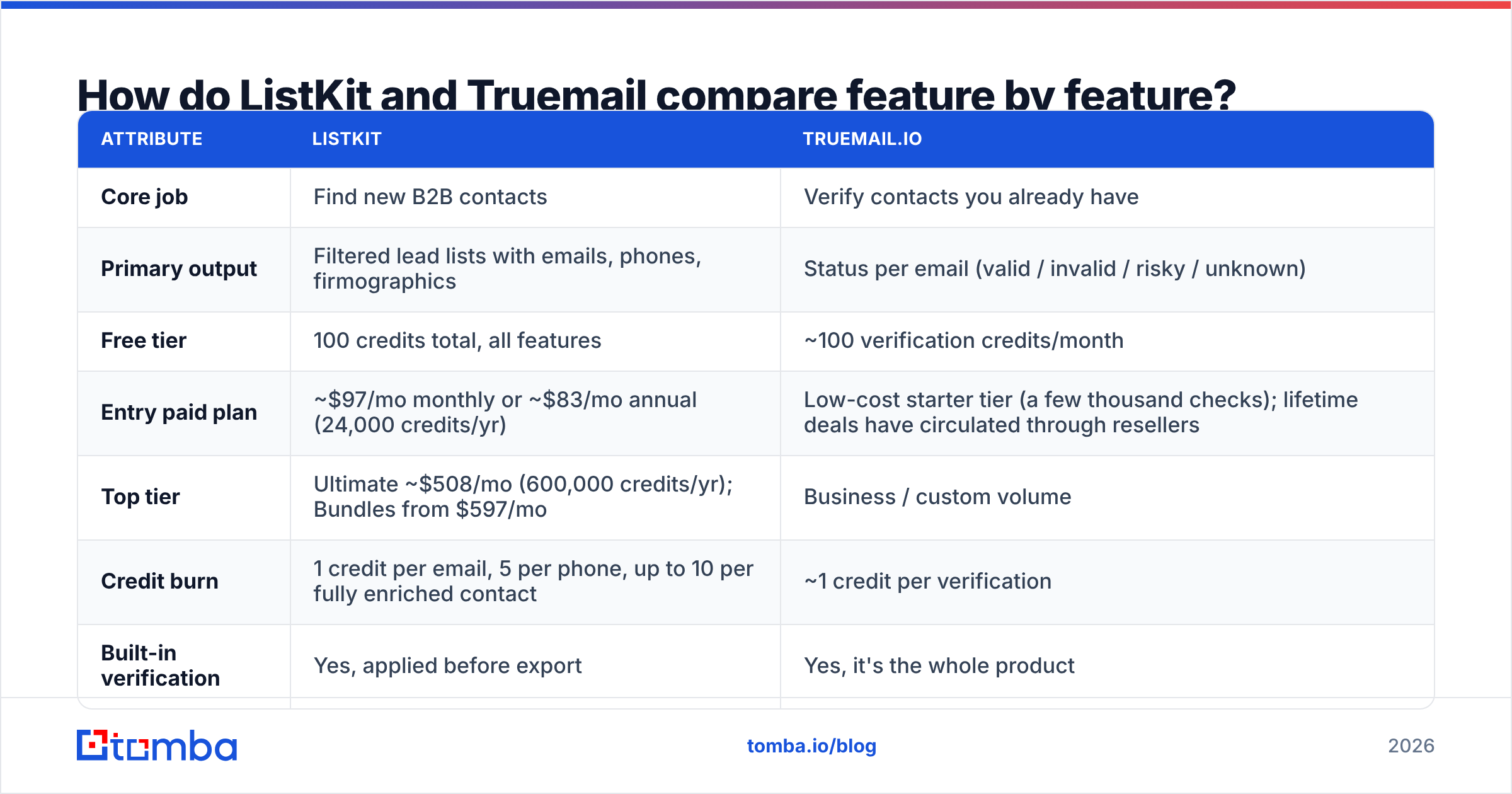
| Attribute | ListKit | Truemail.io |
|---|---|---|
| Core job | Find new B2B contacts | Verify contacts you already have |
| Primary output | Filtered lead lists with emails, phones, firmographics | Status per email (valid / invalid / risky / unknown) |
| Free tier | 100 credits total, all features | ~100 verification credits/month |
| Entry paid plan | ~$97/mo monthly or ~$83/mo annual (24,000 credits/yr) | Low-cost starter tier (a few thousand checks); lifetime deals have circulated through resellers |
| Top tier | Ultimate ~$508/mo (600,000 credits/yr); Bundles from $597/mo | Business / custom volume |
| Credit burn | 1 credit per email, 5 per phone, up to 10 per fully enriched contact | ~1 credit per verification |
| Built-in verification | Yes, applied before export | Yes, it's the whole product |
| Sending infrastructure | Yes, via Bundles (domains + inboxes) | No |
| Domain health checks | No | SPF / DKIM / DMARC checks |
| API | Yes | Yes, real-time verification API |
| Best for | Teams that need net-new pipeline | Teams sitting on unverified data |
Pricing reflects 2026 figures from ListKit's docs and third-party pricing breakdowns. Truemail's list prices have changed several times and many public numbers come from reseller deals, so check the vendor's page before you buy.
How does ListKit pricing actually work in 2026?#
ListKit's headline prices look simple. The detail that matters is how credits are spent. According to ListKit's own credit documentation, a business email costs 1 credit and a phone number costs 5. A fully enriched contact can use up to 10.
That changes the maths:
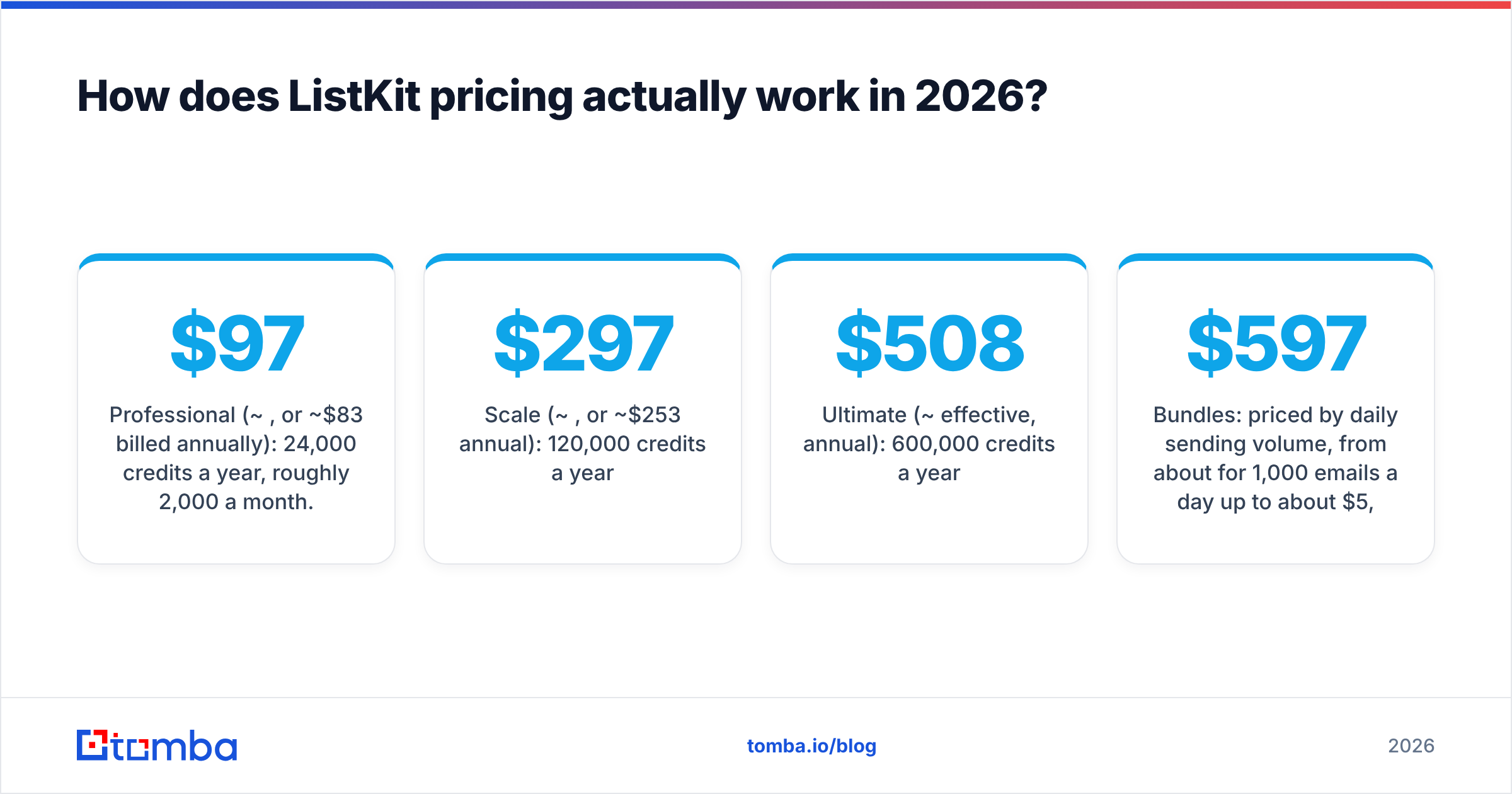
- Professional (~$97/mo, or ~$83/mo billed annually): 24,000 credits a year, roughly 2,000 a month. If you only pull emails, that's about 2,000 leads a month. If you pull every contact with a phone number and full enrichment, it could be as few as 200.
- Scale (~$297/mo, or ~$253/mo annual): 120,000 credits a year.
- Ultimate (~$508/mo effective, annual): 600,000 credits a year.
- Bundles: priced by daily sending volume, from about $597/mo for 1,000 emails a day up to about $5,970/mo for 10,000 a day. Domains are included while you stay subscribed.
The Bundles model is ListKit's real 2026 pitch: leads, inboxes, and domains from one vendor. That's convenient if you're setting up cold email from nothing. It's poor value if you already run Instantly, Smartlead, or your own Google Workspace inboxes, because you'd be paying for infrastructure you already have.

How does Truemail pricing work?#
Truemail charges a small amount per verification. The free plan gives you about 100 checks a month, which is enough to test accuracy on a sample of your own data. Paid tiers scale by verification volume, and larger volumes get custom Business pricing.
Truemail also sold heavily discounted lifetime subscriptions through deal sites (tiers from 10,000 to 60,000 verifications a month). If you bought one of those, your marginal cost per verification is close to zero, and that's a legitimate reason to keep using it.
A few things to check before you rely on any verifier, Truemail included:
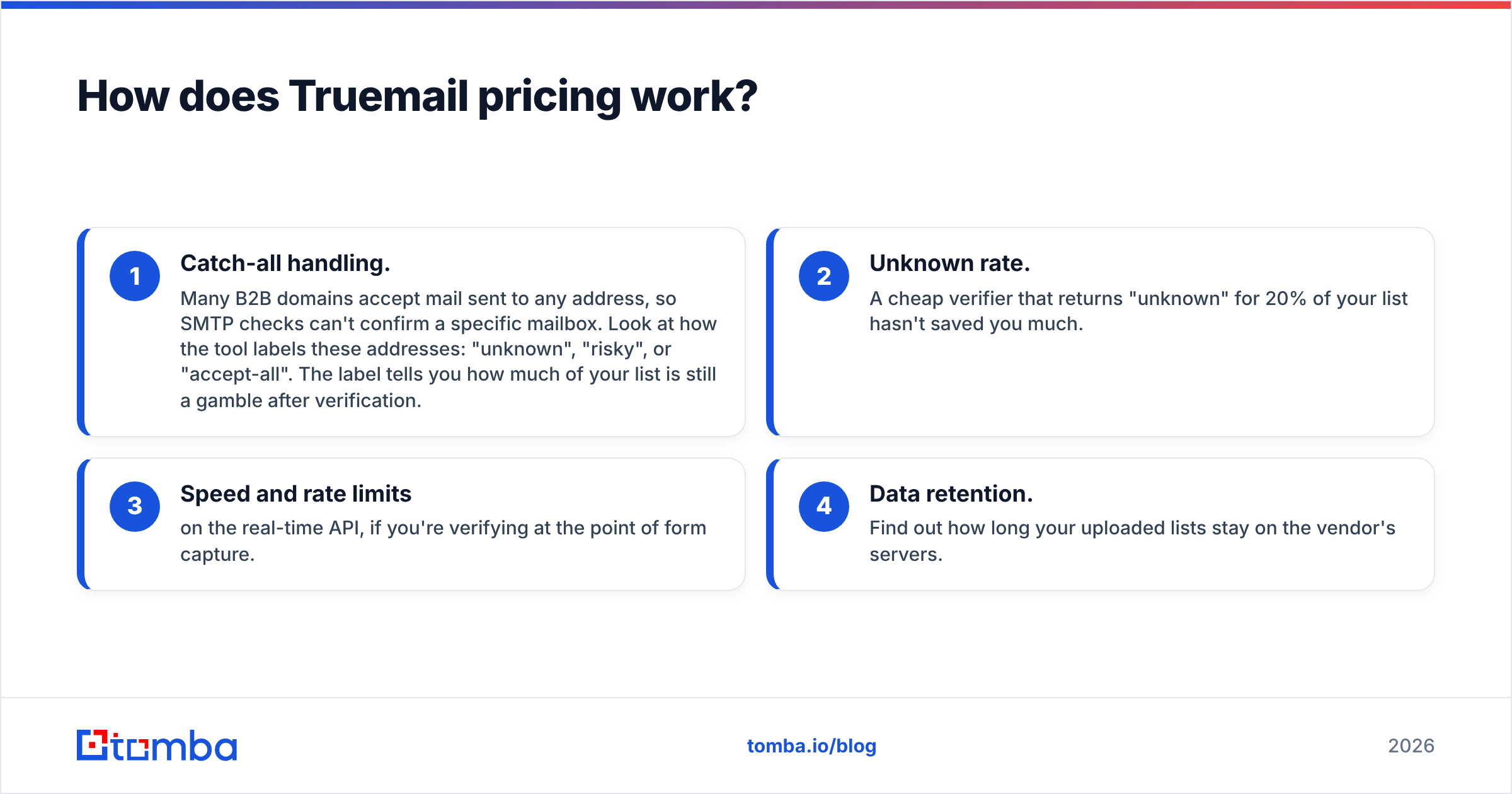
- Catch-all handling. Many B2B domains accept mail sent to any address, so SMTP checks can't confirm a specific mailbox. Look at how the tool labels these addresses: "unknown", "risky", or "accept-all". The label tells you how much of your list is still a gamble after verification.
- Unknown rate. A cheap verifier that returns "unknown" for 20% of your list hasn't saved you much.
- Speed and rate limits on the real-time API, if you're verifying at the point of form capture.
- Data retention. Find out how long your uploaded lists stay on the vendor's servers.
Is ListKit better than Truemail for cold email?#
For starting cold email, yes, because Truemail can't give you a single new prospect. ListKit gives you contacts that have already been verified, and with Bundles it can hand you the sending setup as well.
For running cold email at scale, it depends on where your data comes from. Most mature outbound teams pull contacts from several sources: LinkedIn exports, event lists, CRM backfill, intent-data vendors, and enrichment waterfalls. ListKit's verification only covers ListKit's data. Everything else you import still needs cleaning, and that's the job Truemail does.
The failure mode to avoid: you buy ListKit, then mix its verified leads with a two-year-old CSV from a trade show, and send to all of it. The old addresses bounce, your sender reputation drops, and ListKit's good leads start landing in spam along with everything else.
Which one should you choose? A decision framework#
Use this list to match your situation to the right tool:
- You have no list and no ICP data. Choose ListKit. You need contacts before verification matters at all. Start on the free 100 credits and check coverage for your specific niche before you commit.
- You have 10,000+ contacts in a CRM that nobody has cleaned. Choose Truemail (or any solid verifier). Buying more leads before you clean the ones you have is wasted money.
- You're launching outbound from scratch and don't want to set up DNS. Choose ListKit Bundles, but only if $597/mo or more fits your budget, since the domains and inboxes are the main value.
- You need new leads and ongoing hygiene on mixed-source data. Either buy both tools or buy one that does both. Two subscriptions, two credit balances, and two CSV round-trips add real overhead.
- You're a developer building enrichment into a product. Compare the APIs directly. Truemail's real-time verification API is narrow and simple. ListKit is built more for people using its interface than for high-volume programmatic calls.
What are the pros and cons of each tool?#
ListKit pros
- Verified emails at the point of export, so you don't need a separate cleaning step for ListKit data
- Good filtering for SMB and mid-market lists
- Bundles remove the need to set up domains and inboxes yourself
- Credits cover all features on every plan, so nothing is locked behind a higher tier
ListKit cons
- Credit costs rise quickly once you add phones and enrichment
- Verification doesn't apply to data you bring from elsewhere
- Bundles are expensive if you already own sending infrastructure
- Data depth in some regions and niche verticals varies (common across databases; check reviews on G2 for your segment)
Truemail pros
- Inexpensive per verification, especially on legacy lifetime deals
- Real-time API for form and signup validation
- Domain-health checks as an extra
- Does one job and doesn't pretend to be anything else
Truemail cons
- Can't find anyone new
- Fewer integrations and less current documentation than the biggest verifiers
- Public pricing is inconsistent across sources, so confirm before you buy
- Catch-all results still need a separate decision about whether to send
Where does bounce rate fit into the ListKit vs Truemail choice?#
Bounces are what connect the two tools. Mailbox providers watch your hard-bounce rate closely. Once it goes above roughly 2%, your whole domain's inbox placement starts to suffer. (Wikipedia's page on bounce messages explains the mechanics if you want the protocol-level detail.)
ListKit lowers bounces by only exporting contacts it has checked. Truemail lowers bounces by removing bad addresses before you send. Either way, the aim is to keep invalid addresses out of your sequence. So the useful question isn't which tool is "better". It's where your bad addresses are coming from:
- From your own prospecting. Fix the source, meaning a better database or finder.
- From old or imported data. Fix the list, meaning verification.
- From both. You need both jobs done, preferably in one place.
Is there a tool that covers both jobs?#
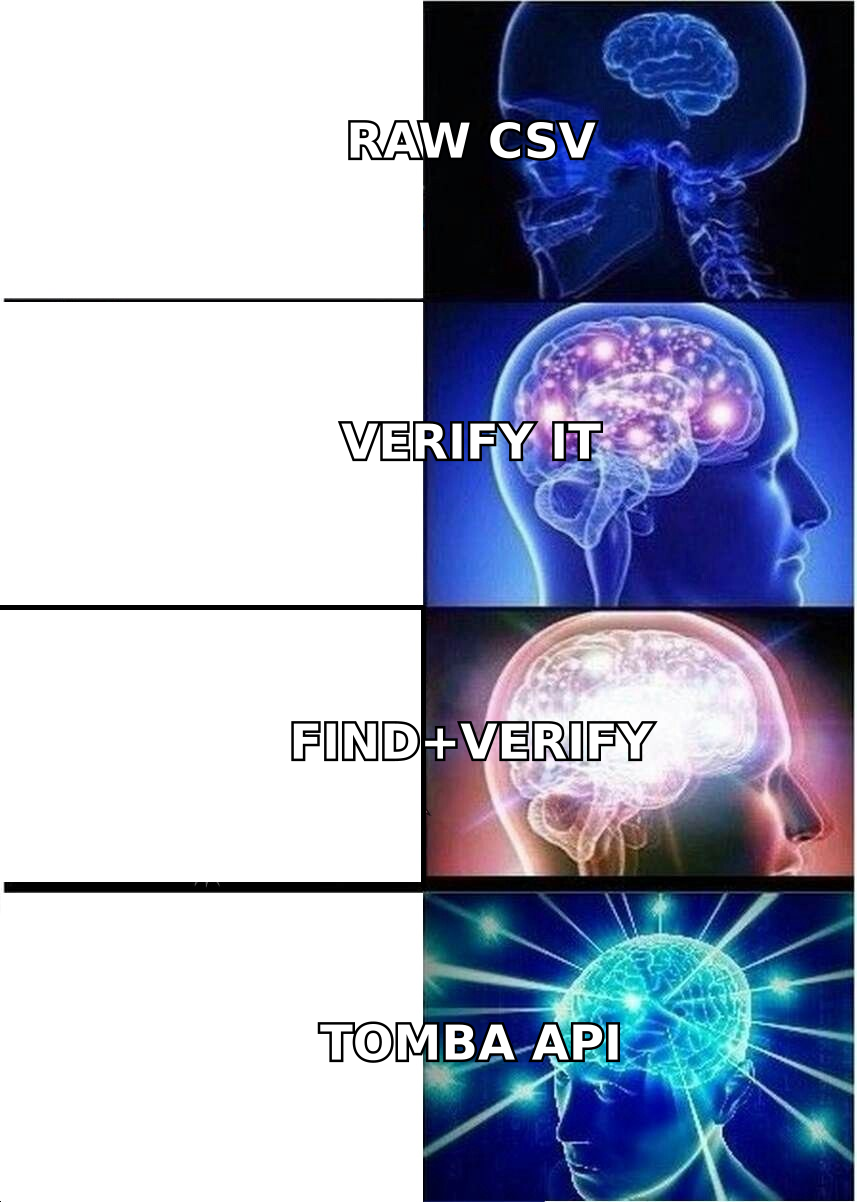
Yes, and for many teams it's the practical answer to "ListKit or Truemail?". Combined platforms find an address and verify it in the same step, and they can also verify lists you upload from other sources. That takes care of both the "no leads" and the "dirty leads" problem with one credit balance.
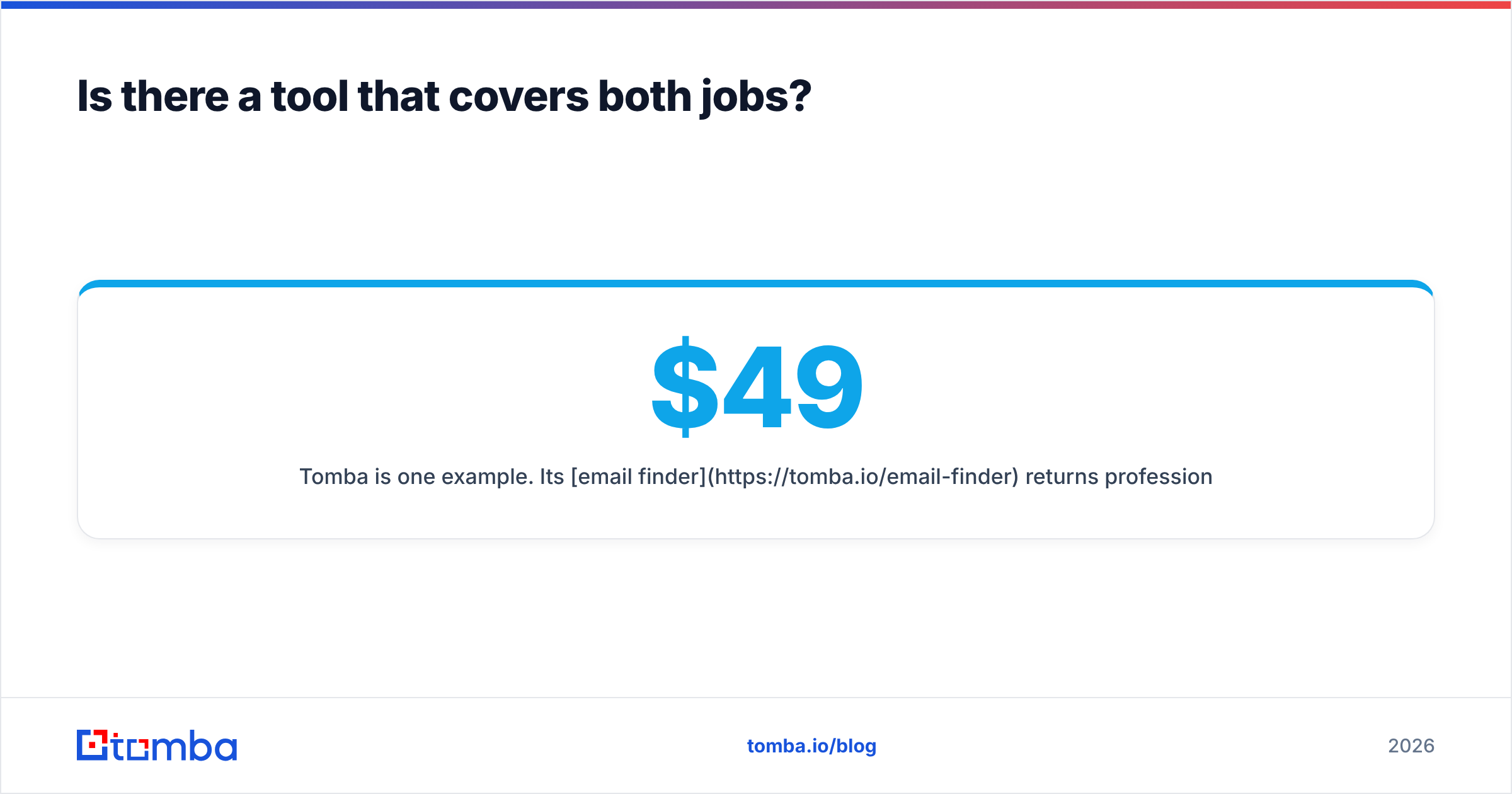
Tomba is one example. Its email finder returns professional addresses from a domain, a name, or a company. Its email verifier runs the same checks on any list you bring in, including a separate catch-all check for domains that accept all mail. Plans start with a free tier of 25 searches a month, then Starter at $49/mo, Growth at $99/mo, and Pro at $249/mo. The full breakdown is on the Tomba pricing page.
That doesn't make ListKit or Truemail a bad choice:
- If you want sending infrastructure bundled in, ListKit's Bundles offer something Tomba doesn't.
- If you already paid for a Truemail lifetime deal, keep using it for bulk hygiene. Your cost per check is effectively zero.
A combined tool makes most sense when you're about to pay for two subscriptions to cover the find and verify steps.
ListKit vs Truemail: what's the final verdict?#
- Choose ListKit if your bottleneck is who to email. Its 2026 strength is verified leads plus optional done-for-you sending infrastructure. Budget more than the headline price suggests once phones and enrichment start using credits.
- Choose Truemail if your bottleneck is whether your existing emails are real. It's inexpensive, narrow, and good enough for routine list hygiene, especially if you locked in a lifetime deal.
- Choose a combined finder-plus-verifier if you keep switching between the two problems. One workflow and one bill mean fewer places for a stale CSV to slip into a live campaign.
Whichever you pick, test before you commit. Run 100 contacts from your real ICP through the free tier, send a small warm-up batch, and measure hard bounces. Your own bounce data is more reliable than any vendor's accuracy claims.
If you want both jobs done in one place without paying for two tools, try the Tomba Email Finder. Enter a company domain or a prospect's name, get back a verified professional email, and run your imported lists through the same account's verifier before they reach your sequencer. The free tier is enough to test it on your own ICP this afternoon.
Related guides#
// get started
Find, verify and enrich your first contacts today
Start on the free plan with 25 searches a month, then scale when your team is ready.
Free plan · No credit card required · GDPR & CCPA
// about the author