ListKit vs ZoomInfo (2026): Pricing, Data Quality and Our Pick
ListKit sells verified lead lists for roughly $83 a month. ZoomInfo sells an enterprise intelligence platform that often costs five figures a year. Here's who each one is for, what they really cost per lead, and when neither is the right pick.
- ListKit is a budget, self-serve B2B lead-list tool. It sells triple-verified emails on credit plans that start around $83/mo billed annually, and it bundles cold-email infrastructure.
- ZoomInfo is an enterprise go-to-market intelligence platform. It publishes no prices, entry contracts start near $15,000/yr, and median deals land well above that.
- On cost per exported contact, ListKit is often cheaper by more than an order of magnitude. ZoomInfo earns its price with intent data, org charts, technographics, and deep CRM workflows.
- Pick ListKit for high-volume cold email on a small budget. Pick ZoomInfo if you run a multi-team sales org that needs account intelligence and compliance tooling.
- If what you actually need is accurate emails for specific people and domains, a pay-as-you-go email finder is often a better fit than either one.
What is ListKit?#
ListKit (listkit.io) is a lead-list builder made for outbound teams and agencies that send cold email at volume. You filter by industry, title, company size, location and a few technographic signals, then export contacts whose emails ListKit says it has "triple-verified" before you pay for them.
What sets ListKit apart from a pure data vendor is the bundle. Its plans also cover sending infrastructure: domains, inboxes, and an email engine with an AI script writer. It's aimed at the buyer who wants one bill for "leads plus the pipes to email them."
How it charges, based on ListKit's own help docs and 2026 pricing listings:
- A free plan with 100 credits for testing
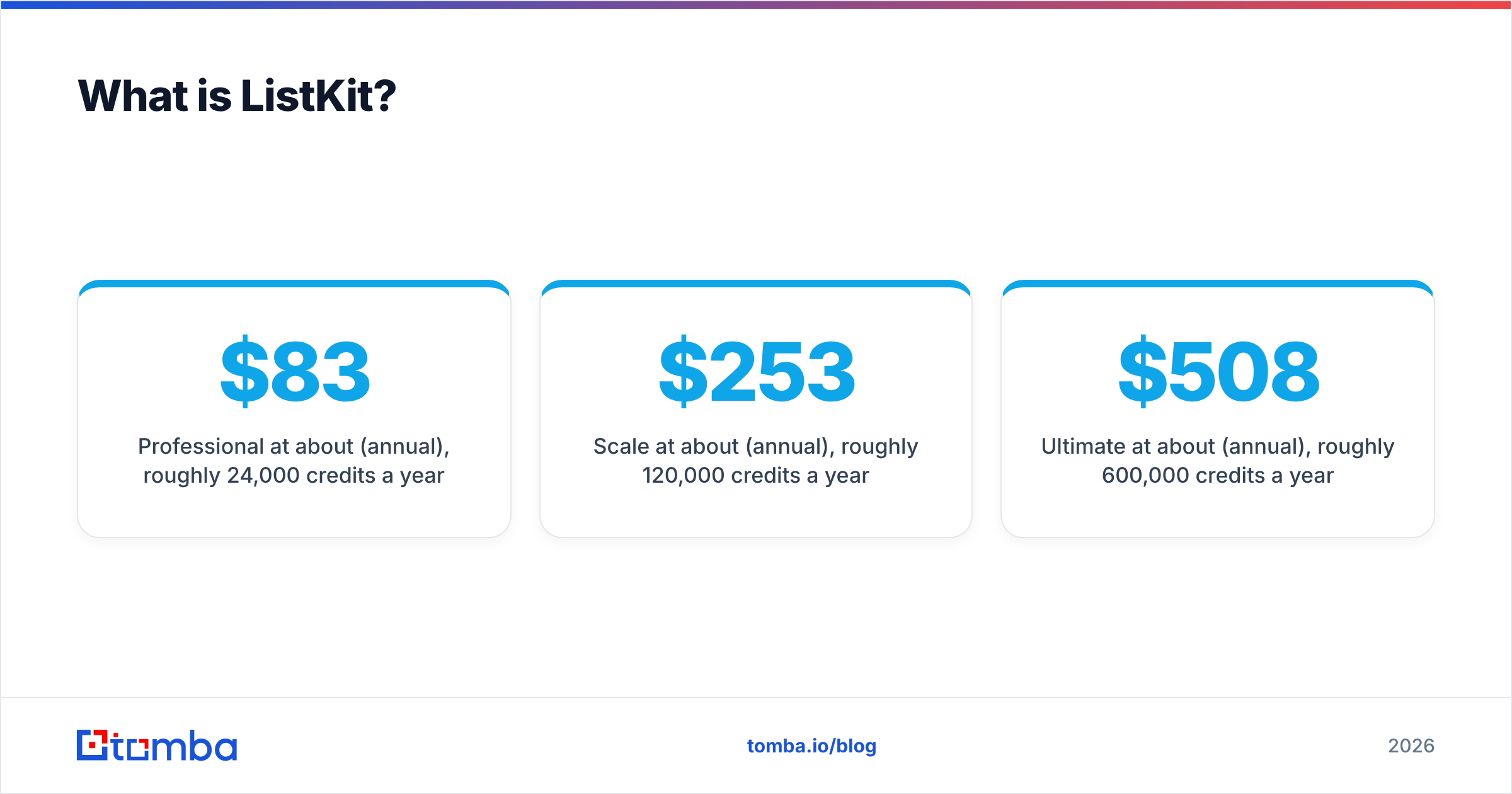
- Professional at about $83/mo (annual), roughly 24,000 credits a year
- Scale at about $253/mo (annual), roughly 120,000 credits a year
- Ultimate at about $508/mo (annual), roughly 600,000 credits a year
- 1 credit per verified email, 3 credits per phone number found
Monthly billing costs more and includes noticeably fewer credits, so most buyers end up on annual. Check the current numbers on ListKit's G2 pricing page or its site before you commit, because tiers get reshuffled often.
What is ZoomInfo?#
ZoomInfo (zoominfo.com) is the incumbent in B2B data. It started as a contact database and now sells a full GTM platform: company and contact data, buyer intent signals, org charts, technographics, website visitor identification, conversation intelligence, and native workflows into Salesforce, HubSpot and Outreach.
ZoomInfo publishes no prices. Its pricing page is a demo form. Figures reported publicly in 2026 put the entry Professional tier at around $15,000/yr for a few seats and a fixed annual credit allotment. Vendr's aggregated purchase data puts the median contract at more than $30,000/yr once you add seats, intent, enrichment and extra credits. Contracts are usually annual, and they often auto-renew with a notice window you need to put on your calendar.
You're paying for breadth and depth: account-level intelligence, hierarchy data, and a platform your RevOps team can wire into every system. For many mid-market and enterprise orgs, that's what justifies the price.

How do ListKit and ZoomInfo compare side by side?#
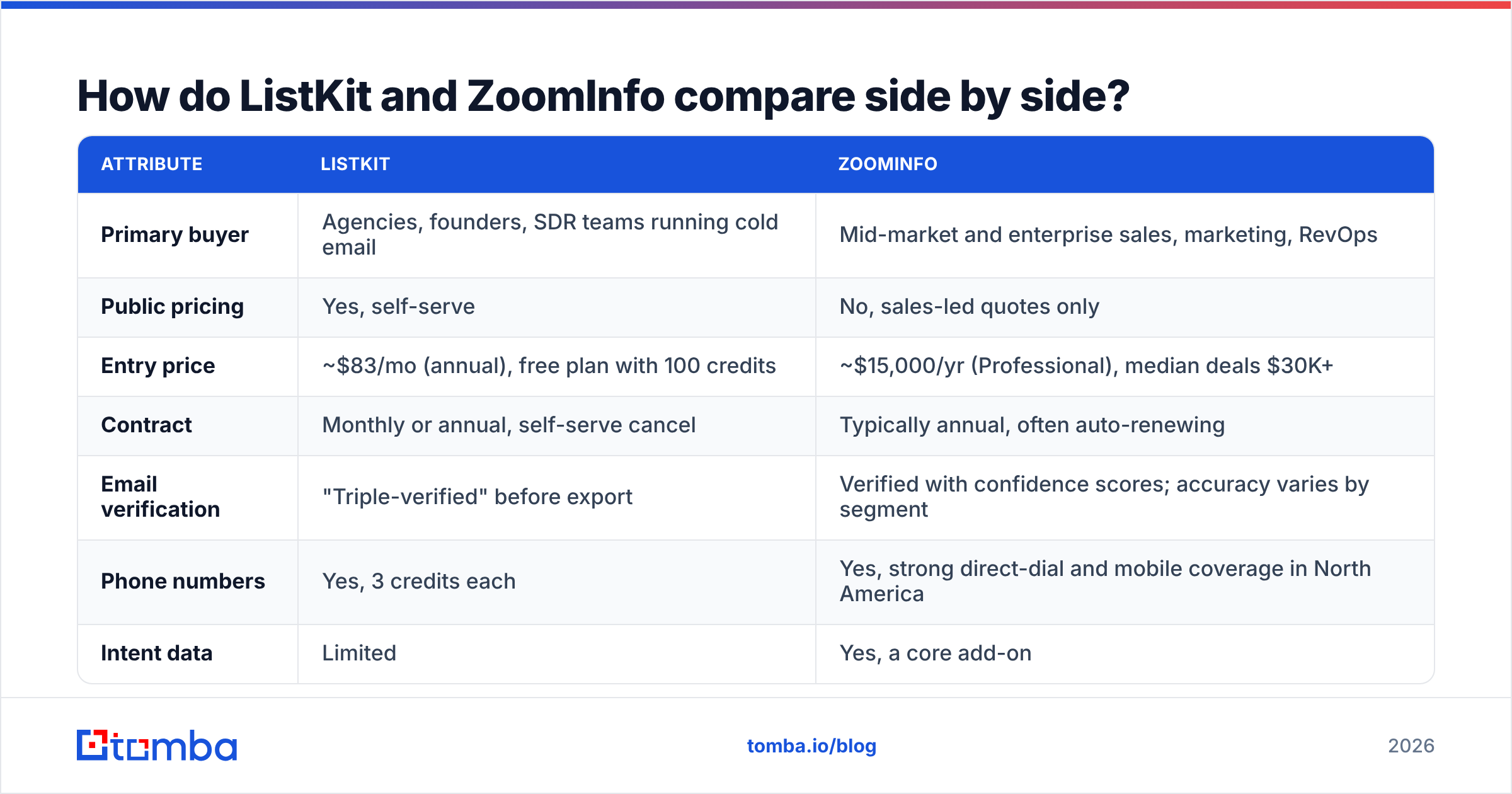
This table shows the attributes that decide most purchases. Pricing reflects publicly reported 2026 figures and may differ from your quote.
| Attribute | ListKit | ZoomInfo |
|---|---|---|
| Primary buyer | Agencies, founders, SDR teams running cold email | Mid-market and enterprise sales, marketing, RevOps |
| Public pricing | Yes, self-serve | No, sales-led quotes only |
| Entry price | ~$83/mo (annual), free plan with 100 credits | ~$15,000/yr (Professional), median deals $30K+ |
| Contract | Monthly or annual, self-serve cancel | Typically annual, often auto-renewing |
| Email verification | "Triple-verified" before export | Verified with confidence scores; accuracy varies by segment |
| Phone numbers | Yes, 3 credits each | Yes, strong direct-dial and mobile coverage in North America |
| Intent data | Limited | Yes, a core add-on |
| Org charts and hierarchies | No | Yes |
| Technographics | Basic filters | Extensive |
| Sending infrastructure | Bundled (domains, inboxes, email engine) | Not a sending tool; integrates with engagement platforms |
| CRM integrations | Export and common integrations | Deep native Salesforce, HubSpot, Dynamics sync |
| Best for | Volume outbound on a budget | Account-based selling at scale |
In short, the two tools overlap on one job: giving you a person's email and phone. Nearly everything else they sell is different.
Which has better data quality, ListKit or ZoomInfo?#
It depends on the segment, and anyone who hands you a single accuracy number is oversimplifying.
ZoomInfo has the deeper graph. It's especially strong on North American mid-market and enterprise accounts, where it has years of contributory data, human research, and direct-dial coverage. It's weaker the further you get from that core: small businesses, parts of EMEA and APAC, and fast-moving startups. Reviews on G2 regularly mention stale titles and bounced emails in those segments.
ListKit focuses on email deliverability at export. Because every exported email has been through multiple verification passes, your bounce rate on a fresh list is usually low. The trade-off is depth. You get fewer firmographic fields, no hierarchy, and thinner phone coverage than ZoomInfo.
Two points hold no matter which vendor you choose:
- Data decays fast. B2B contact data goes stale at a rate commonly estimated at 22–30% a year as people change jobs, companies rebrand, and domains move. A list you exported in January is already out of date by summer.
- Verify before you send. Run anything older than about 30 days through an email verifier. Catch-all domains need particular care, because they accept every address at the SMTP level and hide real bounces until your sender reputation has already taken the hit.
How much do ListKit and ZoomInfo actually cost per lead?#
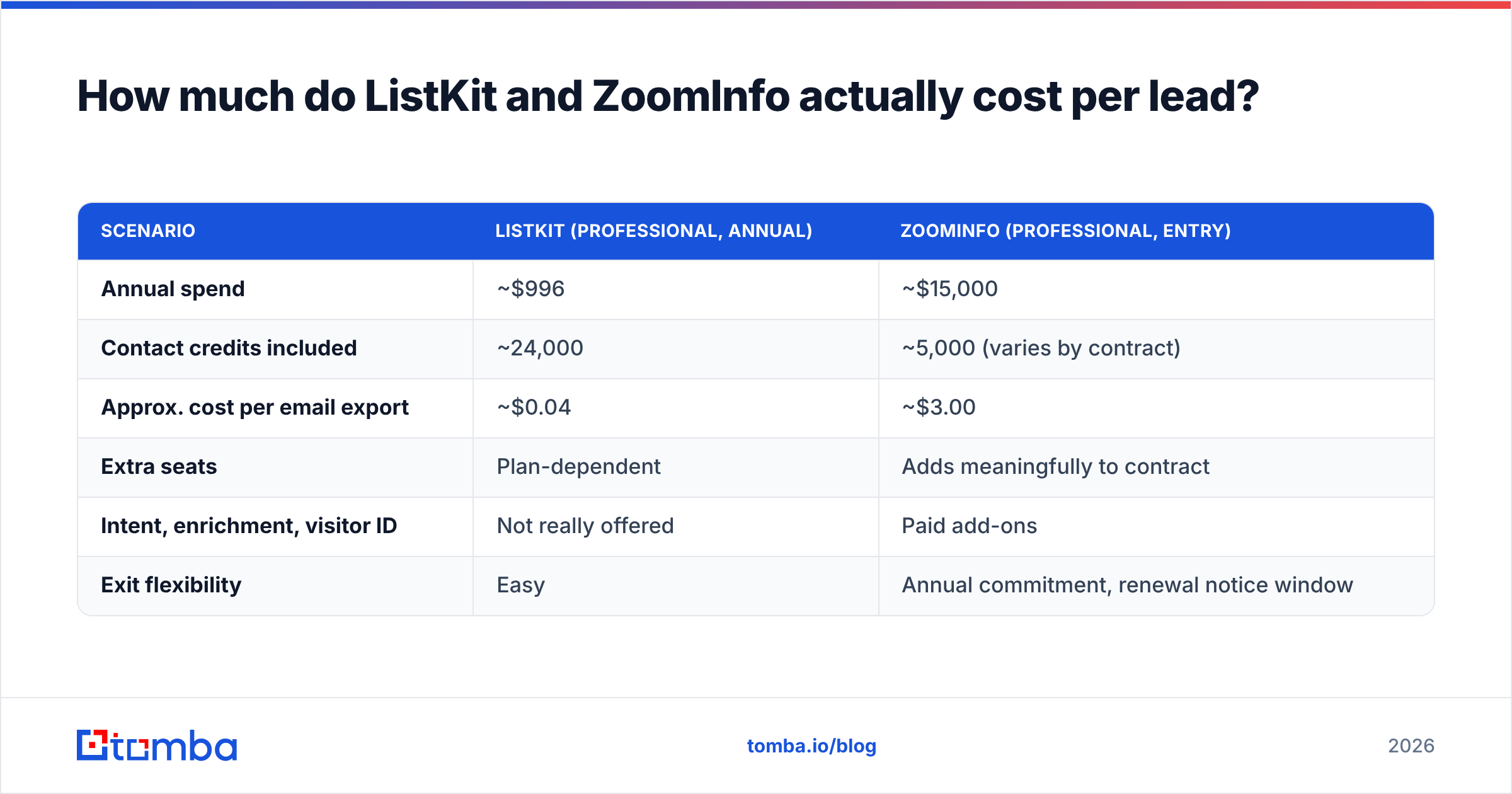
Sticker price is misleading. What matters is cost per usable contact, so here's a rough comparison using the public 2026 figures above.
| Scenario | ListKit (Professional, annual) | ZoomInfo (Professional, entry) |
|---|---|---|
| Annual spend | ~$996 | ~$15,000 |
| Contact credits included | ~24,000 | ~5,000 (varies by contract) |
| Approx. cost per email export | ~$0.04 | ~$3.00 |
| Extra seats | Plan-dependent | Adds meaningfully to contract |
| Intent, enrichment, visitor ID | Not really offered | Paid add-ons |
| Exit flexibility | Easy | Annual commitment, renewal notice window |
On raw contact cost, ZoomInfo is roughly 50–75x more expensive per record. That doesn't mean ZoomInfo is poor value. Its buyers aren't paying for rows in a CSV. They're paying for intent signals that tell them which 200 accounts to work this quarter, and for data that syncs into a CRM that 80 reps rely on.
If your workflow is "pull 5,000 contacts, load a sequencer, send," though, you're paying for platform features you'll never open.
Who should choose ListKit?#
ListKit is the better fit if most of these describe you:
- You run cold email as your main outbound channel and send thousands of emails a week.
- You're an agency running campaigns for several clients and need predictable cost per lead.
- You don't have (or want) a RevOps team to manage a data platform.
- You'd like domains, inboxes and lead data under one subscription.
- Your budget is in the hundreds per month, not the tens of thousands per year.
The main caveat: ListKit's bundled sending infrastructure is convenient, but it ties your data vendor and your deliverability stack together. If you ever switch one, plan the migration so your inbox warmup and domain reputation don't reset.
Who should choose ZoomInfo?#
ZoomInfo earns its price when:
- You run account-based sales across dozens or hundreds of reps.
- You need intent data to prioritise accounts, not just contacts.
- Your team lives in Salesforce or HubSpot and needs continuous enrichment, deduplication and routing.
- You sell into enterprise buying committees where org charts and direct dials matter.
- Procurement, security reviews and compliance documentation are part of your buying process.
The caveats: negotiate hard, get credit limits and renewal terms in writing, and set a reminder well before the auto-renewal window. Plenty of teams find out at renewal that they used a fraction of their credits. Independent analyst coverage from firms like Gartner is useful for benchmarking ZoomInfo against other enterprise data platforms before you sign.

Is there a middle option between ListKit and ZoomInfo?#
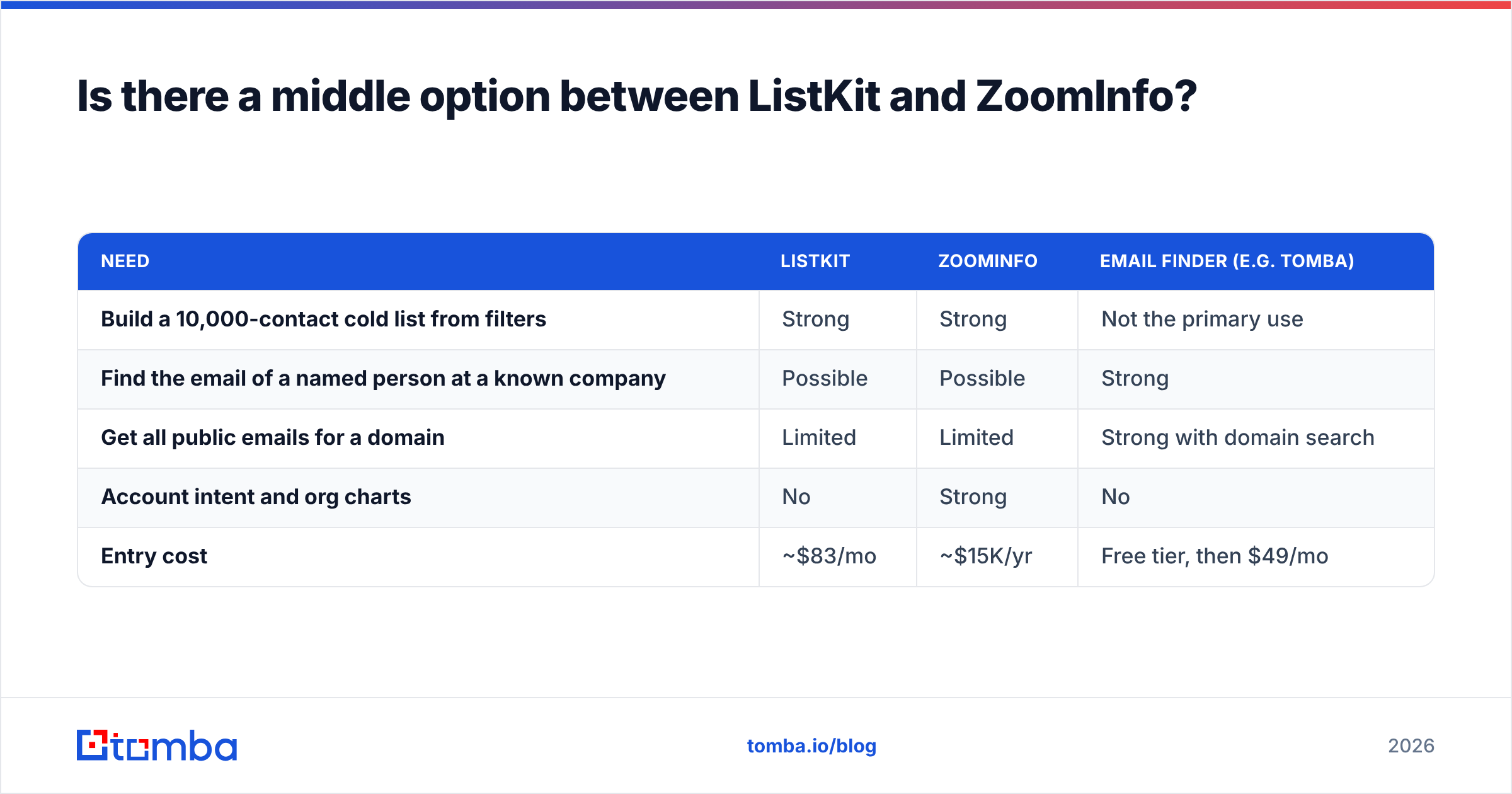
Yes, and for many teams it's the right answer. ListKit and ZoomInfo are both built around lists: you filter a database and export segments. A lot of real prospecting doesn't work that way. You already know the account, sometimes the person, and you only need a correct, verified email.
That's the job an email finder does. You give it a name and a domain, or just a domain, and it returns the most likely address with a confidence score and its public sources. You pay for lookups you actually use instead of a pre-committed pile of exports.
Here's where the three approaches fit:
| Need | ListKit | ZoomInfo | Email finder (e.g. Tomba) |
|---|---|---|---|
| Build a 10,000-contact cold list from filters | Strong | Strong | Not the primary use |
| Find the email of a named person at a known company | Possible | Possible | Strong |
| Get all public emails for a domain | Limited | Limited | Strong with domain search |
| Account intent and org charts | No | Strong | No |
| Entry cost | ~$83/mo | ~$15K/yr | Free tier, then $49/mo |
Tomba's plans run from a free tier (25 searches/mo) to Starter at $49/mo, Growth at $99/mo and Pro at $249/mo, with custom Enterprise pricing. Full details are on the Tomba pricing page. Tomba isn't a replacement for ZoomInfo's intent layer, and it doesn't bundle sending inboxes the way ListKit does. What it covers is precise lookups and verification, and many teams pair it with whichever list tool they already use.
How should you decide between ListKit and ZoomInfo?#
Work through these five questions in order. The first clear "no" usually settles it.
- Do you need account intelligence or just contacts? If intent, hierarchies and technographics drive your pipeline, shortlist ZoomInfo. If you just need emails and phones, cross it off.
- What's your realistic annual data budget? Under $5,000 rules out ZoomInfo in practice. Over $20,000 with multiple teams makes it worth a demo.
- How do you prospect: by list or by name? List-first outbound suits ListKit. Named-account or referral-driven prospecting suits an email finder with pay-as-you-go lookups.
- Who maintains the data? No RevOps means a self-serve tool. A dedicated ops team can get full value from ZoomInfo's CRM sync and enrichment.
- How will you keep the data fresh? Whichever you pick, budget for re-verification and enrichment. With 22–30% annual decay, a list you don't maintain loses about a quarter of its value each year.
Frequently asked questions#
Is ListKit cheaper than ZoomInfo?#
Yes, by a wide margin. ListKit starts around $83/mo billed annually with thousands of export credits. ZoomInfo's entry tier is reported at roughly $15,000/yr, and median contracts land above $30,000.
Does ListKit have intent data like ZoomInfo?#
Not in any comparable way. ListKit is built for filtering and exporting verified contacts. ZoomInfo's intent signals and account intelligence are a core part of what you pay for.
Can I use ListKit and ZoomInfo together?#
Some teams do: ZoomInfo for account selection and intent in the CRM, and a cheaper tool for high-volume cold email lists. It only makes sense if your ZoomInfo contract doesn't already cover the volume you need.
Which is better for cold email?#
ListKit, for most teams. It's priced for volume, verifies emails before export, and bundles sending infrastructure. ZoomInfo can feed cold email too, but at a much higher cost per contact.
Do I still need an email verifier?#
Yes. Verify any list older than a month before you send. Both vendors verify at export time, but data decays after that, and catch-all domains can hide bounces that damage your sender reputation.
What's the bottom line on ListKit vs ZoomInfo?#
ListKit and ZoomInfo don't really compete for the same buyer. ListKit is a lean, low-cost way to fill a cold-email pipeline. ZoomInfo is an enterprise intelligence platform that pays off only when you use the intent, hierarchy and CRM layers you're paying for. Pick based on your workflow, not on who has the bigger database.
If your real problem is simpler (you know the company or the person and need a verified email without a five-figure contract or a bundle of inboxes), try Tomba Email Finder. Search by name and domain, get a confidence-scored address with its public sources, verify it in the same place, and start on the free tier before paying $49/mo for Starter.
Related guides#
// get started
Find, verify and enrich your first contacts today
Start on the free plan with 25 searches a month, then scale when your team is ready.
Free plan · No credit card required · GDPR & CCPA
// about the author