Listmint Pricing Pros and Cons: 2026 Reviews and Honest Breakdown
Listmint charges $99/mo for verification, and catch-all credits are billed separately. Here is what G2 reviewers like, where the pricing gets tight, and when a bundled finder-plus-verifier costs less.
This guide covers Listmint pricing pros and cons, what reviewers say, and who should actually buy it.
TL;DR
- Listmint is an email verifier built around one job: resolving catch-all addresses that standard SMTP checks mark as "unknown" or "accept-all."
- Published pricing starts at $99/month (20,000 standard credits + 5,000 catch-all credits). The Agency plan is $187/month (50,000 standard + 10,000 catch-all). Enterprise is custom, and there's a free account for testing.
- Reviews are few but very positive: 8 reviews averaging 5.0 on G2 at the time of writing. People mostly praise catch-all accuracy and support.
- The main downside is that Listmint only verifies. It won't find emails, so you still pay for a separate data source, and the $99 entry price is steep if you verify fewer than 10,000 emails a month.
- Listmint suits lead-gen agencies and outbound teams whose lists are full of catch-all domains. If you need to find and verify contacts on one bill, a bundled platform usually costs less.
What is Listmint?#
Listmint is a B2B email verification service. It focuses on the part of verification most tools skip: catch-all domains.
Here's the problem it targets. A catch-all (or "accept-all") mail server says yes to every address sent to it. It does this whether or not a mailbox exists. When a normal verifier pings jane.doe@company.com over SMTP, the server replies "OK" no matter what. So most verifiers return catch-all or unknown. That leaves you two bad options: send and risk bounces, or drop the lead and lose pipeline.
Listmint runs a standard SMTP pass first. It sorts addresses into valid, invalid, unknown, and catch-all. Then it runs a second, deeper check on the catch-alls and tells you which ones are actually deliverable. The final export marks each address as "valid" or "catch-all deliverable," so you can see which bucket each lead came from.
The company says this approach recovers "50%+ more valid emails" from existing lead lists. That's a vendor claim with no independent audit behind it, so treat it as the ceiling, not the baseline. You can read the positioning on the Listmint homepage.
If catch-alls are new to you, Tomba's catch-all verifier page explains the mechanics well.
How much does Listmint cost in 2026?#
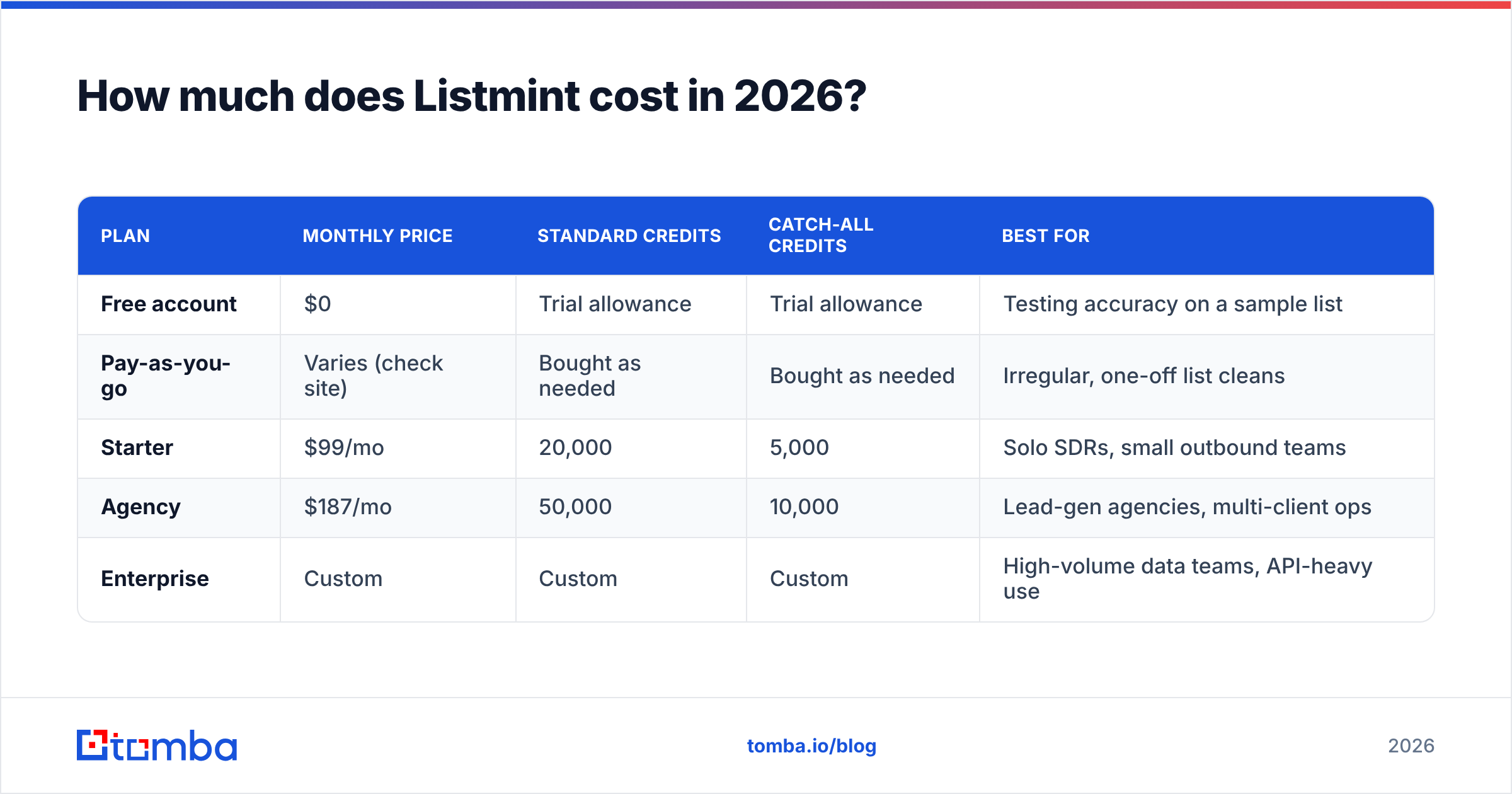
Listmint uses two credit types, and understanding that split is the key to its pricing:
- Standard credits pay for the normal SMTP verification pass. They're cheap and you'll use a lot of them.
- Catch-all credits pay for the deeper resolution of addresses that came back as catch-all. They cost more and come in smaller amounts.
The idea is simple: you only pay the premium rate on addresses that need it. On a typical B2B list, 15% to 40% of addresses sit on catch-all domains. The share is higher for enterprise and mid-market targets. Those companies often run Microsoft 365 or security gateways set to accept everything.
| Plan | Monthly price | Standard credits | Catch-all credits | Best for |
|---|---|---|---|---|
| Free account | $0 | Trial allowance | Trial allowance | Testing accuracy on a sample list |
| Pay-as-you-go | Varies (check site) | Bought as needed | Bought as needed | Irregular, one-off list cleans |
| Starter | $99/mo | 20,000 | 5,000 | Solo SDRs, small outbound teams |
| Agency | $187/mo | 50,000 | 10,000 | Lead-gen agencies, multi-client ops |
| Enterprise | Custom | Custom | Custom | High-volume data teams, API-heavy use |
All paid plans include 24/7 support. Pricing was taken from Listmint's site and third-party directories such as ColdIQ's Listmint profile in 2026. Credit amounts and pay-as-you-go rates change, so confirm on the vendor site before you buy.
What's the real cost per verified email?#
The sticker price hides how the math actually works. Here's how it looks per credit if you use your full allowance:
- Starter: $99 buys 25,000 total checks. That's about $0.004 per check blended, or $0.00495 per check if you only count standard credits.
- Agency: $187 buys 60,000 total checks. That's about $0.0031 per check blended, roughly 22% cheaper per unit than Starter.
The catch: those numbers assume you use every credit every month. Say a Starter user only verifies 6,000 emails in a quiet month. The effective cost jumps to about $0.0165 per email. Subscription verifiers reward steady volume and penalize lumpy volume. If your outbound runs in campaign bursts, look at pay-as-you-go first.
The ratio matters as well. Starter gives you catch-all credits equal to 25% of your standard credits. Agency drops that to 20%. If your list is 40% catch-all (common for enterprise targets), you'll use up catch-all credits well before standard credits and end up buying top-ups or upgrading.

What do Listmint reviews say?#
The public review base is small but consistent. On G2's Listmint reviews page, the product had 8 reviews averaging 5.0 stars when we checked. Eight reviews is too few to call it statistically meaningful. Still, the same themes come up again and again:
- Catch-all resolution works. Reviewers call verifying standard and catch-all addresses in one place a "game-changer," especially lead-gen agencies whose client lists are full of accept-all domains.
- Low bounce rates. One reviewer reported a bounce rate under 1% after sending to Listmint-verified lists, including catch-all deliverables.
- Transparent result labels. Users like that exports separate "valid" from "catch-all deliverable," so they can put riskier segments in a separate sending pool.
- Responsive support. Several reviews say the support team is "super helpful." That matters more than usual in verification, where a bad result can burn a sending domain.
What you won't find yet: long-term reviews from large enterprise buyers, independent accuracy benchmarks, or negative reviews that show where the product breaks down. A spotless 5.0 on a small sample usually means an early, enthusiastic customer base, not proof of no weaknesses. Test it on your own list before committing.
Listmint also runs as a data provider inside Clay. Clay's Listmint integration docs show how to call it in a waterfall. For teams already building enrichment tables in Clay, that's a practical point in its favor.
Listmint pricing pros and cons: what are the trade-offs?#
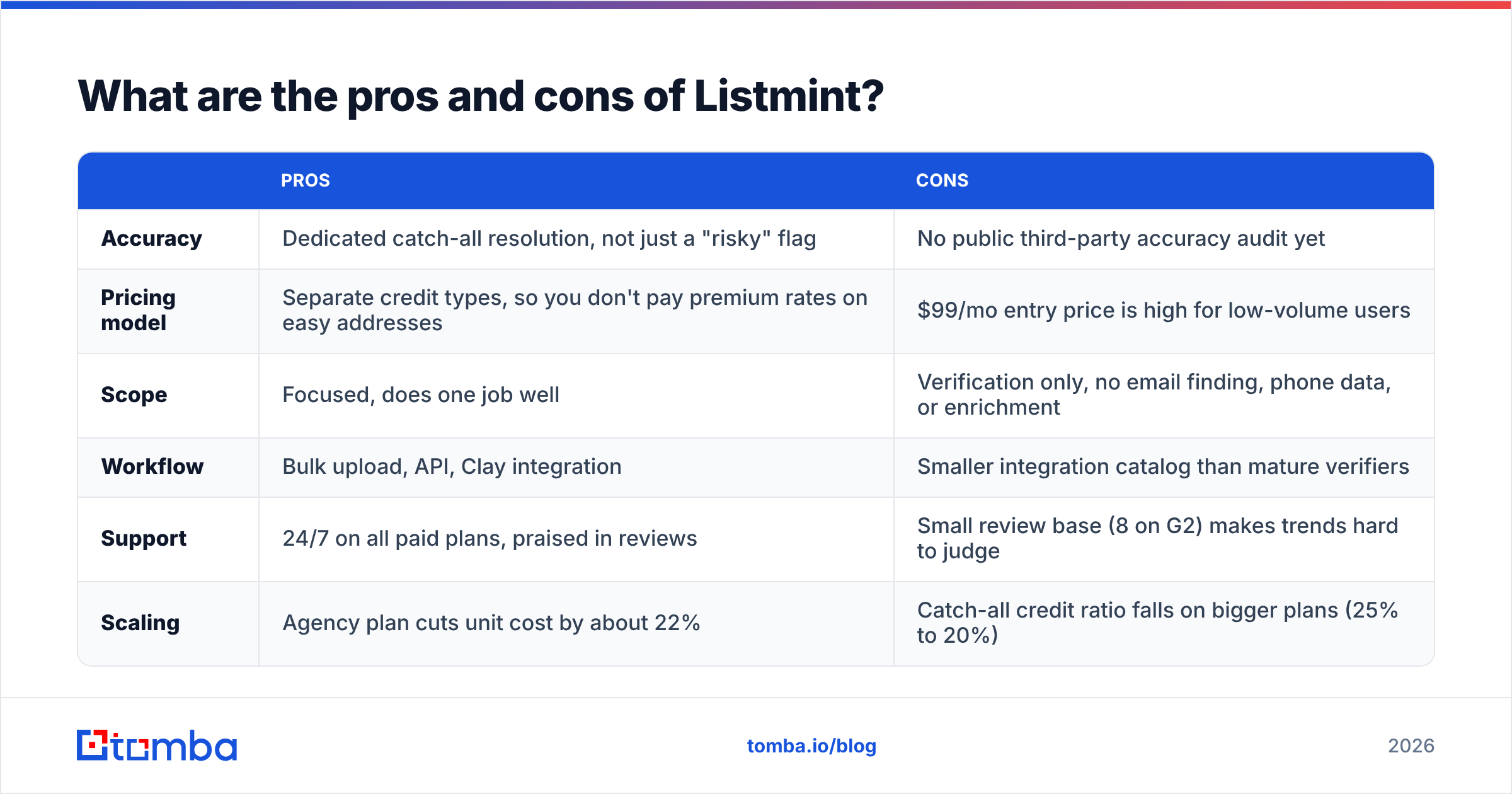
Here's the balanced view of Listmint pricing pros and cons, based on published plans, the feature set, and review themes.
| Pros | Cons | |
|---|---|---|
| Accuracy | Dedicated catch-all resolution, not just a "risky" flag | No public third-party accuracy audit yet |
| Pricing model | Separate credit types, so you don't pay premium rates on easy addresses | $99/mo entry price is high for low-volume users |
| Scope | Focused, does one job well | Verification only, no email finding, phone data, or enrichment |
| Workflow | Bulk upload, API, Clay integration | Smaller integration catalog than mature verifiers |
| Support | 24/7 on all paid plans, praised in reviews | Small review base (8 on G2) makes trends hard to judge |
| Scaling | Agency plan cuts unit cost by about 22% | Catch-all credit ratio falls on bigger plans (25% to 20%) |
Pros in more detail#
It solves a real, expensive problem. Every outbound team has thrown away good catch-all leads. If Listmint recovers even a third of those, one extra meeting a month can pay for the plan.
The dual-credit model is fair. Tools that charge one flat rate for every check are either overpricing easy addresses or underinvesting in hard ones. Listmint's split makes its costs visible.
The labels are useful for sending strategy. Knowing an address is "catch-all deliverable" rather than just "valid" helps you plan. You can send to that segment from a warmed secondary domain. That protects your main sender reputation.
Cons in more detail#
You still need a data source. Listmint verifies emails you already have. It doesn't find them. So its real cost is $99 plus whatever you pay for your email finder or B2B database. For many small teams that combined bill is the actual comparison.
The subscription floor penalizes small users. A freelancer verifying 3,000 emails a month is paying roughly $0.033 per check on Starter. That's far above what a bundled tool or pay-as-you-go verifier would charge.
The catch-all credit ratio can pinch. If you target enterprise accounts, catch-all rates above 30% are common, and you'll run out of catch-all credits before standard ones.
Is Listmint worth it?#
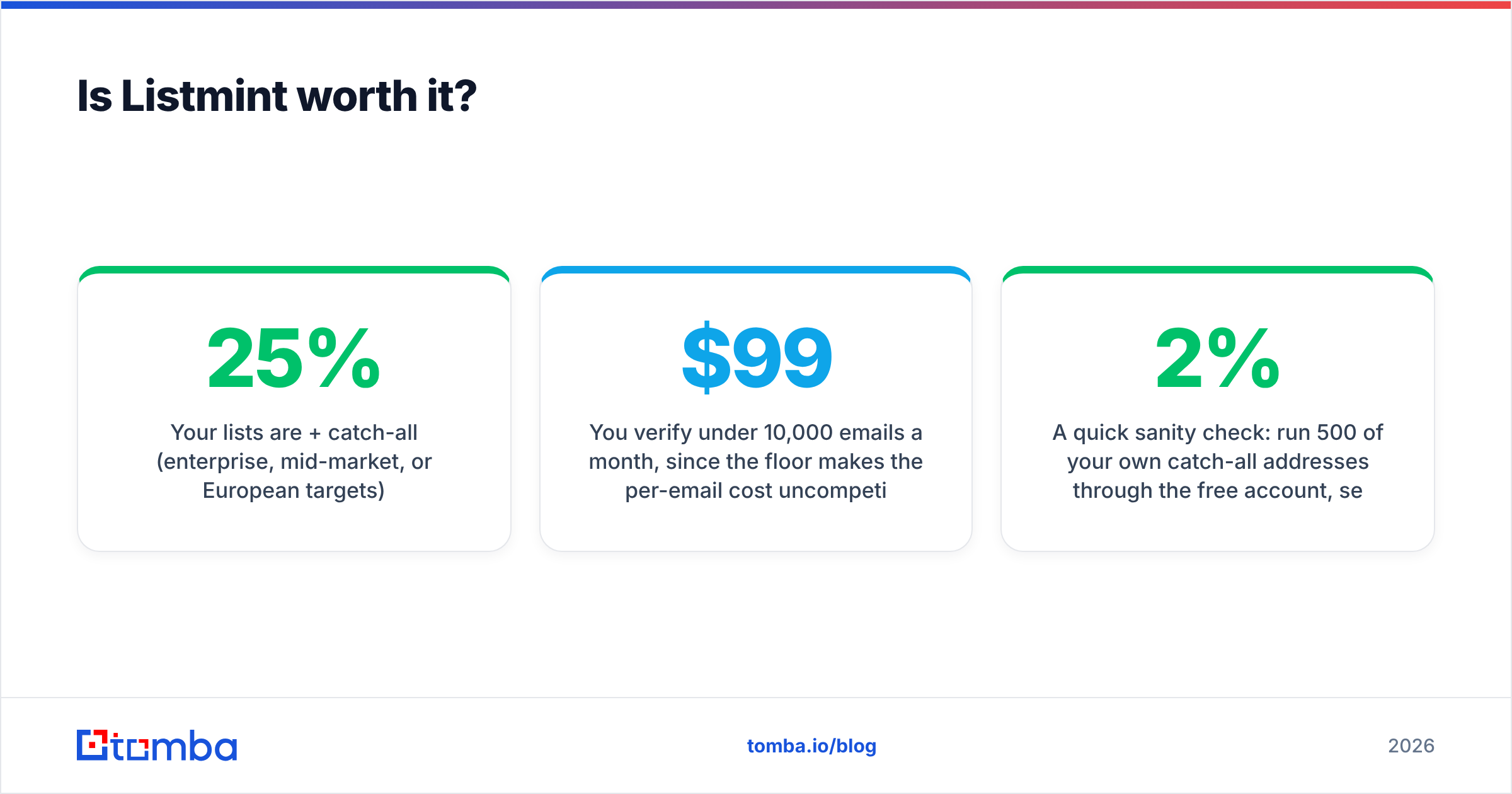
It depends on two numbers: how many emails you verify per month and what share of them are catch-all.
Listmint is likely worth it if:
- You verify 20,000+ emails a month on a steady schedule
- Your lists are 25%+ catch-all (enterprise, mid-market, or European targets)
- You're an agency reselling list-cleaning or running outbound for several clients
- You already have a data source you trust and only need a better verification layer
- You build enrichment waterfalls in Clay
Listmint is probably not worth it if:
- You verify under 10,000 emails a month, since the $99 floor makes the per-email cost uncompetitive
- Your volume swings a lot from month to month
- You don't have a data source yet and need to find emails too
- Your targets are mostly SMBs on Google Workspace, where catch-all rates are lower and standard verification is usually enough
A quick sanity check: run 500 of your own catch-all addresses through the free account, send to the "catch-all deliverable" results from a secondary domain, and measure bounces. If bounces stay under 2%, the premium tier is doing its job for your data.
How does Listmint compare with alternatives?#
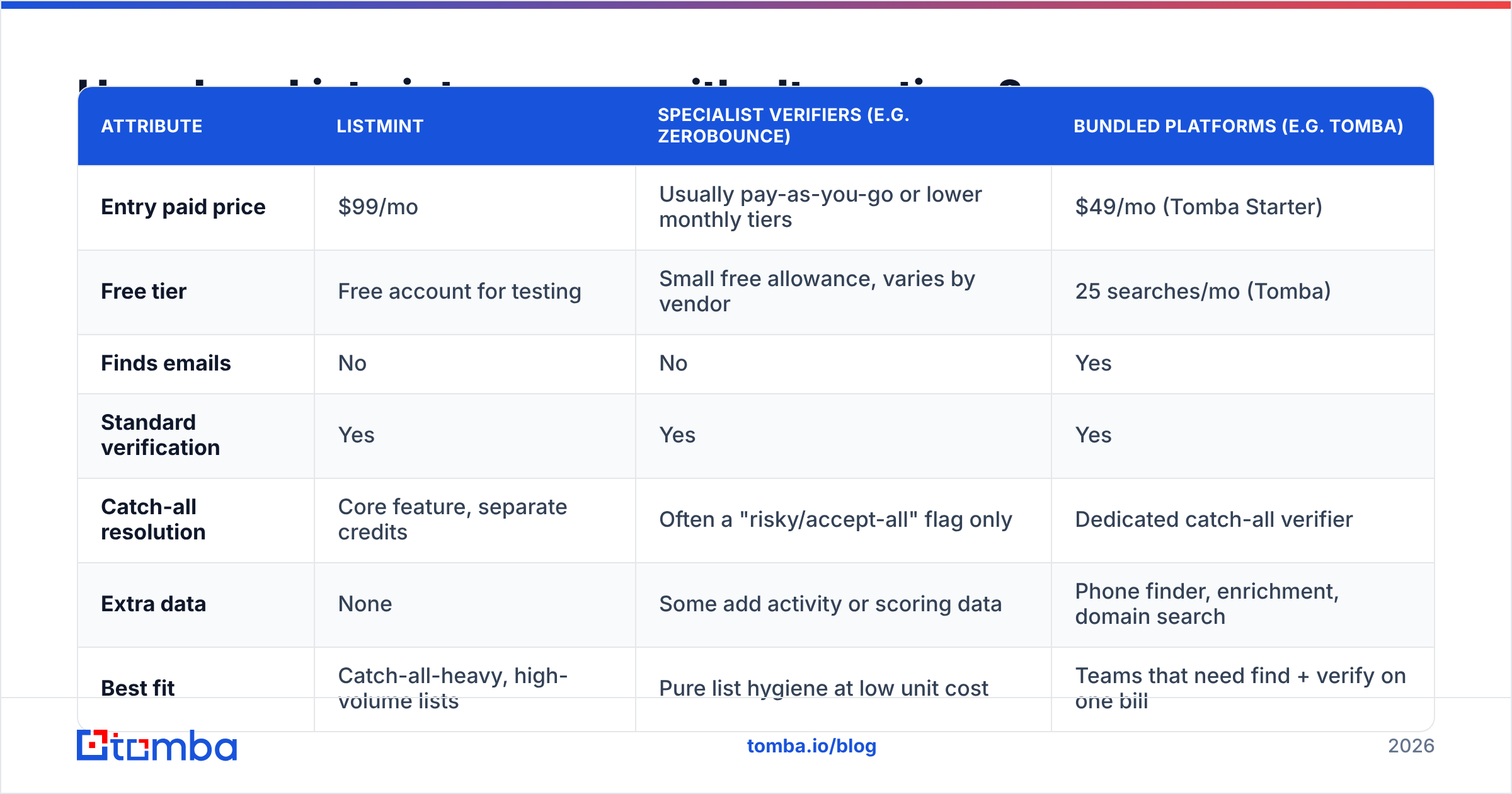
Most buyers comparing Listmint are choosing between a specialist verifier and a bundled finder-plus-verifier. Here's how the categories stack up at entry level:
| Attribute | Listmint | Specialist verifiers (e.g. ZeroBounce) | Bundled platforms (e.g. Tomba) |
|---|---|---|---|
| Entry paid price | $99/mo | Usually pay-as-you-go or lower monthly tiers | $49/mo (Tomba Starter) |
| Free tier | Free account for testing | Small free allowance, varies by vendor | 25 searches/mo (Tomba) |
| Finds emails | No | No | Yes |
| Standard verification | Yes | Yes | Yes |
| Catch-all resolution | Core feature, separate credits | Often a "risky/accept-all" flag only | Dedicated catch-all verifier |
| Extra data | None | Some add activity or scoring data | Phone finder, enrichment, domain search |
| Best fit | Catch-all-heavy, high-volume lists | Pure list hygiene at low unit cost | Teams that need find + verify on one bill |
If you're comparing specialist verifiers specifically, see our ZeroBounce alternative breakdown for how the category prices out.
The honest summary: Listmint's catch-all depth is its advantage, and a bundled platform can't always match a specialist's focus on that one task. But for teams under about 20,000 checks a month, buying a finder and a verifier separately usually costs more than buying them together, and managing one fewer vendor has value too.

How should you evaluate Listmint before paying?#
Use this four-step test on the free account before you commit to $99 or more a month:
- Pull a real sample. Export 1,000 addresses from your CRM or last campaign. Don't use a vendor-supplied demo list.
- Measure your catch-all share. Run the standard pass first. If fewer than 15% come back as catch-all, the premium feature won't pay off much for you.
- Send to catch-all deliverables from a secondary domain. Track hard bounces over 72 hours. Under 2% is a pass, and under 1% matches what reviewers report.
- Model your monthly volume. Multiply your average monthly verifications by your catch-all share. If the catch-all figure is above 5,000, budget for Agency or top-ups.
This takes about a week and tells you more than any review page can.
Frequently asked questions#
Does Listmint have a free plan?#
Listmint offers a free account for testing catch-all verification, bulk uploads, and the API. Ongoing production use requires pay-as-you-go credits or a paid plan starting at $99/month.
What is the difference between standard and catch-all credits?#
Standard credits cover normal SMTP verification (valid, invalid, unknown, catch-all). Catch-all credits cover Listmint's deeper check that decides whether a catch-all address is actually deliverable. Catch-all credits cost more per unit.
Is Listmint an email finder?#
No. Listmint only verifies. You need a separate tool to find the addresses you verify.
Are Listmint reviews trustworthy?#
The reviews on G2 are verified and consistently positive, but there are only eight. Treat them as a good early signal and confirm with your own list test.
What's the bottom line?#
Listmint is a well-built specialist. Weighing the Listmint pricing pros and cons comes down to your lists. If you target enterprise contacts behind catch-all domains and verify tens of thousands of addresses a month, its two-credit model can recover leads other verifiers drop. The positive, if small, review base backs that up.
For most smaller outbound teams, though, the bigger cost is getting the emails in the first place, plus verification on top of that. If that describes you, start with the Tomba Email Finder. It finds professional addresses by name, domain, or company and runs them through Tomba's email verifier and catch-all verifier in the same workflow. Plans start free (25 searches/month) and paid tiers begin at $49/month. See the full Tomba pricing to check whether one bill covers what you'd otherwise split across two vendors.
Related guides#
// get started
Find, verify and enrich your first contacts today
Start on the free plan with 25 searches a month, then scale when your team is ready.
Free plan · No credit card required · GDPR & CCPA
// about the author