Listmint vs ZoomInfo (2026): Verifier or Data Platform?
Listmint and ZoomInfo get compared a lot, but they do different jobs. One checks whether an email will land, especially on catch-all domains. The other sells you the contacts. Here's which one your team actually needs.
TL;DR
- Listmint and ZoomInfo do different jobs. Listmint is an email verification service built around catch-all domains. ZoomInfo is an enterprise B2B data and go-to-market platform.
- Listmint's published plans start at about $99/month with monthly billing. Third-party reports put ZoomInfo at roughly $15,000/year to start, on annual contracts with seat minimums.
- If you already have leads and your bounce rate is the problem, look at Listmint. If you have no leads and need firmographics, intent data, and org charts at scale, ZoomInfo is the product built for that.
- Most small and mid-size teams need something in between: a way to find contacts and verify them without signing a five-figure contract.
- The practical stack for many teams is one tool to find, one tool to verify, and a CRM to hold the results. That can cost far less than a single enterprise license.
Anyone searching "Listmint vs ZoomInfo" is usually comparing two tools that don't compete. It's a bit like comparing a smoke detector to a house. Both matter if you care about safety, but you wouldn't buy one in place of the other.
This guide explains what each tool does, what it costs, and where it fits. Then it tells you which one, if either, your team should pay for in 2026.
What is Listmint?#
Listmint is an email verification service. You give it a list of email addresses and it tells you which ones will accept mail. Its main focus is catch-all domains: companies whose mail servers say "yes" to every address, real or not, which makes standard SMTP checks close to useless on them.
Most verifiers mark catch-all addresses as "risky" or "unknown" and stop there. Listmint tries to resolve them. According to its Clay integration docs, results come back in four states:
valid: a normal, confirmed inboxcatch_all_valid: the address is on a catch-all domain and Listmint judges it deliverableinvalid: no inbox existscatch_all_invalid: the address is on a catch-all domain and Listmint judges it undeliverable
That split is useful. A regular SMTP "valid" and a catch-all "valid" carry different levels of risk, and Listmint tells you which one you're looking at. So you can send to the first group freely and throttle the second.
At the time of writing, Listmint's published plans are:
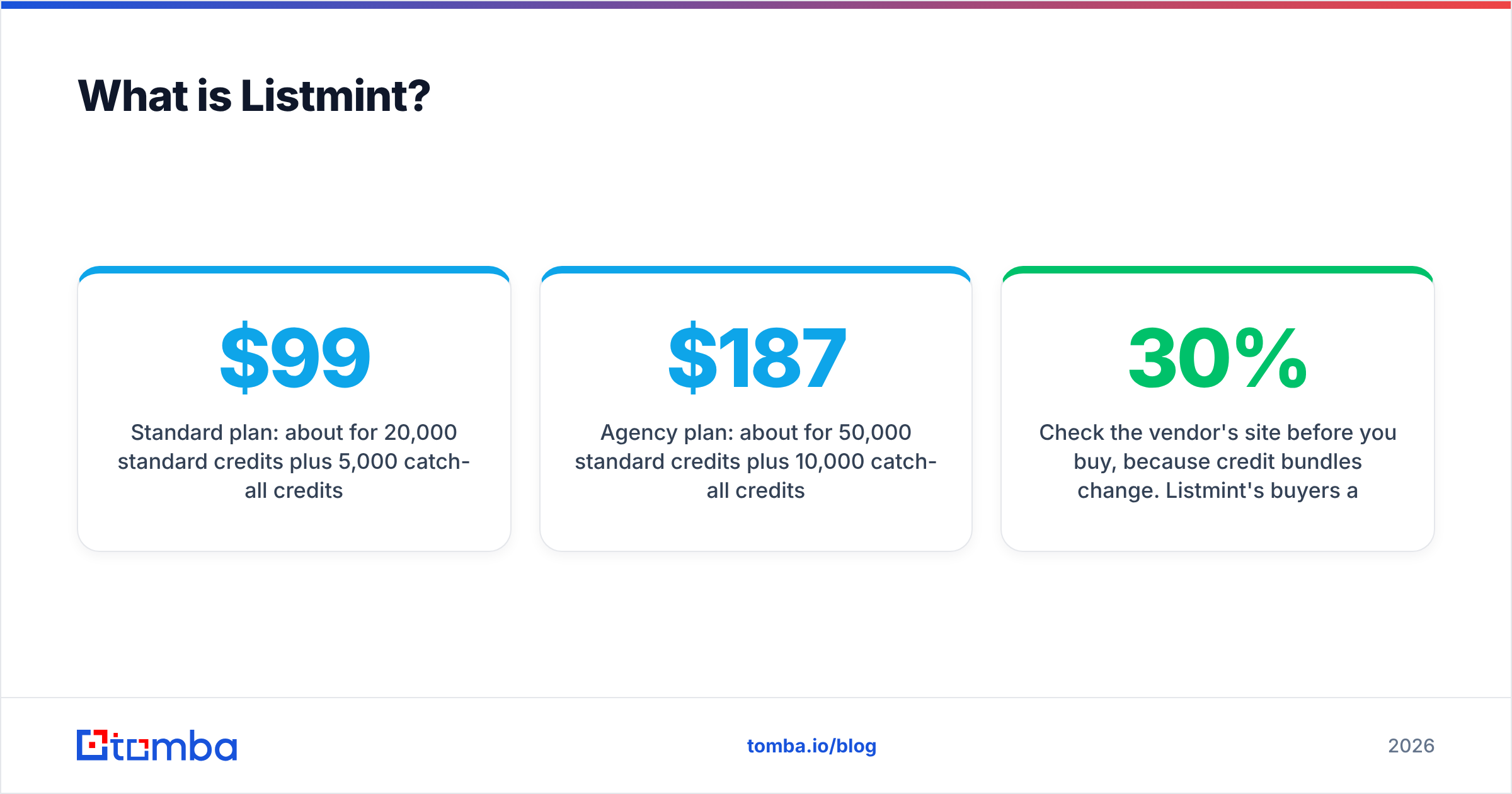
- Standard plan: about $99/month for 20,000 standard credits plus 5,000 catch-all credits
- Agency plan: about $187/month for 50,000 standard credits plus 10,000 catch-all credits
- Enterprise: custom
Check the vendor's site before you buy, because credit bundles change. Listmint's buyers are mostly cold outbound agencies, Clay users, and SDR teams who already have lists and keep losing 15–30% of them to "unknown" verdicts.
What is ZoomInfo?#
ZoomInfo is one of the largest B2B data platforms. It sells contact and company records: emails, direct dials, and mobile numbers, along with firmographics, technographics, org charts, buyer-intent signals, website visitor identification, and workflow tools layered on top. Over the last few years it has also added conversation intelligence, engagement features, and AI assistants, and it now positions itself as a full go-to-market suite.
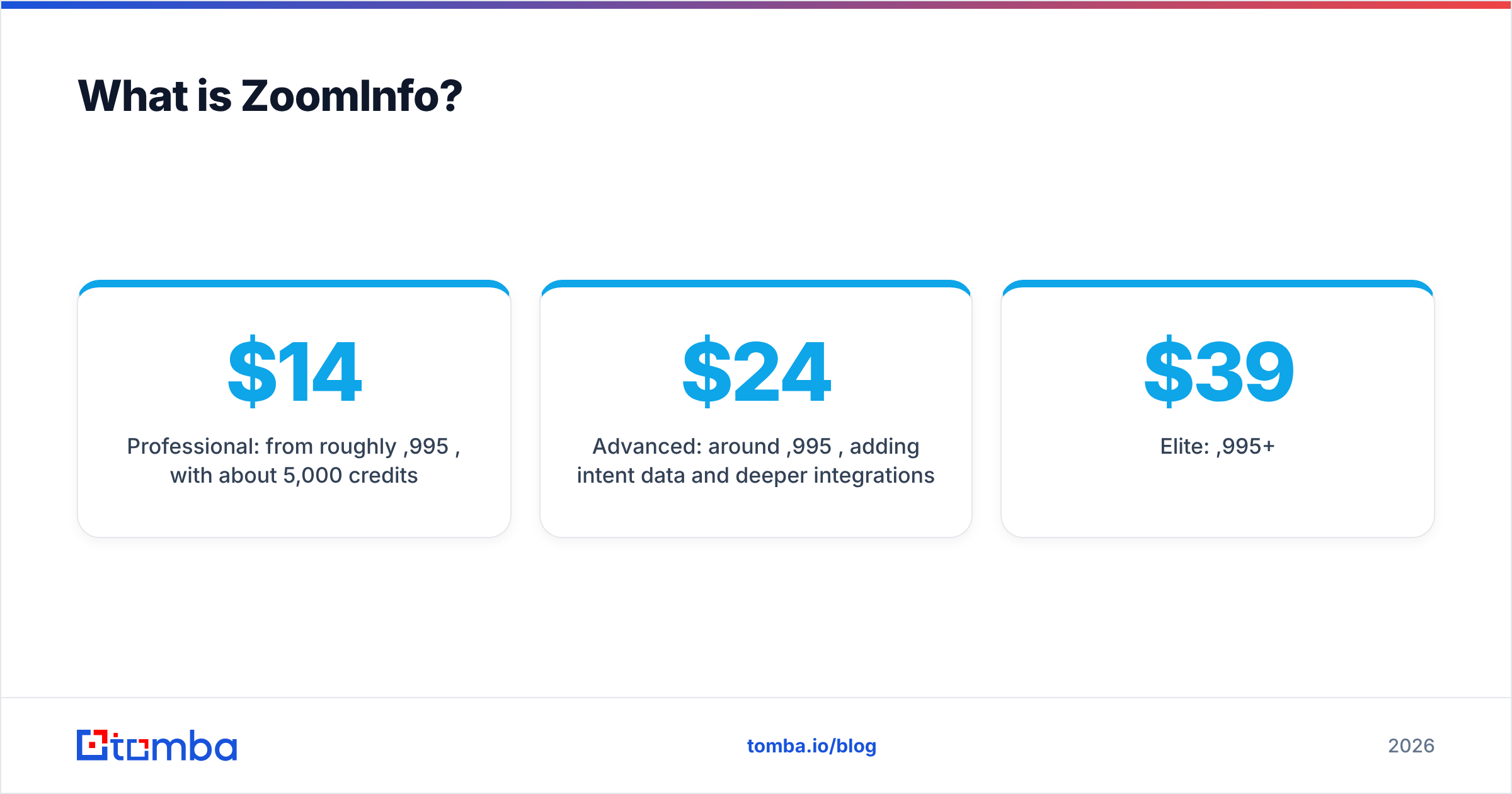
ZoomInfo doesn't publish list prices. Every deal is a custom quote. Third-party pricing breakdowns from 2026 give these rough ranges:
- Professional: from roughly $14,995/year, with about 5,000 credits
- Advanced: around $24,995/year, adding intent data and deeper integrations
- Elite: $39,995+/year
Contracts are usually annual. Several sources also report multi-seat minimums and auto-renewal clauses you need to watch. Seat add-ons, credit top-ups, and intent upgrades push many teams well past the entry price. Confirm current terms on ZoomInfo's official site and in a sales call, since the numbers vary with negotiation.
ZoomInfo also verifies its own records. It isn't a standalone verifier you'd run a third-party list through, though.
How do Listmint and ZoomInfo compare side by side?#
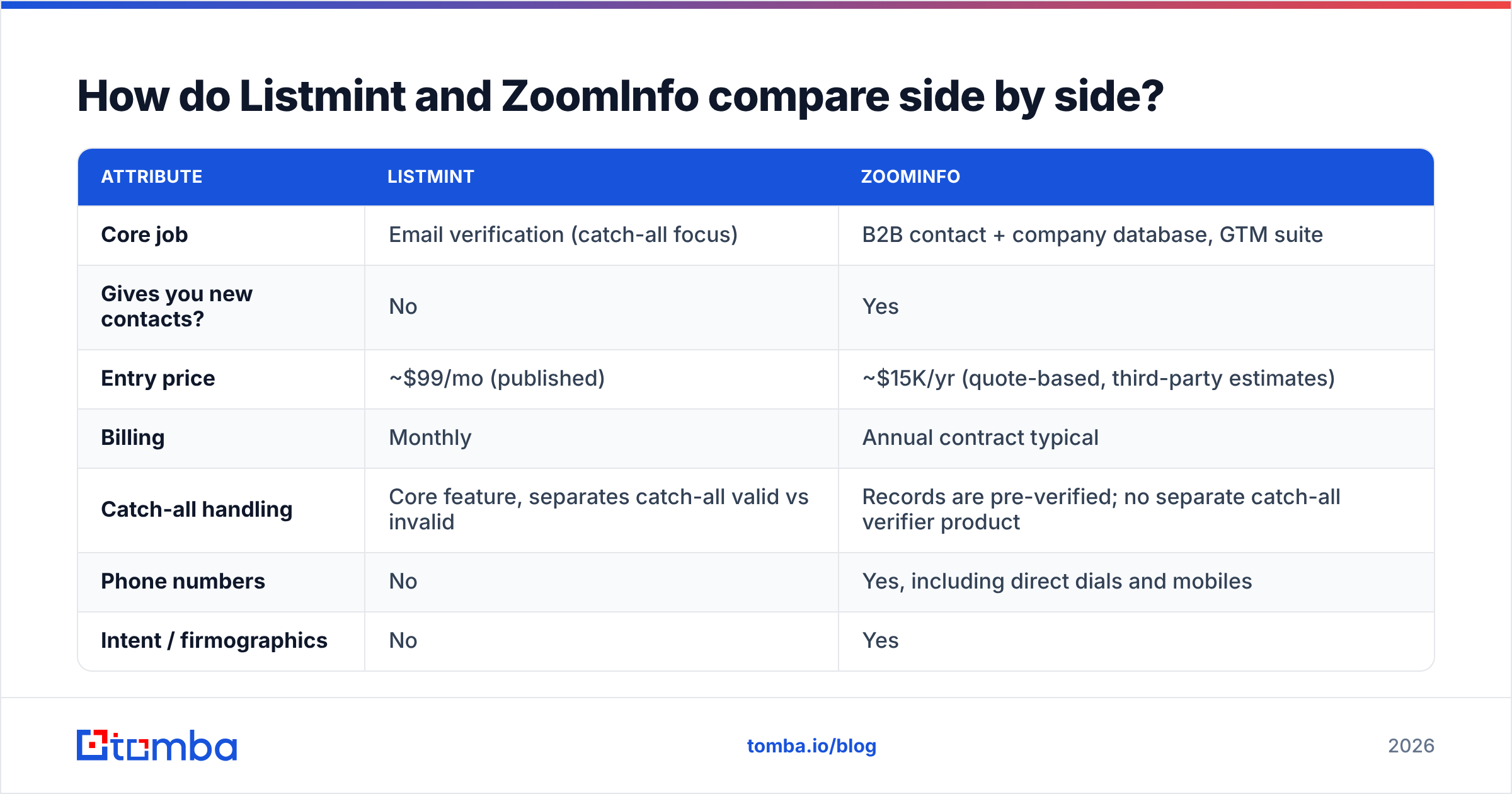
This table puts them next to each other on the attributes buyers ask about most.
| Attribute | Listmint | ZoomInfo |
|---|---|---|
| Core job | Email verification (catch-all focus) | B2B contact + company database, GTM suite |
| Gives you new contacts? | No | Yes |
| Entry price | ~$99/mo (published) | ~$15K/yr (quote-based, third-party estimates) |
| Billing | Monthly | Annual contract typical |
| Catch-all handling | Core feature, separates catch-all valid vs invalid | Records are pre-verified; no separate catch-all verifier product |
| Phone numbers | No | Yes, including direct dials and mobiles |
| Intent / firmographics | No | Yes |
| Integrations | API, Clay | Salesforce, HubSpot, Outreach, Salesloft, many more |
| Best for | Agencies, Clay workflows, cold email senders with existing lists | Mid-market and enterprise sales orgs with large TAMs |
| Time to value | Minutes (upload a CSV) | Weeks (onboarding, admin setup, training) |

The gap is obvious once you lay it out. Listmint is a filter for data you already have. ZoomInfo is a source of new data. Neither replaces the other.
Which problem are you actually trying to solve?#
Before you book a demo with either vendor, work out which of these four situations describes your team. Each one points to a different purchase.
- You have leads, but your bounce rate is above 3%. Your problem is verification, and catch-all domains are probably the cause. A catch-all specialist like Listmint, or any verifier with real catch-all resolution, is the right fix. Buying a database won't help.
- You have no leads and a small, well-defined ICP. You need an email finder, not an enterprise platform. Finding 200–2,000 decision-makers a month doesn't justify a five-figure annual contract.
- You have a large TAM, a team of 10+ reps, and you sell on timing. Intent data, org charts, and direct dials start to pay for themselves at this size. ZoomInfo, or a peer in its tier, is a reasonable buy.
- You run data through Clay or a waterfall. You'll likely stack several providers: one or more finders, then a verifier on the output. Listmint was built for exactly this pattern.
Most readers of this post fall into situation 1 or 2. That matters, because the enterprise sales pitch tends to present situation 3 as the default.
Is Listmint better than ZoomInfo for email deliverability?#
For deliverability specifically, Listmint is the more focused tool, because verification is all it does. When a verifier and a database disagree about an address, the verifier usually has the fresher answer. It checked the mailbox minutes ago. The database record could be months old.
The same logic works in the other direction. People change jobs all the time, and every B2B database decays. Many teams that buy large databases still run exports through a separate verifier before sending. If you do buy ZoomInfo, budget for a verification pass on top. Don't assume every exported email is still good.
Three things drive a clean list, whichever source you use:
- Verify right before sending, not at the moment you capture the lead. A 60-day-old "valid" means much less than a 60-minute-old one.
- Split catch-all results out. Send to
catch_all_validaddresses in smaller batches, and watch bounces per domain. - Protect your sender reputation. One bad batch can hurt inbox placement for weeks, and that cost is harder to see than a contract fee.
How much do Listmint and ZoomInfo really cost per usable contact?#
Sticker prices mislead here, because you're buying different units. A better comparison is cost per sendable contact for a typical outbound team.
Take a team that needs about 1,500 new, verified contacts a month.
- ZoomInfo route: At about $15K/year at entry level, you're spending roughly $1,250/month before overages or extra seats. That covers contacts and enrichment, plus whatever verification is built in. If you use the platform's wider features, such as intent and org charts, the price can make sense. If you only export emails, you're paying for a lot you never use.
- Listmint-only route: Doesn't work alone. Listmint verifies contacts but doesn't supply them, so you still need a source.
- Finder + verifier route: A self-serve email finder plus a verifier with catch-all handling often comes in at a few hundred dollars a month, billed monthly, with no seat minimums. You give up intent data and org charts. You keep cash and flexibility.
The third route is how most early-stage and mid-market outbound teams work. The question is less "Listmint or ZoomInfo" and more "do I need an enterprise suite, or a finder with good verification?"
Where does Tomba fit between the two?#
Tomba sits in the middle of this comparison. It does the job ZoomInfo does for most small teams, finding professional emails, and it also handles the job Listmint specializes in, verification, including catch-all domains.
- Email finder by name + domain, by domain alone, or through the LinkedIn and browser extensions
- Email verifier with SMTP and mailbox checks
- Catch-all verifier for the domains that accept everything
- Domain search, phone finder, and data enrichment in the same account
On price, Tomba has a free tier with 25 searches a month, Starter at $49/month, Growth at $99/month, Pro at $249/month, and custom Enterprise. Everything is published on the Tomba pricing page and billed monthly.
To be fair about the limits: Tomba doesn't try to match ZoomInfo's intent data, org charts, or the depth of its direct-dial coverage in every region. If those features drive your pipeline, an enterprise platform is still the right buy. And if you run a Clay waterfall and want a specialist catch-all verifier at the end of it, Listmint is a strong option for that one step. Tomba is the better fit when you want finding and verifying in one place, at a monthly price a small team can expense.
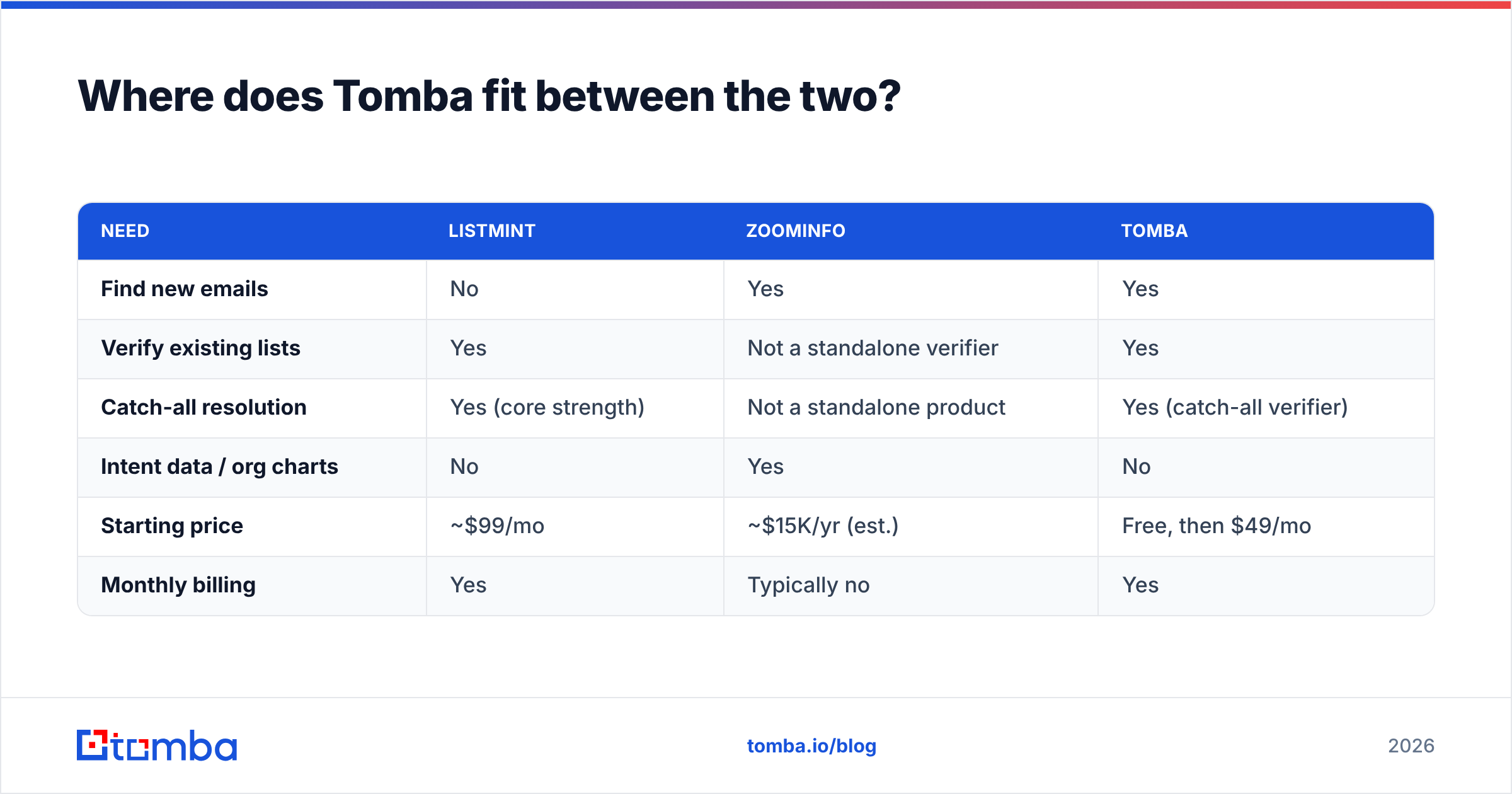
| Need | Listmint | ZoomInfo | Tomba |
|---|---|---|---|
| Find new emails | No | Yes | Yes |
| Verify existing lists | Yes | Not a standalone verifier | Yes |
| Catch-all resolution | Yes (core strength) | Not a standalone product | Yes (catch-all verifier) |
| Intent data / org charts | No | Yes | No |
| Starting price | ~$99/mo | ~$15K/yr (est.) | Free, then $49/mo |
| Monthly billing | Yes | Typically no | Yes |
What do real users say about each tool?#
Review sites are a good sanity check, as long as you read them for patterns and not scores. On Listmint's G2 profile, reviewers mostly praise catch-all recovery, meaning more usable addresses from lists other verifiers had marked "unknown," and the Clay integration. The sample is small, which you'd expect from a niche tool.
ZoomInfo has thousands of reviews. The recurring themes are consistent: data breadth and US coverage get strong marks, and the common complaints are price, contract rigidity, renewal terms, and data decay in fast-moving segments. The complaints are almost always about commercial terms, not the product.

Is ZoomInfo worth it over Listmint in 2026?#
It depends on your team's size and sales motion, not on which tool is "better."
Pick ZoomInfo if:
- You have 10+ quota-carrying reps and a large, US-heavy TAM
- Intent signals and buying-committee mapping actually change how you prioritize accounts
- You have a RevOps owner who will administer the platform and push adoption
- You can commit to an annual contract and negotiate it hard
Pick Listmint if:
- You already have lead sources (Clay, scraping, a finder, events) and your bounce rate is hurting deliverability
- A large share of your lists are on catch-all domains
- You want monthly billing and a tool that does one thing well
Pick neither, and use a finder with built-in verification, if:
- You're a founder, a small SDR team, or an agency with a focused ICP
- You need hundreds to low thousands of verified contacts a month, not millions of records
- You want to start today, not after a procurement cycle
What's the smartest stack for most outbound teams?#
For most teams under 20 reps, a practical 2026 stack looks like this:
- Source: find contacts by name and domain, or pull everyone at a target company with a domain search.
- Verify: run every list through a verifier right before sending, and split catch-all results into their own send stream.
- Enrich: add titles, company size, and phone numbers where the deal size justifies it.
- Sync: push clean records into your CRM (HubSpot's docs and Salesforce both cover import hygiene well) so reps never work from stale spreadsheets.
- Monitor: track bounce rate by list source every month. If one source keeps producing bounces, drop it.
You can build that stack with ZoomInfo at the top if your budget and team size support it. You can add Listmint as a specialist verification step. Or you can run most of it from a single self-serve tool and move up only when the data shows you need to.
Final verdict: Listmint or ZoomInfo?#
Listmint and ZoomInfo aren't rivals. Listmint is a sharp, affordable verifier for teams whose main pain is catch-all domains. ZoomInfo is an enterprise data suite for large sales orgs that will use its intent, org-chart, and workflow features. Choosing between them only makes sense once you know whether your problem is bad data or no data.
If your answer is "a bit of both, and I don't want a five-figure contract," start with Tomba Email Finder. You can find professional emails by name, domain, or company, verify them in the same account, including catch-all domains, and start on the free plan before moving to $49/month when you're ready to scale.
Related guides#
// get started
Find, verify and enrich your first contacts today
Start on the free plan with 25 searches a month, then scale when your team is ready.
Free plan · No credit card required · GDPR & CCPA
Get the Tomba newsletter
Product and data updates
// about the author