Local SEO Lead Generation: How to Win Map Pack Leads in 2026
Ranking in the map pack is only half the job. Here's how local SEO lead generation works in 2026: which signals matter, which pages convert, and how agencies turn local SEO gaps into booked calls.
TL;DR
- Local SEO lead generation means getting found by nearby buyers at the moment they search, then turning that visibility into calls, form fills, and direction requests.
- Google ranks local results on three factors: relevance, distance, and prominence. You can't change distance, so put your effort into the other two.
- Your Google Business Profile, your location or service-area pages, and your reviews produce most local leads. Citations and links matter less but still help.
- Track leads, not rankings. Call tracking, UTM-tagged profile links, and form attribution tell you which of your local SEO work actually pays.
- If you're an agency selling local SEO, the same audit that fixes a client's profile also works as your cold outreach hook. You just need the owner's real email, not
info@.
What is local SEO lead generation?#
Local SEO lead generation is how businesses that serve a specific area (plumbers, dentists, law firms, HVAC contractors, multi-location clinics, and B2B service firms with regional territories) turn local search visibility into qualified inquiries.
It differs from general SEO lead generation in three ways:
- The results page is different. For searches like "emergency electrician Austin" or "accountant near me", Google shows a map pack of three businesses above the organic links. A lot of the clicks go to those three.
- The conversion is faster. Local searchers usually have the problem right now. The "lead" is often a phone call placed from the map listing, not a form fill after a week of research.
- The ranking signals differ. Proximity, your Google Business Profile, review volume and velocity, and consistent name/address/phone (NAP) data all count alongside the usual on-page and link signals.
Google is fairly open about how this works. Its guidance on improving local ranking says local results are based mainly on relevance, distance, and prominence. That gives you a clear to-do list, since two of the three are within your control.
How does local search actually produce leads?#
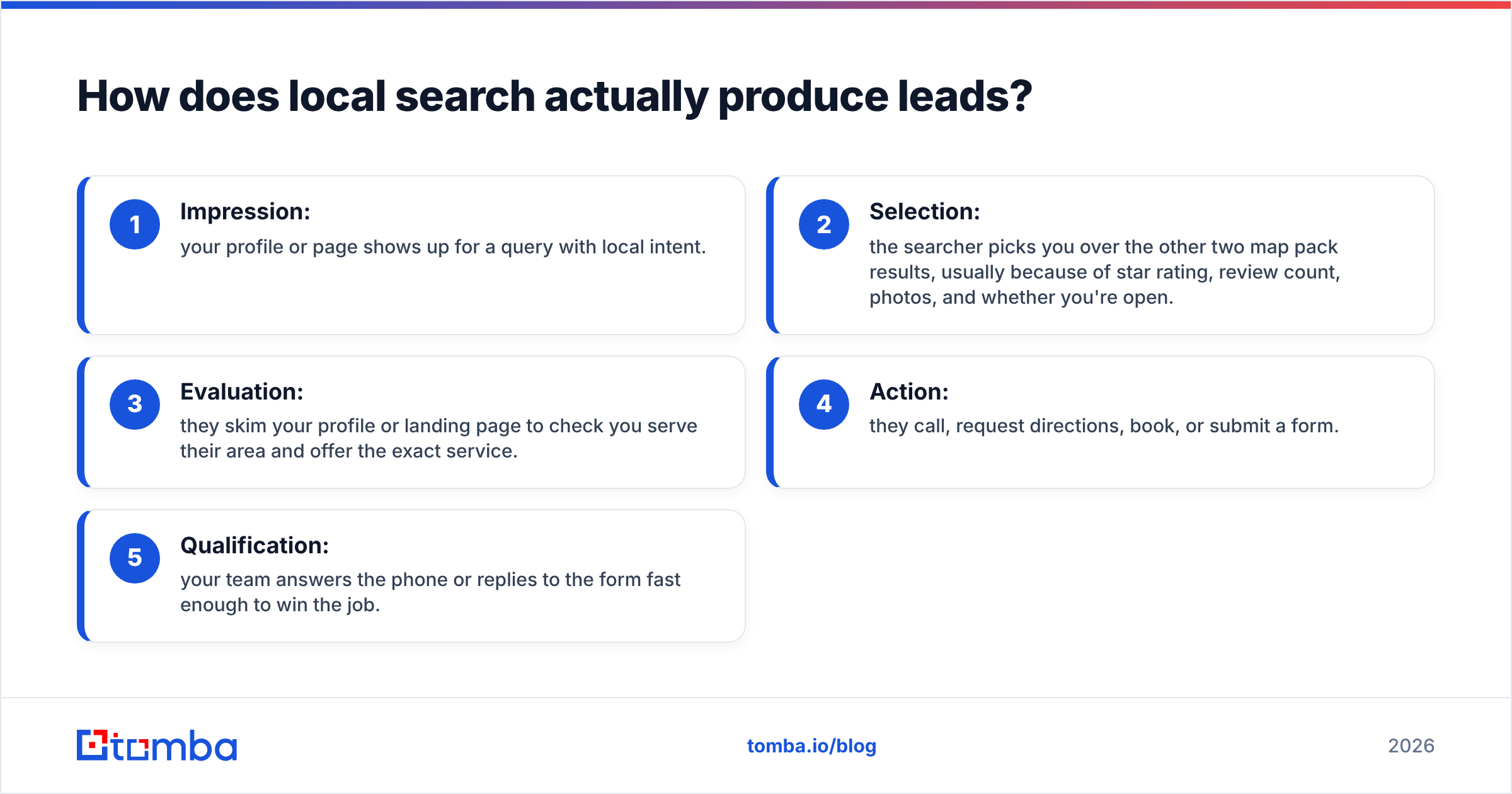
Plenty of businesses rank locally and still get few leads. That's because a searcher goes through five separate steps between typing a query and becoming a lead, and each step can drop them:
- Impression: your profile or page shows up for a query with local intent.
- Selection: the searcher picks you over the other two map pack results, usually because of star rating, review count, photos, and whether you're open.
- Evaluation: they skim your profile or landing page to check you serve their area and offer the exact service.
- Action: they call, request directions, book, or submit a form.
- Qualification: your team answers the phone or replies to the form fast enough to win the job.
Most local SEO advice stops at step 1. The leads come from steps 2 through 5. A profile that ranks #2 with a 4.8 rating and 300 reviews will often take more calls than the #1 listing with 11 reviews and no photos.

Which local SEO channels generate the most leads?#
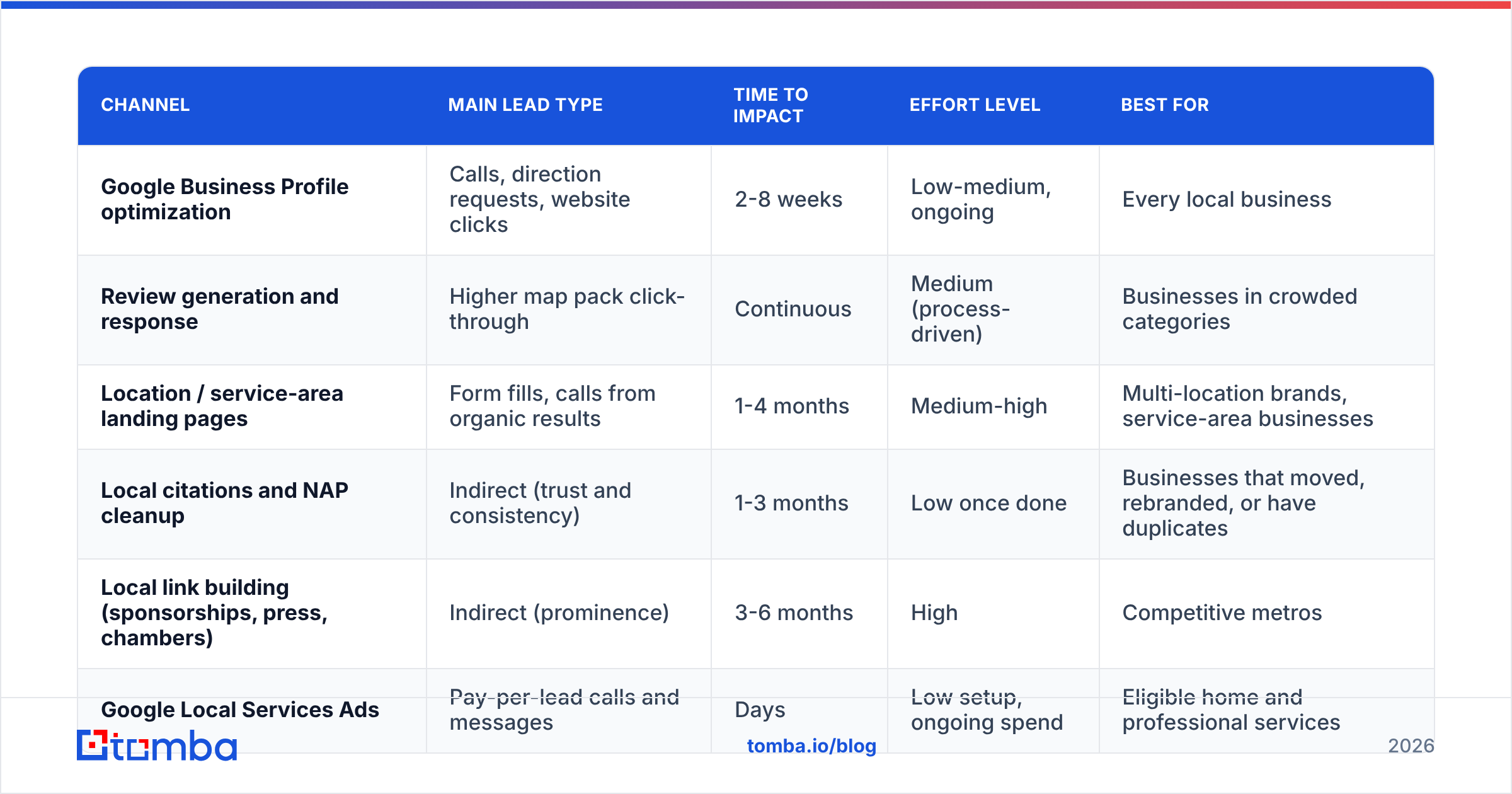
Local SEO covers several channels. They don't carry equal weight, and how you rank them depends on whether you're a single storefront, a service-area business, or a multi-location brand.
| Channel | Main lead type | Time to impact | Effort level | Best for |
|---|---|---|---|---|
| Google Business Profile optimization | Calls, direction requests, website clicks | 2-8 weeks | Low-medium, ongoing | Every local business |
| Review generation and response | Higher map pack click-through | Continuous | Medium (process-driven) | Businesses in crowded categories |
| Location / service-area landing pages | Form fills, calls from organic results | 1-4 months | Medium-high | Multi-location brands, service-area businesses |
| Local citations and NAP cleanup | Indirect (trust and consistency) | 1-3 months | Low once done | Businesses that moved, rebranded, or have duplicates |
| Local link building (sponsorships, press, chambers) | Indirect (prominence) | 3-6 months | High | Competitive metros |
| Google Local Services Ads | Pay-per-lead calls and messages | Days | Low setup, ongoing spend | Eligible home and professional services |
Two things stand out. First, the Google Business Profile is the cheapest lever and has the most direct effect on leads, because the call button sits right on the listing. Second, Local Services Ads aren't SEO, but they appear above the map pack for eligible categories. If you ignore them in your local plan, you're ignoring the top spot on the page.
How do you optimize a Google Business Profile for leads, not just rankings?#
Most businesses claim the profile, fill in the obvious fields, and never touch it again. To get leads from it, you have to maintain it. These five areas matter most:
- Primary category precision: Your primary category carries more weight than anything else you control on the profile. "Personal injury attorney" and "Lawyer" rank for very different queries. Look at which primary categories the top three competitors use and pick the most specific one that's accurate.
- Services and products filled out in full: Every service you list gives Google another relevance signal and gives the searcher another reason to pick you. List each service you want calls for, with a short description in plain language.
- Photos that answer questions: Post real photos of your team, vehicles, storefront, finished work, and the inside of your location. Stock photos don't build trust. A clear photo of your signage cuts down "is this the right place?" hesitation.
- UTM-tagged website link: Add UTM parameters to the website URL on the profile (for example
utm_source=google&utm_medium=organic&utm_campaign=gbp). Without them, GBP traffic lands in "organic" or "direct" in your analytics and you can't attribute the leads. - Q&A and messaging owned by you: Answer the questions buyers actually ask (pricing ranges, service area, emergency availability) before a stranger answers them wrongly. If you turn on messaging, staff it. Slow replies hurt more than having messaging off.
Posts and offers on the profile are optional. They won't fix a weak category or a thin review count, but they do signal an active business and can push a fence-sitter to call.
Do reviews really drive local leads?#
Yes, and they affect two steps. Reviews contribute to prominence (step 1) and they strongly shape which result gets picked (step 2). BrightLocal's recurring Local Consumer Review Survey keeps finding that most consumers read reviews before choosing a local business, and that recency matters as much as the star average.
Build reviews into operations instead of running occasional campaigns:
- Ask at the moment of satisfaction. The best time is right after a job is completed or a problem is solved. Send a text with a direct review link while the customer is still happy.
- Make it one tap. Use the short review link Google provides in your profile dashboard. Every extra click loses people.
- Respond to every review. Thank people for positive reviews. Answer negative ones calmly and specifically. Future customers read your replies as a preview of how you treat people.
- Never gate or incentivize. Filtering unhappy customers away from Google, or paying for reviews, breaks Google's policies and can get reviews removed or the profile suspended.
A steady flow of new reviews usually beats a one-off burst. Twenty reviews spread over six months looks healthier than twenty in one week followed by silence.
How should you build location and service-area pages that convert?#
When a searcher skips the map pack and clicks an organic result, they usually land on a location page or a service page. Weak versions of these pages lose more local leads than anything else in the funnel.
A location page that converts has:
- Unique, local content. Mention the neighborhoods you serve, local conditions ("hard water in Phoenix wrecks water heaters faster"), and projects you've done nearby. Swapping the city name into a template isn't enough. Google is good at spotting doorway pages.
- NAP that matches your profile exactly, plus an embedded map and hours.
- A phone number that's click-to-call on mobile and sits above the fold.
- Proof from that area: reviews from customers in the city, photos of local jobs, local certifications or memberships.
- LocalBusiness schema markup so search engines can read your address, hours, and service area without guessing.
- One clear conversion path: call, book, or request a quote. Don't put five competing CTAs on one page.
Service-area businesses without a storefront should build service + city pages ("roof repair in Plano") only for areas they genuinely cover and can back with real local content. Fifty pages of thin content can hurt the whole domain.
Which tools help with local SEO lead generation?#
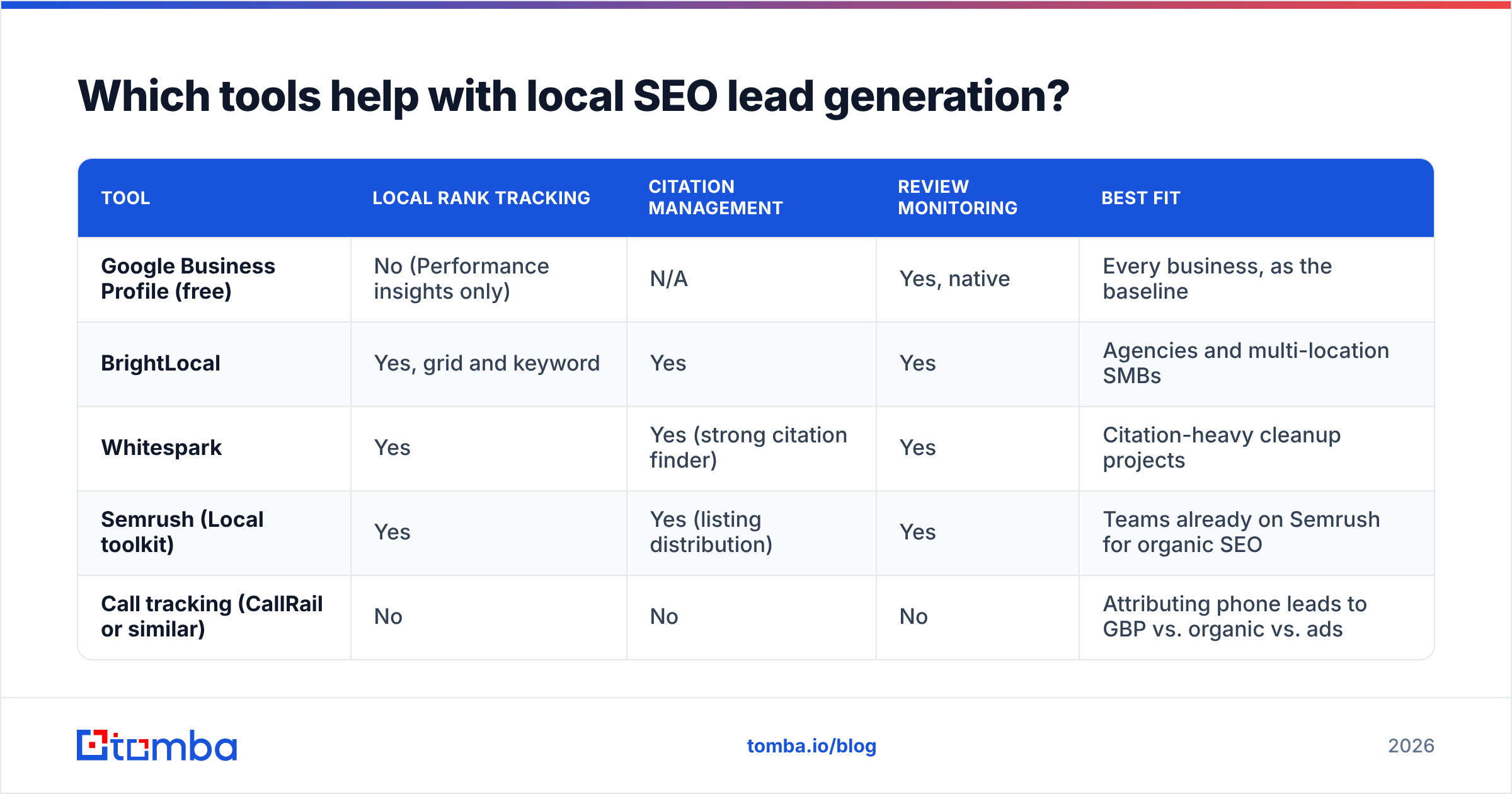
You don't need a big stack. Most teams get by with one tracking and citation tool plus Google's free products. Here's how the common options compare on the jobs that matter for leads:
| Tool | Local rank tracking | Citation management | Review monitoring | Best fit |
|---|---|---|---|---|
| Google Business Profile (free) | No (Performance insights only) | N/A | Yes, native | Every business, as the baseline |
| BrightLocal | Yes, grid and keyword | Yes | Yes | Agencies and multi-location SMBs |
| Whitespark | Yes | Yes (strong citation finder) | Yes | Citation-heavy cleanup projects |
| Semrush (Local toolkit) | Yes | Yes (listing distribution) | Yes | Teams already on Semrush for organic SEO |
| Call tracking (CallRail or similar) | No | No | No | Attributing phone leads to GBP vs. organic vs. ads |
Pricing changes often and depends on location count, so check the vendor pages before you commit. What matters more is setting up attribution before you start optimizing. If you can't tell which calls came from the profile, you can't tell which changes worked.
How do you measure whether local SEO is producing leads?#
Rankings are an input metric. Leads and revenue are what you should report. At a minimum, track:
- GBP actions: calls, direction requests, and website clicks from the profile's Performance tab, trended monthly.
- Tracked calls by source: a dynamic number on the website and a tracking number on the profile. Set the tracking number as the primary and your main line as an additional number so NAP consistency holds.
- Form fills by landing page: so you know which location or service pages actually convert.
- Lead-to-customer rate by source: a call from the map pack and a form fill from a blog post rarely close at the same rate.
- Speed-to-lead: how fast calls get answered and forms get replies. Often this is where the real leak is.
If you work in a CRM, log the lead source on the contact record from the first touch. That lets you compare "local SEO leads" and "referral leads" by closed revenue six months later, instead of relying on memory.
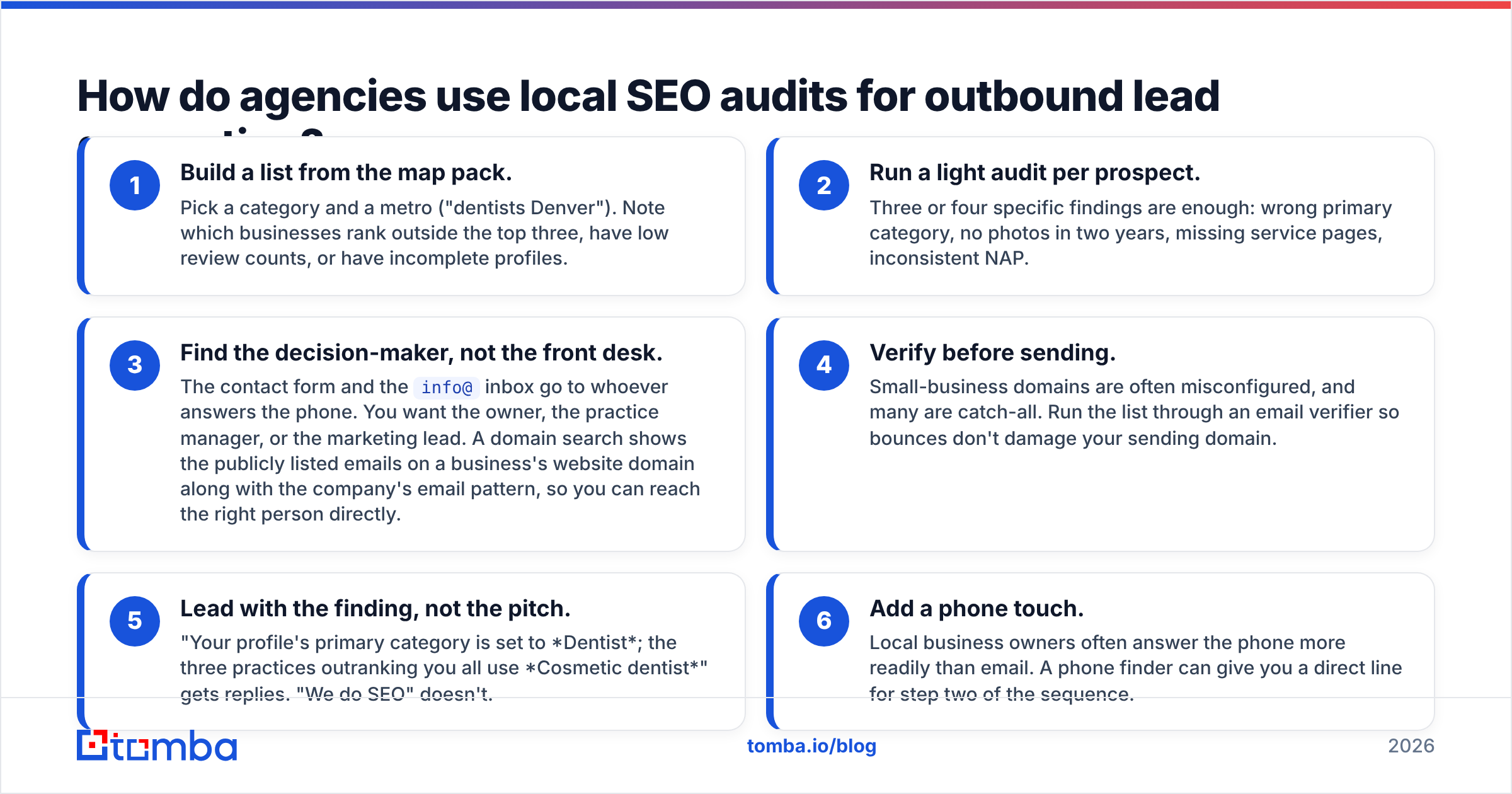
How do agencies use local SEO audits for outbound lead generation?#
This is the other half of local SEO lead generation. If you sell local SEO, whether as an agency, a freelancer, or a SaaS platform for local businesses, the market publishes its own problems. Any business with an unclaimed profile, 9 reviews against a competitor's 240, or a site with no location pages is a qualified prospect you can find with a public search.
The outreach workflow many agencies use:
- Build a list from the map pack. Pick a category and a metro ("dentists Denver"). Note which businesses rank outside the top three, have low review counts, or have incomplete profiles.
- Run a light audit per prospect. Three or four specific findings are enough: wrong primary category, no photos in two years, missing service pages, inconsistent NAP.
- Find the decision-maker, not the front desk. The contact form and the
info@inbox go to whoever answers the phone. You want the owner, the practice manager, or the marketing lead. A domain search shows the publicly listed emails on a business's website domain along with the company's email pattern, so you can reach the right person directly. - Verify before sending. Small-business domains are often misconfigured, and many are catch-all. Run the list through an email verifier so bounces don't damage your sending domain.
- Lead with the finding, not the pitch. "Your profile's primary category is set to Dentist; the three practices outranking you all use Cosmetic dentist" gets replies. "We do SEO" doesn't.
- Add a phone touch. Local business owners often answer the phone more readily than email. A phone finder can give you a direct line for step two of the sequence.
This works because the value is shown before you ask for anything. The prospect can check your claim in ten seconds by searching their own business.

For guidance on keeping these sequences compliant and personal at scale, HubSpot's sales prospecting resources are a solid neutral reference. The main points: keep lists small, write per segment, and follow up by adding value rather than "just checking in."
What mistakes kill local SEO lead flow?#
These show up again and again in audits:
- Duplicate or unverified profiles splitting reviews and confusing Google about which listing is real.
- Keyword-stuffed business names ("Joe's Plumbing Best Plumber Austin TX"). This breaks Google's guidelines and commonly gets profiles suspended right when you rank.
- Virtual office addresses for a storefront profile. Suspensions follow, and reinstatement is slow.
- Unanswered calls during business hours. A ranking you can't answer is just a lead handed to a competitor.
- Location pages that are copies of each other. They rarely rank, and they drag down the pages that could.
- Reporting on rankings only. When the owner asks "how many calls did this get us?", you need a real answer.
Is local SEO lead generation worth it compared to paid ads?#
For most local businesses, yes, but as a base layer rather than a replacement. Ads (search, Local Services Ads, social) turn on right away and stop when the budget stops. Local SEO is slower to build, but it compounds: a well-reviewed profile and strong location pages keep producing calls at almost no marginal cost per lead.
The practical split for most businesses is:
- Months 0-3: Fix the profile, start the review process, set up tracking. Use paid search or LSAs to fill the pipeline while organic catches up.
- Months 3-9: Build location and service pages, clean up citations, earn a handful of local links.
- Month 9+: Cut paid spend where organic leads now cover demand, and move the budget to categories or areas where you're still weak.
For agencies, local SEO's payback is even easier to show, because every audit finding doubles as a proof point in your outbound.
Where does Tomba fit in local SEO lead generation?#
If you run the inbound side for your own business, Tomba isn't the core tool. Your Google Business Profile, reviews, and landing pages are. If you're an agency, consultant, or SaaS company selling to local businesses, contact data is where outreach usually breaks down. The map pack tells you who needs help. It doesn't tell you who makes the decision or how to reach them.
Tomba Email Finder closes that gap. Enter a local business's domain or an owner's name and company, get the professional email with a confidence score, and verify it before it enters your sequence. The free tier covers 25 searches a month, enough to test the audit-led outreach play on one metro and one category. See Tomba pricing when you're ready to scale it across territories.
Related guides#
Ready to find emails that actually work?
Join 150,000+ professionals who stopped guessing and started sending. Free credits on signup — no credit card required.
Get the Tomba newsletter
Practical outbound tactics and product updates — once every two weeks.
About the author