LoopUp Alternatives: 8 Teams Calling Providers Compared for 2026
LoopUp went private in 2024 and now focuses on Microsoft Teams voice. If you're re-tendering your Teams telephony or legacy conferencing, these are the 8 providers worth shortlisting and how to choose between them.
TL;DR
- LoopUp is no longer mainly a conference-calling brand. It delisted from AIM in April 2024, went private, and now sells managed Microsoft Teams telephony through Operator Connect, Direct Routing, and Bring Your Own Carrier.
- The best LoopUp alternatives depend on what you actually bought from them. Teams PSTN replacement, multinational number coverage, and legacy audio conferencing each have a different shortlist.
- For global enterprise Teams voice, look at Tata Communications, Colt, and Orange Business. For mid-market managed service, look at CallTower and Gamma. If you're ready to leave Teams-native calling, look at Zoom Phone and Webex Calling.
- If your footprint is simple, Microsoft's own Calling Plans are often the cheapest route. Price every option on your real country list, not the brochure.
- Whichever provider carries your calls, the outbound team still needs accurate contact data. That's where tools like Tomba fit.
What is LoopUp, and why are teams looking for alternatives?#
LoopUp is a London-based communications provider. It built its name on premium, managed conference calling for law firms, banks, and other professional-services businesses where a dropped client call is a real cost. According to its Wikipedia entry, the company listed on AIM in 2016, acquired MeetingZone in 2019, delisted in April 2024, and closed a private-equity funding round later that year.
The product also changed. LoopUp now describes itself as a managed global telephony provider for Microsoft Teams. It connects Teams to the public phone network (PSTN) so users can dial real numbers from the Teams client. Its pitch rests on three things: a large country footprint (it cites Operator Connect certification in 50+ countries and PSTN coverage in 100+), no on-premises session border controllers, and 24/7 follow-the-sun support.
People search for LoopUp alternatives for a few recurring reasons:
- Contract renewal. Teams voice deals usually run for multiple years, and renewal is the natural point to re-tender.
- Ownership change. After the move to private equity, some procurement teams want to re-check vendor risk and roadmap commitments.
- Product fit. Organizations that bought LoopUp for conferencing may find that Teams, Zoom, or Webex meetings now cover what they need.
- Cost. Per-country minimum commits and number-porting fees add up quickly across a multinational footprint.
Put simply, LoopUp is the phone line plugged into the back of Teams. You're shopping for a different company to supply that line, or deciding whether you need Teams at the front at all.
How do Microsoft Teams calling options actually work?#
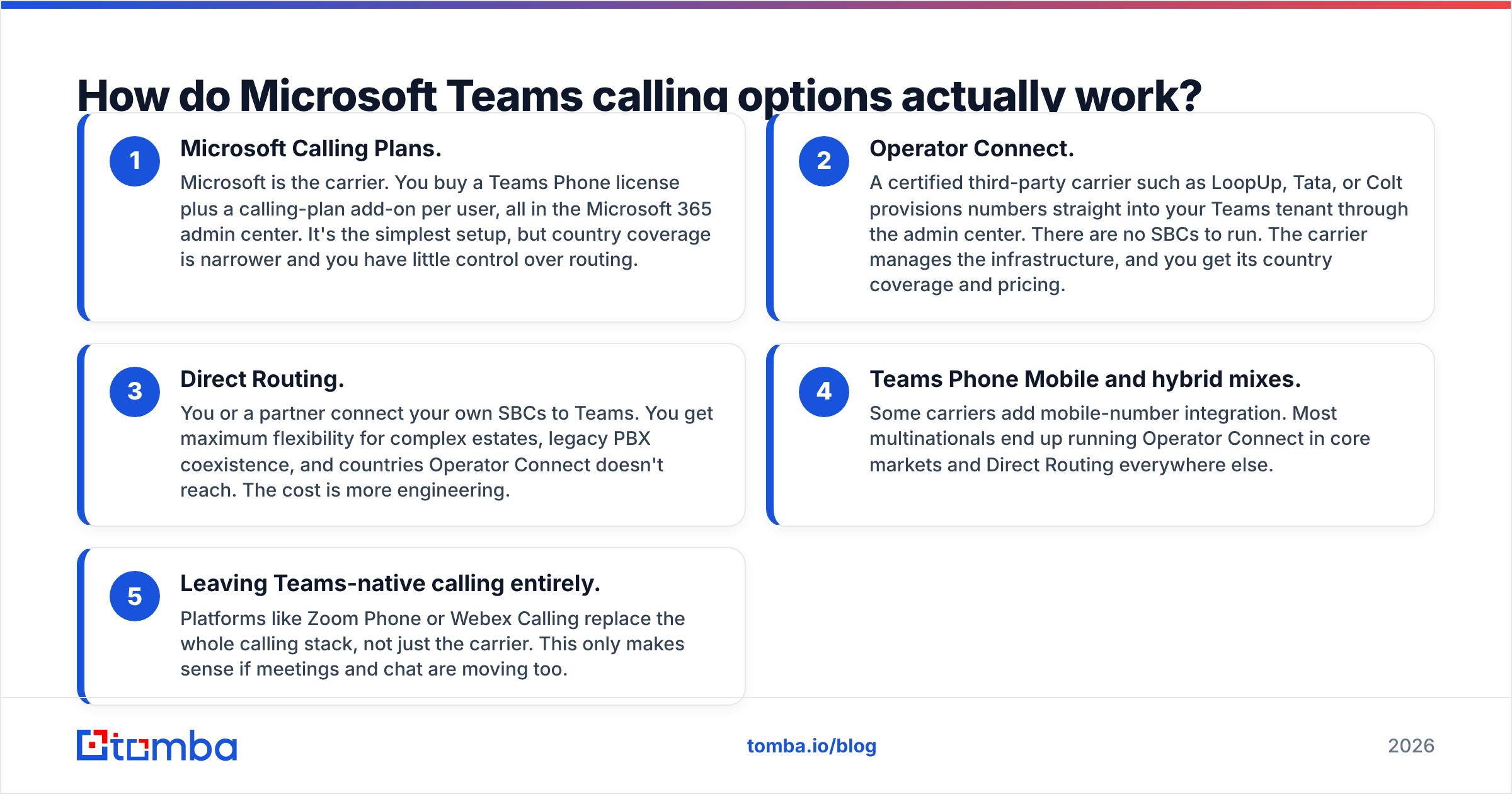
Before comparing vendors, you need to know which connection model you're buying. It shapes the contract, the admin overhead, and which LoopUp alternatives are even relevant. Microsoft documents the models in its Teams Phone PSTN connectivity guidance.
- Microsoft Calling Plans. Microsoft is the carrier. You buy a Teams Phone license plus a calling-plan add-on per user, all in the Microsoft 365 admin center. It's the simplest setup, but country coverage is narrower and you have little control over routing.
- Operator Connect. A certified third-party carrier such as LoopUp, Tata, or Colt provisions numbers straight into your Teams tenant through the admin center. There are no SBCs to run. The carrier manages the infrastructure, and you get its country coverage and pricing.
- Direct Routing. You or a partner connect your own SBCs to Teams. You get maximum flexibility for complex estates, legacy PBX coexistence, and countries Operator Connect doesn't reach. The cost is more engineering.
- Teams Phone Mobile and hybrid mixes. Some carriers add mobile-number integration. Most multinationals end up running Operator Connect in core markets and Direct Routing everywhere else.
- Leaving Teams-native calling entirely. Platforms like Zoom Phone or Webex Calling replace the whole calling stack, not just the carrier. This only makes sense if meetings and chat are moving too.
LoopUp sells options 2 and 3 as a managed blend. A like-for-like replacement therefore has to cover the same countries on the same connection models.
Which LoopUp alternatives are worth shortlisting in 2026?#
These eight providers cover the realistic replacement paths. We've grouped them by the buyer each one suits best, not ranked them by one "winner" score. A 40-country law firm and a 200-seat UK agency should not end up on the same shortlist.
1. Microsoft Teams Calling Plans#
Best for: single-country or few-country organizations that want the least admin.
If most of your users sit in markets where Microsoft is its own carrier (the US, UK, much of Western Europe, and a handful of others), Calling Plans removes a vendor from the stack entirely. You get one bill and one support path. The trade-offs are limited country reach, less flexible number management, and no managed service layer. When something breaks, you're working through Microsoft support, not an account manager who knows your estate.
2. Tata Communications (GlobalRapide / Operator Connect)#
Best for: large multinationals that need the widest carrier-owned footprint.
Tata runs one of the largest global voice networks and is a long-standing Operator Connect partner. It competes most directly with LoopUp on the "one provider for 50+ countries" promise, with the backing of a Tier-1 carrier. Expect enterprise-grade procurement, longer onboarding, and pricing aimed at big deployments.
3. Colt#

Best for: European and APAC financial services, trading, and professional-services firms.
Colt has deep on-net coverage in major financial centers and supports both Operator Connect and Direct Routing. Its customer base overlaps heavily with LoopUp's traditional legal and banking clients, which makes it one of the more natural like-for-like swaps.
4. Orange Business#
Best for: multinationals already buying network or managed services from Orange.
Orange Business packages Teams calling alongside SD-WAN, security, and managed network services. If Orange already runs your WAN, adding voice can simplify contract management and escalation paths.
5. CallTower#
Best for: US-headquartered mid-market and enterprise teams that want a managed UCaaS partner.
CallTower offers Operator Connect and Direct Routing for Teams. It also supports Webex and Zoom, which helps if different business units use different platforms. It leans heavily on white-glove migration and ongoing management.
6. Gamma#

Best for: UK and European mid-market organizations buying through a channel partner.
Gamma is a major UK carrier with an Operator Connect offering and a strong reseller ecosystem. If your footprint is mostly the UK plus a few EU countries, it's often more commercially flexible than a global Tier-1 carrier.
7. Zoom Phone#
Best for: organizations standardizing on Zoom for meetings and happy to move calling off Teams.
Zoom Phone is a full cloud PBX, not a Teams connector. It has per-user metered and unlimited-regional plans, plus a global select option for broader country coverage. It fits when your meetings already run on Zoom and Teams is only a chat tool. It doesn't fit when Teams is your system of record.
8. Webex Calling (Cisco)#
Best for: Cisco-heavy environments and organizations with complex contact-center or device requirements.
Webex Calling offers enterprise-grade calling, strong hardware support, and tight integration with Cisco contact-center products. Like Zoom Phone, it replaces the calling platform rather than feeding Teams, although Cisco does provide Teams interoperability options.
How do the top LoopUp alternatives compare side by side?#
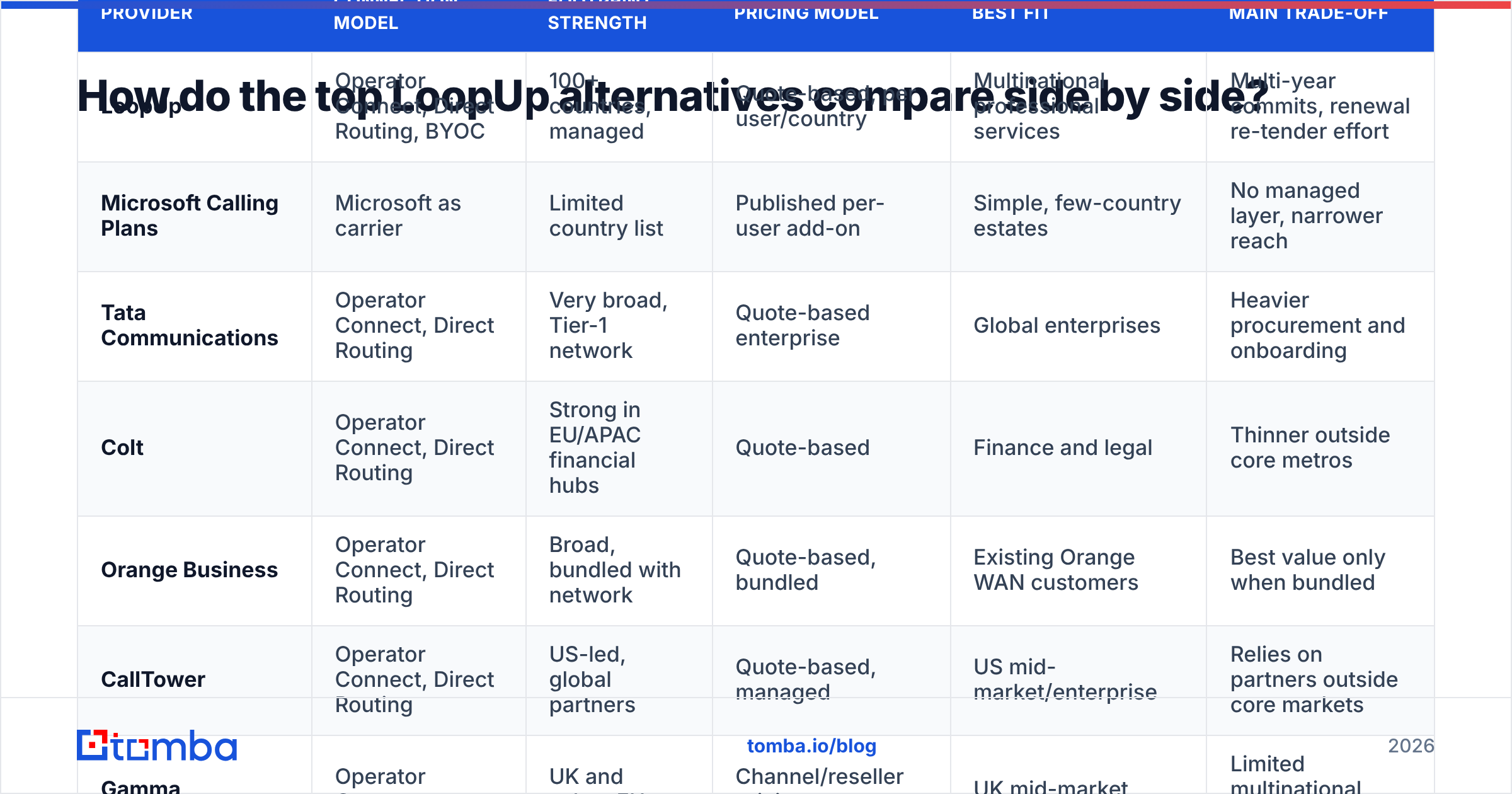
Use this table as a first-pass filter. Pricing for Operator Connect and managed Direct Routing is almost always quoted per country and per user, so treat "quote-based" literally and request pricing against your actual site list.
| Provider | Connection model | Footprint strength | Pricing model | Best fit | Main trade-off |
|---|---|---|---|---|---|
| LoopUp | Operator Connect, Direct Routing, BYOC | 100+ countries, managed | Quote-based, per user/country | Multinational professional services | Multi-year commits, renewal re-tender effort |
| Microsoft Calling Plans | Microsoft as carrier | Limited country list | Published per-user add-on | Simple, few-country estates | No managed layer, narrower reach |
| Tata Communications | Operator Connect, Direct Routing | Very broad, Tier-1 network | Quote-based enterprise | Global enterprises | Heavier procurement and onboarding |
| Colt | Operator Connect, Direct Routing | Strong in EU/APAC financial hubs | Quote-based | Finance and legal | Thinner outside core metros |
| Orange Business | Operator Connect, Direct Routing | Broad, bundled with network | Quote-based, bundled | Existing Orange WAN customers | Best value only when bundled |
| CallTower | Operator Connect, Direct Routing | US-led, global partners | Quote-based, managed | US mid-market/enterprise | Relies on partners outside core markets |
| Gamma | Operator Connect | UK and select EU | Channel/reseller pricing | UK mid-market | Limited multinational reach |
| Zoom Phone | Native cloud PBX | Broad via global select plans | Published per-user tiers | Zoom-first organizations | Moves calling off Teams |
| Webex Calling | Native cloud PBX | Broad, enterprise | Published and quote-based | Cisco-heavy estates | Moves calling off Teams |
Independent review sites help you sanity-check support claims. LoopUp's Capterra reviews and the equivalent pages for each alternative are worth reading for onboarding and support-quality comments specifically, since that's where managed voice providers differ most.
How should you evaluate a LoopUp replacement?#
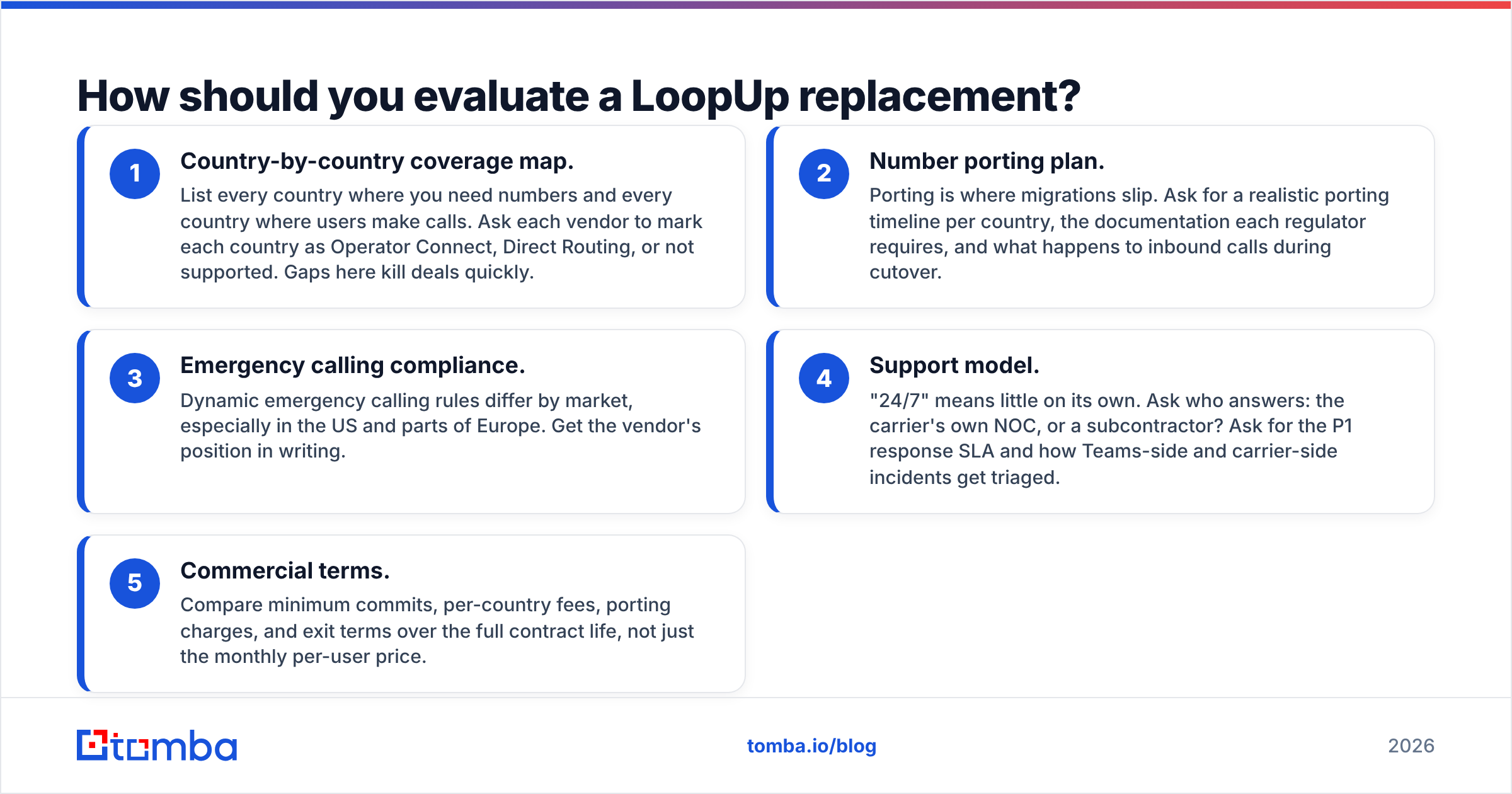
Once you've narrowed the list to three providers, the decision usually comes down to five checks. Run them in this order. Each one eliminates vendors faster than the one after it.
- Country-by-country coverage map. List every country where you need numbers and every country where users make calls. Ask each vendor to mark each country as Operator Connect, Direct Routing, or not supported. Gaps here kill deals quickly.
- Number porting plan. Porting is where migrations slip. Ask for a realistic porting timeline per country, the documentation each regulator requires, and what happens to inbound calls during cutover.
- Emergency calling compliance. Dynamic emergency calling rules differ by market, especially in the US and parts of Europe. Get the vendor's position in writing.
- Support model. "24/7" means little on its own. Ask who answers: the carrier's own NOC, or a subcontractor? Ask for the P1 response SLA and how Teams-side and carrier-side incidents get triaged.
- Commercial terms. Compare minimum commits, per-country fees, porting charges, and exit terms over the full contract life, not just the monthly per-user price.
If you only have time for one check, do the coverage map. A provider that's 15% cheaper but forces Direct Routing workarounds in six countries will cost more by year two.
Is LoopUp still a good choice compared to these alternatives?#
For some buyers, yes. LoopUp's strengths line up well with multinational professional-services firms: it offers Operator Connect across many markets, combined Operator Connect and Direct Routing delivery, no customer-side SBCs, and a support model built for firms where call quality affects client relationships. If your current deployment works and renewal terms are competitive, re-signing is a legitimate outcome of a re-tender.
Switching makes more sense in three situations:
- Your footprint shrank to a few countries that Microsoft Calling Plans or a regional carrier covers more cheaply.
- You're consolidating vendors, for example moving voice onto an existing Orange, Colt, or Tata network contract.
- You're leaving Teams-native calling because the business is standardizing on Zoom or Webex.
What about teams that used LoopUp for conferencing?#
If you bought LoopUp years ago for premium audio conferencing, the market has moved. Teams, Zoom, and Webex meetings all include dial-in audio conferencing, usually as a license add-on. For most organizations, a separate conferencing vendor is no longer necessary.
The exceptions are operator-assisted events such as investor calls, earnings calls, and large externally hosted briefings. Specialist event-conferencing providers still earn their fee there. Separate those use cases from day-to-day meetings before you go to tender.
How does your calling stack connect to outbound prospecting?#
Your telephony provider decides whether calls connect. It says nothing about whether the number you're dialing belongs to the right person. For sales teams running outbound through Teams, Zoom Phone, or Webex, the bottleneck is usually data quality, not carrier quality.
A few practical habits make any calling stack more productive:
- Validate numbers before they hit the dialer. A phone validator flags disconnected, mistyped, or wrong-type numbers (landline vs mobile) before reps waste dials on them.
- Fill gaps with direct lines. A phone finder helps reps reach decision-makers directly instead of cycling through switchboards.
- Pair calls with email. Multichannel sequences get more replies than phone-only cadences. A verified email from an email finder gives you a second channel when a call goes to voicemail.
- Budget the data layer separately from voice. Voice is priced per user per country. Contact data is priced per lookup, so check Tomba pricing, which runs from a free tier of 25 searches a month up to Starter at $49/mo, Growth at $99/mo, and Pro at $249/mo.
Think of the carrier as the road and the contact data as the address. A better road doesn't help if the address is wrong.
What's the bottom line on LoopUp alternatives?#
There's no single best replacement for LoopUp, because LoopUp sells a managed blend of Teams connectivity across a large country list. Match the alternative to your footprint:
- Global, Teams-first, complex: Tata Communications, Colt, or Orange Business
- US mid-market, managed: CallTower
- UK or EU mid-market: Gamma
- Simple, few countries: Microsoft Calling Plans
- Leaving Teams calling: Zoom Phone or Webex Calling
Build the coverage map first, price every shortlisted vendor against it, and put LoopUp's renewal offer in the same spreadsheet. Sometimes the best alternative is a better-negotiated contract with the incumbent.
Once your voice stack is settled, make sure your reps are dialing and emailing the right people. Tomba Email Finder finds professional email addresses by name, domain, or company and verifies them before they reach your sequences. Pair it with phone data and your new calling setup has accurate contacts on both channels. Start on the free tier and upgrade when your outbound volume justifies it.
Related guides#
// get started
Find, verify and enrich your first contacts today
Start on the free plan with 25 searches a month, then scale when your team is ready.
Free plan · No credit card required · GDPR & CCPA
// about the author