7 Best Lunacal Alternatives for Sales Teams in 2026 (Compared)
Lunacal is a solid, cheap scheduler, but it has no free plan and limited routing. We compare 7 Lunacal alternatives on price, team features, and CRM fit so you can pick the right booking tool for your pipeline.
TL;DR
- Lunacal is a low-cost scheduling tool (about $9/user/month on Standard). It has no permanent free plan, and round robin only arrives on the $15 Teams tier.
- Cal.com and TidyCal are the best budget Lunacal alternatives. Cal.com has a free individual plan and open-source code. TidyCal sells a one-time lifetime license.
- Calendly is still the safe default for teams that need a large integration library and admin controls.
- Chili Piper and HubSpot Meetings fit B2B teams where inbound routing and CRM sync matter more than price.
- A booking link can't fix a bad contact list. If your outbound emails bounce, nobody sees your calendar, so check your data before you pay for another scheduler.
What is Lunacal, and why are people looking for alternatives?#
Lunacal is a meeting scheduler. It gives each user a booking page, syncs with Google, Outlook, and Apple calendars, and connects to Zoom and Microsoft Teams. It competes on price and a clean interface. According to its Capterra listing and third-party pricing trackers, plans at the time of writing are:
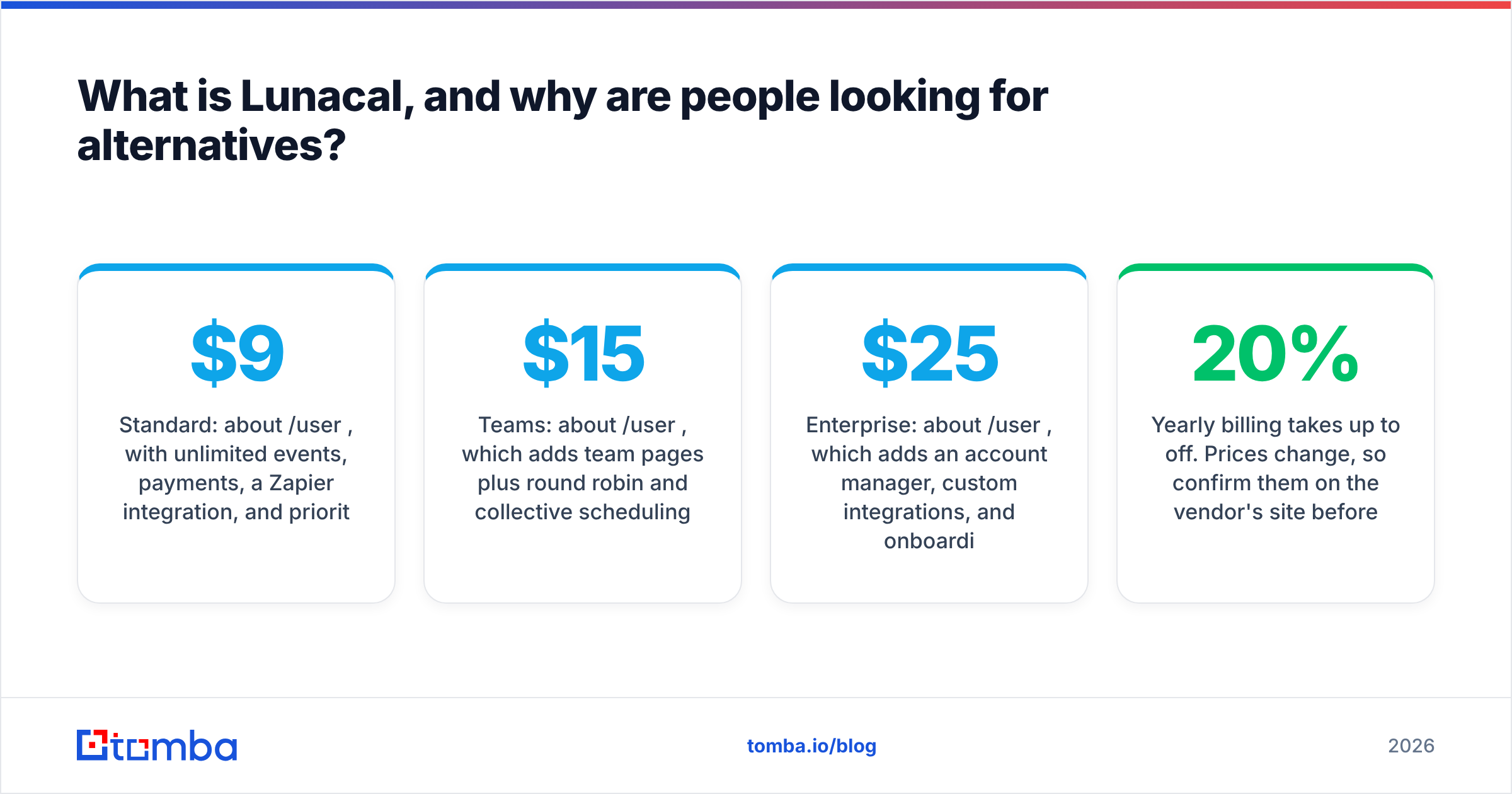
- Standard: about $9/user/month, with unlimited events, payments, a Zapier integration, and priority support
- Teams: about $15/user/month, which adds team pages plus round robin and collective scheduling
- Enterprise: about $25/user/month, which adds an account manager, custom integrations, and onboarding
Yearly billing takes up to 20% off. Prices change, so confirm them on the vendor's site before you buy.
In our research, people who look for Lunacal alternatives usually give one of four reasons:
- No free plan. You pay from the first seat, which makes it hard to trial with a whole SDR team.
- Round robin costs extra. Lead distribution only comes with the Teams tier.
- Shallow CRM behavior. For B2B sales, you want bookings to create or update contacts, deals, and owners in your CRM. Zapier glue works, but it's fragile.
- Ecosystem size. Bigger players have more native integrations, more admin controls, and more answers on community forums.
None of these makes Lunacal a bad product. For a solo consultant or a small team that wants a cheap, good-looking booking page, it's a reasonable choice. Once scheduling becomes part of your sales pipeline, though, the requirements change.

How should you evaluate a Lunacal alternative?#
Before you compare logos, decide what the scheduler has to do in your funnel. Here are five criteria that matter for B2B teams:
- Pricing model. Some tools charge per user, like Calendly, Lunacal, and Cal.com Teams. Others charge per link or plan (SavvyCal) or once (TidyCal Lifetime). For a 10-rep SDR team, this can mean a difference of hundreds of dollars a year.
- Routing and distribution. Round robin, collective availability, and form-based routing decide whether an inbound demo request reaches the right AE in seconds or waits in a shared inbox.
- CRM sync depth. Can a booking create a lead, assign an owner, and log the meeting on the right deal? Native HubSpot and Salesforce sync beats a Zapier workaround.
- Buyer experience. Features like overlaid calendars (SavvyCal's specialty), time zone detection, and short forms reduce friction on the prospect's side, which affects your response rate.
- Admin and compliance. SSO, audit logs, managed event types, and data residency matter once more than a handful of people use the tool.
Score each alternative against these five. The table below does the first pass.
Which Lunacal alternatives are worth comparing in 2026?#
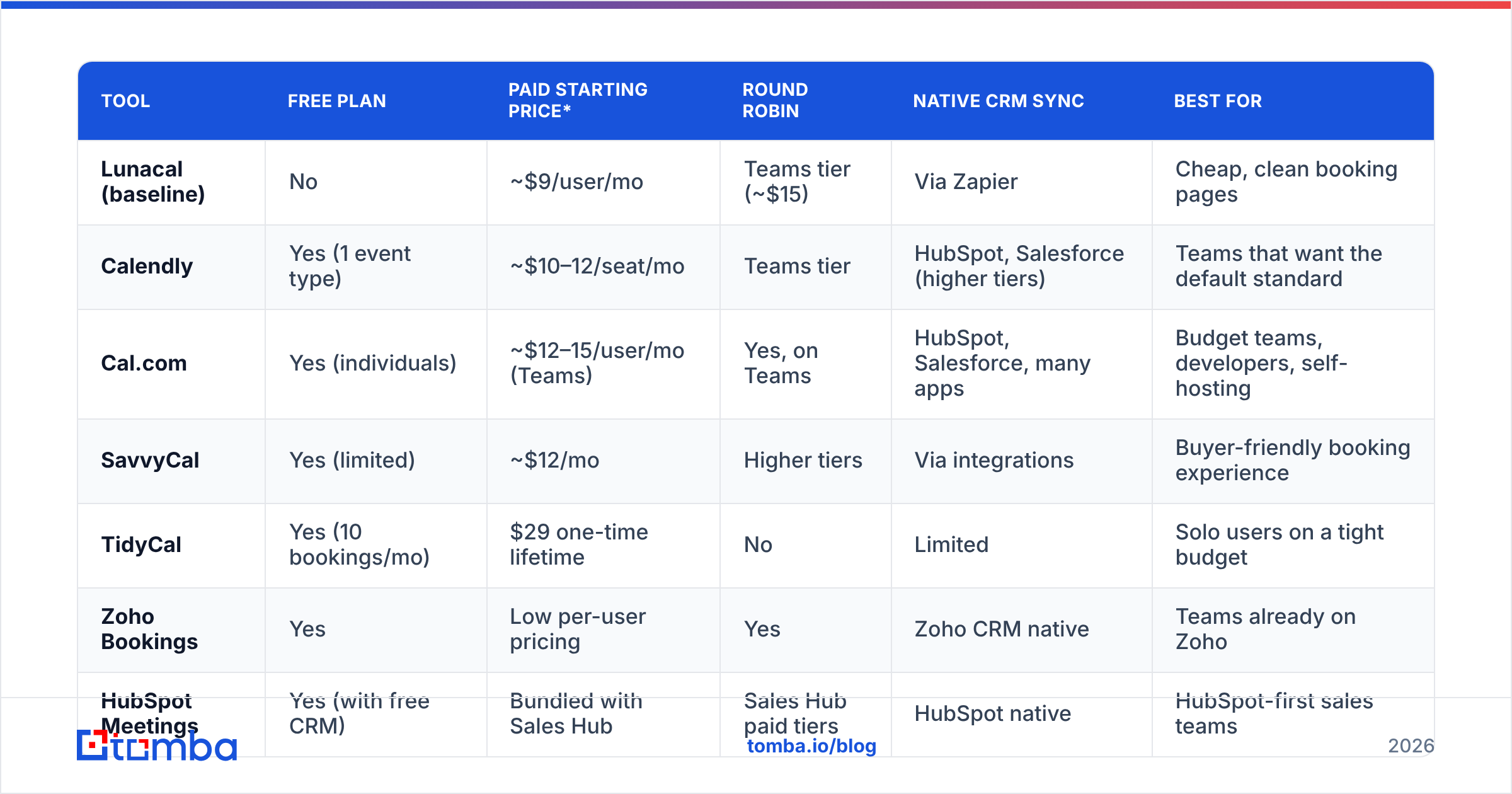
| Tool | Free plan | Paid starting price* | Round robin | Native CRM sync | Best for |
|---|---|---|---|---|---|
| Lunacal (baseline) | No | ~$9/user/mo | Teams tier (~$15) | Via Zapier | Cheap, clean booking pages |
| Calendly | Yes (1 event type) | ~$10–12/seat/mo | Teams tier | HubSpot, Salesforce (higher tiers) | Teams that want the default standard |
| Cal.com | Yes (individuals) | ~$12–15/user/mo (Teams) | Yes, on Teams | HubSpot, Salesforce, many apps | Budget teams, developers, self-hosting |
| SavvyCal | Yes (limited) | ~$12/mo | Higher tiers | Via integrations | Buyer-friendly booking experience |
| TidyCal | Yes (10 bookings/mo) | $29 one-time lifetime | No | Limited | Solo users on a tight budget |
| Zoho Bookings | Yes | Low per-user pricing | Yes | Zoho CRM native | Teams already on Zoho |
| HubSpot Meetings | Yes (with free CRM) | Bundled with Sales Hub | Sales Hub paid tiers | HubSpot native | HubSpot-first sales teams |
| Chili Piper | No | Premium per-seat | Yes, advanced | Salesforce, HubSpot deep | High-volume inbound routing |
*Prices are approximate, change often, and differ between monthly and annual billing. Check each vendor's pricing page.
Is Calendly better than Lunacal?#
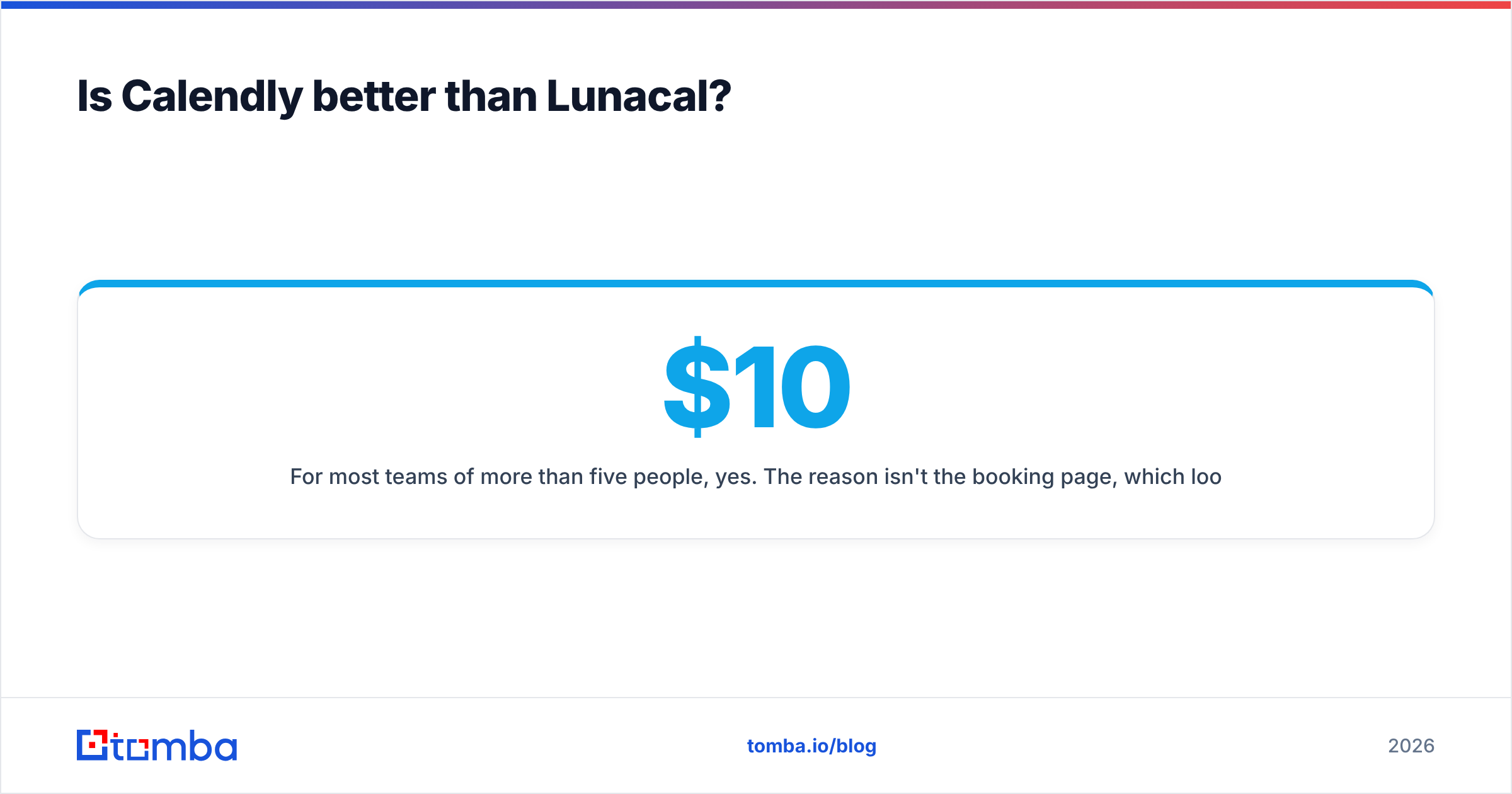
For most teams of more than five people, yes. The reason isn't the booking page, which looks much the same in both tools. It's everything around the page. Calendly has one of the largest integration libraries in the category, admin-managed event templates, and native HubSpot and Salesforce connections on its higher tiers. Its Standard plan costs about $10/seat/month billed annually ($12 monthly), and Teams starts around $16/seat annually ($20 monthly).
Pros: mature routing on Teams, a free plan for testing, familiar to prospects, and strong reporting. Cons: more expensive than Lunacal once you add seats, and some CRM and routing features sit on upper tiers.
Verdict: Choose Calendly if you're scaling past a small team and want the least risk. Stay on Lunacal if you're a solo operator and cost is the main concern.
Is Cal.com a good free Lunacal alternative?#
Cal.com is the strongest option if Lunacal's lack of a free plan is the problem. Individuals can use it at no cost. Paid team plans start around $12–15/user/month, and higher Organization and Enterprise tiers add admin features. Cal.com is also open source, so engineering-heavy teams can self-host it for data control.
Pros: free plan for individuals, wide app store (HubSpot, Salesforce, Zoom, payments), round robin on Teams, and self-hosting. Cons: Cal.com raised prices on its upper tiers in early 2026, and the interface has more settings than Lunacal's, which some reps find cluttered.
Verdict: This is the best "switch without paying more" option for most small sales teams.
Which Lunacal alternative has the best buyer experience?#
SavvyCal. Its best-known feature lets prospects overlay their own calendar on your availability, so they can pick a slot without switching tabs. That small detail makes it easier to book with senior buyers who have full calendars. Pricing works per plan instead of strictly per seat, with a free tier and paid plans from about $12/month.
Pros: easy booking flow for prospects, ranked availability that nudges bookings into your preferred slots, and personalized links. Cons: a smaller integration ecosystem than Calendly or Cal.com, and team routing costs more.
Verdict: Good for founders and AEs doing high-touch outbound to executives.
What's the cheapest Lunacal alternative?#
TidyCal, from AppSumo. There's a free plan capped at 10 bookings per month, a Pro plan around $9/month, and a one-time lifetime license around $29. For a single user, that works out cheaper than a few months of Lunacal.
Pros: very cheap, covers the basics (paid bookings, group events, calendar sync). Cons: no real round robin, limited CRM sync, and no enterprise controls.
Verdict: A good fit for freelancers and solo consultants. It's not built for SDR teams.
Zoho Bookings is the other budget option. It has a free plan and low per-user pricing. It makes most sense if you already use Zoho CRM, because the native sync removes the Zapier layer that Lunacal needs.
What's the best Lunacal alternative for B2B inbound routing?#
This is where the category splits. Lunacal, TidyCal, and SavvyCal are booking tools. Chili Piper and HubSpot Meetings are pipeline tools.
Chili Piper qualifies and routes inbound demo requests as soon as someone submits a form. It checks territory, company size, and account ownership, then shows the prospect the right rep's calendar straight away. It costs much more than Lunacal and needs setup work, but teams with heavy inbound demo volume can often justify the price through fewer leads slipping away.
HubSpot Meetings is included with HubSpot's CRM. The free version handles single-rep links, and the paid Sales Hub tiers add round robin and team links. Every booking creates or updates a contact and logs an activity, which is exactly what Lunacal-plus-Zapier setups try to do by hand. If HubSpot is already your system of record, this is the lowest-friction option. You can also push enriched contacts into it through Tomba's HubSpot integration.

Does switching schedulers actually fix low meeting volume?#
Usually not, and this is the part most "best scheduling tool" roundups leave out.
A scheduler converts interest into a calendar event. It doesn't create interest, and it can't reach anyone your emails never get to. When outbound teams report that "our booking rate dropped," we generally find the cause further up the funnel:
- Bounced emails. Stale or guessed addresses bounce, and the damage to your sender reputation carries over to the next campaign.
- Wrong person. The link reaches a generic inbox or a contact who left the company months ago.
- Catch-all domains. Addresses that "verify" but never reach a real reader.
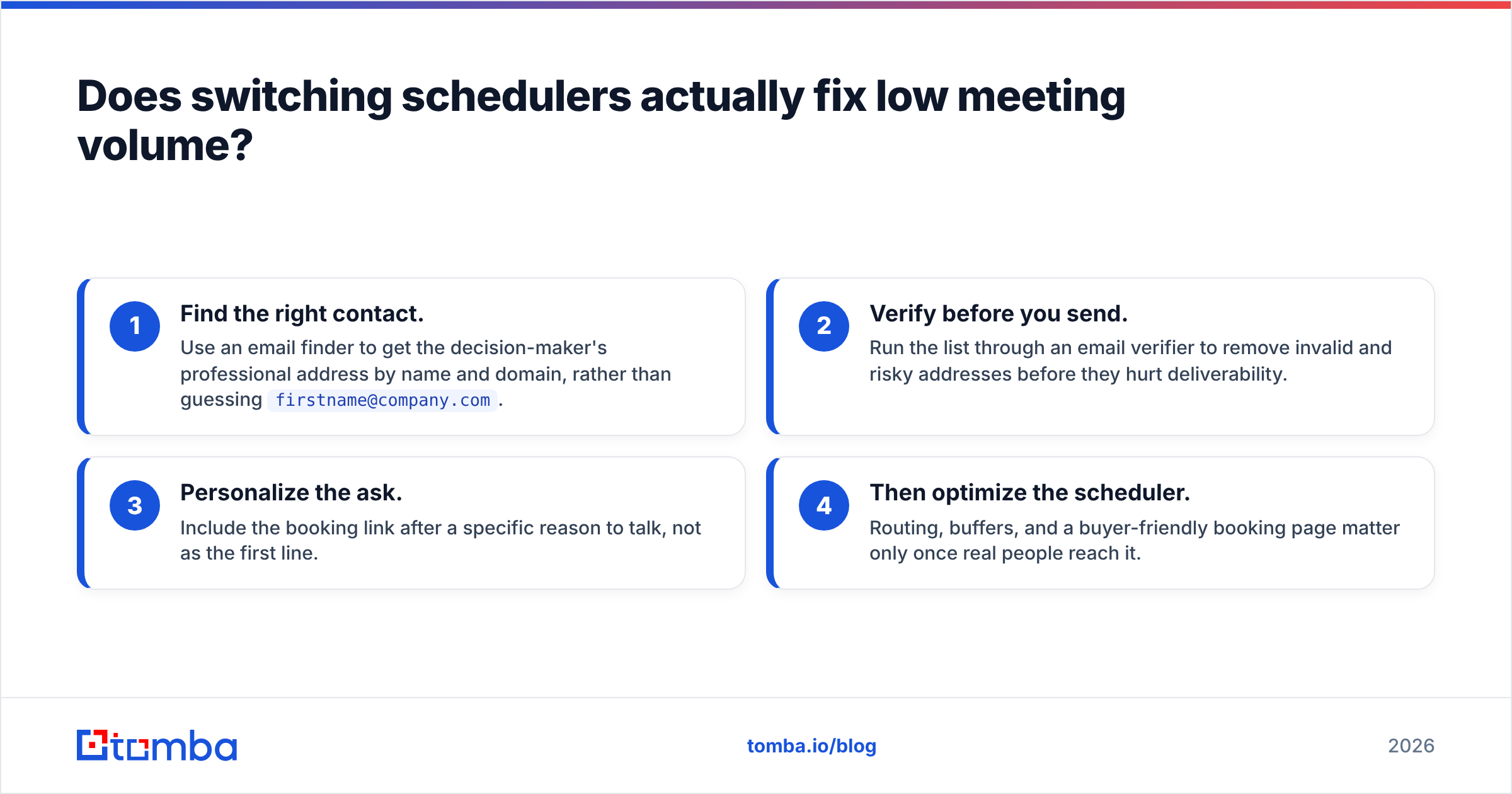
Here's the order we suggest checking things in:
- Find the right contact. Use an email finder to get the decision-maker's professional address by name and domain, rather than guessing
firstname@company.com. - Verify before you send. Run the list through an email verifier to remove invalid and risky addresses before they hurt deliverability.
- Personalize the ask. Include the booking link after a specific reason to talk, not as the first line.
- Then optimize the scheduler. Routing, buffers, and a buyer-friendly booking page matter only once real people reach it.
If you swap Lunacal for Calendly while 12% of your list bounces, you've changed tools without fixing the problem.
Which Lunacal alternative should you pick?#
Match the tool to where scheduling sits in your funnel:
- Solo, budget-first: TidyCal (lifetime license) or Cal.com free.
- Small sales team, cost-conscious: Cal.com Teams. It's close to Lunacal's price, with a free entry point and better CRM connectors.
- Growing team that wants the standard option: Calendly Teams.
- Executive-heavy outbound: SavvyCal, for the booking experience.
- Zoho shop: Zoho Bookings.
- HubSpot shop: HubSpot Meetings. It's already in your stack.
- High-volume inbound demos: Chili Piper.
And if Lunacal already does what you need at $9 a seat, keep it. Switching costs are real: reps have to update email signatures, and the links in old sequences stop working. Move when a missing feature (free seats, round robin, native CRM sync) is actually costing you meetings. A nicer booking page alone isn't a good enough reason.
Get the contacts right before you share the link#
Every scheduler on this list assumes your message reaches a real decision-maker. Tomba Email Finder finds professional email addresses by name, domain, or company, and the built-in verification keeps bounces out of your sequences, so the booking link actually gets seen. Start on the free tier (25 searches a month) or see Tomba pricing for team plans from $49/month. Then pair it with whichever Lunacal alternative fits your team.
Related guides#
// get started
Find, verify and enrich your first contacts today
Start on the free plan with 25 searches a month, then scale when your team is ready.
Free plan · No credit card required · GDPR & CCPA
// about the author