Lusha vs Span Global Services: Which B2B Data Source Wins in 2026?
Lusha sells self-serve contact credits. Span Global Services sells custom-built data lists and enrichment projects. This comparison covers which model fits your team, your budget and your outbound motion in 2026.
TL;DR
- Lusha is a self-serve sales intelligence platform. Reps look up contacts one at a time (or in small batches) through a Chrome extension and web app, paying with monthly credits.
- Span Global Services is a B2B data and marketing services provider. You give it a target spec, and it builds, appends or cleans a contact list for you. Pricing is quoted per project.
- Pick Lusha if individual SDRs need phone numbers and emails on demand inside LinkedIn and the CRM.
- Pick Span Global Services if marketing or ops needs a large, segmented list (by industry, technology install base or job function) delivered as a file, or wants an existing database enriched.
- Neither model removes the need to verify before you send. Data decays every month, so plan a verification step whichever one you buy.
What is the real difference between Lusha and Span Global Services?#
These two vendors get compared a lot, but they sell different things.
Lusha is software. You log in, search or open a LinkedIn profile, click "reveal," and a credit gets spent on an email address or phone number. Everything is self-serve. The rep making the call is also the person pulling the data.
Span Global Services works more like a data agency. Its catalog covers custom B2B contact lists, industry lists (healthcare and technology are big ones), technology install-base lists, data append and enrichment, and data cleansing. You describe the audience you want, for example "IT decision-makers at US manufacturers with 500+ employees running SAP," and the team scopes, quotes and delivers a dataset.
Put simply, Lusha is a vending machine and Span Global is a caterer. A vending machine is quick, priced per item and always open. A caterer costs more to set up, but it makes exactly what you ordered and delivers it in bulk.
That one difference drives most of what follows: pricing, freshness, who on the team uses the tool, and how the data ends up in your stack.
How do Lusha and Span Global Services compare side by side?#
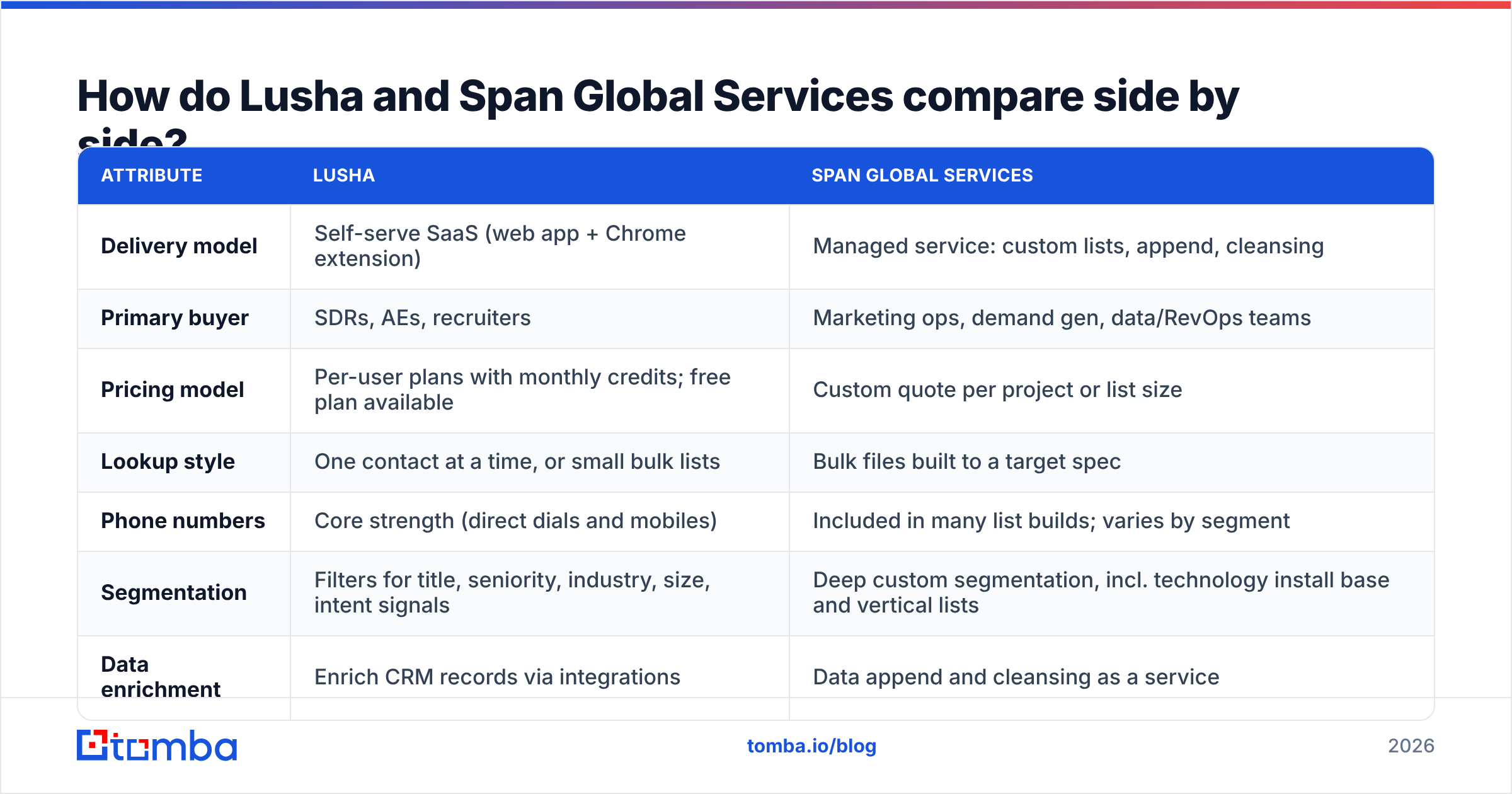
| Attribute | Lusha | Span Global Services |
|---|---|---|
| Delivery model | Self-serve SaaS (web app + Chrome extension) | Managed service: custom lists, append, cleansing |
| Primary buyer | SDRs, AEs, recruiters | Marketing ops, demand gen, data/RevOps teams |
| Pricing model | Per-user plans with monthly credits; free plan available | Custom quote per project or list size |
| Lookup style | One contact at a time, or small bulk lists | Bulk files built to a target spec |
| Phone numbers | Core strength (direct dials and mobiles) | Included in many list builds; varies by segment |
| Segmentation | Filters for title, seniority, industry, size, intent signals | Deep custom segmentation, incl. technology install base and vertical lists |
| Data enrichment | Enrich CRM records via integrations | Data append and cleansing as a service |
| CRM integrations | Native HubSpot, Salesforce, Pipedrive and others | File delivery (CSV/XLS); you import |
| Time to first contact | Seconds | Days to weeks, depending on scope |
| Best for | Daily prospecting by reps | Campaign-scale lists and database hygiene |
How does pricing work for each?#
Lusha uses published pricing. A free plan with a small monthly credit allowance lets you test it. Paid tiers are billed per user and come with bigger credit pools, more bulk actions and admin controls. Enterprise and Scale plans are quoted. Revealing a phone number usually costs more credits than revealing an email, so teams that live on the phone burn through credits faster than they expect. Check current numbers on Lusha's site, because plan names and credit amounts have changed several times.
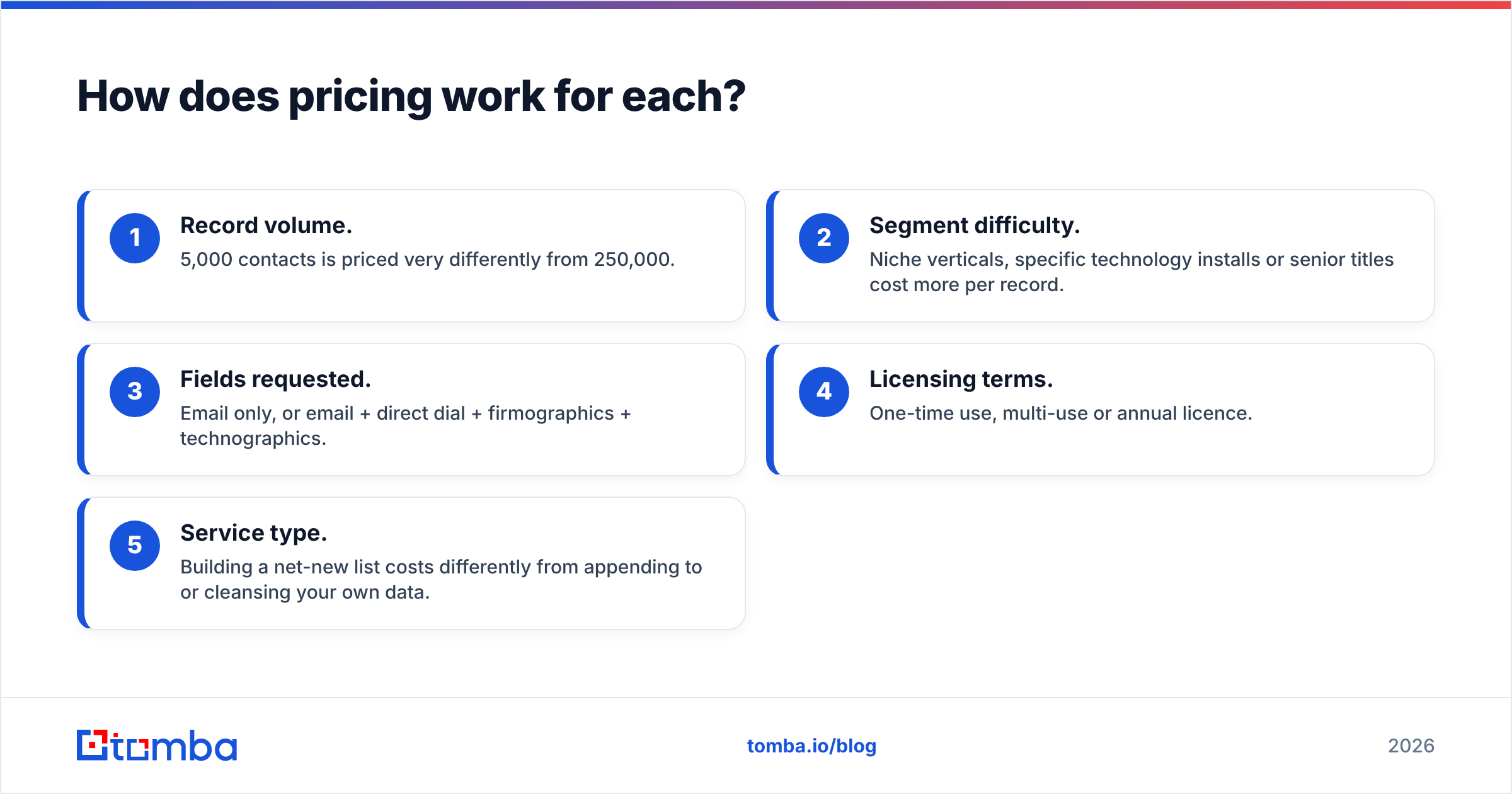
Span Global Services doesn't publish a rate card. The price depends on:
- Record volume. 5,000 contacts is priced very differently from 250,000.
- Segment difficulty. Niche verticals, specific technology installs or senior titles cost more per record.
- Fields requested. Email only, or email + direct dial + firmographics + technographics.
- Licensing terms. One-time use, multi-use or annual licence.
- Service type. Building a net-new list costs differently from appending to or cleansing your own data.
In practice, Lusha's costs grow with headcount × usage, and Span Global's grow with list size × complexity. A 10-rep SDR team running Lusha every day can spend more over a year than one well-scoped Span Global list. The reverse also happens: a marketing team that only needs 2,000 targeted contacts each quarter will overpay for a custom build.
Which one has better data accuracy?#
There's no neutral, public, like-for-like accuracy benchmark between these two, and you should be suspicious of anyone who says there is. Here's what you can actually reason about.
- Lusha pulls from contributor networks, public sources and partner data, then validates records. Because lookups happen in real time, you're looking at the current state of the record each time you reveal one. User reviews on G2 tend to rate its phone numbers highly for North American contacts and describe coverage as patchier in some EMEA and APAC markets.
- Span Global Services says its lists are verified, and the managed model lets it run human and automated checks before delivery. The trade-off is that a file starts aging the day it lands. B2B contact data is commonly estimated to decay by roughly 2–3% a month as people change jobs, get promoted or leave. A list you bought in January is noticeably less accurate by summer.

The practical takeaway is to run every record from either vendor through an email verifier right before it enters a sequence, not only at purchase time. This matters most for Span Global files you work over several months, and for Lusha exports that sit in a CRM for a while before anyone uses them.
Who should choose Lusha?#
Lusha fits when the person using the data is a rep in the middle of a workflow.
- SDR and AE teams doing account-based prospecting. A rep opens a LinkedIn profile, reveals a mobile number and calls a minute later.
- Recruiters who need candidates' direct contact details.
- Small teams with no ops support. No scoping calls, no file imports, no data dictionary to read.
- Phone-first outbound. Direct dials are the main reason people buy Lusha.
- Teams that want CRM sync. Native integrations push revealed contacts straight into HubSpot or Salesforce.
Where Lusha is weaker: large bulk pulls get expensive on per-user plans, coverage outside the US and Western Europe is uneven, and credit limits force reps to ration lookups, which slows prospecting down.
Who should choose Span Global Services?#
Span Global fits when the buyer is a marketing or data team planning campaigns, not an individual rep.
- Demand gen and ABM programs that need tens of thousands of contacts cut to a specific ICP.
- Technology install-base targeting. If you sell an add-on for a particular ERP, CRM or cloud platform, a list of companies known to run it is worth paying for.
- Vertical lists in regulated or hard-to-reach sectors like healthcare, where a generic self-serve database is often thin.
- Database hygiene projects. You have 400,000 aging CRM records and want them appended, deduplicated and cleansed in one pass.
- Teams without a big SaaS budget per seat. One project fee can be easier to get approved than ten annual licences.
Where Span Global is weaker: there's no real-time lookup, you'll wait days rather than seconds, list freshness drops after delivery, and the CRM integration work falls on you. You also need to read the licence terms carefully, because some lists can only be used once.
What are the pros and cons of each?#
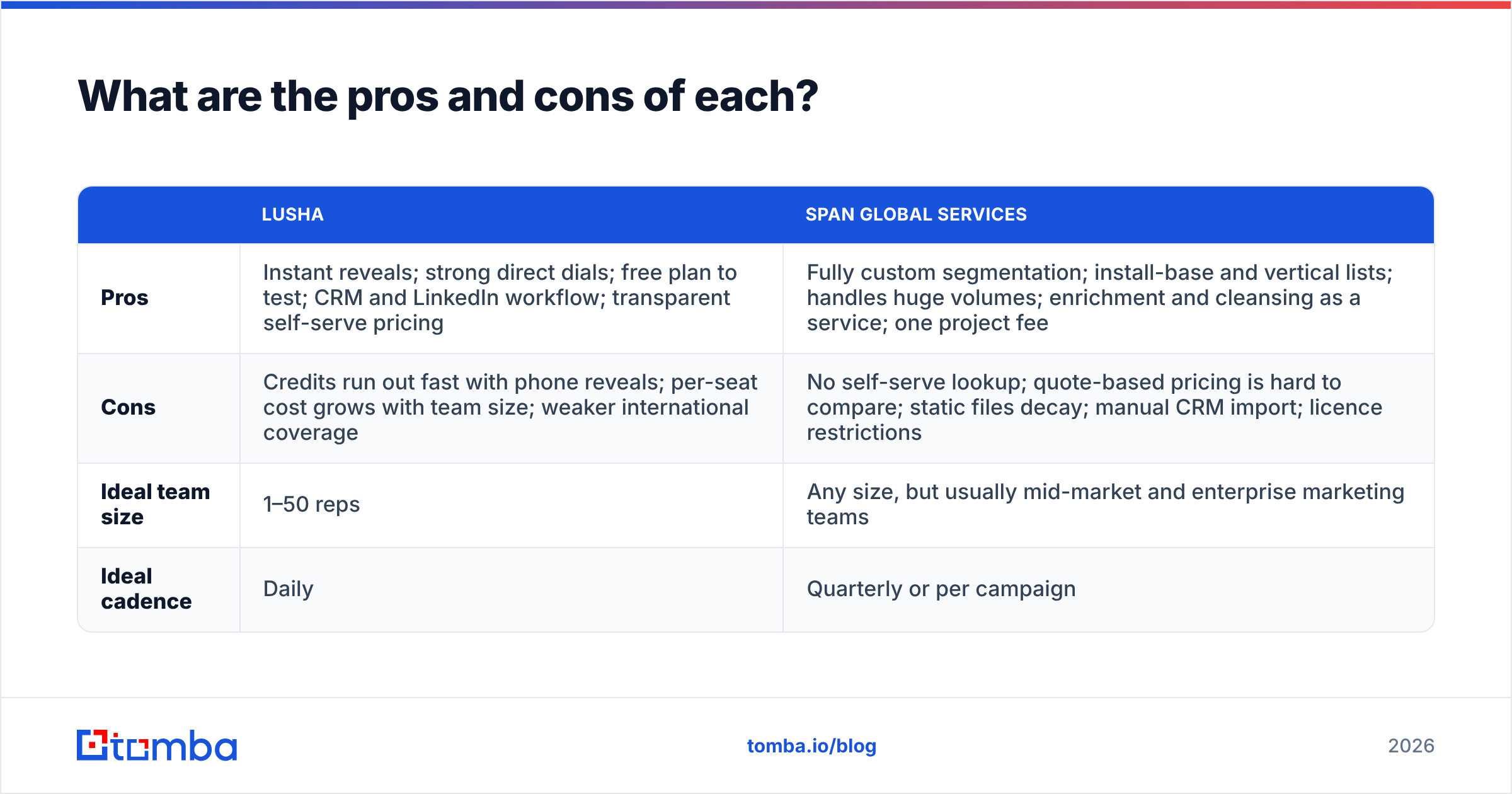
| Lusha | Span Global Services | |
|---|---|---|
| Pros | Instant reveals; strong direct dials; free plan to test; CRM and LinkedIn workflow; transparent self-serve pricing | Fully custom segmentation; install-base and vertical lists; handles huge volumes; enrichment and cleansing as a service; one project fee |
| Cons | Credits run out fast with phone reveals; per-seat cost grows with team size; weaker international coverage | No self-serve lookup; quote-based pricing is hard to compare; static files decay; manual CRM import; licence restrictions |
| Ideal team size | 1–50 reps | Any size, but usually mid-market and enterprise marketing teams |
| Ideal cadence | Daily | Quarterly or per campaign |
How should you decide between them?#
Answer these five questions in order:
- Who touches the data? If it's reps, lean Lusha. If it's marketing or ops, lean Span Global.
- How many contacts per quarter? Under ~3,000 targeted contacts usually favors self-serve. Tens of thousands of contacts with tight segmentation favors a managed build.
- Do you need phones or emails first? Phone-first teams get more out of Lusha. Email-first campaigns at scale often work out cheaper as a custom list plus your own verification.
- How fast do you need it? If it's today, Lusha. If it's for next month's campaign, either one works.
- What's your verification plan? If you don't have one, set one up before you buy from either vendor.
Many mature teams use both: a list vendor for campaign-scale audiences and a self-serve tool for rep-level lookups. Then they standardize verification and enrichment in one layer that doesn't depend on either vendor.

Is there a third option worth considering?#
Yes, if your main need is professional email addresses rather than mobile numbers or install-base intelligence.
A dedicated email finder lets you look up a decision-maker by name and company domain, or pull every public address on a domain, and verify the result in the same step. That covers the main gap in each vendor. You get the on-demand speed of Lusha without per-seat phone-credit costs, and you can refresh and verify the contacts in a Span Global file whenever you want instead of letting the file go stale.
Tomba isn't a replacement for Span Global's custom vertical and technographic list builds, and it isn't Lusha's main competitor on mobile numbers. Its strengths are email discovery, verification and data enrichment through a browser extension, bulk uploads, Google Sheets and an API. Plans start with a free tier of 25 searches a month, and paid plans run from $49/mo (Starter) through $99/mo (Growth) and $249/mo (Pro). See Tomba pricing for credit details.
| Need | Best fit |
|---|---|
| Mobile numbers for cold calling | Lusha |
| Custom list by industry + tech install base | Span Global Services |
| Cleansing a large legacy CRM database | Span Global Services |
| Finding and verifying work emails on demand | Tomba |
| Re-verifying a purchased list before each campaign | Tomba |
What mistakes do teams make when buying B2B data?#
- Buying volume instead of fit. 50,000 contacts outside your ICP will damage your sender reputation faster than they produce pipeline.
- Skipping verification on "verified" data. Data verified at delivery isn't verified on send day. Re-check before every campaign.
- Ignoring licence terms. Some purchased lists can only be used once or can't be loaded into a CRM permanently. Read the contract.
- Comparing headline prices only. Count cost per usable, verified, in-ICP contact, not cost per record or per seat.
- Forgetting compliance. Ask both vendors how they source data, what GDPR and CCPA processes they follow, and how they handle opt-outs.
Verdict: Lusha or Span Global Services?#
Choose Lusha if you're equipping reps who need direct dials and emails in seconds while working LinkedIn and the CRM, and you're comfortable with per-seat, credit-based pricing.
Choose Span Global Services if you need large, custom-segmented audiences, especially by vertical or technology install base, or a one-time cleanup of an existing database, and you have the ops capacity to import and maintain the files.
Neither is better across the board. They solve different problems, and many revenue teams end up running both side by side.
Ready to fill the email gap without another per-seat contract?#
If your outbound runs mostly on email and you want fresh, verified addresses without paying per rep or waiting on a list build, try Tomba Email Finder. Search by name and domain, pull every public email on a company domain, and verify each one before it reaches your sequence. You can start on the free plan with 25 searches a month and move to Starter at $49/mo when the volume justifies it.
Related guides#
// get started
Find, verify and enrich your first contacts today
Start on the free plan with 25 searches a month, then scale when your team is ready.
Free plan · No credit card required · GDPR & CCPA
Get the Tomba newsletter
Product and data updates
// about the author