Lyzr Alternatives: 8 AI Agent Platforms Compared for 2026
Lyzr is a strong enterprise agent framework, but it isn't the only option. Here are 8 Lyzr alternatives covering no-code builders, open-source frameworks, and AI SDRs, with notes on pricing, control, and who each one suits.
TL;DR
- Lyzr is an enterprise-focused AI agent platform: an Agent Studio, prebuilt agents such as the Jazon AI SDR, and deployment options for cloud, VPC and on-prem. It works best for teams that want governance and responsible-AI guardrails built in.
- The best Lyzr alternatives fall into three groups: no-code agent builders (Relevance AI, n8n), developer frameworks (CrewAI, LangGraph) and ecosystem-native agents (Salesforce Agentforce, Microsoft Copilot Studio). If you only want a sales outcome, there are also packaged AI SDRs (11x, Artisan).
- Lyzr changed its pricing model in 2026, moving from pay-per-agent-run toward agent-month subscriptions. Check its live pricing page before you compare costs.
- Whatever platform you pick, a sales agent can only perform as well as the contact data it's given. Your verified email and enrichment layer matters as much as the agent framework.
What is Lyzr, and why are teams looking for alternatives?#
Lyzr is an agent-building platform for enterprises. You design agents in Lyzr Agent Studio, connect them to your knowledge bases and tools, and deploy them either on Lyzr's cloud or inside your own VPC. Lyzr also sells prebuilt "AI workers," the best known being Jazon, an AI SDR that researches prospects and writes outreach.
What sets it apart is governance. Lyzr pitches responsible-AI controls such as hallucination checks, PII redaction and audit trails as first-class features. Banks, insurers and other regulated buyers care about exactly those controls.
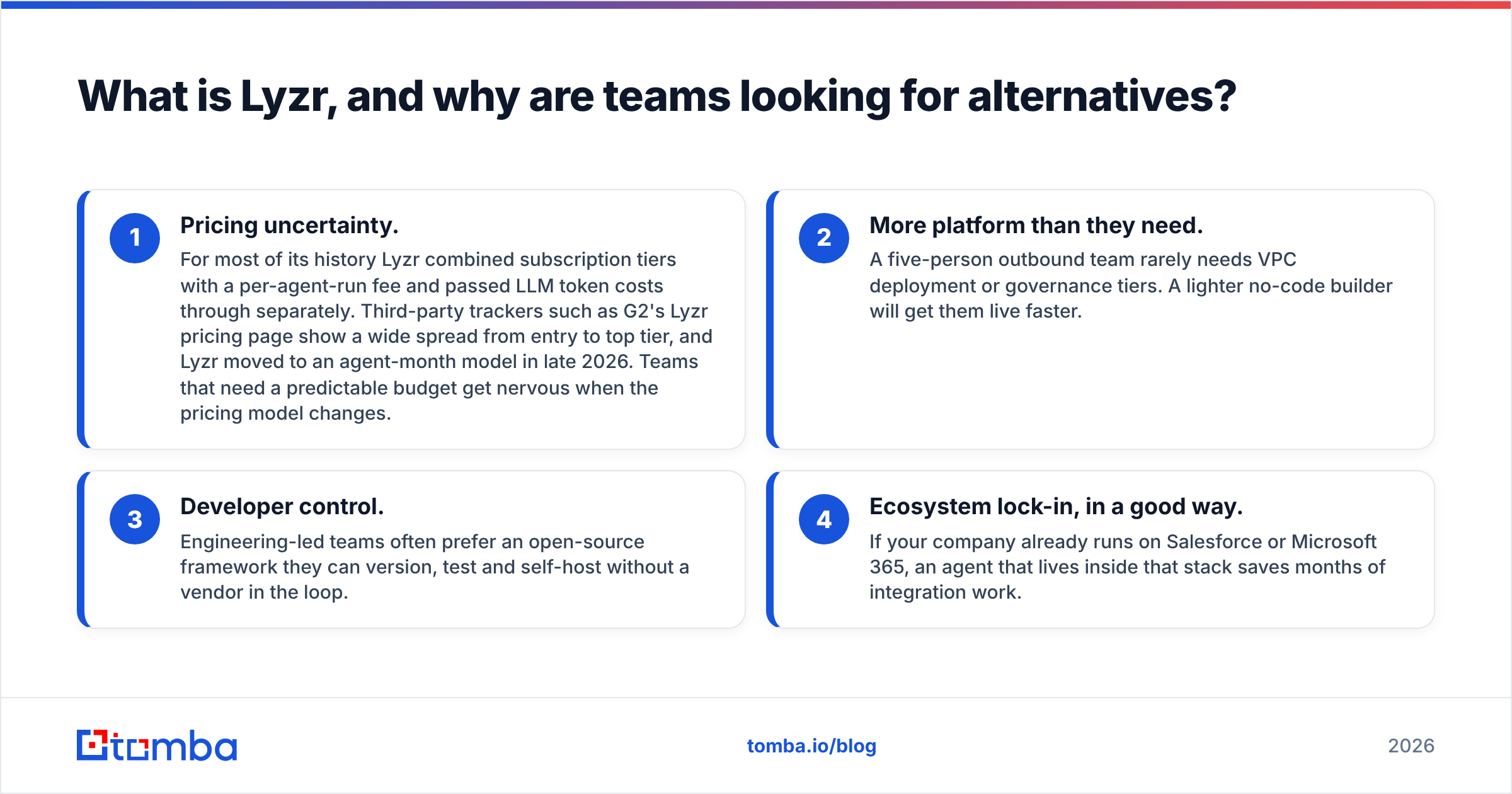
People usually start looking at Lyzr alternatives for one of four reasons:
- Pricing uncertainty. For most of its history Lyzr combined subscription tiers with a per-agent-run fee and passed LLM token costs through separately. Third-party trackers such as G2's Lyzr pricing page show a wide spread from entry to top tier, and Lyzr moved to an agent-month model in late 2026. Teams that need a predictable budget get nervous when the pricing model changes.
- More platform than they need. A five-person outbound team rarely needs VPC deployment or governance tiers. A lighter no-code builder will get them live faster.
- Developer control. Engineering-led teams often prefer an open-source framework they can version, test and self-host without a vendor in the loop.
- Ecosystem lock-in, in a good way. If your company already runs on Salesforce or Microsoft 365, an agent that lives inside that stack saves months of integration work.
None of these are dealbreakers on Lyzr. They're fit questions, and the rest of this post is about fit.
How should you evaluate Lyzr alternatives?#
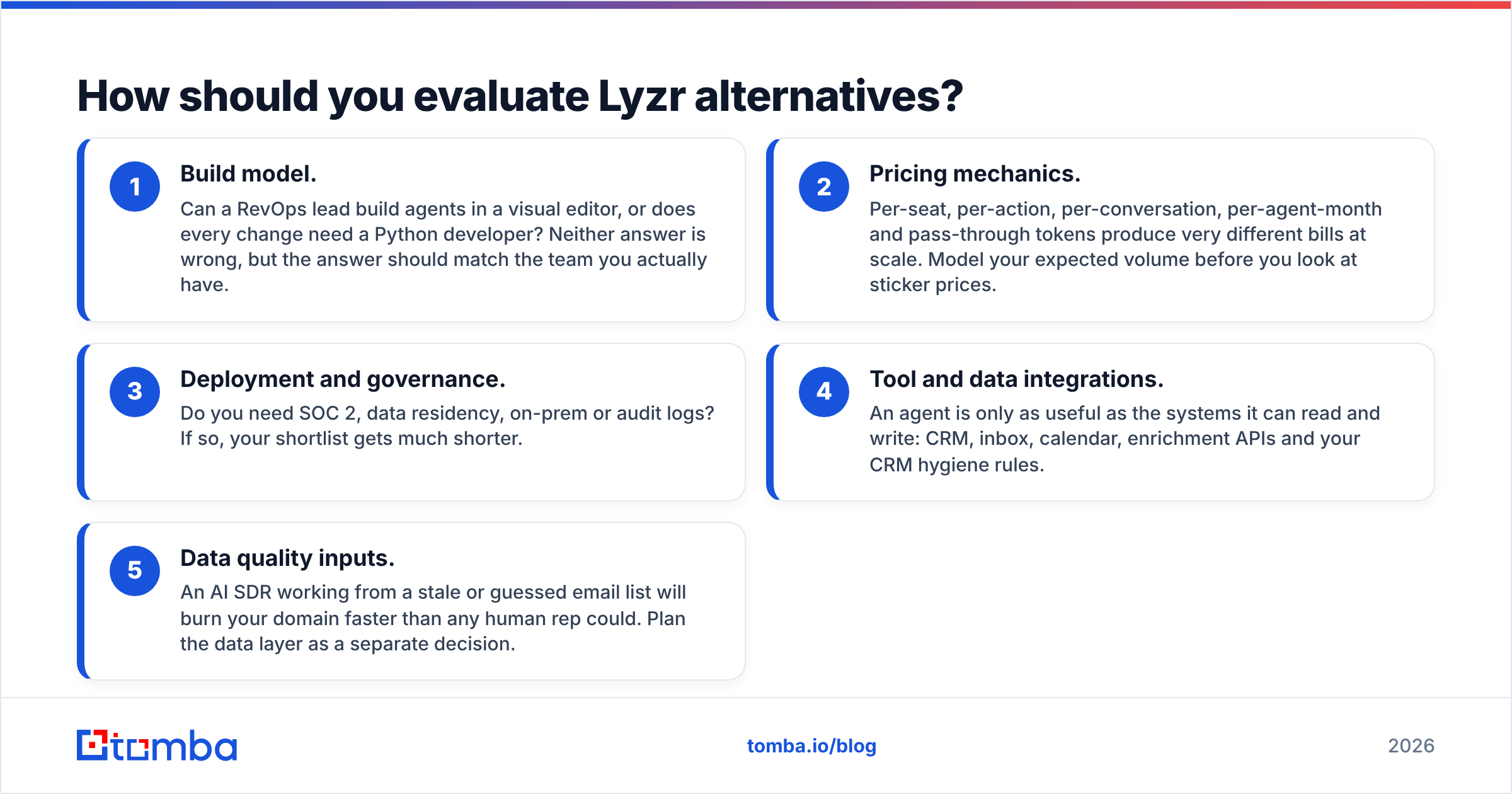
Before you open a single pricing page, score each candidate on these five criteria. They decide whether an agent project ships or stalls.
- Build model. Can a RevOps lead build agents in a visual editor, or does every change need a Python developer? Neither answer is wrong, but the answer should match the team you actually have.
- Pricing mechanics. Per-seat, per-action, per-conversation, per-agent-month and pass-through tokens produce very different bills at scale. Model your expected volume before you look at sticker prices.
- Deployment and governance. Do you need SOC 2, data residency, on-prem or audit logs? If so, your shortlist gets much shorter.
- Tool and data integrations. An agent is only as useful as the systems it can read and write: CRM, inbox, calendar, enrichment APIs and your CRM hygiene rules.
- Data quality inputs. An AI SDR working from a stale or guessed email list will burn your domain faster than any human rep could. Plan the data layer as a separate decision.
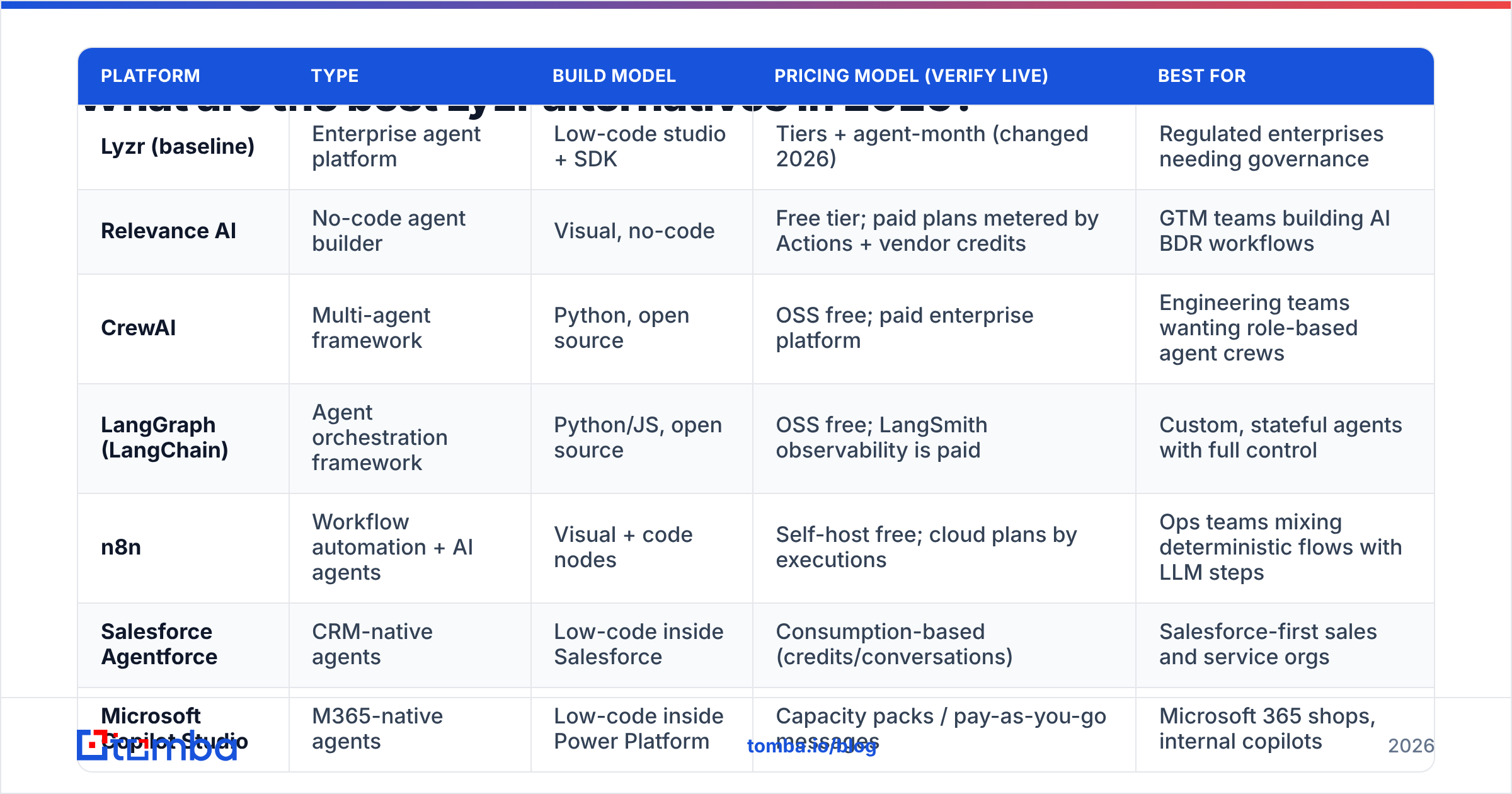
What are the best Lyzr alternatives in 2026?#
Here's the shortlist, grouped by the kind of team each one suits.
| Platform | Type | Build model | Pricing model (verify live) | Best for |
|---|---|---|---|---|
| Lyzr (baseline) | Enterprise agent platform | Low-code studio + SDK | Tiers + agent-month (changed 2026) | Regulated enterprises needing governance |
| Relevance AI | No-code agent builder | Visual, no-code | Free tier; paid plans metered by Actions + vendor credits | GTM teams building AI BDR workflows |
| CrewAI | Multi-agent framework | Python, open source | OSS free; paid enterprise platform | Engineering teams wanting role-based agent crews |
| LangGraph (LangChain) | Agent orchestration framework | Python/JS, open source | OSS free; LangSmith observability is paid | Custom, stateful agents with full control |
| n8n | Workflow automation + AI agents | Visual + code nodes | Self-host free; cloud plans by executions | Ops teams mixing deterministic flows with LLM steps |
| Salesforce Agentforce | CRM-native agents | Low-code inside Salesforce | Consumption-based (credits/conversations) | Salesforce-first sales and service orgs |
| Microsoft Copilot Studio | M365-native agents | Low-code inside Power Platform | Capacity packs / pay-as-you-go messages | Microsoft 365 shops, internal copilots |
| 11x | Packaged AI SDR | Configure, don't build | Custom annual contracts | Teams buying an outcome, not a platform |
| Artisan | Packaged AI BDR | Configure, don't build | Custom, sales-led | SMB and mid-market outbound replacement |
The prices in this space change quarterly, so treat the pricing column as a list of what to ask about, not as quotes.
1. Relevance AI: the closest no-code alternative#
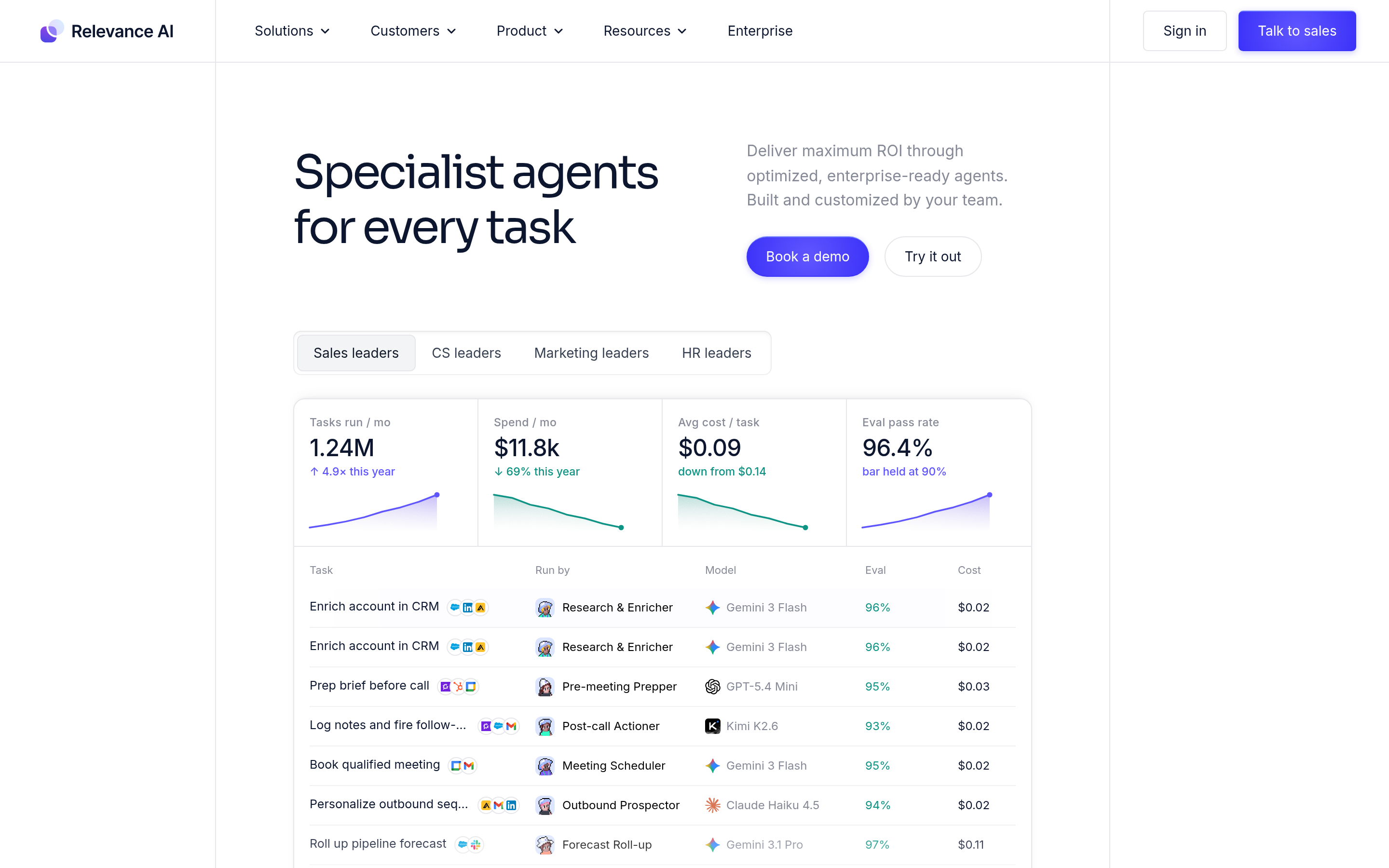
Relevance AI is probably the most direct alternative to Lyzr for go-to-market teams. You build agents and "tools" in a visual editor, chain them into multi-agent workforces, and trigger them from your CRM, inbox or webhooks. Its templates lean hard into sales: AI BDRs, account research agents and inbound qualifiers.
- Pros: Fast for non-developers to get started, a large template library, a strong sales use-case focus.
- Cons: Usage is metered in Actions plus model credits, so costs climb with volume, and complex logic eventually feels cramped in a visual builder.
- Pick it over Lyzr if: RevOps owns the build and you don't need on-prem deployment.
2. CrewAI: the developer's multi-agent framework#
CrewAI is an open-source Python framework that models agents as a "crew" with roles, goals and tasks: a researcher hands off to a writer, who hands off to a reviewer. A commercial platform adds deployment, monitoring and enterprise controls on top.
- Pros: Free to start, an intuitive role-based mental model, and a big community. You own the code.
- Cons: You also own the infrastructure, the evals and the on-call rotation.
- Pick it over Lyzr if: You have Python engineers and want agents in your own repository, not in a vendor's studio.
3. LangGraph: maximum control for complex agents#
LangGraph, from the LangChain team, treats an agent as a graph of states and transitions. That makes long-running, branching and human-in-the-loop workflows explicit and debuggable. Paired with LangSmith for tracing and evaluation, it's the default choice for many production AI teams.
- Pros: Very flexible, good support for persistence and human approvals, large ecosystem of integrations.
- Cons: It's the steepest learning curve on this list. You're building software, not configuring a product.
- Pick it over Lyzr if: Your agent logic is unusual enough that no studio will model it cleanly.
4. n8n: automation first, agents second#
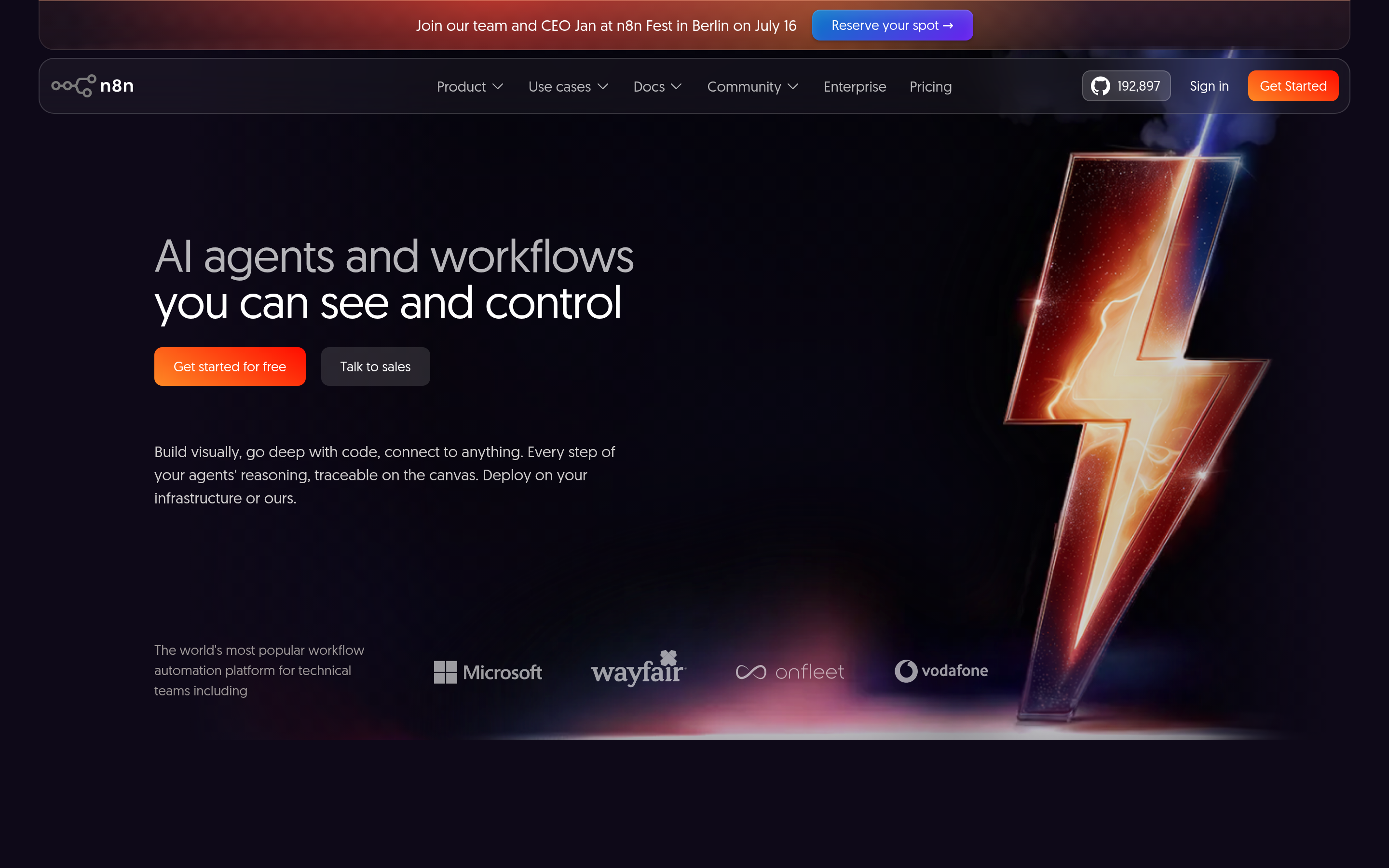
n8n started as an open-source Zapier alternative and now ships native AI agent nodes. Its strength is mixing deterministic steps ("if the lead score is above 70, create a deal") with LLM steps ("summarise this company's last 10-K") in one visual flow, and you can self-host the whole thing.
- Pros: Self-hostable, predictable execution-based pricing, hundreds of integrations.
- Cons: The agent features are newer and less opinionated than those of purpose-built agent platforms.
- Pick it over Lyzr if: Most of your "agent" is really a workflow with a few smart steps in it. That describes most sales automation.
5. Salesforce Agentforce: if your CRM is the center of gravity#
Agentforce runs AI agents directly on Salesforce data and permissions, including an SDR agent that can nurture leads and book meetings. Because it inherits your org's security model, it skips much of the integration and governance work Lyzr would otherwise handle. Salesforce documents the product on its Agentforce pages.
- Pros: Native CRM context, enterprise trust controls, no data sync needed.
- Cons: Consumption pricing can be hard to forecast, and it only makes sense if you're deeply invested in Salesforce.
- Pick it over Lyzr if: Salesforce already is your platform.
6. Microsoft Copilot Studio: for Microsoft 365 organizations#
Copilot Studio lets you build agents that live in Teams, Outlook and SharePoint, grounded in your Microsoft Graph data. It's strongest for internal copilots, such as sales enablement Q&A or proposal drafting, and less suited to autonomous outbound.
- Pros: Already inside your tenant, with familiar admin and compliance controls.
- Cons: Less tailored to external prospecting, and message-based capacity pricing takes some modeling.
- Pick it over Lyzr if: Your use case is internal productivity, not an outbound AI SDR.
7. 11x and 8. Artisan: when you want an AI SDR, not a platform#
If what you actually wanted from Lyzr was Jazon, and you'd rather not build anything, packaged AI SDRs are the honest alternative. 11x (with its "Alice" SDR) and Artisan (with "Ava") sell a digital worker that sources leads, writes sequences and sends them.
- Pros: The fastest time to first email, and no building required.
- Cons: Annual contracts, limited visibility into how the agent decides, and real deliverability risk if volume outpaces list quality.
- Pick them over Lyzr if: You're buying pipeline as an outcome and accept a black box in exchange for speed.
Is Lyzr better than Relevance AI or CrewAI?#
It depends on who's building, and that's the most useful way to cut the decision.
- Compliance or IT leads the project: Lyzr's governance features and VPC option give it the edge. Agentforce or Copilot Studio are the alternatives if you're already in those ecosystems.
- RevOps or growth leads the project: Relevance AI or n8n will usually get you to production faster and more cheaply than Lyzr.
- Engineering leads the project: CrewAI or LangGraph give you more control than any studio, Lyzr included, at the cost of owning the infrastructure.
- Nobody wants to build anything: Skip platforms entirely and evaluate 11x or Artisan.
A useful gut check: if you can't name who will maintain the agent six months from now, choose the option that needs the least maintenance.
Why does the data layer matter more than the agent platform?#
Here's the part most "AI SDR" demos skip. An outbound agent's output is roughly targeting quality × data accuracy × message quality. The platform mostly affects the third factor. The first two come from your data.
When an agent works from guessed email patterns (firstname.lastname@ applied to every domain) or from an outdated contact list, three things happen:
- Bounce rates spike. Mailbox providers read that as a spam signal, and your sender reputation drops for every rep on the domain.
- The agent keeps going. Unlike a human SDR, it doesn't notice that something feels off after 20 bounces. It sends the next 2,000.
- Personalization breaks. The agent confidently congratulates a prospect on a role they left a year ago.
So whichever Lyzr alternative you choose, give it a verified data source as a tool. Most of these platforms can call an external API or MCP server. In practice, that means:
- Finding addresses: Call an email finder API at the moment the agent needs a contact, so it never guesses a pattern. The Tomba API returns an address along with a confidence score and the sources it was found on.
- Verifying before sending: Add an email verification step to the agent's workflow and block sends to invalid or risky addresses.
- Enriching for personalization: Pull role, company size and tech stack through contact enrichment so the agent's research is grounded in data, not hallucinated.
- Agent-native access: If you build on Claude or another MCP-compatible stack, the Tomba MCP server exposes these lookups as tools the agent can call directly.
This isn't specific to Tomba. Whichever provider you use, the rule is the same: the agent should look up and verify contact data, never infer it.
How do you migrate from Lyzr without breaking production?#
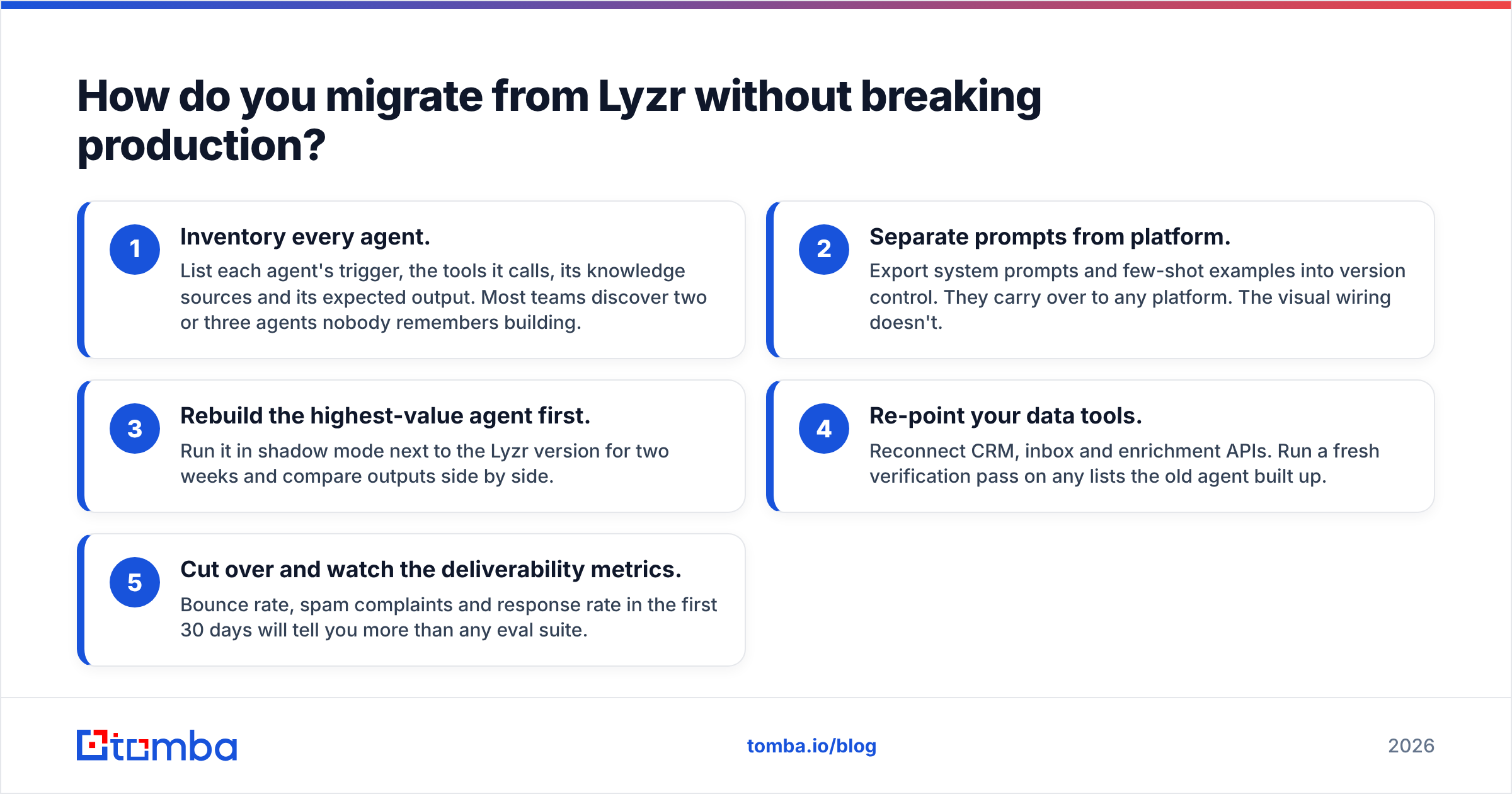
If you already have Lyzr agents running, a careful migration looks like this:
- Inventory every agent. List each agent's trigger, the tools it calls, its knowledge sources and its expected output. Most teams discover two or three agents nobody remembers building.
- Separate prompts from platform. Export system prompts and few-shot examples into version control. They carry over to any platform. The visual wiring doesn't.
- Rebuild the highest-value agent first. Run it in shadow mode next to the Lyzr version for two weeks and compare outputs side by side.
- Re-point your data tools. Reconnect CRM, inbox and enrichment APIs. Run a fresh verification pass on any lists the old agent built up.
- Cut over and watch the deliverability metrics. Bounce rate, spam complaints and response rate in the first 30 days will tell you more than any eval suite.
Which Lyzr alternative should you choose?#
Here's the short version:
- Most similar to Lyzr, easier to run: Relevance AI
- Open source, multi-agent: CrewAI
- Maximum control for complex logic: LangGraph
- Workflow-heavy automation, self-hosted: n8n
- Salesforce shop: Agentforce
- Microsoft 365 shop, internal copilots: Copilot Studio
- Want an AI SDR outcome with zero building: 11x or Artisan
- Regulated enterprise needing governance and VPC: stay on Lyzr, but renegotiate under the new pricing model
Shortlist two options, build the same agent on both, and decide on real outputs and a real invoice rather than demos.
Ready to give your AI agent data it can trust?#
Whichever agent platform you choose, the fastest way to protect your domain is to stop letting the agent guess contact details. Tomba Email Finder finds professional email addresses by domain, name or company, and returns a confidence score your agent can act on. You can plug it into Relevance AI, n8n, CrewAI or an MCP-based agent through the API. Start on the free tier with 25 searches a month, then move to a paid plan from $49/mo when your agents scale.
Related guides#
// start free
See who Tomba finds at any company
Type a company's domain to see its people, their roles and verified work emails, each with the pages it was found on. Free account, no card.
Free plan · No credit card required · GDPR & CCPA
// about the author