Mailerfind Pricing, Reviews, Pros and Cons: 2026 Verdict
Mailerfind costs €97 to €997 a month and earns 4.7/5 on Capterra, but its value-for-money score is lower. Here is what the credits actually buy, who it suits, and when a B2B email finder is the better buy.
This guide covers Mailerfind pricing, reviews, pros and cons in one place. It shows what you pay, what users say, and when another tool is the better buy.
TL;DR
- Mailerfind is an Instagram-first lead tool. It pulls public contact emails from followers, likers, commenters, hashtags and locations, then lets you email those people from the same app.
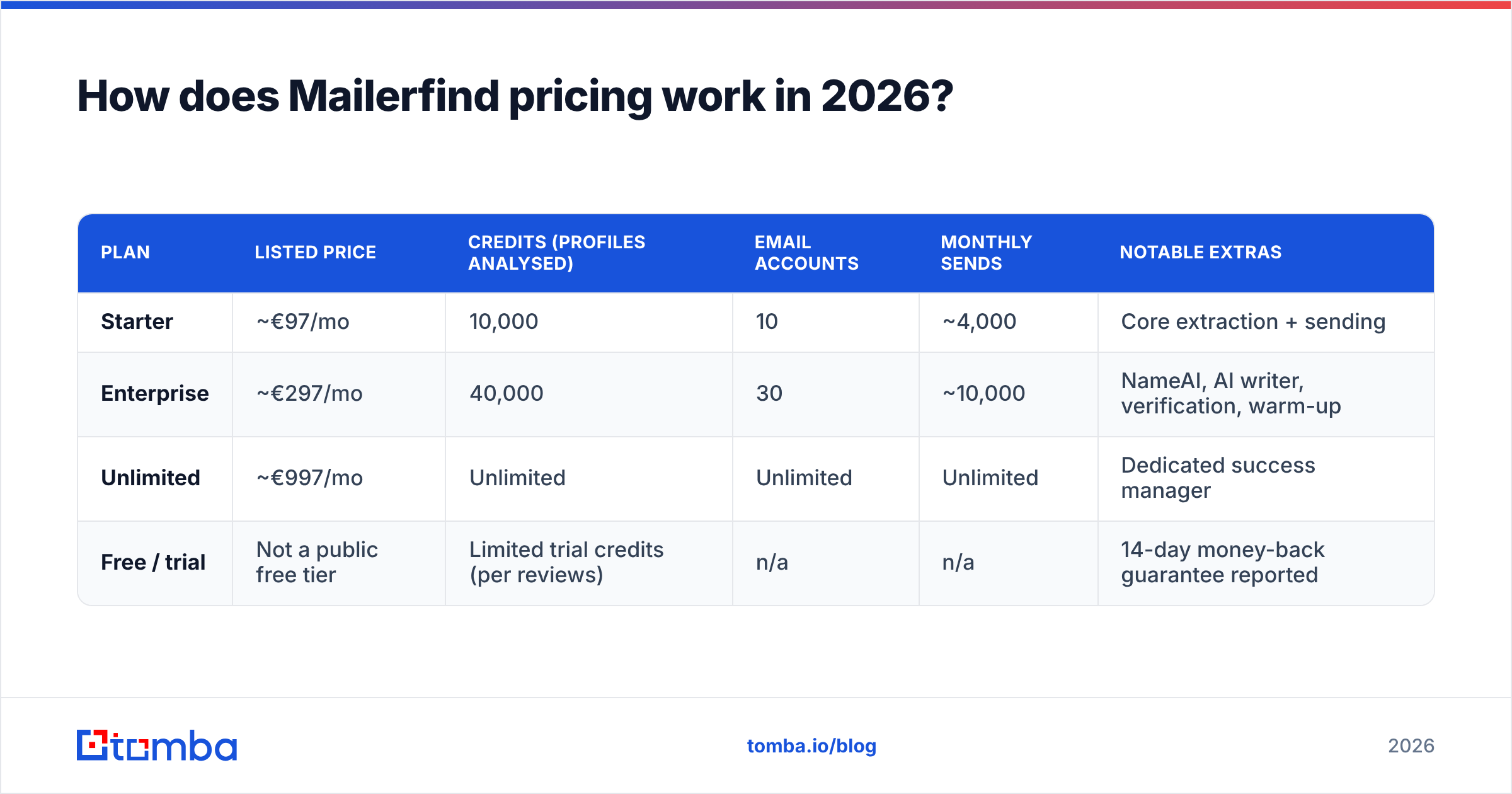
- Third-party listings put Mailerfind pricing at Starter about €97/mo (10,000 credits), Enterprise about €297/mo (40,000 credits) and Unlimited about €997/mo. Mailerfind does not advertise a permanent free plan. Trial terms vary by source.
- Reviews are strong overall (about 4.7/5 on Capterra from roughly 500 reviews). The two most common complaints are credits running out fast and a low share of profiles that actually return an email.
- It fits B2C brands, coaches, agencies and creators who sell to Instagram audiences. It is a weak fit for B2B prospecting by company, job title or domain.
- If your buyers work at companies, a domain-based B2B email finder such as Tomba (free tier, then $49/mo) usually costs less per usable contact.
What is Mailerfind?#
Mailerfind is a Spain-based SaaS that turns Instagram audiences into email lists. You give it a target, such as a competitor's account, a hashtag, a location or a post's commenters. It scans those profiles and pulls out any public contact data. That is mainly the email in the bio or the business contact button. Then you can run a cold email campaign to that list without leaving the platform.
That last part matters for pricing. Mailerfind is not a plain email finder. It bundles three jobs into one subscription:
- Audience extraction: scraping public profile data from Instagram targets
- Email sending: connected inboxes, campaigns and send limits
- Add-ons on higher tiers: verification, warm-up, an AI writing assistant and "NameAI" (first-name detection for personalization)
Most reviews are written by Spanish-speaking users: e-commerce owners, infoproduct sellers, coaches and small agencies. That tells you who the product is built for. The audience is people whose customers spend time on Instagram, not people who need the VP of Finance at a 500-person SaaS company.
How does Mailerfind pricing work in 2026?#
Mailerfind uses a credit model. One credit roughly equals one profile analysed, not one email found. That difference drives most of the "credits run out fast" complaints.
The figures below come from public third-party listings (Capterra's Mailerfind profile, GetApp and SpotSaas). Prices are usually in euros. One aggregator shows the top tier at $497 rather than €997, so check the live page at mailerfind.com before you buy.
| Plan | Listed price | Credits (profiles analysed) | Email accounts | Monthly sends | Notable extras |
|---|---|---|---|---|---|
| Starter | ~€97/mo | 10,000 | 10 | ~4,000 | Core extraction + sending |
| Enterprise | ~€297/mo | 40,000 | 30 | ~10,000 | NameAI, AI writer, verification, warm-up |
| Unlimited | ~€997/mo | Unlimited | Unlimited | Unlimited | Dedicated success manager |
| Free / trial | Not a public free tier | Limited trial credits (per reviews) | n/a | n/a | 14-day money-back guarantee reported |
A few details are worth flagging:
- Plans are monthly. Listings mention a money-back window but no big annual discount.
- Verification and warm-up sit on Enterprise. If you send from Starter, you may need a separate verifier and warm-up tool to protect your sender reputation.
- The jump from Enterprise to Unlimited is steep. It goes from €297 to €997, a 3.4x increase.
What does one usable email actually cost on Mailerfind?#
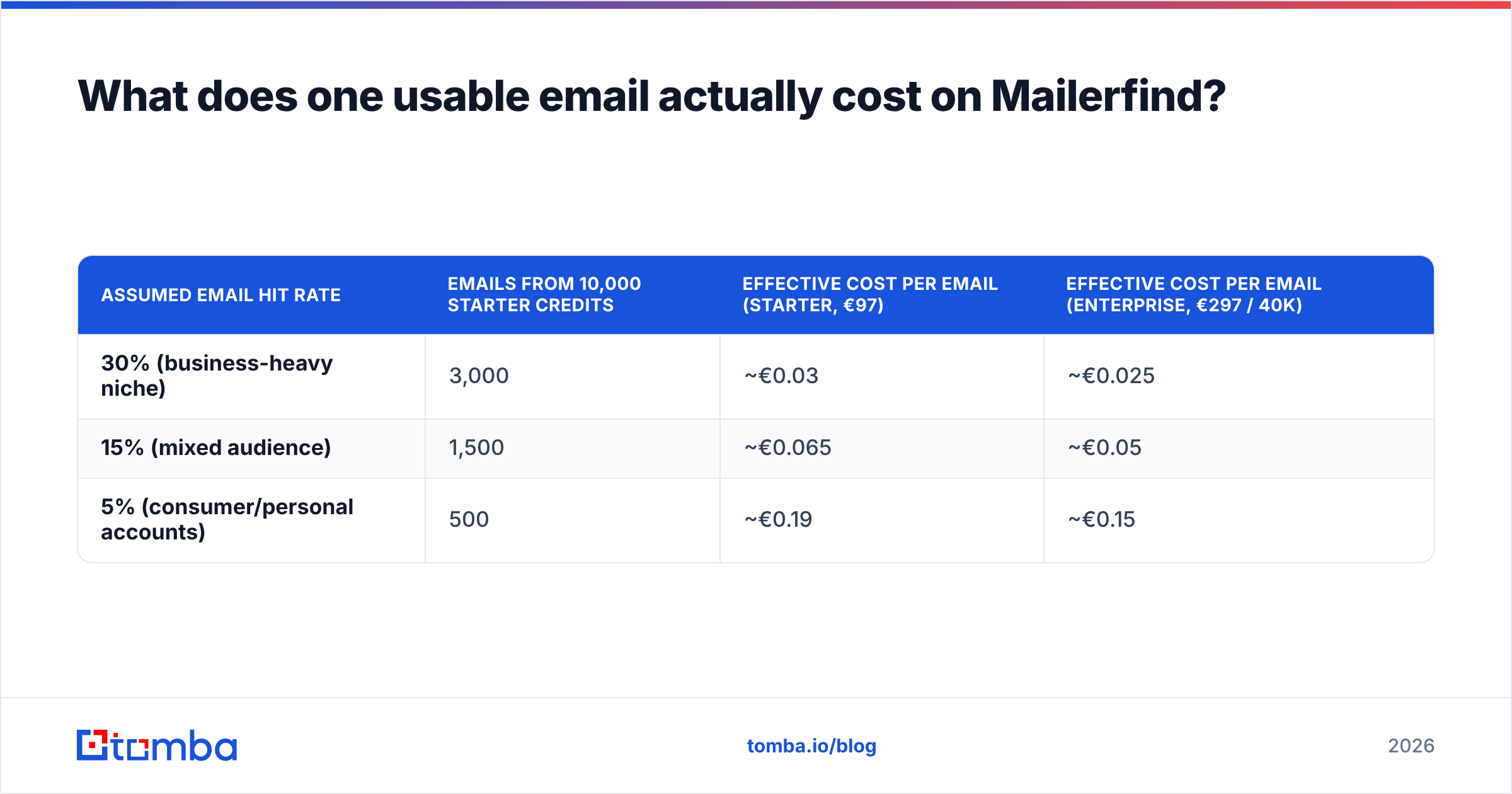
Mailerfind pricing per credit looks cheap: about €0.0097 per profile on Starter and €0.0074 on Enterprise. But you pay per profile analysed. Most Instagram profiles do not show an email.
Mailerfind does not publish a hit rate, so here is a worked example with assumed yields. Replace them with your own numbers after a trial.
| Assumed email hit rate | Emails from 10,000 Starter credits | Effective cost per email (Starter, €97) | Effective cost per email (Enterprise, €297 / 40k) |
|---|---|---|---|
| 30% (business-heavy niche) | 3,000 | ~€0.03 | ~€0.025 |
| 15% (mixed audience) | 1,500 | ~€0.065 | ~€0.05 |
| 5% (consumer/personal accounts) | 500 | ~€0.19 | ~€0.15 |
These numbers ignore bounces. Instagram bio emails are self-reported and often stale: an old Gmail, a shared inbox, or an address the creator abandoned. One Capterra reviewer said they had to clean out invalid addresses to avoid bounces. If you send unverified, you lose more than credits. You also damage your domain reputation, and that is harder to undo.
So test it before committing. Use the trial or the first paid month on one representative target. Count the verified emails you end up with, and divide the plan cost by that number. That figure is your real price.

What do Mailerfind reviews say?#
On Capterra and its sister sites (GetApp, Software Advice), Mailerfind holds about 4.7/5 from roughly 500 reviews. That is a strong score for a niche tool. Its value-for-money sub-score is lower, reported around 3.8/5. That gap is the most useful signal in the reviews.
Here are the recurring themes, grouped:
- Fast setup: several reviewers say they were extracting contacts in under 10 minutes. The interface is described as simple and well documented, with tutorials.
- Competitor audience targeting: pulling the followers or commenters of a rival brand comes up again and again as the main reason people buy.
- Doesn't touch your Instagram account: reviewers like that the extraction doesn't run through their own IG login, which lowers the risk of an account ban.
- Credit burn: this is the most common complaint. Trial credits feel too thin to judge the product, and paid credits drain faster than expected.
- Low extraction ratio: one reviewer noted that only a small share of analysed profiles produced an email, though the ones found were good quality.
- Learning curve on the points system: you need to understand credits, targets and filters before you stop wasting runs.
The reviews give a consistent picture. The product does what it says, and the frustration is about Mailerfind pricing and credit economics. That fits a credit-per-profile model aimed at a channel where most profiles don't publish an email.
What are Mailerfind's pros and cons?#
| Pros | Cons |
|---|---|
| Built for Instagram: followers, likers, commenters, hashtags, locations, following | Little use for B2B prospecting by company, role or domain |
| Extraction and sending in one subscription | Credits are per profile analysed, not per email found |
| Strong review score (~4.7/5) and helpful onboarding | Value-for-money score trails the overall rating |
| Doesn't use your own Instagram login | Verification and warm-up locked to the €297 tier |
| Precise audience segmentation for B2C niches | Big price jump from €297 to €997 |
| 14-day money-back guarantee reported | No public permanent free plan, and trial terms vary |
There's also a compliance point that matters more than any feature row. Instagram's terms restrict automated data collection. In the EU and UK, emailing consumers who never opted in creates GDPR and ePrivacy exposure (GDPR overview). "Public in a bio" is not the same as "consented to marketing." B2C senders carry more of this risk than B2B senders, who can sometimes rely on legitimate interest for relevant business outreach. Talk to counsel before you scale cold B2C email.
Who should actually pay for Mailerfind?#
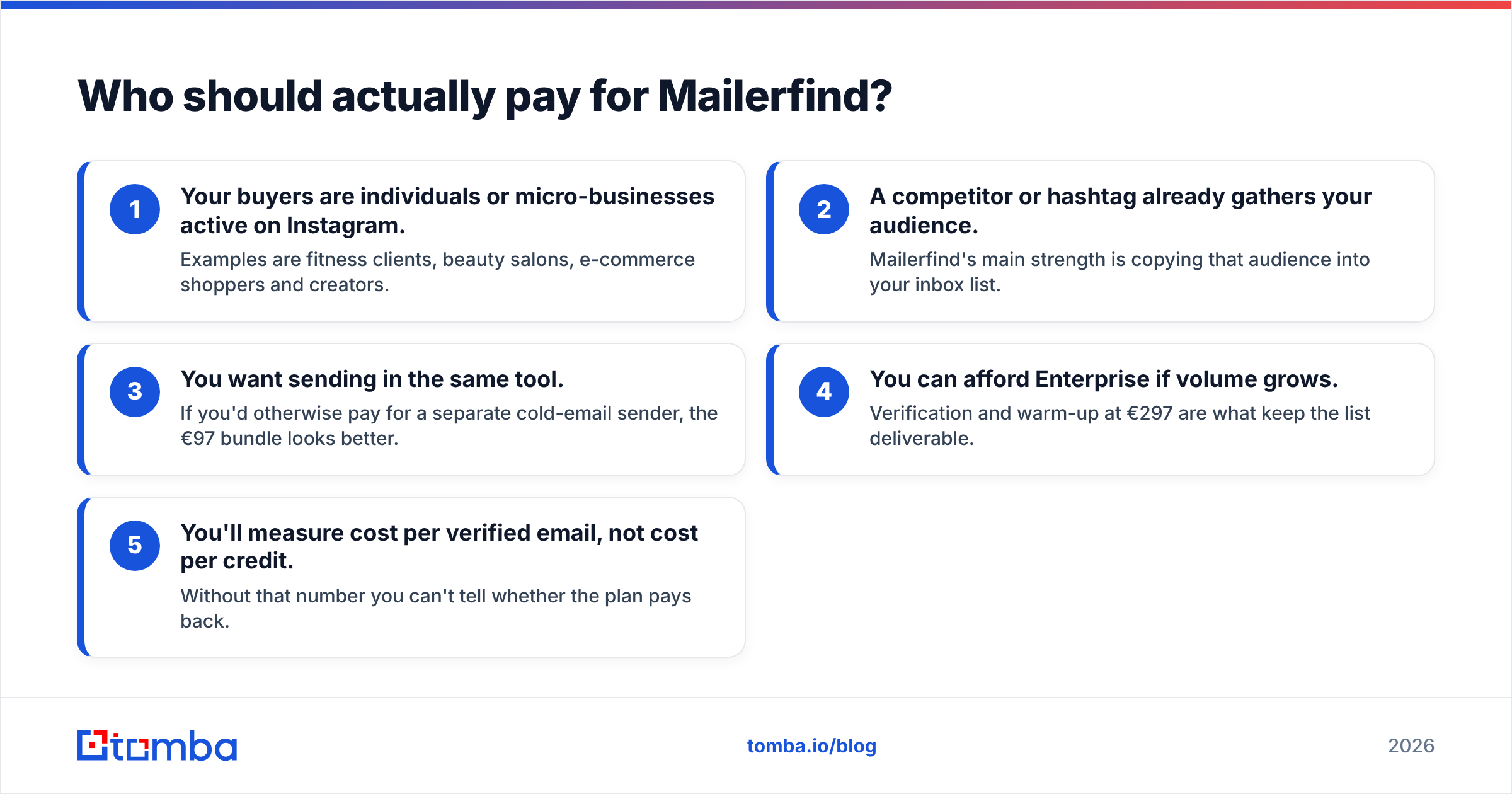
Use this short checklist. If you answer yes to the first three, Mailerfind is probably worth a paid month.
- Your buyers are individuals or micro-businesses active on Instagram. Examples are fitness clients, beauty salons, e-commerce shoppers and creators.
- A competitor or hashtag already gathers your audience. Mailerfind's main strength is copying that audience into your inbox list.
- You want sending in the same tool. If you'd otherwise pay for a separate cold-email sender, the €97 bundle looks better.
- You can afford Enterprise if volume grows. Verification and warm-up at €297 are what keep the list deliverable.
- You'll measure cost per verified email, not cost per credit. Without that number you can't tell whether the plan pays back.
If your answer to #1 is "no, we sell to companies," stop here. You're shopping in the wrong category.
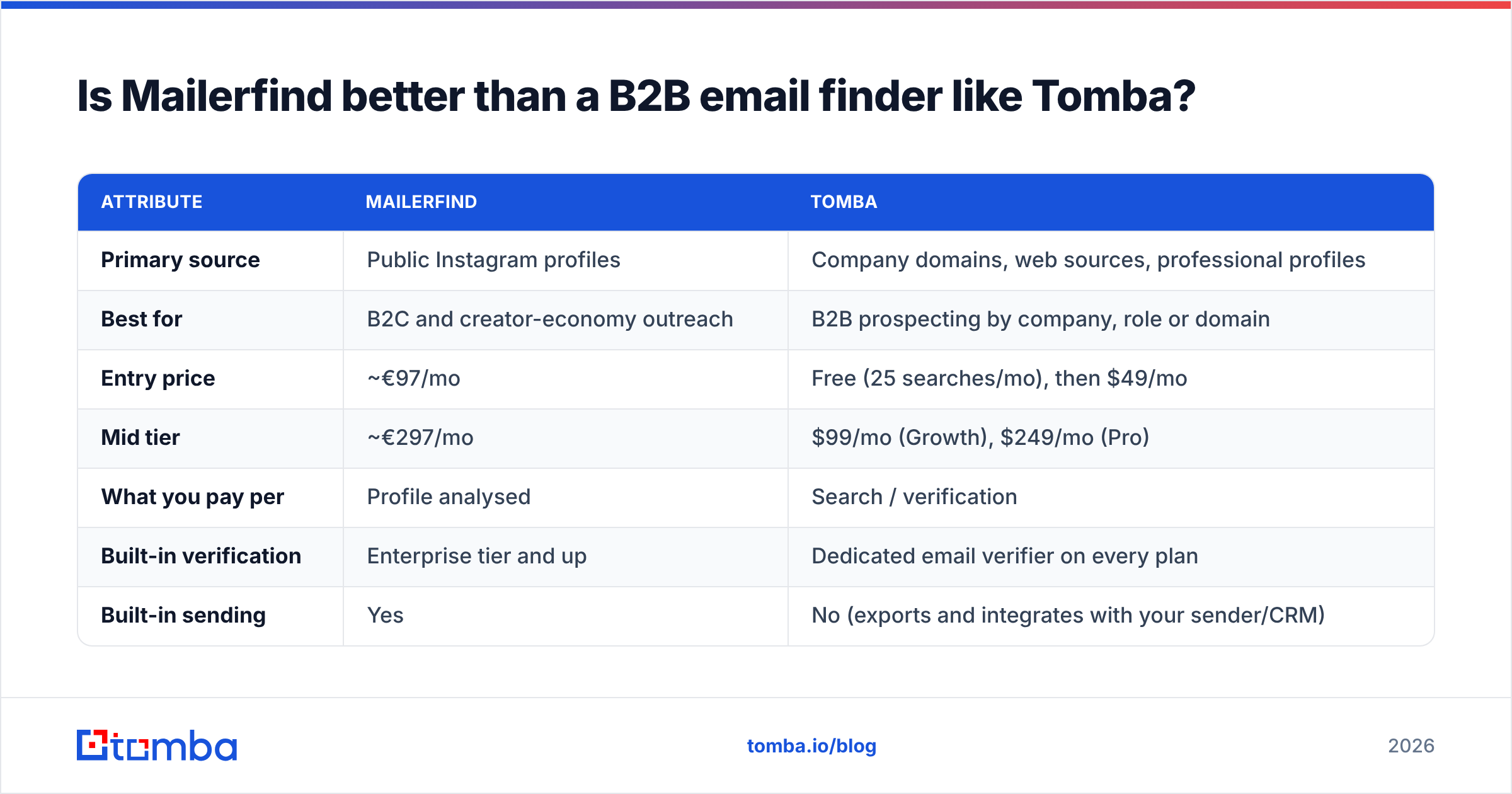
Is Mailerfind better than a B2B email finder like Tomba?#
They solve different problems, so "better" depends on who you're trying to reach.
Mailerfind starts from a social audience and works backwards to whatever email is public. A B2B email finder like Tomba starts from a company or person (a domain, a name, a LinkedIn profile) and returns the professional address. It can then verify that the mailbox exists.
| Attribute | Mailerfind | Tomba |
|---|---|---|
| Primary source | Public Instagram profiles | Company domains, web sources, professional profiles |
| Best for | B2C and creator-economy outreach | B2B prospecting by company, role or domain |
| Entry price | ~€97/mo | Free (25 searches/mo), then $49/mo |
| Mid tier | ~€297/mo | $99/mo (Growth), $249/mo (Pro) |
| What you pay per | Profile analysed | Search / verification |
| Built-in verification | Enterprise tier and up | Dedicated email verifier on every plan |
| Built-in sending | Yes | No (exports and integrates with your sender/CRM) |
| Find everyone at a company | No | Yes, via domain search |
| API access | Not a core focus | Yes |

Bottom line: if your buyer has a work email at a company you can name, a domain-based finder is cheaper per usable contact. It's also easier to defend on compliance and more accurate. Work addresses follow predictable patterns and can be checked with SMTP. If your buyer is a person you can only reach through Instagram, Mailerfind does something Tomba doesn't try to do.
Plenty of teams use both. They might use Mailerfind for an influencer or creator list, and a B2B finder for agency partners, suppliers and brand-side contacts. You can see how the tiers compare on Tomba pricing.
How can you cut costs if you do choose Mailerfind?#
- Pick high-signal targets first. Commenters on a recent post and followers of small, business-oriented accounts usually return more emails per credit than a massive consumer account.
- Filter before extracting. Use the segmentation filters (business accounts, keywords in bio) so you don't spend credits on personal profiles with no contact data.
- Verify before every send. If you're on Starter, run the export through an external verifier. If a domain accepts every address, use a catch-all verifier before you trust it.
- Warm up new inboxes. Instagram-sourced lists bounce more than curated B2B lists. Don't point a cold domain at them on day one.
- Re-check monthly. If cost per verified email climbs above what a B2B tool or a paid list costs you, move budget elsewhere.
Frequently asked questions#
Does Mailerfind have a free plan?#
Mailerfind does not advertise a permanent free tier on its public pricing. Reviewers mention limited trial credits, and listings report a 14-day money-back guarantee on paid plans. Check the current terms on the official site.
How much does Mailerfind cost per month?#
Third-party listings show Mailerfind pricing at about €97/mo for Starter (10,000 credits), €297/mo for Enterprise (40,000 credits) and €997/mo for Unlimited. Some aggregators list the top tier in dollars at a lower figure, so confirm before buying.
Is Mailerfind legal to use?#
It extracts publicly displayed contact information. Whether you can email those people depends on your jurisdiction and audience. Cold B2C email to EU residents without consent carries real GDPR and ePrivacy risk.
Is Mailerfind good for B2B lead generation?#
Only if your B2B buyers are small businesses that live on Instagram. For company- or role-based prospecting, a domain-based email finder is faster and cheaper per verified contact.
What is the best Mailerfind alternative for B2B?#
Use a tool that finds professional emails from a name and company domain and verifies them. Tomba, for example, has a free tier and a $49/mo Starter plan.
The verdict: is Mailerfind worth it in 2026?#
Mailerfind is a well-reviewed, easy-to-use tool for one job: turning Instagram audiences into email lists you can message right away. At €97/mo, Mailerfind pricing is fair for a B2C brand or agency whose audience gathers around certain accounts or hashtags. The catches are the per-profile credit model and a low, unpredictable email yield. Safeguards like verification and warm-up are also locked behind the €297 tier. Measure your cost per verified email in the first month and let that number decide.
If your prospects work at companies, you don't need an Instagram scraper. You need the right professional address and confirmation that it will land. Tomba Email Finder finds work emails from a name plus a domain and verifies them. It starts free with 25 searches a month, then paid plans from $49/mo. Run your next target account list through it and compare the cost per verified contact with what you're paying now.
Related guides#
// start free
See who Tomba finds at any company
Type a company's domain to see its people, their roles and verified work emails, each with the pages it was found on. Free account, no card.
Free plan · No credit card required · GDPR & CCPA
// about the author