Clodura.ai vs Ocean.io: Full 2026 Comparison & Verdict
Clodura.ai and Ocean.io both promise clean B2B prospecting data, but they solve different problems. Here's an honest, side-by-side breakdown of data, pricing, and fit — plus a leaner pick for teams that only need verified contacts.
The Clodura.ai vs Ocean.io choice comes down to one question: do you need an all-in-one outbound engine, or a precise data layer that feeds your existing tools? Both platforms sell "better B2B data." But they aim at different buyers. This Clodura.ai vs Ocean.io comparison breaks down what each tool does, where the data holds up, and what you pay. It also shows when a lighter, verification-first tool beats paying for a full suite.
TL;DR: Clodura.ai vs Ocean.io in 30 seconds#
- Clodura.ai is an all-in-one sales prospecting platform: a contact database, email sequencing, buyer-intent signals, and a built-in dialer aimed at SMB outbound teams.
- Ocean.io is a lookalike and account-intelligence engine — its strength is finding companies similar to your best customers and building precise account lists for ABM.
- Data accuracy is comparable on core firmographics; both rely on verification steps, and both show gaps outside North America and Western Europe.
- Pricing is seat-based and quote-heavy on both sides, which gets expensive fast for small teams that only need verified emails.
- If your real bottleneck is finding and verifying contact emails, a focused tool like Tomba covers that job at a fraction of the cost — and plugs into whichever platform you keep.
What are Clodura.ai and Ocean.io?#
Think of these two as different aisles in the same store. Clodura.ai wants to be your whole outbound kitchen — pantry, stove, and dishwasher in one. Ocean.io wants to be the sharpest knife on the block: it doesn't try to run your sequences, it tries to make sure you're targeting the right accounts in the first place.
Clodura.ai positions itself as an end-to-end sales intelligence and engagement platform. Its pitch is that a rep can log in, pull a list of decision-makers, load them into an email cadence, and start dialing without leaving the tool. It leans toward SMB and mid-market teams that want fewer subscriptions and a single login. You can read more on the official Clodura.ai site.
Ocean.io takes the opposite approach. It is built around company similarity: feed it your best accounts, and it returns statistically similar companies using firmographic and technographic signals. That makes it a favorite for account-based marketing (ABM) teams and RevOps functions that build target account lists rather than blast individual contacts. See the Ocean.io homepage for its account-list angle.
The practical difference: Clodura is contact-and-activity heavy, Ocean is account-and-targeting heavy. Neither is "wrong" — they're built for different stages of the funnel.
How do Clodura.ai and Ocean.io compare at a glance?#
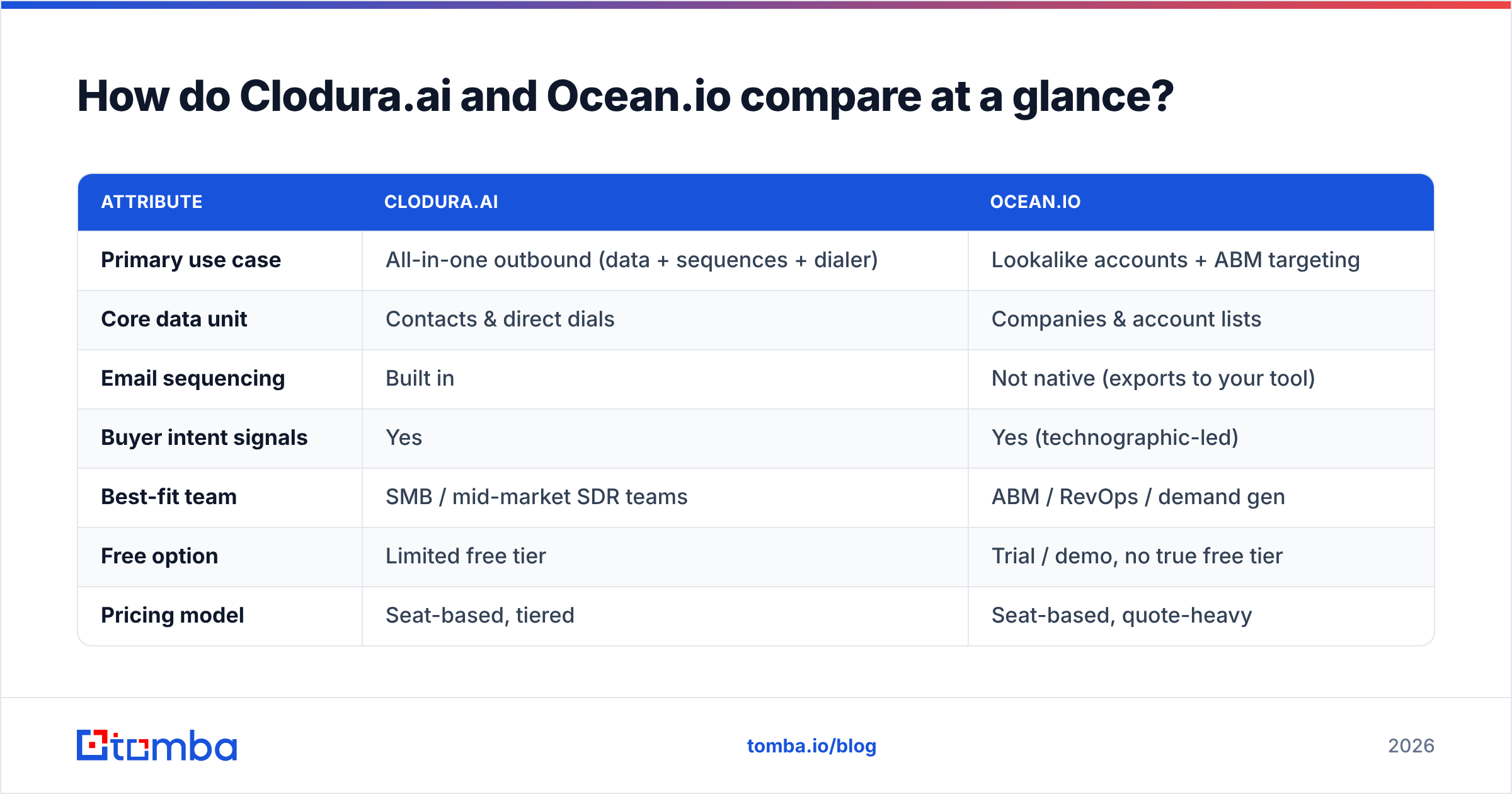
Here's the Clodura.ai vs Ocean.io head-to-head on the attributes buyers actually evaluate. Numbers reflect publicly listed positioning as of 2026. Always confirm current quotes, since both vendors move a lot of features behind sales calls.
| Attribute | Clodura.ai | Ocean.io |
|---|---|---|
| Primary use case | All-in-one outbound (data + sequences + dialer) | Lookalike accounts + ABM targeting |
| Core data unit | Contacts & direct dials | Companies & account lists |
| Email sequencing | Built in | Not native (exports to your tool) |
| Buyer intent signals | Yes | Yes (technographic-led) |
| Best-fit team | SMB / mid-market SDR teams | ABM / RevOps / demand gen |
| Free option | Limited free tier | Trial / demo, no true free tier |
| Pricing model | Seat-based, tiered | Seat-based, quote-heavy |
| Data strongest in | North America contacts | EU + NA company graph |
The table makes the split obvious: Clodura sells motion, Ocean sells precision. If you already own a sequencer like your CRM or a cold-email tool, you're paying twice for Clodura's engagement layer. If you don't run structured ABM, you're paying for Ocean's lookalike engine you won't fully use.
What is the difference in data coverage and accuracy?#
Accuracy is where the Clodura.ai vs Ocean.io comparison gets slippery. "Database size" is a vanity metric. A 200-million-record database that is 30% stale is worse than a smaller, fresh one. What matters is simple: how often the contact you export reaches a real inbox.
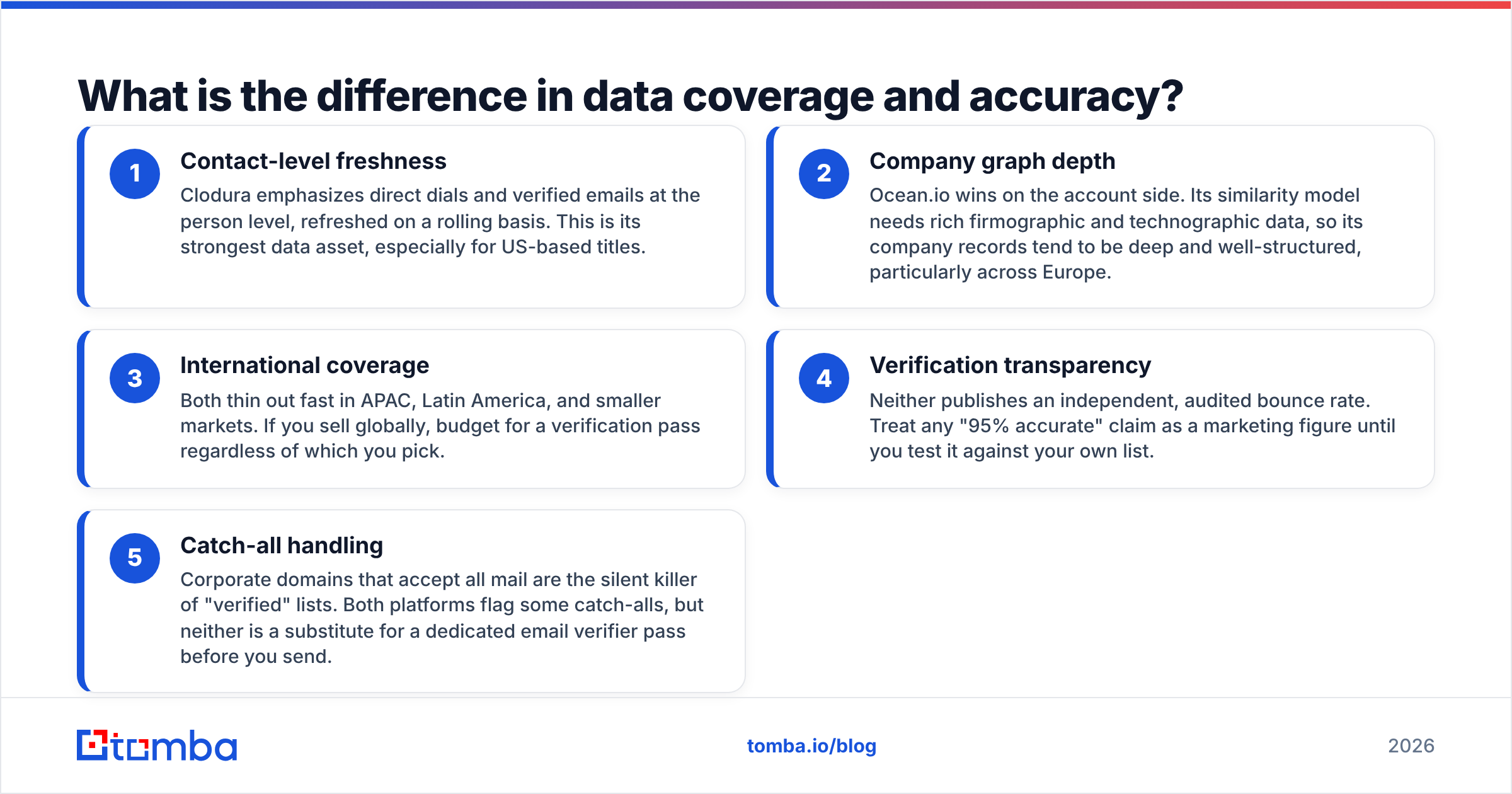
Here's how the two stack up on the dimensions that drive real deliverability:
- Contact-level freshness — Clodura emphasizes direct dials and verified emails at the person level, refreshed on a rolling basis. This is its strongest data asset, especially for US-based titles.
- Company graph depth — Ocean.io wins on the account side. Its similarity model needs rich firmographic and technographic data, so its company records tend to be deep and well-structured, particularly across Europe.
- International coverage — Both thin out fast in APAC, Latin America, and smaller markets. If you sell globally, budget for a verification pass regardless of which you pick.
- Verification transparency — Neither publishes an independent, audited bounce rate. Treat any "95% accurate" claim as a marketing figure until you test it against your own list.
- Catch-all handling — Corporate domains that accept all mail are the silent killer of "verified" lists. Both platforms flag some catch-alls, but neither is a substitute for a dedicated email verifier pass before you send.
The honest takeaway: for contacts, Clodura's data is the more useful raw material; for accounts, Ocean's graph is stronger. But in both cases, the email you export should be re-verified before it hits a live campaign. That's not a knock on either tool — it's true of every database vendor, and the teams that skip it are the ones nuking their sender reputation.
For a deeper look at why database freshness decays and how sourcing works, browse independent reviews on G2 before committing to an annual contract.
How do Clodura.ai and Ocean.io pricing compare?#
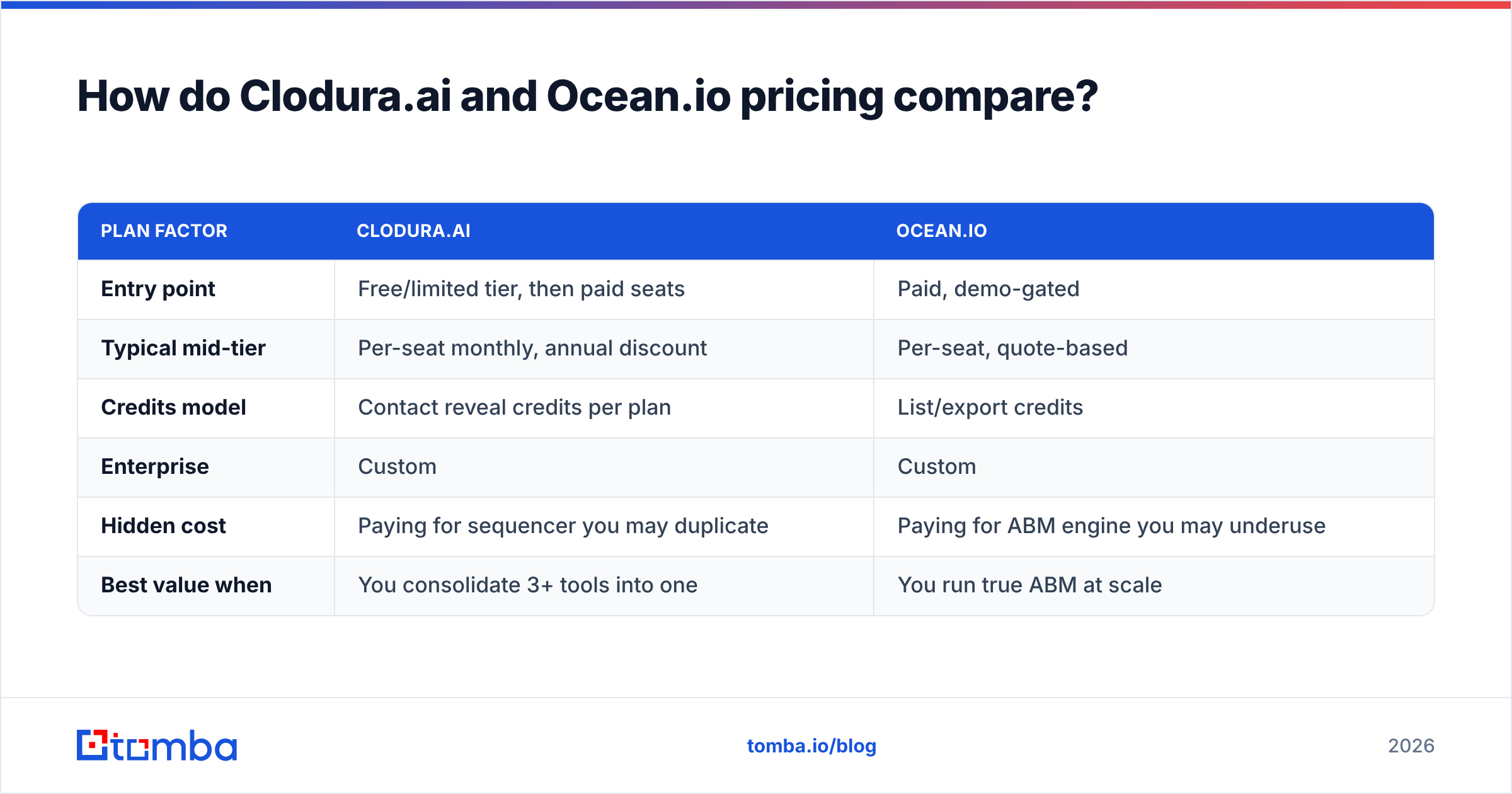
On price, the Clodura.ai vs Ocean.io setup is similar. Both lean on seat-based pricing with big jumps between tiers. Both push larger buyers into custom quotes. That is fine for a funded team building a full SDR org. It is painful for a two-person team that just needs 3,000 verified emails a month.
| Plan factor | Clodura.ai | Ocean.io |
|---|---|---|
| Entry point | Free/limited tier, then paid seats | Paid, demo-gated |
| Typical mid-tier | Per-seat monthly, annual discount | Per-seat, quote-based |
| Credits model | Contact reveal credits per plan | List/export credits |
| Enterprise | Custom | Custom |
| Hidden cost | Paying for sequencer you may duplicate | Paying for ABM engine you may underuse |
| Best value when | You consolidate 3+ tools into one | You run true ABM at scale |
The recurring theme in buyer complaints for both is the same: you commit to a seat-based annual plan, then discover your reveal or export credits run out mid-quarter, forcing an upsell. If your workflow is "find the right person, get a verified email, hand off to the CRM," you're subsidizing a lot of surface area you never touch.

Which features matter most for your team?#
Match the tool to the bottleneck, not the feature list. A few concrete scenarios:
- You run high-volume SDR outbound and want one login. Clodura's bundled sequencer and dialer genuinely reduce tool sprawl. The tradeoff is that best-of-breed sequencers usually out-perform an included one on deliverability controls.
- You run ABM and pick accounts before contacts. Ocean.io's lookalike engine is the differentiator here. Nothing in Clodura replicates "show me 500 companies like my top 20 customers" as cleanly.
- You mostly need contact data to feed existing tools. Neither suite is efficient here. A dedicated email finder and verifier does the job for less and drops straight into your stack.
- You care about direct dials for phone-first sales. Clodura's dialer and dial data give it the edge for cold-calling motions.
- You need clean data enrichment inside your CRM. Both can enrich, but check API limits and per-record cost — this is where quote-based pricing bites.
The pattern: the more of the platform you'll genuinely use, the more the all-in-one math works. The narrower your need, the more you overpay.
Is Clodura.ai better than Ocean.io?#
The Clodura.ai vs Ocean.io winner depends on your motion, since each tool wins a different job. Pick Clodura.ai if you are an SMB or mid-market team that wants prospecting, sequencing, and dialing under one roof. It fits best when you are happy with a US-centric contact database. Pick Ocean.io if your growth motion is account-based and your first question is "which companies should we even target," especially with a European footprint.
But there's a third, quieter answer a lot of teams land on after the trial: you didn't need the whole suite. If you strip the pitch down, most reps just need to find the right person, confirm the email is deliverable, and move on. When that's the actual job, an all-in-one platform is expensive overhead — and its "verified" data still deserves a verification pass anyway.
Where does Tomba fit against Clodura.ai and Ocean.io?#
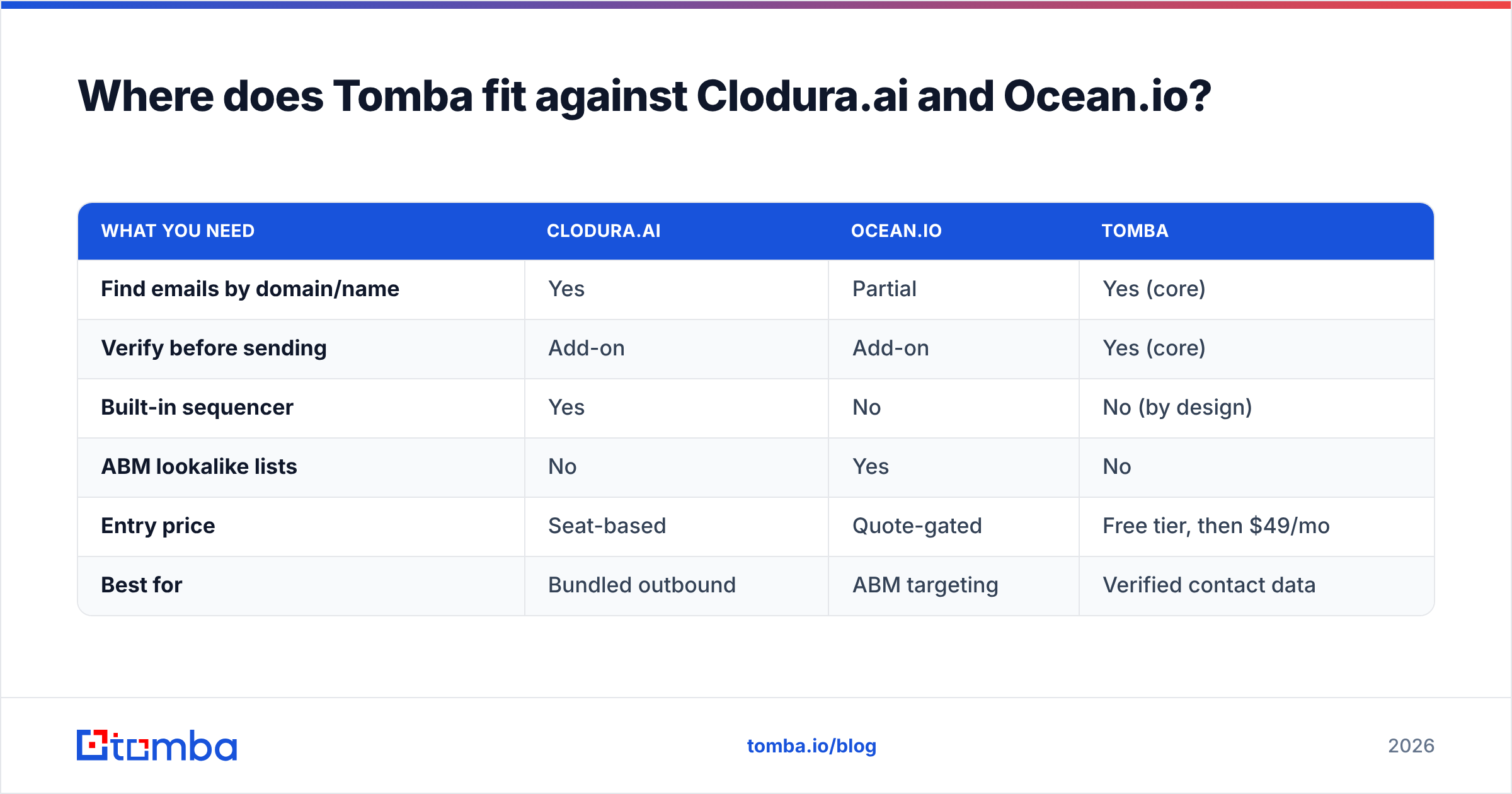
Tomba isn't trying to be an all-in-one outbound suite or an ABM lookalike engine — and that's the point. It's a focused data layer: find professional emails by name or domain, verify them, enrich records, and push them wherever you work. If your bottleneck is contacts and deliverability rather than sequencing or account modeling, that focus is the feature.
| What you need | Clodura.ai | Ocean.io | Tomba |
|---|---|---|---|
| Find emails by domain/name | Yes | Partial | Yes (core) |
| Verify before sending | Add-on | Add-on | Yes (core) |
| Built-in sequencer | Yes | No | No (by design) |
| ABM lookalike lists | No | Yes | No |
| Entry price | Seat-based | Quote-gated | Free tier, then $49/mo |
| Best for | Bundled outbound | ABM targeting | Verified contact data |
Tomba's pricing is built for exactly the team that finds the suites overkill: a free tier with 25 searches a month, Starter at $49/mo, Growth at $99/mo, and Pro at $249/mo — no seat math, no demo gate to see a number. You keep your CRM, your sequencer, and your ABM tool if you use one, and swap in a cleaner, cheaper source of verified contacts underneath.
FAQ#
Is Clodura.ai or Ocean.io more accurate? For person-level contacts and direct dials, Clodura's data tends to be the more actionable, especially in North America. For company-level firmographics and technographics, Ocean.io's graph is deeper. Either way, verify exported emails before a live send.
Does Ocean.io do email sequencing? No native sequencer. Ocean.io is designed to build account and contact lists you export into your own outreach tools, which is why it pairs well with a dedicated sending platform.
Are Clodura.ai and Ocean.io free? Clodura.ai offers a limited free tier; Ocean.io is generally demo-gated with no true free plan. Both push serious usage into seat-based annual contracts.
What's the cheapest way to just get verified B2B emails? A focused finder-and-verifier. Tomba starts free and scales at $49/mo, versus seat-based suite pricing — and you can bulk verify a list before importing it anywhere.
The bottom line#
The Clodura.ai vs Ocean.io decision matters most for buyers who will use most of a broad platform. Clodura fits bundled SMB outbound. Ocean fits account-based targeting. But if your real job is finding the right person and confirming the email actually lands, you do not need to rent either whole suite.
Start with the Tomba Email Finder: pull verified professional emails by name, domain, or company, run them through built-in verification, and feed them into whatever outbound or ABM stack you already trust. Test it on your next target list for free — then decide how much platform you actually need to pay for.
Related guides#
// get started
Find, verify and enrich your first contacts today
Start on the free plan with 25 searches a month, then scale when your team is ready.
Free plan · No credit card required · GDPR & CCPA
// about the author