Cloudura.ai vs OutboundView (2026): Which Fits Your Outbound?
Cloudura.ai is prospecting software; OutboundView is a done-for-you agency. This honest 2026 comparison shows which model fits your team, budget, and pipeline goals.
Cloudura.ai vs OutboundView (2026): Which Fits Your Outbound?
Cloudura.ai vs OutboundView is not really a product comparison. It is a choice between two ways to run outbound. Cloudura.ai hands you the software, and your team runs the plays. OutboundView takes the plays off your plate and runs them for you. Pick the wrong one and you waste a quarter and a budget line. So this guide stays practical.
TL;DR#
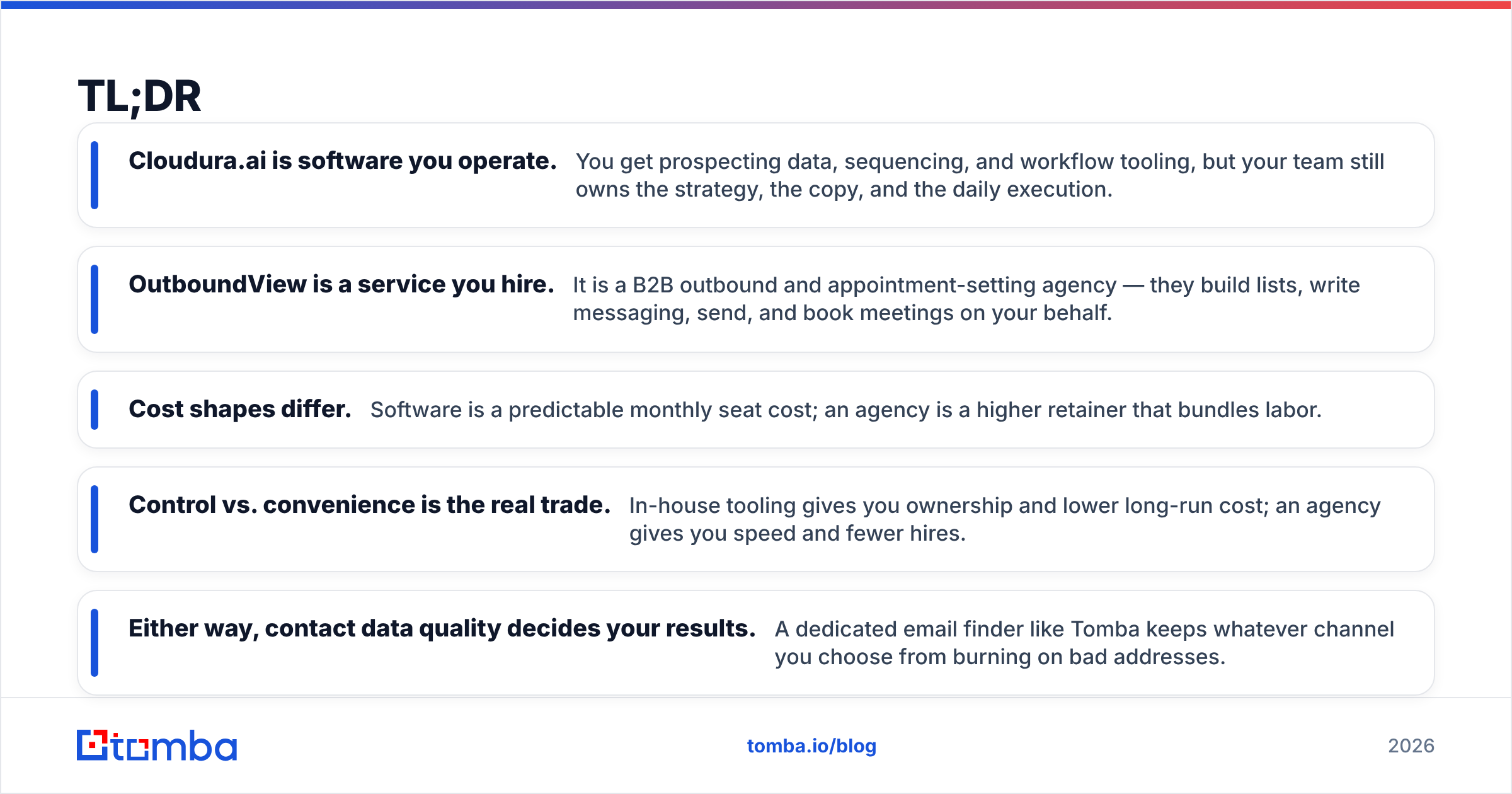
- Cloudura.ai is software you operate. You get prospecting data, sequencing, and workflow tooling, but your team still owns the strategy, the copy, and the daily execution.
- OutboundView is a service you hire. It is a B2B outbound and appointment-setting agency — they build lists, write messaging, send, and book meetings on your behalf.
- Cost shapes differ. Software is a predictable monthly seat cost; an agency is a higher retainer that bundles labor.
- Control vs. convenience is the real trade. In-house tooling gives you ownership and lower long-run cost; an agency gives you speed and fewer hires.
- Either way, contact data quality decides your results. A dedicated email finder like Tomba keeps whatever channel you choose from burning on bad addresses.
What is Cloudura.ai?#
Cloudura.ai calls itself an outbound and sales-intelligence platform. You find prospects, load them into sequences, and run outreach from one dashboard. Think of it as a workbench. You buy the workbench, and your SDRs stand at it every morning.
So the value you get depends on the people using it. Good reps with a good message and clean data will win. The same tool with a thin list and a weak pitch will fall flat, because software does not fix strategy. If you already run outbound and just need better rails, this model is a good fit. You pay for the tool, not the labor.
The upside of the software route is ownership. Your sequences, your learnings, your data, and your relationships stay inside your walls. The downside is that someone on your payroll has to actually run it, and that person needs training, management, and time to ramp.

What is OutboundView?#
OutboundView is an outbound agency. Instead of licensing you a tool, they run the whole motion. They build lists, write messaging, send across email and phone, and book qualified meetings onto your calendar. Think of it as a contractor. You describe the outcome you want — meetings with a defined ICP — and they build the team and process to deliver it.
This is attractive when you do not have an outbound team, do not want to hire one yet, or need pipeline faster than a hiring cycle allows. You trade per-meeting economics and some control for speed and reduced management overhead. You are buying an outcome, not a workbench.
The trade-off runs the other way from software. You get moving quickly, but the institutional knowledge — what messaging worked, which segments converted — lives partly with the agency. If you offboard, some of that walks out with them. Agencies also work best when your offer is already validated; they amplify a working motion far better than they invent one.
Cloudura.ai vs OutboundView: the core difference#
Here is the one-sentence version: Cloudura.ai is a tool your team runs; OutboundView is a team you rent. Everything else — price, speed, control, risk — falls out of that single distinction.
Use this checklist to place yourself before you look at any pricing page:
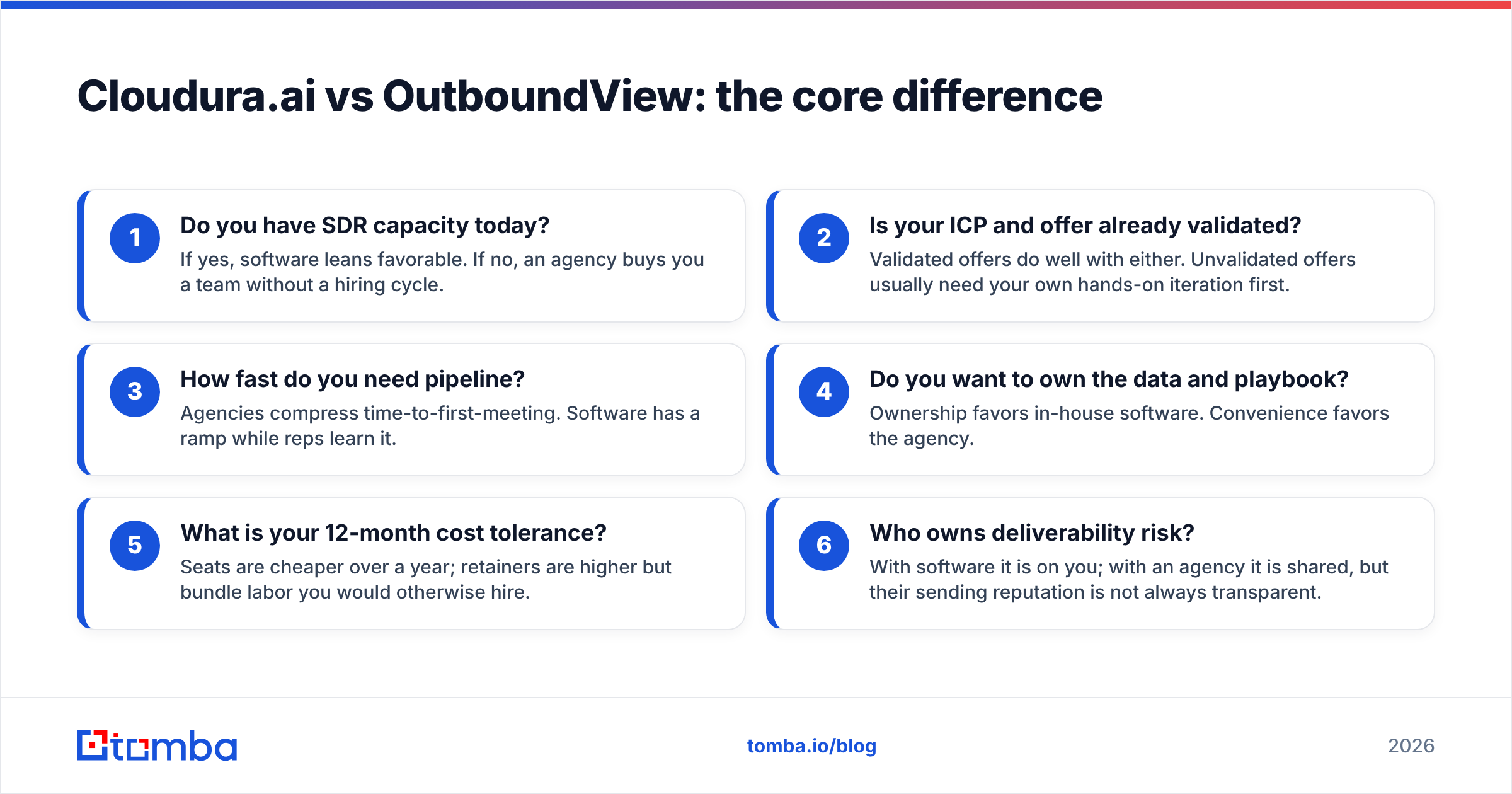
- Do you have SDR capacity today? If yes, software leans favorable. If no, an agency buys you a team without a hiring cycle.
- Is your ICP and offer already validated? Validated offers do well with either. Unvalidated offers usually need your own hands-on iteration first.
- How fast do you need pipeline? Agencies compress time-to-first-meeting. Software has a ramp while reps learn it.
- Do you want to own the data and playbook? Ownership favors in-house software. Convenience favors the agency.
- What is your 12-month cost tolerance? Seats are cheaper over a year; retainers are higher but bundle labor you would otherwise hire.
- Who owns deliverability risk? With software it is on you; with an agency it is shared, but their sending reputation is not always transparent.
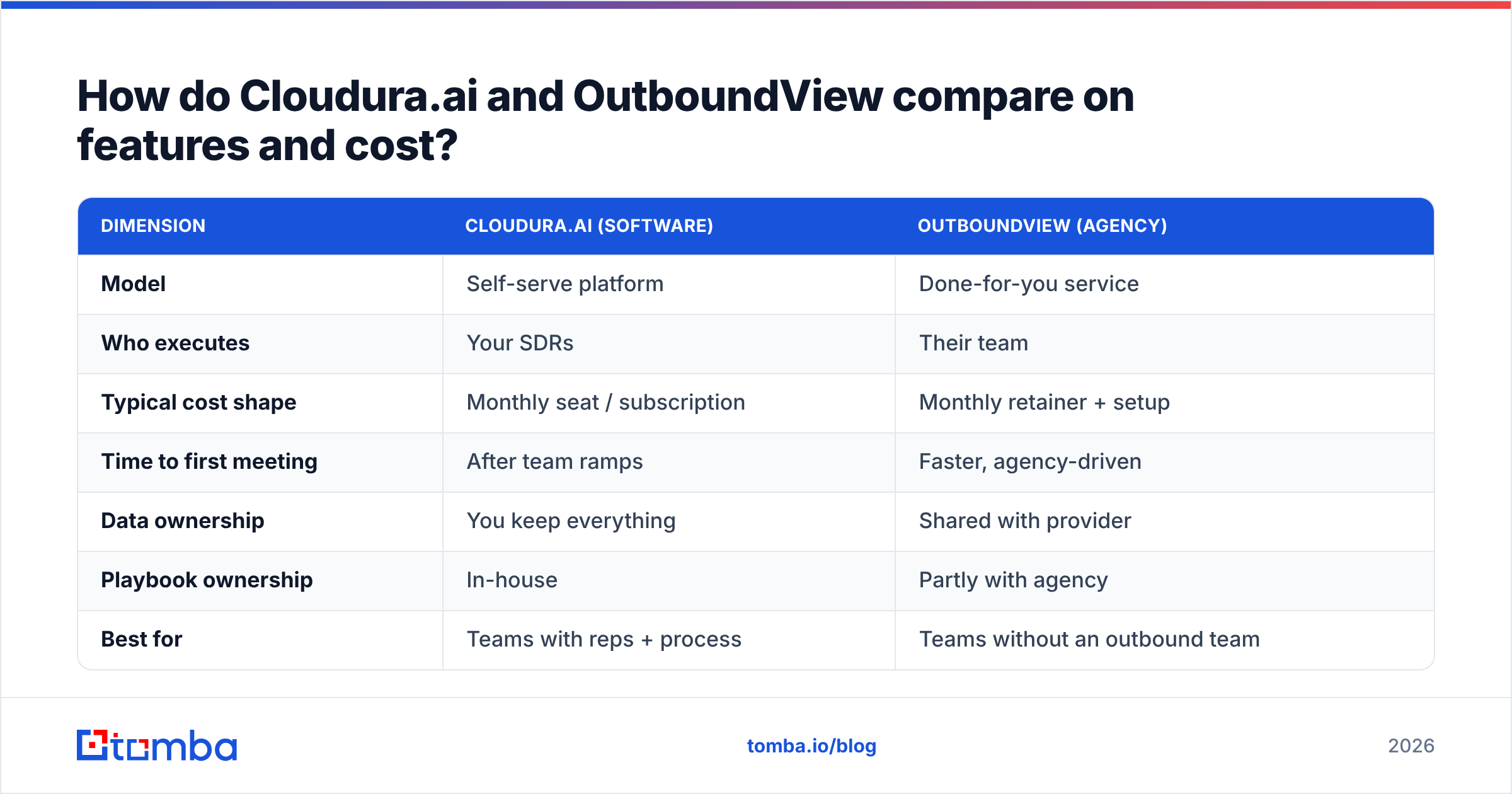
How do Cloudura.ai and OutboundView compare on features and cost?#
| Dimension | Cloudura.ai (software) | OutboundView (agency) |
|---|---|---|
| Model | Self-serve platform | Done-for-you service |
| Who executes | Your SDRs | Their team |
| Typical cost shape | Monthly seat / subscription | Monthly retainer + setup |
| Time to first meeting | After team ramps | Faster, agency-driven |
| Data ownership | You keep everything | Shared with provider |
| Playbook ownership | In-house | Partly with agency |
| Best for | Teams with reps + process | Teams without an outbound team |
| Long-run cost | Lower per meeting at scale | Higher per meeting, less overhead |
| Scalability | Add seats + reps | Add scope, negotiate |
Two honest caveats. First, published agency pricing is rarely fixed — retainers flex with scope, geography, and volume, so treat any number you see as a starting point and get a written scope. Second, software pricing looks cheaper on the invoice but hides the fully-loaded cost of the reps who run it. Compare cost per booked meeting, not sticker price, or you will fool yourself.
For a neutral read on how buyers rate outbound platforms and agencies, cross-check profiles on G2 before you commit — verified reviews surface the operational gotchas that marketing pages skip.
Which one should you pick?#
Pick Cloudura.ai (the software model) if you already employ SDRs, your offer converts, and you want to own the data and the learnings. Over a year, running your own tooling is almost always cheaper per meeting, and every optimization compounds inside your own account instead of an agency's.
Pick OutboundView (the agency model) if you need pipeline before you can realistically hire and train a team, or you want to test outbound as a channel without committing to headcount. You are paying a premium for speed and for skipping the management burden — a rational trade when time-to-pipeline is the binding constraint.
There is also a hybrid worth naming: hire an agency to prove the channel and generate early pipeline, then bring the motion in-house on software once you know what works. Many teams that follow this path use the agency phase to write the playbook, then run it themselves at a fraction of the cost.
Why contact data quality outranks the software-vs-agency debate#
Here is the part both models quietly depend on: the accuracy of the contact data underneath. A pristine sequence sent to a stale list still bounces. An agency with a great process still fails if the emails it sends to are wrong. Data is the floor, and neither a slick platform nor a polished agency raises a floor that is cracked.
This is where a dedicated verification layer earns its keep. Bounced sends punish your sender reputation, and once your domain's reputation dips, even your good emails land in spam. Running prospects through an email verifier before you send — regardless of whether a tool or an agency is doing the sending — protects the email deliverability that every outbound dollar rides on.
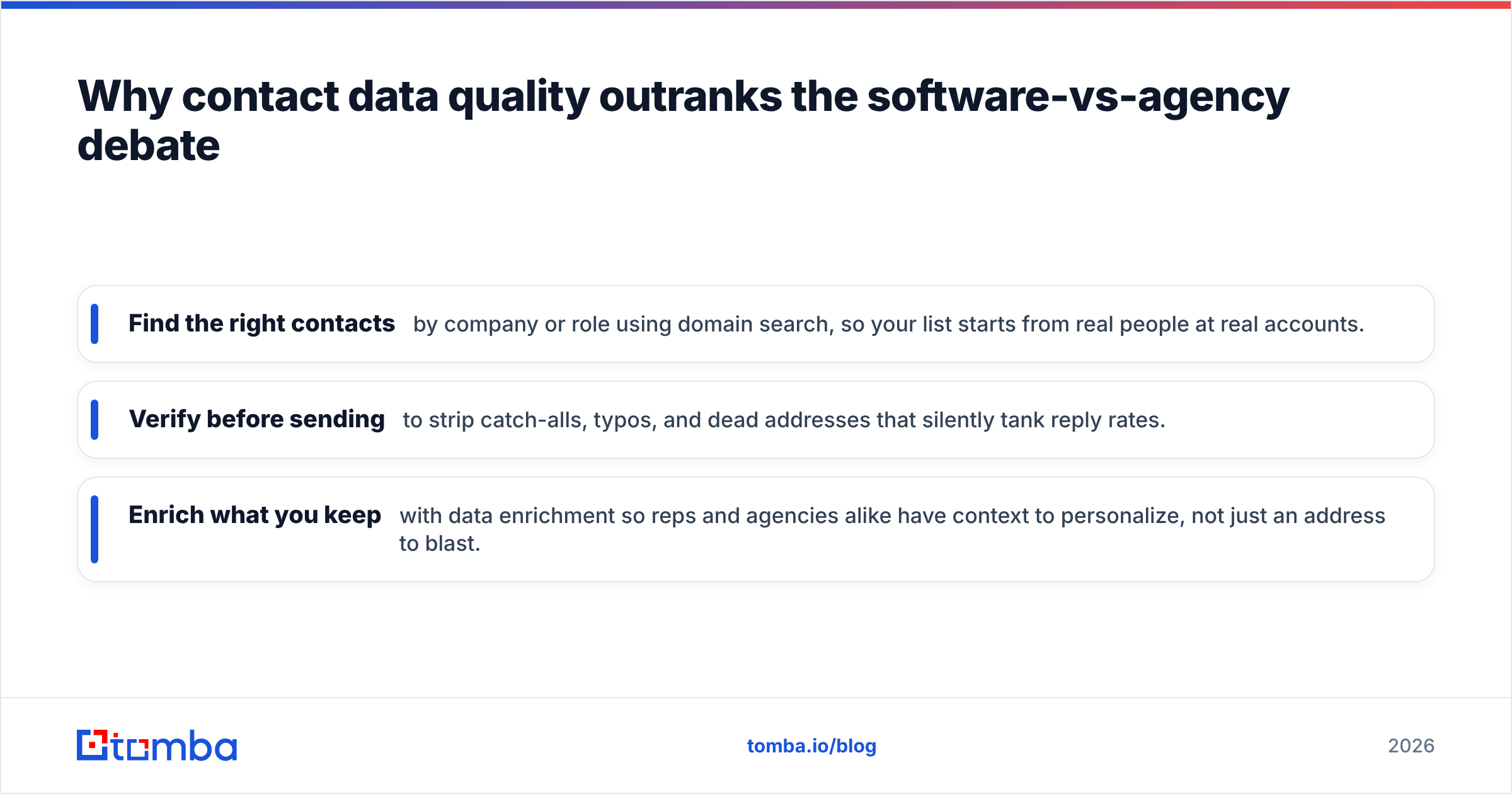
The practical stack looks like this no matter which model you choose:
- Find the right contacts by company or role using domain search, so your list starts from real people at real accounts.
- Verify before sending to strip catch-alls, typos, and dead addresses that silently tank reply rates.
- Enrich what you keep with data enrichment so reps and agencies alike have context to personalize, not just an address to blast.
If you want to see where accurate B2B data actually comes from, most reputable providers — Cloudura, agencies, and finders included — lean on a blend of public web crawling, verification, and pattern matching. HubSpot's own sales statistics roundup is a good sanity check on how much personalization and data quality move reply rates in modern outbound.
Is a done-for-you agency worth the premium?#
Sometimes, and the answer hinges on opportunity cost. If building an outbound team would pull your two best closers off revenue for a quarter, an agency retainer can be cheaper than the distraction. If you already have idle SDR capacity, paying an agency to do what your team could do is just margin you are giving away.
Run the math on incremental pipeline per dollar. Ask the agency for a realistic meetings-per-month range and a definition of "qualified," then compare it against what one more SDR on software would produce. Agencies win on speed and specialization; software wins on unit economics at scale. Neither wins on a spreadsheet you did not build.
One more diligence item: ask any agency exactly how they source and verify contacts, and whether you keep the enriched list when the engagement ends. If the data walks out the door with them, you were renting pipeline, not building an asset — and that changes the value calculus entirely.
The bottom line#
Cloudura.ai and OutboundView are not really competitors so much as two answers to the same question: who runs your outbound? Choose the software if you have — or will build — a team and want to own the machine. Choose the agency if you need meetings before you can staff for them. Choose the hybrid if you want the agency to write the playbook and your team to run it cheaply forever after.
Whatever you pick, do not let bad data quietly cap your results. Start every campaign with verified, enriched contacts from the Tomba Email Finder, and check the Tomba pricing — a free tier of 25 searches a month, then $49/mo Starter — before you commit a cent to any tool or retainer. The cheapest way to make outbound work is to make sure the addresses are real before anyone hits send.
Related guides#
// get started
Find, verify and enrich your first contacts today
Start on the free plan with 25 searches a month, then scale when your team is ready.
Free plan · No credit card required · GDPR & CCPA
// about the author