Clodura.ai vs Pipileads (2026): Which Prospecting Tool Wins?
A neutral, head-to-head breakdown of Clodura.ai vs Pipileads for 2026 — data accuracy, pricing, features, and which sales prospecting tool actually fits your team.
The Clodura.ai vs Pipileads choice comes down to one question. Do you want an all-in-one sales suite? Or a lean, fast email tool that stays out of your way? Both promise contact data and outreach help. But they solve different problems. Pay for the wrong one, and you burn budget on records you can't email.
This is a neutral, feature-by-feature comparison. No hype. No "buy this today." Just the differences that change how you work. Plus where a focused finder like the Tomba Email Finder fits when data accuracy is what you pay for.
TL;DR — Clodura.ai vs Pipileads at a glance#
- Clodura.ai is a full sales-intelligence platform. It offers a large B2B database, buyer-intent signals, email sequences, and a built-in dialer. It fits outbound teams that want prospecting, enrichment, and cadence in one login.
- Pipileads is a lighter, price-first lead tool. It focuses on finding and extracting emails at volume. It fits solo founders, agencies, and lean SDR teams that want contacts fast.
- Data accuracy is the real battleground. Both rely on database matches. So verify before you send, whichever you pick.
- Pricing: Clodura.ai costs more, with platform pricing and intent data. Pipileads competes on cheaper credit-based plans.
- If accuracy matters most, pair either tool with a specialist finder and verifier. That is the safest way to protect your sender reputation.
What is Clodura.ai?#
Clodura.ai is a B2B sales-intelligence platform. It runs on a self-reported database of hundreds of millions of contacts and companies. Think of it as a prospecting cockpit, not a single tool. You search for accounts. You pull verified contacts. You add buyer-intent and technographic signals. Then you push leads into email sequences or a built-in dialer.
Its pitch is consolidation. You skip stitching together a database, an email finder, a sequencer, and a dialer. Instead, you get them under one subscription. For teams doing real multi-channel outbound at scale, that can cut both tool sprawl and per-seat cost.
The trade-off is weight. All-in-one suites carry a learning curve, more setup, and higher pricing. If you only need clean emails, you pay for a lot you'll never use.
What is Pipileads?#
Pipileads is a leaner lead-generation and email-finding tool. It aims for speed and low cost. Its main job is simple. It helps you find and extract professional email addresses by domain, company, or bulk list. There's no heavy suite to learn.
The appeal is price and simplicity. Solo founders, small agencies, and budget SDR teams like tools in this class. You log in, run a search or upload a list, and export contacts in minutes. There's far less to set up than a platform like Clodura.ai.
The flip side of "light" is "narrow." You get fewer intent signals. You get thinner CRM-grade enrichment. And you get less native cadence tooling. For many lean teams, that's a feature, not a bug. But you'll often add a separate verifier and sequencer to finish the job.
How do Clodura.ai and Pipileads compare on features?#
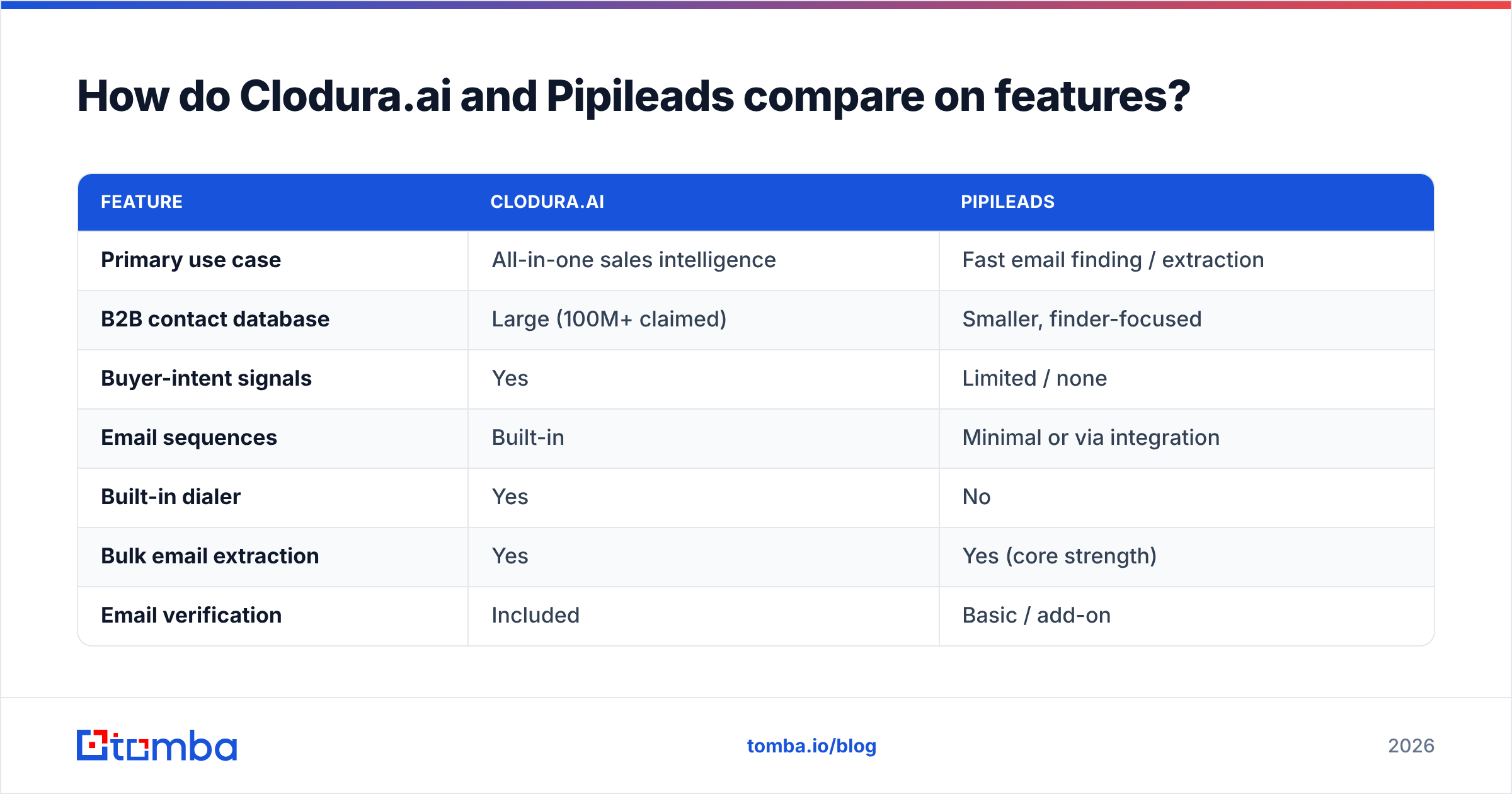
Here's the Clodura.ai vs Pipileads head-to-head on the traits that change your daily work. Treat vendor database sizes and accuracy claims as rough guides. Always confirm them against your own test list.
| Feature | Clodura.ai | Pipileads |
|---|---|---|
| Primary use case | All-in-one sales intelligence | Fast email finding / extraction |
| B2B contact database | Large (100M+ claimed) | Smaller, finder-focused |
| Buyer-intent signals | Yes | Limited / none |
| Email sequences | Built-in | Minimal or via integration |
| Built-in dialer | Yes | No |
| Bulk email extraction | Yes | Yes (core strength) |
| Email verification | Included | Basic / add-on |
| Best fit | Outbound teams, RevOps | Founders, agencies, lean SDRs |
| Pricing model | Platform tiers (higher) | Credit-based (cheaper) |
The pattern is clear. Clodura.ai wins on breadth. Pipileads wins on focus and cost. But neither edge helps if the emails bounce. That's why the next section matters more than any feature box.
Which has better data accuracy?#
Data accuracy is where these comparisons are won or lost. It's also where marketing claims get slippery. Both tools return contacts from a database. And every database decays. People change jobs. Companies rebrand. Catch-all domains hide invalid mailboxes. A "verified" flag is a starting point, not a promise.

The rule is simple. Never send to unverified data, no matter whose database it came from. A 5–10% bounce rate can hurt your email deliverability and get your domain flagged. That's true for Clodura.ai, Pipileads, or any other source.
This is where a specialist layer earns its keep. Run exported lists through a dedicated email verifier before your first send. It catches dead mailboxes and catch-all traps that platform verification often misses. If accuracy is your top goal, use the prospecting tool to source. Then use a purpose-built finder and verifier to confirm.
Tomba, for context, focuses on that one job. It sources professional emails by domain and name, then verifies them. It doesn't try to be a full cadence suite. That's a smaller scope. But it's the scope that protects your inbox reputation.
Clodura.ai vs Pipileads: pricing compared#
Pricing is the clearest dividing line. Clodura.ai prices like a platform. You pay for database access plus intent, sequencing, and dialing. So entry costs run higher and scale with seats and credits. Pipileads competes on price with credit-based plans for smaller budgets.

Check a few things before you commit:
- Credit definitions — Does a "credit" mean one search, one revealed contact, or one verified email? Vendors count differently. It changes real cost a lot.
- Rollover rules — Do unused credits carry over? Or do you lose them each month? Bursty prospecting cycles suffer under strict monthly resets.
- Verification cost — Is verification bundled or billed on top? A "cheap" plan that charges extra to verify isn't cheap.
- Export limits — Some tiers cap how many contacts you can export per month, whatever your credits.
- Contract terms — Annual lock-in versus monthly flexibility matters while you're still testing fit.
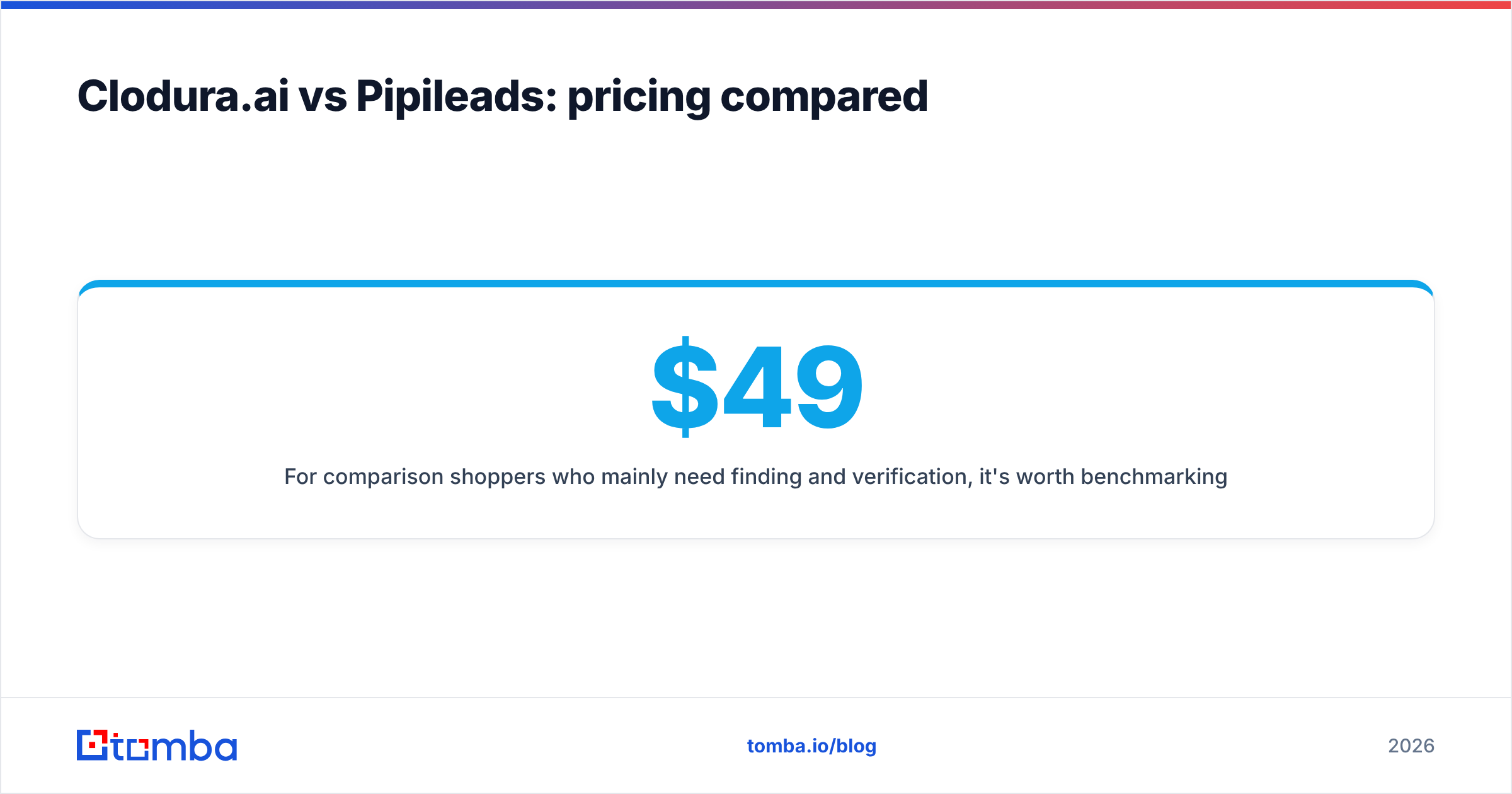
If you mainly need finding and verification, benchmark against a focused finder's transparent pricing. Tomba runs a free tier (25 searches/mo), Starter at $49/mo, Growth at $99/mo, and Pro at $249/mo. Cheaper isn't always better. But you should map what you use to what you're billed for.
Which tool should you choose?#
Match the tool to your motion, not to the longest feature list.
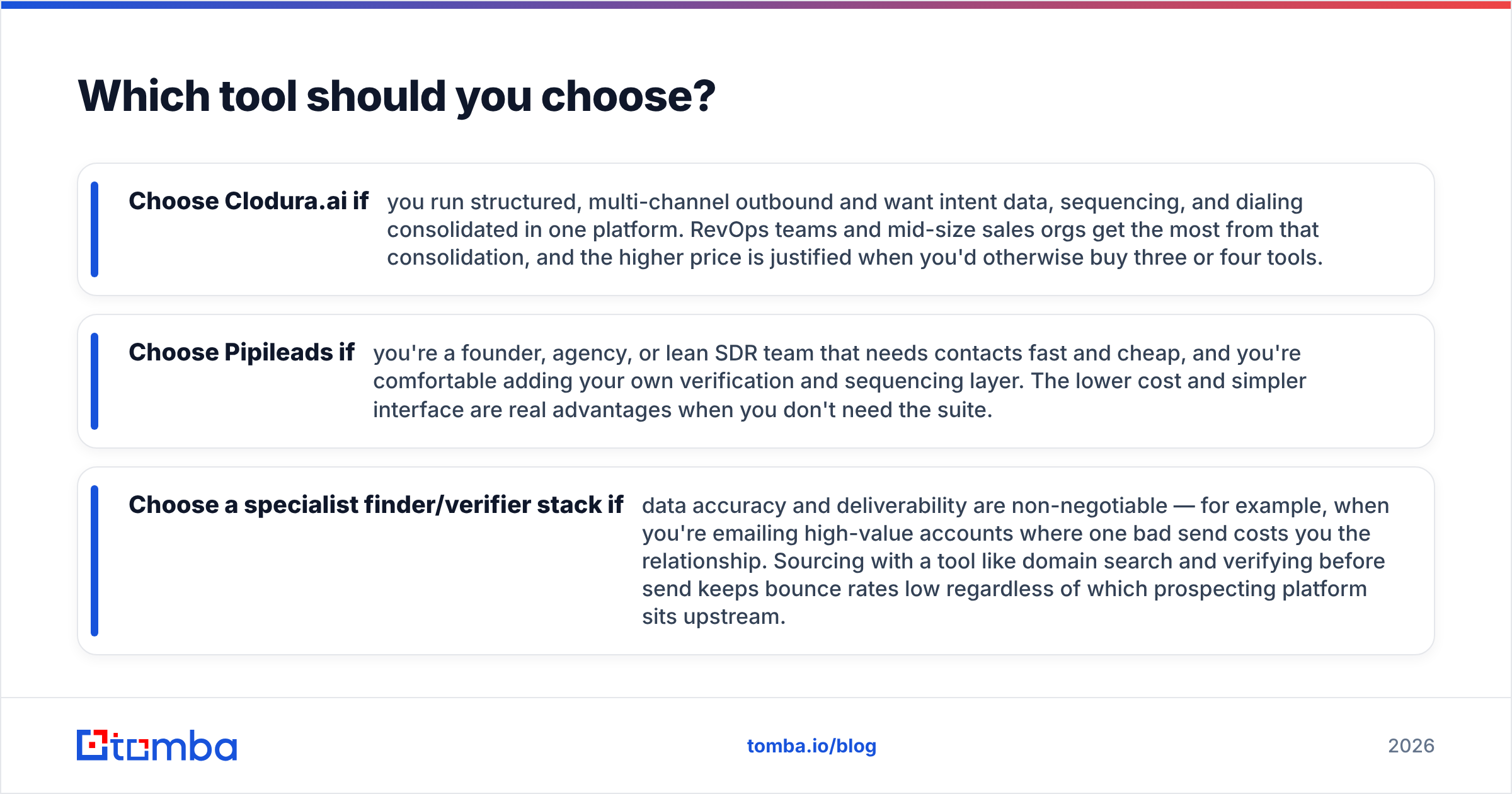
- Choose Clodura.ai if you run structured, multi-channel outbound. You want intent data, sequencing, and dialing in one platform. RevOps teams and mid-size sales orgs gain the most here. The higher price pays off when you'd otherwise buy three or four tools.
- Choose Pipileads if you're a founder, agency, or lean SDR team. You need contacts fast and cheap. And you're fine adding your own verification and sequencing layer. The lower cost and simpler interface are real wins.
- Choose a specialist finder and verifier if accuracy and deliverability are non-negotiable. Think high-value accounts, where one bad send costs you the relationship. Source with a tool like domain search and verify before you send. That keeps bounce rates low, whatever platform sits upstream.
Many teams run a hybrid. They use a prospecting tool to discover, and a dedicated finder and verifier to confirm. That's not indecision. It's how you get both coverage and clean data.
How to evaluate any prospecting tool before you buy#
Whichever way you lean, run the same test before you pay for a year:
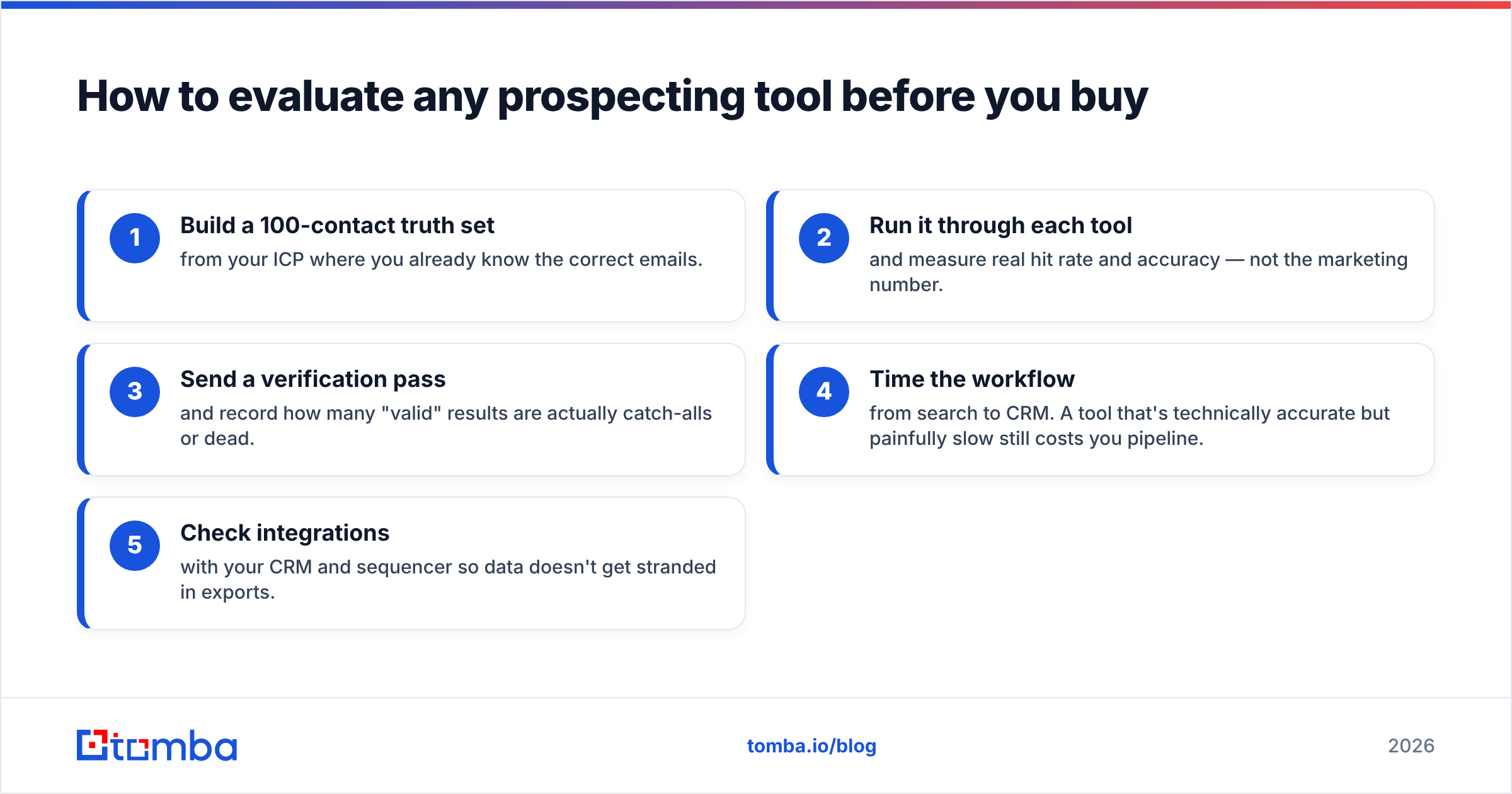
- Build a 100-contact truth set from your ICP, where you already know the right emails.
- Run it through each tool. Measure the real hit rate and accuracy, not the marketing number.
- Send a verification pass. Record how many "valid" results are catch-alls or dead.
- Time the workflow from search to CRM. A slow but accurate tool still costs you pipeline.
- Check integrations with your CRM and sequencer, so data doesn't get stuck in exports.
Reviews on G2 and Capterra help you spot recurring complaints, like billing surprises, stale data, or support gaps. The official Clodura.ai site is the source of truth for its current plans. But nothing beats your own truth-set test. Vendor claims and your own results are rarely the same number.
The bottom line#
Clodura.ai vs Pipileads isn't really a fight for the same buyer. Clodura.ai is the broader, pricier sales-intelligence platform. Pipileads is the leaner, cheaper email finder. Pick Clodura.ai for consolidated multi-channel outbound. Pick Pipileads for fast, cheap contact sourcing. In both cases, verify before you send.
If your real goal is accurate, deliverable emails rather than a full suite, start with a specialist. The Tomba Email Finder sources professional emails by domain, name, or company. It verifies them before they hit your outreach. So your bounce rate stays low. Your sender reputation stays clean. And your reps spend time selling, not scrubbing bad data. Try the free tier, run your own truth-set test, and let the numbers decide.
Related guides#
Ready to find emails that actually work?
Join 150,000+ professionals who stopped guessing and started sending. Free credits on signup — no credit card required.
Get the Tomba newsletter
Practical outbound tactics and product updates — once every two weeks.
About the author