Clodura.ai vs Plusvibe (2026): Which B2B Sales Tool Wins?
Clodura.ai is a B2B database with built-in sequencing; Plusvibe is a lean cold email autopilot. Here's an honest, side-by-side breakdown of which one fits your outbound motion in 2026 — and where a dedicated data layer beats both.
Choosing between Clodura.ai and Plusvibe usually comes down to one question: do you need the contacts or the cadence? Clodura.ai leans into being a B2B data platform with sequencing bolted on. Plusvibe is a lightweight cold email autopilot built for sending volume without getting flagged. They overlap in the middle, and that overlap is exactly where teams pick the wrong tool.
This is a neutral, hands-on comparison — no fluff, no "both are great" cop-out. By the end you'll know which one fits your outbound motion, and where you'll still want a dedicated data layer underneath either.
TL;DR: Clodura.ai vs Plusvibe at a glance#
- Clodura.ai is a B2B database + sales intelligence tool with a built-in email finder, sequences, and buying-signal alerts. Best if you have no contact source yet.
- Plusvibe is a cold email sending platform — inbox rotation, warmup, unified inbox, AI copy — built to send at volume and stay deliverable. Best if you already have data.
- Data quality is the make-or-break for both. Clodura's database is broad but ages; Plusvibe assumes you bring your own list.
- Pricing favors Plusvibe for pure sending; Clodura costs more because you're paying for the data layer too.
- The honest verdict: most teams get the best result by pairing a verified data source with a lean sender — not by forcing one tool to do everything.
What is Clodura.ai?#
Clodura.ai is a sales prospecting platform built around a large B2B contact database (it advertises hundreds of millions of contacts and direct dials). Think of it as a filing cabinet that also mails your letters: you search for accounts and people, pull their emails and phone numbers, then run them through built-in email sequences. It layers on sales-intelligence features — org charts, technographics, and buying-intent signals — so reps can time outreach around trigger events.
The pitch is "all-in-one prospecting." You start from zero contacts and finish with sent emails inside one login. For teams without an existing data source, that consolidation is genuinely useful.
The catch is the same one every bundled database faces: coverage is wide but accuracy drifts. B2B data decays roughly 25–30% a year as people change jobs, so any static database needs constant re-verification. Clodura does verify, but if you rely on its numbers without a second check, bounce rates creep up — and bounces are what torch your sender reputation.
What is Plusvibe?#
Plusvibe (plusvibe.ai) is a cold email automation platform in the same lane as Instantly and Smartlead. It doesn't try to be your database. Instead it focuses on the sending problem: connecting many mailboxes, rotating sends across them, warming inboxes automatically, and pulling every reply into one unified inbox so a small team can manage large-volume campaigns.
If Clodura is the filing cabinet, Plusvibe is the mailroom — optimized to get thousands of messages out the door without tripping spam filters. It adds AI copywriting, spintax for message variation, and analytics on opens, replies, and deliverability.
Plusvibe's honesty is also its limitation: it assumes you already have contacts. There's no deep prospecting database to lean on. You bring a CSV or connect a data source, and Plusvibe sends. That's a feature if you already invest in clean data, and a gap if you don't.

Clodura.ai vs Plusvibe: full comparison table#
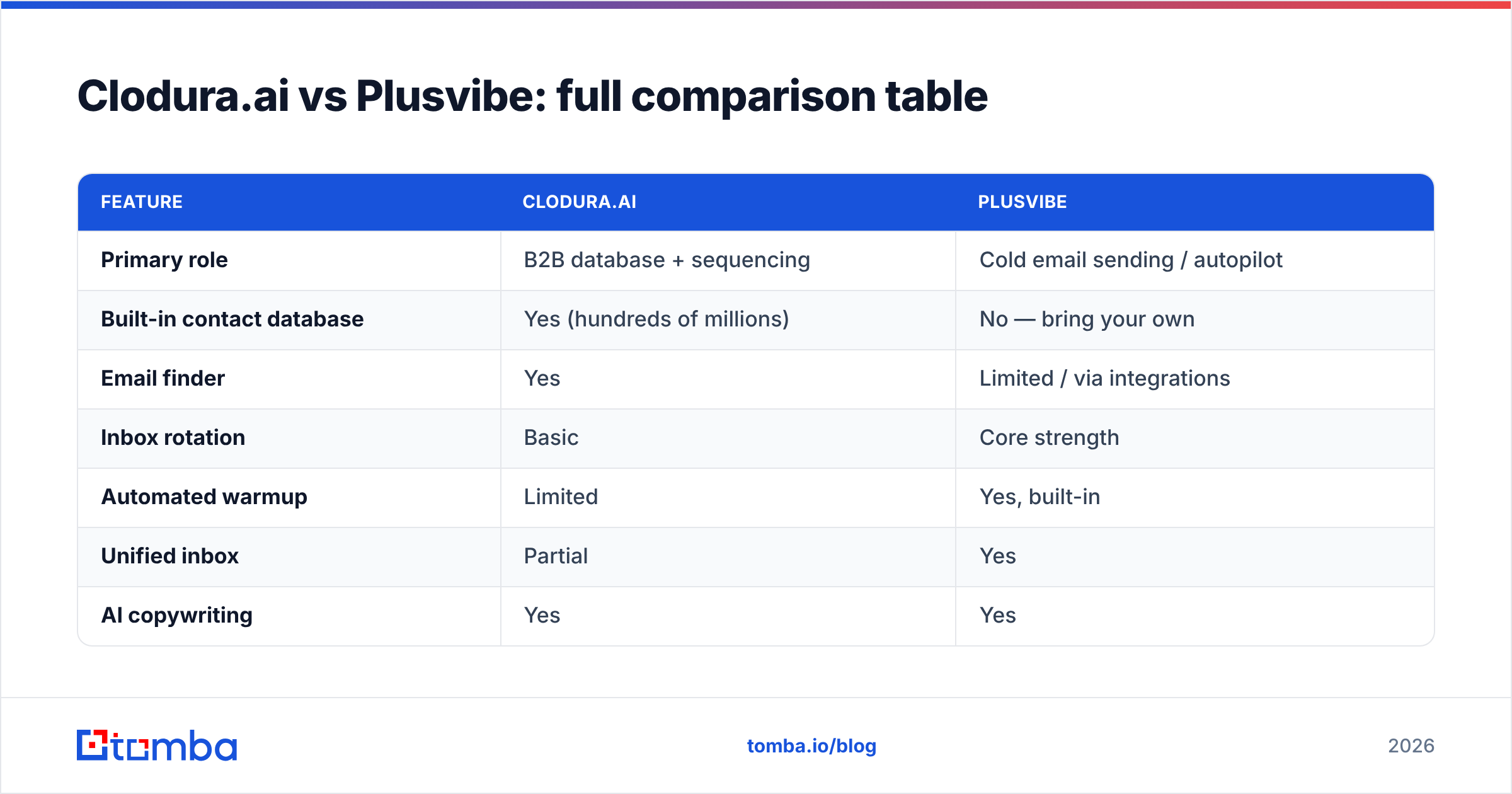
Here's the side-by-side on the attributes that actually change your results.
| Feature | Clodura.ai | Plusvibe |
|---|---|---|
| Primary role | B2B database + sequencing | Cold email sending / autopilot |
| Built-in contact database | Yes (hundreds of millions) | No — bring your own |
| Email finder | Yes | Limited / via integrations |
| Inbox rotation | Basic | Core strength |
| Automated warmup | Limited | Yes, built-in |
| Unified inbox | Partial | Yes |
| AI copywriting | Yes | Yes |
| Buying-intent signals | Yes | No |
| Best for | Teams with no data source | Teams with clean lists |
| Starting price | Higher (data included) | Lower (sending only) |
The pattern is clear: Clodura sells you the inputs, Plusvibe optimizes the delivery. Neither one is a full replacement for a dedicated, continuously verified data provider — which is why the data-quality question below matters more than either feature list.
Which one has better data quality?#
Clodura wins on raw coverage; neither wins on trust-without-verification. This is the decision most buyers get wrong. A sequencing tool with perfect deliverability still fails if 20% of the addresses bounce, and a huge database is worthless if a quarter of it is stale.
Here's the uncomfortable truth about relying on any single bundled database:
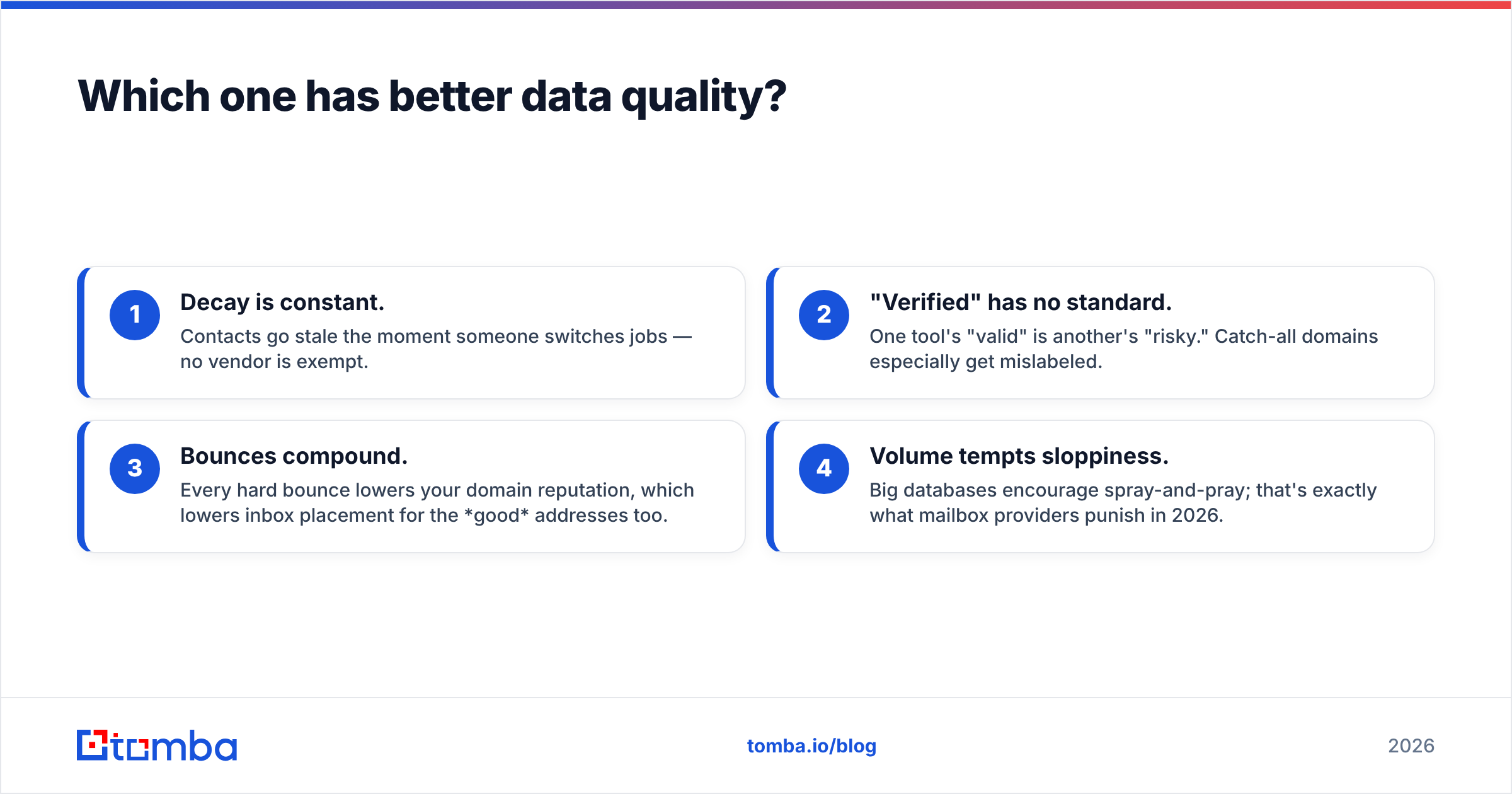
- Decay is constant. Contacts go stale the moment someone switches jobs — no vendor is exempt.
- "Verified" has no standard. One tool's "valid" is another's "risky." Catch-all domains especially get mislabeled.
- Bounces compound. Every hard bounce lowers your domain reputation, which lowers inbox placement for the good addresses too.
- Volume tempts sloppiness. Big databases encourage spray-and-pray; that's exactly what mailbox providers punish in 2026.
The fix is boring but effective: verify every address right before you send, regardless of where it came from. Running your Clodura exports — or your Plusvibe upload list — through an independent email verifier catches the dead addresses before they ever hit a mailbox. And when a database returns a catch-all domain, a dedicated catch-all verifier tells you whether the specific mailbox actually exists instead of guessing.
This is the layer both Clodura and Plusvibe under-serve. Clodura gives you data but a shallow re-check; Plusvibe gives you sending but no data of its own. A standalone email finder with high match rates and independent verification slots neatly underneath either platform.
Which is better for deliverability?#
Plusvibe, clearly — that's its entire reason to exist. Inbox rotation, automated warmup, and per-mailbox sending caps are first-class in Plusvibe and only partially present in Clodura. If your bottleneck is "my emails land in spam," Plusvibe is the more focused answer.
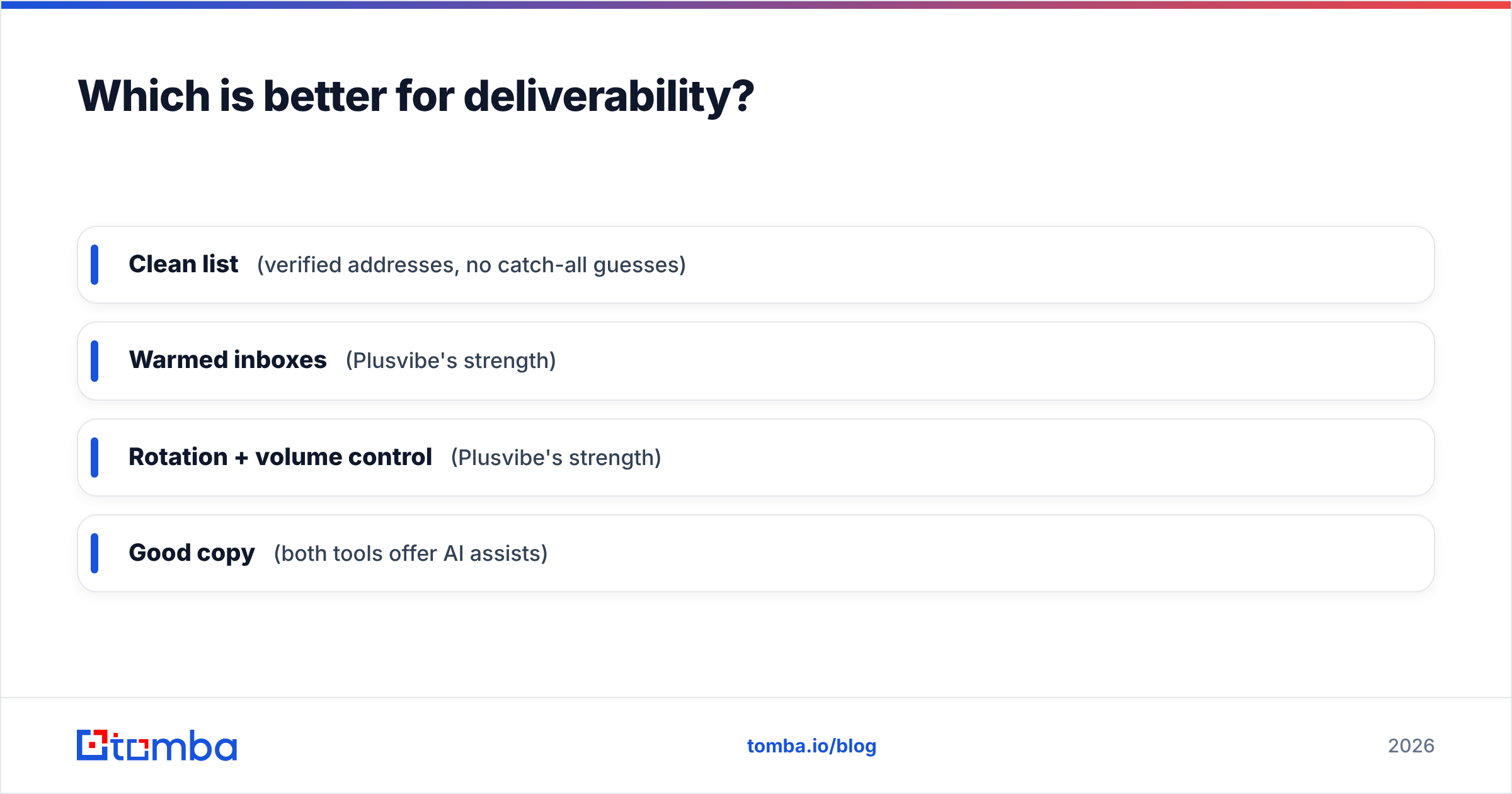
But deliverability isn't only about the sender. It starts with the list. Sending flawless, well-warmed messages to bad addresses still generates bounces and spam complaints — the two fastest ways to wreck sender reputation. So the real deliverability stack is:
- Clean list (verified addresses, no catch-all guesses)
- Warmed inboxes (Plusvibe's strength)
- Rotation + volume control (Plusvibe's strength)
- Good copy (both tools offer AI assists)
Plusvibe covers three of four out of the box. The first one — the list — is where you'll want an external verification pass no matter which platform you sign up for. For broader context on what actually moves inbox placement, Google's own Postmaster guidelines and the industry consensus tracked on G2 both put list hygiene ahead of nearly everything else.
Which is better for pricing?#
Plusvibe is cheaper for pure sending; Clodura costs more because you're renting a database. That's not a knock on Clodura — you get more surface area. But if you already have contacts, you're paying for data you don't need.
A simple way to think about total cost:
| Scenario | Lower-cost path |
|---|---|
| No data source at all | Clodura (data + sending bundled) |
| Already have clean lists | Plusvibe (sending only) |
| Need best accuracy per dollar | Dedicated finder + verifier + a lean sender |
| High sending volume | Plusvibe + external verification |
For comparison, a specialized data provider like Tomba starts with a free tier (25 searches/month) and a Starter plan at $49/month, scaling to Growth at $99/month — see the full Tomba pricing breakdown. Pairing an affordable, accurate finder with a focused sender like Plusvibe often beats an all-in-one bundle on both cost and results, because you're not overpaying for a database you'll re-verify anyway.
When should you pick Clodura.ai?#
Pick Clodura.ai if:
- You're starting from zero contacts and want prospecting, data, and sequencing under one roof.
- You value buying-intent signals and org-chart intelligence to time your outreach.
- You prefer one login over stitching tools together, and you'll layer verification on top.
- Your volume is moderate — you're not blasting tens of thousands of emails a week where dedicated rotation matters most.
Just budget for an independent verification step. Clodura's database is a strong starting point, not a substitute for pre-send hygiene.
When should you pick Plusvibe?#
Pick Plusvibe if:
- You already have data from a finder, CRM, or enrichment tool.
- Deliverability is your pain — you need warmup, rotation, and a unified inbox that scales.
- You send at volume and want per-mailbox control to protect your domains.
- You want a lean stack and are happy to source contacts separately (which you should be doing anyway for accuracy).
Plusvibe does one job well. Feed it clean, verified addresses and it performs. Feed it a stale list and even the best warmup won't save you from the bounce spiral.
The honest verdict: is there a better setup than either?#
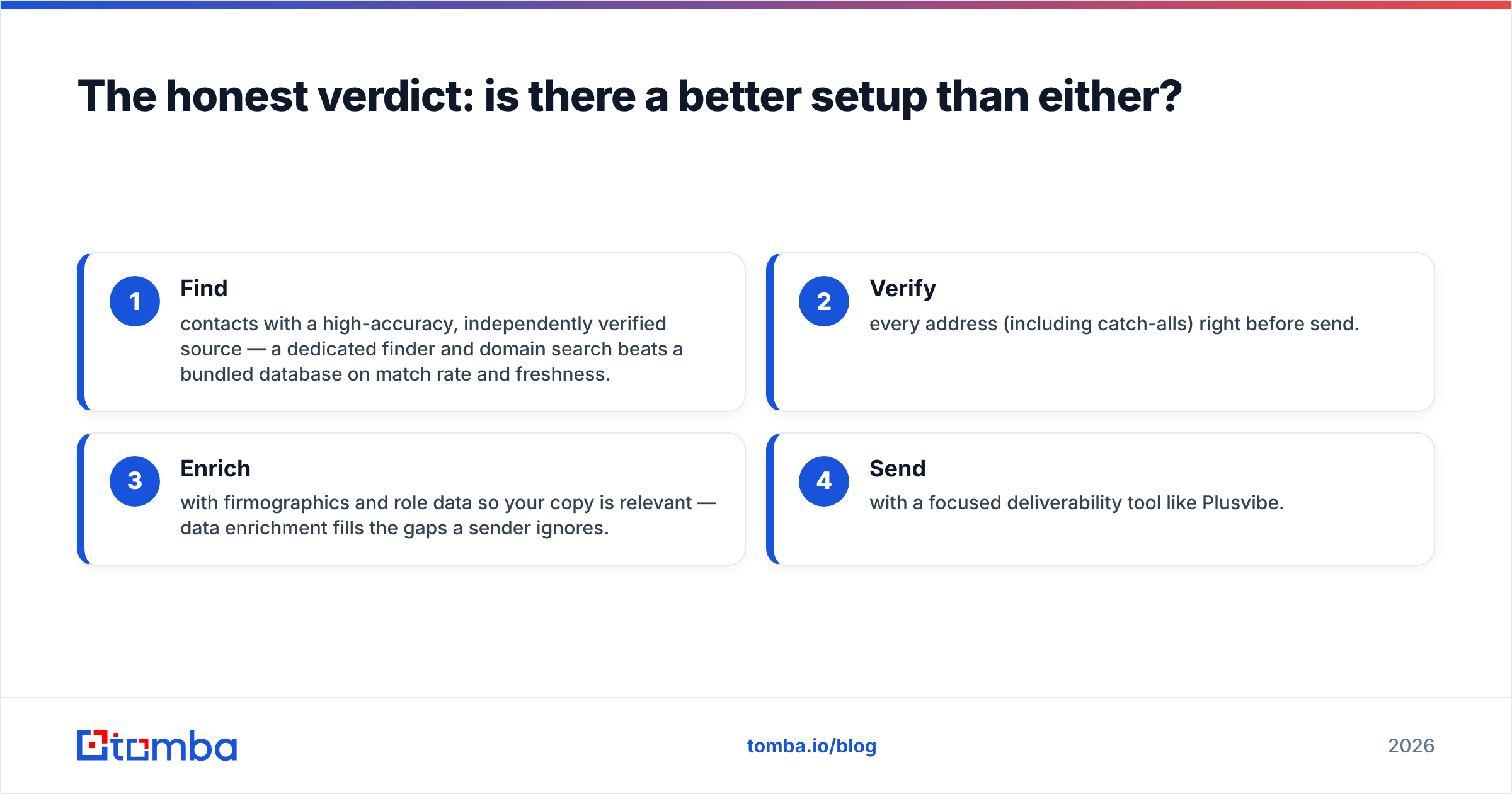
For most teams, yes — separate the data problem from the sending problem. Clodura tries to own both and does data adequately and sending adequately. Plusvibe owns sending brilliantly and skips data entirely. The highest-ROI stack in 2026 usually looks like this:
- Find contacts with a high-accuracy, independently verified source — a dedicated finder and domain search beats a bundled database on match rate and freshness.
- Verify every address (including catch-alls) right before send.
- Enrich with firmographics and role data so your copy is relevant — data enrichment fills the gaps a sender ignores.
- Send with a focused deliverability tool like Plusvibe.
That modular approach means you upgrade any one layer without ripping out the others — and you're never paying for overlapping features. If Clodura's data ages, swap the finder. If Plusvibe raises prices, swap the sender. Lock-in is the hidden cost of "all-in-one."
Final recommendation#
- No contacts, want simplicity? Clodura.ai — add an external verifier.
- Have contacts, need inbox placement? Plusvibe — it's the better sender.
- Want the best accuracy-per-dollar? Build a modular stack: dedicated finder + verifier + Plusvibe.
Both Clodura.ai and Plusvibe are legitimate tools that solve real problems. The mistake is expecting either to be your entire outbound engine. Sequencing without clean data is a fast way to burn a domain; data without deliverability is a slow way to waste it.
If the data layer is where you're weakest — and for most teams it is — start there. The Tomba Email Finder gives you verified professional emails by name, domain, or company, with a free tier to test match rates before you commit, and it drops straight into Clodura, Plusvibe, or whatever sender you already run. Fix the inputs first, and every tool downstream works better.
Related guides#
// get started
Find, verify and enrich your first contacts today
Start on the free plan with 25 searches a month, then scale when your team is ready.
Free plan · No credit card required · GDPR & CCPA
// about the author