Cloduraai vs Power Almanac: B2B Data Compared 2026
Clodura.ai is an AI prospecting engine; Power Almanac is a local-government contact database. Here's an honest, use-case-by-use-case comparison to help you pick the right B2B data source in 2026.
Choosing a B2B data provider gets harder when the two tools don't do the same job. That is the case with Cloduraai vs Power Almanac (you'll also see it written Clodura.ai vs Power Almanac). One is an AI-driven sales-prospecting platform. The other is a focused database of U.S. local-government officials. A head-to-head only makes sense once you know who each tool serves.
This guide breaks down coverage, accuracy, pricing, and fit. By the end, you'll know which tool belongs in your stack. You'll also see whether a dedicated email finder should sit alongside it.
TL;DR: Cloduraai vs Power Almanac at a glance#
- Clodura.ai is a broad B2B sales-intelligence platform. It bundles a company database, contact discovery, intent signals, and email sequencing. It targets outbound teams that sell to businesses.
- Power Almanac is a niche database of elected and appointed officials. It covers U.S. cities, counties, and townships. It's built for people who sell to or lobby local government.
- They rarely compete. Sell to commercial companies? Clodura fits. Sell to municipal decision-makers? Power Almanac fits.
- Both have accuracy gaps. Any static B2B list decays 20–30% per year. So verification is a must, whichever you pick.
- Best move: add a real-time email verifier on top of whichever database you choose. It protects your deliverability.
What is Clodura.ai?#
Clodura.ai is an AI-powered sales-prospecting platform. Think of it as one dashboard. Reps research accounts, pull contact details, watch buying signals, and launch email cadences there. They don't have to bounce between five tools.
Its core pieces:
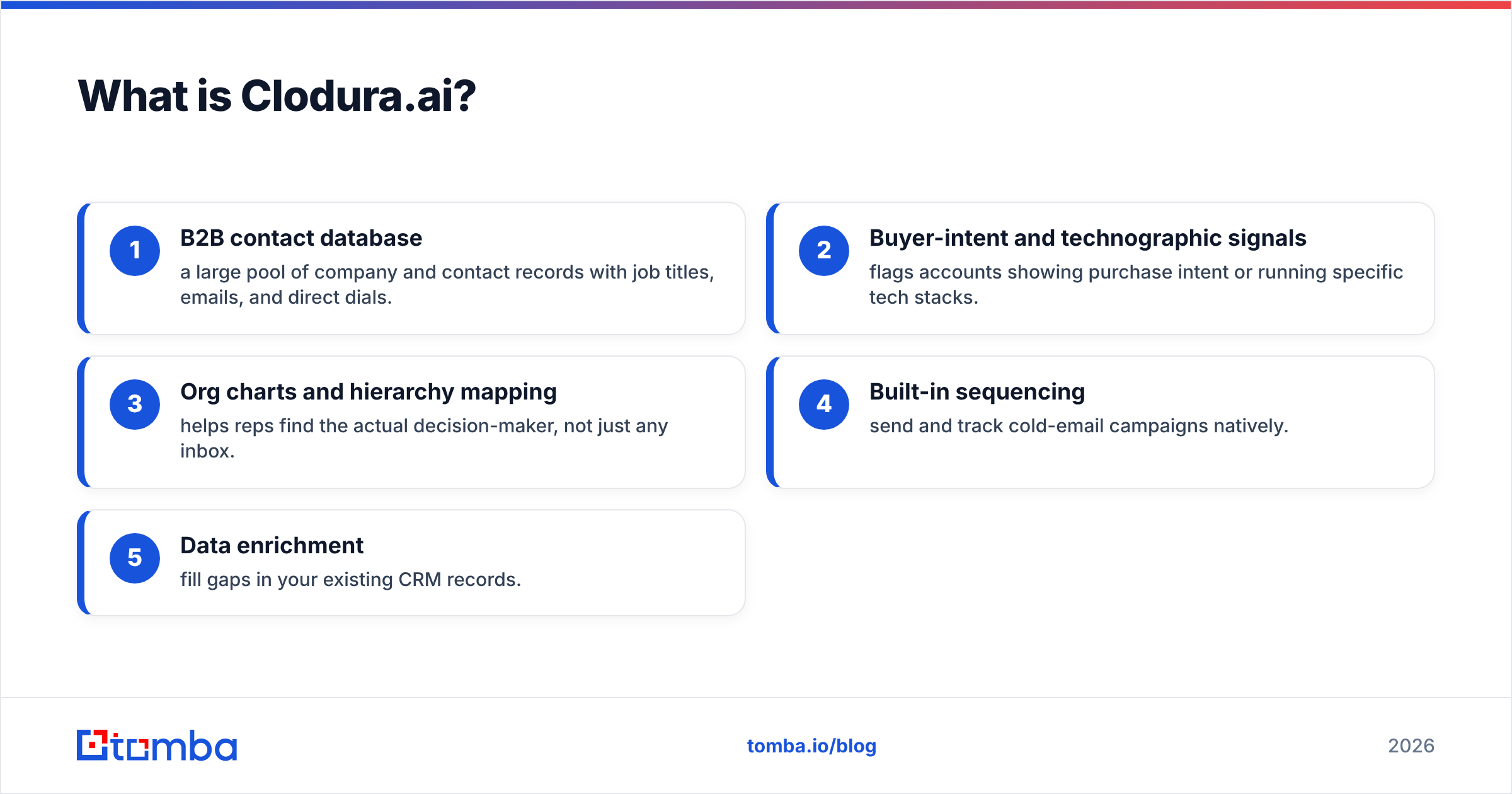
- B2B contact database — a large pool of company and contact records, with job titles, emails, and direct dials.
- Buyer-intent and technographic signals — flags accounts that show purchase intent or run specific tech stacks.
- Org charts and hierarchy mapping — helps reps find the real decision-maker, not just any inbox.
- Built-in sequencing — send and track cold-email campaigns natively.
- Data enrichment — fill gaps in your existing CRM records.
Clodura sells itself as an all-in-one option. Instead of stitching together a database, an intent tool, and an outreach app, you get one platform. You can read more about the category on the B2B data and intelligence side of modern go-to-market. Its home base is clodura.ai.
What is Power Almanac?#
Power Almanac does one thing on purpose. It maintains contact data for U.S. local-government officials. Think mayors, city managers, council members, county commissioners, public-works directors, and purchasing agents. These are the people who control municipal budgets.
A general B2B tool tries to cover every company on earth. Power Almanac instead covers roughly 40,000+ local governments and the named people inside them. Its value is depth in a segment most commercial databases ignore or get wrong.
Typical buyers:
- GovTech vendors selling software to cities and counties.
- Public-sector consultants and lobbyists who need accurate rosters.
- Infrastructure, utilities, and equipment suppliers targeting municipal procurement.
- Researchers and advocacy groups mapping local decision-makers.
Is your total addressable market "every city hall in America"? A horizontal platform like Clodura will frustrate you. Is your TAM "every SaaS company in fintech"? Then Power Almanac is the wrong shelf. You can see their scope at poweralmanac.com.
Cloduraai vs Power Almanac: side-by-side comparison#
Here's the honest breakdown. Neither tool is "better" in the abstract. They just optimize for different buyers.
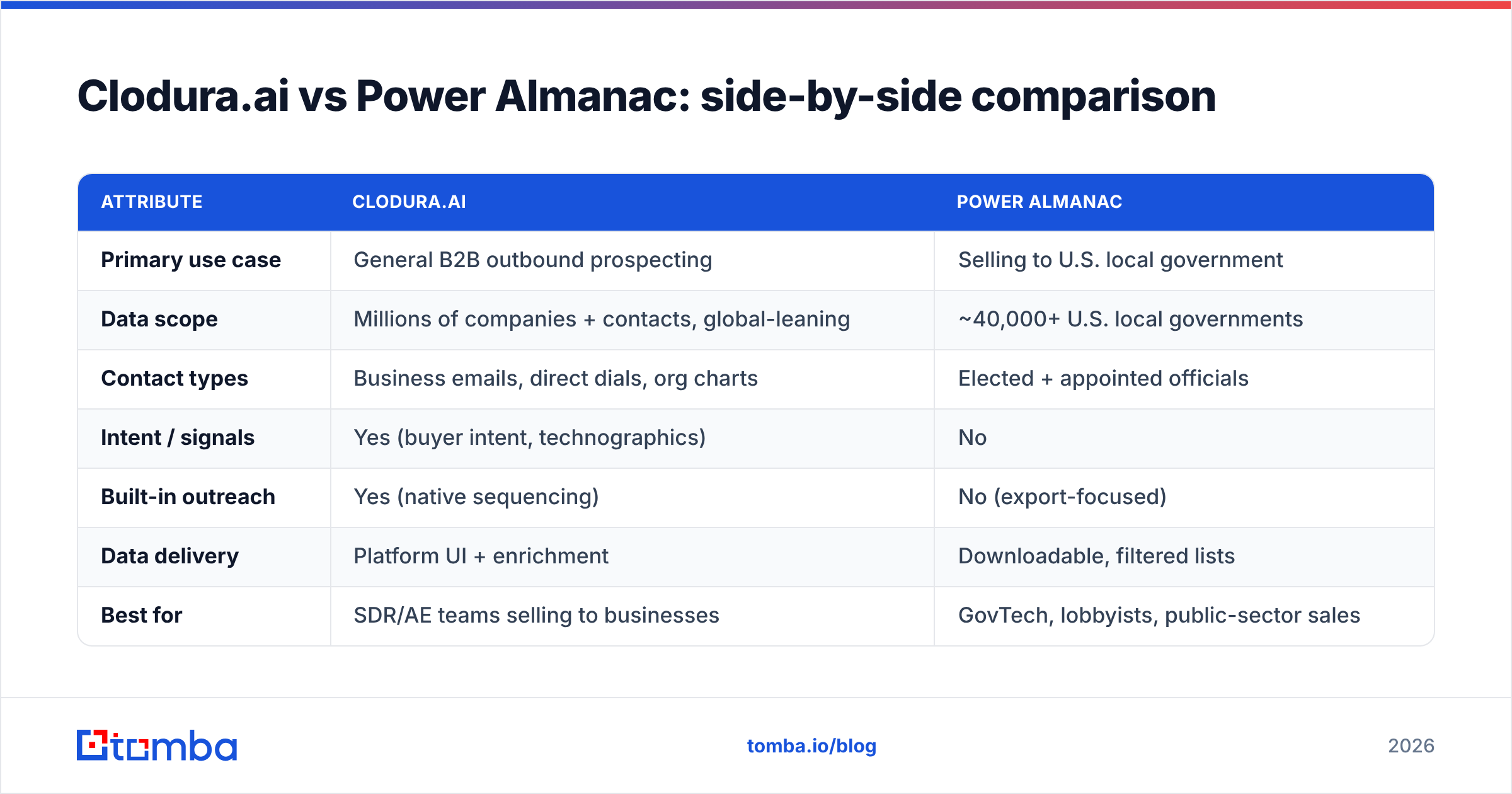
| Attribute | Clodura.ai | Power Almanac |
|---|---|---|
| Primary use case | General B2B outbound prospecting | Selling to U.S. local government |
| Data scope | Millions of companies + contacts, global-leaning | ~40,000+ U.S. local governments |
| Contact types | Business emails, direct dials, org charts | Elected + appointed officials |
| Intent / signals | Yes (buyer intent, technographics) | No |
| Built-in outreach | Yes (native sequencing) | No (export-focused) |
| Data delivery | Platform UI + enrichment | Downloadable, filtered lists |
| Best for | SDR/AE teams selling to businesses | GovTech, lobbyists, public-sector sales |
| Weak spot | Local-gov coverage is thin | No commercial B2B coverage |
The pattern is clear. Clodura is a wide tool. Power Almanac is a deep one. Your buyer persona decides the winner before pricing even comes up.
How do they compare on pricing?#
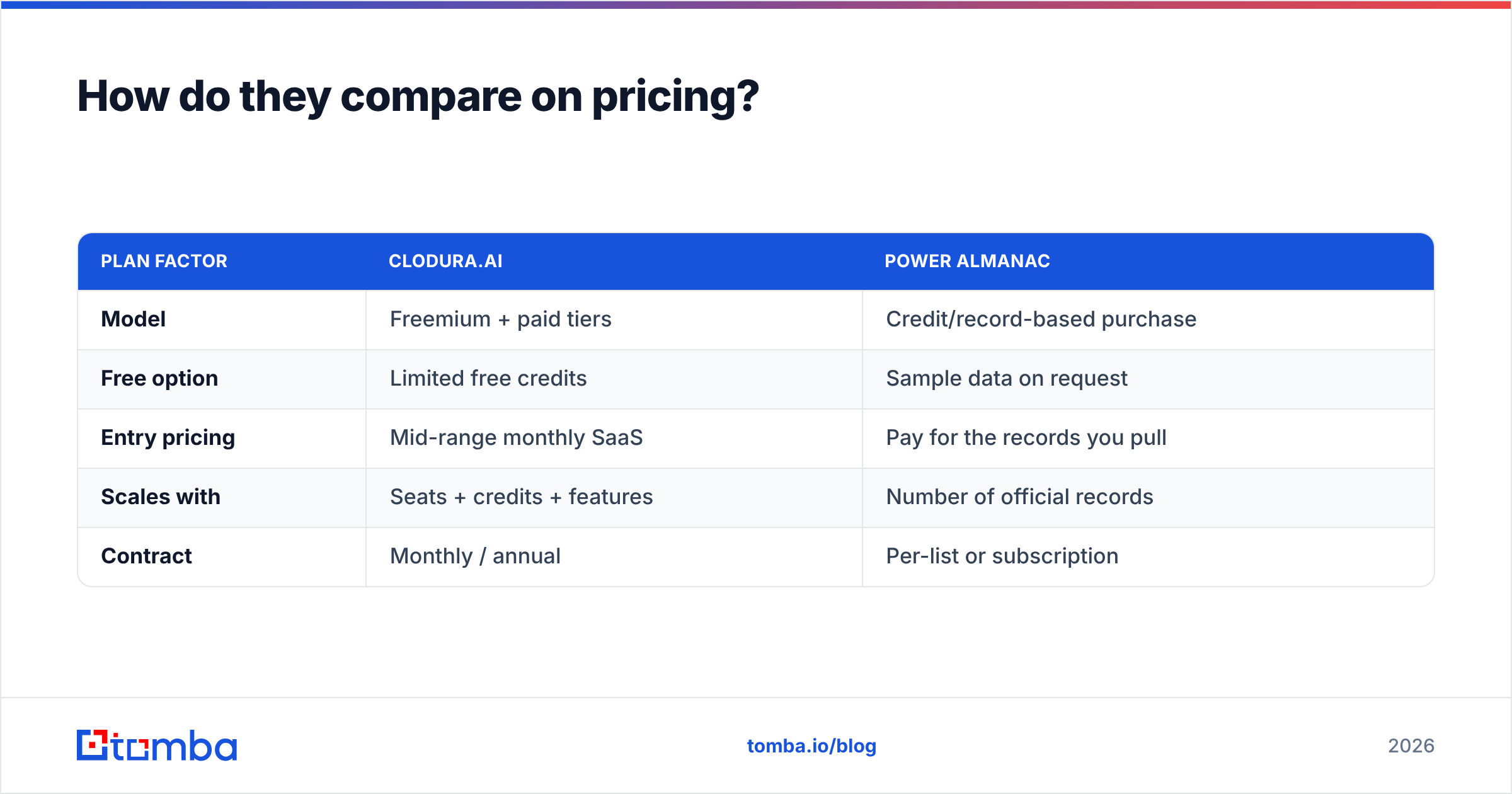
Both vendors use quote-based or tiered pricing. It shifts with seats and record volume. So treat these numbers as directional, not exact.
| Plan factor | Clodura.ai | Power Almanac |
|---|---|---|
| Model | Freemium + paid tiers | Credit/record-based purchase |
| Free option | Limited free credits | Sample data on request |
| Entry pricing | Mid-range monthly SaaS | Pay for the records you pull |
| Scales with | Seats + credits + features | Number of official records |
| Contract | Monthly / annual | Per-list or subscription |
Clodura bills like most SaaS platforms. You pay for seats and monthly credits. Intent data and sequencing sit in higher tiers. Power Almanac bills more like a data broker. You filter down to the officials you want and pay for that slice.
One caution applies to both. List price is not your real cost. If 25% of the records bounce, your true cost per usable contact jumps by a third. That's why teams now pair any database with independent verification. More on that below.
Which tool is more accurate?#
Accuracy is where marketing claims meet reality. Neither vendor escapes the core problem: B2B data decays fast.
People change jobs. Officials lose elections or finish their terms. Companies rebrand, merge, or fold. Industry estimates put annual contact-data decay at 20% to 30%. Public-sector rosters churn hard around every election. Power Almanac has one edge here. A small, focused dataset is easier to keep current than a sprawling global one. Still, municipal turnover is brutal, so even a specialist must re-verify often.
Clodura faces the opposite problem: breadth. It covers millions of contacts. Some records are pristine. Some are years old. And you can't always tell which from the dashboard.
The professional answer is the same for both. Never trust a static list on send day. Run every address through a live check first. A dedicated email verification step catches bounces, spam traps, and catch-all domains. Every database, general or niche, will include some.
When should you choose Clodura.ai?#
Pick Clodura.ai if most of these fit you:
- You sell to businesses, not governments. Your buyers work at companies. You need broad commercial coverage.
- You want an all-in-one workflow. Research, contact data, intent, and sequencing in one place beats five subscriptions.
- Intent signals matter to you. It's worth paying to spot accounts that are in-market now.
- Your team runs a full SDR/AE motion. Native cadence tools earn their keep when reps live in the platform all day.
Where Clodura falls short: local-government contacts. Its municipal coverage is thin and inconsistent. Push it into gov sales and it's a horizontal tool wearing a vertical hat.
When should you choose Power Almanac?#
Pick Power Almanac if:
- Your whole market is U.S. local government. Cities, counties, townships, and special districts.
- You need named officials, not generic "info@" inboxes. You want the purchasing agent or public-works director by name.
- You run campaigns, research, or lobbying where roster accuracy in one segment beats broad coverage.
- You export and work lists elsewhere. You have your own outreach stack, so built-in sequencing doesn't matter.
Where Power Almanac falls short: it has almost no commercial B2B coverage. The moment your ICP includes private companies, you'll need a second source.
What about the data gaps both tools leave?#
Here's the part vendors skip. Whichever platform you choose, you'll hit contacts it can't find or verify. A GovTech seller on Power Almanac still needs commercial contacts for channel partners. A Clodura user still hits accounts where the decision-maker's email is missing.
That's the case for a flexible, on-demand email finder. It works from a name and domain. It's not a locked database. It's a real-time lookup that fills the holes your primary tool leaves.
A layered stack looks like this:
- Primary database (Clodura or Power Almanac) — bulk discovery for your core segment.
- On-demand finder — find email addresses for the specific people your database missed.
- Verification layer — a final email verifier pass so nothing bounces.
- Bulk workflow — a bulk email finder for large lists you assemble from multiple sources.
This is how experienced teams protect email deliverability. They treat every database as a starting point, not gospel. Then they verify before they send.
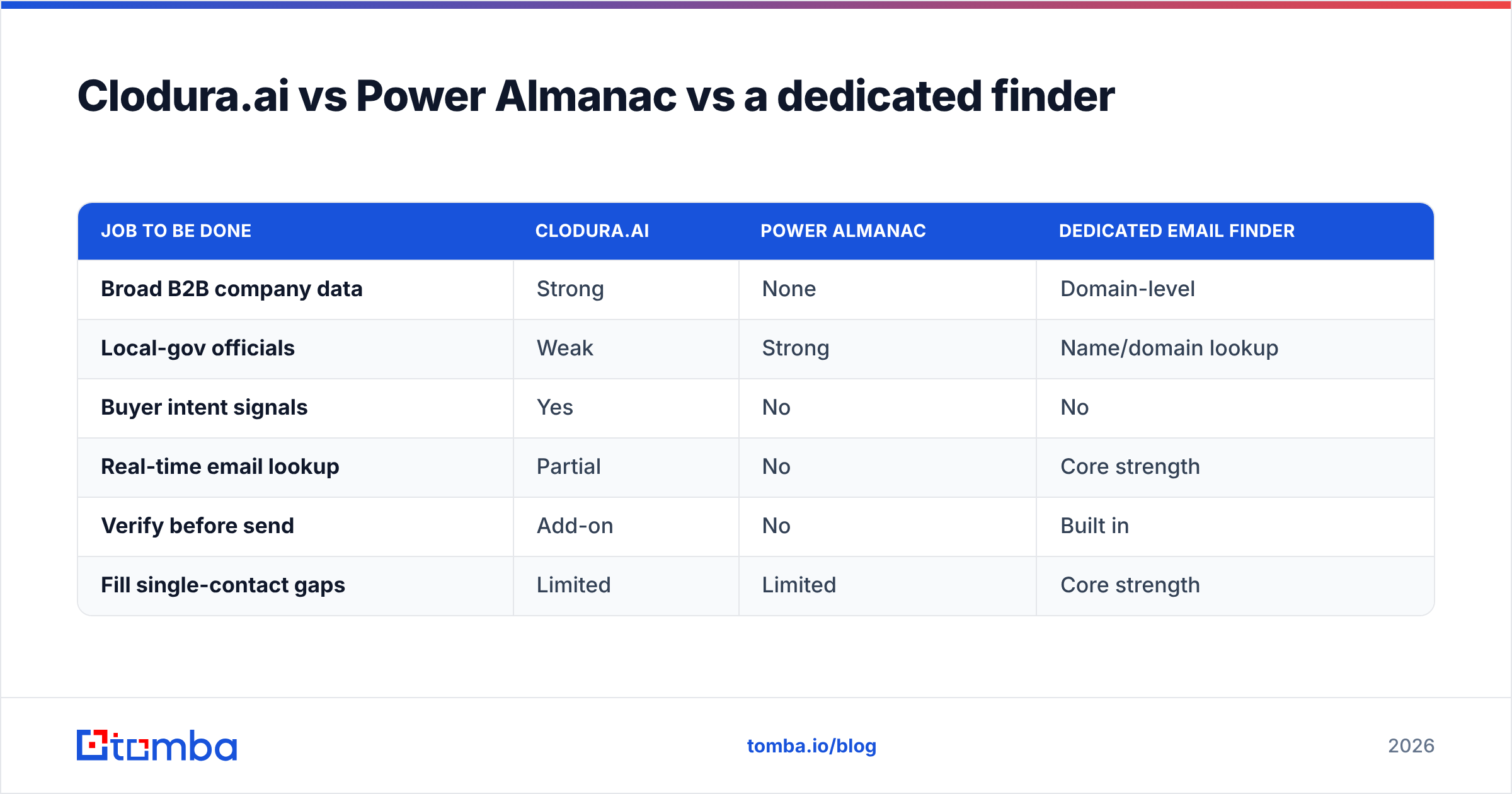
Cloduraai vs Power Almanac vs a dedicated finder#
To make the three-way fit obvious:
| Job to be done | Clodura.ai | Power Almanac | Dedicated email finder |
|---|---|---|---|
| Broad B2B company data | Strong | None | Domain-level |
| Local-gov officials | Weak | Strong | Name/domain lookup |
| Buyer intent signals | Yes | No | No |
| Real-time email lookup | Partial | No | Core strength |
| Verify before send | Add-on | No | Built in |
| Fill single-contact gaps | Limited | Limited | Core strength |
The takeaway: a finder doesn't replace either platform. It's the connective tissue that makes both more reliable. Set it next to how the two databases price and gate access. The marginal cost of verified lookups is small next to the bounce-rate savings.
The verdict: which one wins?#
There's no universal winner. The winner is whichever matches your buyer.
- Selling to businesses? Clodura.ai is the stronger fit. That's doubly true if you want intent data and native outreach in one place.
- Selling to U.S. local government? Power Almanac's depth beats any horizontal tool, Clodura included.
- Doing both, or serious about deliverability? Neither database alone is enough. Pair your primary source with real-time finding and verification.
The mistake to avoid is treating this as a pure feature race. It isn't. It's a market-fit question with a data-hygiene footnote. And that footnote — verify everything — applies no matter which logo you pick.
Close the data gaps with Tomba#
Whichever platform anchors your prospecting, you'll still hit contacts your database can't reach. Stale records quietly kill your bounce rate too. That's where a dedicated finder pays for itself.
Tomba Email Finder finds verified professional email addresses from a name and company domain. You can fill the gaps Clodura or Power Almanac leaves. You can also confirm every address before it enters a sequence. Start on the free tier (25 searches/month). Then scale with plans from $49/mo — see full Tomba pricing for details. Layer it over your database and send with confidence instead of hope.
Related guides#
Ready to find emails that actually work?
Join 150,000+ professionals who stopped guessing and started sending. Free credits on signup — no credit card required.
Get the Tomba newsletter
Practical outbound tactics and product updates — once every two weeks.
About the author