Clodura.ai vs Reachinbox (2026): Which Sales Tool Wins?
Clodura.ai is a B2B database with built-in sequencing; Reachinbox is an AI cold-email sender with deep deliverability tooling. Here's the honest breakdown of which one fits your outbound stack in 2026 — and where each one quietly falls short.
In the Clodura.ai vs Reachinbox debate, both tools get pitched as rivals. But they solve two different halves of the same problem. One builds your list. The other sends the emails. Pick between them without seeing that split, and you end up paying for a database you don't send from — or a sending engine you can't feed.
This Clodura.ai vs Reachinbox comparison is neutral and hands-on. It covers both platforms for 2026: what each does well, where the data or deliverability quietly breaks, and which one belongs in your outbound stack.
TL;DR: Clodura.ai vs Reachinbox at a glance#
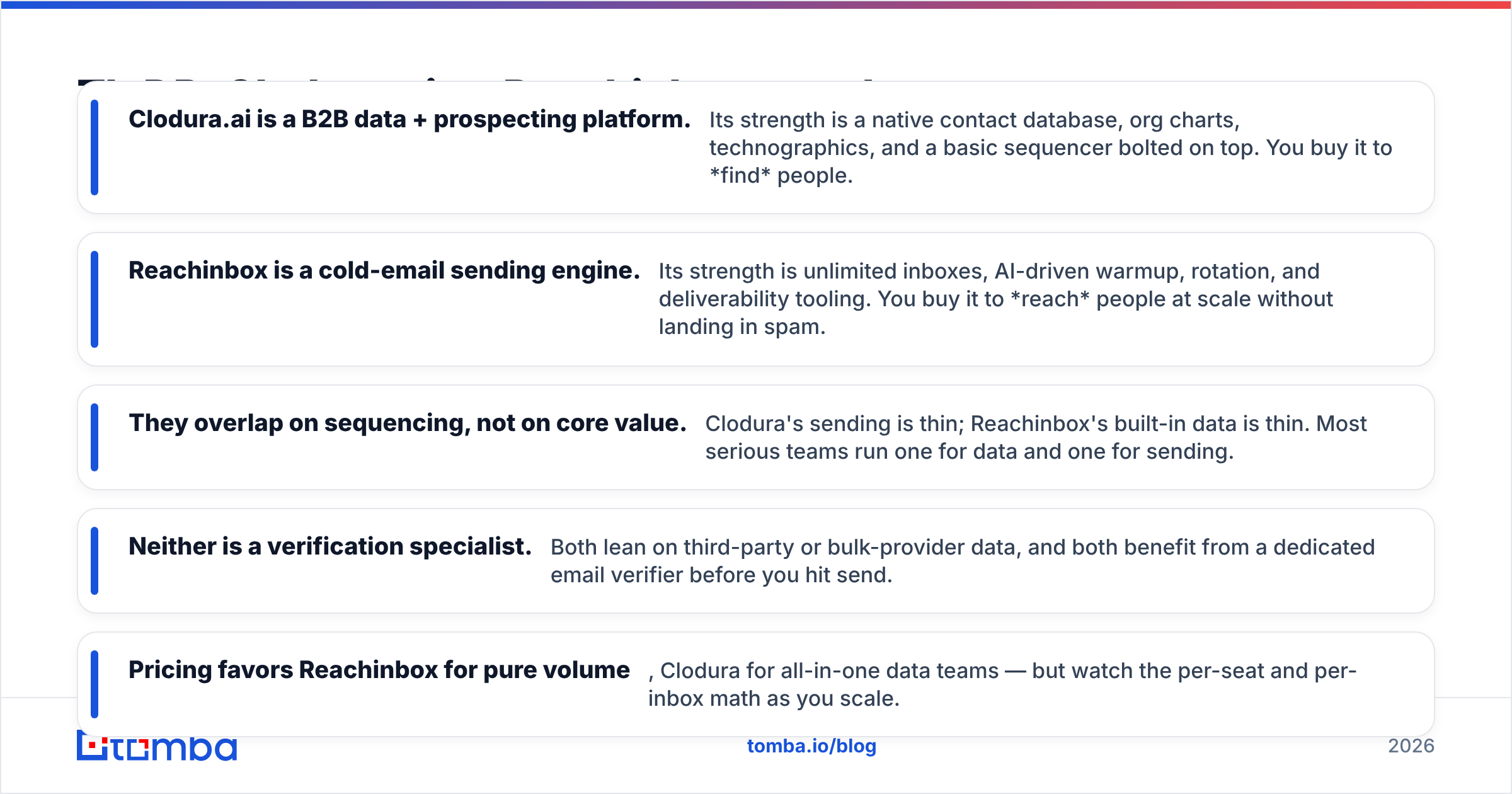
- Clodura.ai is a B2B data + prospecting platform. Its strength is a native contact database, org charts, technographics, and a basic sequencer bolted on top. You buy it to find people.
- Reachinbox is a cold-email sending engine. Its strength is unlimited inboxes, AI-driven warmup, rotation, and deliverability tooling. You buy it to reach people at scale without landing in spam.
- They overlap on sequencing, not on core value. Clodura's sending is thin. Reachinbox's built-in data is thin. Most serious teams run one for data and one for sending.
- Neither is a verification specialist. Both lean on third-party or bulk-provider data. Both benefit from a dedicated email verifier before you hit send.
- Pricing favors Reachinbox for pure volume, Clodura for all-in-one data teams. Just watch the per-seat and per-inbox math as you scale.
What is Clodura.ai?#
Clodura.ai bills itself as a sales prospecting platform. It ships a B2B contact database (it advertises hundreds of millions of contacts and direct dials), buyer-intent signals, technographic filters, and org charts. It also adds an email sequencer and a basic email verification step.
The pitch is "everything in one login." You search the database, build a list, verify, and drop contacts into a cadence without leaving the tool. For a small team that doesn't already own a data source, that consolidation is genuinely useful. You're not stitching together four subscriptions.
Where Clodura earns its keep is the intelligence layer. Org charts and intent data help you prioritize accounts. The technographic search ("show me companies using Salesforce and HubSpot") is a real prospecting accelerant. If your bottleneck is who to contact, Clodura is built for that question.
The weak spot is the outbound engine. Clodura's sequencer works, but it's not in the same league as tools built purely for sending. You get fewer deliverability controls, less inbox rotation, and thinner warmup than a specialist. Teams that push high daily volume tend to outgrow it. They export contacts to a dedicated sender anyway.
What is Reachinbox?#
Reachinbox is an AI-powered cold outreach platform focused on one job: getting a high volume of cold emails into the primary inbox. Its headline features are unlimited email accounts, automated warmup, inbox rotation across many mailboxes, a unified master inbox for replies, and AI that helps draft and personalize sequences.
Say your bottleneck is deliverability at scale. You have the list, but your emails keep hitting spam or your domain reputation is fragile. Reachinbox is engineered for exactly that. Connecting dozens or hundreds of sending accounts and rotating sends across them is a core workflow, not an afterthought.
What Reachinbox is not is a data provider. It doesn't ship a large native prospecting database the way Clodura does. You bring your own list — from a database, a scraper, or an email finder — and Reachinbox handles the sending, warmup, and reply management. That's a feature, not a bug, if you already have a data source you trust. It's a gap if you hoped to buy contacts and send from the same tool.
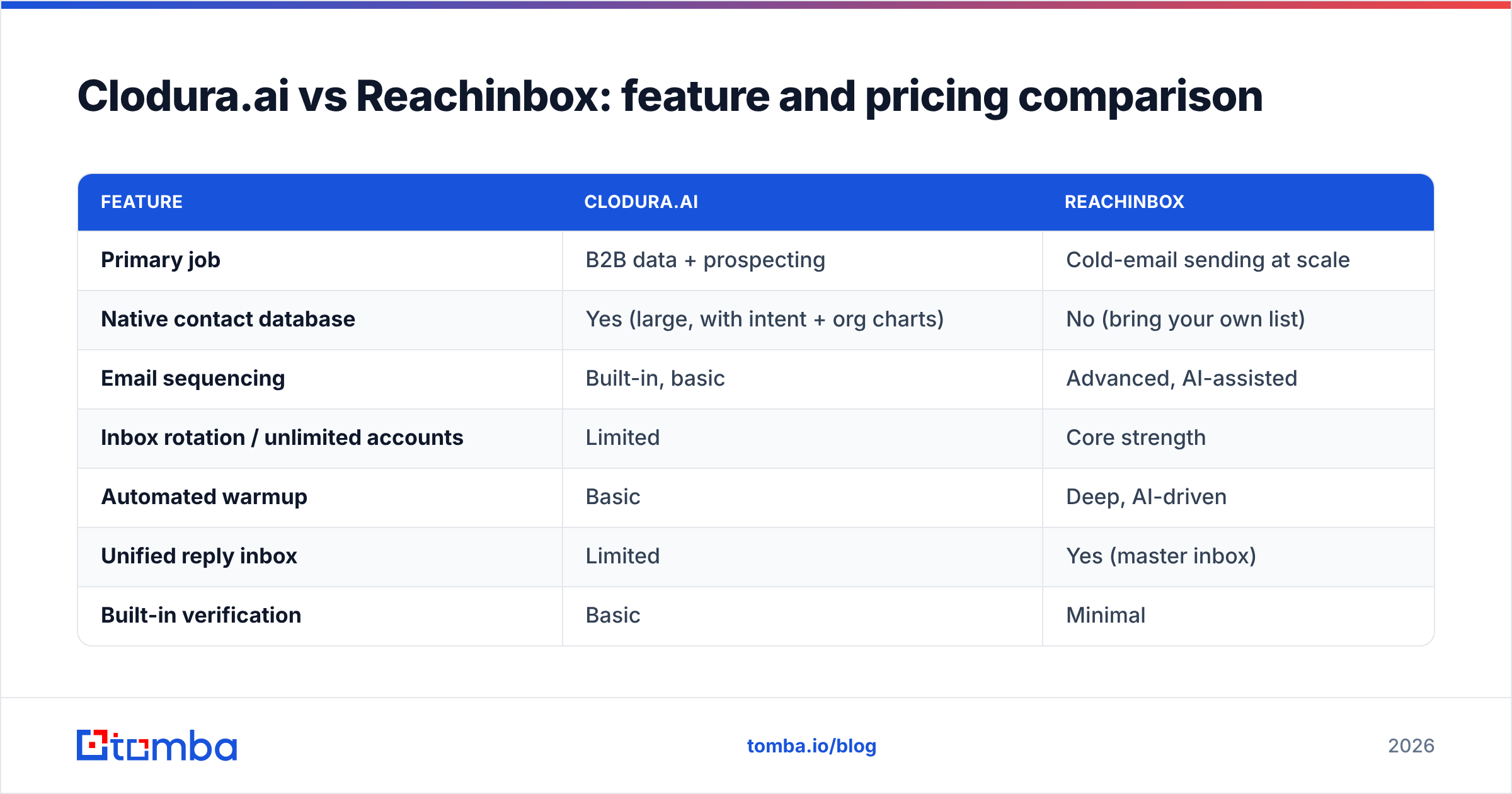
Clodura.ai vs Reachinbox: feature and pricing comparison#
Here's the Clodura.ai vs Reachinbox head-to-head on the attributes that actually change your workflow. (Vendor pricing shifts often, so confirm current tiers on each site before you commit.)
| Feature | Clodura.ai | Reachinbox |
|---|---|---|
| Primary job | B2B data + prospecting | Cold-email sending at scale |
| Native contact database | Yes (large, with intent + org charts) | No (bring your own list) |
| Email sequencing | Built-in, basic | Advanced, AI-assisted |
| Inbox rotation / unlimited accounts | Limited | Core strength |
| Automated warmup | Basic | Deep, AI-driven |
| Unified reply inbox | Limited | Yes (master inbox) |
| Built-in verification | Basic | Minimal |
| Best for | Finding + prioritizing accounts | Delivering high volume to inbox |
| Entry pricing (approx.) | Mid-tier per-seat plans | Volume/inbox-based plans |
The pattern is clear: they're strong in inverse places. Clodura wins on who and why. Reachinbox wins on how and how much.
Is Clodura.ai better than Reachinbox?#
It depends entirely on your bottleneck. In the Clodura.ai vs Reachinbox call, there's no universal winner. Use this decision split:
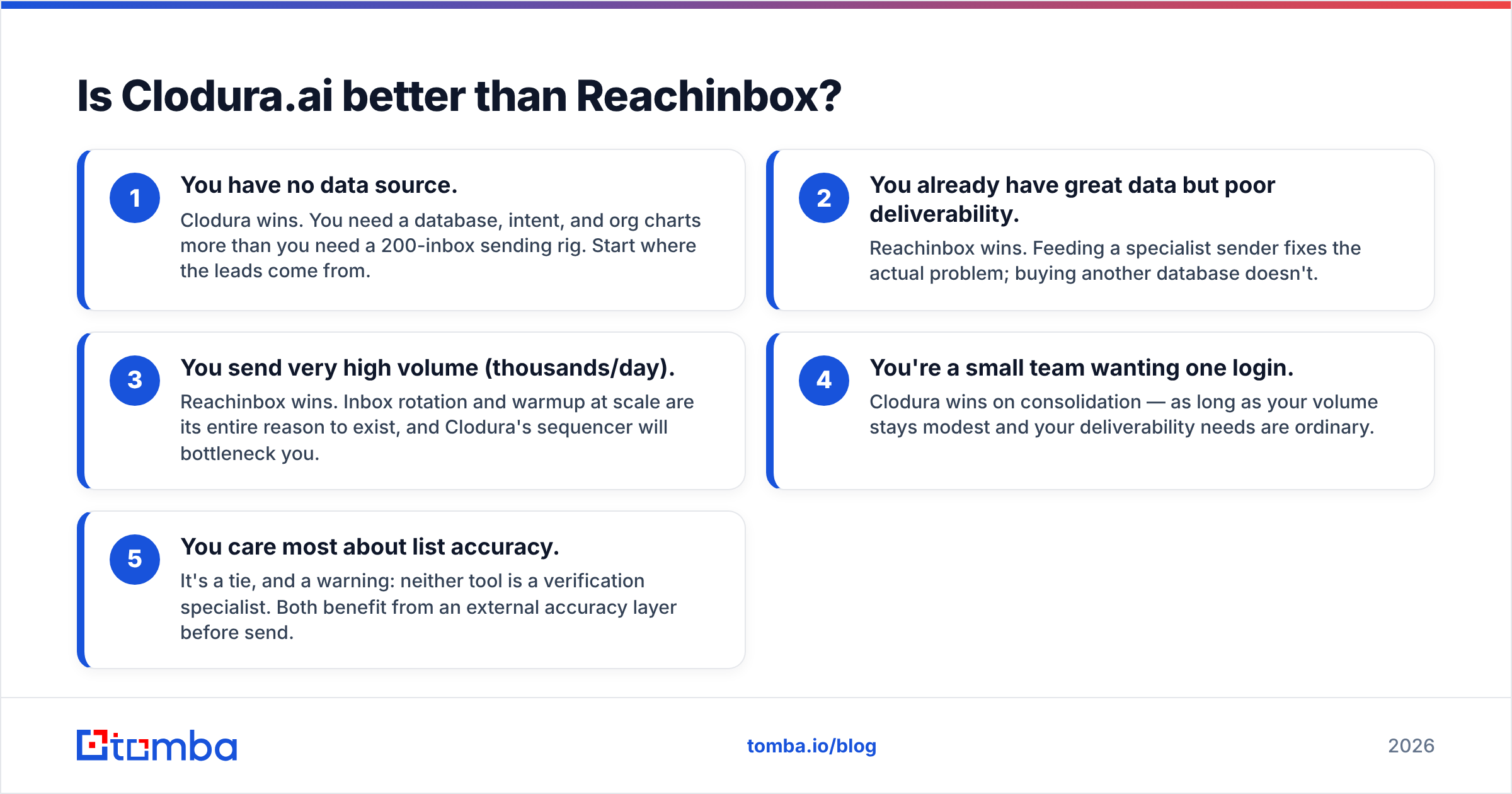
- You have no data source. Clodura wins. You need a database, intent, and org charts more than a 200-inbox sending rig. Start where the leads come from.
- You already have great data but poor deliverability. Reachinbox wins. Feeding a specialist sender fixes the actual problem. Buying another database doesn't.
- You send very high volume (thousands a day). Reachinbox wins. Inbox rotation and warmup at scale are its whole reason to exist, and Clodura's sequencer will bottleneck you.
- You're a small team that wants one login. Clodura wins on consolidation, as long as your volume stays modest and your deliverability needs are ordinary.
- You care most about list accuracy. It's a tie, and a warning. Neither tool is a verification specialist. Both need an external accuracy layer before send.
That fifth point is where a lot of outbound programs quietly bleed money.
What about data accuracy and bounce rates?#
This is the honest caveat both vendors soft-pedal. A big database and a great sending engine both fail if the underlying emails are wrong. Clodura's database will hold stale and role-based addresses, like any large B2B dataset. Reachinbox will happily send to whatever list you upload — including the dead addresses that torch your sender reputation.

High bounce rates don't just waste sends. They damage email deliverability and drag down sender reputation. That means even your good emails start landing in spam. Reachinbox's warmup can't fully outrun a dirty list. Clodura's basic verification isn't built to catch catch-all traps or freshly abandoned mailboxes.
The fix is boring and effective: verify before you send, every time. A dedicated email verification pass — plus a catch-all verifier for domains that accept everything — strips the addresses that would otherwise cost you reputation. Building lists in bulk? Run them through a bulk verify step before they ever touch a sequence. This is the layer neither platform specializes in, and it's the cheapest insurance in your stack.
According to independent reviews on G2, the most common complaint across both categories — data platforms and cold-email senders — is data quality drift over time. That's not a knock on either vendor. It's the nature of B2B contact data. It's also exactly why a separate verification step pays for itself.
How do the workflows actually differ day to day?#
In the day-to-day Clodura.ai vs Reachinbox split, the starting point changes. With Clodura.ai, a rep's day starts inside the database. You filter by industry, headcount, tech stack, and intent. You build a target list, run the built-in check, and load contacts into a sequence. Everything happens in one place. That's fast for low-to-mid volume and great for reps who also need account research.
With Reachinbox, the day starts with a list you've already sourced. You connect your sending accounts and let warmup run in the background. You launch campaigns that rotate across mailboxes, then manage replies in the master inbox. The tool assumes the "who" is solved. It obsesses over "did it land, and did they reply."
That's why so many teams run both, or run one plus a specialist. A common 2026 stack looks like this: a data source (Clodura or a dedicated finder) → a verification pass → a sending engine (Reachinbox) → a CRM. Force one tool to do all four jobs, and that's where quality slips.
Where does a dedicated email finder fit?#
Both tools have a data gap you can close cheaply. Reachinbox has no native database at all. Clodura has one, but you'll still hit missing contacts, unverified addresses, and accounts where you know the company but not the right person's email.
That's the seam a focused finder fills. With domain search you pull every reachable contact at a target company. With a name-plus-domain lookup you get one specific person's professional address. And with data enrichment you fill the blank fields Clodura or your CRM left empty. Layered on top of either platform, it raises match rates without you switching your whole workflow.
The point isn't to replace Clodura or Reachinbox. It's that "find the right person" and "verify the address" are specialist jobs. Treat them as afterthoughts inside a broader tool, and deliverability quietly erodes.
Quick verdict#
Here's the short Clodura.ai vs Reachinbox verdict:
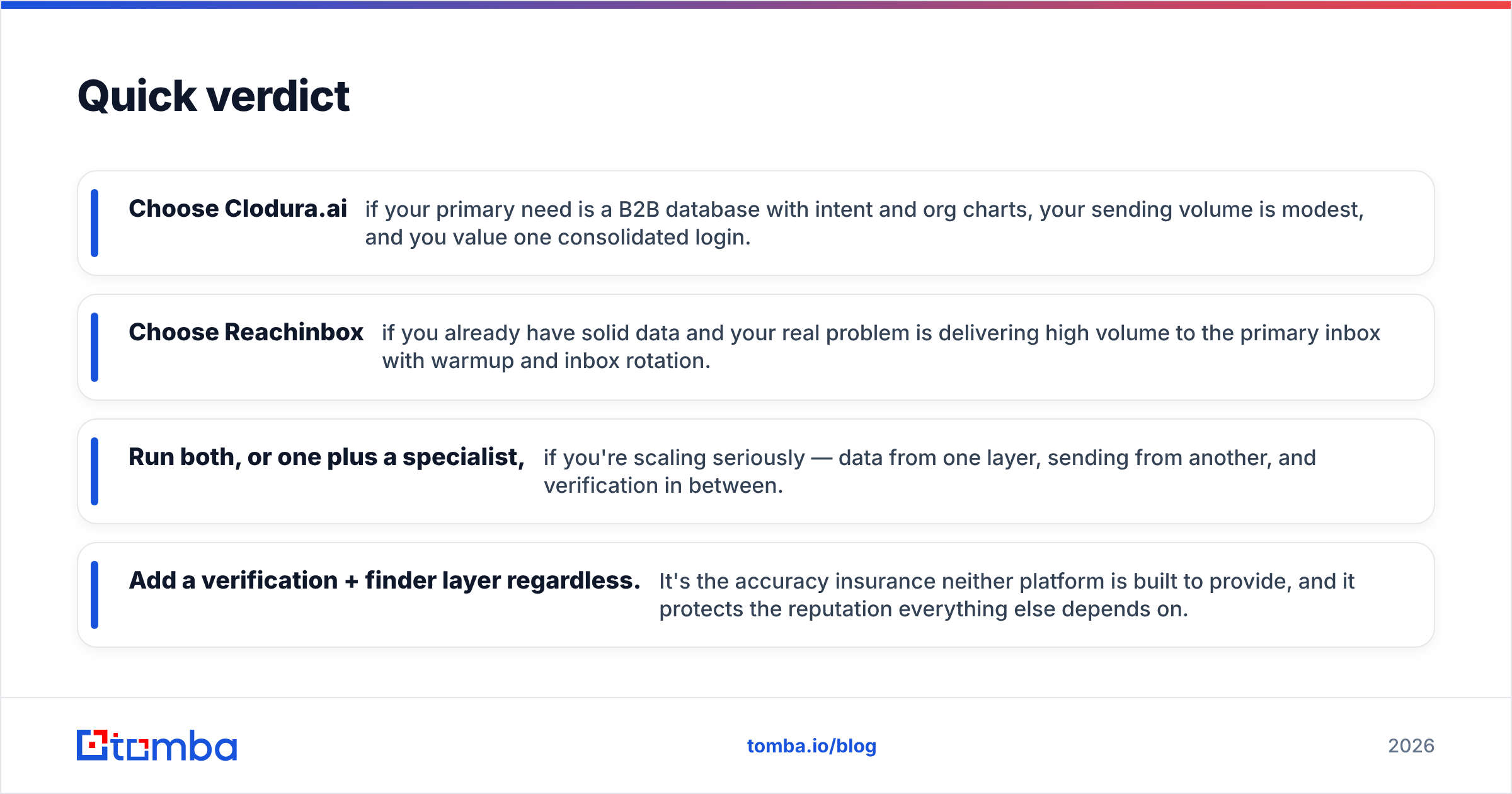
- Choose Clodura.ai if your main need is a B2B database with intent and org charts, your sending volume is modest, and you value one consolidated login.
- Choose Reachinbox if you already have solid data and your real problem is delivering high volume to the primary inbox with warmup and inbox rotation.
- Run both, or one plus a specialist, if you're scaling seriously. Data from one layer, sending from another, and verification in between.
- Add a verification + finder layer regardless. It's the accuracy insurance neither platform is built to provide, and it protects the reputation everything else depends on.
Compare each vendor's current details directly on Clodura.ai and Reachinbox before you buy. Tiers and limits change, and the right call hinges on your exact bottleneck.
Close the accuracy gap with Tomba#
Whichever platform you pick, your results are only as good as the emails you feed it. Tomba's Email Finder fills the "who's the right contact" gap that Reachinbox leaves open and that Clodura's database can't always cover. You get professional addresses by name, company, or domain, with verification built into the flow so dead addresses never reach your sequences. Pair it with the email verifier for a clean list before every campaign. The free tier gives you 25 searches a month to test match rates against your current data. Paid plans start at $49/mo when you're ready to scale. Send fewer emails to better addresses, and let the deliverability tools you're already paying for do their job.
Related guides#
// get started
Find, verify and enrich your first contacts today
Start on the free plan with 25 searches a month, then scale when your team is ready.
Free plan · No credit card required · GDPR & CCPA
// about the author