Cloudura.ai vs Salesbot (2026): Which Sales Tool Wins?
Cloudura.ai and Salesbot both promise to automate B2B outreach, but they solve different problems. Here's an honest, side-by-side breakdown to help you pick the right one for your pipeline in 2026.
Choosing between Cloudura.ai and Salesbot usually comes down to one question you might not have asked yet: are you trying to find and sequence prospects, or converse and qualify them? The two tools get lumped together as "sales automation," but they sit on opposite ends of the pipeline. Pick the wrong one and you'll pay for features you never touch.
This is a neutral, hands-on breakdown — not a sales page for either vendor. We'll cover what each tool actually does, where they overlap, how pricing and data quality stack up, and which team profile each one fits. And because both live or die on the accuracy of the contact data feeding them, we'll be honest about where a dedicated data layer matters.
TL;DR: Cloudura.ai vs Salesbot at a glance#
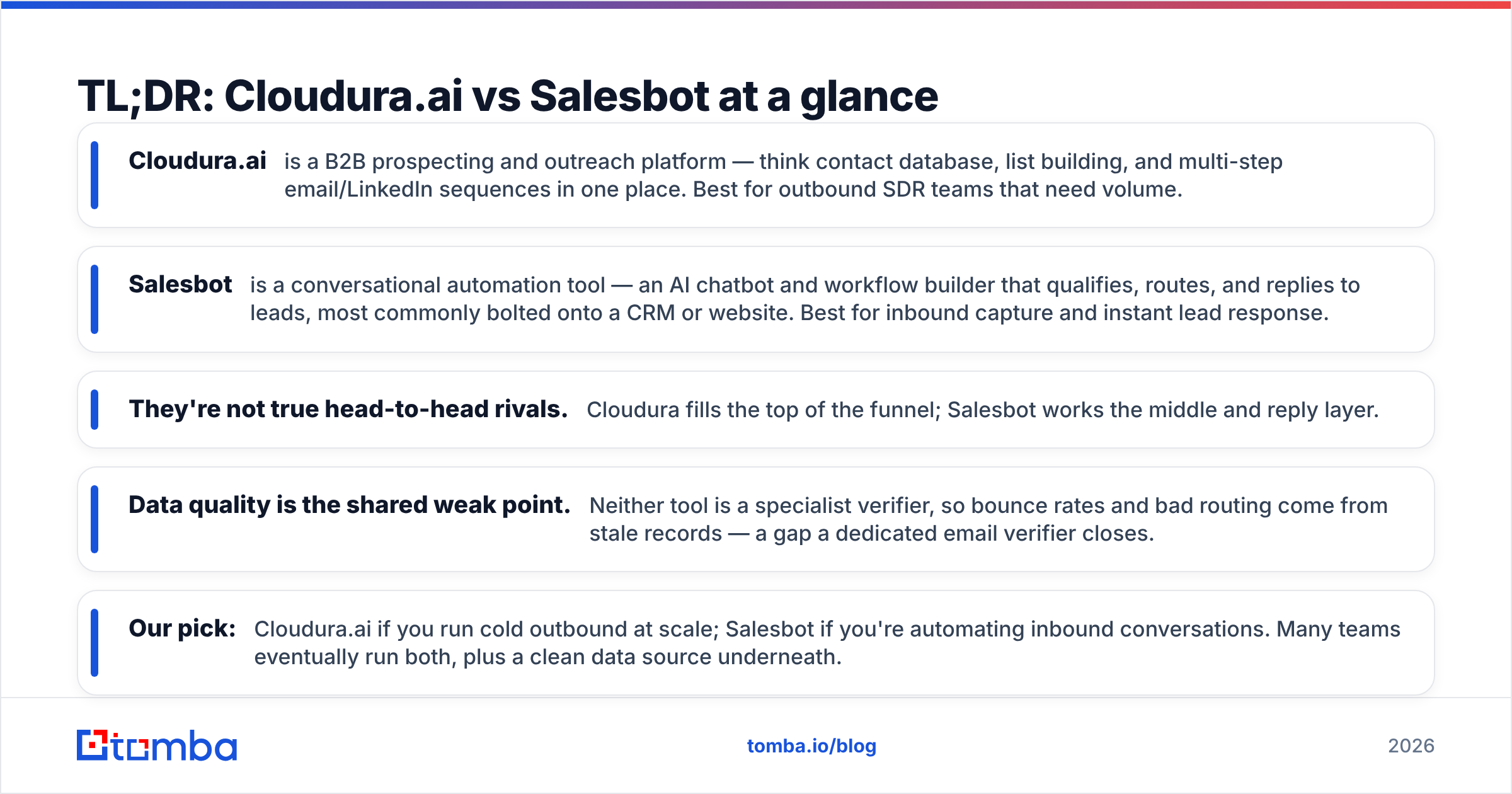
- Cloudura.ai is a B2B prospecting and outreach platform — think contact database, list building, and multi-step email/LinkedIn sequences in one place. Best for outbound SDR teams that need volume.
- Salesbot is a conversational automation tool — an AI chatbot and workflow builder that qualifies, routes, and replies to leads, most commonly bolted onto a CRM or website. Best for inbound capture and instant lead response.
- They're not true head-to-head rivals. Cloudura fills the top of the funnel; Salesbot works the middle and reply layer.
- Data quality is the shared weak point. Neither tool is a specialist verifier, so bounce rates and bad routing come from stale records — a gap a dedicated email verifier closes.
- Our pick: Cloudura.ai if you run cold outbound at scale; Salesbot if you're automating inbound conversations. Many teams eventually run both, plus a clean data source underneath.
What is Cloudura.ai?#
Cloudura.ai is a prospecting-first sales automation platform. Its pitch is to collapse three tools — a contact database, a list-building layer, and a sequencing engine — into a single subscription. You search for companies and roles, pull contact details, load them into a cadence, and let the platform send multi-channel touches (typically email plus LinkedIn steps) on a schedule.
The appeal is obvious for a lean outbound team: instead of stitching a data vendor to a separate sending tool, you get one login. For SDRs measured on activity volume, that consolidation is real time saved.
The tradeoff is depth. Platforms that try to own the whole outbound stack rarely match a specialist in any single layer — the database isn't as deep as a dedicated data provider, and the sequencer isn't as configurable as a purpose-built engine. That's fine if you value simplicity over control. It's a problem if deliverability or data coverage is your bottleneck.
What is Salesbot?#
Salesbot is a conversational automation tool. Rather than sourcing cold contacts, it works the leads you already have — visitors on your site, inbound form fills, or records inside a connected CRM. You build a bot flow: it greets a lead, asks qualifying questions, books a meeting, updates the CRM, and can hand off to a human when the conversation gets complex.
Think of Salesbot as a tireless front-desk rep. It never sleeps, replies in seconds, and follows your script exactly. For inbound-heavy businesses where speed-to-lead decides who wins the deal, that instant response is genuinely valuable — studies on lead response time consistently show that contacting a lead within the first few minutes dramatically improves conversion.
Where Salesbot struggles is cold outbound. It has nothing to say to a prospect who hasn't raised a hand, and it doesn't build target lists. It's a reply-and-qualify layer, not a demand-generation engine.
Cloudura.ai vs Salesbot: feature comparison#
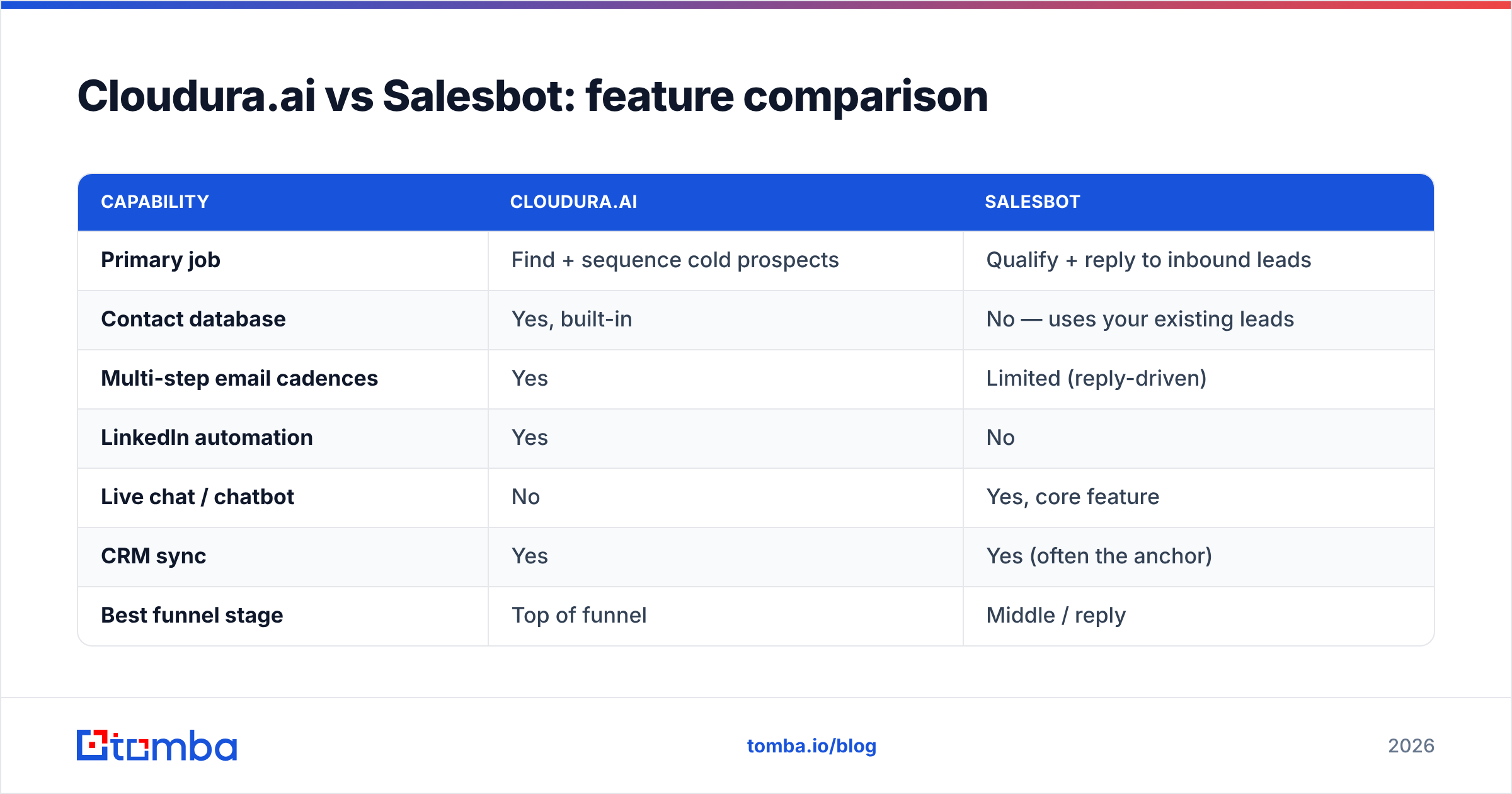
Here's the honest side-by-side. Notice how little the core jobs actually overlap — most rows show one tool leading because they were built for different stages.
| Capability | Cloudura.ai | Salesbot |
|---|---|---|
| Primary job | Find + sequence cold prospects | Qualify + reply to inbound leads |
| Contact database | Yes, built-in | No — uses your existing leads |
| Multi-step email cadences | Yes | Limited (reply-driven) |
| LinkedIn automation | Yes | No |
| Live chat / chatbot | No | Yes, core feature |
| CRM sync | Yes | Yes (often the anchor) |
| Best funnel stage | Top of funnel | Middle / reply |
| Learning curve | Moderate | Low to moderate |
| Data verification built in | Basic | None |
The pattern is clear: Cloudura is an outbound machine, Salesbot is an inbound responder. If someone tells you one is strictly "better," ask which funnel stage they're actually talking about.
Which is better for cold outbound?#
Cloudura.ai wins cold outbound, but only as far as its data lets it. A sequencer is only as good as the list you load into it. Send 1,000 cold emails to addresses that are 20% stale and you don't just waste those sends — you damage your sender reputation and drag down deliverability for every future campaign.
This is the quiet failure mode of all-in-one prospecting tools. The built-in database gets you a contact, but "a contact" isn't the same as "a verified, currently-employed, mailbox-exists contact." Bounce rates above 3–4% start to trip spam filters, and most consolidated platforms treat verification as an afterthought.
The fix is a two-step workflow: pull your list, then run it through a dedicated verification pass before the first send. Tomba's bulk email finder and verifier exist for exactly this — you enrich and clean the list first, then hand clean data to whatever sequencer you use, Cloudura included.
Which is better for inbound and lead response?#
Salesbot wins inbound, hands down. If your problem is "leads come in and sit unanswered for hours," Cloudura has no answer for you and Salesbot is purpose-built. A bot that qualifies and books meetings around the clock will beat a human team that only works business hours in one time zone.
But inbound has its own data trap. When a form fill gives you jsmith@acme.com and nothing else, your bot is routing and scoring on almost no context. Enriching that record — company size, role, seniority — at the moment of capture is what turns a dumb router into a smart one. A data enrichment call appends the missing fields so Salesbot can route a VP to sales and a student to a nurture track. Without it, every inbound lead looks the same.
How do pricing and value compare?#
Both vendors use tiered subscriptions, and both tend to gate their most useful features (higher send limits, more seats, API access) behind upper plans. Because vendor pricing changes often, verify the current numbers on their official pages before you commit — don't trust a comparison post's figures, including this one, as gospel.
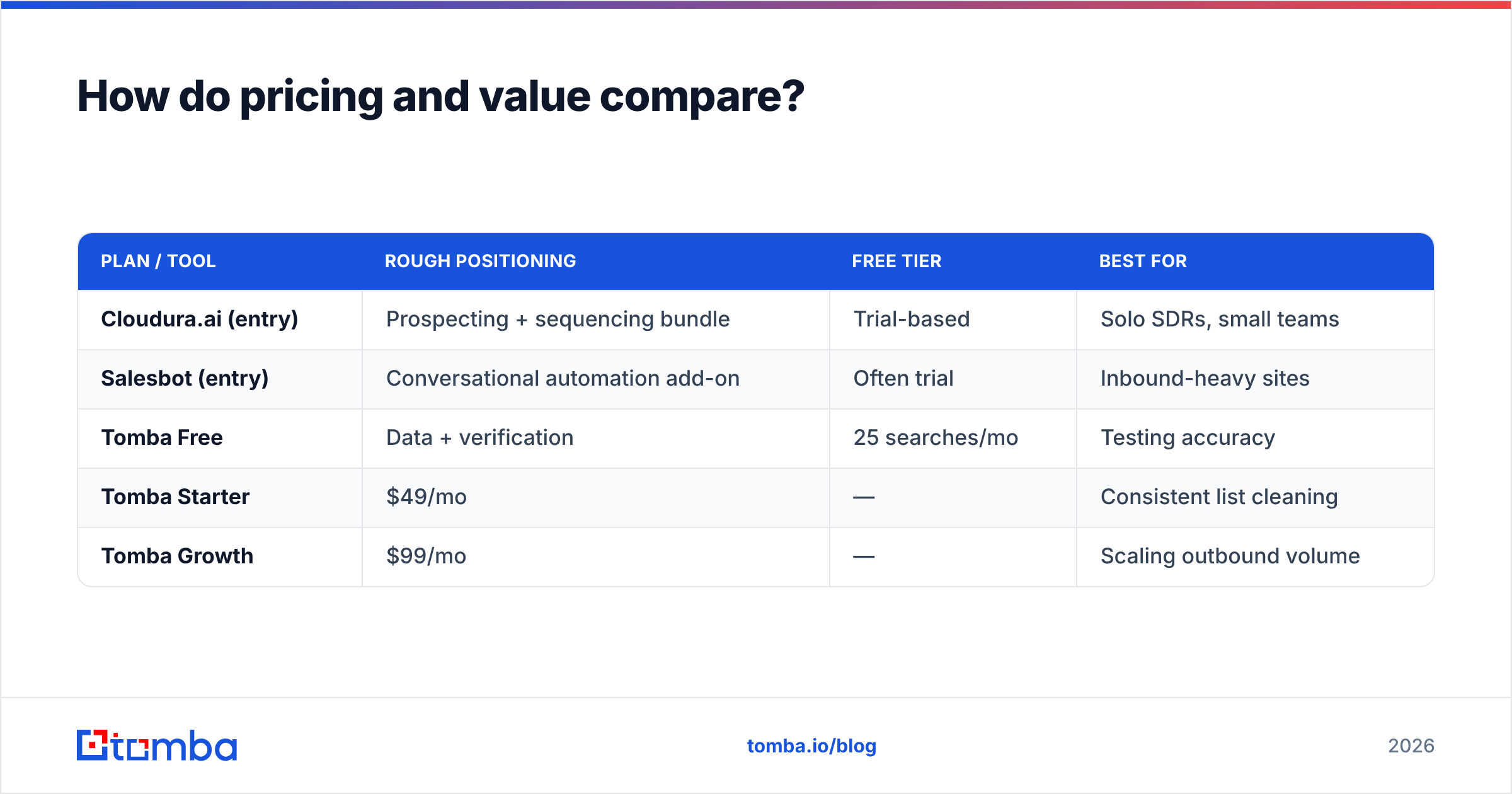
The more useful lens is cost per outcome, not sticker price. A cheap prospecting plan that feeds you a 15% bounce rate is more expensive than a pricier one with clean data, once you factor in domain reputation damage. Here's how the value equation looks when you add a dedicated data layer to the mix:
| Plan / tool | Rough positioning | Free tier | Best for |
|---|---|---|---|
| Cloudura.ai (entry) | Prospecting + sequencing bundle | Trial-based | Solo SDRs, small teams |
| Salesbot (entry) | Conversational automation add-on | Often trial | Inbound-heavy sites |
| Tomba Free | Data + verification | 25 searches/mo | Testing accuracy |
| Tomba Starter | $49/mo | — | Consistent list cleaning |
| Tomba Growth | $99/mo | — | Scaling outbound volume |
You can see the full Tomba pricing breakdown separately. The point isn't that Tomba replaces either tool — it doesn't send sequences or run chatbots. It's that the data layer costs a fraction of either platform and protects the money you're already spending on them.
Can you use them together?#
Yes, and for a lot of teams that's the real answer. The three tools solve non-overlapping problems:
- Data layer (find + verify) — build and clean your target list with a specialist so both downstream tools work off accurate records. Tomba's email finder and verifier fill this slot.
- Cloudura.ai (outbound) — load the clean list, run cold email and LinkedIn cadences to generate net-new conversations.
- Salesbot (inbound + reply) — catch the responses and inbound traffic those campaigns generate, qualify them instantly, and book meetings.
Run in that order, each tool covers the other's blind spot. Cloudura has no reply-capture intelligence; Salesbot has no top-of-funnel; neither has serious verification. Slot the right specialist into each stage and the pipeline stops leaking.
For teams already living in a CRM, check native integrations first — most of these tools connect through platforms like HubSpot or via a middleware layer, and Tomba offers its own HubSpot integration so enriched contacts flow in without CSV juggling.
Cloudura.ai vs Salesbot: pros and cons#
Cloudura.ai
- Pros: All-in-one prospecting, built-in database, multi-channel cadences, good for outbound volume.
- Cons: Data depth and verification are shallow; jack-of-all-trades sequencer; deliverability depends on you cleaning lists yourself.
Salesbot
- Pros: Instant lead response, strong CRM handoff, low-lift automation for inbound, works 24/7.
- Cons: No cold outbound, no list building, needs enriched records to route intelligently, limited outside inbound.
The neutral verdict: neither is a scam and neither is a silver bullet. They're specialists dressed up as platforms. Match the tool to the funnel stage that's actually costing you deals.
How do I decide in 5 minutes?#
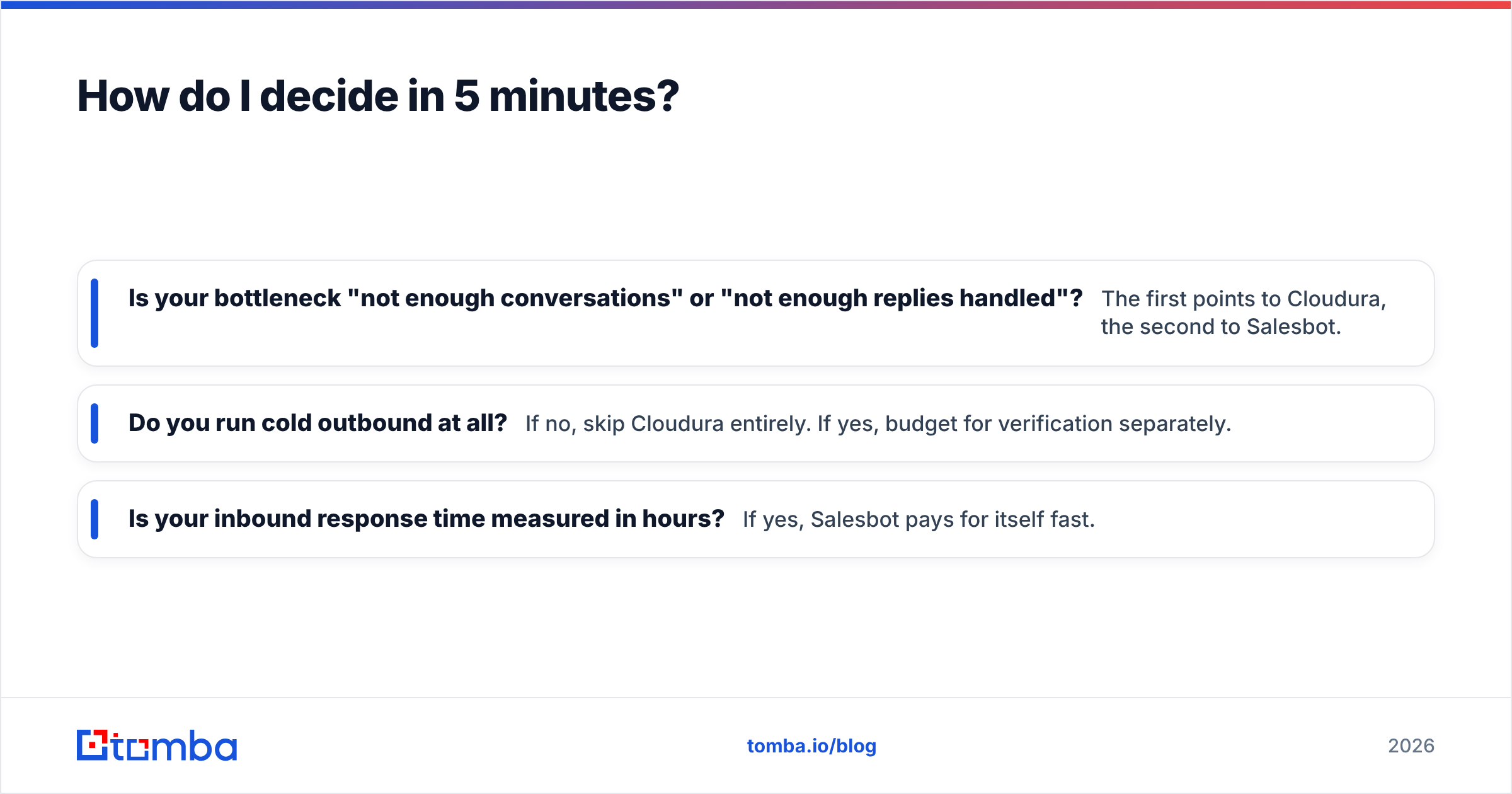
Answer three questions:
- Is your bottleneck "not enough conversations" or "not enough replies handled"? The first points to Cloudura, the second to Salesbot.
- Do you run cold outbound at all? If no, skip Cloudura entirely. If yes, budget for verification separately.
- Is your inbound response time measured in hours? If yes, Salesbot pays for itself fast.
If you answered "both" — which is common past a certain team size — plan for a stack, not a single purchase, and put the cheapest, highest-leverage piece (clean data) at the foundation.
You can validate the data-quality claim in this post yourself before spending on any platform. Independent tool reviews on G2 will tell you how each vendor's users rate deliverability and data accuracy in practice — read the 3-star reviews, not the 5-star ones, for the honest signal.
The bottom line#
Cloudura.ai and Salesbot aren't really competitors — they're neighbors on the same pipeline. Cloudura finds and sequences cold prospects; Salesbot qualifies and replies to inbound ones. Choose by the funnel stage that's leaking, not by which brand shouts louder.
Whichever you pick, the input that makes both work is accurate, verified contact data — and that's the one thing neither tool specializes in. Start there. Use the Tomba Email Finder to build and verify your list once, feed clean records into Cloudura's sequences and Salesbot's routing, and you'll get more from both tools than either can deliver on its own. Spin up the free tier with 25 searches, test the accuracy against your own domain, and only then decide where the rest of your budget goes.
Related guides#
Ready to find emails that actually work?
Join 150,000+ professionals who stopped guessing and started sending. Free credits on signup — no credit card required.
Get the Tomba newsletter
Practical outbound tactics and product updates — once every two weeks.
About the author