Cloduraai vs SendFlock (2026): Full Comparison and Verdict
Clodura.ai bundles a B2B database with sales cadences; SendFlock focuses on cold-email sending at scale. Here is an honest, side-by-side breakdown to pick the right fit for your 2026 outbound stack.
The Cloduraai vs SendFlock choice comes down to one question. Do you need a place to find leads, or a place to send to them? These two tools get grouped together in "outbound stack" roundups. But they solve different halves of the same problem. This guide breaks down where each tool wins and where each one struggles. It also shows you how to avoid paying twice for the same features.
TL;DR — Cloduraai vs SendFlock at a glance#
- Clodura.ai is a B2B data-plus-cadence platform: a built-in contact database, email finder, and sequence engine in one login. Best if you have no data source yet.
- SendFlock is a cold-email sending engine focused on inbox placement — multi-inbox rotation, warmup, and volume. Best if you already own your lead data.
- They are complementary, not interchangeable. Many teams run a data tool to build lists and a sending tool to deliver — buying only one leaves a gap.
- Data accuracy is the real bottleneck. Neither platform is a specialist email-verification engine, so pairing with a dedicated email verifier protects your sender reputation.
- Verdict: Pick Clodura.ai for all-in-one prospecting on a budget; pick SendFlock if deliverability at volume is your #1 pain. Layer in accurate data either way.
What is Clodura.ai?#
Clodura.ai is an all-in-one sales prospecting platform built around a proprietary B2B database. Instead of stitching together a data vendor, an email finder, and a sequencer, you get all three in a single subscription. The pitch is simple. Search 600M+ contacts, pull verified emails and direct dials, then push those contacts into an automated email cadence — all without leaving the app.
The platform leans heavily on intent signals and org-chart mapping. You can filter by technology used, hiring signals, and company triggers, which is useful for account-based plays. For a small team that has no existing data source, this consolidation is the main draw — one tool, one bill, one place to learn.
The trade-off is depth. Because Clodura.ai spreads across data, finding, and sending, no single module is best-in-class. The email cadence tool works, but it is not as deliverability-obsessed as a purpose-built sender. Its data freshness also varies by region and seniority. You can read more on their official site to see the current feature matrix.
What is SendFlock?#
SendFlock is a cold-email sending platform built for one job: getting high volumes of email into the primary inbox. It is part of the newer wave of tools designed around inbox rotation — spreading sends across many connected mailboxes so no single domain gets torched — plus automated warmup, spintax personalization, and unified reply handling.
SendFlock does not sell you leads. You bring your own list (from a data provider, a scrape, or an email finder), and SendFlock focuses on landing those messages. That narrow scope is a feature, not a bug: teams running high-volume outbound often want the best possible sender, not a jack-of-all-trades.
The catch is the same one in reverse: SendFlock is only as good as the data you feed it. Send to unverified or stale addresses and even the best rotation engine will rack up bounces, drag your sender reputation down, and undo the warmup. Sending infrastructure amplifies data quality — it does not fix it.
Cloduraai vs SendFlock: the core comparison#
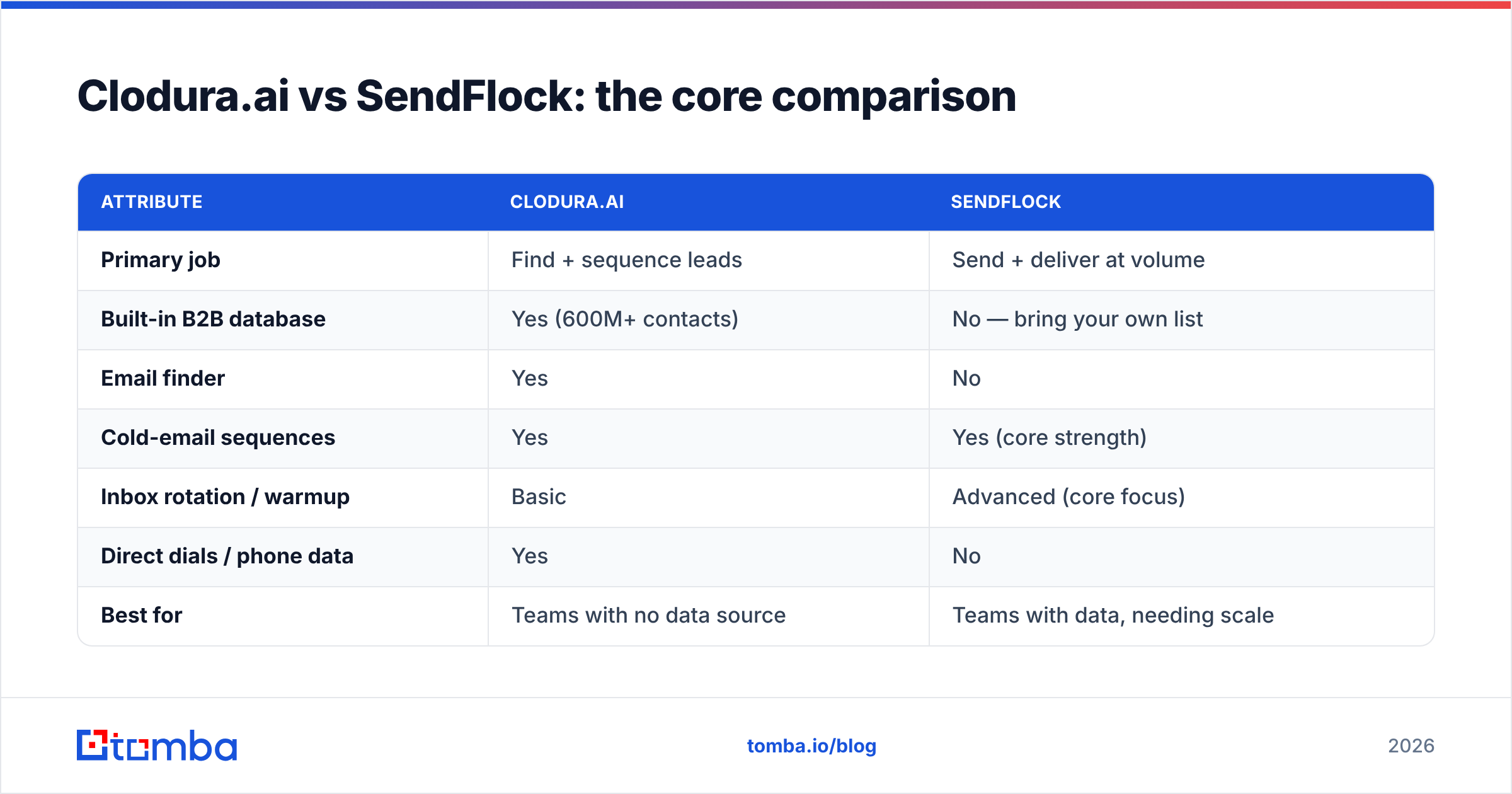
Here is the head-to-head on the attributes that actually change your results. Prices are indicative entry tiers and shift over time — always confirm on each vendor's pricing page before buying.
| Attribute | Clodura.ai | SendFlock |
|---|---|---|
| Primary job | Find + sequence leads | Send + deliver at volume |
| Built-in B2B database | Yes (600M+ contacts) | No — bring your own list |
| Email finder | Yes | No |
| Cold-email sequences | Yes | Yes (core strength) |
| Inbox rotation / warmup | Basic | Advanced (core focus) |
| Direct dials / phone data | Yes | No |
| Best for | Teams with no data source | Teams with data, needing scale |
| Learning curve | Moderate (many modules) | Low (focused tool) |
| Entry pricing | Free tier + paid plans | Volume-based paid plans |
The pattern is clear: Clodura.ai is broad, SendFlock is deep. If you drew a Venn diagram, the only real overlap is "email sequences" — and even there they optimize for different outcomes. Clodura wants to fill your pipeline from scratch; SendFlock wants your existing pipeline to actually reach inboxes.
Is Clodura.ai better than SendFlock?#
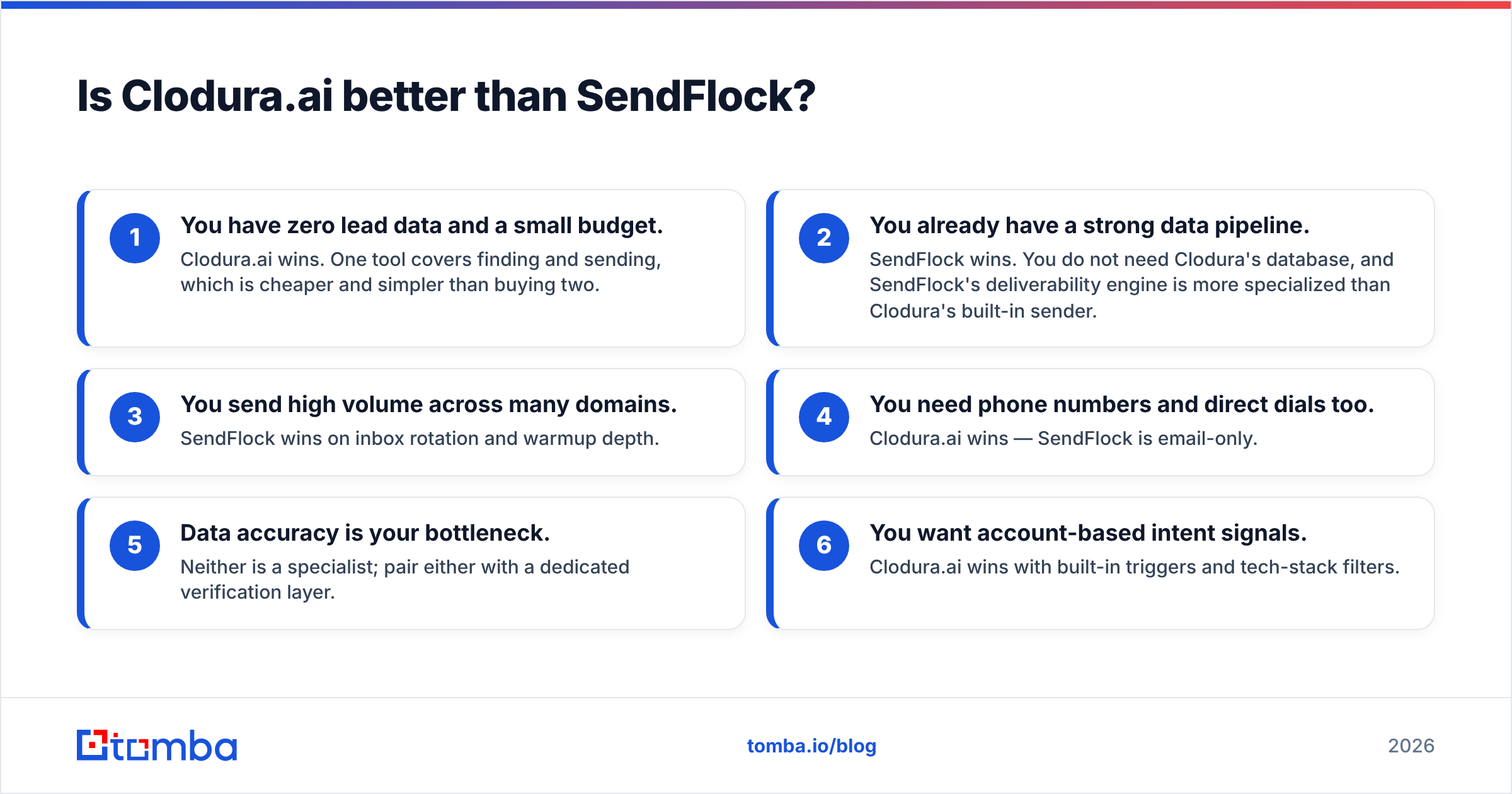
Neither is "better" in the abstract — they are better for different situations. Use this decision framework:
- You have zero lead data and a small budget. Clodura.ai wins. One tool covers finding and sending, which is cheaper and simpler than buying two.
- You already have a strong data pipeline. SendFlock wins. You do not need Clodura's database, and SendFlock's deliverability engine is more specialized than Clodura's built-in sender.
- You send high volume across many domains. SendFlock wins on inbox rotation and warmup depth.
- You need phone numbers and direct dials too. Clodura.ai wins — SendFlock is email-only.
- Data accuracy is your bottleneck. Neither is a specialist; pair either with a dedicated verification layer.
- You want account-based intent signals. Clodura.ai wins with built-in triggers and tech-stack filters.
Notice that most rows come back to a single axis: do you own good data yet? That is the fork in the road. Everything else is secondary.
Where both tools fall short: data accuracy#
Here is the uncomfortable truth that neither product page advertises loudly: a bundled email finder or a great sending engine is not the same as a specialist data-accuracy layer. Bundled data ages. Bounce rates creep up. And once your bounce rate crosses roughly 2–3%, mailbox providers start throttling you regardless of how clever your warmup is.
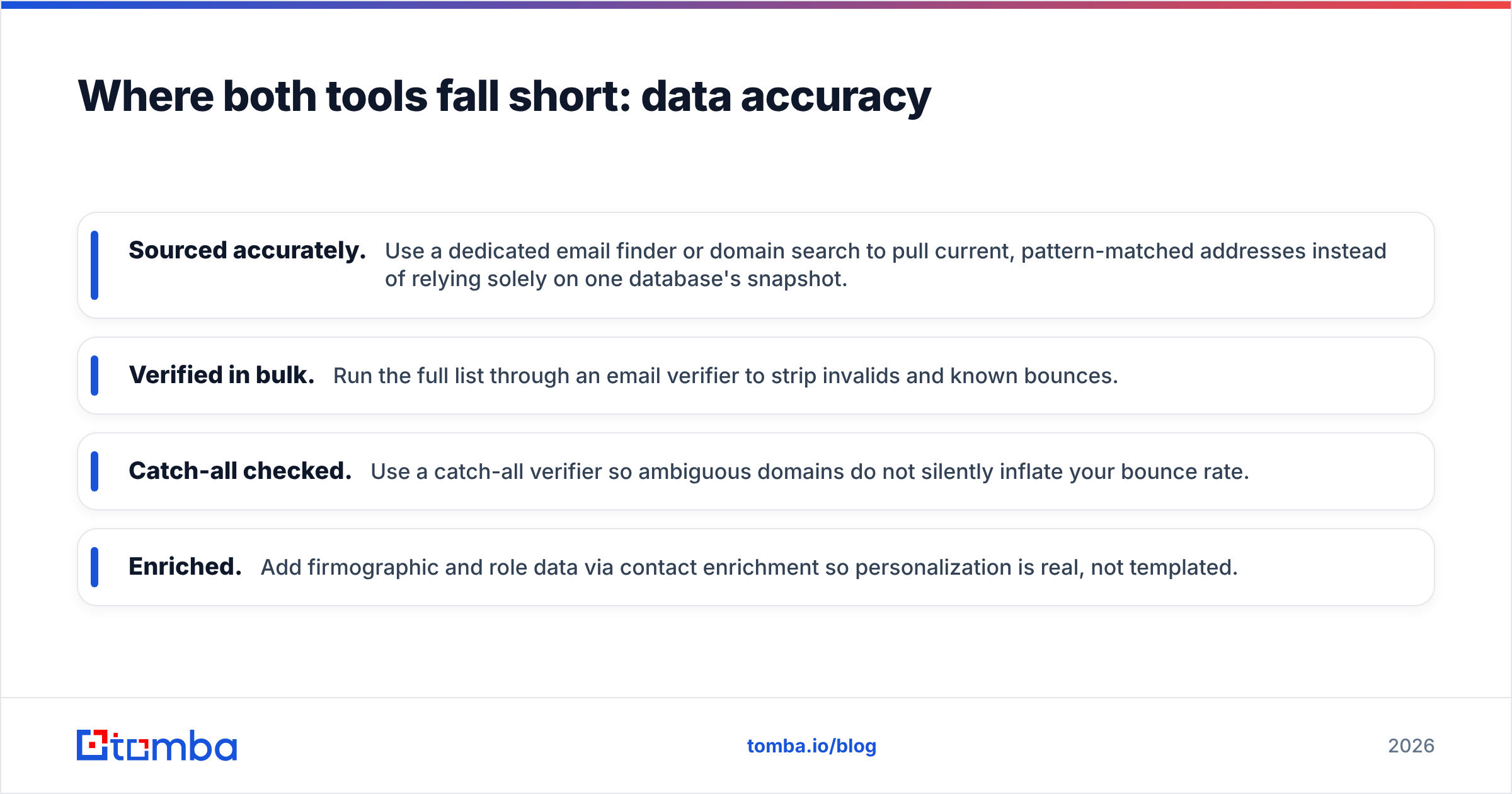
This is where a focused workflow beats a bundle. Before any list touches a sequence — Clodura's or SendFlock's — it should be:
- Sourced accurately. Use a dedicated email finder or domain search to pull current, pattern-matched addresses instead of relying solely on one database's snapshot.
- Verified in bulk. Run the full list through an email verifier to strip invalids and known bounces.
- Catch-all checked. Use a catch-all verifier so ambiguous domains do not silently inflate your bounce rate.
- Enriched. Add firmographic and role data via contact enrichment so personalization is real, not templated.

Tomba's tools sit upstream of both Clodura.ai and SendFlock. You are not replacing your sending or sequencing tool — you are protecting it. Clean, verified data is what makes any deliverability engine actually deliver, and it is what keeps a bundled cadence tool from burning your domain. According to peer reviews aggregated on G2, "data went stale" and "bounce rates too high" are among the most common complaints across every all-in-one prospecting platform — a gap a dedicated verifier closes cheaply.
Pricing: what you actually pay#
Clodura.ai offers a free tier plus paid plans that scale by credits and seats, bundling data and sending together. SendFlock prices around sending volume and connected inboxes, so cost scales with how aggressively you send. The honest framing:
- Clodura.ai can look cheaper because it is one bill — but you are paying for modules you may not use, and the bundled data may still need external verification.
- SendFlock looks like an add-on cost, but if you already have data, you are paying only for the one thing you need done well.
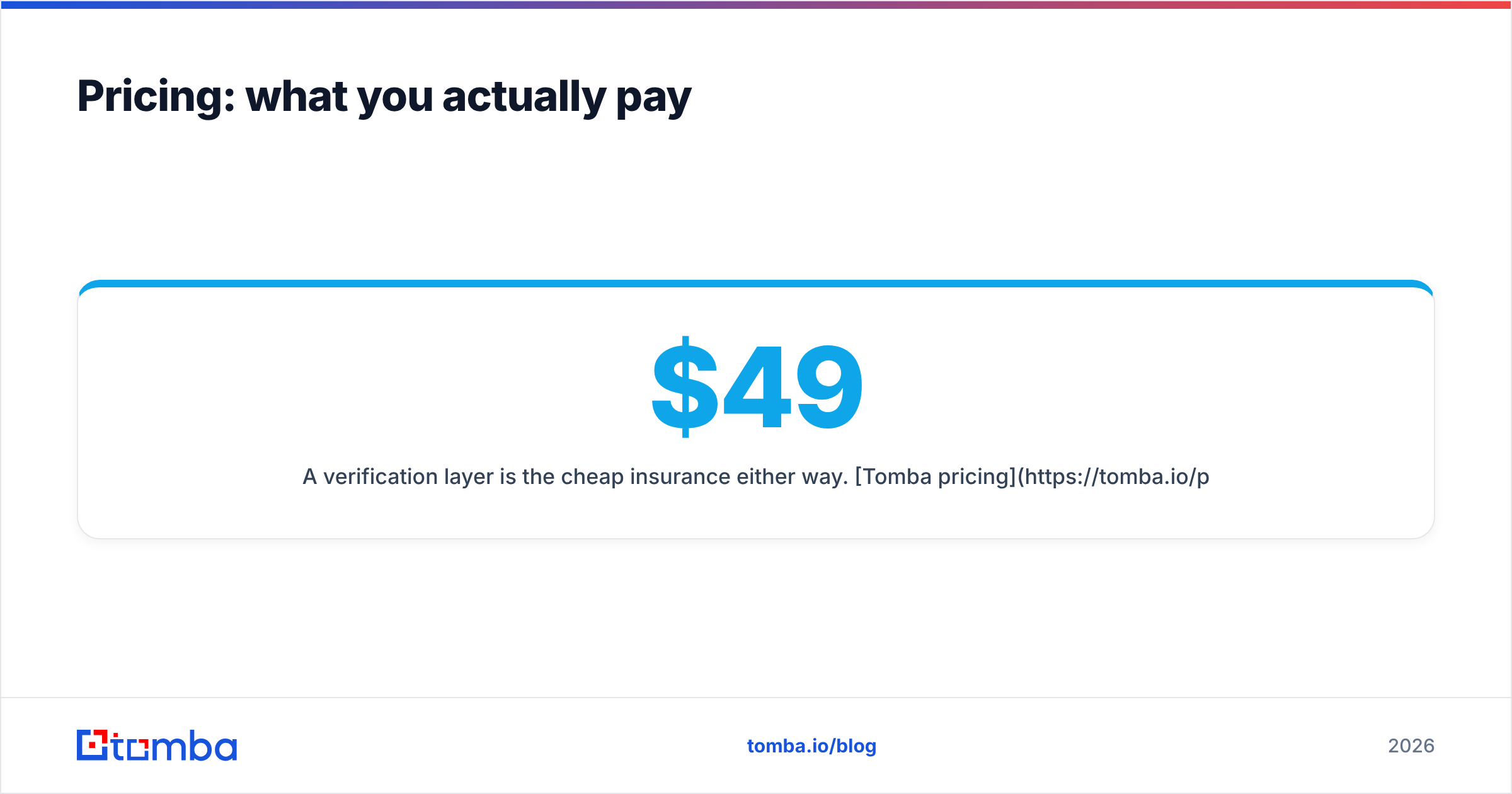
- A verification layer is the cheap insurance either way. Tomba pricing starts with a free tier (25 searches/mo), then Starter at $49/mo, Growth at $99/mo, and Pro at $249/mo — a small line item relative to the deliverability you protect.
The most expensive mistake is not the tool you pick; it is sending 10,000 emails to a list you never verified and torching a domain you spent weeks warming up. That single event costs far more than any subscription.
Can you use Clodura.ai and SendFlock together?#
Yes, and for some teams that is the strongest setup. Use Clodura.ai as the data source — mine its database, pull direct dials, and identify intent-signal accounts — then export those contacts, clean them, and route sending through SendFlock's rotation engine for maximum inbox placement.
The bridge between them is verification. Export from Clodura, run the list through a bulk verify pass, and only then load the survivors into SendFlock. That three-step chain — source, verify, send — outperforms leaning on either tool's native capability alone, because each stage uses a specialist instead of a generalist.
If you prefer to keep everything in fewer logins, connect the pieces through native integrations or push contacts into your CRM first (many teams use HubSpot or Salesforce as the hub) and sync from there. The architecture matters less than the principle: never let unverified data reach a sending engine.
Which should you choose in 2026?#
Quick verdict, by profile:
- Solo founder or tiny team, no data yet: Start with Clodura.ai for the all-in-one simplicity, and add a verifier before you send.
- Established outbound team with data: Choose SendFlock for deliverability, and keep your data pipeline sharp with a dedicated finder and verifier.
- Agency or high-volume sender: SendFlock for the rotation depth, non-negotiably paired with bulk verification on every list.
- ABM-focused team: Clodura.ai for the intent signals and org mapping, enriched and verified before outreach.
The meta-point: the "versus" framing is slightly misleading. The real competition is not Clodura.ai against SendFlock — it is any outbound stack against dirty data. Get the data layer right and both tools perform dramatically better.
The data layer that makes either tool work#
Whichever platform you land on, its output depends on the quality of the emails you feed it. That is the one variable both Clodura.ai and SendFlock leave partly in your hands.
Start with the Tomba Email Finder to source current, pattern-verified professional emails by domain, name, or company — then verify them in bulk before a single message goes out. A free tier gives you 25 searches a month to test accuracy against your existing lists, and paid plans start at $49/mo when you scale. Whether you sequence in Clodura.ai or send through SendFlock, feed the machine clean data and watch your bounce rate, sender reputation, and reply rate all move in the right direction.
Related guides#
Ready to find emails that actually work?
Join 150,000+ professionals who stopped guessing and started sending. Free credits on signup — no credit card required.
Get the Tomba newsletter
Practical outbound tactics and product updates — once every two weeks.
About the author