Clodura.ai vs Skyp: B2B Prospecting Tools Compared (2026)
Clodura.ai and Skyp both promise B2B contact data and prospecting automation, but they aim at very different buyers. Here's an honest breakdown of pricing, data accuracy, and where each one leaves gaps.
Clodura.ai vs Skyp: B2B Prospecting Tools Compared (2026)
Choosing between Clodura.ai and Skyp usually comes down to one question: do you want an all-in-one prospecting platform with a large built-in database, or a lightweight tool that finds and verifies contacts without the bloat? Both sit in the B2B sales-intelligence space, both surface emails and phone numbers, and both promise to fill your pipeline. But they are built for different teams, priced on different logic, and they fail in different places.
This is a neutral breakdown — not a sales page. If your real bottleneck is contact accuracy rather than dashboards, the honest answer might be a third option, and we'll get to that too.
TL;DR: Clodura.ai vs Skyp at a glance#
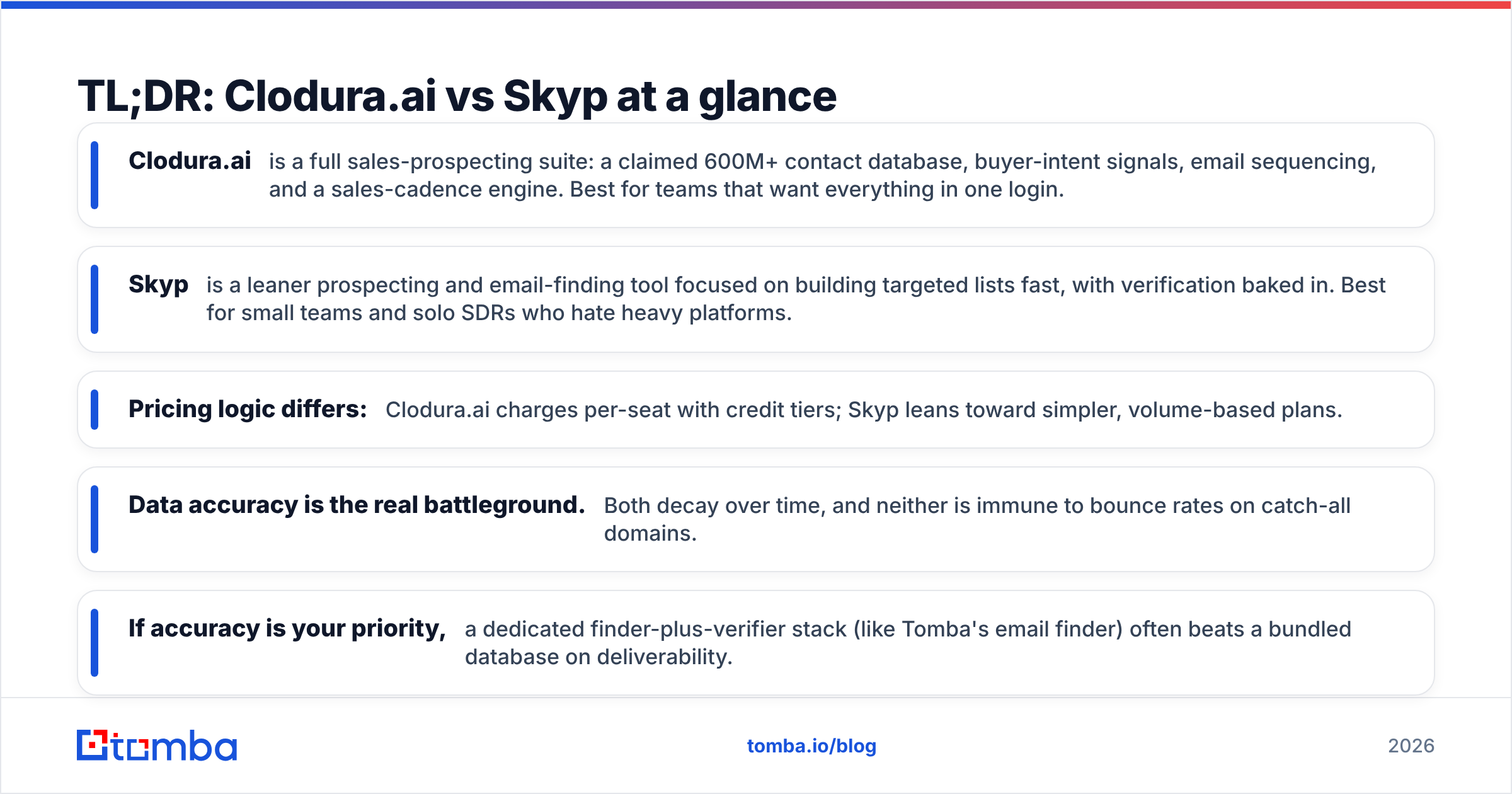
- Clodura.ai is a full sales-prospecting suite: a claimed 600M+ contact database, buyer-intent signals, email sequencing, and a sales-cadence engine. Best for teams that want everything in one login.
- Skyp is a leaner prospecting and email-finding tool focused on building targeted lists fast, with verification baked in. Best for small teams and solo SDRs who hate heavy platforms.
- Pricing logic differs: Clodura.ai charges per-seat with credit tiers; Skyp leans toward simpler, volume-based plans.
- Data accuracy is the real battleground. Both decay over time, and neither is immune to bounce rates on catch-all domains.
- If accuracy is your priority, a dedicated finder-plus-verifier stack (like Tomba's email finder) often beats a bundled database on deliverability.
What is Clodura.ai?#
Clodura.ai is an AI-powered sales-prospecting platform aimed at outbound teams that want their database, cadence tool, and intent data under one roof. Think of it as a Swiss Army knife: instead of stitching together a data provider, a sequencer, and a verifier, you get all three in a single subscription.
Its core pitch is scale. Clodura.ai advertises a large B2B contact database with direct dials, org charts, and technographic filters, layered with buyer-intent signals so reps can prioritize accounts showing purchase behavior. It also ships an email-sequencing engine, so you can move from "found the lead" to "emailed the lead" without leaving the app.
The trade-off with any all-in-one is depth versus breadth. You get convenience, but each individual module — the verifier, the sequencer, the dialer — competes with best-of-breed specialists that do only that one job. You can read more about how a large B2B database is assembled and where the coverage gaps typically appear.
What is Skyp?#
Skyp is a prospecting and email-finding tool built around speed and simplicity. Rather than trying to be a full revenue platform, it focuses on the top of the funnel: define your target audience, pull matching contacts, verify the emails, and export. That narrower scope is the point — fewer tabs, fewer settings, faster list-building for a lone SDR or a small founder-led sales motion.
Because Skyp is lighter, it tends to be friendlier to teams that don't need intent data, org charts, or a built-in cadence engine. If your workflow is "find contacts → drop them into an existing sequencer like Instantly or your CRM," Skyp fits that shape well. If you want the tool to run the whole outbound program, it will feel thin.
The honest caveat for both tools: a contact is only useful if the email actually lands. That's where email verification matters more than raw database size — a 600M-record database with a 15% bounce rate is worse than a smaller list that's 98% deliverable.
Clodura.ai vs Skyp: the feature comparison#
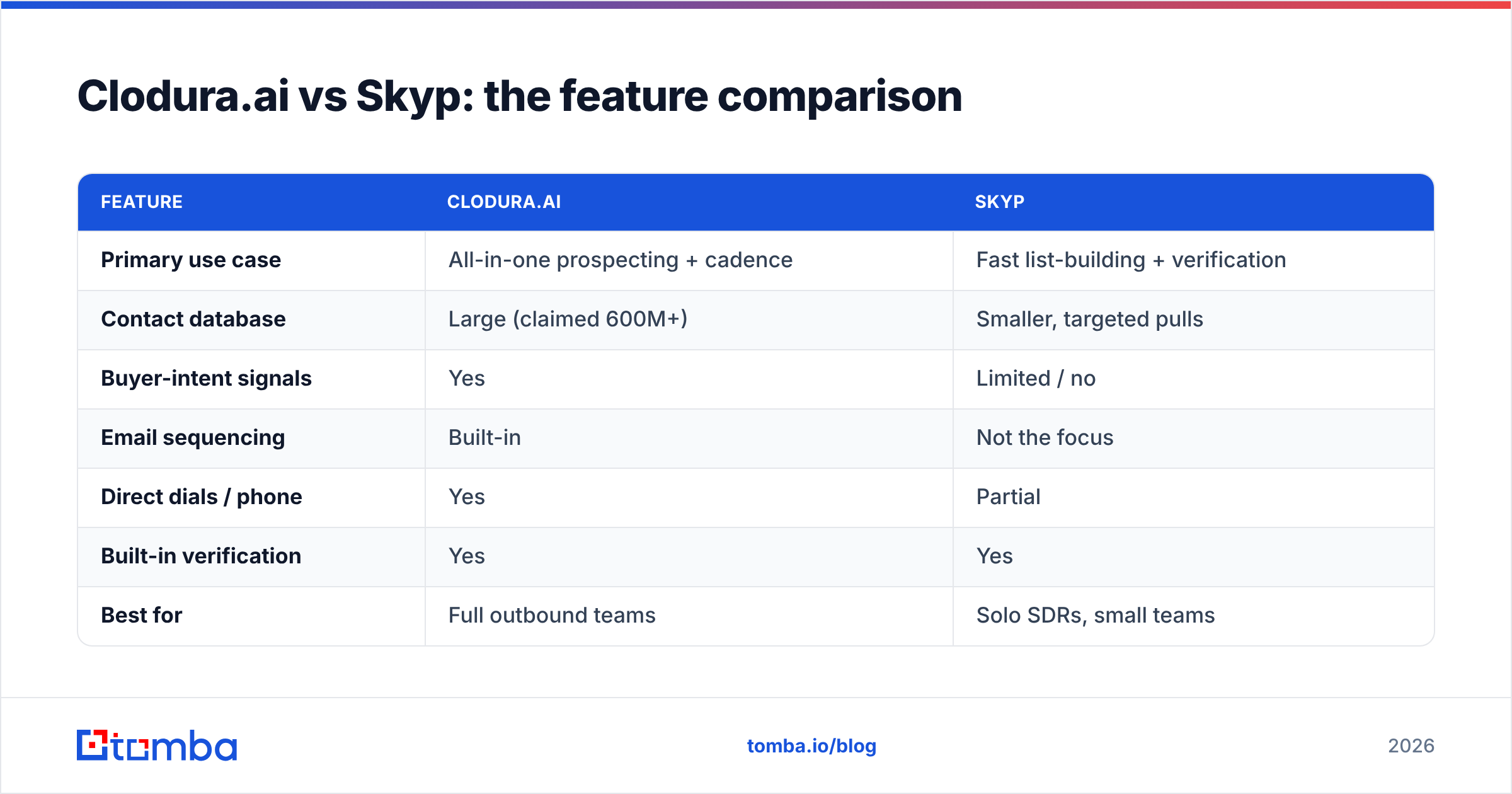
Here's the side-by-side. Treat vendor-published database sizes as marketing claims, not audited numbers — coverage in your specific niche is what counts.
| Feature | Clodura.ai | Skyp |
|---|---|---|
| Primary use case | All-in-one prospecting + cadence | Fast list-building + verification |
| Contact database | Large (claimed 600M+) | Smaller, targeted pulls |
| Buyer-intent signals | Yes | Limited / no |
| Email sequencing | Built-in | Not the focus |
| Direct dials / phone | Yes | Partial |
| Built-in verification | Yes | Yes |
| Best for | Full outbound teams | Solo SDRs, small teams |
| Learning curve | Steeper | Light |
| Pricing model | Per-seat + credits | Volume / simpler tiers |
The pattern is clear: Clodura.ai wins on breadth, Skyp wins on simplicity. Neither of those is "accuracy," which is the thing that actually determines whether your cold emails reach an inbox.
Is Clodura.ai better than Skyp?#
It depends on your team shape — there's no universal winner. Use this quick decision guide:
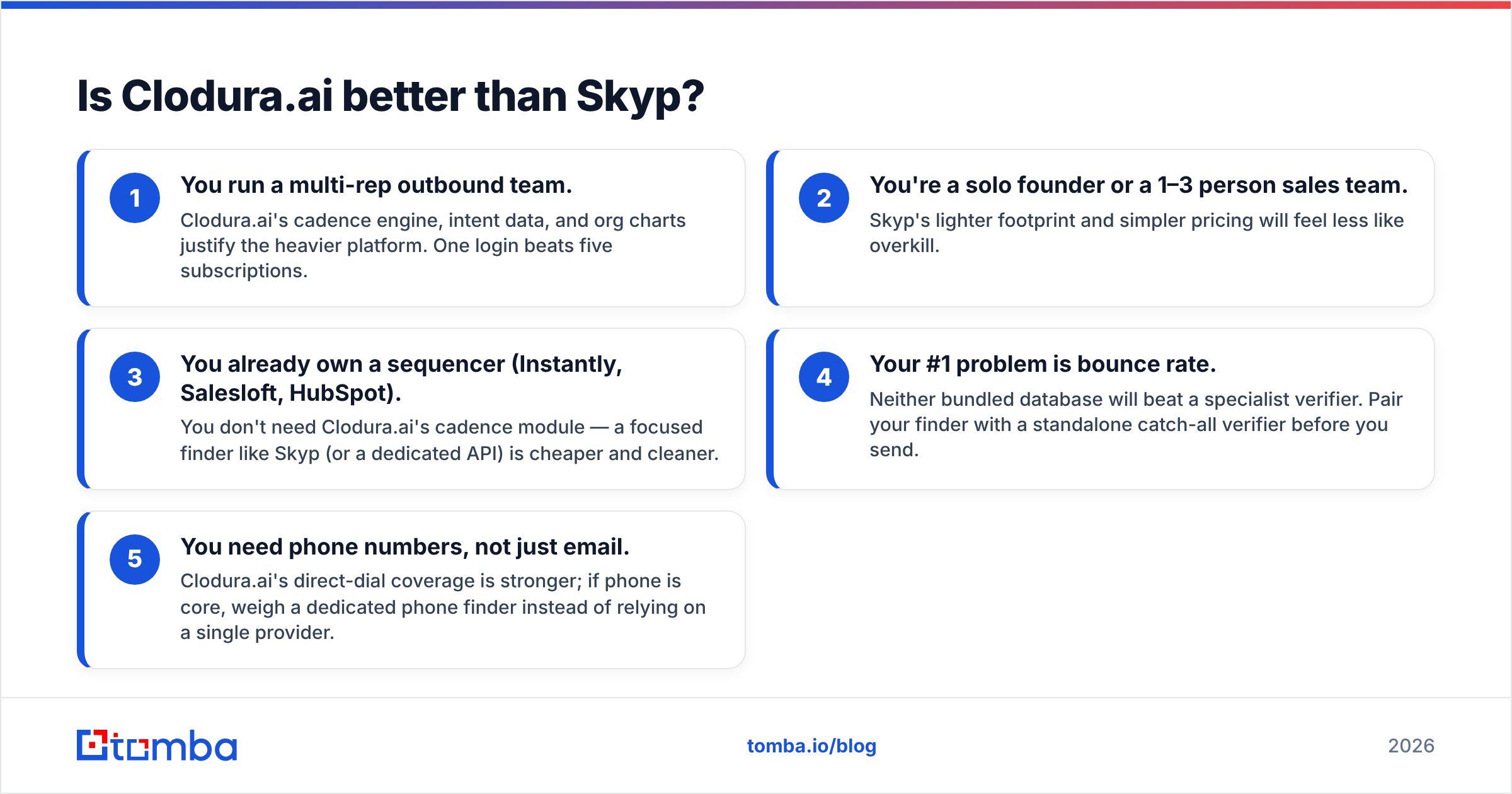
- You run a multi-rep outbound team. Clodura.ai's cadence engine, intent data, and org charts justify the heavier platform. One login beats five subscriptions.
- You're a solo founder or a 1–3 person sales team. Skyp's lighter footprint and simpler pricing will feel less like overkill.
- You already own a sequencer (Instantly, Salesloft, HubSpot). You don't need Clodura.ai's cadence module — a focused finder like Skyp (or a dedicated API) is cheaper and cleaner.
- Your #1 problem is bounce rate. Neither bundled database will beat a specialist verifier. Pair your finder with a standalone catch-all verifier before you send.
- You need phone numbers, not just email. Clodura.ai's direct-dial coverage is stronger; if phone is core, weigh a dedicated phone finder instead of relying on a single provider.
For third-party reviews and user sentiment, G2's B2B data category is a useful sanity check against vendor claims — real buyers tend to be blunt about data decay.
How accurate is the data — and why it matters most#
Accuracy is where these comparisons get real. Every B2B database decays: people change jobs, companies rebrand domains, and catch-all servers accept mail for addresses that don't exist. Industry estimates put contact-data decay at roughly 20–30% per year. That means a database "snapshot" is stale the moment it's built.

Two things separate reliable data from a bounce factory:
- Verification at send time, not build time. A record verified six months ago is a guess today. Re-verifying right before you export is the single biggest lever on deliverability.
- Honest catch-all handling. Many tools mark catch-all domains as "valid" because the server accepts everything. That inflates their accuracy score and your bounce rate at the same time.
Both Clodura.ai and Skyp include verification, which is good. But bundled verifiers are optimized for coverage (keep the record) rather than caution (drop the risky one). A standalone verifier that's willing to say "unknown" is often what protects your sender reputation.
Where does Tomba fit in this comparison?#
Tomba isn't an all-in-one cadence platform, and it isn't trying to be. It's a specialist: find the email, verify the email, enrich the record — done accurately, with an API teams can build on. If your frustration with Clodura.ai or Skyp is deliverability rather than dashboards, that specialization is the point.
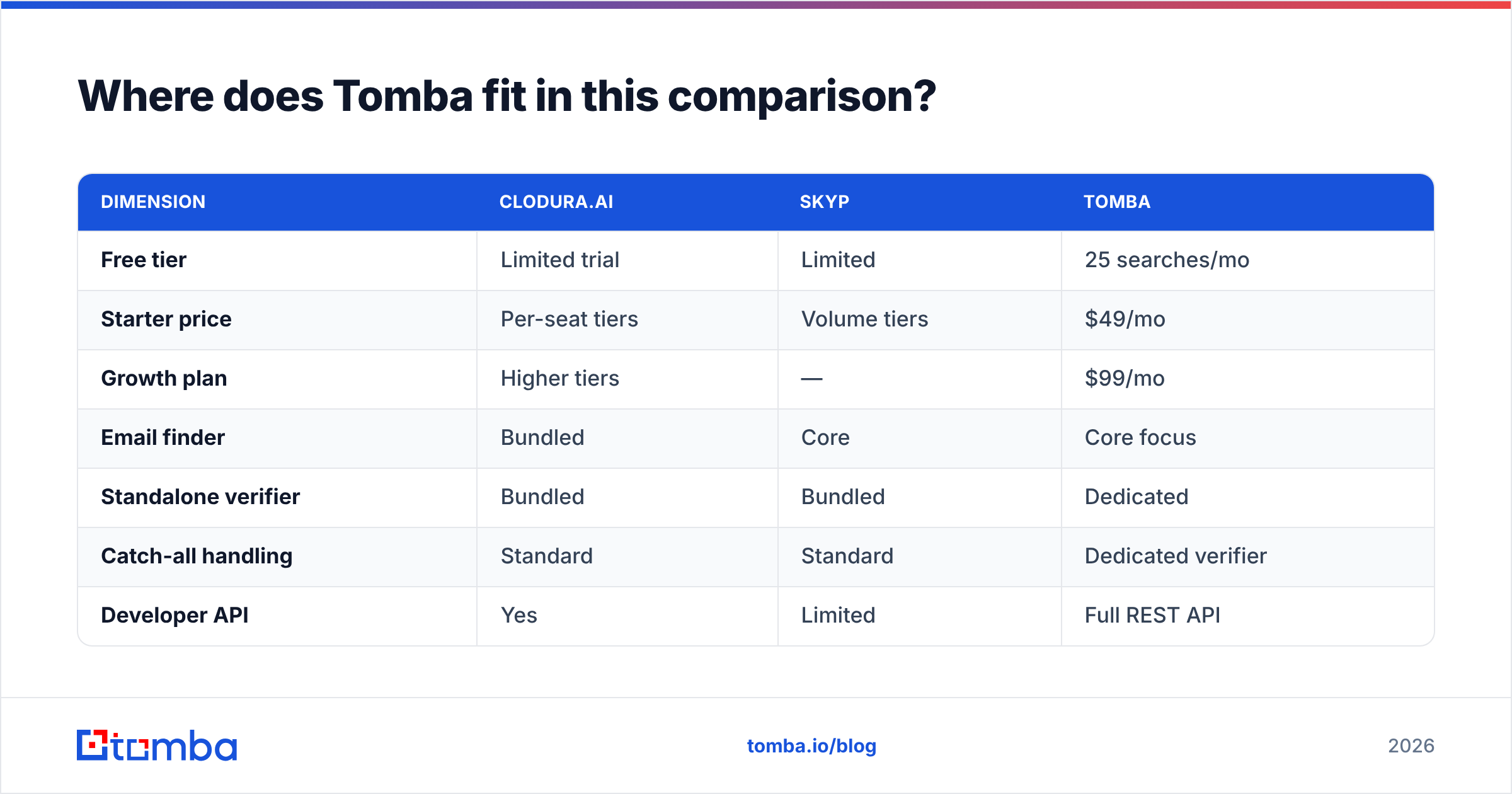
Here's how the three stack up on the dimensions that drive reply rates:

| Dimension | Clodura.ai | Skyp | Tomba |
|---|---|---|---|
| Free tier | Limited trial | Limited | 25 searches/mo |
| Starter price | Per-seat tiers | Volume tiers | $49/mo |
| Growth plan | Higher tiers | — | $99/mo |
| Email finder | Bundled | Core | Core focus |
| Standalone verifier | Bundled | Bundled | Dedicated |
| Catch-all handling | Standard | Standard | Dedicated verifier |
| Developer API | Yes | Limited | Full REST API |
| Sequencing/cadence | Built-in | No | No (by design) |
A few honest notes:
- If you want one tool to run outbound end to end, Clodura.ai does more than Tomba does. That's a real advantage for the right team.
- If you want a light list-builder, Skyp and Tomba overlap heavily; the tiebreaker is accuracy and API access.
- If you're a developer or RevOps team wiring data into your own stack, Tomba's email finder API and predictable pricing are built for that job. See full Tomba pricing — the $49/mo Starter and $99/mo Growth tiers are flat, not per-seat.
What about pricing — which is cheaper?#
Cheaper depends on how you count. Per-seat platforms like Clodura.ai get expensive fast as your team grows, because every rep is a line item. Volume-based tools like Skyp scale on credits, which is friendlier for small teams but can spike if you run large campaigns.
The hidden cost in both models is wasted sends. If 12% of your list bounces, you're not just burning credits — you're damaging email deliverability for every future campaign from that domain. A slightly higher data cost that cuts bounce rate in half is almost always the cheaper option once you factor in domain reputation recovery.
Run the math on your own funnel:
- Monthly contacts needed × your bounce rate = wasted sends
- Wasted sends × deliverability risk = the real cost of "cheap" data
- Compare that against a flat-rate finder-plus-verifier stack before you commit annually
The verdict: which should you pick?#
Pick Clodura.ai if you're a growing outbound team that wants database, intent data, and cadence in one subscription and you're willing to pay per seat for the convenience.
Pick Skyp if you're a solo SDR or small team who wants fast, no-fuss list-building and you already have a sequencer or CRM handling the rest.
Pick a specialist like Tomba if your bottleneck is accuracy and deliverability — you need clean, verified emails and phone numbers, a real API, and flat pricing that doesn't punish you for adding seats. Start with the Tomba Email Finder on the free tier (25 searches a month, no card), find your first verified contacts, and pipe them straight into whatever sequencer you already trust. The best prospecting data isn't the biggest database — it's the one that actually reaches the inbox.
Related guides#
Ready to find emails that actually work?
Join 150,000+ professionals who stopped guessing and started sending. Free credits on signup — no credit card required.
Get the Tomba newsletter
Practical outbound tactics and product updates — once every two weeks.
About the author